The disease burden of surgical site infection (SSI) is well documented.Reference Kurtz, Lau, Schmier, Ong, Zhao and Parvizi1–Reference Segreti, Parvizi, Berbari, Ricks and Berríos-Torres3 The effect on patient health is potentially devastating, but there are also associated system-level costs. Joint replacement patients are particularly vulnerable to SSI due to associated comorbidities and the presence of a large foreign body. Infection can occur during surgery or at any time after the prosthesis is in place.Reference Zimmerli, Trampuz and Ochsner4 The Centers for Disease Control (CDC) include in their guidelines for the prevention of SSI a section specific to prosthetic joint arthroplasty given the considerable disease and financial burden.Reference Berríos-Torres, Umscheid and Bratzler5 With aging populations and increasing obesity rates, health jurisdictions globally are expecting an increase in knee replacement surgeries (TKAs)Reference Wolford, Hatfield, Paul, Yi and Slayton6 and have an interest in understanding clinical and health system costs of SSI.
The onset of SSI following joint replacement can occur years after surgeryReference Zimmerli, Trampuz and Ochsner4,Reference Davies and Patel7,Reference Yokoe, Avery, Platt and Huang8 ; therefore, to accurately account for costs due to infection, a lengthy follow-up period is required. Often studies only include costs during surgical admission,Reference Jenks, Laurent, McQuarry and Watkins9,Reference Graves, Weinhold and Tong10 30 or 90 days after surgery,Reference Peel, Cheng and Liew11–Reference Kaye, Marchaim and Chen14 or 1 year from surgery.Reference Whitehouse, Friedman, Kirkland, Richardson and Sexton15–Reference González-Vélez, Romero-Martín, Villanueva-Orbaiz, Díaz-Agero-Pérez, Robustillo-Rodela and Monge-Jodra17 Costs due to infection may vary depending on how soon after surgery the diagnosis occurred. Those diagnosed within 30 days may have a much different cost profile than those diagnosed at 1 year.
A multitude of methods have been used to examine SSI costs, making comparisons across studies difficult.Reference Badia, Casey, Petrosillo, Hudson, Mitchell and Crosby18,Reference Broex, van Asselt, Bruggeman and van Tiel19 Given that infection is the most common reason for TKA revisionsReference Berríos-Torres, Umscheid and Bratzler5 and expected increase in the number of surgeries,Reference Wolford, Hatfield, Paul, Yi and Slayton6,Reference Kurtz, Ong and Schmier20 it is important to understand the cost implications to help plan for future resource allocation.
The objective of this study was to measure the system-level disease burden of infection following primary TKA by comparing costs and utilization of infected and noninfected patients. A secondary objective was to investigate variations in costs by time-to-diagnosis category which, to our knowledge, has not been examined previously.
Methods
Data
This case-control retrospective study utilized linked administrative data to measure the health system costs and utilization. Procedures were selected from the Canadian Institute for Health Information (CIHI) hospital discharge data. Data for the 2005–2018 period were included to encompass the perioperative and follow-up period. Cost and utilization data following surgery were generated from hospital as well as physician claims data to capture information on visits outside the hospital.
Study population
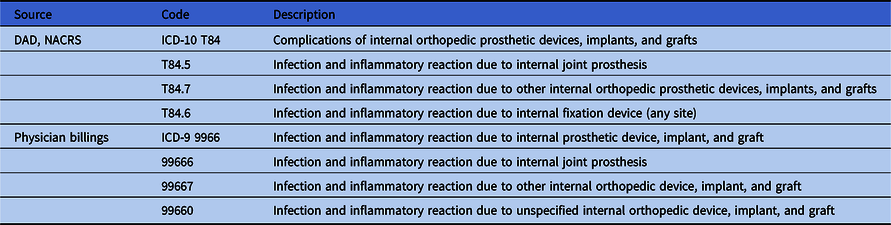
All primary TKA cases in Nova Scotia (NS), Canada from 2005–2016 were identified using Canadian Classification of Health Intervention (CCI) procedure codes. From this population, study cases and controls were selected. Cases were identified as all those individuals who were diagnosed with an SSI within 1 year of surgery. All diagnostic variables in both hospital and outpatient data sources were scanned for International Classification of Diseases (ICD) codes that indicate SSI. The ICD codes selected correspond to those used in a recent paper measuring SSI following joint replacementReference Lethbridge, Richardson and Dunbar21 in which the authors adapted codes from a previous validation study.Reference Rennert-May, Manns and Smith22 Since physician claims data utilize ICD-9 codes, an online crosswalk tool was used to convert to the previous version (see Table 1 for specific codes). A one-to-one control group was selected from those individuals with a TKA without an infection diagnosis within 5 years of surgery using exact matching on age, sex, and comorbidities. The Charlson comorbidity score was used to categorize comorbidities into 0, 1, or ≥2 health conditions.
International Classification of Disease Codes for Surgical Site Infection

Analysis
Costs and utilization from inpatient, day surgery, clinic, and physician claims data were totaled over two years following discharge, a clinically relevant follow-up period. To measure hospital costs, the resource intensity weight variable was multiplied by the CIHI standard hospital cost for CaD$5,976 (US$4,269).23 Outpatient costs were computed from the payment amounts in the claims data. All costs were converted to 2018 Canadian dollars (CaD$) and US dollar (US$) equivalents are provided. Utilization was calculated as the sum of hospital admissions and physician visits.
Means per case and control were determined as well as totals across all observations over the study period. To isolate the effect of infection, net means and totals were computed. Costs and utilization for controls were subtracted from those for cases because it is expected that those without SSI will have had some follow-up care after surgery. Cases were categorized into groups based on days from surgery to diagnosis, namely within 30, 30–90, 90–180, and 180–365 days, and costs were generated for each grouping. For each case, the first occurrence of an infection diagnosis following the index surgery was used as the diagnosis date. Finally, the analysis was carried out on cases and controls for which the Charlson comorbidity score was zero. Since the comorbidity matching was based on the number of conditions and not type, a case/control could be matched with a control/case who has the same number of comorbidities, yet the nature of the conditions is such that the patient requires more care. Including only those with zero comorbidities reduces the cost effects of other conditions and helps in assessing the robustness of the results.
Statistical analyses were carried out using SAS version 9.4 software (SAS Institute, Cary, NC), and research ethics approval was granted by Nova Scotia Health Authority Research Ethics Board.
Results
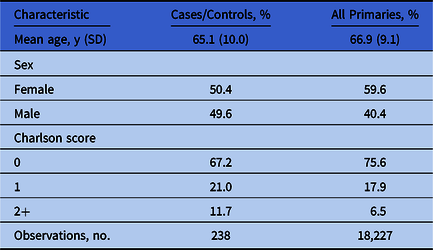
In total, 18,227 primary TKAs were performed over the study period, of which 238 cases (1.3%) were identified as SSI cases. Matching characteristics are given in Table 2 for cases and controls as well as the entire population of primary TKAs. The mean age at surgery was 65.1 years for the cases and controls, which was lower than the mean age for all primary cases (66.9 years). There was a lower percentage of women in the case–control groups compared to all primaries. Cases and controls had more comorbidities, with 32.8% having least 1 condition compared with 24.4% for all.
Patient Characteristics

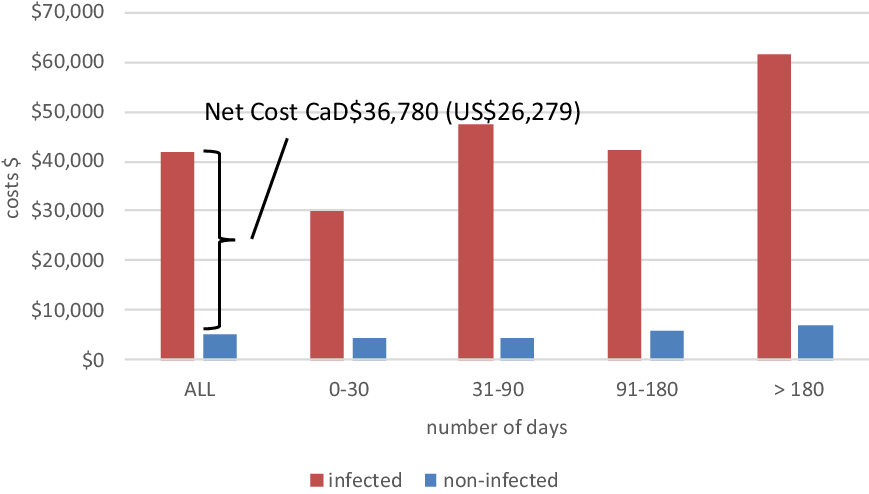
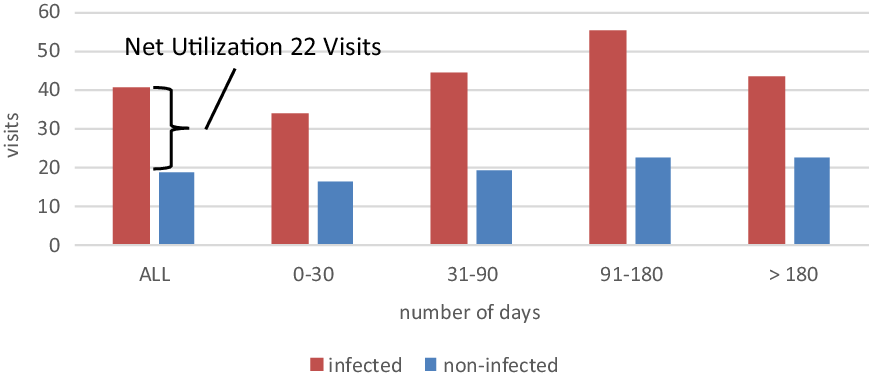
In the 2-year period following surgery, SSI cases averaged 41 hospital and physician visits and noninfected controls averaged 19. Average costs during the follow-up period were >8 times higher for SSI cases, specifically CaD$41,938 (US$29,965) compared to CaD$5,158 (US$3,685) for controls (Fig. 2). Total costs over the study period were CaD$9,981,133 (US$713,161) and CaD$1,227,555 (US$877,100) for SSI cases and controls, respectively. For SSI cases, 95.8% of the costs can be attributed to hospital visits, whereas the percentage for controls was 84.5%. Net costs and utilization averaged CaD$36,780 (US$26,279) and 22 visits per SSI case and the net total costs over the entire study period was CaD$8,753,578 (US$6,254,519).
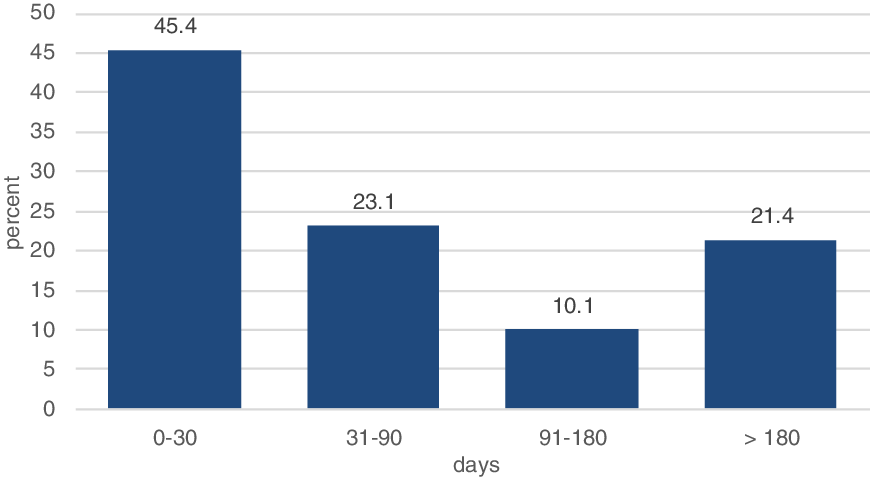
Days until infection diagnosis.

Average costs by days until infection diagnosis category.

When including only those patients with zero comorbidities, costs averaged CaD$34,099 (US$24,364) per case and CaD$4,933 (US$3,524) per control, 7 times higher. Utilization fell for cases averaging 37 visits, but controls remained the same as the full control sample, averaging 19.
Overall, 45% of SSI cases were diagnosed within 30 days of surgery, with 33.2% in the 30–180 range, and 21.4% were diagnosed at 180 days or after (Fig. 1). Costs across diagnosis categories are shown in Figure 2. The highest costs due to infection were incurred by those diagnosed at >180 days, averaging a net cost of CaD$54,623 (US$39,028), with a ratio of noninfected to infected costs of 8.8 (Table 3). The lowest net costs among SSI cases occurred among those diagnosed within 30 days of surgery (CaD$25,316 [US$18,088]). Utilization showed a slightly different pattern, with the highest net number of visits (n = 33) in the 91–180-day category, which was 2.5 times higher for cases than for controls. Similar to costs, net utilization was the smallest for those in the 0–30-day category (Fig. 3).
Ratio of Surgical Site Infection (SSI) to Non-SSI Patients Regarding Costs and Utilization by Days Until Infection Diagnosis Category

Average utilization by days until infection diagnosis category.

Discussion
The costs of infection were 8 times higher for infected cases compared to noninfected controls in the 2-year period following surgery. A long follow-up is important when analyzing SSI costs because diagnosis and treatment could be weeks or years after surgery.Reference Zimmerli, Trampuz and Ochsner4,Reference Davies and Patel7,Reference Yokoe, Avery, Platt and Huang8 Our results indicate a higher cost burden than previous literature, suggesting that a longer time frame captures additional cost differences not shown in earlier research. Although datasets such as the National Surgical Quality Improvement Program are of great value in tracking surgical outcomes, the 30-day follow-up period is a limitation for tracking SSI costs following joint replacement.
We faced several challenges in comparing findings from this work to previous studies due to variations in data, design, and methods. In a recent review, Badia et alReference Badia, Casey, Petrosillo, Hudson, Mitchell and Crosby18 concluded that the financial burden due to SSI is substantial, yet the heterogeneity of methods precluded these authors from quantifying the cost difference across studies. Broex et alReference Broex, van Asselt, Bruggeman and van Tiel19 completed a literature review of studies from 9 countries and concluded that costs are twice as high for patients who acquire an SSI. Studies that specifically focused on joint replacement showed similar findings. A systematic review of arthroplasty patients showed that follow-up costs for infected arthroplasty cases were 3 times higher.Reference Moura, Baylina and Moreira24 Another showed that SSI cases cost 4.1 times more than noninfected cases and averaged 3.6 readmissions compared to 0.1.Reference Kapadia, McElroy, Issa, Johnson, Bozic and Mont25 Gow et alReference Gow, McGuinness, Morris, McLellan, Morris and Roberts13 concluded that infected arthroplasty cases cost twice that of noninfected cases, whereas Peel et alReference Peel, Cheng and Liew11 included inpatient and outpatient costs and found costs to be 1.6 times higher. Whitehouse et alReference Whitehouse, Friedman, Kirkland, Richardson and Sexton15 followed patients for 1 year, and calculated hospital costs were 3.6 times higher. Our study incorporates a longer follow-up period compared to previous studies, and costs were >8 times higher for SSI cases. This finding suggests that the cost differential due to infection extends beyond the commonly used study follow-up periods.
We identified substantial variation in costs and utilization depending on diagnosis date. Infected patients would be expected to have increased contact with the health system both before diagnosis during assessment and afterward when extensive care is required. TKA cases with SSI have a high likelihood of revision surgery, after which the risk of reinfection is even higher. As we show, net costs are highest for those diagnosed >6 months after surgery compared to those diagnosed earlier. Strategies to closely monitor patients for SSI soon after surgery may be beneficial in reducing costs.
In our study, the coding used to identify infected cases did not distinguish between superficial and deep infection, however, the difference between superficial and deep wound is not well defined in the literature.Reference Guirro, Hinarejos, Pelfort, Leal-Blanquet, Torres-Claramunt and Puig-Verdie26 In addition, those diagnosed with superficial infection are considerably more likely to develop deep infectionReference Guirro, Hinarejos, Pelfort, Leal-Blanquet, Torres-Claramunt and Puig-Verdie26,Reference Johnson and Bannister27 suggesting that many of those diagnosed with superficial infection will also be diagnosed with a deep infection. Carroll et alReference Carroll, Dowsey, Choong and Peel28 indicated that 71% of those with deep infection had previously been diagnosed with superficial infection. Furthermore, those with superficial infection have increased risk of further complications.Reference Galat, McGovern, Larson, Harrington, Hanssen and Clarke29 Whether a patient develops superficial infection, deep infection, or both, costs are expected to be higher compared to those without SSI. Our results showing considerably higher costs for cases than for controls in each diagnosis category, is consistent with our expectation. Superficial infection is often defined as occurring within 30 days of surgery,Reference Ridgeway, Wilson, Charlet, Kafatos, Pearson and Coello30 and the net cost differences were smallest in this category, which corresponds with our expectation that costs for deep SSI are higher.
Our study has several strengths. The 2-year period after surgery accounted for costs and utilization for a longer time frame than previous research, which aligns with clinical expertise regarding the care trajectory for SSI. Variations in costs and utilization depended on the time of diagnosis, which has been not previously explored. The study population included primary TKA patients only, a procedure that is expected to be performed at increasing rates over the coming decades.Reference Kurtz, Ong and Schmier31 Finally, both hospital and out-of-hospital data sources were used, which facilitated a more comprehensive analysis.
This study has several limitations. Some costs associated with SSI care were not part of this analysis, including drug costs, home care, rehabilitation, and personal costs. To the extent that there are differences between infected and noninfected patients in these excluded data sources, our results may have underestimated the costs. The limitations of using diagnostic codes in administrative data to identify infected cases have been highlighted previously.Reference Cunningham, Cai, Topps, Svenson, Jetté and Quan32–Reference Drees, Gerber, Morgan and Lee35 Also, our results are specific to Nova Scotia and may not reflect other jurisdictions. Finally, we did not distinguish between superficial and deep infection. Our conclusions could be strengthened by the inclusion of clinical data sources to validate the identification of infected cases and to distinguish between infection types.
The costs of SSI following TKA are substantial and are expected to increase rapidly due to anticipated increases in procedure and infection rates. Reducing the incidence of SSI is achievable by focusing on modifiable risk factors perioperatively and after discharge. It is important to continue to work toward understanding the full costs of infection following TKA to help develop cost-effective strategies to mitigate these costs.
Acknowledgments
We thank the Nova Scotia Department of Health and Wellness for data access and extracting the required variables in a timely manner.
Financial support
M.D. received the Queen Elizabeth II Foundation Chair in Arthroplasty, which funded this work.
Conflicts of interest
M.D. and G.R. have received grants and fees from Stryker Corporation and DePuy Synthes. L.L. has no conflicts of interest.