Introduction
The goal of palliative care is to provide patients with a holistic approach to care so that patients and families living with advanced disease have the opportunity to achieve the best quality-of-life possible, as defined by that individual.1, 2 Informed consent is an integral component in healthcare and is an important concept in most Western healthcare systems, including Canada, the United States and United Kingdom (UK).Reference Freeman, Lamed, Gingras and Shenouda3–Reference Mendelson and Stoltzfus Jost6 Obtaining informed consent is a legal right for patients and a requirement for treatment by healthcare professionals (HCPs), which has shaped current standards of practice for various allied health professions, including radiation therapy.7–12 Informed consent demonstrates respect for patient autonomy and promotes a patient-centred approach to care whereby the patient is seen as a healthcare consumer, who is able and willing to participate in decisions relating to their own medical treatment.Reference Berger13–Reference Thorne, Oliffe and Stajduhar16 Shared decision making (SDM) is a trending methodology used to obtain informed consent by providing the opportunity for HCPs and patients to exchange information and negotiate the best treatment decision option based on medical experience and patient preferences.Reference Purtilo and Doherty4
This paper will critically review the legal and ethical issues relevant to Canadian and UK informed consent and SDM practices and how these processes relate to current palliative care practices, with a particular emphasis on radiation therapy.
Informed consent
The General Medical Council (GMC)17 states that successful relationships between HCPs and patients depends on trust that is fostered by respecting an individual's right to choose whether or not to undergo treatment; regardless if refusal of treatment may result in harm or death. The GMC17 practice guidelines maintain that patients must be provided with sufficient information, which they can understand, so that they may exercise the right to make informed decisions regarding their care. Obtaining informed consent, through effective communication, fosters trust between HCPs and patients and is considered an essential aspect of the HCP–patient relationship.Reference Purtilo and Doherty4, Reference Falagas, Korbila, Giannopoulou, Kondilis and Peppas18, Reference Kagan19
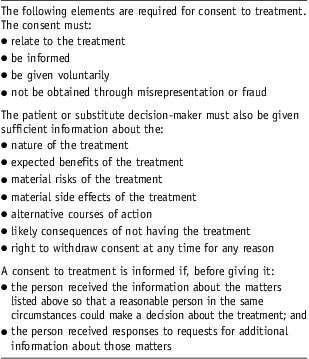
The right to choose to consent is well established and protected in law and legal principles provide ‘a guide to the minimal requirements of good practice in seeking informed consent from patients’.17 In Canada, consent for treatment is governed by provincial legislatures who regulate the conduct of medical practitioners.Reference Mendelson and Stoltzfus Jost6 Within the province of Ontario, the Health Care Consent Act provides the legal framework for consent (Table 1) and has been used in the development of local and provincial standards of practice for various HCPs,11 including allied health.7, 8, 10 Similar frameworks are also identified in international practice guidelines,2, 17 such as the UK's Reference Guide to Consent for Examination or Treatment. 9
Health Care Consent Act, 1996 – Summary of Informed Consent12

Legal and ethical ideals promote the fundamental principle that cancer patients are to be knowledgeable regarding their prognosis,Reference Verhaak, Kraaimaat, Staps and van Daal20 the risks and benefits of proposed treatments, alternative options and the consequences of choices during treatment decision making.Reference Albrecht, Franks and Ruckdeschel21 Failure to adequately counsel a patient regarding procedures and associated material risks, under the reasonable person standard in Canada,Reference Mazur22 would not demonstrate respect for autonomy, place patient safety at risk and could result in legal action for medical negligence and/or battery.Reference Freeman, Lamed, Gingras and Shenouda3, Reference Pace and Hendry23, Reference Schenker, Fernandez, Sudore and Schillinger24
A key concept of informed consent is the importance of a patient's understanding of the information provided by HCPs.Reference Schenker, Fernandez, Sudore and Schillinger24 Although patients are often competent to make treatment decisions and do so voluntarily without coercion, patient comprehension of the essential elements of consent is often inadequate.Reference Schenker and Meisel15, Reference Albrecht, Franks and Ruckdeschel21, Reference Schenker, Fernandez, Sudore and Schillinger24 The literature recognises a shift from a paternalistic approach to a patient-centred method of consent, which encourages patients to be active participants in medical decision making.Reference Berger13, Reference Leighl, Butow and Tattersall14, Reference Thorne, Oliffe and Stajduhar16, Reference Falagas, Korbila, Giannopoulou, Kondilis and Peppas18 Patients who actively participate in discussions regarding treatment decisions tend to better understand the information presented than patients who chose to take a passive role.Reference Timmermans, van der Maazen, Verhaak, van Roosmalen, van Daal and Kraaimaat25 In addition, involvement in decision making has been associated with increased treatment compliance, which results in better health-related outcomes and quality-of-life.Reference Leighl, Butow and Tattersall14, Reference Timmermans, van der Maazen, Verhaak, van Roosmalen, van Daal and Kraaimaat25–Reference Gaston and Mitchell27
Informed consent in palliative care
The aim of palliative care is to relieve suffering and improve quality-of-life during the final stages of the disease trajectory.1 Treatment decision making is considered a complex and dynamic process, which is subject to a variety of influencing factors.Reference Karnieli-Miller and Eisikovits28 Informed consent and decision making has been more recently described as a process, rather than an isolated occurrence, acknowledging that patients need time to reflect upon information before making a decision.Reference Purtilo and Doherty4, Reference Berger13, 17, Reference Heywood, Macaskill and Williams29 For patients with advanced, incurable cancer, treatment decisions are further complicated because of shortened life expectancy, treatment-related toxicities, unguaranteed benefits and physical and emotional distress.Reference Leighl, Butow and Tattersall14, Reference Gattellari, Voigt, Butow and Tattersall30 In addition, patients’ decision-making capacity can also become impaired because of fatigue, physical deterioration, medical complications or drug-induced cognitive impairments.Reference Addington-Hall31, Reference Rees32 It could be argued that palliative cancer patients may not have the ability to be involved in decision making and provide fully informed consent because of the challenges posed by disease progression and its subsequent management.Reference Albrecht, Franks and Ruckdeschel21 However, palliative cancer patients will be required to make multiple complex decisions, which will impact their overall end-of-life experiences.Reference Bakitas, Kryworuchko, Matlock and Volandes33 The National Institute for Clinical Excellence (NICE)2 practice guidelines emphasise that patients want to be involved in decisions regarding their care and desire information pertaining to their disease, possible treatments and supportive services. This is supported by ReesReference Rees32 who identified that patients with advanced cancer and a limited prognosis are ‘still people with decision-making capacity (unless proved otherwise)’ and desire information regarding their disease and available options. Gaston and MitchellReference Gaston and Mitchell27 support that patients want to be involved in decision making as it provides a sense of control, which can decrease anxiety and ensure realistic expectations regarding treatment outcomes. These authors also identify that patients cannot make fully informed decisions if they are not aware of their prognosis. Failure to provide this information may cause patients to become overly optimistic about treatment outcomes and possibly continue with futile treatments, which will prevent end-of-life activities from being achieved.Reference Leighl, Butow and Tattersall14, Reference Clayton, Hancock and Parker34–Reference Keating, Landrum and Rogers36
SDM
As identified in the NICE2 practice guidelines, patients are recognised as key players in the decision making process regarding their own care. SDM is a method that encourages patient participation in treatment decisions and is considered a central component of the consent process, which can facilitate informed decision making; making patients feel valued, respected and supported.Reference Thorne, Oliffe and Stajduhar16, Reference Verhaak, Kraaimaat, Staps and van Daal20, Reference Grunfeld, Maher and Browne37 This methodology involves discussing and respecting patients’ preferences regarding their level of involvement during decision making. A particularly important factor at the end-of-life where personal values and goals prevail.Reference Belanger, Rodriguez and Groleau38 SDM ensures that treatment discussions are aligned with patients’ preferences and priorities and are based on HCPs’ knowledge and expertise, which has shown to provide better quality of care.Reference Bakitas, Kryworuchko, Matlock and Volandes33, Reference Song, Chen and Bensen39 In addition to respecting patient preferences, other key principles associated with SDM are the importance of providing information to patients, which is timely, balanced and tailored specifically to their needs, the impact of family and cultural influences on medical decision making, and encouraging and empowering patients to be active members of their own healthcare team. However, despite its benefits, SDM has also been associated with decisional conflict, increased anxiety and increased demands on institutional resources.Reference Gaston and Mitchell27, Reference Gattellari, Voigt, Butow and Tattersall30, Reference Song, Chen and Bensen39
Providing balanced and tailored information
Practice guidelines2 acknowledge that patients wish to be treated as individuals and personal preferences regarding their role in SDM can be varied and impacted by disease progression, cultural influences and input from others.Reference Gaston and Mitchell27, Reference Bakitas, Kryworuchko, Matlock and Volandes33, Reference Grunfeld, Maher and Browne37, Reference Song, Chen and Bensen39 Therefore, HCPs should tailor options2, 7–9, 17 so as not to overwhelm individuals who might relinquish decision making back to the HCP.Reference Bakitas, Kryworuchko, Matlock and Volandes33 Guidelines also recognise the importance of providing balanced information so that decisions are not swayed in a particular direction.9, Reference Heywood, Macaskill and Williams29, Reference Gattellari, Voigt, Butow and Tattersall30, Reference van Kleffens, van Baarsen and van Leeuwen40 Bakitas et al.Reference Bakitas, Kryworuchko, Matlock and Volandes33 acknowledged that tailoring options may decrease the possibility of fully informed consent, but argued it will increase patients’ abilities to participate in discussions and help build trusting relationships with HCPs.
Family and cultural influences on medical decision making
Family and cultural influences are also important aspects of informed consent.Reference Edwards, Davies and Edwards26, Reference Ho41 In Western society, HCPs are often unaware of cultural influences and assume autonomous decision making.Reference Edwards, Davies and Edwards26, Reference Ho41 The literature frequently focuses on professional coercion, however, HoReference Ho41 identifies that culture dictates the level of family involvement, which could counter autonomy by placing undue pressure on the patient to consent for treatment. Disease progression and subsequent treatments also have a significant impact on the patients’ family and carers’ well-being, and a communal approach to SDM should be considered as an option and be incorporated into the informed consent process when appropriate.Reference Ho41
Quantity and timeliness of information
In addition to providing balanced and tailored information, quantity and timeliness of information can also impact decision making. Providing information too soon or to those not wishing to obtain it could cause further harm, including anxiety and confusion.Reference Gattellari, Voigt, Butow and Tattersall30, Reference Bakitas, Kryworuchko, Matlock and Volandes33 Often, because palliative patients do not have an accurate understanding of their disease prognosis, they will prioritise survival over quality-of-life.Reference Leighl, Butow and Tattersall14, Reference Audrey, Abel, Blazeby, Falk and Campbell42 This results in patients who are willing to undergo treatments with high treatment burden despite low survival gains.Reference Leighl, Butow and Tattersall14, Reference Karnieli-Miller and Eisikovits28, Reference Keating, Landrum and Rogers36, Reference Audrey, Abel, Blazeby, Falk and Campbell42 Enduring futile treatments with limited outcomes delays the offering of alternative options (i.e. supportive care), which can negatively impact end-of-life experiences and quality-of-life.Reference Gaston and Mitchell27, Reference Keating, Landrum and Rogers36
Empowerment
The Canadian Hospice and Palliative Care Association's Nursing Standards of Practice8 supports informed choice and empowering patients to be active participants in their care. Knowledge enables patients to act as healthcare advocates and assists patients to better navigate through the healthcare system. Disease experience is a unique characteristic of this patient population, which can impact SDM discussions because of an already increased familiarity with treatment regimens.Reference Timmermans, van der Maazen, Leer and Kraaimaat43 Decision making is also influenced by experience and information acquired through previous medical encounters and engagement with other information resources outside of the treatment staff, such as the internet, media and patient groups.Reference Edwards, Davies and Edwards26, Reference Timmermans, van der Maazen, Leer and Kraaimaat43–Reference Walsh, Trentham-Dietz and Schroepfer45 Access to this wealth of information allows patients to feel empowered, in control and more satisfied with health-related outcomes; however, it could also result in interpersonal issues between HCPs and the patient, hindering communication and SDM.Reference Edwards, Davies and Edwards26
Conflict
As previously discussed, providing patients with too much information or options, can result in confusion and/or increased anxiety resulting in decisional conflict, which adversely effects SDM.Reference Heywood, Macaskill and Williams29, Reference Bakitas, Kryworuchko, Matlock and Volandes33 Patients want professional input to guide them through the SDM process, especially when faced with advanced disease.Reference Song, Chen and Bensen39, Reference Keating, Landrum and Arora46 In these situations, the HCP is seen as an expert resource, who can counsel and educate the patient regarding their options.Reference Karnieli-Miller and Eisikovits28 Although the literature stresses that informed consent can only occur when a patient is knowledgeable about their disease and actively participates in SDM discussions, studies have found that patients with advanced disease, despite being knowledgeable, have decreased involvement in treatment decisions.Reference Song, Chen and Bensen39, Reference Keating, Landrum and Arora46 Patients will transfer control and responsibility back to the ‘experts’ because of lack of confidence, fear of being responsible for making the ‘wrong decision’ and the increased potential for regret.Reference Song, Chen and Bensen39, Reference Keating, Landrum and Arora46 Eventually reverting back to the HCP-centred model of care.Reference Karnieli-Miller and Eisikovits28
Legal and ethical considerations
In Canada, within the province of Ontario, various professional codes of conduct10, 11 use the Health Care Consent Act as the basis to develop practice guidelines, which uphold the legal requirements of informed consent. HCPs have an ethical and legal obligation to obtain consent before commencing any medical treatment.Reference Freeman, Lamed, Gingras and Shenouda3, 9, 11, 47, Reference Schenker, Wang, Selig, Ng and Fernandez48 SDM promotes autonomy and a patient-centred approach to acquiring informed consent as it is an exchange of information between the HCP and patient regarding feasible healthcare options and patient preferences.Reference Purtilo and Doherty4, Reference Moulton and King49 The law views informed consent as a method of respecting and protecting patient autonomy.Reference Moulton and King49 It is not, however, concerned with the methodology used to obtain consent, only the evidence, which demonstrates that an exchange of information and a reasonable disclosure of the potential treatment risks and benefits, in addition to, the right to waiver consent, have occurred.9–12, Reference Heywood, Macaskill and Williams29, Reference Moulton and King49 Failure to provide sufficient evidence could result in legal action for medical negligence and/or battery.Reference Freeman, Lamed, Gingras and Shenouda3, Reference Pace and Hendry23, Reference Schenker, Fernandez, Sudore and Schillinger24 Although SDM includes the traditional disclosure of information there is more to consider, particularly when working with vulnerable patient groups, then the recitation of facts, risks and alternative treatments.Reference Rees32, Reference Moulton and King49
Obtaining informed consent from palliative patients raises several ethical issues. SDM supports autonomy, a key principle of the consent process, focusing on the patient's ability to provide informed consent.Reference Moulton and King49, Reference Hickman, Cartwright, Nelson and Knafl50 However, studies have identified that palliative patients are considered a vulnerable patient populationReference Rees32, Reference Schenker, Wang, Selig, Ng and Fernandez48 and this vulnerability can influence decision making.Reference Ho41 Valid consent must be given voluntarily9, 12, 17 and it is argued that at end-of-life, patients are unable to provide voluntary consent because of poor health and fluctuating/diminishing cognitive capacity resulting in difficulty retaining and understanding information.Reference Heywood, Macaskill and Williams29, Reference Rees32, Reference Hickman, Cartwright, Nelson and Knafl50, Reference Sibbald and Chidwick51 Palliative patients can also be more susceptible to HCPs’ undue influences because of their vulnerability and dependence on treating clinicians to provide on-going care and may feel the need to show gratitude for the care they have received.Reference Purtilo and Doherty4, Reference Pace and Hendry23, Reference Rees32, Reference Hickman, Cartwright, Nelson and Knafl50 It is therefore imperative for HCPs working with vulnerable patient groups, such as palliative cancer patients, to provide and obtain informed consent to ensure ‘patient safety and the provision of equitable, patient-centred health care’.Reference Schenker, Wang, Selig, Ng and Fernandez48
In addition to autonomy, the principles of beneficence and non-maleficence can be applied to SDM.Reference Purtilo and Doherty4, Reference Edwards, Davies and Edwards26, Reference Moulton and King49 Beneficence, the duty to prevent harm, influences the informed consent process.Reference Purtilo and Doherty4, Reference Moulton and King49 The GMC17 reinforces that HCPs are required to provide patients with the information they want about their diagnosis and prognosis. The once common and historic practice of ‘therapeutic privilege’ whereby withholding information to protect the patient from undue harm is no longer deemed acceptable.Reference Feuz52 A fiduciary relationship, which is built on trust and confidence, obliges HCPs to disclose all relevant facts.Reference Pace and Hendry23 SDM is thought to minimise power differentials and the coercive influences of HCPs,Reference Thorne, Oliffe and Stajduhar16, Reference Edwards, Davies and Edwards26 however, Karnieli-Miller and EiskovitsReference Karnieli-Miller and Eisikovits28 argue that partial information is frequently provided to increase the chances of patients accepting treatment options believed by HCPs to be in the patient's best interests. Another study, identified physicians’ influences on decision making based on treatment intent.Reference van Kleffens, van Baarsen and van Leeuwen40 Physicians emitted less pressure on patients to consent for non-curative regimes and demonstrated increased respect for patient autonomy versus patients undergoing curative regimes.Reference van Kleffens, van Baarsen and van Leeuwen40
Another explanation for providing only partial information is supported by the principle of non-maleficence, the duty to do no harm.Reference Purtilo and Doherty4 Providing too much information or information that is not desired can have adverse effects on decision making and cause further distress to the patient.9, Reference Heywood, Macaskill and Williams29 This could potentially result in the refusal of treatment increasing harm (i.e. pain or death) and negatively impacting quality-of-life. Practice guidelines9 emphasise the importance of providing balanced information based on patient preferences, particularly at the end-of-life; however, the literature recognises that HCPs tend to practice defensive medicine, focusing on risks to guard against legal action.Reference Heywood, Macaskill and Williams29 Karneili-Miller and EiskovitsReference Karnieli-Miller and Eisikovits28 also claim that providing partial information increases harm because patients will suffer through any treatment, despite receiving only minimal benefits, to fight their disease. By providing all feasible options, the authorsReference Karnieli-Miller and Eisikovits28 recognise that patients may choose alternative treatments that will permit achievement of other personal goals that allow their end-of-life preferences to be fulfilled.
In the attempt to uphold the principles of beneficence and non-maleficence, HCPs often overestimate life expectancy and therapeutic benefits and will offer treatment only to provide hope.Reference Mack, Wolfe, Cook, Grier, Cleary and Weeks53 Keating et al.Reference Keating, Landrum and Rogers36 acknowledges that HCPs are often uncomfortable discussing palliative care issues and will delay supportive care discussions until all treatment options have been exhausted. This often occurs too late in the disease trajectory to address patient end-of-life preferences. Although SDM promotes an exchange of knowledge, disagreements can occur.Reference Ho41 In these situations, patient autonomy supersedes beneficence and will always determine treatment decisions; ensuring alignment with end-of-life goals.Reference Moulton and King49
Clinical implications for radiotherapy practice
Enhancing communication
Advanced cancer treatments require a multidisciplinary team approach, which provides information to the patient throughout the disease pathway.Reference Colyer54 SDM has been identified as best practice in cancer communication;Reference Thorne, Oliffe and Stajduhar16 however, open and effective communication regarding realistic outcomes and patient preferences is essential not only between the multidisciplinary team and patient but between multidisciplinary team members themselves for this to be a valid consent methodology.Reference Thorne, Oliffe and Stajduhar16, Reference Heywood, Macaskill and Williams29, Reference Grunfeld, Maher and Browne37, Reference Koedoot, de Hann and Stiggelbout44 Informed consent requires time to reflect upon information provided during discussions17 and time constraints within the clinical environment can negatively impact decision making.Reference Schenker and Meisel15 To improve patient knowledge and encourage communication, decision aids have been acknowledged as useful tools, which minimise decisional conflict and improve patient satisfaction and health-related outcomes.Reference Leighl, Butow and Tattersall14, Reference Timmermans, van der Maazen, Verhaak, van Roosmalen, van Daal and Kraaimaat25, Reference Smith, Dow, Virago, Khatcheressian, Matsuyama and Lyckholm55 Various forms of decision aids (i.e. print, video, audio, web-based interactive materials) are available for patients to review on their own time with family, carers or other HCPs before consultations and have been shown to be a cost-effective and time-saving method to improve communication of complex information, which would otherwise be hindered due to the challenges experienced by palliative cancer patients.Reference Schenker and Meisel15, Reference Falagas, Korbila, Giannopoulou, Kondilis and Peppas18, Reference Bakitas, Kryworuchko, Matlock and Volandes33, Reference Walsh, Trentham-Dietz and Schroepfer45
The role of the radiation therapist in obtaining informed consent for radiotherapy
A multidisciplinary team approach to care has allowed other professions to embrace skills once considered being within medical domains. Advanced practice roles are incorporating the delegated act of obtaining informed consent into practice, which has shown to increase professional autonomy, accountability and improves patient-centred care.Reference Fairley56 Radiation therapists (RTs) are currently major contributors in providing information to patients regarding the radiotherapy process.Reference Halkett and Kristjanson57, Reference Halkett, Merchant and Jiwa58 In Ontario, Canada, clinical practice pertaining to informed consent is governed by provincial professional standards of practice,10 which states that RTs must understand, and adhere to, the legislation governing professional practice12 and enforces that consent is the physicians responsibility. However, the UK's Department of Health59 supports the person treating the patient is the best person to seek patient's consent and as a result has developed Informed Consent Radiation Therapist roles.Reference Colyer54, Reference Acharya, Acharya, Raja Vatsavayi and Cox60 In Ontario, advanced practice roles, currently under development, are incorporating the delegated act of informed consent into practice for specific site groups (i.e. palliative and breast patients).
RTs have good communication skills and are already working in consultant roles with good outcomes, helping to minimise wait times by providing additional resources.Reference Shi, Cox, Atyeo, Loh, Chuong and Back61 However, the development and implementation of advanced practice roles will have implications on institutional resources should organisations wish to incorporate the position into current clinical practice. Institutions should provide individuals with initial supervised practical training, continuing education and support, in addition to on-going monitoring and evaluation by a consultant physician. Individuals must be educated to achieve the appropriate skill levels to accurately interpret all documentation relating to diagnosis and prognosis in order to feel confident to undertake the added responsibility of consenting patients.Reference Shi, Cox, Atyeo, Loh, Chuong and Back61 Current practice at the author's institution and a possible suggestion for future practice, would be for individuals to remain site specific and become specialists for one particular site group and develop the necessary breadth and depth of knowledge required for consent.
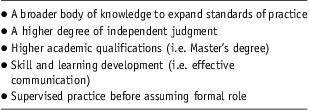
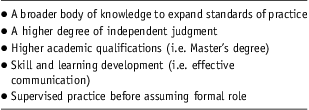
Obtaining informed consent would also require expansion of the standards of practice, which is necessary with advanced practice roles.Reference White and McKay62 The primary focus of informed consent would be on the radiotherapy process; however, RTs must be prepared to address patients’ questions regarding diagnosis and prognosis.Reference Colyer54 Advanced practice roles could help minimise the large amounts of overlapping information patients receive and would allow for a formal opportunity to integrate consent into the RT role.Reference Halkett, Merchant and Jiwa58 Despite findings that RTs have little confidence in their abilities to discuss the ‘reasons for prescribing radiotherapy’ and to accept the full responsibility of obtaining informed consent,Reference Colyer54, Reference Halkett, Merchant and Jiwa58 RTs are believed to be capable of obtaining consent because of their direct association with treatment delivery and ability to provide patients with treatment-specific information.Reference Acharya, Acharya, Raja Vatsavayi and Cox60 The development of professional frameworks for practice is required to support development of the specialised skill sets recommended for advanced practice roles (Table 2). Although there is currently no definitive guidelines indicating the level of education required for advanced practice roles, for radiation therapy or other allied health professions, current recommendations call for a minimum of a Master's degree level in addition to supervised practice before assuming the role.Reference Colyer54, Reference Fairley56, Reference Acharya, Acharya, Raja Vatsavayi and Cox60 In addition to training, individuals taking on informed consent roles must be fully aware of the ethical and legal obligations/responsibilities such as providing appropriate information, as per the Health Care Consent Act, to ensure patients provide informed treatment decisions.12, Reference Acharya, Acharya, Raja Vatsavayi and Cox60
Summary of recommended skills required for obtaining informed consent54,56,60
Conclusion
The trend towards SDM in cancer communication provides a shift towards a patient-centred approach to obtaining informed consent and respects patient autonomy. Legal requirements of informed consent are used as frameworks to shape current clinical practice, which emphasises the importance of patient participation during decision making. Although current practice requires physicians to obtain consent, a multidisciplinary team approach to care can provide opportunities for non-medical HCPs to become involved in the consent process. RTs, as members of the multidisciplinary team, are key contributors in providing information to patients regarding the radiotherapy process. Individuals working within advanced practice roles have begun to incorporate the delegated act of obtaining informed consent into practice, which has shown to have a positive impact on professional practices and improves patient-centred care.
Treatment options for palliative cancer patients are already complex but additional challenges such as disease progression and fluctuating cognitive capacity raises questions regarding the validity of informed consent. However, the literature recognises that palliative patients desire the opportunity to participate in decision-making discussions. In order for SDM to be considered an effective and valid methodology to obtaining informed consent, open and honest communication between the patient and multidisciplinary team is essential and can be enhanced by the use of decision aids, which can assist patients to better process complex information and increase involvement in discussions. This has shown to increase patients’ knowledge and understanding about their disease, provides a sense of control and allows individuals to choose realistic treatment options. Alignment with personal preferences allows patients to achieve end-of-life goals, which are related to increased overall quality-of-life and is the goal of palliative care.
Acknowledgement
None.
Sources of Support
None.