Introduction
The existence, or non-existence, of methane on Mars is still a matter of debate (Formisano et al. Reference Formisano, Atreya, Encrenaz, Ignatiev and Giuranna2004; Krasnopolsky et al. Reference Krasnopolsky2004; Mumma et al. Reference Mumma2009; Zahnle et al. Reference Zahnle, Freedman and Catling2011); a debate that NASA's Mars Science Lander (MSL) has contributed to by setting an upper limit of ∼3.5 ppbv at Gale Crater (Webster et al. Reference Webster2013), although this limit does not yet rule out methane at levels compatible with previous claims (Hand Reference Hand2012) in different locales, and/or due to seasonal variations. If methane is definitively discovered on Mars by MSL, as it progressively increases its sensitivity and as the seasons changes, or by future missions such as ESA's ExoMars Trace Gas Orbiter (due for launch in 2016 and able to detect atmospheric methane down to a few parts per trillion), then the unanswered question still remains: where could the methane originate from?
The exciting answer to this question is a biological origin. However, before assuming an origin for which there is no other evidence, more routine geochemical paths need to be considered. One possible geochemical source is that the gas evolved during hypervelocity impacts. Impacts are on-going on Mars (e.g. Malin et al. Reference Malin, Edgett, Posiolova, McColley and Noe Dobrea2006; Byrne et al. Reference Byrne2009), at a rate of ∼40 per year (Ivanov et al. Reference Ivanov, Melosh and McEwen2010a) with impact speeds ranging from a few km s−1 (the Martian in-fall speed is 5 km s−1) to 50 km s−1 (Steel Reference Steel1998). Additionally, impacts onto the northern hemisphere of Mars have exposed water ice under the Martian regolith (Bryne et al. Reference Byrne2009; Dundas & Byrne Reference Dundas and Byrne2010). It is thus clear that hypervelocity impacts occur, or have occurred, onto rock/ice mixtures, including intimate mixes of olivine family minerals (which are within the Martian regolith – Koeppen & Hamilton Reference Koeppen and Hamilton2008) carbonates and (CO2 rich/pure) water ice. This raises the intriguing possibility of impact driven shock synthesis and/or alteration of minerals with subsequent release of methane. Therefore, we set out to investigate two questions:
(1) Could contemporary impacts on Mars produce sufficient methane to explain the excess reported in its atmosphere, thus ruling out a biotic origin?
(2) Can the quantity of any such methane (or other materials) produced be estimated given data regarding the current and past impact rate on Mars?
The answers to these questions would be a major contribution to the ongoing Mars methane debate. Two possible mechanisms were investigated looking for excess methane production: (i) evolution of methane from shock impacting basaltic rocks and, (ii) shock-induced serpentinization of a mix of water ice, CO2 ice and olivine grains.
Previous experiments have shown (McMahon et al. Reference McMahon, Parnell, Burchell and Blamey2012) that an organic-rich impactor was able to increase the relative abundance of methane in a porous sandstone target. A natural extension of this work was to take some well-characterized basaltic rocks, known to contain varying quantities of methane, and impact them with a stainless steel impactor to see if the shock changed the relative abundance of intrinsic methane within the rock. Impacts could therefore possibly generate atmospheric methane by releasing gas trapped in the underlying Martian basaltic lithology. To investigate if, and how much, gas may be released during such impacts we have taken three different types of basalt and fired projectiles at them in a light gas gun (LGG). The projectile impact speed was close to the Martian escape velocity of 5 km s−1. Shocked and unshocked samples were then crushed and the evolved gases measured in a high-sensitivity mass spectrometer.
A second possible source of methane is through impact-induced serpentinization (where olivine reacts with water and carbolic acid to produce, among other products, serpentine and, in some reaction routes, methane). Again, to determine if this is a potentially viable process, Martian analogue soil mixtures of anhydrous olivine grains, CO2 and water ice were impacted and the ejecta collected. The recovered olivine grains were then examined using a Raman spectrometer to try and detect any signs of serpentine. Serpentine can be detected by the strong hydroxyl (OH) vibrational lines in Raman spectra at 3670 and 3700 cm−1, (Auzende et al. Reference Auzende, Daniel, Reynard, Lemaire and Guyot2004; Mouri & Enami Reference Mouri and Enami2008). Although CO2 ice is thought to only exist in substantial quantities at the Martian south pole (Phillips et al. Reference Phillips2011) carbonates have been detected at lower latitudes (Morris et al. Reference Morris2010) and would release CO2 gas upon impact shocking, providing a secondary source of CO2 (Ivanov & Pierazzo Reference Ivanov and Pierazzo2011). Furthermore, CO2 gas could also be trapped in fissures and vesicles in the subsurface or simply be frozen into the subsurface water ice.
It is therefore possible that methane and/or magnesite could be produced in the Martian subsurface, potentially at significant distances from an impact point, due to shock wave propagation. Methane produced via this route could be trapped in the subsurface for long periods and does not require a hydrothermal production mechanism (such as described in Schwenzer & Kring Reference Schwenzer and Kring2009), whether contemporary or otherwise.
Experimental programme A: methane release from impacted basalts
Methodology
Three different types of basalt were used in these experiments:
Sample (i) An intrusive basalt from Fife, Scotland.
Sample (ii) A recent Icelandic basalt from mid-Atlantic magmatic activity.
Sample (iii) A Devonian basalt from continental volcanic activity in Scotland.
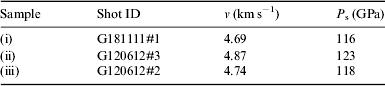
Each sample was mounted (see example in Fig. 1) in the LGG at the University of Kent (Burchell et al. Reference Burchell, Cole, McDonnell and Zarnecki1999) and fired into with a stainless steel projectile. The impact speed was measured in each shot to an accuracy of ±1%. Table 1 gives a summary of the shots performed, and the approximate peak shock pressure, P s (Pa), as calculated using the late stage effective energy method (LSEE), developed by Mizutani et al. (Reference Mizutani, Takagi and Kawakami1990) and used by Burchell et al. (Reference Burchell, Mann and Bunch2004) and Parnell et al. (Reference Parnell, Bowden, Lindgren, Burchell, Milner, Baldwin and Crawford2010) to describe impacts in the Kent LGG, which gives:
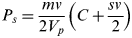 $$P_s = \displaystyle{{mv} \over {2V_p}} \left( {C + \displaystyle{{sv} \hskip 1.5pt \over 2}} \right)$$
where V p and m are the projectile volume (4.19×10⁻⁹ m3 for a 2 mm diameter sphere; 8.18×10⁻⁹ m3 for a 2.5 mm sphere) and mass (3.24×10⁻⁵ kg for a 2 mm diameter sphere; 6.33×10⁻⁵ kg for a 2.5 mm diameter sphere), respectively, C (2600 m s−1) and s (1.62) are the linear shock wave speed parameters for basalt (Melosh Reference Melosh1989) and v is the impact velocity (m s−1).
Photographs of typical shot setup with sample ‘(iii)’ mounted in the LGG chamber prior to shooting (top) and after removal from the gun (bottom). The impact direction is shown arrowed in each image. For scale, the rock is ∼100 mm long, 80 mm wide and 60 mm deep. Note the corner of the rock has been removed (bottom left-hand corner) to give a pre-shocked sample to analyse. Post shot (right-hand panel) not only has a crater been formed (seen on the upper surface) but the extent of the subsurface damage can also be seen on the front face.

Shot parameters. The projectile was a 2.5 mm diameter stainless steel-420 sphere for samples (i) and a 2.0 mm diameter sphere for samples (ii) and (iii)
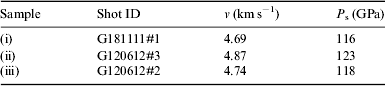
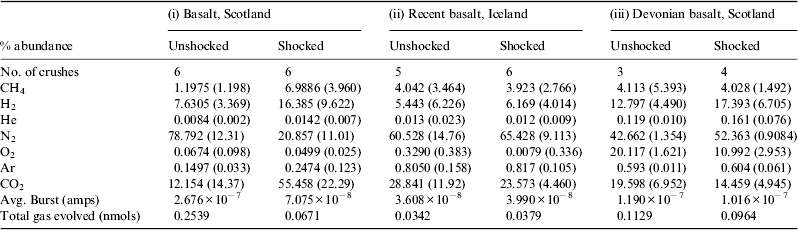
In each case, several grams of pre-shot material were kept to compare gas concentrations within the material before and after the shot. After shooting, ∼0.1 g samples were taken from the shocked regions within the impact craters and from the pre-shot material, crushed and analysed separately using Pfeiffer Prisma quadrupole mass spectrometers at New Mexico Tech. Several crushes per sample were performed to obtain some statistical data on the spread of the gas concentration within each sample (the exact number of crushes for each sample is given in Table 2). The sampling and analysis techniques are discussed in great detail in Norman & Moore (Reference Norman and Moore1997); Moore et al. (Reference Moore, Norman and Mack Kennedy2001); Norman & Blamey (Reference Norman and Blamey2001); Parry & Blamey (Reference Parry and Blamey2010) and Blamey (Reference Blamey2012).
Measured values of gases evolved during the crush process. The percentages of each of the detected (above background) species are given. Numbers in ‘()'s are standard deviations. ‘Average burst’ is the average signal current measured during each of the crushes, which is then converted into a total number of nano-moles of gas evolved
Results
Table 2 presents the relative abundances of each gas detected. It should be emphasized that crushing does not liberate all entrapped gases within the sample and the amount of fluid released varies with each crush (McMahon et al. Reference McMahon, Parnell, Burchell and Blamey2012). Note that the abundance level of helium is very close to the detection limit of the analysis instrumentation, and therefore care must be taken in inferring any trend for the He data. There was no significant change in the relative abundance (within the experimental spread of data) for any gas within the rocks, including methane, with the exception of decreases in both N2 in sample (i) and O2 in all three of the samples.
Hydrocode modelling
To try and understand why certain gases (such a N2 and O2) appear to be released from the basalt, but others (such as methane) did not, hydrocode modelling was undertaken to give some insight into the pressure and temperatures experienced by the target during an impact. It may be that it requires a combination of high temperatures and pressures, held for a certain period of time, for a specific gas to be desorbed from the rock during the impact.
iSALE-2D (e.g. Amsden et al. Reference Amsden, Ruppel and Hirt1980; Collins et al. Reference Collins, Melosh and Ivanov2004) is a multi-material and multi-rheology finite difference shock physics code used for simulating impact processes. The code has been benchmarked against other hydrocodes (Pierazzo et al. Reference Pierazzo2008) and validated against laboratory experiments (Davison et al. Reference Davison, Collins, Elbeshausen, Wünnemann and Kearsley2011). The target in iSALE-2D was modelled as a cylindrically symmetrical half-space mesh with the cell size of 0.1 mm×0.1 mm. A material model for basalt composed of a Tillotson equation of state (Tillotson Reference Tillotson1962), with parameters taken from Benz & Asphaug (Reference Benz and Asphaug1999) and the strength and damage model taken from Ivanov et al. (Reference Ivanov, Melosh, Pierazzo, Gibson and Reimold2010b), were used as target material properties.
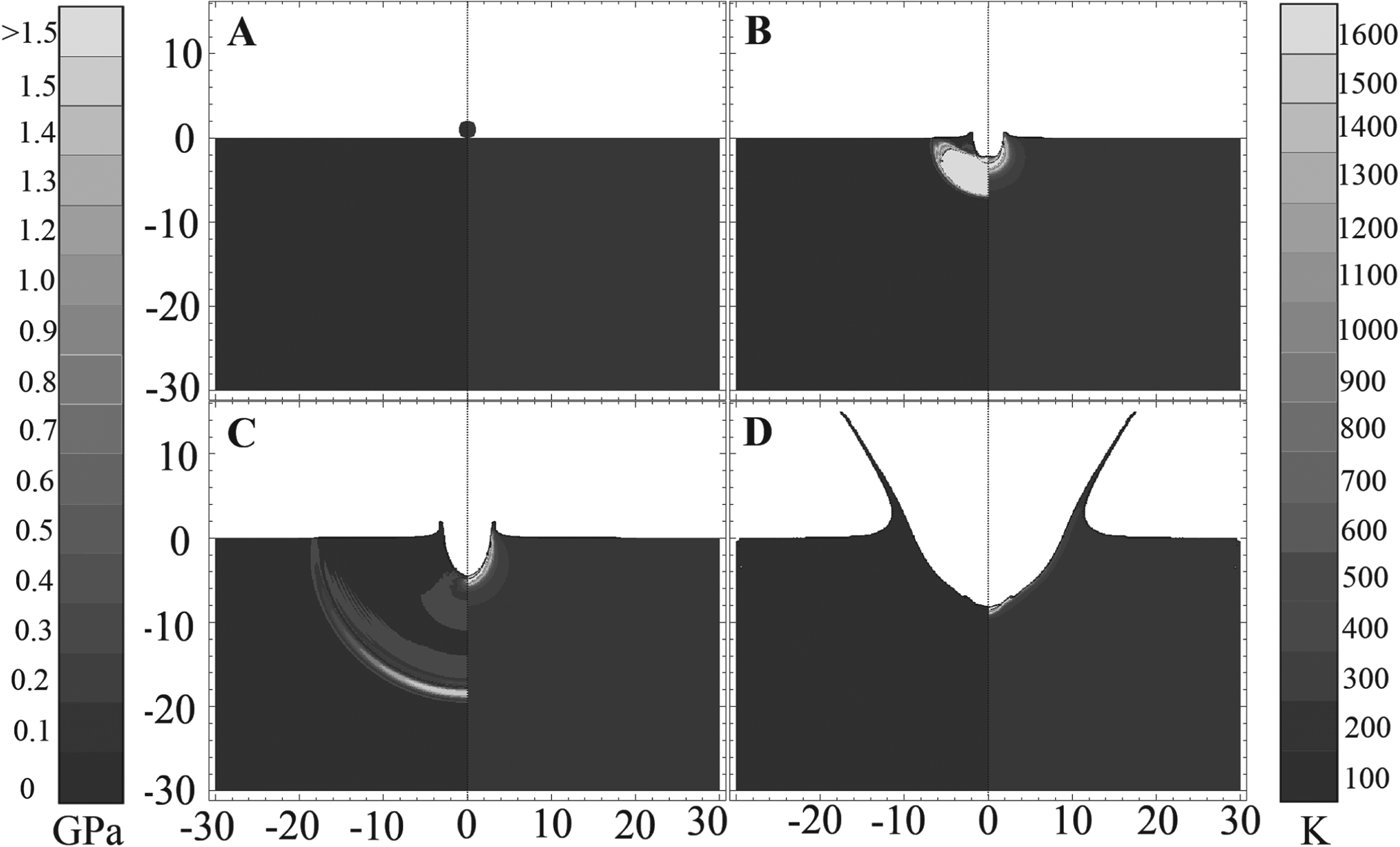
Figure 2 shows the output from an impact simulation made by a 2 mm-metal projectile impacting vertically into the basalt target at 5 km s−1 impact speed. In each of the four panels (Fig. 2 (a)–(d)) the left half of the panel shows contours of pressure (Pa) and the right half contours are of temperature (K).
iSALE hydrocode output showing contours of pressure and temperature as a function of time. (A): t=0 μs, (B): t=1 μs, (C): t=3 μs, (D): t=100 μs. Each panel (‘A’, ‘B’, ‘C’, ‘D’) is split into two halves: the left-hand half shows pressure (left-hand colour key), the right-hand half displays temperature (right-hand colour key). Dimensions along the X- and Y-axes are in millimetres. The impactor was a 2 m diameter stainless-steel sphere impacting at 5 km s−1 onto a basalt target.
The simulations show that the peak pressure experienced was ∼65 GPa and a peak temperature of ∼1600 K. Although these values are high, they are only experienced in the target for ∼100 μs, possibly insufficient time for desorption of trapped methane. For larger scale impacts, as modelled by Marinova et al. (Reference Marinova, Aharonson and Asphaug2011), the timescales for which these pressures and temperatures are experienced increases as a function of the impactor size. Thus, for a 100 m diameter impactor, the high pressures and temperatures will persist for ∼10s of seconds, possibly sufficient to cause significant outgassing of the target material. This could, potentially, be partially tested experimentally by flashing heating samples of basalt to temperatures, and for timescales, provided by the simulations.
Programme B: Impact-induced serpentinization
Serpentine can be produced via:
 $$\eqalign{Olivine + water + carbonic\;acid \cr \quad \to serpentine + magnetite + methane}$$
 $$\eqalign{\left( {{\rm Fe},{\rm Mg}} \right)_{\rm 2} {\rm SiO}_{\rm 4} + \left( {{\rm nH}_{\rm 2} {\rm O} + {\rm CO}_{\rm 2}} \right) \cr \quad \to {\rm Mg}_{\rm 3} {\rm Si}_{\rm 2} {\rm O}_{\rm 5} \left( {{\rm OH}} \right)_{\rm 4} + {\rm Fe}_{\rm 3} {\rm O}_{\rm 4} + {\rm CH}_{\rm 4} }$$
and
 $$\eqalign{Olivine + water + carbonic\;acid \cr \quad \to serpentine + magnetite + magnesite + silica}$$
 $$\eqalign{\left( {{\rm Fe},{\rm Mg}} \right)_{\rm 2} {\rm SiO}_{\rm 4} + ({\rm nH}_{\rm 2} {\rm O} + {\rm CO}_{\rm 2} ) \cr \quad \to {\rm Mg}_{\rm 3} {\rm Si}_{\rm 2} {\rm O}_{\rm 5} \left( {{\rm OH}} \right)_{\rm 4} + {\rm Fe}_{\rm 3} {\rm O}_{\rm 4} + {\rm MgCO}_{\rm 3} + {\rm SiO}_{\rm 2} }$$
Both methane and magnesite (MgCO3) are of astrobiological significance (Russell et al. Reference Russell1999; Trieman et al. Reference Trieman, Amundsen, Blake and Bunch2002). Shock production of either negates the necessity for a biological origin. For example, the possible identification of microbiota in ALH84001 (McKay et al. Reference McKay1996) was supported by the discovery of carbonate globules. However, similar globules are produced in shock impacts (see Figure 2 from Lindgren et al. Reference Lindgren2013) into calcite, and have also been observed in iron rich carbonates (Trieman Reference Trieman2003). Additional supporting work has shown that methane can be impregnated, and subsequently trapped, within a porous sandstone target by a hypervelocity impact from an organic-rich impactor (McMahon et al. Reference McMahon, Parnell, Burchell and Blamey2012) indicating that there may be reservoirs of methane on Mars from historic impact of organic rich impactors.
Methodology
Targets were made-up of a mixture of CO2, H2O (ice) and olivine grains (>355 μm in diameter), with a 2 : 2 : 1 weight ratio, respectively. The olivine grains were baked in a furnace at 600 °C for 12 h to remove any serpentinization which may have previously occurred. Heating the grains in air at 600 °C causes the reaction below (Deer et al. Reference Deer, Howie and Zussman1992), which yields anhydrous olivine.
 $${\rm 2Mg}_{\rm 3} {\rm Si}_{\rm 2} {\rm O}_{\rm 5} \left( {{\rm OH}} \right)_{\rm 4} \to {\rm 3Mg}_{\rm 2} {\rm SiO}_{\rm 4} + {\rm SiO}_{\rm 2} + {\rm 4H}_{\rm 2} {\rm O}$$
Crushed CO2 (sourced from ‘BOC special gases’, UK) and H2O ice (made from filtered, reverse osmosis water) were mixed with the olivine grains (total mass 100 g, sourced from the Natural History Museum's (London) mineral collection), and the surface sprayed with high performance liquid chromatography grade (HPLC) water before being stored overnight in a freezer at −30 °C prior to the hypervelocity impact. Spraying the target with HPLC water prevents the target material crumbling when being placed into the horizontal target holder.
Four shots were made in this part of the programme. In each case the targets were impacted by a 2 mm diameter stainless steel sphere at velocities between 3 and 6 km s−1. A four segment ejecta capture system (ECS) was used to collect ejected target material. Each segment (labelled ESC 1–ECS 4) of the ECS collects materials at different angles of ejection (ESC 1: 0–25°, ECS 2: 50–65°, ECS 3: 65–75° and ECS 4: 75–85° – see Fig. 3).
Photograph of the ECS (right) and target holder (left) in the LGG target chamber. The projectile direction is from right→left and the ejecta is contained within the four compartments of the capture system (ECS 1 is closest to the target). The capture system is then disassembled and the resulting ejecta removed. For scale, the length of the capture system is 271 mm and it has an outside diameter of 231 mm.
Analysis
The impacted material recovered from each segment of the ECS, control, and the remaining target material within the target container, were placed into separate funnels onto clean filter paper and placed inside a fume cupboard. This allowed the olivine grains to be quickly separated from the CO2 and H2O ice mixture, ensuring any serpentinization that may have occurred resulted from the impact alone. The grains were then left overnight in a fume cupboard to dry completely before analysis was carried out.
A Horiba LabRam-HR Raman spectrometer was used to determine if serpentinization had occurred in the shocked olivine grains. The presence of a hydroxyl (OH) peak between 3692 and 3710 cm−1 would indicate hydration had occurred, and therefore serpentinization, which would have released CH4 or H2 (depending on the reaction that took place).
Fifty grains were analysed from each segment of the ECS and the unshocked control sample to establish if there was a statistical difference in the quantity of grains (if any) that presented signs of serpentinization. Raman spectra of 50 pre-shocked olivine grains showed high Mg olivine, with a doublet peak at 823 and 856 cm−1 (Kuebler et al. Reference Kuebler, Jolliff, Wang and Haskin2006), and had no detectable (above instrument noise) OH feature between 3690 and 3710 cm−1. In addition, grains were analysed from the remnant material in the target holder, although (due to sublimation of the CO2 ice) it is impossible to tell where such grains were in relation to the impact site. None of the grains taken from the shocked target container showed any signs of hydration.
Table 3 (below) gives calculations of the approximate peak shock pressures experienced by the olivine grains at the four impact velocities used here, as serpentinization is known to occur at pressures between 0.1 MPa and 1 GPa (Hyndman & Peacock Reference Hyndman and Peacock2003; Deangelis et al. Reference Deangelis, Labotka, Cole and Fayek2010). The approximate shock pressures were calculated using equation (1), and shock wave parameters for CO2 ice, water ice and olivine were taken from Zubarev & Telegin (Reference Zubarev and Telegin1962), Bakanova et al. (Reference Bakanova, Zubarev, Sutulov Yu and Trunin1975) and Brown et al. (Reference Brown, Furnish, McQueen, Manghnani and Syono1987), respectively. In each impact the peak pressures well exceed the threshold for serpentinization.

Initially, a number of grains showed a strong, sharp peak within the range expected for serpentine at 3673 cm−1. However, closer examination of the spectra, and comparison with known standards, showed that these peaks were associated with either talc or actinolite, which were also found within olivine grains as inclusions prior to impact.
Post shot, two olivine grains (from G100513#2: ECS 2) showed a strong sign of hydration, possibly from serpentinization (Fig. 4). However, these were the only two occurrences to show serpentinization from any of the 200 grains collected from this investigation. The occurrence of only these two grains (out of 200 studied) indicates that any amount of serpentinization present is low or that there may have been some form of contamination that may have occurred within this particular set of grains from that section of the ECS.
Raman spectra of the two sampled hydrated olivine grains (B: red line, C: pink line) from G100513#2 ECS 2, compared with an unshocked olivine grain from the G100513#2 control sample (A: green line) and pure serpentine (D: blue line).
Hydrocode modelling
In a similar vein to the first suite of experiments, hydrocode modelling was performed in order to establish the approximate range of temperatures and pressures generated during the impact process. This is important, as the serpentinization reaction is a strong function of pressure and temperature (see for example, Berndt et al. Reference Berndt, Allen and Seyfried1996; Oze & Sharma Reference Oze and Sharma2007; Camille Jones et al. Reference Camille Jones, Rosenbauer, Goldsmith and Oze2010; Schwenzer, Reference Schwenzer2011). The reaction rate the methane synthesis route R1 (above) increases by several orders of magnitude depending on the temperature, and also the presence of any surrounding metal particles (particularly nickel) which can catalyse the serpentinization reaction (Oze & Sharma Reference Oze and Sharma2005).
In order to simulate the impacts into ice, we used Ansys' AUTODYN hydrocode (Hayhurst & Clegg Reference Hayhurst and Clegg1997) using a standard library material for the projectile (stainless-steel) and a 5-phase equation-of-state taken from Senft & Stewart (Reference Senft and Stewart2008) for water ice and incorporated into AUTODYN via a user written subroutine. A simple Von Mises strength model was used for ice, using yield strength of 500 MPa, a shear modulus of 3.52 GPa and a tensile strength of 170 kPa.
Table 3 gives the peak pressures and temperatures for all four of the shots performed. Note that the pressure values calculated by AUTODYN are approximately less than 50% of those calculated using equation (1). In Parnell et al. (Reference Parnell, Bowden, Lindgren, Burchell, Milner, Baldwin and Crawford2010) a comparison was made of peak pressures calculated by the LSEE (Equation (1)) and AUTODYN. It was found that the two approaches agreed well for limited regions in both projectile and target close to the contact plane, but that peak pressures fell rapidly inside the projectile at depth in the target. Specifically, the mean peak pressure found by AUTODYN in the leading half of the projectile was ∼50% of that predicted by the LSEE method. Similarly, Parnell et al. found that at one projectile depth inside the target, the peak pressure had fallen by just over 50% from that at the surface. Thus while the LSEE gives a reasonable value of the peak pressure experienced by some materials in the impact, most of the shocked material experiences lower peak pressures.
Discussion
Geminale et al. (Reference Geminale, Formisano and Giuranna2008) have estimated that the measured Martian atmospheric methane concentrations imply an annual influx of ∼200 tonnes. Although the case for the presence of methane has not been universally accepted (Zahnle et al. Reference Zahnle, Freedman and Catling2011), numerous plausible sources have now been proposed and discussed. Potential endogenous sources include serpentinization reactions, magmatic or hydrothermal fluid–rock interactions, and microbial activity (Oze & Sharma Reference Oze and Sharma2005; Lyons et al. Reference Lyons, Manning and Nimmo2005). Methane release could be mediated by the destabilization of clathrate hydrate deposits or desorption from mineral grains (Chastain & Chevrier Reference Chastain and Chevrier2007; Gough et al. Reference Gough, Tolbert, McKay and Toon2010). However, there is no independent evidence for any of these activities on Mars; in particular, the Mars Odyssey thermal emission survey (THEMIS) found no evidence of magmatic or hydrothermal activity (Christensen et al. Reference Christensen2003).
Hence, exogenous sources must also be considered. Several mechanisms by which meteoritic material might contribute have now been investigated. Court & Sephton (Reference Court and Sephton2009) showed that the direct release of methane via the atmospheric ablation of organic-rich micrometeorites cannot supply the required flux. Krasnopolsky (Reference Krasnopolsky2006) found that interplanetary dust, comets and meteorites could deliver only 6% of this flux. However, additional gas could be generated during impact events or by the photodegradation of meteoritic organics under ultraviolet radiation (Keppler et al. Reference Keppler, Vigano, McLeod, Ott, Früchtl and Röckmann2012).
Another possibility is that ancient methane trapped in rocks near the Martian surface is released during impact events. Using the techniques employed by the present study, McMahon et al. (Reference McMahon, Parnell, Burchell and Blamey2012) found that an organic-rich siltstone impactor was able to increase the relative abundance of methane in a porous sandstone target. In these experiments a 1.5 mm cube of organic rich Devonian siltstone from the Orcadian basin of northeast Scotland was fired at 5 km s−1 into a sandstone target (Triassic ‘Beestone’) known to be very low in intrinsic organics. Samples were taken from the resulting shocked target and the methane content measured. The CH4/CO2 ratio of fluids released during subsequent crushing of these samples was higher than a control sample (unimpacted Beestone) and increased towards the crater centre, suggesting that a small amount of methane was impregnated from the organic-rich impactor into the target rock.
Therefore, it is possible that impact events may have injected methane into the Martian crust over geological time. Moreover, McMahon et al. (Reference McMahon, Parnell and Blamey2013) found that methane was present in fluid inclusions or interstitial sites in a wide range of terrestrial basalts. This methane is likely to be the product of water–rock or hydrothermal fluid–rock reactions. If so, flood basalts on Mars might amount to a substantial methane reservoir. The Martian mantle is believed to be both more reducing and more iron-rich than the Earth's and may therefore (a) equilibrate with more CH4-rich hydrothermal fluids and (b) generate more methane by the serpentinization of FeO-rich minerals (Sleep et al. Reference Sleep, Meibom, Fridriksson, Coleman and Bird2004; Lyons et al. Reference Lyons, Manning and Nimmo2005; Bridges & Warren Reference Bridges and Warren2006; Hirschmann & Withers Reference Hirschmann and Withers2008). Hence, typical Martian basalt may possibly be more methane-rich than typical terrestrial basalt.
Here, we have investigated: (a) whether hypervelocity impacts can release methane from basalt and, (b) whether shocked targets analogous to the Martian surface undergo rapid serpentinization. Although methane was present in all three basalt targets, it did not show a consistent pattern of increase or depletion following impact. Hence, the hypothesis that significant quantities of methane might be released from impacted basalt during impact events is not supported (notwithstanding the possibility that Martian basalts may be rich in CH4 for the reasons mentioned above). Moreover, there was no compelling evidence of rapid serpentinization in the shocked basalt. However, this may not be surprising given the timescales (nanoseconds–microseconds) involved. Neubeck et al. (Reference Neubeck2011) discuss the formation process of methane due to weathering, and only detect methane (at temperatures between 30 and 70 °C) after a couple of hundred days under (Earth) atmospheric pressure. Again, as with the impacts into basalt, it may be that at the sizes achievable in the laboratory, that timescales are too short (even under high temperatures and pressures) for any serpentinization reaction to begin. Larger scale modelling could provide some insight into the process, as well as adding chemical reactions into the hydrocode in an attempt to predict the possible quantities of methane produced. Finally, it is possible that methane could be produced due to the vaporization of the CO2 and water ice. The energy of the impact generates a plasma above the target, and recombination reactions between the ionized H and C within this plasma could provide a route for the synthesis of methane. However, to date, no experiments have been performed to investigate this theory.
Conclusions
The first set of experiments suggest that under the impact conditions we can achieve with a typical LGG (∼100 GPa at impact speeds of ∼5 km s−1 with mm sized projectiles), methane is not released at a level which significantly depletes the methane content of the basalt. This implies that any methane that may be confirmed on Mars is therefore not due to release from impacts onto basaltic bedrocks, although basalts are known to be methane bearing (McMahon et al. Reference McMahon, Parnell and Blamey2013). However, the data do show that other volatiles (here N2 and O2) may be released during impacts which could add to the atmospheric and surface chemistry.
The second series of hypervelocity impacts conducted showed no statistically significant sign of impact induced hydration, and thus rapid serpentinization, which could produce methane, although there was a small positive result in one experiment. This suggests that the quantity of serpentine produce from hypervelocity impacts is (at best) very small, and that higher velocities are required to generate higher pressures, or that rapid serpentinization of olivine does not occur. It does not however rule out shock induced serpentinization which could occur from larger impacts, which would cause elevated pressures and temperatures on longer timescales.
Acknowledgements
The researchers at Kent acknowledge the STFC, UK for funding this work. Nisha Ramkissoon thanks the UK Space Agency for her support via an Aurora studentship. KM's work is funded by the UnivEarthS LabEx project of the University of Sorbonne Paris Cité.