Introduction
One of the central issues in psycholinguistic research about bilingualism has been how bilinguals organize their two languages in memory. Although there is not complete agreement concerning the organization of the lexicons of the two languages (i.e., whether they are represented in two different systems or in a single system), the most influential theoretical models assume a shared conceptual representation between the two languages (de Groot, Reference De Groot, Frost and Kaatz1992a; Kroll & Stewart, 1994, see also Kroll & Tokowicz, Reference Kroll, Tokowicz, Kroll and de Groot2005, for an overview). Indeed, a number of studies, using different experimental tasks and paradigms, have provided support for this assumption (see Francis, Reference Francis, Kroll and de Groot2005, for an overview). In spite of this evidence, there are still some relevant questions to be clarified, concerning which variables can modulate the access to the conceptual system from L1 and L2 lexical representations. Past research has demonstrated the relevance of variables related with the bilinguals, such as their proficiency (e.g., Ferré, Sánchez-Casas & Guasch, Reference Ferré, Sánchez-Casas and Guasch2006; Sunderman & Kroll, Reference Sunderman and Kroll2006), their learning history (e.g., Kotz & Elston-Güttler, Reference Kotz and Elston-Güttler2004), their language usage (e.g., Linck, Kroll & Sunderman, Reference Linck, Kroll and Sunderman2009) or the extent to which they are balanced (e.g., Duñabeitia, Perea & Carreiras, Reference Duñabeitia, Perea and Carreiras2010). Other relevant factors are the translation direction in which experiments are conducted (from L1 to L2 or from L2 to L1, Dimitropoulou, Duñabeitia & Carreiras, Reference Dimitropoulou, Duñabeitia and Carreiras2011a, Reference Dimitropoulou, Duñabeitia and Carreiras2011b; Gollan, Forster & Frost, Reference Gollan, Forster and Frost1997; Schoonbaert, Duyck, Brysbaert & Hartsuycker, Reference Schoonbaert, Duyck, Brysbaert and Hartsuiker2009) and the characteristics of the words in the two languages, such as cognate status or concreteness (e.g., Davis, Sánchez-Casas, García-Albea, Guasch, Molero & Ferré, Reference Davis, Sánchez-Casas, García-Albea, Guasch, Molero and Ferré2010; Duñabeitia et al., Reference Duñabeitia, Perea and Carreiras2010; Sánchez-Casas & García-Albea, Reference Sánchez-Casas, García-Albea, Kroll and de Groot2005; van Hell & de Groot, Reference Van Hell and de Groot1998, Reference Van Hell and de Groot2008).
One of the models of bilingual memory which has emphasized the role of word type on cross-language processing is the Distributed Feature Model (DFM, de Groot, Reference De Groot, Frost and Kaatz1992a; van Hell & de Groot, Reference Van Hell and de Groot1998). According to this model, words are represented at a conceptual level as a set of distributed features. Translation equivalents have both shared and separate meaning components. Importantly, the degree of meaning overlap between them depends upon the type of word represented, being larger for cognate words (translation equivalents with a similar form, e.g., “papel-paper” in Spanish and English, respectively) than for noncognate words (translation equivalents without any similarity in form, e.g., “libro-book”). Similarly, concrete words (those refering to objects, persons or places that can be experienced by the senses, e.g., “luna-moon”) would share a greater number of semantic features across languages than abstract words (those whose referents cannot be experienced by the senses, e.g., “alma-soul”). Experimental evidence has been obtained during the last years supporting the DFM in studies that have focused either in cognate status or in concreteness. However, there are no studies to date that have investigated the conjoint effect of the two variables. The only exception is the study of van Hell and De Groot (Reference Van Hell and de Groot1998), to be described later, which relied on a bilingual word association task. Therefore, the aim of the present study was to test the prediction of the DFM with respect to a greater cross-language overlap for cognates and concrete words than for noncognates and abstract words by orthogonally manipulating cognate status and concreteness. To this end, we tested proficient unbalanced Spanish–English bilinguals in the two translation directions by using a lexical decision task combined with a masked translation priming paradigm.
We chose this experimental approach because it has been extensively used in the literature to examine the architecture of bilingual memory (Forster & Davis, Reference Forster and Davis1984). Thus, in the masked translation priming lexical decision task, a forward mask (usually a row of symbols, such as hash marks) is followed by a briefly presented prime word in lowercase which can be the translation of the target or an unrelated word. The prime, in turn, is immediately followed by an uppercase target word, which overwrites it. Participants have to decide whether or not the target is a real word in a given language. The masking effect from the forward mask, together with the backward masking effect of the target, renders the prime virtually invisible (Forster & Jiang, Reference Forster, Jiang and Nicol2001), allowing researchers to examine early automatic effects in visual word recognition (Duñabeitia et al., Reference Duñabeitia, Perea and Carreiras2010). A large number of studies conducted during the last two decades have reported effects of masked translation priming. That is, participants respond faster to targets when they are preceded by their translations than by matched unrelated words (see Altarriba & Basnight-Brown, Reference Altarriba and Basnight-Brown2007; Dimitropoulou et al., Reference Dimitropoulou, Duñabeitia and Carreiras2011a, Reference Dimitropoulou, Duñabeitia and Carreiras2011b; Duñabeitia et al., Reference Duñabeitia, Perea and Carreiras2010; Schoonbaert et al., Reference Schoonbaert, Duyck, Brysbaert and Hartsuiker2009, for recent overviews). According to the DFM (de Groot, Reference De Groot, Frost and Kaatz1992a), this facilitation is produced because the presentation of the prime preactivates the semantic representations shared with the target. Thus, the masked translation priming effect has been considered as evidence of a shared conceptual system between the two languages (Duñabeitia et al., Reference Duñabeitia, Perea and Carreiras2010). The size of the effect varies however as a function of variables such as the direction of translation priming. Indeed, many studies have reported a translation direction priming asymmetry, that is, priming effects in the forward direction (L1-L2) are stronger than in the backward direction (L2-L1, Dimitropoulou et al., Reference Dimitropoulou, Duñabeitia and Carreiras2011b; Gollan et al., Reference Gollan, Forster and Frost1997; Schoonbaert et al., Reference Schoonbaert, Duyck, Brysbaert and Hartsuiker2009). This asymmetry seems to be, in turn, modulated by proficiency and the relative balance of a bilingual's two languages, as it is mainly observed with unbalanced bilinguals, but not with highly proficient and balanced bilinguals (Basnight-Brown & Altarriba, Reference Basnight-Brown and Altarriba2007; Duñabeitia et al., Reference Duñabeitia, Perea and Carreiras2010; Perea, Duñabeitia & Carreiras, Reference Perea, Duñabeitia and Carreiras2008; Wang, Reference Wang2013). The DFM (de Groot, Reference De Groot, Frost and Kaatz1992a; van Hell & de Groot, Reference Van Hell and de Groot1998) explains this asymmetry as a result of the difference between L1 and L2 words in the number of semantic features they are able to activate. The model assumes that the semantic representation is richer for L1 than for L2 words in proficient unbalanced bilinguals. As a consequence, more shared features are activated by L1 words than by L2 words, thus producing stronger priming effects.
Apart from participants’ characteristics and translation direction, another variable which seems to modulate translation priming is the type of word examined. Of particular interest for the present research is the distinction between cognates and noncognates. In fact, the abovementioned results concerning translation asymmetry refer to studies that used only noncognate translations. The pattern of findings with cognate translations is not so clear, in part because the number of studies conducted with cognate words is lower than those conducted with noncognate words. Thus, whereas there is a strong forward translation priming effect for cognates, the evidence of backward priming is mixed (see Duñabeitia et al., Reference Duñabeitia, Perea and Carreiras2010, for an overview). Besides, several studies that have tested whether or not there are differences between cognates and noncognates in the magnitude of priming have shown that the former produce more robust priming effects than the latter, the so-called cognate facilitation effect in masked translation priming (Davis et al., Reference Davis, Sánchez-Casas, García-Albea, Guasch, Molero and Ferré2010; de Groot & Nas, Reference De Groot and Nas1991; Duñabeitia et al., Reference Duñabeitia, Perea and Carreiras2010; García-Albea, Sánchez-Casas & Igoa, Reference García-Albea, Sánchez-Casas and Igoa1998; Gollan et al., Reference Gollan, Forster and Frost1997; Sánchez-Casas & García-Albea, Reference Sánchez-Casas, García-Albea, Kroll and de Groot2005; Voga & Grainger, Reference Voga and Grainger2007; but see Kim & Davis, Reference Kim and Davis2003, for evidence of priming effects of the same magnitude in both types of translations). The DFM explains this result as a consequence of the proportion of shared meaning components being larger for cognates than for noncognates. The reason is that, as cognates look more alike than noncognates, when people learn a cognate in an L2, they may simply map this new L2 word onto the existing conceptual representation of its L1 translation equivalent. In contrast, when they learn noncognates, the formal dissimilarity between translation equivalents may prevent L2 learners from automatically mapping them onto the conceptual representations of their L1 translations (de Groot, Reference De Groot, Frost and Kaatz1992a; van Hell & de Groot, Reference Van Hell and de Groot1998).
Another relevant aspect of the DFM is that it assumes that semantic overlap between translations is larger for concrete than for abstract words. The rationale under this tenet is that the meaning of the latter is less consistent and more dependent on their linguistic context than the meaning of the former. Evidence in support of this proposal was obtained by the authors of the model (De Groot, Reference De Groot1992b; De Groot, Dannenburg & van Hell, Reference De Groot, Dannenburg and Van Hell1994), who demonstrated that concrete words were translated faster than abstract words. Similarly, work on second language acquisition has revealed that concrete words are acquired earlier than abstract words in novel word learning paradigms (e.g., De Groot & Keijzer, Reference De Groot and Keijzer2000; Kaushanskaya & Rechtzigel, Reference Kaushanskaya and Rechtzigel2012). Finally, of relevance here is the study of van Hell and de Groot (Reference Van Hell and de Groot1998), who used a bilingual word association task. They asked participants to produce associates to a series of words, once in the language of the stimulus words, and once in the other language. The stimulus words were orthogonally varied on concreteness and cognate status. The authors found that the highest degree of equivalence of associations within language and across languages was for cognate concrete words, the ones that were proposed to have the maximum degree of meaning overlap by the DFM.
Even though van Hell and de Groot (Reference Van Hell and de Groot1998) obtained findings supporting the DFM in a bilingual word association task, it should be noted that this paradigm does not tap automatic word processing. Thus, it can be affected by participants’ strategies. To investigate the issue of the modulation of cross-languages conceptual overlap by words’ characteristics, a more suitable paradigm is masked translation priming, which overcomes the limitations of the bilingual word association task above mentioned. It guarantees more automatic word recognition processing since participants are unaware of the prime and its relationship to the target, avoiding strategic influences. The prediction of the DFM concerning this paradigm would be that cognate and concrete words would produce more robust translation priming effects than noncognate and abstract words, respectively, due to the higher degree of meaning overlap of the former with respect to the latter. However, in spite of their potential relevance for theoretical reasons, the specific role of concreteness in masked translation priming has been neglected when compared to the role of cognate status. To our knowledge, there are only two studies using this paradigm that have manipulated concreteness of noncognate words. Schoonbaert et al. (Reference Schoonbaert, Duyck, Brysbaert and Hartsuiker2009) tested Dutch–English bilinguals in a lexical decision task with two different stimulus-onset asynchronies (SOA, 250 ms and 100 ms). The authors failed to find a significant main effect of concreteness. However, when they analyzed separately the two SOAs, they observed that priming effects in the 100 ms SOA were restricted to concrete words. In a similarly oriented study, Chen, Liang, Cui and Dunlap (Reference Chen, Liang, Cui and Dunlap2014) tested Chinese–English bilinguals in two translation priming experiments with a 200 ms SOA. Again, concreteness did not have any effect on bilinguals’ performance, neither when the task to do with the targets was a lexical decision nor when it was a semantic decision. Overall, the results of these two studies seem to indicate that the concreteness effect has a short-living time, modulating priming only when the SOA is lower than 200 ms. Therefore, the SOA employed in priming paradigms seems to be a relevant variable to consider in this line of research. Besides, as these two studies only included noncognate words, we do not know whether these results extend to cognate words.
Thus, the main aim of this study was to disentangle for the first time the influence of concreteness and cognate status in masked translation priming in the two translation directions (forward and backward) by testing a group of proficient unbalanced Spanish–English bilinguals. Cognate status and concreteness were orthogonally manipulated in two experiments that differed in the SOA employed. SOA was manipulated to further explore the time course of the concreteness effect. Thus, in the first experiment we used an SOA of 50 ms, which has been commonly used in this field of research, mainly in masked translation priming studies in which either translation direction or cognate status have been manipulated (see Duñabeitia et al., Reference Duñabeitia, Perea and Carreiras2010, for an overview). The use of this brief prime duration was important for two reasons: a) to minimize the influence of strategic effects and b) to be able to produce reliable cross-language semantic priming effects (i.e., a facilitation in the processing of the target when it is preceded by a semantically related word in the other language; see for instance, Perea et al., Reference Perea, Duñabeitia and Carreiras2008). In the second experiment, we used an SOA of 100. This last SOA was the same as that employed by Schoonbaert et al. (Reference Schoonbaert, Duyck, Brysbaert and Hartsuiker2009) in which the effects of concreteness were reliable. The results will enable us to better characterize the extent to which there is an overlap in meaning between languages. In line with the predictions of the DFM, and with the results of past studies conducted with unbalanced bilinguals, we expected to find greater priming effects in the forward than in the backward direction. Concerning word type, greater priming effects for cognates and concrete words than for noncognates and abstract words were anticipated. In fact, we expected the maximum facilitation for cognate concrete words, since according to the DFM these words have the highest degree of semantic overlap.
Experiment 1
Method
Participants
Thirty-two proficient Spanish (L1)–English (L2) bilingual students (28 female; mean age 24.8, SD = 4.2) from the University Rovira i Virgili in Tarragona, Spain, participated in the experiment. They received course credits for their participation. All of them had normal or corrected-to-normal vision. In order to assess their level of L2 proficiency, participants completed a language questionnaire in which they were asked to provide the age at which they began to learn each of their languages and to estimate their proficiency on a 10-point Likert scale (1 = not literate, 10 = very literate). The mean age of English acquisition for these bilinguals was 7.3 years (SD = 1.1) and their average proficiency was 9.9 (SD = 0.1) and 7.9 (SD = 1.4) for Spanish and English respectively. Furthermore, in order to be sure that participants knew the meaning of the experimental items, at the end of the experiment they were asked to translate a list containing the 34 less frequent experimental English words. The average frequency of these words was 12.2 (SD = 6.8) occurrences per million (data obtained from N-Watch, Davis, Reference Davis2005). All participants translated correctly at least 70% of the words.
Materials
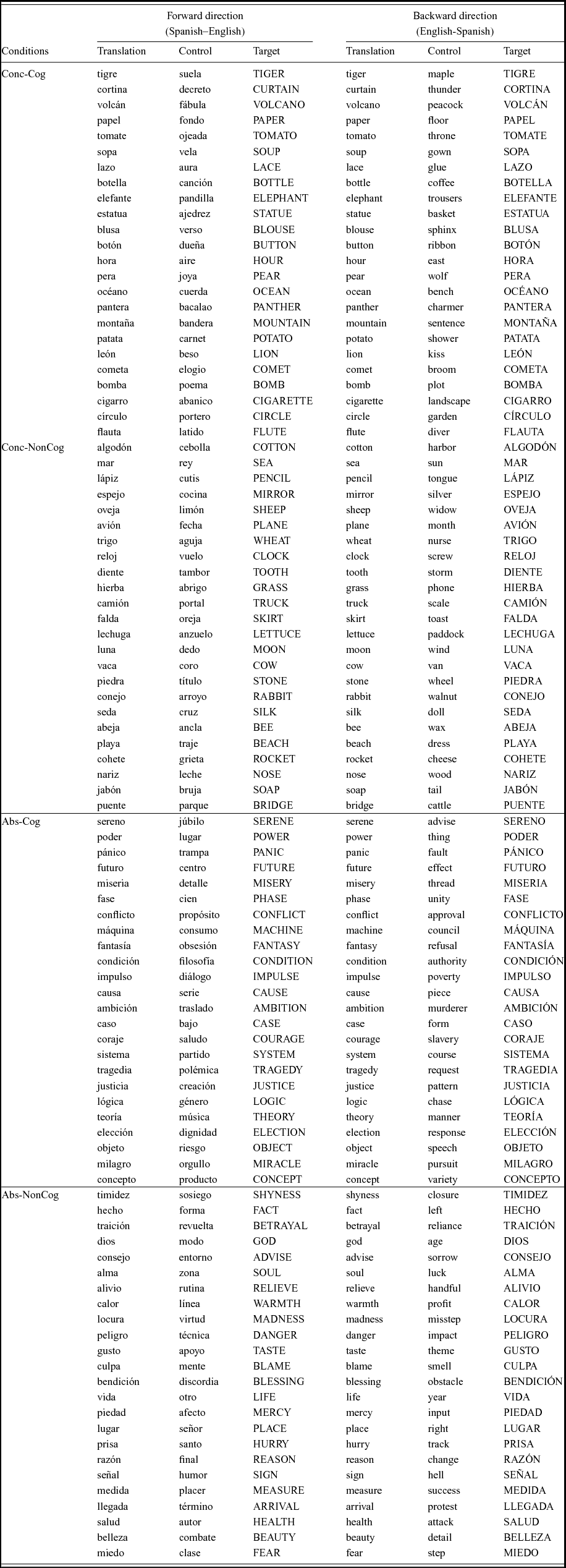
Ninety-six Spanish words and their English translations were selected to be used as targets in the English-Spanish and Spanish-English translation directions. Half of them were cognates and the other half were noncognates. We computed the degree of orthographic overlap across languages by using the Levensthein Normalized distance algorithm, which ranges from 0 (minimum orthographic similarity) to 1 (maximum orthographic similarity). Cognate words showed a high degree of orthographic overlap (M = 0.67, SD = 0.12), whereas this value was very low for noncognates (M = 0.15, SD = 0.14). Additionally, within both cognates and noncognates, 24 were concrete words and 24 were abstract words. We classified the words as concrete or abstract according to their imageability, obtained from N-Watch (Davis, Reference Davis2005) and B-Pal databases (Davis & Perea, Reference Davis and Perea2005) for English and Spanish words, respectively. Thus, there were four different sets, with 24 words each: cognate concrete words, cognate abstract words, noncognate concrete words and noncognate abstract words (see the Appendix). Cognate and noncognate target words were matched in frequency and imageability in both languages (both ps > .15) and concrete and abstract targets were matched in the degree of orthographic overlap across languages (p = .43).
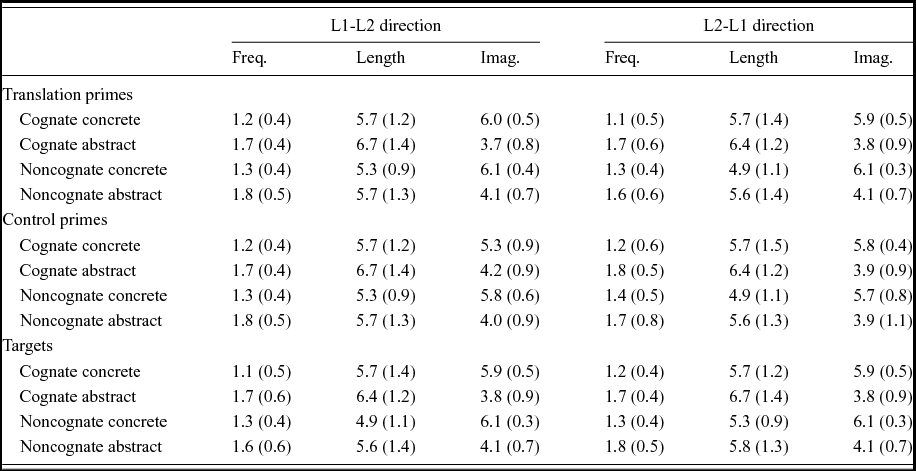
In the two translation directions of the experiment, both Spanish and English targets could be presented either under a related or an unrelated priming condition. In the related condition, targets were preceded by their translation equivalents (e.g., pear-PERA and luna-MOON for cognate and noncognate targets respectively) whereas in the unrelated condition, primes were words in the other language unrelated in form and in meaning to the targets (e.g., wolf-PERA or wind-LUNA). As the aim of the present work was to study priming effects (i.e., the dependent variable was the magnitude of priming), extreme care was taken to match the related and unrelated primes, in order to ensure that other variables apart from relatedness cannot explain the effects observed. Therefore, related primes were matched to the unrelated primes in length, frequency, orthographic neighborhood, mean bigram frequency and imageability in Spanish and English (all ts < 1.02, see Table 1).
Mean and standard deviation (in parentheses) of logarithmic frequency (Freq.), length and imageability (Imag.) as a function of translation direction, cognate status, concreteness and relatedness.

Two different experimental lists were constructed for each translation direction to counterbalance the materials across prime-target relatedness (translations vs. unrelated words). Thus, any target appeared under both the related and the unrelated conditions across lists but participants saw each target only once, under a particular condition. In addition, ninety-six Spanish and ninety-six English pseudowords were also created for the purposes of the lexical decision task. They were constructed from real words by changing one or two letters. All of them were legal and pronounceable sequences in Spanish or English. Furthermore, they had the same length as the target words. Primes for the Spanish pseudoword targets consisted of 48 cognate and 48 noncognate English words. Primes for the English pseudoword targets were 48 cognate and 48 noncognate Spanish words. The prime-pseudoword pairs were the same in the two experimental lists of each direction.
Finally, two sets of 12 practice items were constructed, one set for the English-Spanish direction and another one for the Spanish-English direction. In both sets half of the targets were words and the other half were pseudowords.
Procedure
The experiment was conducted in two sessions, one session for the Spanish-English (forward) translation direction and another session for the English-Spanish (backward) translation direction. The time elapsed between sessions was two weeks. All the participants completed the two sessions and the order of sessions was counterbalanced.
Participants were tested singly in separate soundproof booths. Presentation of the stimuli and recording of reaction times (RTs) and errors (%E) were controlled by using the DMDX software (Forster & Forster, Reference Forster and Forster2003). There was a practice block with 12 randomized trials. Then the experiment began, containing 192 experimental trials (96 with a word target and 96 with a pseudoword target). Participants pressed a foot-switch to start the experiment. Each trial consisted of three visual events that were centered in the viewing screen, with each event superimposed on the one preceding. The first stimulus acted as a forward mask that was displayed for 500 ms. It consisted of a row of hash marks (#) with a length that was matched to the length of the longest string stimulus (prime or target) on a trial-by-trial basis. Immediately following the mask, a lowercase prime was displayed for 50 ms, which was in turn followed by an uppercase target presented for 500 ms. The target was replaced by a blank screen until the participant made a response. Primes and targets were displayed using a 10-point Courier font. They were on average 1.5 cm in length and 0.6 cm high.
Participants were asked to make a lexical decision on the stimuli in uppercase by pressing one of two response buttons, ‘word’ responses being made with the preferred hand. Participants, who were not informed about the presence of prime words, came back to the laboratory two weeks later to perform the second session, in which the translation direction was reversed. The procedure of the second session was exactly the same as that of the first session. The only difference was that at the end of the second session participants were given a sheet of paper containing the 34 less frequent experimental English words and they were asked to translate them into Spanish, in order to assure that they had enough knowledge of the experimental stimuli.
Results and discussion
Incorrect responses and RTs less than 200 ms or greater than 2000 ms were excluded from the latency analysis. RTs falling more than 2 standard deviations (SDs) from the mean for a given participant in all conditions were also removed. As a result, 4% of the data were eliminated in the forward direction and 4.3% of the data in the backward direction. Furthermore, any participant who made more than 20% of errors was excluded. Four items were removed: Two of them because of typographical errors and the other two (“shyness” and “betrayal”) because their error rate was higher than 75%.
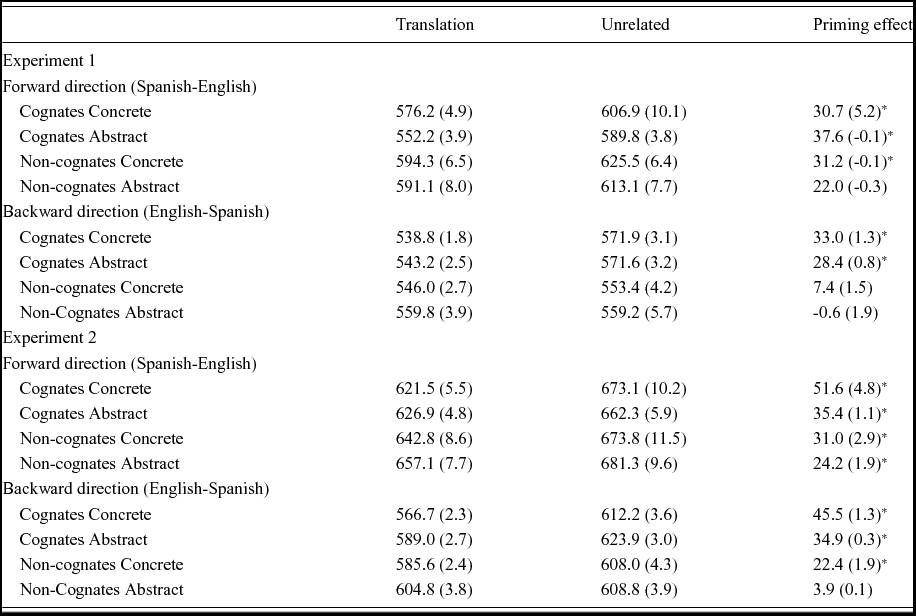
Table 2 shows the mean RT data for correct responses as well as the percentage of errors (%E) for all the experimental conditions. We conducted the statistical analyses on the magnitudes of priming effects rather than on the means. The reason was that magnitudes of priming were the relevant data for testing the predictions of the DFM concerning a greater conceptual overlap between cognates and concrete words with respect to noncognates and abstract words. These magnitudes were computed by subtracting the data of the related conditions from the unrelated conditions. Separate ANOVAs by participants and by items were conducted for RT and E% data. These analyses included the factors ‘experimental list’ (List 1 vs. List 2), ‘direction’ (forward vs backward), ‘cognate status’ (cognates vs. non-cognates), and ‘concreteness’ (concrete vs. abstract). In the analysis by participants, ‘experimental list’ was a between-participants dummy variable whereas ‘direction’, ‘cognate status’ and ‘concreteness’ were within-participants factors. In the analysis by items, ‘experimental list’ and ‘direction’ were within-items factors whereas ‘cognate status’ and ‘concreteness’ were between-items factors.
Mean RTs and percentage of errors (%E) as a function of translation direction, cognate status, concreteness and relatedness.

*p <.05. Comparison between the translation condition and the unrelated condition.
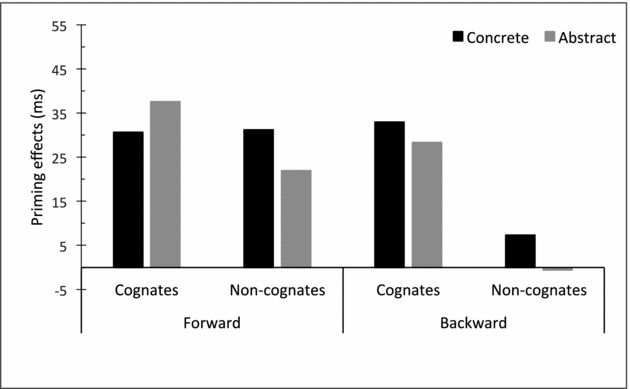
The RT ANOVA revealed that the experimental list factor did not show either a main effect or an interaction with any of the other factors. We obtained a significant effect of direction, as the magnitude of priming was larger in the forward direction (M = 30.4) than in the backward direction (M = 17.1), F 1(1, 31) = 8.62, MSE = 1314.65, p < .01, ŋ2p = .22, F2(1, 88) = 7.50, MSE = 1772.57, p < .01, ŋ2p = .08. A main effect of cognate status was also obtained. It was significant in the by participants analysis and near to significance in the by items analysis, F 1(1, 31) = 10.06, MSE = 1931.56, p < .005, ŋ2p = .24, F 2(1, 88) = 2.99, MSE = 4168.03, p = .09, ŋ2p = .03. This effect revealed that the magnitude of priming was greater for cognates (M = 32.4) than for noncognates (M = 15.0). The interaction between direction and cognate status reached statistical significance only in the by-participants analysis, F 1(1, 31) = 4.48, MSE = 1395.08, p < .05, ŋ2p = .13, F 2(1, 88) = 1.54, MSE = 1772.57, p = .22, ŋ2p = .02. This interaction revealed that, whereas in the forward direction there was a priming effect of a similar size for cognates and noncognates (34.14 and 26.6 for cognates and noncognates, respectively, p = .41), in the backward direction priming was significant only for cognate words (priming effects of 30.72 and 3.41 for cognate and noncognates, respectively, see Figure 1). Finally, the main effect for the concreteness factor was not significant.
Priming effects (ms) as a function of translation direction, cognate status and concreteness (Experiment 1).

The same analysis was applied to the magnitude of priming in the %E data. No main effects nor interactions were significant.
The results of this experiment can be summarized as follows: the translation priming effect was larger in the forward than in the backward direction, and stronger for cognates than for noncognates. The effects of cognate status were modulated by translation direction. That is, whereas in the forward direction there was priming for cognates as well as for noncognates, in the backward direction it was restricted to cognates. The direction asymmetry in translation priming effects was consistent with previous studies conducted with proficient unbalanced bilinguals (e.g., Chen et al., Reference Chen, Liang, Cui and Dunlap2014; Dimitropoulou et al., Reference Dimitropoulou, Duñabeitia and Carreiras2011b; Gollan et al., Reference Gollan, Forster and Frost1997; Grainger & Frenck-Mestre, 1998; Schoonbaert et al., Reference Schoonbaert, Duyck, Brysbaert and Hartsuiker2009), as it was the larger translation priming effect for cognates than for noncognates (Davis et al., Reference Davis, Sánchez-Casas, García-Albea, Guasch, Molero and Ferré2010; de Groot & Nas, Reference De Groot and Nas1991; Duñabeitia et al., Reference Duñabeitia, Perea and Carreiras2010; García-Albea et al., Reference García-Albea, Sánchez-Casas and Igoa1998; Gollan et al., Reference Gollan, Forster and Frost1997; Sánchez-Casas & García-Albea, Reference Sánchez-Casas, García-Albea, Kroll and de Groot2005; Voga & Grainger, Reference Voga and Grainger2007).
In contrast to the significant effects of translation direction and cognate status, concreteness failed to modulate translation priming. A possible reason for the lack of concreteness effects can be the SOA used. Although there are reports in the literature of semantic effects with a 50 ms SOA with other experimental paradigms (i.e., in the cross-language semantic priming paradigm, Perea et al., Reference Perea, Duñabeitia and Carreiras2008), it might be that it is an SOA not long enough to fully activate words’ semantics in order to get fine-grained semantic effects (i.e., concreteness effects). As a matter of fact, the only study to date reporting a concreteness effect with the masked translation priming paradigm used a 100 ms SOA (Schoonbaert et al., Reference Schoonbaert, Duyck, Brysbaert and Hartsuiker2009). Of note, the effect disappeared with longer SOA durations (at 200 ms, Chen et al., Reference Chen, Liang, Cui and Dunlap2014, or at 250 ms SOA, Schoonbaert et al., Reference Schoonbaert, Duyck, Brysbaert and Hartsuiker2009). Taking into account these results, we decided to conduct a second experiment with a 100 ms SOA.
However, before exploring whether the lack of concreteness effects are due to the SOA used, the effect of confounding variables should be ruled out. One of these variables is the number of translations. As Tokowicz and Kroll (Reference Tokowicz and Kroll2007) pointed out, concrete words tend to have fewer number of translations than abstract words. In fact, these authors demonstrated that the concreteness effect in a translation task is only observed in words with multiple translations, but not in words with a single translation. Taking this into account, we decided to look at the number of translations of our concrete and abstract words in order to explore the possible influence of this variable on the results. The inspection of the Word Reference dictionary (Kellogg, Reference Kellogg1999) revealed that the number of English translations for our Spanish targets was 1.81 (SD = 1.16) and 2.60 (SD = 1.43) for concrete and abstract words, respectively. This difference was significant (p < .01). Similarly, concrete English targets had fewer numbers of translations in Spanish (M = 2.25, SD = 1.49) than abstract English targets (M = 3.50, SD = 1.88, p <.005). First of all, these data show that our targets are multiple translation words. Secondly, that concrete targets have fewer numbers of translations than abstract targets. It is important to note that those are in fact the conditions in which concreteness effects have been reported in translation tasks. Namely, when multiple translation words have been used (Tokowicz & Kroll, Reference Tokowicz and Kroll2007) or when the number of translations across conditions has not been controlled (De Groot, 1992, De Groot et al., Reference De Groot, Dannenburg and Van Hell1994). Thus, it does not seem that the lack of concreteness effects in this translation priming experiment can be accounted for by a confounding with the number of translations.
Taking all of the above into account, and considering the possible relevance of the SOA (Chen et al., Reference Chen, Liang, Cui and Dunlap2014; Schoonbaert et al., Reference Schoonbaert, Duyck, Brysbaert and Hartsuiker2009), we decided to conduct a second experiment by using a 100 ms SOA, to increase the probability of observing reliable modulations on masked priming effects as a function of concreteness.
Experiment 2
Method
Participants
Thirty-eight proficient Spanish (L1)-English (L2) bilingual students (29 female; mean age, 19.4, SD = 1.8) from the University Rovira i Virgili in Tarragona, Spain, participated in the experiment. They received course credits for their participation. All of them had normal or corrected-to-normal vision. They completed the same language questionnaire as participants in Experiment 1. The mean age of English acquisition for these bilinguals was 6.1 years (SD = 1.8) and their average proficiency was 9.6 (SD = 0.6) and 7.6 (SD = 1.1) for Spanish and English respectively. As in Experiment 1, at the end of the second session participants were asked to translate a list containing the 34 less frequent experimental English words. All of them translated correctly at least 70% of the words.
Materials
The experimental materials were exactly the same as those used in Experiment 1.
Procedure
The difference with respect to the procedure of Experiment 1 was the SOA used. To maintain the prime duration constant (50 ms), a 50 ms backward mask was introduced to get a 100 ms SOA. The rationale of this manipulation was to increase the time during which participants could process the prime before the presentation of the target. The procedure of this experiment was identical to that used by Schoonbaert et al. (Reference Schoonbaert, Duyck, Brysbaert and Hartsuiker2009) in the 100 ms SOA condition. Each trial consisted of a sequence of four visual elements. The first stimulus acted as a forward mask that was displayed for 500 ms. As in Experiment 1, it consisted of a row of hash marks (#) with a length that was matched to the length of the longest string stimulus (prime or target) on a trial-by-trial basis. Immediately following the mask, the lowercase prime was displayed for 50 ms. It was in turn followed by a 50 ms backward mask that was identical to the forward mask. The fourth and final element was the uppercase target, which was presented for 500 ms.
Results and discussion
The same data trimming procedure as in Experiment 1 was applied to the data of the present experiment. Thus, incorrect responses and RTs less than 200 ms or greater than 2000 ms were excluded from the latency analysis. RTs falling more than 2 SDs from the mean for a given participant in all conditions were also removed. As a result, 4.4 % of the data were eliminated in the forward direction and 3.9 % of the data in the backward direction. Furthermore, any participant who made more than 20% of errors was excluded. Three items were removed: Two of them due to typographical errors (the same items as in Experiment 1) and the item “warmth” because its error rate was higher than 75%.
Table 2 shows the mean RT data for correct responses as well as the percentage of errors (%E) for all the experimental conditions. As in Experiment 1, the analyses were conducted on the magnitudes of priming effects. Separate ANOVAs by participants and by items were conducted for RT data and for %E data. The factors were the same as in Experiment 1.
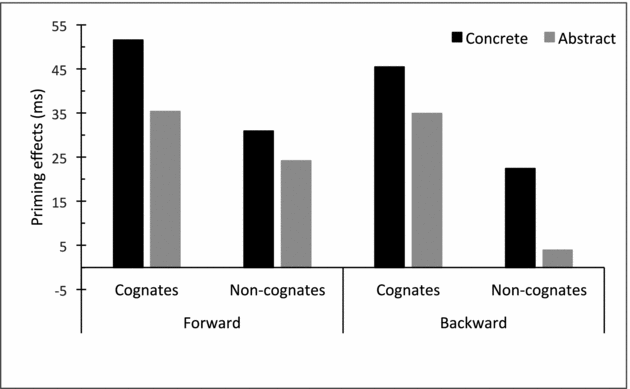
The RTs ANOVA showed that the experimental list factor failed to show either a main effect or an interaction with any of the other factors. There was an effect of direction, significant only in the by items analysis, F 1(1, 37) = 2.27, MSE = 2621.19, p = .14, ŋ2p = .06, F 2(1,89) = 5.46, MSE = 2249.83, p < .05, ŋ2p = .06, revealing that the magnitude of priming was larger in the forward direction (M = 44.60) than in the backward direction (M = 28.32). The effect of cognate status was also significant, F 1(1, 37) = 14.68, MSE = 2381.33, p < .001, ŋ2p = .28, F 2(1, 89) = 5.99, MSE =2731.80, p < .05, ŋ2p = .06, as the magnitude of the effect was larger for cognates (M = 41.8) than for noncognates (M = 24.1, p < .001, see Figure 2). The interaction between translation direction and cognate status failed to reach statistical significance in the present experiment, F 1(1, 37) = 1.69, MSE = 2331.81, p = .20, ŋ2p = .04, F 2(1, 89) = 0.92, MSE =2072.95, p = .34, ŋ2p = .01, as both cognates and noncognates showed significant priming in the two translation directions. However, it is worth emphasizing that whereas there were no differences in the magnitude of priming between cognates and noncognates in the forward direction (43.51 and 40.19 for cognates and noncognates, respectively, p = .70), priming was larger for cognates than for noncognates in the backward direction (27.61 and 13.21 for cognates and noncognates, respectively, p < .05, see Fig. 2). Finally, the most relevant finding of this experiment concerns concreteness. In contrast to Experiment 1, this factor reached statistical significance in the analysis by participants and was marginally significant in the analysis by items, F 1(1, 37) = 5.04, MSE = 2554.03, p < .05, ŋ2p = .12, F 2(1,89) = 2.93, MSE =2731.80, p = .09, ŋ2p = .03, revealing that priming was larger for concrete words (M = 37.6) than for abstract words (M = 24.6).
Priming effects (ms) as a function of translation direction, cognate status and concreteness (Experiment 2).

The same analysis was applied to the %E data. No main effects or interactions were significant.
The results of this experiment were clear-cut: translation priming effects were larger in the forward direction than in the backward direction, and they were stronger for cognates than for noncognates. This pattern of results is very similar to that of Experiment 1, although the interaction between cognate status and direction was not significant in Experiment 2. Of note, the main finding of this experiment was that concreteness modulated priming effects. This result is in agreement with that of Schoonbaert et al. (Reference Schoonbaert, Duyck, Brysbaert and Hartsuiker2009), who found reliable effects of this variable with a 100 ms SOA, but not when a longer SOA was used. Therefore, the present results provide evidence supporting the proposal of the DFM concerning a larger semantic overlap between translations for cognate and concrete words than for noncognate and abstract words, respectively (de Groot, Reference De Groot, Frost and Kaatz1992a; van Hell & de Groot, Reference Van Hell and de Groot1998). As a matter of fact, the proponents of the model found that the highest degree of equivalence of associations within language and across languages in a bilingual word association task was for cognate concrete words (van Hell & de Groot, Reference Van Hell and de Groot1998). These words were also those exhibiting the largest amount of priming in this experiment (average of the effects between the forward and backward direction, M = 48.55). In contrast, the smallest amount of priming was that observed with noncognate abstract words (M = 14.90). To explore in more detail these differences, we checked if there were priming effects in each experimental condition (i.e., by comparing with a Student t-test the related conditions with the unrelated conditions). This analysis revealed that abstract noncognate pairs in the backward direction were the only which failed to show a significant priming effect (magnitude of priming = 3.99, see Table 2).
Discussion
In the present study we tested unbalanced proficient bilinguals of Spanish and English in two masked translation priming experiments conducted in the two translation directions and with two different SOAs. We investigated whether priming effects could be affected by the conjoint manipulation of cognate status and words’ concreteness. Overall, the results revealed a translation priming effect that was stronger in the forward direction than in the backward direction and larger for cognates than for noncognates. In addition, concreteness modulated priming effects only in the 100 ms SOA experiment. The results support the DFM (de Groot, Reference De Groot, Frost and Kaatz1992a, Reference De Groot1992b; van Hell & de Groot, Reference Van Hell and de Groot1998), which assumes a higher conceptual overlap for concrete and cognate words than for abstract and noncognate words.
The translation priming asymmetry found when comparing the forward and the backward direction is in agreement with past research conducted with proficient unbalanced bilinguals (Chen et al., Reference Chen, Liang, Cui and Dunlap2014; Dimitropoulou et al., Reference Dimitropoulou, Duñabeitia and Carreiras2011b; Gollan et al., Reference Gollan, Forster and Frost1997; Grainger & Frenck-Mestre, 1998; Schoonbaert et al., Reference Schoonbaert, Duyck, Brysbaert and Hartsuiker2009). In this study, the asymmetry was modulated by cognate status. In Experiment 1, the significant interaction found between translation direction and cognate status revealed that, whereas the priming effect was significant for both cognates and noncognates in the forward direction, only cognates showed priming in the backward direction. Concerning Experiment 2, although the interaction failed to reach statistical significance, the pattern of results was similar. In particular, although there was priming for cognates as well as for noncognates in the two translation directions, only in the backward direction the magnitude of the effect was larger for cognates than for noncognates. Therefore, the increase in the time given to process the target in Experiment 2 not only has produced larger priming effects when compared to Experiment 1 (see Table 2), but also, and more interestingly, has allowed the emergence of priming for noncognates in the backward direction (although the effect is smaller than that found with cognates).
The modulation of the translation asymmetry by cognate status can be interpreted within the framework of the DFM. Accordingly, L2 cognate words, when compared to noncognates, might exhibit a smaller difference with respect to L1 words in their capacity to activate the shared semantic features, as a consequence of their higher conceptual overlap. The model also proposes that, as proficiency increases, L2 words would become more similar to L1 words with respect to their capacity to produce priming. Therefore, we might expect that, if we had tested bilinguals more proficient in their L2, translation asymmetries would have disappeared and we would have obtained backward priming effects of a similar magnitude for cognates and noncognates.
Apart from the asymmetry above mentioned, what is clear from the present study is the relevance of words’ characteristics in bilingual word recognition. Indeed, priming effects were more robust for cognates than for noncognates, a result which entirely agrees with the literature in the field (Davis et al., Reference Davis, Sánchez-Casas, García-Albea, Guasch, Molero and Ferré2010; de Groot & Nas, Reference De Groot and Nas1991; Duñabeitia et al., Reference Duñabeitia, Perea and Carreiras2010; García-Albea et al., Reference García-Albea, Sánchez-Casas and Igoa1998; Gollan et al., Reference Gollan, Forster and Frost1997; Sánchez-Casas & García-Albea, Reference Sánchez-Casas, García-Albea, Kroll and de Groot2005; Voga & Grainger, Reference Voga and Grainger2007). This advantage for cognate words is accounted for by the DFM in terms of the degree of meaning overlap (de Groot, Reference De Groot, Frost and Kaatz1992a, Reference De Groot1992b; van Hell & de Groot, Reference Van Hell and de Groot1998). The same mechanism would explain the advantage in processing for concrete words with respect to abstract words. The results of the present work provide support for the last proposal. Namely, in Experiment 2 (i.e., in the 100 ms SOA experiment), we obtained larger priming effects for concrete words than for abstract words. This result is in line with that reported by Schoonbaert et al. (Reference Schoonbaert, Duyck, Brysbaert and Hartsuiker2009) with the same SOA. Furthermore, it extends these findings to cognate words; as, in that study, only noncognate words were considered. Note, however, that the advantage was neither observed with a lower SOA (50 ms in Experiment 1) nor with larger SOAs (i.e., 200 ms in the study of Chen et al., Reference Chen, Liang, Cui and Dunlap2014, or 250 ms in the study of Schoonbaert et al., Reference Schoonbaert, Duyck, Brysbaert and Hartsuiker2009). These findings point out that the SOA employed is a relevant variable in determining the concreteness effect on priming (being probably maximum at 100 ms). Thus, smaller SOAs than 50 ms would not allow the full activation of words’ semantics in order to capture fine-grained effects such as those of concreteness. On the contrary, with longer SOAs the advantage would disappear, indicating that the concreteness effect has a short-living duration.
The comparison of the effect of cognate status with that of concreteness reveals that the former is more robust than the latter and not dependent on the SOA used. This fact leads us to think that probably the cognate advantage cannot be fully explained by the greater conceptual overlap across languages between cognates when compared to noncognates. Importantly, other kind of explanations have been proposed for this advantage. In particular, the Bilingual Interactive Activation Plus Model (BIA+, Dijkstra & van Heuven, Reference Dijkstra and van Heuven2002; Dijkstra, Miwa, Brummelhuis, Sappelli & Baayen, Reference Dijkstra, Miwa, Brummelhuis, Sappelli and Baayen2010) deserves a mention here. This model posits that the difference between cognate and noncognate words is that only cognate words share orthographic and phonological representations with their translation equivalents. According to this account, whereas the presentation of both cognates and noncognates would activate the overlapping semantic representations across languages, activation of shared orthographic/phonological representations would be restricted to cognate words, leading to their advantage in recognition over noncognates (see also Voga & Grainger, Reference Voga and Grainger2007, for a similar account of cognate effects in terms of form and meaning overlap).
To sum up, the present experiments have shown that both cognate status and concreteness play a role during the early stages of word recognition. Indeed, masked translation priming effects were modulated by both factors, as well as by translation direction. Furthermore, the SOA seems a relevant variable to take into account in masked translation priming studies, as it modulated the emergence of concreteness effects as well as of priming effects for noncognate words in the backward direction. These findings mainly support the proposal of the DFM concerning a greater meaning overlap for cognate and concrete words than for noncognate and abstract words (de Groot, Reference De Groot, Frost and Kaatz1992a; van Hell & de Groot, Reference Van Hell and de Groot1998). However, orthographic and phonological overlap are probably more relevant in determining the priming advantage for cognate words, as has been proposed from other theoretical accounts (Dijkstra & van Heuven, Reference Dijkstra and van Heuven2002; Dijkstra et al., Reference Dijkstra, Miwa, Brummelhuis, Sappelli and Baayen2010).
Critical Spanish and English stimuli as a function of translation direction, concreteness and cognate status.