Given that a competent, clean, and merit-based civil service is crucial to further economic reform and social development, various authorities in Asia seek to design civil service reforms that will affect the behaviour of government employees, and thus, improve administrative performance. In the effort to make the bureaucracy more meritocratic, authorities in China are no exception.Footnote 1
China's civil service system has experienced multiple reforms in the past three decades.Footnote 2 A key theme underlying these reforms has been to professionalize the Chinese civil service as a way to improve administrative performance. To develop and maintain a professionalized civil service, Chinese leaders have faced the challenge of attracting talented individuals to join public organizations and keeping them motivated. Nonetheless, as widely reported in the media, there have recently been unprecedentedly high turnover rates in government agencies, particularly those in top-tier cities.Footnote 3 This recent phenomenon contrasts with the not-so-distant past in which numerous college graduates signed up each year for civil service exams to compete for very limited openings. Similarly, government job seekers have declined considerably in number in recent years.Footnote 4 These trends raise questions about the level of job satisfactionFootnote 5 among public employees. Has job satisfaction dropped among public employees? Have there been changes in the antecedents of job satisfaction among public employees over time? As the civil service becomes more professionalized and faces ever-increasing political and societal pressures for better performance, has it become more difficult to keep public employees satisfied with their jobs? Answers to these questions are critically important for civil service reform in China.
In the existing English literature, few studies focus on the job satisfaction of Chinese public-sector employees. Although a handful of scholars have discussed this issue, most of them worked on the largely unexamined, and probably outdated, assumption that Chinese officials generally feel satisfied with their jobs, which are presumably accompanied by alluring perks ranging from tenure security and low performance expectations to varying kinds of non-wage benefits and hidden subsidies.Footnote 6 An article published by Liu and TangFootnote 7 exemplifies this assumption. Assuming that public-sector jobs signal a high output (expected income)/input (anticipated effort) ratio for their holders, the authors characterize public-sector jobs as a “steel rice bowl” (tie fanwan 铁饭碗). They argue that those who are predominantly money-orientated are likely to be very contented working in public organizations. Nonetheless, when considering many recent policy changes, alongside President Xi Jinping's high-profile anti-corruption campaign which has already led to the imprisonment of over 500,000 government officials,Footnote 8 one must question the conventional wisdom that public-sector jobs are inherently desirable.
This article reports on an empirical study on the changing levels of job satisfaction among public employees in China. The study draws on surveys completed by enforcement officials from an environmental protection bureau located in an economically advanced capital city, anonymously identified as G, of a southern China province in years 2000 and 2014 respectively. In addition, interviews were conducted in 2016 and 2017 with leaders of enforcement teams of city G's environmental protection bureau (henceforth: GEPB) in all 11 administrative districts within its jurisdictions. Based on these surveys and interview data, we were able to trace the changes in job satisfaction among this group of public employees over the past 15 years.
Data from the two rounds of surveys among GEPB enforcement officials show that respondents were overall less satisfied with their jobs in 2014 than those in 2000. In addition, our interviews with enforcement team leaders in 2016 and 2017 show that they had not only raised serious reservations about their pay scales and promotion opportunities but had also expressed earnest concerns about the generational gap between younger and senior team members, with the latter lacking the necessary professional skills to carry out basic enforcement tasks. These qualitative findings mirror those from the two rounds of survey, which show that mission match (defined as the extent to which an employee's own values and characteristics match those of the organization) is more strongly correlated with job satisfaction in 2014 than in 2000.
These qualitative and quantitative findings also reflect, to some extent, the increasingly challenging institutional environments faced by street-level bureaucrats: 1) rising political and societal expectations for environmental improvements;Footnote 9 2) inadequate fiscal and personnel resources;Footnote 10 and 3) limited enforcement authority.Footnote 11 In addition to these challenging environments, the Civil Service Law (Gongwuyuan fa 公务员法) came into effect in 2006, which “lays down the most detailed employment and human resource procedures under which a civil servant might be recruited.”Footnote 12 As a result, junior officials have become more professionalized as recruitments have increasingly been based on professional qualifications. More stringent standards have also been introduced to hold officials accountable for performance. Owing to all these emerging contexts, the drivers of job satisfaction have changed over the years.
This study illustrates a key lesson on administrative reform: as efforts are made to enhance the professionalism of public officials, administrative agencies must be reshaped to support the motivational needs of a more professionalized workforce. Specifically, commensurate resources and authority must be made available to the officials. The mid-level leadership needs to focus on creating conditions in which employees can appreciate the organization's mission on “both a personal basis and on its perceived societal impact.”Footnote 13
The remaining parts of this paper proceed as follows. We begin with an overview of the institutional set-up of the Chinese environmental management system. Then, we use information from in-depth interviews to identify the possible factors that have an impact on the job satisfaction of street-level enforcement officials of GEPB. The third section is devoted to hypothesis development. The fourth section details variable measurements and analytical methods. Findings are presented in the fifth section. The paper concludes by discussing policy implications and agendas for future research.
Environmental Governance in China
Environmental governance in China is run by a system of centralized policymaking and supervision, but of decentralized implementation. Serving as one of 25 integral departments of the State Council, the State Environmental Protection Administration was upgraded to the Ministry of Environmental Protection (MEP)Footnote 14 in 2008 to signal its increasing importance in the country's overall strategic planning. Tasked to revive China's blue sky, green land and clean water, MEP assumes responsibilities for 1) promulgating environmental laws, regulations and guidelines; 2) supervising environmental protection agencies at the provincial, city and township levels; and 3) institutionalizing an accountability system to monitor local regulatory enforcement. Under MEP's leadership, a revised version of the Environmental Protection Law (huanjing baohu fa 环境保护法) with stringent amendments was enacted in 2015. Funded by its respective level of government, the environmental management regime at each subnational level is subject to accountability mechanisms that combine inspections from higher-level officials and citizen complaint channels from below.
The multilayered structure of China's environmental management system can be sketched as follows: subordinating to MEP, a Department of Environmental Protection is established in each province. Below this level, each city sets up its Environmental Protection Bureau (EPB), which is followed by implementation branches based in each district within the city. In our research, we surveyed and interviewed the enforcement team officials working for the district-level EPBs in city G. Serving at the lowest level of the environmental governance system, these officials are the street-level bureaucrats who enforce environmental regulations and handle citizens’ complaints.
Over the past ten years, we have witnessed increasing efforts made at both the national and local levels to enhance the effectiveness of environmental enforcement in China. At the national level, smarter and voluminous measurement tools have been deployed to ensure local compliance with environmental rules and standards. Gao,Footnote 15 for instance, details the countermeasures utilized by the central government to combat misreporting, falsification or embellishment of environmental performance data submitted by local administrations. At the subnational level, each province and its capital city have scrambled to demonstrate their competency to forge a “green” path to economic growth. The vast majority of our interviewees acknowledged that environmental protection was indeed high on the agenda of their respective territorial governments.
Theory Building: Exploring Antecedents to Job Satisfaction
We conducted two rounds of questionnaire surveys, distributed to officials of the district-level enforcement teams in GEPB, and follow-up interviews with a selected group of enforcement team leaders. In comparison with questionnaire surveys, interviews provide more textured data with scholars’ “first-hand involvement in the organizational setting under study;”Footnote 16 thus serving as a cornerstone for theory development.Footnote 17 Hence, we first turn to results obtained from our interviews with enforcement team leaders, identifying common denominators that have an impact on the job satisfaction of local enforcement officials.
Between December 2016 and March 2017, we conducted semi-structured interviews with environmental enforcement leaders in all 11 administrative districts of city G. Interviewees were prompted to describe their teams’ major responsibilities, self-evaluate their performance in relation to public and governmental expectations, elaborate on the difficulties they encountered in daily enforcement activities, and describe their work pressure. These interviews, each lasting around one to two hours, were recorded and later transcribed.
When asked about the approaches they adopted to motivate their subordinates, interviewees unexceptionally expressed their inability to do so. They noted promotion and salary increases as two major work motivators, but neither of which are available these days. Three enforcement team leaders explained:
To be honest, it is extremely difficult for individuals to seek promotion in the environmental protection system. Our bureau is a case in point. We have an official staff establishment of 57 people, of which 27 are given civil enforcement posts (zhifa bianzhi 执法编制). Unfortunately, only four leadership positions are budgeted for the entire enforcement team. Unless one of these four “leaders” reaches his or her mandatory retirement age, the promotion prospects for individual members of my team are from slim to none. We need to go to great lengths to promote someone to the deputy-section level. This is nowhere near the case for employees in other government agencies. They can easily get promoted to the section-level within a few years.Footnote 18
My salary has hardly doubled over the past 20 years – in 1997, my annual income was 120,000 yuan; currently, my annual income is around 200,000 yuan. However, do you have any idea about how dramatically housing and retail prices in city G have grown in this time span? There is a widespread rumour indicating that civil servants in China experienced a significant pay hike last year. Let me tell you how “significant” it was. As I saw in my pay slip, my monthly salary last year was adjusted upward to be 100 yuan more than my previous one. Don't you find it rather amusing?Footnote 19
Our monthly salary cannot even afford one square metre of a residential real estate these days. I purchased my property in 2004. At the time, my salary was around 4,800 yuan per month, and the housing price was about 5,400 yuan per square meter. By taking bank loans, my salary enabled me to own a roof over my head. Currently, my salary is approximately 12,000 yuan, but housing prices have soared to the extent that even the cheapest, second-hand one is between 38,000 yuan and 40,000 yuan per square metre. By doing simple maths, you can understand how “outdated” and “unreasonable” our salary system is.Footnote 20
Officials’ discontent, as partly revealed in the above quotations, is understandable. On the surface, the adjustments made to the salaries of public officials have been keeping up with inflation over the past two decades.Footnote 21 Nevertheless, the soaring housing prices, which are “detached from the increase in real salaries, principally in major Chinese cities,”Footnote 22 are not fully factored into calculations of this nature. The grievance of Chinese public employees thus arises, in part, from being the unfortunate “sandwich class,” who are neither able to meet their housing needs directly through the market nor qualified to join the government-sponsored economical housing scheme (jingji shiyong fang jihua 经济适用房计划) designed for the urban poor.Footnote 23 For instance, when looking into the housing price index in relation to annual income, DingFootnote 24 showed that this ratio reached 8.5 times the average annual salary and exceeded it 14 times in coastal cities in China. While relatively low interest rates encourage individuals to take on mortgages, we should not forget about the 30 per cent down payment, which by itself could be approximately one million yuan, and which exerts telling pressures on housebuyers’ budgets from the outset.Footnote 25 Making matters worse, due to a number of counterproductive government-initiated measures intended to cool down the overheated housing market, Chinese real estate prices have been experiencing a retaliatory growth starting in 2015, trending considerably upwards particularly in first-tier cities.Footnote 26 In the absence of family support, GEPB officials’ personal incomes are simply a drop in the bucket compared to the million yuan needed to cover the down payment of a residential property. Facing such unaffordability, together with limited opportunities for career advancement, the average official is unlikely to be in high spirits at work.
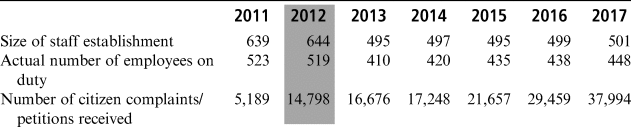
In addition, nearly all interviewees flew off the handle when they began detailing the accountability system (wenze zhidu 问责制度) that was designed to ensure their responsiveness to citizen complaints. Based on the official data provided in GEPB's budget and final accounting reports, enforcement teams handled about 30,000 citizen complaints in 2016 alone. More notably, while the number of citizen petitions received and processed by GEPB soared from 5,189 in 2011 to 29,459 in 2016, the overall size of the staff establishment ironically shrank over these years (concrete numbers that showcase these widening discrepancies are provided in Table 1). In the opinion of our interviewees, many of these complaints were neither reasonable nor resolvable.
Staff Size vs Increasing Numbers of Citizen Complaints Received by GEPB

Note:
Year 2012 marked a watershed when the workload of individual GEPB officials began to greatly increase. This was also the year when President Xi took office as the leader of the Communist Party. Under his leadership and a suite of anti-corruption and rectification campaigns, government agencies have been subject to a tightened accountability system (qianghua wenze 强化问责) and a hiring freeze (bianzhi dongjie 编制冻结).
Nonetheless, the enforcement team faced serious consequences if it failed to respond promptly in writing to all complaints. The head of the enforcement team, for instance, could be held personally accountable and face sanctions, ranging from pay decreases to forced resignation. In the words of one team leader:
Citizens never ask themselves whether they have made any contributions to this society. Instead, they have endless demands and requests. They hope to reap all societal benefits without paying any prices, and this selfish motive is revealed in their complaints. On the one hand, for example, they are extremely content that their property prices are soaring. On the other hand, they consider those restaurants in their neighbourhoods to be nuisances. They thus file air pollution complaints, urging us to shut down those restaurants. What can we do about these complaints? Our gut feeling was that they complained to the wrong department. It was the planning department that should be responsible for the unpleasantness. That is, land-use licences should not have been issued to any restaurants located unreasonably close to residential buildings in the first place. Unfortunately, we couldn't say it out loud; otherwise, we would be “held accountable.”
We then sent our teammates to investigate the restaurant those citizens alluded to. It turned out that the volume of the cooking oil fumes emitted by the diner was completely within the legal limits. We had no basis to put a stop to its operation. When we patiently explained the whole situation to the citizens, they didn't even want to listen. They accused us of condoning the wrongdoing of the restaurant owner – a groundless allegation that was emotionally very hurtful to us. I personally want to ask these angry citizens a very simple question: “Do you really think that your house can still be valued at several million dollars even in the absence of those restaurants that have brought huge convenience to the surrounding residents and office staff?”Footnote 27
When commenting on their subordinates’ performance, team leaders uniformly pointed to the existence of intergenerational differences in work-related skills, abilities and attitudes. Apparently, some senior members of the environmental enforcement teams are demobilized soldiers. They were offered government positions as a compensatory scheme for military personnel. Junior members, on the contrary, are mostly college graduates who passed the admission examination for public employment administered by the Ministry of Education; these younger team members are technically more skilful and attitudinally more upbeat. As one interviewee suggested:
Youngsters are more competent and dedicated; they have a strong sense of responsibility for their job and high moral standards. Most of the senior members are demobilized soldiers assigned to our team. While experienced, they haven't received any professional training and have no idea what this job currently entails. Some of them, given their prior service to the country, administratively outrank me. In this scenario, I feel that I am not in the position to ask them to do anything. For example, our team recently purchased mobile tracking devises to enhance enforcement effectiveness. However, a few senior teammates don't even know how to operate a tablet. Considering that my request for the quota of new recruits was denied, I am at my wit's end.Footnote 28
Overall, information derived from these interviews indicates several major challenges faced by the enforcement teams: insufficient extrinsic rewards, an unreasonable accountability system, and generational gaps between senior and younger team members.
Based on an understanding of these challenges, together with an appreciation of other contextual factors, we can begin to speculate the antecedents of job satisfaction among environmental enforcement officials in city G. First of all, if enforcement team leaders believe that their pay severely lags behind the cost of living and that of other professions, their subordinates are likely to echo this sentiment. Similarly, when leaders feel enormous pressure from handling citizens’ complaints, their subordinates can hardly disagree, because they are the ones who tackle these complaints daily. In addition, given the highly hierarchical nature of the Chinese bureaucracy, management support is likely to be a key determinant of officials’ psychological welfare. If team members perceive an instructive, protective and supportive leadership, they are likely to feel less burdened in their dealings with complaints and thus more satisfied with their jobs.
Finally, our sympathies go to those demobilized soldiers who were assigned to the enforcement teams as part of their post-service resettlement. Their dearth of professional knowledge and skills, coupled with a lack of personal interest in environmental issues, can be conceptualized as a form of mission misalignment between individual members and their units. Such a mission misalignment may lead to a perception of low self-efficacy that has been shown in many studies to be negatively correlated with job satisfaction.Footnote 29
Given that we conducted questionnaire surveys about the enforcement teams in 2000 and 2014, data from the two surveys enable us to examine quantitatively how mission match, extrinsic benefits and management support are related to the job satisfaction of the enforcement officials; data gained from these two surveys also allow us to examine changes in correlations over time.
Hypothesis Development
Overall job satisfaction
There are at least two reasons why job satisfaction may have been falling among Chinese public employees over the past 15 years. First, although several civil service reforms pronounced an increase in the pay for grassroots civil servants, the actual pay rises have remained nominal, leading to growing turnovers of competent employees who believed that their earnings paled in comparison to their contributions.Footnote 30 While we do not have access to concrete turnover data for this bureau (and its district-level enforcement teams), our argument is partly supported by data on “personnel decisions” (renshi renmian 人事任免) available on the official website of GEPB. Although partial and highly selective, these data give us a peek into an increasing number of departures made by its able employees. From 2016 onwards, for example, announcements on the early retirement and resignations of employees in leadership positions began to appear. Among these cases, the early retirement of two consecutive directors in charge of solid waste management is particularly noteworthy. Anecdotally, a liaison person at the Research Academy of Environmental Sciences in city G also told us during casual conversations in 2017 that more employees had left GEPB in comparison with the old days when the turnover rate was minimal. He particularly mentioned two cases in which employees in the enforcement team quit their jobs and became lawyers in private law firms.
Second, since most megacities such as city G have experienced severe environmental degradation and widespread public resentment over it, local enforcement officials have been under considerable work-related stress.Footnote 31 Behind the splendid skyscrapers mushrooming in the city, GEPB employees appear to be distressed over their inability to narrow the pronounced wedge “between environmental regulation and regulatory enforcement”Footnote 32 driven partly by the pro-growth local interests embedded in the local party-state establishment. Although societal expectations and political pressure from higher-level governments have skyrocketed in recent years, the authority and resources at the disposal of district-level EPBs have not been increased proportionally.Footnote 33 Each local EPB continues to be funded primarily by its respective district government, whose leadership must balance environmental protection against other competing priorities. As a result, most district-level EPBs have continued to suffer from a) a lack of resources needed for timely enforcement;Footnote 34 b) feeble de facto power to deter non-compliance by regulated industries;Footnote 35 and c) inconsistent and unreliable horizontal support from municipal agencies that prioritize economic issues.Footnote 36 These, together with our interviewees’ complaints about the lack of opportunities for promotion and meaningful salary rises, lead us to propose the following hypothesis.
H1:
Overall job satisfaction among GEPB enforcement officials was lower in 2014 than in 2000.
Mission match
There is sizeable literature suggesting that mission match, defined as “the intrinsic value afforded by the organization's mission,”Footnote 37 contributes to job satisfaction and other related outcomes. Moynihan and PandeyFootnote 38 found that when public employees perceived a strong fit between their personal and organizational values, their expressed intention to quit significantly declined. In addition, SmithFootnote 39 argued that individual workers tend to exert more effort in their jobs when they are convinced that a) the achievement of the organizational mission(s) is beneficial to society (that is, social impact); and b) their daily tasks are consistent with their true interests and values (that is, self-concordance). Despite a lack of direct evidence from studies in the Chinese context, it is reasonable to posit a positive correlation between mission match and job satisfaction among public officials in China.Footnote 40 Our second hypothesis, as indicated below, is also consistent with what we learned from the enforcement team leaders as they repeatedly stressed their frustration in not being able to accomplish their tasks and organizational mission within existing institutional constraints.
H2:
In both 2000 and 2014, GEPB enforcement officials with a higher degree of mission match are more likely to have higher job satisfaction.
With the adoption of the Civil Service Law (Gongwuyuan fa 公务员法) in 2006, the recruitment to Chinese public agencies has increasingly been based on openness and transparency, as well as on applicants’ professional qualifications and performance in civil service examinations.Footnote 41 Environmental agencies in big cities have followed a similar trend; new recruits in the past decade have become more professionalized, with more and more having an educational background in fields that are closely related to environmental engineering and management. Such a trend has also been repeatedly mentioned by our interviewees. In comparison with their previous-generation counterparts who tend to consider jobs in the environmental bureau as merely a means to eke out a living, recent enforcement officials are more likely to consider their jobs as a personal calling,Footnote 42 which is associated with heightened expectations of an alignment with organizational missions.Footnote 43 In other words, mission match carried greater weight in determining job satisfaction among enforcement officials in 2014 than those in 2000, which leads to the hypothesis formulated as follows.
H3:
Mission match was more strongly correlated with job satisfaction among GEPB enforcement officials in 2014 than in 2000.
Extrinsic rewards
The classic crowding-out theoryFootnote 44 suggested that an emphasis on extrinsic rewards might risk undermining government employees’ service-oriented motivations. Recent scholarship, however, questions this argument by showing that two pillars – the achievability of organizational goals with social importance and adequate provision of extrinsic rewards – work in concert to ensure public employees’ satisfaction with, and commitment to, their positions.Footnote 45 Information from our recent interviews with enforcement team leaders in city G suggests the important role extrinsic rewards play in officials’ job satisfaction as the interviewees repeatedly mentioned their disappointment in poor promotion prospects and pay stagnation; thus, we posit the following hypothesis.
H4:
Extrinsic rewards are positively correlated with job satisfaction among GEPB enforcement officials in both 2000 and 2014.
As many news reports have pointed out, particularly in top-tier cities where housing prices have been skyrocketing and periodic pay rises have repeatedly failed to catch up with the cost of living, public employees no longer take a shine to their positions once considered prestigious. This was, however, far from the case 15 years ago. While subsidized housing projects (fuli fenfang 福利分房) for public employees were halted in the mid-1990s as part of the state-owned enterprise reform, most public organizations resorted to incremental compliance. It was not until the early 2000s that government-allocated housing fully exited the picture, and GEPB was no exception in this respect; its enforcement officials in the year 2000 still benefited from subsidized housing. Those who entered the service after the early 2000s are less lucky in the sense that they have to bear the exorbitantly high property prices themselves. In the absence of family support, their personal incomes (salaries plus housing subsidies) are next to nothing compared to the millions of yuan needed to own a roof over their heads. Even without considering the housing issue, as noted by most of our interviewees, the purchasing power of their regular salaries has seriously lagged behind the cost of living in recent years, and such a gap has increasingly been a source of frustration. Together, these considerations lead us to propose the hypothesis as follows.
H5:
GEPB enforcement officials’ satisfaction with extrinsic rewards declined from 2000 to 2014.
Management support
Leadership styles affect public employees’ job satisfaction.Footnote 46 Transformational leaders, for example, motivate employees by creating an inspiring vision and articulating common grounds between employees and the organization. EllicksonFootnote 47 showed that a conducive organizational environment for collaboration is more important than career prospects for public employees in terms of job satisfaction. We are thus led to believe that management support is equally important for generating job satisfaction among local enforcement officials in city G.Footnote 48 Our hypothesis is proposed as follows.
H6:
In both 2000 and 2014, GEPB enforcement officials with greater management support are more likely to have higher job satisfaction.
Survey Data and Research Design
Data collection
Quantitative data were gathered from two waves of questionnaire surveys of GEPB enforcement team officials, one carried out in 2000 and another in 2014, with 175 valid responses in the former and 207 in the latter. These two surveys are highly similar in format and wording. Both surveys contain identical or almost the same questions on work environments, enforcement effectiveness, membership allegiance and pay satisfaction.
Surveying government officials in authoritarian states like China is extremely difficult, as Chinese bureaucrats in general are very reluctant to take part in academic studies and express their genuine thoughts. To ensure the validity of collected data, our team reached out to GEPB division leaders for permission and endorsement prior to the distribution of each survey. In addition, we organized a briefing session before each survey was disseminated. In these sessions, street-level enforcement officials were informed that a) the survey was for pure research purposes and b) anonymity was guaranteed.
Variable measurements
Job satisfaction. The job satisfaction scale (JSS) developed by Judge et al.Footnote 49 is widely used in private-sector management research. The scale includes three key items: a) most days I am enthusiastic about my work; b) I find real enjoyment in my work; and c) every day at work seems like it will never end (reversed-scored). Since JSS has been considered applicable to public organizations across cultural contexts,Footnote 50 we operationalized job satisfaction using four items that largely correspond to the items in JSS: 1) I am proud to tell others that I am part of this environmental organization; 2) I talk up this organization to my friends as a great organization to work for; 3) my organization is an ideal place for me to work in; and 4) I would like to work for this organization in the long run. The internal reliability estimate (Cronbach's coefficient alpha) for this measure reaches 0.81.
Mission match. SmithFootnote 51 suggested two dimensions of mission match: social impact and self-concordance. Survey items selected to measure this variable include proxies for both dimensions, for example, 1) my organization is providing an important public service; and 2) I find that my values and the organization's values are very similar. The Cronbach's coefficient alpha for this measure reaches 0.80.
Extrinsic rewards. When discussing the reasons why competent public employees ultimately all landed on their feet in big agencies, Ellickson suggested that big organizations are able to make sizeable “investments” in their employees,Footnote 52 but such investments can seldom be afforded by small entities. These loyalty-securing investments often included, but were not limited to, ample opportunities for career advancement, performance-based bonuses of various kinds, and miscellaneous fringe benefits.Footnote 53 In accordance with these earning categories, we chose survey items that asked how enforcement officials felt about their basic pay level, benefits-in-kind, and promotion prospects. The Cronbach's coefficient alpha for this measure reaches 0.85.
Management support. A productive management structure is expected to embody leaders with diverse skills, of which the three most important are the ability to: 1) demonstrate, articulate and communicate organizational purposes in an encouraging manner; 2) use performance-based incentives; and 3) boost employee morale so that employees are self-driven to work efficiently and conscientiously.Footnote 54 The survey items we used to represent management support echo these three elements: 1) leadership in the organization has defined a clear mission for its employees; 2) my supervisor gives me the support and guidance I need to be effective in my work; and 3) my supervisor treats me with concern and respect. The Cronbach's coefficient alpha for this measure reaches 0.82.
Control variables. In both questionnaires, respondents were asked about their demographic information, including gender, age and educational level. These individual-level characteristics thus served as control variables in the analysis. We also included environmental consciousness as a control. Given the fact that frontline officials are directly responsible for regulatory enforcement, their environmental consciousness may affect their dedication to and satisfaction with their jobs.Footnote 55
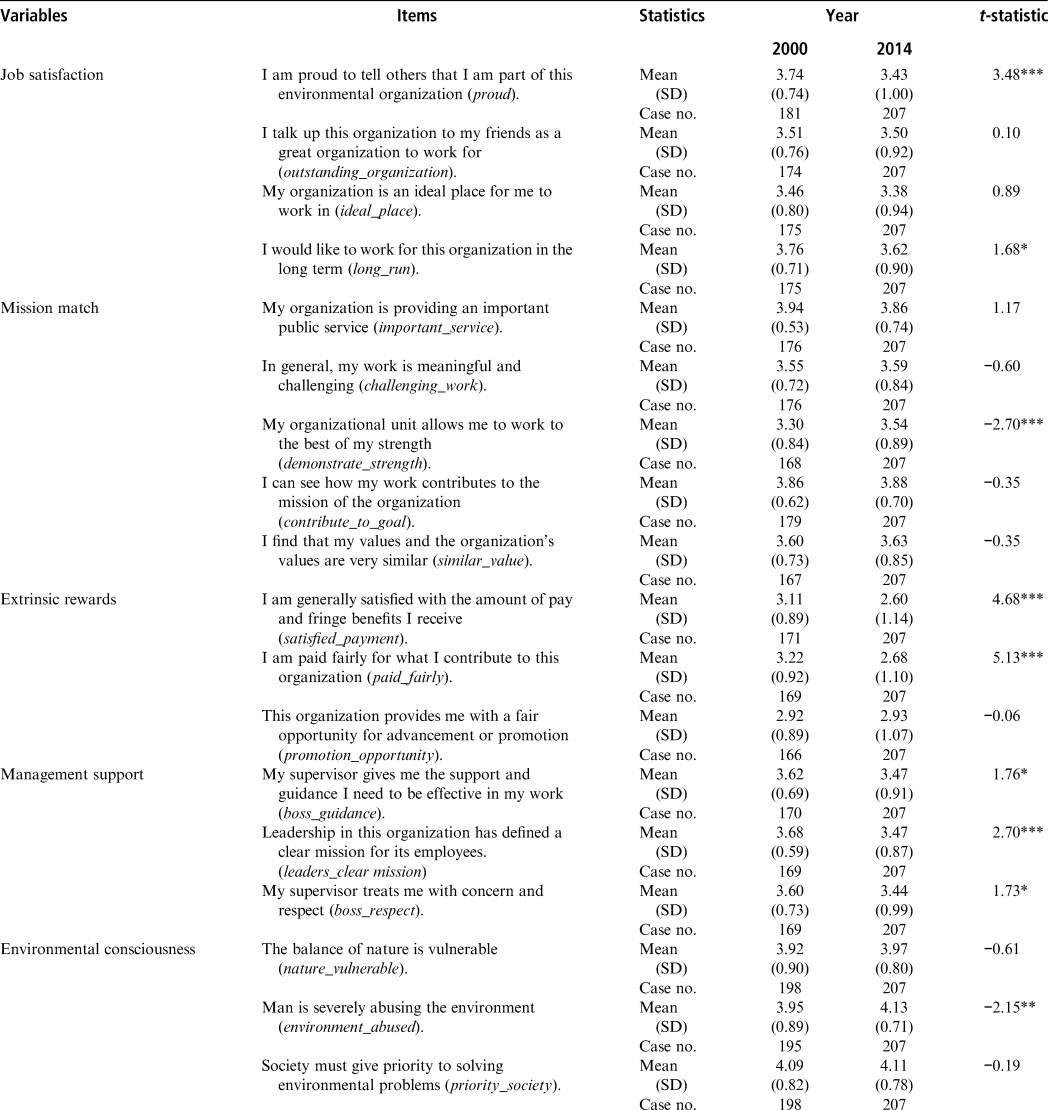
Respondents’ answers to all survey questions were measured on a five-point Likert scale, in which 1 stands for strongly disagree and 5 stands for strongly agree. Negatively phrased items were reverse-scored prior to calculating their respective means. Specific survey items employed to measure all the respective variables are identified in Table 2.
Variable Measurements

Notes:
The scores are based on Likert-scale questions, and the answers include “strongly disagree” (1), “disagree” (2), “neutral” (3), “agree” (4) and “strongly agree” (5). *p<0.1; **p<0.05; ***p<0.01. Significance based on two-tailed tests.
Analytical strategies
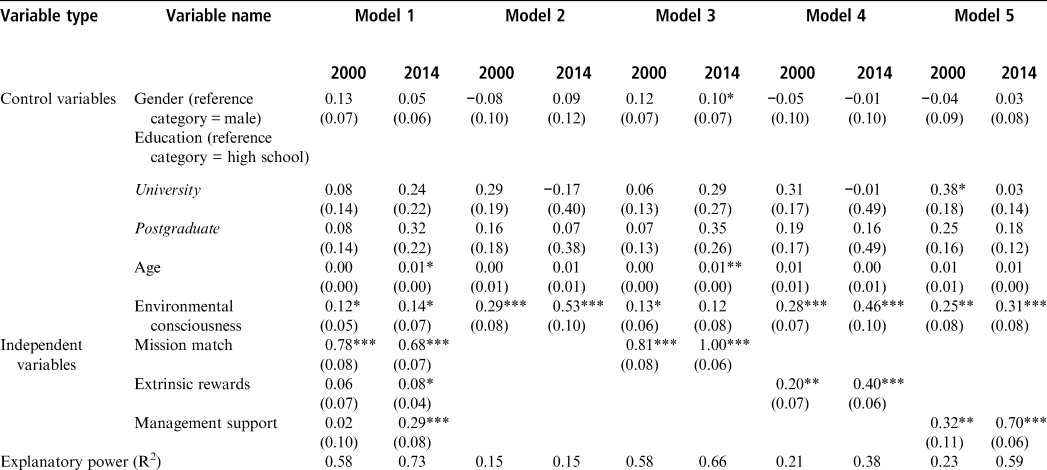
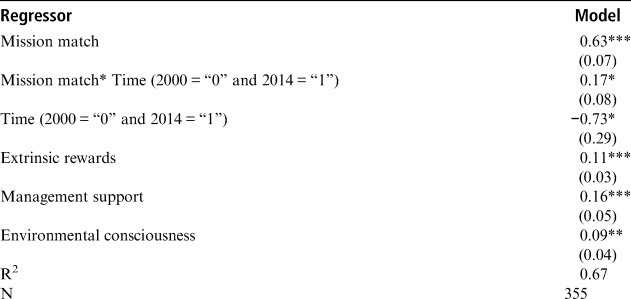
Our research data were analysed using multivariate OLS (ordinary least square) regressions. The dependent variable, job satisfaction, was regressed on mission match, extrinsic rewards, management support and other control variables in separate equations, one based on data from 2000 and the other from 2014. To evaluate the predictive power of each explanatory variable, the model was built in three hierarchical steps. The control variables were entered first, followed by the main predictors one at a time. In the third step, comprehensive models were displayed for both years (see Table 3). To examine Hypothesis 3, job satisfaction was regressed on mission match, year (t = 0 if 2000 and t = 1 if 2014), their interaction, and other covariates. To account for possible heteroscedasticity, Huber-White standard errors were computed.
Independent Explanatory Power of Different Types of Variables in the Context of Cross-sectional Analysis

Note:
Unstandardized coefficients with heteroscedasticity-adjusted standard errors in parenthesis. *p<0.05, **p<0.01, ***p<0.001 (two-sided). Theoretically, hierarchical partitioning (HP) analysis helps rank a list of variables by their independent contributions to the model. However, scholars led by Nally point out that this method offers “little guidance as to which variables to retain for the purpose of making management decisions.”Footnote 56 We thus regress the dependent variable on independent variables one at a time (with all control variables). The respective R2 values can give us a glimpse into the independent explanatory power of the key variables under scrutiny. For reference purposes, the respective values of the full regression model (Model 1) and the null regression model (Model 2) are also provided.
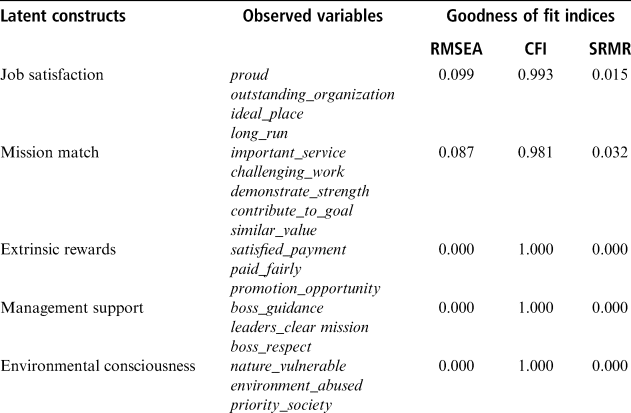
Prior to hypothesis testing, we performed structural equation modelling to assess the overall fit of the proposed measurement model (see Table 4).Footnote 58 Modification fit indices were reported as follows: the comparative fit index (CFI) = 0.920, the root mean square error of approximation (RMSEA) = 0.077, and the standardized root mean square residual (SRMR) = 0.06. In general, a theoretical model is considered accurate in capturing the pattern of relationships existing in the data if CFI is at least 0.90,Footnote 59 RMSEA is preferably smaller than 0.06 but acceptable at the 0.08 level for small-scale studies,Footnote 60 and SRMR is less than 0.08.Footnote 61 Based on these criteria, our “theoretical” model fits the observed variables.
Structural Equation Model Estimation

Note:
To conclude that “there is a relatively good fit between the hypothesized model and the observed data,”Footnote 57 the following rules of thumb must be adhered to: RMSEA < 0.06 (<0.08 is also considered acceptable); CFI > 0.90 (preferably >0.95); SRMR < 0.08. Notably, “job satisfaction” and “mission match” have RMSEA values slightly above the cut-off threshold. These results are not gravely troubling, as this particular indicator is highly sensitive to sample size (when N > 200, the chi-square is surely significant, increasing the unlikelihood of gaining perfect RMSEA values).
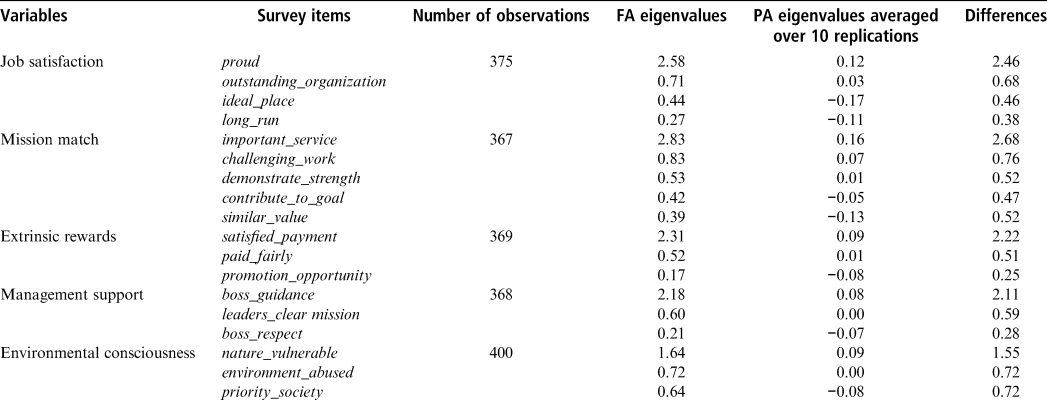
Finally, a parallel analysis was conducted to ensure that redundant dimensions are excluded from each composite variable. Compared to the eigenvalue-greater-than-one rule which “is problematic and inefficient when it comes to determining the number of factors,”Footnote 63 parallel analysis is a more stable approach for determining what factors to retain. Specifically, a factor is considered retainable if its respective eigenvalue is greater than its averaged counterpart obtained from ten randomly generated observations. Table 5 shows the role that each item plays in representing its underlying construct.
Parallel Factor Analysis

Note:
Parallel analysis is a method based on the generation of random variables to determine the number of factors to retain. “Factor was considered significant if the associated eigenvalue was bigger than the mean of those obtained from the random uncorrelated data.”Footnote 62
Empirical Findings
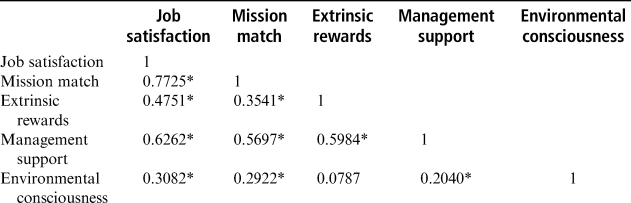
Correlation matrices for all dependent and independent variables are presented in Table 6. The correlations between job satisfaction and all three antecedent variables – mission match, extrinsic rewards, and management support – are significant, indicating that each contributes to the variance of job satisfaction. Given the psychometric nature of our survey instruments, some significant correlations among the explanatory variables were detected, warranting concerns about multicollinearity. To address this potential problem, variance inflation factor (VIF) scores were computed for both regressions, yielding results of 1.69 and 3.89 for the years 2000 and 2014, respectively. According to the most commonly used standard, a VIF score less than ten suggests that multicollinearity is not a serious problem.Footnote 64
Correlation Matrix (2 Time Points, N = 355)

Note:
*Correlation is significant at the 0.05 level (two-tailed).
Descriptive analysis
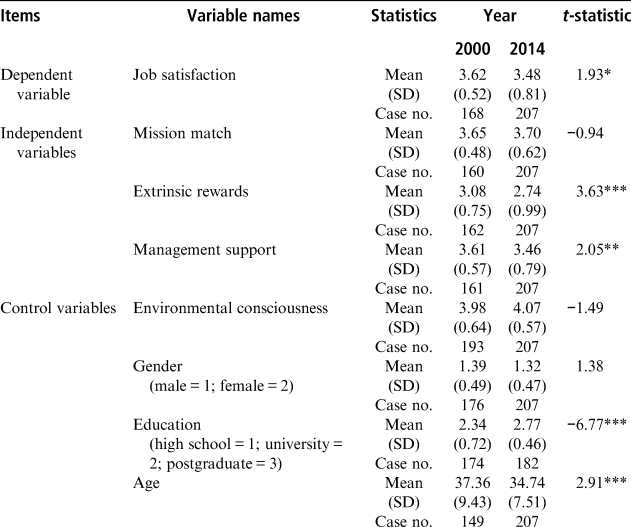
Descriptive statistics for all dependent, explanatory and control variables in both years are detailed in Table 7.
Descriptive Analysis: Decreased Job Satisfaction among GEPB Officials

Note:
Variables highlighted in grey are based on Likert-scale questions, ranging unexceptionally from “strongly disagree” (1) to “strongly agree” (5). *p <0.1; **p < 0.05; ***p < 0.01. Significance based on two-tailed tests.
The overall job satisfaction of enforcement officials declined from 3.62 in 2000 to 3.48 in 2014. Taking into account the respective sample sizes, a student's t-test was performed to assess whether a statistically significant difference in job satisfaction existed across the two samples. This test statistic was significant at the one per cent level, supporting our first hypothesis that enforcement officials’ job satisfaction had decreased over the 14-year period. A similar, though more pronounced, tendency was found in the dimension of extrinsic rewards. Enforcement officials’ average rating for this composite measure of three items was 3.08/5 in 2000 but 2.74/5 in 2014. The difference between these two numbers reached the one per cent significance level. Since the numerical value 3 is the midpoint between positive and negative sentiments in the scale, an average score below 3 not only corroborates Hypothesis 5 that GEPB enforcement officials’ satisfaction with extrinsic rewards went down from 2000 to 2014 but also shows the negative emotions generated by this downward trend.
Regression results
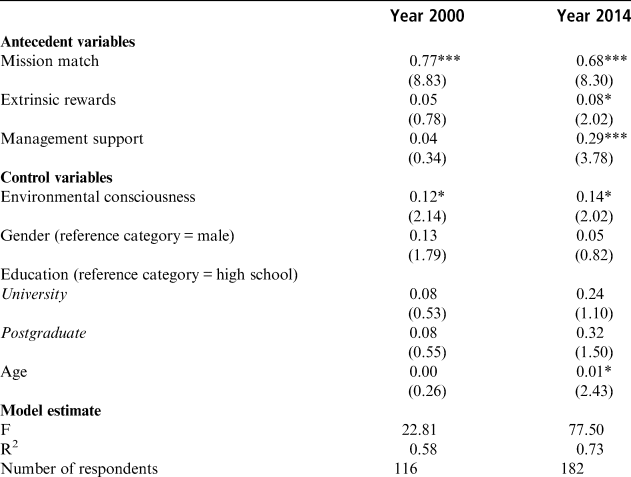
Regression outputs are shown in Table 8. The R2 values for both regressions are above 0.5, suggesting that a substantial portion of the variance in job satisfaction can be explained by the proposed factors that include mission match, overall contentment with extrinsic rewards, and the presence of supportive managers. Specifically, mission-matched respondents were more likely than their mission-mismatched counterparts to report higher job satisfaction in both years (supporting Hypothesis 2). In addition, Hypotheses 4 and 6 are partially supported given that the coefficients for extrinsic rewards and management support were statistically significant only in 2014.
OLS Regression Results: Job Satisfaction on Antecedent and Control Variables

Notes:
All entries are variable coefficients with t-scores in parentheses. Breusch-Pagan tests were performed for both regressions. As the resulting test statistic was 20.67 (chi-square distribution with 8 degrees of freedom) for the year 2000 and 40.57 (chi-square distribution with 8 degrees of freedom) for the year 2014, the null hypothesis of homoscedasticity was rejected for both models. To account for heteroscedasticity, robust standard errors were computed for inference by using the Huber-White sandwich estimator of variance. In each regression, the sample size is reduced due to the omission of cases involving missing data.
*p<0.05, **p<0.01, ***p<0.005.
Interaction effect of mission match and time on job satisfaction
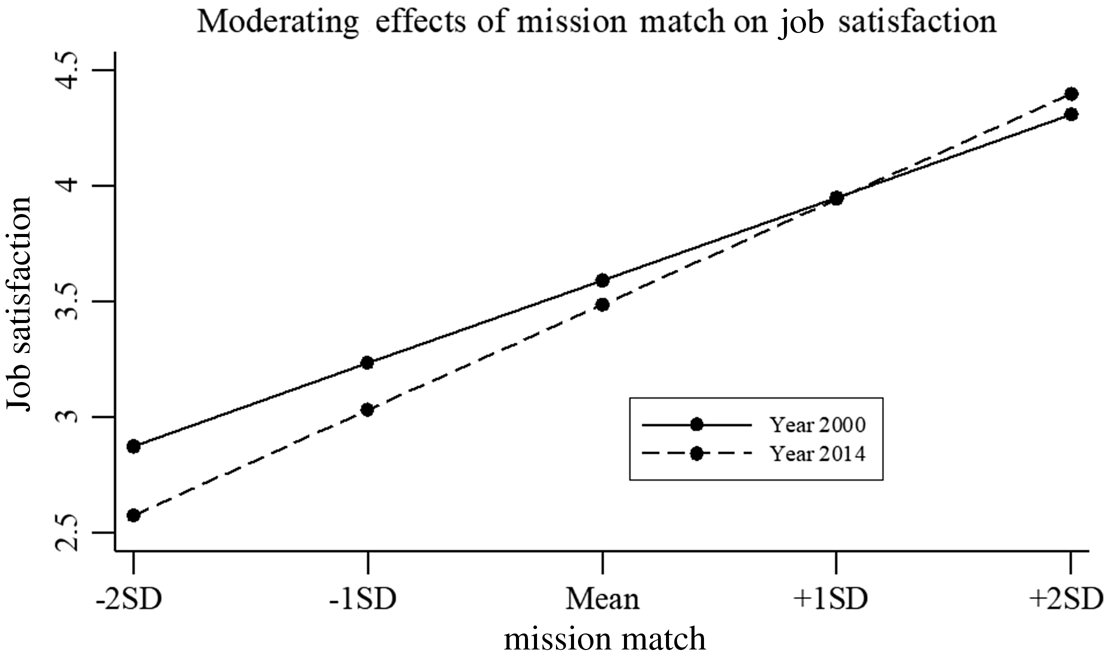
Since we only possess repeated cross-section data,Footnote 65 a good approach to estimating possible changes over time is to “think of time as a variable that moderates the effect of X on Y. Instead of using time as the basis for differencing, we include time in the model as a variable and interact it with the variable(s) of interest.”Footnote 67 If the slope for the interaction term is statistically significant, this suggests that the strength of the correlation between X and Y varies at different times.
Hence, we created a binary time variable t, which equals 0 and 1 in years 2000 and 2014 respectively, prior to appending the datasets in STATA.Footnote 68 In the merged file, we generated an interactive variable between mission match and time. Job satisfaction was regressed on all variables of interest plus the interaction term (see Table 9). Both the interaction term and time were statistically significant at the five per cent level. Specifically, 1) the coefficient for time was negative, indicating a declining trend of job satisfaction between 2000 and 2014; and 2) the interaction term had a positive coefficient, indicating the increasingly important role mission match played in affecting job satisfaction among enforcement officials between the two years.
Differential Effects of Mission Match on Job Satisfaction across Time

Note:
*p<0.05, **p<0.01, ***p<0.005 (two-tailed).
Since the appended dataset cannot guarantee that the same individual units are observed over time, three control variables (age, gender and educational level) are excluded here.Footnote 66 Entries shown for the variables are regression coefficients from ordinary least squares (OLS) with robust SEs in parentheses.
Many underlying factors may account for the results. Compared to 14 years ago, individuals are now living in an increasingly interconnected and globalized world filled with more challenges, uncertainties and opportunities. Particularly for public employees who are mostly well educated, far-sighted and marketable, there are many options other than their government jobs.Footnote 69 Our two surveys indeed captured an overall increase in educational levels of local enforcement officials in city G. In both surveys, “secondary school” was coded as 1, “college/university” as 2, and “postgraduate” as 3. The average in the 2000 survey was 2.3, while that in the 2014 survey was 2.8. The difference is statistically significant at the one per cent level.
With higher levels of education, enforcement officials also have heightened expectations on the quality, utility and meaningfulness of their chosen option – a government job. These expectations can be a double-edged sword.Footnote 70 For instance, if public employees realize that the organization's mission is incompatible with their personal plans and aspirations, they are likely to become more dissatisfied. The same logic can be applied to the Chinese context. In contrast to their counterparts 15 years ago when government jobs were probably considered an ideal placement, enforcement officials in 2014 had a variety of irons in the fire and tended to be more adamant about devoting themselves to value-congruent and socially impactful careers.
Figure 1 visualizes how time moderates the correlation between mission match and job satisfaction. The line depicting the relationship between mission match and job satisfaction in 2014 is steeper than the one in 2000, supporting Hypothesis 3.
Interaction Effect

Discussion and Conclusion
Against the background of increasing political and societal demand for bureaucratic accountability, local public officials in China are often viewed by the public as free riders, the privileged few or bureaucratic parasites.Footnote 71 Public opinion surveys have shown repeatedly in recent years that the public perceived the central government as comparatively trustworthy often due to the belief that central leaders were “well-meaning but totally incapacitated” while local officials were the ones who sabotaged well-meaning policies from above.Footnote 72
While often perceived by the public as the cause of policy failures, local officials are themselves increasingly frustrated. This phenomenon was particularly pronounced among officials in top-tier cities, in which an increasing number of high-ranking officials resigned from their relatively powerful positions to seek private employment.Footnote 73 Although many factors may account for this tide of departures, monetary considerations are definitely high on the list. As Zhu explained, taking into account their educational qualifications and work experience, local public-sector employees in China are generally underpaid.Footnote 74 Particularly for those who reside at the bottom of the pyramid, their salaries are not even remotely commensurate with their years of hard work and contribution. The 2015 civil service reform (Gongwuyuan zhidu gaige 公务员制度改革) did further the goal of guaranteeing a pay rise for public employees. Unfortunately, after accounting for adjustments in pension plans and pre-tax cut-off rates, this pay hike scheme eventually resulted in a nominal increase of a few hundred yuan only.Footnote 75
As more and more discouraging information becomes evident, one may begin to wonder if the portrayal of depressed Chinese public officials reflects reality. Drawing on data from two rounds of surveys, we found that job satisfaction of enforcement officers serving in GEPB declined from 2000 to 2014. This decline in job satisfaction can be partly seen as an unintended consequence of institutional reforms in recent years. For example, the implementation of the tax-assignment system (fenshuizhi 分税制) severely crippled the fiscal capacity of local governments, whose resultant reliance on land-based finance arguably contributed to the housing price bubble that has lasted into the present day.Footnote 76 The subsequent state-owned enterprise reform (guoyou qiye gaige 国有企业改革), which abolished subsidized housing in the early 2000s, added fuel to the fire by reducing substantially the total compensation packages available to local public officials. Other institutional reforms – such as increasing the accountability for bureaucratic performance and providing convenient channels for citizen complaints while limiting the size of the bureaucracy and official compensations – have created a different work environment for many local government officials. The building of a more professionalized government bureaucracy also has its unintended consequences. In addition to being disappointed about extrinsic rewards, the younger breed of government officials has become more concerned with the extent to which their professional and social values are compatible with their agency's goals and missions. Together, all these changes call for a new type of public-sector leadership that can 1) recruit officials with a higher mission-match potential; 2) adopt a transformational style of leadership to foster mutual trust and work motivation among employees; and 3) provide salaries at a competitive, locally adjusted level.
This study has several limitations. First, the quantitative analyses are based on data from questionnaire surveys, which are subject to self-reporting and common-source biases.Footnote 77 Second, because of the anonymity of the two surveys, we are not able to trace whether there have been changes for the same individuals who might have participated in both surveys. Another limitation is that our study examined the job satisfaction of officials in city G, one of the most economically advanced cities in China. It remains a puzzle as to whether the same set of changes has happened to local officials in less economically developed regions of the country. Finally, our study focused on officials responsible for environmental regulation enforcement, which involves specialized technical and professional knowledge. This may partly explain our results regarding the changing correlation between mission match and job satisfaction. Similar research needs to be replicated in other areas of bureaucratic operations to fully test our theoretical arguments.
In conclusion, although there is a sizeable literature examining sources of job satisfaction in the public sector, few studies investigate this very issue in China. As the most populated country in the world, China has an estimated 50 million public-sector employees working in government agencies, state-owned enterprises and service organization units (shiye danwei 事业单位).Footnote 78 Neglecting their emotional well-being would be a grave policy mistake. This paper thus fills a literature gap in that it not only looks into the black box of the inner world of Chinese civil servants, but also gets a foothold in the discussion about the changes in these public employees’ job satisfaction over time and the possible reasons contributing to such a trend. Future scholars and relevant policymakers need to consider strategies for forging a more satisfied, productive and accountable public workforce.
Acknowledgements
Research for the article was funded by the project “Reforming service organizations in China: a longitudinal and cross-jurisdictional study” through the Research Grants Council of the Hong Kong Special Administrative Region (RGC no. PolyU5476/11H). Special thanks also go to the editor and two anonymous reviewers for providing thought-provoking comments on an earlier draft of this paper. All remaining errors and oversights (if any) are the sole responsibility of the authors.
Biographical notes
Bo WEN is assistant professor in the Department of Public Policy at City University of Hong Kong. His primary areas of study are public management, organization theory and behaviour, institutional analysis, policy implementation, and Chinese politics.
Shui-Yan TANG is the Frances R. and John J. Duggan Professor of Public Administration in the Sol Price School of Public Policy at the University of Southern California. His research focuses on institutional analysis and design, common-pool resource governance, and collaborative governance.
Carlos Wing-Hung LO is professor and head of the Department of Government and Public Administration at the Chinese University of Hong Kong.