For Dmitri Shostakovich, reaching the heights of the Soviet musical establishment proved easier than staying there. He triumphed with his Fifth Symphony of 1937, the Stalinist equivalent of a hit record. Its premiere and subsequent rise, metaphorically speaking, to the top of the Soviet charts marked the composer's return to official favour after the scandalous denunciation of his second opera, Lady Macbeth of the Mtsensk District, and third ballet, The Bright Stream, in the pages of Pravda, the newspaper of the Central Committee of the All-Union Communist Party (Bolsheviks).Footnote 1 In Soviet music, politics inevitably played a role in distinguishing successes from failures, and Shostakovich's career, like his posthumous reputation, was politically over-determined. (His chief rival in this context was the formalist arriviste Sergey Prokofiev.) The cultural establishment ensured that the musical superheroes attracted more praise – as well as animus – than mere mortals. Because Shostakovich headed the legion of superheroes, his career see-sawed: one work was glorified, another pilloried. The sequel to the Fifth was bound to be a let-down.
Having recovered from the fallow period that followed the premiere of the Fifth Symphony, he spoke about finally getting down to composing an opera based on Mikhail Lermontov's 1835 play Masquerade, to be completed for the centennial in 1940 of Lermontov's death.Footnote 2 Instead, he honoured another canonic Russian composer by embarking on a re-orchestration of Modest Mussorgsky's opera Boris Godunov. Shostakovich was elected to the Leningrad City Council, and confirmed as a professor of composition at the Leningrad Conservatoire. He had a toddler as well as a newborn at home, and Wendy Lesser interprets his First String Quartet in C Major, composed and premiered in 1938, as ‘a route back to his childhood’.Footnote 3 The sketches for the quartet include two blocks of music that ended up in a brooding movie score, The Man with the Gun (Chelovek s ruzh'yom).Footnote 4 As the go-to composer for the Lenfilm studio, Shostakovich wrote music for three other full-length films during this period,Footnote 5 and for a 1939 short colour cartoon called The Silly [or Stupid] Little Mouse (Skazka o glupom mïshonke). The Song and Dance Ensemble of the secret police (NKVD, the People's Commissariat for Internal Affairs) was established in the fall of 1939, and Shostakovich soon joined the collective, providing light patriotic music for NKVD-produced spectacles.Footnote 6 He was considered for (but not eventually named to) the committee tasked with planning the 1940 centennial of Tchaikovsky's birth.Footnote 7 And from January to October of 1939, he worked on the Sixth Symphony.
After several partial and complete closed-door hearings, Yevgeny Mravinsky conducted the premiere of the Sixth Symphony on 21 November 1939, in Leningrad as part of the third festival, or dekada, of Soviet music.Footnote 8 Also featured were chamber, vocal, and orchestral works by composers from Russia, Ukraine, Belorussia, and Georgia – from east to west, north to south, of the Union. Prokofiev's Alexander Nevsky (1938) was performed along with Yury Shaporin's Na pole Kulikovom (On the Field of Kulikovo, 1939), Vladimir Shcherbachyov's Peter I (1939), and Marian Koval's Yemel'yan Pugachyov (1939). Music of a more charged political character included Aram Khachaturian's tribute to Stalin on the occasion of his sixtieth birthday, ‘A Poem about Stalin’ (‘Poema o Staline’, 1939), and Vano Muradeli's Symphony No. 1 (1938), ‘To the Memory of Sergey Mironovich Kirov’.Footnote 9 The programmatic works in the dekada collapsed the centuries, linking Holy Rus, the Rurik and Romanov dynasties, and the Soviet era. Monumental opuses celebrating the heroes of yesteryear, their achievements, and their sacrifices, were heard along with soaring cantilenas about the ‘epic’ heroes of the present – Stalin and Kirov among them. But not, as it turned out, Lenin.
Without the comparison to the symphonies that preceded and followed – the triumphant Fifth and blockbuster Seventh, the ‘Leningrad’ Symphony – perhaps the Sixth might have been considered a modest success. But it was not, for the reasons described by Georgy Khubov, deputy editor of Sovetskaya muzïka, in his Pravda review. He opened by questioning whether expectations had been met. Did the composer retrace the path laid down in 1937, or might he have extended it, producing a symphony ‘more significant’ than ‘the inspiring pages’ of the Fifth, closer ‘to the feelings and thoughts of the Soviet people, alive and exciting’. Khubov's answer: no. The Sixth was ‘a step not forward, but back’.
The protracted, monotonous first movement is perplexing from the get-go. This is not a simple man's true sorrow; rather, the music pretends to philosophical depth, ‘Weltschmerz’, in the composer's soul. But after his ‘one-note’ philosophical debate Shostakovich suddenly returns to the old chest from which a familiar toy pops out: a garrulous, elegant, and empty scherzo. That is the second movement. Why? What is the meaning of this musical somersault? But the listener hears no answer to this question even in the symphony's third and final movement, which is scored with exceptional virtuosic brilliance, but poor in content. Brilliant technique does not serve the lofty aims of art in Shostakovich's Sixth Symphony. At times, in the finale, it becomes an end in itself. Such brilliant ‘coquettishness’ by means of virtuoso technique can, perhaps, elicit a smile, amuse a little, create a laugh, but it can hardly entice, enthrall, or excite. Some say that the Sixth Symphony is a ‘complex’ work. Other critics are even inclined to conceive of the complexity in terms of a Soviet symphonic ideal. This is a profound mistake. Narrowness and mannered ‘complexity’ speak not to the artist's unique, diverse ideas and feelings, but to his estrangement from lived reality. He should refrain from ‘complexity’, from complication, and the sooner the better.Footnote 10
Khubov implies that the composer had not even lived up to the standards of his former self. He was a caricaturist before, but at least the music made some sense. As an old-school proletarian musician and a propagator of lighter musical genres, Khubov might be expected to express hostility towards the symphony.
But other critical appraisals read more or less the same.Footnote 11 A follow-up review in Sovetskaya muzïka both repeats Khubov's points and challenges them. The Sixth Symphony ‘rightly disappointed’ most in the audience owing to the absence of ‘a grand, integral idea’, the unidentified author comments. Bereft of inspiration, Shostakovich defaulted to recycling: ‘The repetition of devices from the Fifth Symphony in somewhat depleted form offered no pleasure.’ Still, the reviewer adds, ‘it would be wrong to subject all of the music in the symphony to unconditional defamation: The best episodes, the finale in particular, delight in the glossiness of their presentation, the iridescence of colours, the infectious cheerfulness. So there is no reason to put the positive qualities of the Sixth Symphony in scare quotes, as some comrades [e.g., Khubov] do.’ Reviewing the reviews, Dmitri Kabalevsky complained about the ‘danger’ of comparing the Fifth and Sixth Symphonies, given their fundamentally different conceptions. He does not offer his own analysis, but chides his peers for denouncing the Sixth as a ‘formalist wasteland’. He allegorizes the contrast between the burdened-sounding first movement and the faster, giddier second and third movements: ‘This striking contrast, the contrast between the two poles of the emotional state of the human soul, is expressed by Shostakovich with striking colours and, in the main, new means, and this is the cause of the disputes about the symphony.’Footnote 12
Levon Hakobian identifies another cause: the lack of drama that sonata-allegro opening movements tend to provide. Hakobian points out, unhappily, that the Sixth earned the reputation of a ‘headless’ work – a second, third, and fourth movement without a first.Footnote 13
The reviews perpetuated the cycle of sin and redemption, redemption and sin that plagued Shostakovich's career after 1936. Another analogy comes to mind: falling off the wagon, politically speaking. The Fifth Symphony had been celebrated as proof that the composer had conquered his demons, but he had then reverted to dissolute type, taking to the bottle once again. These narrative tropes require rethinking, however, to consider more carefully not only the reactions to the Sixth, but also the decisions before the symphony was even set to paper.
In beginning his new work, Shostakovich faced the choice of successful artists everywhere: repeat, refute, or re-inscribe. Yet certain options, in this specific context, could not be entertained. He had withdrawn his Fourth Symphony from rehearsalFootnote 14 following the Pravda denouncement and considered it unwise to revisit its ‘grandioso-mania’.Footnote 15 His earlier symphonies predated the establishment of the Committee on Arts Affairs (Komitet po delam iskusstv/KDI) and the reactionary turn in Soviet musical culture; he could not model the new score on his, or his peers’, output of the pre-KDI era. Critics of the period expected the Sixth to be another Fifth, but the question remained as to the appropriate degree of separation, or whether the new score should be something else altogether. No path seemed clear.
Shostakovich first thought about going big with his new project, composing a massive score about Lenin, then decided to go small, grounding the first movement in folk fare and mixing light genres in the others. He funnelled a diverse collection of materials into a disorienting three-movement assemblage that has no plot, no obvious point, and no overarching design. The conformist Soviet musicologist Ivan Martïnov thus lamented the ‘absence of a unifying principle and the essential impoverishment of the ideas and emotional content of the symphony (the second and third movements in particular)’, but believed that the material merely awaited further exploration. The score at present was a draft, a ‘sketch’, he claimed. He hoped that Shostakovich would end his ‘search for new paths’ and return to ‘the artistic positions’ he had earlier ‘fought for’, meaning ‘the grand, full-blooded art’ of the Fifth Symphony.Footnote 16
Shostakovich did not, and instead created a score whose parts do not add up to a whole.Footnote 17 The Sixth has no ‘unifying principle’, as Martïnov notes, and presumably was not meant to. It collapses boundaries, both semantic and syntactic, pulling them back from a fixed state (Shostakovich's intended majestic musical narrative) into a play of possibilities. Hence the misalignment the critics never tired of maligning; hence the sketchiness.
But why? Consider again the precedent he had set for himself. The Fifth Symphony may have been a huge success, but at what cost? Shostakovich went through a tumult so extreme as to form the core of all histories of Soviet music. His denunciation and vindication thanks to a heroic socialist-realist symphony became a parable in his time and ours, the most gripping chapter in music appreciation textbooks. The ruptures in the composer's career – as in his country – were real. No wonder he seemed confused between 1937 and 1939, changing his mind about his tvorcheskiy protsess (creative process) and contradicting himself in his official pronouncements. Such was the problem of the sequel, the Sixth: What is to be done? What happens when an artist grows disenchanted with the artistic method that he took to easily, but that no longer provided stimulus?
In his bewilderment, which is our aporia, he considered going big, then going small, and ended up going, as it were, not at all.
Option 1: going big
According to Shostakovich's biographer, Laurel Fay, Shostakovich ‘announced in late September 1938 that he was anxious to get down to work on his Sixth Symphony, a monumental composition for soloists, chorus, and orchestra employing the poem “Vladimir Ilyich Lenin” by Mayakovsky’.Footnote 18 There existed another such setting, a 1931 symphony-oratorio by Vissarion Shebalin, which had been performed in 1933 with musicians from the Bolshoi Theater. Shebalin and Shostakovich were ‘chums’,Footnote 19 and Shostakovich would have known this score. There are three movements, moving from struggle, through revolution, to utopian triumph. The orchestra is heard alone in the first movement, churning through a fugue; chorus, solo singers, and a reciter enter in the second and third movements. The influence of nineteenth-century ‘Russian Classics’ like Borodin can be heard, along with Beethoven (the Fifth and Ninth Symphonies).Footnote 20 Shebalin took the text exclusively from the prologue to Mayakovsky's poem.Footnote 21 Shostakovich acknowledged the challenge of setting this poem to music, and perhaps had Shebalin's partial effort in mind.
Despite generating some sketches for the project, Shostakovich found himself stuck. He decided that Mayakovsky needed company, and considered including other examples of Leniniana. Curiously, he suggested that the project would absorb advice that he had received from fans of his music, although the relevant letters have not been located. ‘I am carefully studying tributes to Lenin by other Soviet poets’, Shostakovich explained in an interview published in Sovetskoye iskusstvo:
To be specific, I have already picked out several poems for my composition by the national poet of Daghestan, Suleyman Stalsky, and the national poet of Kazakhstan, Jambul. Recently I have received several dozen letters from different parts of the Soviet Union from people of the most diverse professions, who are giving me advice and expressing their wishes about the contents of the future symphony. The most valued advice I have received from my audience is to make broader use of our folklore. All the letters are unanimous in their desire to help the author create the most vivid and multifaceted image of Vladimir Lenin.Footnote 22
In a related article published in Literaturnaya gazeta, Shostakovich mentioned another source, The History of the Communist Party of the Soviet Union (Bolsheviks): Short Course.Footnote 23 Shostakovich (or his ghostwriter) could not avoid mentioning it in notes about his creative plans: ‘I am tremendously helped in my work on the Sixth Symphony by the book on every Soviet person's, every Soviet intellectual's tabletop.’Footnote 24 The Short Course, as it is generally known, was published on 1 October 1938, in a massive print run. It highlights the people's support of the party, and the party's support of the people, but, of course, if someone does not believe in the party, they are no longer a member of the people.Footnote 25 Consider the implications of this circular postulate for Shostakovich's project: he did not want to become a non-person, as he had risked being back in 1936. Following the publication of the Short Course, he resolved to align himself, as much as possible, with what the party defined as the folk.
The ‘national poet of Kazakhstan’, Jambul, is the Stalin-Prize winning singer and poet Dzhambul Dzhabayev (1846–1945). An ‘ethnic teller’ of prominence, his ‘transparently eulogistic songs were done up in local traditional style, featuring God-like leaders bathed in national idioms and figures’. In 1937, he published a poem in Pravda about the People's Commissar for Internal Affairs Nikolay Yezhov, an overseer of the purges.Footnote 26 Suleyman Stalsky (1869–1937) escaped a hardscrabble existence (born in a stable, orphaned, eking out an existence as a peasant labourer and, after the Revolution, as a collective farmer) to be named a People's Poet of Daghestan and receive the Order of Lenin. His invented last name, like Stalin's, comes from the Russian word for steel. He arrived in Moscow wearing a noisome sheepskin coat, a thick beard, and big hat that he rarely removed. In 1934, Maxim Gorky introduced Stalsky at the First All-Union Congress of Soviet Writers in Moscow as the ‘Homer of the twentieth century’, an exaggeration that simply suited Gorky's agenda: the creation of ‘new’ folklore as a ‘weapon of class conflict’.Footnote 27 The two poet-singers – one from the steppe, the other from the highlands – attracted Gorky's attention, as did the other ethnic bards who had been elected to the presidiums of the writers’ congresses in the diverse regions of the Soviet Union that still bore the traces of Arabic, Turkish, and Persian traditions.
The official press represented Dzhabayev and Stalsky as ageless wonder-workers who had apparently transcended illiteracy. Yevgeny Dobrenko comments that the ‘originals’ of their poems and songs cannot be located; perhaps they never existed in the first place, though anecdote has cotton-producers and liquorice-root extractors gathering round to hear them sing for hours. Dobrenko recoils from these tales, focusing instead on the later agitprop, the deluge of metaphors and hyperbole in Dzhabayev's and Stalsky's odes to Soviet power. The publications attributed to them in their later years were commissioned and communicated, transcribed, and translated by others. There are anachronisms in the output, attributions made ‘30–50 years’ after the fact. Authentication is further complicated by the absence of diaries, sketches, and letters; difficulties accessing their publications in the ‘peripheral press’; and the mutilation of archives during the purges. Certainly Dzhabayev and Stalsky existed, but just as surely they could not have produced all of the texts credited to them. Dobrenko, accordingly, describes the repertoire as a ‘literature without authors’ and a ‘literature without readers’.Footnote 28
Pravda quoted Stalsky about his craft as follows: ‘Like sheep to the shepherd and trees to the forester, readers are the toil for us poets. It might be unfortunate that I can't write, but the birds help create my songs.’Footnote 29 Like Pope Gregory or Saint Fevroniya of Murom, a heroine of Slavic legend, Stalsky claimed divine natural inspiration for his chants. But the assistance he received more likely came from the agitprop division of the Central Committee of the All-Union Communist Party (Bolsheviks). And the ‘readers’ of his poems, the hearers of his songs, were not shepherds or foresters or residents of the place of his birth, the Lezghin village of Ashagastal in southern Daghestan near Kasumkent. They were Russians.
Shostakovich announced that he had ‘picked out’ several of Dzhabayev's and Stalsky's poems for his symphony, but there is not much difference between them. The folk arcana in the poems are stock in trade: so too the effaced ethnic exotica. In the songs about Lenin, the focus is consistent. The singer gathers his audience around (‘Of Lenin I will tell, listen ye’), then refers to the fall of the last Tsar and the storming of the Winter Palace before taking up the matter of class warfare:
‘Folklore does not need an author’, Dobrenko comments at the end of his deconstruction of the Dzhabayev-Stalsky phenomenon. Invented folklore, he adds, is an oxymoron.Footnote 31 For Shostakovich, the fakeness of the folklore was more positive than negative.Footnote 32 Of chief importance was the political function of the texts, not their authorship or authenticity.
It can never be known how a symphonic treatment of the paeans to Lenin like the one quoted above, combined with Mayakovsky's idiosyncratic, experimental poem, sprinkled with ‘advice’ Shostakovich received from letter-writers, would have been received by the censors of the KDI. Prokofiev had tried something similar in his Cantata for the Twentieth Anniversary of October (1937). The mash-up of quotations from Marx, Lenin, and Stalin in that gargantuan score provoked the censors, who decried Prokofiev's bombastic, hubristic excesses. He resisted redoing it, and the cantata was banned.Footnote 33 Shostakovich's proposed mega-symphony had better prospects, even if, in the end, he put the project aside. Perhaps conscious of Prokofiev's experience, he chose not to quote (as Prokofiev imprudently did) from Lenin's actual words. The KDI could not have accused him of tampering with holy writ. Censor-approved fake-lore was, for him, and for Prokofiev in the future, the safer bet, and the topic – Lenin's omniscience – never fell out of fashion in his lifetime.
Indeed, Shostakovich stuck with his plans for a Lenin Symphony even after he chose another route for the Sixth, a score that, unlike the poems credited to the poet-bards, remains impervious to a single interpretive model. Among the oddities in Shostakovich's career are his repeated public announcements that he was beginning, or about to begin, a symphony about Lenin. He talked about this project with his peers between September 1938 and March 1941, as though he knew he had it to do it, and intended to do it, but could not quite get it done. The project kept being pushed to the backburner, prompting commentators to speculate that his words on the subject were good for nothing, an ‘alibi’ that got him out of composing a piece in honour of Stalin's sixtieth birthday in 1939, as Prokofiev, Khachaturian, and others ‘volunteered’ to do.Footnote 34 Olga Digonskaya has explored this subject in meticulous detail and stresses that the absence of musical sketches for the planned ‘Lenin’ symphony does not prove a fib. The symphony was sincerely conceived; Shostakovich intended to compose it, and if he said he had outlined some thematic material he probably did. He might have thrown the draft materials out, for example, and his housekeeper might not have rescued them from the trash, as she had been instructed to do by the composer's friend and benefactor Levon Atovmyan. Or, Digonskaya speculates, sketches might exist but have not yet been identified as part of the Lenin project.Footnote 35 Even if Shostakovich was spinning a tale in the Soviet press, there was no reason for him to spin it to his peers, who heard about his struggles with the Lenin project during a talk he gave at the State Literature Museum in Moscow on 24 December 1940.Footnote 36 (The subject of the talk: Mayakovsky, as he had known him.) Eventually, two decades later, Shostakovich did in fact compose a Lenin Symphony of sorts: his text-free Twelfth, which he subtitled ‘The Year 1917’ and dedicated to the Bolshevik leader's memory.
Lenin fell away, as did the poet bards of Kazakhstan and Daghestan, but the Sixth Symphony retains at least an atmospheric connection to Mayakovsky, as first noted by the musicologist Marina Sabinina, who lived the entire Soviet experience and beyond (born 1917, died 2000). She knew Shostakovich, who lived two-thirds of the experience, personally. Mayakovsky's verses about Lenin's death, Sabinina proposes, ‘help to explain the requiem-like character of the first movement, the resemblance in the undertow to a funeral march, and the “surreal” cast of the development, seemingly immersed in distant memories, and – at the beginning of the reprise – the return to harsh reality, to brave, sorrowful thoughts’.Footnote 37 Sabinina adds, however, that the Mayakovsky connection disappears, bizarrely, in the second and third movements.
Like Shebalin, Shostakovich knew Mayakovsky professionally, if not personally.Footnote 38 And like most everyone in the Soviet cultural sphere, he knew that on the morning of 14 April 1930, the poet had pointed a revolver loaded with a single bullet at his heart and pulled the trigger in an act described the next day in Pravda as ‘monstrous’ and ‘incomprehensible’. The newspaper's writers insisted, however, that the suicide had nothing to do with political or artistic matters, but stemmed from ‘a long illness, from which the poet had not completely convalesced’.Footnote 39 According to his muse Lily Brik, ‘the idea of suicide was like a chronic disease inside him’.Footnote 40 Quarrels with his lover, denial of a travel visa, and, chiefly, merciless heckling at readings of his poems only exacerbated his depression. The flaming experimentalism and progressivism of the 1920s, when Mayakovsky rose to fame as a leading Futurist, had been extinguished for good. The Russian Association of Proletarian Writers (RAPP) demanded a return to classical (later: socialist) realism in literature. No more abstraction; henceforth, accessible writing for the masses. Mayakovsky's final composition – the suicide note he wrote two days before he pulled the trigger, with its assertion that ‘the heart yearns for a bullet’ – became for scholars of Russian literature a ‘model’ of its morbid type.Footnote 41 ‘Seriously’, he wrote at the end, ‘there's nothing to be done – goodbye’.Footnote 42
Thus his answer to a question posed by an earlier socialist writer, Nikolay Chernïshevsky, in his 1863 novel Chto delat’? (What is to be done?). The question was asked too, albeit rhetorically, by Vladimir Lenin in a 1902 political pamphlet of the same name, Chto delat’? Lenin's answer, of course, was the Bolshevik elimination of the Russian provisional government in autumn 1917. The dream of revolution, for Mayakovsky, ended with the establishment of RAPP and other hard-line cultural organizations. He did not conform; he resisted demands that he undergo ideological re-education for what Lenin called – referring to a poem about a Russian peasant with 150,000,000 heads doing battle against Woodrow Wilson – his ‘hooligan-communism’.Footnote 43 He escaped in death, and might have been forgotten altogether had not Stalin, in 1935, declared Mayakovsky ‘still the best and the most talented poet of our Soviet epoch’ when Brik protested the besmirching of the poet's reputation by his antagonists. ‘Indifference to his cultural heritage is a crime’, Stalin added.Footnote 44 With this endorsement, Mayakovsky became an instant classic; his poems and plays reappeared in print, and he entered the curriculum of Soviet schools (topics included ‘Mayakovsky in the struggle with bourgeois-decadent poetry’ and ‘Mayakovsky in the struggle against religion’Footnote 45). His statue stands in the centre of a major square in Moscow, atop the metro station that bears his name.
Mayakovsky's nonsensical, surrealistic non-poems, which randomized syntax and broke apart rhythmic patterns, find their ideal analogue in Shostakovich's early music. Composer matched poet in aligning the high and the low, privileging noise, and breaking apart familiar forms. Perhaps Shostakovich suffered similar disenchantment as Mayakovsky (without the suicide) when the creative unions and the immense syncytium of the Committee on Arts Affairs came into existence in the mid-1930s. The KDI decided what artists had to do, but boasted of acting on their behalf, responding to their wishes for less abstraction and more living human content in art. In this formulation, the Fifth Symphony was not coerced, but Shostakovich's ‘practical creative answer’ to the ‘just criticism’ he had received for his opera and ballet.Footnote 46 The situation he found himself in recalls Franz Kafka's famous parable about accommodation: ‘The animal snatches the whip from its master and whips itself so as to become master, and does not know that all of this is only a phantasy caused by a new knot in the master's whiplash.’Footnote 47 With the Sixth Symphony, the accommodation, the self-whipping, appeared to continue, although it will never be known if his ‘correctness’ was partly or wholly ‘ceremonial’. Was the setback he suffered in 1936 with his opera and ballet so extreme that he was engaged in a cycle of ‘imagined wrong-doing and atonement’?Footnote 48 There are no answers, only facts. Shostakovich announced that he would be setting his selection of texts about Lenin: Dzhabayev's and Stalsky's fake-lore, and Mayakovsky's turbo-fake-lore, the epic poem he wrote about Lenin in 1924, the year Lenin died.
At 1,087 lines long, in two parts, the poem has been interpreted as an agitprop version of a bïlina, or starina, an epic narrative form combining fact and fable about heroic days of yore. Nikolay Rimsky-Korsakov's 1896 opera Sadko models itself on the genre, and perhaps Shostakovich imagined archaic intonations of the bïlina informing his Sixth Symphony. In Mayakovsky's poem, Lenin emerges as an epic hero whose cause did not die with him. The ‘grieving’ fictional narrator of the poem ponders aloud ‘not only how Bolshevik Russia can pursue the fallen leader's lead, but also whether and how a leader ever deserves to emerge in a Marxist, collectivist society’. Dale E. Peterson, whom I quote here, notes that, from the start, Mayakovsky stratified his text, placing it in the past and the present at the same time. As per Peterson's translation, the opening lines read: ‘IT'S TIME – and I begin the tale of Lenin to tell. / But not because the grief could not be greater. / It's time because the sharp anguish / has become a clear and conscious ill. / It's time, and again Lenin's slogans are a whirl … / Lenin right now is more alive than the living.’ Lost in translation is the impassioned insistence of these words, which Peterson describes as converting ‘commemorative time to processional time’.Footnote 49
With the death of the Bolshevik leader, a myth was born. Soviet schoolchildren recited the words ‘more alive than the living’ on anniversaries of Lenin's death, while also learning about Lenin's personal qualities (‘Lenin was never late’, for example) and intellectual heft. In the second part of the poem, the pamphleteer who improvised the overthrow of the government of the largest nation on earth becomes the Supreme Soviet Being. According to Peterson, ‘If the first canto recites the Marxist prehistory which gives birth to the secular, charismatic leader Lenin, the second canto, not by accident, gives birth to the legendary, wonder-working “Il'ich”, a bogatyr’ whose roots are buried in the ancient loam of Russian folk survivals.’Footnote 50
Mayakovsky refers to events after Lenin's passing was announced. Throngs passed by his coffin in the House of Unions and black drapes were hung in the Bolshoi Theatre while the corpse was installed in a wooden mausoleum on Red Square. Thus the text shifts between past and present, recollection and action, fantasy and reality, lament and march. The plach’ (sob) of the lament and beat patterns of the march are captured in the syntax and layout of the poem, which Mayakovsky intended, from the start, for public recitation. The most pronounced juncture in the poem parallels the organization of Shostakovich's Sixth Symphony. ‘Horrors! Shut your eyes and do not glance’, Mayakovsky writes, ‘as if you were walking the tightrope's wire / As if for a minute face to face / you were alone with a huge, incomparable truth’. Then the change in mood: ‘I'm happy. The flow of a ringing march / bears off my weightless body. / And I know, now and forever more / in me this very minute will last.’Footnote 51 Shostakovich achieves a comparable transformation in his symphony, moving from a first movement that includes graveyard music (or, taking into account the flute solo, whistling past the graveyard music) at R23 into a more buoyant scherzo and galop. Yet the juxtaposition is less jarring than banal, as David Hurwitz's description of the symphony inadvertently affirms: ‘It follows a totally convincing emotional progression from darkness and desolation, to bittersweet humor tinged with nostalgia to rambunctious high spirits, and does so in about half an hour.’Footnote 52
For Hurwitz, the Sixth is ‘kind’ to its listeners, ‘approachable and appealing’. The dark-to-light narrative he describes is obvious; there are no ciphers, no mysteries to be discovered, no in-betweens, no splits, nothing to fuel a seminar in semiotics. Hurwitz simply encourages us to relax and enjoy the ‘satisfyingly complete’, ‘fresh sounding, never overly taxing’ music.Footnote 53 In his interpretation, published in an ‘unlocking the masters series’ by Amadeus Press, the Sixth gives lie to what another listener calls the ‘uninterestingly enigmatic’ aspects of Shostakovich's music.Footnote 54
From a broader interpretive standpoint, it proves more useful to consider the Sixth Symphony less as a farewell to Lenin than a farewell to Leniniana. Shostakovich would come back to Lenin in later years, but leave theatrics behind. Context matters: 1939 was neither 1930 nor 1924, and the 33-year-old Shostakovich of that especially bleak year was not the 21-year-old Shostakovich of his Second, ‘October’ Symphony, a score that initially included a jamboree of factory whistles. Later he foreswore such effects.
Ultimately, Shostakovich decided against going big. There would be no singers in his symphony, no Mayakovsky, no folk poets, no input from his devotees. As Laurel Fay put it, ‘The relationship between the Sixth Symphony and the “Lenin” symphony [was] severed’ in favour of a strictly instrumental composition in three movements.Footnote 55 Without the fake-lore, the contrasts between the three movements lost even a banal justification, lost even the possibility for being interpreted as self-consciously, hence ironically, obvious in its connection to Mayakovsky's rhetorical pivot. The music instead became eccentric, less like Mayakovsky's epic poem about Lenin than the pro-Communist, anti-Capitalist poem 150,000,000, which Lenin (the real person, not the myth) despised for its caprice.
Nevertheless, reviews of the premiere reveal that eccentricity posed no risk for Shostakovich. Indeed, he was all but expected to compose a symphony that everyone understood they did not understand. Had he pulled out all the stops to pen a massive paean to the founder of the Soviet state, his capitulation would have been perceived as calculated. This was the problem with the Fifth: it showed him falling into line, but he had to make it seem that he had not been hectored into compromise, that he was his own muse. Everyone was pretending: the composer in his contrition, the reviewers in their raves, and the authorities in their delighted surprise that he had done the right thing, establishing the benchmark for his composer comrades in the process.
Option 2: going small
The opposite of going big is going small, and it could be argued that Shostakovich sacrificed his maximalist conception of the Sixth Symphony for a modest assemblage of sketches, drafts, and materials from his notebooks. Bidding goodbye to Leniniana, he turned to bricolage. This was not an unusual procedure for Shostakovich, who assembled his movie scores and music-hall pieces from easily accessible things. Often finding himself overworked, he chose to recycle himself, or to retrieve material intended for one score for use in another.
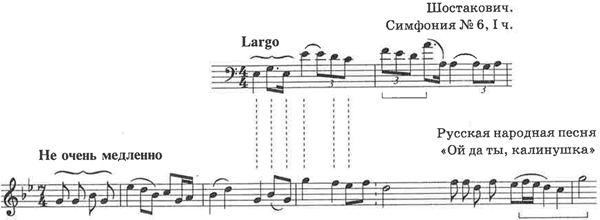
Going small in the Sixth Symphony meant basing an entire movement on a single interval, the minor third, and a melodic gesture he might or might not have extracted from a folksong about a soldier pining for home: ‘Oy, you Kalinushka’. Manashir Iakubov makes this reasonably convincing connection in the 2004 critical edition of the score (Figure 1).Footnote 56
Manashir Iakubov's comparison of the opening of the first movement of the Sixth Symphony and the folksong ‘Oy, you Kalinushka’.

Another possible source for this particular intonatsiya was identified by Ivan Martïnov, who panned the Sixth in 1939 but changed his mind in a 1962 monograph about Shostakovich's ‘interesting but complicated’ career. He points to the opening chorus of Bach's Passion According to St Matthew,Footnote 57 and backs up his claim with the detail that Shostakovich taught the Passion to his students at the Leningrad Conservatoire while busy at work on the Sixth. Martïnov finds no semantic links between the two works, merely likening Shostakovich's contrapuntal procedures to Bach's. Terry Dean, in contrast, discovers an ‘association’ in the two works ‘of the theme of death’. He also hears Tchaikovsky's Symphony No. 6 (the Pathétique) at the start and Chopin's Second Piano Sonata funeral march towards the middle of the movement. There are also Mahler moments. Dean compares the flute solo ‘cadenza’ section at R23–5 to the flute and piccolo duet heard midway through the Im Tempo des Scherzos finale of Mahler's ‘Resurrection’ Symphony.Footnote 58 Thus in his hearing, the movement becomes a procession of tragic motifs, or a sort of symphonic Kingdom of the Shades. Tchaikovsky is heard elsewhere – in the swoon, the attempted plunge to a rocky death implied by the Manfred ‘fate’ theme, for example – but the references to Mahler's textures and timbres predominate, beginning with Mahler's First Symphony. The plucked descending fourth that begins a measure before R14 in the Shostakovich and the cor anglais solo at R14 recalls the ‘Bruder Martin’ section from the third movement funeral march of Mahler's First. In particular, the first bar of the solo sounds like a compressed version of the oboe counter-theme introduced in bar 19 of Mahler's symphony. Shostakovich puts metric emphasis on the minor-third leap while Mahler's minor third arrives on the offbeat, but this modification is outweighed by the similarities: the falling fourth, the opening dotted figure, the melodic contour, the timbre. The trumpet theme that begins three quavers before R3 in the Shostakovich mimics the Mahler klezmer-like tune at bars 47–8. The repeat of this tune at R32 is even more striking; the reference is easy to hear despite Shostakovich having tweaked it so that the lower neighbour note is a whole tone rather than a half and the last note falling rather than rising. The ‘Bruder Martin’ and klezmer references reappear almost side by side at the end of Shostakovich's first movement (R33 for ‘Bruder Martin’, R32 for the klezmer).
I hear other references as well. From R8, Shostakovich recalls the opening love sighs and amorous reveries of Prokofiev's Romeo and Juliet. The ballet had not yet been premiered in 1939, but the first and second orchestral suites were played at successive festivals (dekadï) of Soviet music, and Shostakovich could have remembered them. Consider too the harp, striking and holding the pitch E on its lowest string as a death knell effect at R23, recalling Richard Strauss's tone poem Death and Transfiguration.
The echoes of the funereal insist that listeners attach a narrative to the music, whether some generalized notion about death and dying, a more historical reflection on Lenin's tomb, or (recalling Manfred) a mythic quest through the cavernous underworld. These myriad musical signs of death collapse under their own weight, buried beneath the fresh and fertile surface of variations on ‘Oy, you Kalinushka’. The title refers, at the end, to a guelder rose shrub, otherwise known as a snowball tree, originating in China and widespread in Ukraine.Footnote 59 Poets who place flora and fauna at the centre of their craft associate the ‘fragile flakes’ that break off into the air and the ‘fatal petals’ on the ground with aging and death: ‘How many more years, then, have you still got?’ the Hungarian poet Kriztina Tóth asks of the ornamental flowering shrub.Footnote 60 In Eastern European folk fare, it is also a symbol of brides or would-be brides, forsaken maidens futilely awaiting their hero's return: ‘Over his grave, / I shall become a guelder rose’, the Belorussian poet Naścia Sidorka writes in a self-consciously retrospective mode in ‘A Tale of Kalina’, from her collection of poems called Petals (Pialiostki, 2013).Footnote 61 The text of the folksong linked by Iakubov to Shostakovich's Sixth Symphony is standard issue. ‘Don't stand there, don't grow on the steep mountain’, the singer intones, over and over, round and round, repeating words but ending each verse with a different one. ‘Do not let your leaves fall into the blue sea.’ The ensuing circular fillip describes a ship sailing in the sea as the waters bellow. Aboard that ship are two regiments of boyish soldiers, whose captain prays to God for protection while one of the soldiers asks to go home. The captain agrees: ‘Let's go home!’ to the hearth, to mama and papa and the patient maiden too.Footnote 62
Those round and round repetitions, and the assemblage of a little story through the accumulation of images, find their equivalent in the first movement of the Sixth Symphony, a slow movement twice as long as the other two. The first theme or themes (there are two interrelated assemblages, according to Michael Rofe's fine analysis of the movement)Footnote 63 become the basis for a set of variations. The rise and fall of a minor third, octave leap, and the subsequent stepwise descent in the third and fourth bars derive from the guelder rose folksong, line A1. The line involves, at the start, two minor third sequences. The other line, A2, relies on the minor third of D♭–B♭ to bring us to a cadence at R2, a tritone away from where we began. Neither the opening E minor nor this B♭ minor represents the home key of the movement. R4, R29, and the concluding cadence establish B minor as the tonic. The ‘off-tonic opening’, in David Fanning's assessment (echoed by Terry Dean), has an antecedent in Tchaikovsky's Pathétique, which established the symbols Shostakovich uses to represent impending fate – ours not his.Footnote 64 Beginning the movement with a tonal mis- or re-direction is patently Tchaikovskian, as is the dispersal of a tune, in this case a folk tune, through the entire string section. Shostakovich relies on a quasi-fugal elaboration such that no single string or woodwind instrument owns it.
Theme A is heard in eight different variations, and these come at us faster and faster, like the rhymes in the guelder rose folksong. The first four are about a minute long, in Rofe's accounting, and then the timeframe is compressed to about 45 seconds.Footnote 65 R14 introduces what, according to the consensus, is theme B. It is subject to transformations, or Brahms-like developmental variations between R14 and R23. There follows the elaborate solo ‘cadenza’ for flute. Shostakovich moves between symphonic and concerto textures with vocal intonations. The home key of B minor emerges, but not without a struggle: the waves crash against the ship, the captain calls for help. E minor, B♭ minor, F minor, F♯ minor enter and exit the tonal fabric. R29 brings the soldiers and their captain home to B minor, and the rest of the movement stays there.
There is no readily identifiable structure here. Rofe privileges terms such as ‘intra-dimensional’ and ‘multi-dimensional’ as he writes about Shostakovich's symphonies. Much of Rofe's analysis concerns Shostakovich's treatment of tritone dissonances and their resolution. The progression moves from strong to weak in terms of energy levels, although Rofe, following Shostakovich's confidant, the Russian music theorist Boleslav Yavorsky, considers dissonance and consonance less important in terms of the articulation of form than transience versus stasis.
Rofe represents the first movement of the Sixth Symphony as a kind of power grid, at risk of sudden surges and outages, and enriches the discussion that frames his charts and graphs with elements of time-frequency analysis and language taken from atomic particle theory. He includes a picture at the end that resembles a non-sinusoidal waveform, ‘a single, global energy curve’ (Figure 2):
The initial section up to R14 is relatively motivic: thematic cells are in a constant state of flux; contained variations create a sense of focused direction; a symmetrical phrase structure creates order, but this structure also evolves through the shortening of phrase lengths; waves of climactic growth and decay phase across variation boundaries; and the tonal plan is both flowing and directed. The entry of theme B at R14 marks a breaking down of this momentum: thematic process diversifies into an episodic structure; points of tonal stability become less obvious and occur less frequently; change becomes less frequent. This grinding to a halt reaches its end-point at the cadenza: tonal motion completely seizes up; climactic energy flat-lines; and thematic cells are regurgitated without any clear rhythmic or transformational pattern. This is one of the most static soundscapes in all of Shostakovich's output. Progress is slowly re-established as the composer drags the music out of the black hole by brightening the timbre and by successively negating the tritone forces, ultimately re-stating B minor and theme A at R29. Progress is subsequently back on track, as Shostakovich re-establishes clear phrase structures, focused harmonic progression and an overall tonal centricity. It is possible to reduce the movement to a single, global energy curve: a gradual intensification, a descent into the abyss, a partial re-emergence and a final dissipation.Footnote 66
Michael Rofe's ‘global energy curve’.

The reference to black holes is telling, insofar as one of Shostakovich's students, Galina Ustvolskaya, felt that he had fallen into a black hole by resigning himself to ‘Soviet’ music instead of breaking free from its strictures.Footnote 67 Rofe, however, references black holes in a specific interpretive context. He interprets the flute solo ‘cadenza’ section of the first movement, specifically the E–B♭ tritone in the bass, as just this type of void. ‘Light’ cannot escape this musical vortex, though Shostakovich eventually manages to ‘brighten’ the texture and bring the movement to a stable close.
There is a richly imaginative aspect to his discussion of the Sixth Symphony – extending beyond his conception of the first movement as: 1) a damped oscillation motion of up and down and then up less; and 2) a differential equation turned into an orchestral score. Rofe finds golden mean ratios in the Sixth Symphony, and explores proportional time distributions in the musical climaxes. The first movement is about 1.6 times the length of the second and third movements combined, and the ‘cadence’ in the first movement happens about 0.62 of the way through its own length. The ‘stylistic incongruence between movements conceals the underlying durational balance of the symphony as a whole’, he writes.Footnote 68
It is extremely doubtful that anyone in the audience for the Leningrad and Moscow premieres of the symphony in 1939 perceived these hidden designs or appreciated their mysticism. (Nor, for the record, did the reviewer of Rofe's book for DSCH Journal, who belittled Rofe's ‘near obsession with a proportional relationship that is only tenuously present in a handful of Shostakovich's works’.Footnote 69) It is more than likely, however, that audiences would have heard the flows Rofe identifies between the positive and negative, consonant and dissonant ‘terminals’ of the score, the attacks and decays that define and un-define timbre, the tritone polarities, and the power surges in the densest chromatic passages. These aspects of the symphony are easy to hear, even as they defy standard operating procedure.
Yet critics, official and unofficial, focused much less on sonata form contra waveform in their reactions to the symphony than on the non-programme programme. The second movement scherzo has been described as a panorama akin to Alexander Pushkin's 1830 poem ‘The Demons’ (‘Besï’),Footnote 70 with its ‘endless, hideous hordes … pressing / Round us, in the moon's dull light. / Demons whirling, flying, massing, / Like November leaves in flight.’Footnote 71 The movement moves briskly in 3/8 for seven minutes or so. The timpani stumbles around, but there is not one faltering step in the rapid underlying pulse pattern. The first section (R34–51), which inspired the Pushkin comparison, consists of seething, swarming, gliding, weaving tunelets that build, in the middle (R55–66), into an ear-splitting harrowing fanfare of over-blown octaves, fourths, and fifths. The opening section presents three such tunelets, a, b, and c, and two variations, a1 and b1. Besides Pushkin's demons, one could liken the gathering to the ‘quintet’ of citizens in Fyodor Dostoevsky's 1871–2 novel The Possessed (or The Demons), which Shostakovich admired.Footnote 72 Mary McCarthy describes the quintet, which she also labels ‘chords’ and ‘automata’, as ‘possessed of ideas that have lost all powers of thought, which may seem paradoxical till you reflect on it’. Shostakovich's music furnishes a similar paradox: it teems with musical postulates, but these are hollowed-out, turned into ostinati – the acoustic equivalent of ideas that ‘have lost all powers of thought’. To push the comparison further would be to place Shostakovich in the role of Dostoevsky's novelistic simulacrum, the protagonist Pyotr Verkhovensky, the truest demon in that great novel, who is possessed by a single ‘Idea’, albeit one ‘without specific content – a principle devoted (but not dedicated) to destruction’.Footnote 73 Shostakovich had a nihilistic streak, but he was probably not quite as bleak as this character.
Clearer and more relevant parallels can be drawn between the scherzos of the Fourth and Sixth Symphonies. The composer had a reserve of macabre sounds, some of them drawn from Mahler,Footnote 74 and a destructive impulse to compose violent climaxes that have no implication for things to come. Sounds heard at the beginning are reprised in compressed form at the end, despite the central blowouts. Marina Sabinina highlights the ‘playful, grunting’ opening theme of the Sixth Symphony scherzo, which is ‘coloured by the harsh, slightly nasal timbre of the piccolo [E♭] clarinet’,Footnote 75 but three other clarinets sound at the start, and the violins peck away beneath them before the flute, oboe, and cor anglais join in the jamboree, making the music seem, to invoke another author (Charles Dickens), as ‘mad as Bedlam’.Footnote 76 The creepy, spritely passage that follows the reprise, the coda at R78–81, suggests an X-rated version of the Christmas tree-growing music and snowflake waltz of The Nutcracker, played backwards. The infectiousness resides, throughout, in the jerky, screechy, scratchy, clicking sounds of the strings and upper woodwinds. The jerkier and scratchier the better: The composer drains the music of all sentiment and coarsens the texture. The point might be to get us to like his chorus of demons, and then to have them jeer us for doing so.
Just as A has its B in the first movement, so too the scherzo has its flipside in the galop-centred finale. This genre was a problem for Soviet composers, and generated an argument in musical circles nicknamed galopshchina by Marina Frolova-Walker. The debate centred on whether or not ‘a light-hearted and playful representation of exuberance and joy was convincing after other serious movements’.Footnote 77 Shostakovich's solution, which admittedly predates the galopshchina argument, was to make the romp less light-hearted and playful. Haydn (vaguely, the finale of Symphony No. 102), Mozart (clearly, the finale of Symphony No. 39), Mendelssohn, and Rossini are points of reference. But this galop morphs into other genres, including a waltz and a march. R96 marks the joint between the galop and the waltz, both depicting insanely fast dancers who, when it comes time for the waltz, have leaden feet. It is a paradoxical sound: up-tempo, but nailed to the floor, a waltz with the bellicosity of a march that is then subject to contrapuntal overlay and a brass-laden climax that leaves behind all thought of dance. The movement accelerates into a madcap riot, not dissimilar to the grotesquely circus-like sexual assault music at the end of act I, scene 3 of Lady Macbeth.
Why did the galop, a dance of ancient pedigree, so obsess Shostakovich? The name comes from horses at full gait, but more specifically refers to the romp of two or three minutes that finished balls and ballets (the 1870 Coppélia, for example) in the nineteenth century. The galop derives from the Slovak friska, which shares encyclopaedia entries with the czardas and polka, predecessors of the can-can. These dances all inform the final section of the dance suite known as the quadrille. Social versions of the galop involve couples locked arm in arm alternating glide, skip, and chassé in rapid 2/4 time.Footnote 78 Champagne compounded the dizziness caused by galoping in circles; performers of higher octane, ‘infernal’ examples galoped until they dropped. ‘The great rapidity of this dance requires the upmost care to prevent … its degenerating into a mere scramble’, an 1868 Ball-Room Companion cautions. ‘This is undoubtedly one of the fastest of dances, and from its life and spirit – also from the circumstance of its always being allied with the most dance-compelling music – it has always been, and, we venture to say, will continue to be a great favourite.’Footnote 79 An 1839 coloured-copper engraving of a ‘grand galop’ to the music of Johann Strauss Sr presents just such a scramble, with tuxedoed men tumbling like dominoes towards a prostrate woman. The bandmaster watches from the balcony above while a crowd observes from the middle of the circle.Footnote 80 Another Dickensian (Dostoevskian) image comes to mind: Katharine Drake's A Lunatics’ Ball at the Somerset County Asylum. The 1848 lithograph, a real horror of the ablest imagination, depicts ‘a roomful of agitated, abstracted couples dancing to a six-piece band under a sign reading “Harmony”’.Footnote 81
Shostakovich encountered the galop as a child. He recalled liking ‘a piece called “Galop” by the composer Streabbog [the pseudonym, his last name spelled backwards, of Jean-Louis Gobbaerts (1835–86), a Belgian pianist, composer and author of a piano manual], which I had heard played in a six-hand arrangement by my sister and her friends. I asked my mother to teach me how to tap out the keys for the first and second hand. She showed me.’Footnote 82 The composition in question must have been Gobbaerts's ubiquitous (in the four-hand piano literature) Tramway Galop, a glissando- and arpeggio-laden score that refers, in its title, to horse-drawn streetcars. Shostakovich played galops for a living as a silent movie accompanist during the period of Lenin's New Economic Policy (NEP). This low-paid work – performing galops, polkas, and other light music for films such as The Extraordinary Adventures of Mr. West in the Land of the Bolsheviks – allowed him to support himself, his mother, and his sisters after his father's death. Esti Sheinberg uses the phrase ‘frenzied grotesque caricature’ to describe the galop in Shostakovich's Gogol-based opera The Nose. It is the ‘musical correlative of violence’, too fast for dancing and too heavily accented and scored.Footnote 83 For Anton Safronov, a more nuanced commentator, Shostakovich's galops range from being exact, ‘one-to-one’ copies of the galops of Gobbaerts & Co., to expressing, in the middle of the third movement of the Eighth Symphony, the ‘banality’ of wartime ‘evil’.Footnote 84 Other galops appear in the finale of the Second Violin Concerto; the incidental music for Mayakovsky's play The Bedbug (Klop); the stage revue Hypothetically Murdered (Uslovno ubitïy); part of the finale of the Fourth Symphony; the operetta Moscow, Cheryomushki; the ballet The Bright Stream; the ‘Train Station’ and ‘Store’ cues in the soundtrack to The New Babylon (Novïy Vavilon),Footnote 85 and the Suite (prepared for Shostakovich by Levon Atovmyan) from the soundtrack to The Gadfly (Ovod).
The galop became one of his more obvious musical idiosyncrasies, like the ‘tak skazat'’ (‘so to speak’) verbal tic that everyone who met him noticed. In the symphonies, the galops are disruptive. The more filigreed of them, involving offbeat rhythms performed in presto pizzicato, recall the brisk staccato strings of Mendelssohn's Midsummer Night's Dream pixies.Footnote 86 The giddiestFootnote 87 suggest jockeys barely hanging on to their thoroughbred colts and the pictorial and sculptural fantasies known as galops volant. Ancient Chinese figurines survive showing horses with fully extended limbs in midair. The Chinese horses are not meant to be realistic, but the same anatomically impossible phenomenon can be seen in nineteenth-century historical tableaux. Equestrian historians have posed this question to animal locomotion experts: ‘How could fully extended limbs possibly spring back under the ribcage to push off the ground again?’Footnote 88 Answer: they can't, which prompted Mara Naselli to write an elegant essay on the subject. ‘I have wondered if the problem of rendering motion and the problem of riding motion do not share something crucial’, she muses, finding in such impossible depictions ‘a desire to possess something our human bodies can't quite contain. Riding wants the motion of another body; painting wants the feeling.’Footnote 89 Music possesses the feeling painting wants, but not all composers have been interested in expressing it. In the third movement of the Sixth Symphony, the complexities of standard rondo ‘structure’ (note the spatial metaphor) disintegrate for the sake of feeling.
The term Surreal (with a capital S) could be applied to Shostakovich's embrace of the absurd, which, quoting André Breton's 1924 Manifesto of Surrealism, is ‘exempt from any aesthetic or moral concern’.Footnote 90 The circus is an important Surrealist theme, likewise the cabaret, the bordello, and the ne'er-do-wells and fringe folk frequenting them. Shostakovich trolled through the lower musical depths in the first years after the Revolution, and seemed to be galloping away from responsibilities. His lack of seriousness made him, at this stage, an anti-Surrealist. (As L. Jay Sperling said of the circus models created by the sculptor Alexander Carter, ‘No ‘true’ Surrealist could be so blithely and happily oblivious to the intellectual.’Footnote 91) He took risks with his first theatrical works, his first opera and first ballet, and began to play, Surrealistically, with opposites, grotesquely conjoining the funny and the awful. Such are his galops: funny and awful. In the 1930s and the 1940s, the funny and the awful became the traumatic (he could not get the silent movies out of his head), and then the traumatic morphed into the obscene. He used galops and other light genres, including the operetta jingle ‘You'll Find Me at Maxim's’, to caricature Hitler and the killing machines of the Nazis.
Shostakovich's interspersion of galop, waltz, and scherzo recalls the unbalanced third movement of Tchaikovsky's Fifth Symphony, which moves from the racetrack to the ballroom in 6/8. Tchaikovsky lived before the invention of silent movies, but his music ended up in the piano scores that accompanied them. Combining references and allusions, mixing and matching quotations, is characteristic of Shostakovich, a dedicated musical scrapbooker, and it amounts to an abdication of authorship, an abdication of responsibility, even, in favour of the expression of others.
Like Tchaikovsky's Fifth, Shostakovich's Sixth does not cohere in programmatic terms, which is both the problem with the work and the solution to the problem. The terrain mutates from the emotional to the intellectual (the firmness of execution of the scherzo movement) to the kinetic. There is sustained pathos; there is a symmetrical formation; and there is a power surge and sounds that spin, referring back to Rofe, at the edge of a black hole. It is big and it is small, it is everything and it is nothing, an eccentric's manifesto.
Option 3: going not at all
The Soviet Commentariat wanted the Sixth to be a sequel to the Fifth, but the composer, in the Commentariat's collective opinion, failed to deliver: ‘We expected Shostakovich to produce something full of the same tension of symphonic development and just as integral in dramaturgical intention as the Fifth Symphony’, but the contrasts between the three movements ‘aroused confusion’.Footnote 92 Such criticism bore consequences. The composer's stock fell among his peers, and he noticed the selloff. Levon Atovmyan, a Soviet musical Macher, informed Shostakovich that their mutual colleagues were ‘indignant’ about the Sixth Symphony. He despaired, or pretended to, then asked a chum a version of the same question that Myaskovsky, Chernïshevsky, and Lenin had asked: Chto delat? ‘What can be done? I didn't oblige, evidently’, he acknowledged. ‘As much as I try not to be distressed by this circumstance, all the same my heart is heavy.’Footnote 93
Here was a work that tried to engage on multiple levels, but left critics at the time, like critics today, baffled. Academics too. David Fanning interprets the music as a successful failure. The first movement
constantly suggests that it is going to be one thing – a fugue, a monumental introduction to a sonata allegro, a Brucknerian adagio – and then fails to be anything of the kind. In fact it fails so interestingly that it is perceived – or at least can be perceived – as a disquisition on failure rather than as an exemplar of it: not an artistic failure, but a work of art about failure as part of the human condition and about how that can be faced.Footnote 94
Thus the Sixth Symphony is socialist realist after all, concerned with character development, learning through mistakes. We could extend the insight further, imagining the entire enterprise as an exercise in deception, as a set of aggressive mimicries. Don't get too comfortable listening to this music, because it's a ruse, the composer could be telling us. The world isn't comfortable; it's harsh out there – hence the second and third movements turning from ‘I'm happy’ into manic states. For Fanning, the music of the first movement (the one movement that he attends to) is like that species of spider that imitates the scent of moths: fugue imitates sonata form, which in turn imitates Lied form, and if you get lured into the trap of thinking it is one thing or another, you just get stung.Footnote 95
The movement might appear to be monumental, but it is in fact over-inflated – a big difference. Shostakovich said all the politically correct things about his tvorcheskiy protsess in the Soviet press, but in one instance engaged in a ruse. After putting aside the ‘Lenin’ idea, he proposed that, ‘in terms of the nature of the music, the Sixth Symphony will differ in mood and emotional tone from the Fifth Symphony, which was characterized by tragic and tense moments. In the last symphony, contemplative and lyrical music prevails. I want to express spring, joy, and youth within it.’Footnote 96 Two of the movements were done, he informed a reporter for Leningradskaya pravda at the end of August 1939, and he planned on writing up the third in the coming weeks. Shostakovich made it seem as though he was curating a collection of light classics, as opposed to composing a symphony that had more tragic and tense moments than the one before it. When the interview appeared in print, it was placed beside an article about a ‘citywide youth carnival’ (‘obshchegorodskoy molodyozhnïy karnaval’) in the Leningrad park named after the slain Communist Party official Kirov. The conception of the third movement, the symphonic version of this carnival, strangely mirrors the conception of the first movement: a kind of trap. Upon release of the spring, to quote the aesthetician Eric LeMay's ‘comic memoir about comedy’, ‘we learn to suspect, to doubt and probe and cringe against the unknown and unforeseeable. The world is where we brace for a joke that's about to be played on us.’Footnote 97
Shostakovich expressed pride in the third movement. ‘For the first time I think I've written a successful finale’, he commented to Isaak Glikman, without mention of the other two movements, ‘I don't think even the sternest critics will find anything to carp at in it.’Footnote 98 He would be proven wrong, and not through the fault of the musicians, despite some ‘hesitancy’ in the rehearsals of the kaleidoscopically orchestrated finale.Footnote 99 It is cast in a rondo, but the form did not (for Khubov and other members of the Commentariat) excuse the composer for getting stuck in an obsessive loop, which he escaped less through the introduction of contrasting themes than fortissimo passages of total noise.
He had got stuck before, and he would get stuck again, inserting a galop-apocalypse in the Eighth Symphony and an enigmatic (this time interestingly enigmatic) galop in his symphonic swan song, the Fifteenth, the rhythm finally reconnected to Rossini's William Tell tune from which, one would have to think, it sprang. No one has yet made sense of this last gasp of a galop, perhaps because it was not intended to make sense. Intention and making sense were fraught concepts that the composer, at the end of his life, annulled. As the British music critic Tom Service remarked about the Fifteenth:
Instead of infectious operatic cheeriness, we're in a place of existential symphonic crisis. If anything, you hear the disjunction in meaning and context even more precisely because the pattern of the notes is so familiar. Make sense? Possibly not – but these are the kind of labyrinths Shostakovich's symphony leads you into … (Even Shostakovich himself couldn't properly explain the reason for the quotes in this symphony: ‘I don't myself quite know why the quotations are there, but I could not, could not, not include them’, he told his friend Isaak Glikman in a tortuous bit of triple-negativity.)Footnote 100
Shostakovich sifts through the rubble of the symphonic tradition, the operas of Rossini and Wagner, and his own childhood memories recalled amid the clatter of hospital machines. Because he was able to say what he wanted, he ended up saying nothing at all, then enriched that nothingness by building a musical edifice at the rim of meaning. He had not suffered the indignities of losing – banishment to the hinterlands, forfeiture of his career, surrender to drink and depression while trying to stoke a creative spark – as had so many others. Alexander Mosolov found himself in the loser's column, as did, before him, Arthur Lourié and, before them both, Alexander Gretchaninoff. Shostakovich was instead a winner, and winners could afford to be experimental and eccentric while still accepting Lenin and Stalin Prizes. Thus was the Fifteenth Symphony, a product of old age and Brezhnevite stagnation.
The Sixth, the prequel, likewise defied the familiar, the known, and the settled. Lenin's death, fake-lore, folklore, the futurists’ future known as socialist realism, Pushkin's (Dostoevsky's) demons, ideas hollowed out of everything but their ringing lies, a genre that had its origins as background music for aristocratic social occasions. Ultimately Shostakovich ended where he began, in a realm of meanings before or beyond meaning, of traumatic, absurdist interactions syntactically and semantically. A graveyard, a carnival, then a carnival in a graveyard: such are the three movements of Shostakovich's Sixth Symphony, not just in that order.