Implications
‘Adapt to endure’ has become a necessity in agriculture, but the means to do so remain largely undefined. ‘How the herd contributes to enhancing the adaptive capacity of the livestock farming system’ is the question we try to answer in this literature review.
Introduction
Between 1950 and 1980, the outlook for the development of animal production systems seemed to be clearly mapped out in Europe. It involved steadily increasing control over objects and processes to obtain the productive potential of animals and plants in a general context of stable prices, thanks to the European Union Common Agricultural Policy (CAP). Today, these prospects are measured in the light of a system's capacity to adapt to a constantly changing world and evolve despite uncertainty over what the future may hold (Lemery et al., Reference Lemery, Ingrand, Dedieu and Dégrange2005; Darnhofer et al., Reference Darnhofer, Bellon, Dedieu and Milestad2010). This uncertainty refers notably to climate change and the occurrence of extreme climatic events, price volatility and the likely future of public policies. ‘Adapt to endure’ has become a necessity in agriculture, but the means to do this remain largely undefined. The question of how farming systems can evolve within a highly uncertain environment has not been widely addressed by agricultural research. But a few studies have been published recently (Milestad and Darnhofer, Reference Milestad and Darnhofer2003; Lopez-Ridaura et al., Reference Lopez-Ridaura, Van Keulen, Van Ittersum and Leffelaar2005; Dedieu, Reference Dedieu2009). Reidsma et al. (Reference Reidsma, Ewert, Lansink and Leemans2010) underline that adaptations in agriculture take place in a wide range of forms (managerial, technical and financial), at different scales (local, regional and global) and mobilise various stakeholders (farmers, industries and government). Other research tries to classify the ways in which farm livelihoods can adapt by themselves. For example, Smit and Skinner (Reference Smit and Skinner2002) specify that adaptation options can be grouped into four main categories, which are: farm production practices, farm financial management, technological developments and government programmes and insurance. Nevertheless, several articles and literature reviews have examined how farmers integrate risk into the management of their farming systems and decision-making (Eldin and Milleville, Reference Eldin and Milleville1989; Hardaker et al., Reference Hardaker, Huirne and Anderson1998).
In ruminant production literature, some studies suggest that livestock farming systems (LFS) should be described not only through their efficiency but also by their ‘adaptive capacity’ (Duru et al., Reference Duru, Gibon and Osty1988; Landais, Reference Landais1992). These studies are based in harsh environments where constraints are known, such as shortened vegetation period or limited rainfall. They analyse the operation of LFS and the performance of systems or animals in these situations. This adaptive capacity appears to be a more relevant property of LFS in the present perturbed context, either in favoured or less favoured areas (Dedieu and Ingrand, Reference Dedieu and Ingrand2010). Though this is now commonly accepted, there is a lack of understanding of what the adaptive capacity sources in farms are and how to integrate this knowledge into new LFS design notably via modelling (Thornton et al., Reference Thornton, Van de Steeg, Notenbaert and Herrero2010; Darnhofer et al., Reference Darnhofer, Bellon, Dedieu and Milestad2010). Adaptive capacity has been defined as related to buffer capacity, to circumstantial adaptive management and to learning capacity (Gunderson, Reference Gunderson2000). In this literature review, our aim is to contribute to analysing the first two items of adaptive capacity (buffer and management) in LFS, through the prism of the flexibility concept. We also try to explore ways to strengthen them (Lev and Campbell, Reference Lev and Campbell1987). Livestock Farming System, as a concept, places the farmer, the herd and the resources used for production in relation with each other (Gibon et al., Reference Gibon, Sibbald, Flamant, Lhoste, Revilla, Rubino and Sorensen1999). We will focus here on the farmer–herd interactions.
In the first section, we present the nature of the research included in the overview and the conceptual framework used to analyse the capacities of a livestock system to adapt to uncertainties. In the second section, we identify the sources of flexibility derived from the herd and the manner in which these sources are combined within a system and evaluated in the literature. The overall results are discussed in the last section.
Presentation of the methodology and conceptual frameworks used for the literature review
Herd operation flexibility and perturbations are the keywords of our review. We detail in the first section the concepts to which these words refer. Then we give an overview of our reviewing methodology.
The herd
The ‘herd’ is a collection of various animals, in terms of physiological stages, age and sex, with a composition permanently changing through culling and replacement. The herd is often divided into batches for separated management of groups of animals (Ingrand et al., Reference Ingrand, Dedieu, Chassaing and Josien1993). The livestock farmer's rearing practices ensure herd renewal and maintain the ability to sell animal products. Coherence of practices is related to farmer objectives, in terms of production (level, annual distribution), herd composition (genetic level, animal numbers; Cournut and Dedieu, Reference Cournut and Dedieu2004) and adaptive capacity and robustness, at both the animal and herd scales (Sauvant and Martin, Reference Sauvant and Martin2010). The whole process, linking farmer decisions and practices to the dynamics of the collection of animals, is called ‘operation of the herd’ (Moulin, Reference Moulin1993).
Flexibility
Flexibility is a broad, multifaceted concept coming from management sciences and industrial economics. It aims at recognising the capacity of enterprises to adapt to rapid, profound and unpredictable changes in the environment in which they operate in order to maintain and develop their competitiveness (Cohendet and Llerena, Reference Cohendet and Llerena1999). Pasin and Tchokogué (Reference Pasin and Tchokogué2001) proposed a definition of this concept based on a review of current research on the subject: Flexibility is the ‘capacity to absorb and adapt to change, to preserve and create options and to learn’. For Ingrand et al. (Reference Ingrand, Astigarraga, Chia, David, Coquil and Fiorelli2009), flexibility relies on an organisational capacity, intrinsically dynamic, associating stability and change, in the link between the system and its environment. Literature about this concept abounds. As this article proceeds, we present several aspects of flexibility.
The concept of flexibility is currently used in livestock farming system approaches to characterise a system's capacity to adapt to continuous perturbations (Dedieu and Ingrand, Reference Dedieu and Ingrand2010). Two lines of research should be noted. The first analyses sources of flexibility that rely on the properties of biotechnical – decisional components of the LFS. We can quote animal responses (Blanc et al., Reference Blanc, Bocquier, Agabriel, D'hour and Chilliard2006), longevity and lifetime production traits (Tichit et al., Reference Tichit, Ingrand, Moulin, Cournut, Lasseur and Dedieu2004b), diversity of forage resources (Andrieu et al., Reference Andrieu, Coléno and Duru2008) and livestock farmers’ relations to the market (Chia, Reference Chia2008). The second aims at understanding the values and long-term logics on which breeders base their system's flexibility in order to endure (Lemery et al., Reference Lemery, Ingrand, Dedieu and Dégrange2005; Cialdella and Dedieu, Reference Cialdella and Dedieu2010). In our literature review, we focus more on the analysis of sources of flexibility connected with herd operation. Therefore, we propose to extend the ‘source of flexibility’ notion (Tarondeau, Reference Tarondeau1999) to the entire set of elements used to acquire and develop the herd's capacity to face perturbations.
Perturbations
Numerous non-standardised terms are used in the literature to describe a changing reality: risks, uncertainty, variations or variability. They all refer to the occurrence of an exogenous event which may be characterised, but not systematically so, by a variable that is associated with a probability and that has a favourable or unfavourable impact on the system involved. We decide to call this reality ‘perturbations’ and to focus on its nature.
Cordier et al. (Reference Cordier, Erhel, Pindard and Courleux2008) distinguish five categories of perturbation in agriculture that are defined by the type of event with which they are linked:
(i) Climatic and animal health risks, both of which affect yields and product quality
(ii) Price and market risks linked to fluctuations in the prices of end products and inputs
(iii) Institutional risk generated by changes in policy or regulations affecting agriculture
(iv) Financial risk linked to variations in interest and exchange rates, which also includes non-payment and liquidity risks
(v) Human (disease, death) and professional risks (theft, degradation, destruction of production tools).
Although the last two perturbation types are shared by all kinds of enterprises, the first three are generally more specific to agricultural enterprises. They are the ones we encountered most frequently in the literature. In over half of the research works reviewed, climate perturbation alone is taken into account. In almost all of the articles, studying perturbations linked to prices or institutions, the management of climate perturbations is also included.
Reviewing methodology
This literature review is based on articles which study how a livestock farming system deals with perturbations and which describe the herd operation. The range of our review was limited to research on livestock production activities involving ruminants, which are characterised by long cycles and strong territorial ties. We address different livestock systems worldwide following types defined by Steinfeld and Mäki-Hokkonen (Reference Steinfeld and Mäki-Hokkonen1995): extensive grazing systems, intensive grazing systems, irrigated mixed crop systems and rainfed mixed crop systems. Excluded were articles examining very intensive systems seeking to overcome or control the biophysical environment and articles studying systems strictly dedicated to fattening operations, where the issue of internal herd reproduction over the long term is non-existent. However, we took into account other studies when they discussed the contribution of the herd to managing uncertain situations, or the involvement of animal production knowledge in such environments. These additional articles examine:
• The operation of technical systems, the development of performance at animal scale or system scale over the medium and long term (Blackburn and Cartwright, Reference Blackburn and Cartwright1987a, Reference Blackburn and Cartwright1987b and Reference Blackburn and Cartwright1987c; Santucci, Reference Santucci1991; McCullough and DeLorenzo, Reference McCullough and DeLorenzo1996; Girard and Lasseur, Reference Girard and Lasseur1997; Lehenbauer and Oltjen, Reference Lehenbauer and Oltjen1998; Guimarães et al., Reference Guimarães, Tedeschi and Rodrigues2009; Perochon et al., Reference Perochon, Ingrand, Force, Dedieu, Blanc and Agabriel2009). Some of these articles explore how uncertainty linked to biological processes is managed, such as reproduction, which by its very nature is uncertain (e.g. Cournut and Dedieu, Reference Cournut and Dedieu2004).
• Livestock farmer strategies (Lemery et al., Reference Lemery, Ingrand, Dedieu and Dégrange2005; Morales Grosskopf, Reference Morales Grosskopf2007; Hildebrand and Wilsey, Reference Hildebrand and Wilsey2008).
• Livestock production activities in difficult environments (Molenat and Jarrige, Reference Molenat and Jarrige1979; Nienaber and Hahn, Reference Nienaber and Hahn1999).
We decided to exclude from our analysis studies that directly address the management of health risks (Hovi et al., Reference Hovi, Sundrum and Thamsborg2003; Von Borell and Sørensen, Reference Von Borell and Sørensen2004) and those, mainly from economics, which focus on the behaviour of the producer faced with risks (such as Hardaker et al., Reference Hardaker, Huirne and Anderson1998). We also excluded research on adaptation of systems to climate or global change (including climate change, population growth, globalisation, urbanisation, such as the studies by Parsons et al., Reference Parsons, Armstrong, Turnpenny, Matthews, Cooper and Clarck2001; Thornton et al., Reference Thornton, Van de Steeg, Notenbaert and Herrero2010). We have excluded these three subjects because we feel that they merit separate reviews, given the quantity of articles about them in the literature. Furthermore, they discuss general trends, but do not consider effects of perturbations on LFS, in relation with herd operation.
The objectives and time frames of the research reviewed varied. Some studies focus on understanding the operation of a system and how the system copes with climate and market changes over the long term (Desta and Coppock, Reference Desta and Coppock2002; Kobayashi et al., Reference Kobayashi, Howitt, Jarvis and Laca2007). Other research analyses the situation before and after a financial crisis, drought or institutional change (Louhichi et al., Reference Louhichi, Alary and Grimaud2004; Astigarraga et al., Reference Astigarraga, Chia and Ingrand2008). The research reviewed falls into two categories: models to analyse the sensitivity of a system to one or more external disturbances and analyses of in situ observations and literature reviews.
Six types of sources of flexibility involving the herd
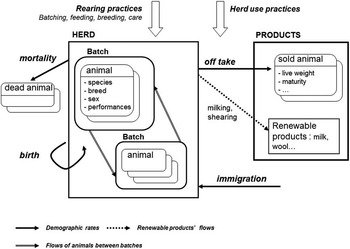
To identify LFS sources of flexibility related to the herd, we analyse herd operation by using flexibility frameworks. We consider the subsystem composing the ‘herd’ and ‘products’ objects driven by the practices of the farmer (Figure 1). We identify sources of operational flexibility such as products, processes and inputs as Tarondeau (Reference Tarondeau1999) specified them. Inside process and input sources, we distinguish the source that refers to ‘adaptive management’ and the one linked to ‘buffer capacity’ (Gunderson, Reference Gunderson2000). By combining these conceptual frameworks, we define six sources of flexibility related to the herd.
Elements analysed to show that a herd can be a source of flexibility.

The first source of flexibility is linked to the products. We call it ‘combine a diversity of products’. Indeed, a variety of animal products could be used to cope with market perturbations (Astigarraga et al., Reference Astigarraga, Chia and Ingrand2008).
Tarondeau (Reference Tarondeau1999) defines the ‘inputs’ source in the situation when the system adapts itself to variations of input. To do this, using the herd, the farmer has several possibilities. He can choose different types of animals or breeds, using their capacity to survive and produce in a harsh environment. ‘Use diversity of species and breeds’ is an ‘input’ source of flexibility, related to the herd, enhancing LFS buffer capacity. Mace (Reference Mace1990) and Blench and Marriage (Reference Blench and Marriage1999) illustrate how a farmer may combine several animal species in the herd or different breeds from the same species. Owing to their differences in feeding behaviour, a multispecies herd may use resources better than a herd composed of a single species. For example, when livestock has a major function in terms of savings, the presence of animals of various sizes and sensibilities in the herd (small ruminants, cattle, camels) makes it possible to sell an animal corresponding to the amount of cash required. For one breed, each animal or lineage may more or less express adaptive abilities which could be used to decide whether to keep them in the herd or not.
Farmer practices determine the animal flows in and out of the herd and the herd size. ‘Juggle herd numbers’ is another source of flexibility linked to the herd, as a response to variations of input. This source refers to adaptive management in the livestock farming system. It is used to build flexibility in two different ways. On the one hand, increases or decreases in herd size, decided by the farmer, are a way of adapting the needs of the herd to the variability of resources over time and of coping with market price fluctuations. On the other hand, in order to maintain the herd over time, the farmer may seek to have a large herd. In this way, the reproductive core of the herd will be sufficiently preserved, if perturbations affect the herd (animal mortality due to severe drought or epizooty) or if there are unforeseen family expenses, such as illness, leading to the sale of several animals.
The farmer can move the herd over long distances to search for better rearing conditions. ‘Organise herd mobility’ is the fourth source of flexibility, as a response to input modifications when spontaneous vegetation is the only resource for the animals. This source of flexibility is an ‘input’ source, which is a form of adaptive management. Toulmin (Reference Toulmin1999) or Krätli (Reference Krätli2008) describe how a breeder organises the mobility of the herd, seeking for grass and water where they are located for a season, and how this is a means of coping with variability of resources in space and time. Practices playing upon modifications in the livestock farm environment, such as prophylaxis, housing conditions and management of supplementary feed, were not included in the study, because they refer to environmental modifications and not to herd functioning.
Tarondeau (Reference Tarondeau1999) defines the ‘processes’ source by the capacity of a system to change its industrial processes. In the herd, we also consider biological processes at the animal level, and the behaviour of groups of animals affected by rearing practices, batching, reproduction, feeding, husbandry and sales.
One ‘processes’ source identified is related to individual animal adaptive ability, such as the capacity to mobilise and reconstitute body reserves or tolerance to heat. This is the ‘processes’ source that enhances LFS buffer capacity. Molenat and Jarrige (Reference Molenat and Jarrige1979) or Blanc et al. (Reference Blanc, Bocquier, Agabriel, D'hour and Chilliard2006) explore how these abilities and their diversity could be exploited or not by a breeder. We call it the ‘Use animal adaptive capacities’.
The ‘processes’ source, which refers to adaptive management, corresponds to a control of technical processes which regulate the functioning of the herd. We call it ‘mastering the balance between productivity and the survival of animals’. For this last source of flexibility, the farmer allows biological regulations to express themselves, playing with the adaptive capacities of the animals kept in the herd. For instance, Moulin (Reference Moulin2000) concludes that open females can be kept in the herd after breeding seasons. In this way, the biological intensity of female lifespan is limited, with the benefit of extending the lifespan of females in the herd. Dedieu et al. (Reference Dedieu, Gibon and Roux1991) show how only key phases of the productive cycle can be secured, such as mating, end of pregnancy and suckling, and how the farmer relies on the ability of the animals to withstand periods of deficit. However, the farmer can achieve high female productivity and improve the biological intensity of female lifespan, with a large number of herd management practices, with repeated sorting of animals into various batches and adapting rearing practices to each period of the cycle. Finally, the changes in herd use practices, such as decrease of milking, shifting sale periods, etc., are ways of balancing productivity and survival. They also make it possible to cope with market fluctuations or mortality risks.
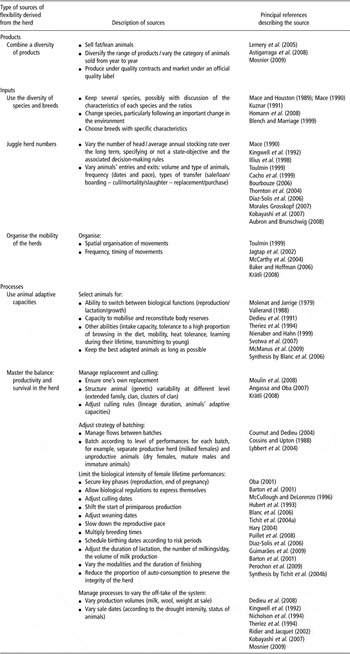
Table 1 gives details for each source, considering the various methods used in the scientific literature to describe, analyse and mobilise them. We reformulate breeder actions and practices, chosen from the literature, introducing locutions with verbs (see Table 1). We must note that the six sources interact: mobilising one source of flexibility may affect another source.
Description of sources of flexibility derived from the herd

Are sources linked to the type of systems?
Considering the livestock farming systems that are addressed in these studies (Table 1), we try to link the sources of flexibility and the type of systems in which they are used. Farmers in sub-Saharan Africa (e.g. Burkina-Faso, Mali, Niger, Ethiopia and Kenya) mobilise the ‘Use diversity of species and breeds’ source. In these countries, the biophysical environment is harsh, covering semi-arid and mountainous areas. The socio-economic environment necessitates several types of livestock – bovine, ovine, goats, camelidae – ensuring major functions for households, especially savings to make families secure, given the weak social policies of some states (Mace, Reference Mace1990; Kuznar, Reference Kuznar1991; Homann et al., Reference Homann, Rischkowsky, Steinbach, Kirk and Mathias2008). Obviously, specialised livestock farming systems in industrialised countries (North America and North Europe) generally do not use this source. In such systems, a single species (e.g. dairy cattle or wool sheep) is intended to generate income, and specialisation is a way to maximise productivity of production factors, especially labour (Fitzgerald et al., Reference Fitzgerald, Brereton and Holden2005).
The ‘use animal adaptive capacities’ source can be used either in mono- or multispecies systems. It is used in situations where a year-long balance between the animals’ potential production of healthy animals and feed supply is not an important issue. Studies analysing this source are often located in Mediterranean countries (southern Europe and North Africa) or in semi-mountainous countries in temperate zones, as in the studies by Molenat and Jarrige (Reference Molenat and Jarrige1979) and Theriez et al. (Reference Theriez, Petit and Martin-Rosset1994).
The ‘combine a diversity of products’ source is only described in beef cattle systems (Astigarraga et al., Reference Astigarraga, Chia and Ingrand2008; Mosnier, Reference Mosnier2009), addressing issues on selling lean or fattened types of animal (young bulls, steers, heifers, mature cows after culling), in various markets, especially under official quality labels. We do not observe the use of this source in dairy systems selling milk to the industry. Only the on-farm cheese-makers may use this source, diversifying the cheese specialities they offer. This source can be mobilised, considering animal products (meat v. milk), but its use is also linked with local market organisations and with the capacities of farmers to access the different markets.
The ‘organise herd mobility’ source is obviously specific to pastoral systems (Toulmin, Reference Toulmin1999; McCarthy et al., Reference McCarthy, Dutilly-Diané, Drabo, Kamara and Vanderlinden2004), especially in sub-Saharan Africa, where the rangelands are not owned by individual farmers. In these arid and semi-arid areas, herd and family mobility are the best way of using scarce resources heterogeneously distributed in space and time. Nevertheless, mobility is not always a response to climatic perturbations. Baker and Hoffman (Reference Baker and Hoffman2006) demonstrate that the practices of livestock farmers in South Africa are primarily responses to social, political or personal contexts and that rainfall variations alone cannot explain the differences between sedentary or nomadic systems.
The ‘juggle herd numbers’ source is cited in two situations. First, in ranching systems (Thornton et al., Reference Thornton, Fawcett, Galvin, Boone, Hudson and Vogel2004; Diaz-Solis et al., Reference Diaz-Solis, Kothmann, Grant and De Luna-Villarreal2006), where soil property rights are defined, the rangelands are fenced and the stocking rate is one of the main elements for maximising income. These studies analyse which average stocking rate should be maintained to cope with interannual rainfall variations and which decision rules about sales and purchases of animals are adopted to vary the stocking rate. Then secondly, in nomadic pastoral systems (Mace, Reference Mace1990; Toulmin, Reference Toulmin1999; Kobayashi et al., Reference Kobayashi, Howitt, Jarvis and Laca2007; Boone and Wang, Reference Boone and Wang2007), usually located in weak socio-economic environments, the survival of the herd is a priority. The main issue is to maintain a sufficient number of animals to ensure the reconstitution of the herd after a crisis.
The ‘master the balance between productivity and survival in the herd’ source can be observed in various situations of ruminant livestock systems with reproductive females. These systems differ in terms of the objective, the type and volume of products. We can quote home consumption of milk (Lybbert et al., Reference Lybbert, Barrett, Desta and Coppock2004) or meat (Tichit et al., Reference Tichit, Hubert, Doyen and Genin2004a), wool production (Kingwell et al., Reference Kingwell, Morrison and Bathgate1992; Kobayashi et al., Reference Kobayashi, Howitt, Jarvis and Laca2007), and small or large-scale sale of milk, meat or animals for fattening or reproduction. They also differ by the size of the farm structures from several dozen animals in sub-Saharan Africa to several hundred in North Africa (Alary and El Mourid, Reference Alary and El Mourid2007) and Europe (Hubert et al., Reference Hubert, Girard, Lasseur and Bellon1993), to several thousand in Australia (Kingwell et al., Reference Kingwell, Morrison and Bathgate1992).
We note that, for specialised sedentary systems with one breed and one product, and with maintenance of stable feed resources, it is possible to keep a constant herd of reproductive females. ‘Use animal adaptive capacity’ and ‘master the balance between productivity and survival in the herd’ seem to be the only herd-linked sources that are available to build flexibility. For nomadic pastoral systems, with several species and products, all the sources can be used. In all the literature we identify, when there is little at stake in the achievement of production objectives, it is possible to make wide use of the ‘juggle herd numbers’ and ‘combine a diversity of products’ sources of flexibility. But in systems where much is at stake in achieving the production objective, with the high level of herd productivity, these sources will be used as a last resort (Mosnier, Reference Mosnier2009). In these cases, the articles reviewed found a major mobilisation of sources linked to resources (and not to the herd): the constitution of stocks of forage (Fitzgerald et al., Reference Fitzgerald, Brereton and Holden2005; Dedieu et al., Reference Dedieu, Louault, Tournadre and Benoit2008) or crop systems such as variations in the cropping pattern (Hubert et al., Reference Hubert, Girard, Lasseur and Bellon1993; Ridier et al., Reference Ridier, Mignot, Colson and Jacquet2001; Ridier and Jacquet, Reference Ridier and Jacquet2002; Mosnier, Reference Mosnier2009). These points lead us to hypothesise that the higher the stakes in achieving production objectives, the less choice there is in sources of flexibility derived from the herd. In certain cases, particularly in situations where the environment (climate or economic) is very variable, the use of the ‘juggle the herd numbers’ and ‘combine a diversity of products’ sources of flexibility may condition and affect the level and type of production.
The use of the sources of flexibility derived from the herd
The use of the herd to manage perturbations was analysed from three angles: the way a source or a type of source is used, the alternative(s) between sources and the organisation of sources in terms of subordination, scheduling or combination. Some studies (Illius et al., Reference Illius, Derry and Gordon1998 and Reference Illius, Derry and Gordon2000; Cabrera et al., Reference Cabrera, Hildebrand, Jones, Letson and de Vries2006; Diaz-Solis et al., Reference Diaz-Solis, Kothmann, Grant and De Luna-Villarreal2006) approach the issue from all three angles.
Sources of flexibility are used in different ways: example of ‘juggling the number of stock present’
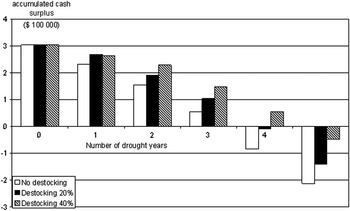
Sources of flexibility are described in the literature by studying the different modalities of their use. This is particularly evident in the case of ‘juggle herd numbers’. This source is first described by the volume of animals to be kept or destocked (Stafford Smith and Foran, Reference Stafford Smith and Foran1992; Thornton et al., Reference Thornton, Fawcett, Galvin, Boone, Hudson and Vogel2004; Hahn et al., Reference Hahn, Richardson, Hoffman, Roberts, Todd and Carrick2005) through the analysis of either variations in the number of animals or different destocking rates. Stafford Smith and Foran (Reference Stafford Smith and Foran1992) modelled an enterprise owning a flock of 14 600 sheep (6500 ewes) on 80 000 ha in South Australia. Through simulations, they tested three destocking modalities (0%, 20% or 40% of livestock) with three representations of climate hazards. The first test was over a period of 10 years with all the combinations of good/average/adverse years. The second one used the actual climate sequence of 1885 and 1985. Then they tested over a period of 20 years within which there was a succession of 0 to 5 drought years (Figure 2). These authors concluded that, for this series of 20 years, destocking was always better as a strategy than ‘doing nothing’. If there is only one drought year in 20 years, selling off 40% of livestock is less advantageous than selling off 20%; however, once there are more than 2 drought years, it is better to sell 40% of the herd. Destocking may be governed by decision rules which are precisely described and analysed (Illius et al., Reference Illius, Derry and Gordon1998 and Reference Illius, Derry and Gordon2000; Diaz-Solis et al., Reference Diaz-Solis, Kothmann, Grant and De Luna-Villarreal2006; Morales Grosskopf, Reference Morales Grosskopf2007; Diaz-Solis et al., Reference Diaz-Solis, Grant, Kothmann, Teague and Diaz-Garcia2009). Diaz-Solis et al. (Reference Diaz-Solis, Kothmann, Grant and De Luna-Villarreal2006) modelled a suckler cattle production system in a semi-arid region of Mexico and varied the number of breeding cows destocked according to the evolution of body condition scores (BCSs). Three decision rules were tested: In the first simulation case, a cow is culled when she loses 1 point of her BCS over the preceding 2 months. The second case is when she loses 2 points of her BCS over the preceding 2 months, and in the third case it is when she loses 3 points of her BCS. In each case, when the entire herd has reached a BCS below 2, all of the females are sold. The effect of these decision rules was evaluated in the case of two stocking levels (high/low) on variables such as surface area productivity and the weight of calves at weaning.
Financial results of three livestock destocking strategies after the reconstitution of livestock when the test takes place over 20 years, which include 0 to 5 drought years (adapting to Stafford Smith and Foran, Reference Stafford Smith and Foran1992).

This ‘juggle herd numbers’ source is also described in the literature through the observation of the categories of animals sold. In Diaz-Solis et al. (Reference Diaz-Solis, Kothmann, Grant and De Luna-Villarreal2006), open heifers are sold first, followed by cows that are lactating just before the beginning of the breeding season. This pacing of destocking is close to what was observed by Bourbouze (Reference Bourbouze2006) in North Africa. Illius et al. (Reference Illius, Derry and Gordon1998) show that sales of females are necessary to overcome drought, which compromises the regeneration of the herd. Morton and Barton (Reference Morton and Barton2002) note two strategies when drought occurs in Africa: selling animals still in good shape, and selling animals in very poor condition for salvage slaughter. As Oba (Reference Oba2001) and Angassa and Oba (Reference Angassa and Oba2007) show, it seems that perturbations do not affect the categories in the same manner: mature males are least affected by droughts as opposed to breeding females and calves.
The types of animal transfer are further described, particularly in pastoral societies of sub-Saharan Africa (Toulmin, Reference Toulmin1999; McPeak and Barrett, Reference McPeak and Barrett2001; McPeak, Reference McPeak2006; Lybbert et al., Reference Lybbert, Barrett, Desta and Coppock2004; de Vries et al., Reference De Vries, Leslie and McCabe2006), as a sale, gift, loan or theft. They very much depend on access to the market and relations between stockbreeders. The study of these types of transfer is interesting in order to understand their functions as insurance, savings or risk sharing between several livestock producers, and to describe the remanence related to the use of a source of flexibility. A sale or death which occurs during a drought – when it is not possible to repurchase cattle – may have consequences over several years (Cossins and Upton, Reference Cossins and Upton1988; Oba, Reference Oba2001). For example, Stafford Smith and Foran (Reference Stafford Smith and Foran1992) show that when over a series of 20 years there are 5 drought years and the livestock farmer's strategy is to not destock, the herd takes 18 years to reconstitute itself. When the strategy is to sell off 40% of the cattle, the herd returns to its original level after only 11 years. Some authors examine the measures that may diminish this remanence related to a shock. The repurchase of females following a sale or after high drought-related mortality may be identified as being necessary to maintain production at a constant level from 1 year to another (Illius et al., Reference Illius, Derry and Gordon1998 and Reference Illius, Derry and Gordon2000). This is not always possible in terms of cash flows, cattle availability and prices (Toulmin, Reference Toulmin1999) and depends on the strategy adopted during the drought, especially sales of reproductive females (Sieff, Reference Sieff1999). In other cases, authors recommend relying on internal herd replacement, which is slower and allows vegetation to renew itself (Müller et al., Reference Müller, Frank and Wissel2007). This last example leads us to suggest that objectives such as maintaining production levels or environmental conservation may be defining elements in the use of sources of flexibility.
The timing of source use is analysed. The analysis could be made through the study of sale periods, which may be thought of as a function of the period in which a perturbation is likely to arise (Illius et al., Reference Illius, Derry and Gordon1998 and Reference Illius, Derry and Gordon2000; McPeak, Reference McPeak2006). For example, in Kazakhstan (Kobayashi et al., Reference Kobayashi, Howitt, Jarvis and Laca2007), the traditional sale period is in the autumn: the livestock farmer adjusts the herd according to the available conserved forage resources. The farmer also has the opportunity to sell in the spring. The simulation of the herd operation according to available resources, carried out by Kobayashi et al. (Reference Kobayashi, Howitt, Jarvis and Laca2007), shows that this second sale period is only used when there are two successive drought years. Alarm systems can exist to organise the sale of animals before a dry period (Toulmin, Reference Toulmin1999). The timing of source use can also be analysed according to the duration of the perturbation. For example, Toulmin (Reference Toulmin1999) underlines that the longer the drought lasts, the less advantageous it is to sell animals, which will anyway be very emaciated and sold at very low prices because the market has collapsed with the influx of animals.
The other five sources may also be described according to their modalities of use. For example, Romera et al. (Reference Romera, Burges, Morris, Hodgson and Woodward2008) in their model vary the weaning age of calves (from 170 to 260 days), which corresponds to the ‘master the balance between productivity and survival in the herd’ source. Furthermore, the analysis of source use could include a comparison with the scenario in which these sources are not mobilised. Some research focuses on the alternative between using a source and not using it. This is the case in the study by Astigarraga et al. (Reference Astigarraga, Chia and Ingrand2008), in which the advantages of selling breeding heifers in a beef cattle system are weighed.
On the basis of these examples, one may conclude that the way sources are used depends on the nature, intensity and frequency of a perturbation and the combination with other perturbations. They are also evaluated with regard to the nature and constancy of expected results (income, cash flow or zootechnical performance, combined or not with environmental stakes, as in the study by Morton and Barton, Reference Morton and Barton2002) and to the environment in which the system is situated (described by its fragility: speed of recovery after a shock or by its organisation, as in the research by Krätli, Reference Krätli2008). These three elements contribute to the construction of an optimal use of sources or to a trigger for their use in the form of ‘if … then’, as proposed in the nomadic systems of Kazakhstan by Kobayashi et al. (Reference Kobayashi, Howitt, Jarvis and Laca2007), who demonstrate that, ‘when there are two successive drought years, animals must be sold in the spring (in addition to the traditional autumn sale)’. It would be interesting to further explore what type of information (internal/external) is necessary to define these rules of use (optimal thresholds, triggers).
Ranking or comparison of sources of flexibility
Some research studies compare or rank sources (Cabrera et al., Reference Cabrera, Hildebrand, Jones, Letson and de Vries2006; Diaz-Solis et al., Reference Diaz-Solis, Kothmann, Grant and De Luna-Villarreal2006; Puillet et al., Reference Puillet, Sauvant and Tichit2008). In South Africa, Thornton et al. (Reference Thornton, Fawcett, Galvin, Boone, Hudson and Vogel2004) compare two solutions to managing the climate swings caused by the El Niño phenomenon. They model the operation of a livestock farming system (dairy cows, possibly including several sheep), optimising either the year-round stocking rate, which leads to defining the herd size (600 head) that could resist the set of climatic situations observed previously, or culling part of the herd during drought years, which leads to determining the optimal culling level for those years (40% of the 600 animals in El Niño years). The model makes it possible to evaluate the use of one or the other of these two sources in relation to obtaining an average income over the entire simulation period. They find that the use of a 40% culling rate in drought years earns a higher mean annual income than maintaining a herd size of 600 head.
Again in South Africa, Hahn et al. (Reference Hahn, Richardson, Hoffman, Roberts, Todd and Carrick2005) model the operation of a goat production system in interaction with the climate and with changes in vegetation over a long-time period (100 years). The objective of a livestock unit may be measured by several different indicators, two notable ones being the annual level of milk production (litres of milk/year) and the total number of goats sold per year. In a region where the climate is very variable, these authors analyse the effect of different herd sizes (fixed number of animals present over the year) on the level of expected performance. They conclude that if the objective is to maximise the number of annual sales, then, under these unpredictable conditions, it is preferable to limit the number of goats to 2000 head on the 20 000 hectares of the village area considered in the simulation. On the one hand, if the chosen performance indicator is the annual volume of milk produced, then it is not necessary to cap the goat population. The total quantity of milk produced when there are more goats (simulations are made for 2500 to 6000 goats) remains the same but the condition of the animals is not as good as when there are fewer animals. On the other hand, if a system has a dual goal (to ensure income for the farmer through animal production and to protect the plant resource from being compromised), then, under the unpredictable conditions of a semi-arid environment, it is better to vary the number of animals according to the climate and consequently to destock during drought periods.
The nature of perturbation and the coexistence of perturbations may also govern choices between alternative sources. For example, Kingwell et al. (Reference Kingwell, Morrison and Bathgate1992) demonstrate that a variation in prices (of wool and of grazing lupin seeds) is managed by varying the stocking rate. If a climatic perturbation is added to this variation in price, one may observe animals being boarded out or a variation in the animal body reserves.
The environment of a livestock farming system is also a determining factor in the choice between alternative sources. For example, Homann et al. (Reference Homann, Rischkowsky, Steinbach, Kirk and Mathias2008) examine the case where changes in policy (decentralisation and increase of direct assistance) have led to sedentarisation. They show that farmers replace the ‘organise mobility’ source with ‘combine and use the genetic types of breeds and species’ to be able to continue to manage perturbations related to a scarcity of rain. They do so by modifying species composition, replacing a portion of the herd of small ruminants by camelidae, or by adopting a beef breed that can withstand high grazing pressure and low-quality vegetation to the detriment of breeds more suited to managing heat stress and movement. Hary (Reference Hary2004) suggests that in the case of sedentarisation, a way of dealing with resource variability is to restrict breeding.
Some authors compare several sources (Illius et al., Reference Illius, Derry and Gordon1998 and Reference Illius, Derry and Gordon2000; Cacho et al., Reference Cacho, Bywater and Dillon1999; Diaz-Solis et al., Reference Diaz-Solis, Kothmann, Grant and De Luna-Villarreal2006), simultaneously seeking to define optimal use modalities and triggers. Diaz-Solis et al. (Reference Diaz-Solis, Kothmann, Grant and De Luna-Villarreal2006) test four types of sources in particular. Three of them are related to the herd: the age at weaning (defined as a function of the female's BCS), the breeding period (six periods tested) and the stocking rate (sale of animals as a function of variations in BCSs during a 2-month period). The various simulations lead the authors to conclude that a reduction in the stocking rate over the short term is the option that best allows performances to be maintained. These performances were measured in terms of animal production, expressed in kg of weaned calf meat per year and per hectare, and the body condition of the females, as well as the productivity of surface areas (excellent/good/mediocre/low) under very unpredictable environmental conditions.
As in the previous paragraph, ranking and comparison of sources are described according to economic and environmental performance objectives. Various criteria are used to describe the objectives, such as maximising the utility function, maximising profits and technical performance and resource preservation (Diaz-Solis et al., Reference Diaz-Solis, Kothmann, Grant and De Luna-Villarreal2006), limiting scrub invasion and reducing nitrogen leaching (Cabrera et al., Reference Cabrera, Hildebrand, Jones, Letson and de Vries2006). They are also compared according to perturbation (intensity, frequency) and to the context within which the system operates.
How the sources are connected
The analysis of these studies highlights that several sources of flexibility may be mobilised together and linked to each other. For example, for Barton et al. (Reference Barton, Meadows and Morton2001), having a large herd is not sufficient for resisting drought; it also depends on the possibility of mobility and on labour availability. The question then is: ‘how are the sources connected? We propose to analyse the connection between two sources according to three features. Tarondeau (Reference Tarondeau1999) distinguishes two levels of flexibility: a strategic and an operational level. The strategic level refers to long-term choices and the capacity to modify the system structure; the operational level refers to adjustment decisions during the production cycle. Another way of analysing flexibility is proposed by Chia and Marchesnay (Reference Chia and Marchesnay2008), who bring to light two forms of flexibility: static and dynamic. For us, this distinction will be illustrated by the absence or presence of farmer intervention. Moreover, for dynamic flexibility, it is possible to make the difference between proactive flexibility (implemented before the perturbation) and reactive flexibility.
The studies of Diaz-Solis et al. (Reference Diaz-Solis, Kothmann, Grant and De Luna-Villarreal2006) and of Kingwell et al. (Reference Kingwell, Morrison and Bathgate1992) illustrate the connection between strategic and operational intervention levels. The mean annual stocking level is defined a priori so that a system may achieve a certain level of performance even during adverse climate years. When there are droughts, supplements are purchased and distributed to animals. This fixed mean annual stocking level may be combined, in other cases, with a reduction in weight at the time of sale (Kobayashi et al., Reference Kobayashi, Howitt, Jarvis and Laca2007; Mosnier, Reference Mosnier2009). In these situations, an operational flexibility source adds to a more strategic source. In others, an operational flexibility source makes the strategic source possible. This is the case in the studies by Gillard and Monypenny (Reference Gillard and Monypenny1990) and Kingwell et al. (Reference Kingwell, Morrison and Bathgate1992), where the stable mean annual stocking rate is made possible by boarding out or selling some animals in order to balance births. Kingwell et al. (Reference Kingwell, Morrison and Bathgate1992) and Fitzgerald et al. (Reference Fitzgerald, Brereton and Holden2005) distinguish these two levels of decision-making in their models: they contrast ‘tactical’ and ‘strategic’ levels of intervention. In some cases, two features of the same source or two different sources combine at a strategic level. In North African sheep farms examined by Bourbouze (Reference Bourbouze2006), the switches between periods of decapitalisation (sales of 40 female lambs, 50 male lambs and 20 adult ewes for a flock of 100 adult ewes) and of breeding herd reconstitution (sales of 15 female lambs and 55 male lambs only) are made possible by exploiting a herd whose size (200 to 300 head) is sufficiently large to withstand a prolonged drought. In other words, ‘varying the numbers’ is subordinate to ‘having a sufficiently large herd’, which are two features of the same source, ‘juggle herd numbers’. Mace and Houston (Reference Mace and Houston1989) and Mace (Reference Mace1990) show that if the herd becomes sufficiently large, then the partial replacement of small ruminants by camelidae (species with long reproductive cycles but which can resist drought) is possible. In this case, ‘combining and using capacities of species and breeds’ is only possible if the ‘juggle herd numbers’ source has been put to use in a particular direction, leading to a sufficient number of animals. Tichit et al. (Reference Tichit, Hubert, Doyen and Genin2004a) analyse a similar case where ‘master the balance between productivity and survival’ depends on the number of animals.
The producer's choice of a species or breed (resistant to heat or capable of mobilising and reconstituting their body reserves) can allow a biotechnical system to self-adjust due to regulatory processes linked to the animals. Therefore, the ‘use adaptive capacities of the animals’ source may be mobilised without the intervention of the farmer who simply chooses to leave the animals to adapt or not. These alternatives are illustrated in African studies which discuss the best way to resist droughts. Three choices are examined: destocking/restocking strategy, keeping a low fixed stocking rate (corresponding to a previous choice and allowing the system to react when the perturbation happens) or a combination of both (Illius et al., Reference Illius, Derry and Gordon1998 and Reference Illius, Derry and Gordon2000; Morton and Barton, Reference Morton and Barton2002; Thornton et al., Reference Thornton, Fawcett, Galvin, Boone, Hudson and Vogel2004). It would seem that this situation, in which the farmer lets the system self-adjust, is only possible in cases where the production objective (number of sales, weight at sale, volume of milk) is not too close to the production optimum or when it can vary from 1 year to another.
A source used in anticipation of a perturbation may be complemented by the use of another source when the perturbation occurs. Anticipation practices include creating fodder/animal stocks, fencing out part of the farm area during rainy years, choosing to draw out breeding periods or, by contrast, choosing to regroup parturitions to low perturbation periods (Bourbouze, Reference Bourbouze2006; Müller et al., Reference Müller, Frank and Wissel2007). Practices that react to the actual occurrence of a drought may then be implemented: distributing supplements, selling animals, departing on transhumance, moving forward the weaning date (to preserve females). Two forms of flexibility are mobilised here: a proactive form, prior to the occurrence of a perturbation, and a reactive form, following its arrival. These two steps are described by Mosnier (Reference Mosnier2009) as being necessary in the management of perturbation by farmers. Choosing to mobilise one source of flexibility before or after a shock may depend on the structure of the system, particularly matching periods where climatic or economic perturbations are more intense, with periods where animal production requirements are low. Dedieu et al. (Reference Dedieu, Gibon and Roux1991), Gibon et al. (Reference Gibon, Balent and Duru1983) and Blanc et al. (Reference Blanc, Bocquier, Agabriel, D'hour and Chilliard2006) highlight the key stages in the biological cycle where resource security levels must be the highest.
All of the above demonstrate the richness of a flexibility analysis framework (Chia and Marchesnay, Reference Chia and Marchesnay2008) to analyse the connection between different sources of flexibility. Nevertheless, the three features we described earlier (e.g. strategic/operational, do something or not and proactive/reactive) are not independent: the sources mobilised from a strategic point of view are often called upon in anticipation of a perturbation in a proactive way. One or another of these three features may be preferred according to the objectives of the analysis undertaken. However, we do not think it is possible to classify a priori the sources (listed in Table 1) according to these three features. Characteristics of the system (objectives, resources …) and context (environment, perturbation …) lead the choice of sources.
Discussion
Weaknesses and strengths of conceptual frameworks
In this review, we focus on the sources of flexibility involving the herd. We choose to use a conceptual framework combining flexibility and herd operation. This is why we assume that we have identified most of the sources of flexibility that are linked to the herd, although it is not possible to make an exhaustive interrogation of the literature and describe exhaustively the sources of flexibility because none of the studies focus on this subject directly. We bring to light elements to describe the six sources of flexibility linked to the herd and major principles for their mobilisation. To do this, we address different livestock systems worldwide. But for specifying the description and use of each source, it would be necessary to adopt a local approach and clarify the context, objectives and nature of perturbations.
The studies identified in the literature essentially analyse perturbation management at the level of the overall livestock farming system. Many works examine how the herd is used in coordination with other resources like forage stock levels (Kingwell et al., Reference Kingwell, Morrison and Bathgate1992), purchase or on-farm production of feed (Mosnier, Reference Mosnier2009) or irrigation and water management (Cacho et al., Reference Cacho, Bywater and Dillon1999). Lastly, some studies analyse sources of flexibility located at a higher level. For example, one may cite levels of investment and debt (Ridier et al., Reference Ridier, Mignot, Colson and Jacquet2001; Morales Grosskopf, Reference Morales Grosskopf2007), labour and its productivity (Kingwell et al., Reference Kingwell, Morrison and Bathgate1992; Astigarraga et al., Reference Astigarraga, Chia and Ingrand2008), the level and types of relations between livestock farmers and information provided for them (de Vries et al., Reference De Vries, Leslie and McCabe2006; Hildebrand and Wilsey, Reference Hildebrand and Wilsey2008), and other sources of family revenue (Ridier et al., Reference Ridier, Mignot, Colson and Jacquet2001; Bourbouze, Reference Bourbouze2006). The design of livestock systems with greater adaptive capacity has to consider all these sources of flexibility, including all those related to the herd, as described in this review.
Different multifaceted concepts are used to analyse movements, changes and adaptive capacity in a livestock farming system: resilience, a concept derived from ecology, developed by Holling (Reference Holling2001) and mobilised by Milestad and Darnhofer (Reference Milestad and Darnhofer2003), flexibility (cf. above), capabilities and vulnerability (Sen, Reference Sen1992), room for manoeuvre (Papy et al., Reference Papy, Attonaty, Laporte and Soler1988). The links between system and environment are very important for these notions. Moreover, flexibility and resilience emphasise adaptive management and system properties (overcapacity, regulatory processes). Nevertheless, flexibility is an effective concept to analyse how one part of a system can be a means of action to face perturbations. This is how we use it in this review.
The elements summarised here do not enable us to draw conclusions in terms of source choice for each type of perturbation. The sources identified could possibly be used to manage another kind of perturbation (e.g. health). Furthermore, adopting a source of flexibility faced with a perturbation, such as moving the herd towards wetter zones in case of drought, can lead to facing another perturbation such as a new type of disease (Blench and Marriage, Reference Blench and Marriage1999).
Can flexibility be assessed?
We have shown that the definition of the objectives of a production system, the nature of the perturbation the system confronts, and the environment in which it operates influence the choice of the flexibility source – whether or not derived from the herd – the modalities of use and the connections between sources. Together, these points lead us to state that evaluating a source of flexibility in absolute terms is irrelevant as it is necessary to take into account the objectives, environment and type/intensity/frequency of a perturbation. We could suppose that the same conclusion applies to global LFS flexibility. This agrees with the point of view of Galvin et al. (Reference Galvin, Thornton, Boone and Sunderland2004) and that of Toulmin (Reference Toulmin1999) that new and persistent environmental, political and social pressures can limit or influence choices that have traditionally been available. More generally, Thornton et al. (Reference Thornton, Boone, Galvin, BurnSilver, Waithaka, Kuyiah, Karanja, Gonzalez-Estrada and Herrero2007) specify that the solution used to reduce the impact of external stresses depends on the country in which the farm is situated. These authors propose a case-by-case basis for integrated assessments.
It seems that global flexibility and the way the sources can be mobilised depend on the size of the livestock farming systems as shown by Sieff (Reference Sieff1999), Desta and Coppock (Reference Desta and Coppock2002) and Lybbert et al. (Reference Lybbert, Barrett, Desta and Coppock2004). Large farms in Florida (Cabrera et al., Reference Cabrera, Hildebrand, Jones, Letson and de Vries2006), which are sensitive to climate swings caused by El Niño and have important environmental objectives, use more sources (level of protein in rations, reduction in the length of wintering, variation in rotation of forage or market crops) than small farms. Lemery et al. (Reference Lemery, Ingrand, Dedieu and Dégrange2005) or Krätli (Reference Krätli2008) show that increasing the size of the system (and thus of the herd) makes it less sensitive to the disturbances of the environment. Elsewhere, Thornton et al. (Reference Thornton, Boone, Galvin, BurnSilver, Waithaka, Kuyiah, Karanja, Gonzalez-Estrada and Herrero2007) underline that there are thresholds in systems, linked to farm size, above which it is very unlikely that management options alone will be able to offset increasing system stresses.
How is flexibility built?
The analysis of the sources of flexibility linked to the herd allows us to propose a framework on which livestock farmers build the adaptive capacities of their systems. We confirm that organisation of diversity is a way to build flexibility, and we distinguish three principles with which it can be built. The first principle is the overcapacity of a system to respond to perturbations, that is, the maintenance of a gap between the potential of animal production and the targeted production objective. The use of biological regulatory processes at the level of the animal, plant, batch and field is the second principle. The third is the variation of the production objective, or adaptive management.
Some of the research discussed in this synthesis illustrates the choices that may be made of developing the flexibility of a system, either by configuring it to leave significant room to manoeuvre (with overcapacity or allowing expression of biological regulatory processes) or by turning instead to adaptive management. We refer in particular to research about the way climate perturbation is managed in arid environments at the level of the technical system. Should one ‘seize opportunities’, adapting one's practices, particularly by varying the number of animals present, or ‘plan’, remaining below optimal production with a stocking rate that enables a certain level of production to be ensured, even in unfavourable years? Müller et al. (Reference Müller, Frank and Wissel2007) demonstrate how the choice between the two options may be made with regard to biophysical conditions (rate of plant reproduction). The choice of overcapacity v. adaptive management is also discussed with regard to the difference between models and reality. The results from Thornton et al. (Reference Thornton, Fawcett, Galvin, Boone, Hudson and Vogel2004) indicate that culling 40% of the animals in El Niño years is the strategy that maximised annual income over the long term. However, this is not what stockbreeders do in reality, possibly because they follow a different strategy (accumulating cattle in the case of communal systems), or because the risk management practice habitually followed consists of adopting a very low stocking rate to withstand unfavourable years. How should these three elements (overcapacity/regulatory process/adaptive management) be described? How do choices between, and/or combinations of, elements contribute to the development of an adaptive capacity of livestock farming systems?
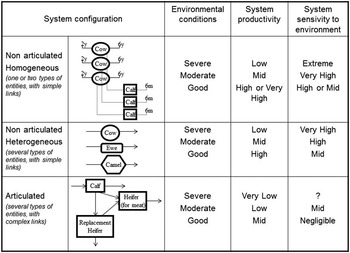
The organisation of the diversity of elements and processes at different temporal and spatial scales is another principle underlying flexibility. The organisation of this diversity, as analysed by Krätli (Reference Krätli2008) in WoDaaBe livestock farming systems (Niger), makes it possible to manage the perturbation in reactive and proactive ways. The diversity of a system is described by both the number of elements that exist and the number of interactions between them. Viglizzo (Reference Viglizzo1994) describes three types of diversity (Figure 3), depending on the number of elements and interactions between them. He evaluates how each type of diversity conditions system productivity and system sensitivity to variations in its environment. He concludes that the non-articulated but heterogeneous system can have high productivity and medium sensitivity unlike the homogeneous system, which has one or two types of elements, with simple links. Viglizzo suggests that systems composed of diverse interacting elements withstand environmental disturbances better (buffer effect). Although diversity permits perturbation management, we may assume that too much diversity, and too much interaction between elements, may produce an inverse effect.
Hypothetical schema of a livestock farming system's response to the environment when the system is configured varying the levels of diversity (adapted from Viglizzo, Reference Viglizzo1994).

This synthesis leads us to return to the issue of how a production objective should be defined and evaluated. We have shown that studying sources of flexibility leads to including among them variations in production objectives from year to year. Yet up until now, the production goals of livestock farming systems in temperate zones were thought to be stable over time. A new challenge for animal production science today is to find how one should think about dynamic production goals. It may be by using frameworks such as the one used by appreciative systems (Checkland, Reference Checkland1985). The first step is to consider dynamic production goals over time as a compromise between an acceptable average level of performance associated with a mild degree of variation (Olson et al., Reference Olson, George, Menke, Murphy, Van Horne and Lohr1987; Olson and Mikesell, Reference Olson and Mikesell1988). For Thornton et al. (Reference Thornton, Boone, Galvin, BurnSilver, Waithaka, Kuyiah, Karanja, Gonzalez-Estrada and Herrero2007), ‘changing variances (of production goals and resources) in the system may be as important as changing means, if not more so’.
This flexibility may manage itself, possibly by calling upon optimal levels of source use (cf. above) and on triggers for their use. These triggers may be linked to a production objective or to the intensity/frequency of perturbation, as well as to the timing of an action and to the previous use of another source. For Gibon and Duru (Reference Gibon and Duru1987), the closer one comes to the end of a process (as in the production of lambs, for example), the less room there is to manoeuvre. One may thus consider that when source A is mobilised at time t, this conditions the use of source B at time t + 1. For further research, other frameworks may be pertinent to use, like that of path dependence (Arthur, Reference Arthur1994; Mahoney, Reference Mahoney2000), which makes it possible to understand how the set of decisions is influenced by decisions made in the past. This set of triggers also makes possible a sequential use of sources according to increasing perturbation. When a mountain sheep farming system faces drought, Dedieu et al. (Reference Dedieu, Louault, Tournadre and Benoit2008) suggest that first lambs should be weaned earlier than usual in order for the females to avoid losing too much of their body reserves, and then, if the drought continues, to house the lambs in order to fatten them with stored purchased supplements. A question could be how the temporal horizons of perturbation (frequency) and sources (moment of use) are organised to obtain variable production goals (dynamic over time). Thinking about optimal levels of source use, triggers and timing for their use could help to renew frameworks and methods for analysing livestock farming systems and to build models to understand how a system acts or reacts if there are perturbations.
Conclusion
In the face of unpredictable exogenous phenomena and a wide range of perturbations, the herd may be used as a source of flexibility in combination with other sources derived from different components of a livestock farming system. Six types of sources derived from the herd were identified in the literature. It is possible to play upon animal adaptive capacities and diversity of species and breeds, to combine a diversity of products, to organise herd mobility, to juggle herd numbers and to master the balance between productivity and survival in the herd. The use and evaluation of these sources with regard to modalities, alternatives and links are governed by environmental conditions, the types of risk (intensity and frequency) and the production objectives (type, level of precision, stakes). An inventory of these sources demonstrates the benefit of building a certain amount of diversity, organised at several levels, within a livestock farming system, the necessity of understanding regulatory processes in order to manage them, and the importance of thinking about dynamic production objectives. We believe it is necessary to continue research to better understand how this flexibility is constructed by farmers. Furthermore, it could be pertinent to analyse which configuration of the markets and which public policy systems reduce or strengthen flexibility. It could also be relevant to understand how new sources of flexibility are invented, internal or external to the LFS, if flexibility is reduced. For example, subsidies per head of cattle in the European policy prevent the farmer from juggling the herd number. Finally, farming system design should integrate how flexibility can be built and maintained, when the system is confronted by new challenges.
Acknowledgements
The authors thank the anonymous reviewers whose comments helped in improving the manuscript.