Introduction
Among the millions of fungal species, only several hundred have been found to cause human infections.Reference O'Brien, Parrent, Jackson, Moncalvo and Vilgalys1 Through evolution, mammals have developed sophisticated immune systems against fungi,Reference Köhler, Casadevall and Perfect2 which may have been responsible for their emergence as dominant land animals.Reference Casadevall3,Reference Casadevall4 Invasive fungal diseases have seen a recent upsurgeReference Chakrabarti, Chatterjee and Shivaprakash5 because of the large population of individuals with weakened immune systems. Despite disfiguring surgical procedures and aggressive therapy, morbidity and mortality among such patients remain high.
Host defences against fungi can be broadly classified as innate and adaptive immune responses. The innate or ‘non-specific’ immune response consists of: neutrophils, mononuclear cells and dendritic cells, which are involved in fungal cell recognition and damage; physical barriers, such as the skin and respiratory mucosa, which prevent microbial entry into the host; and complement proteins that aid recognition by immune effector cells.Reference Antachopoulos6,Reference Ghuman and Voelz7
The adaptive or ‘specific’ immune response addresses invasive fungal infections through cell-mediated immunity, which involves the differentiation of mononuclear blood cells into T-helper 1 or T-helper 2 cells.Reference Antachopoulos6 The T-helper 1 response, which is mediated by the interleukin (IL)-12 and interferon-γ axis, stimulates phagocytic activity against fungal infections. The phagocyte-induced release of nitric oxide and reactive oxygen species causes the intracellular growth arrest of fungi.Reference Dambuza, Levitz, Netea and Brown8 Phagocytes also activate natural killer cells that localise at the infection site, regulate macrophages and cause hyphal death.Reference Ghuman and Voelz7 The T-helper 2 response involves the production of IL-4, IL-5 and IL-10, which downregulate T-helper 1 cytokine activity,Reference Antachopoulos6 and promote alternatively activated macrophages that permit fungal growth.Reference Davis, Tsang, Qiu, Dayrit, Freij and Huffnagle9 Hence, cell-mediated immunity has been classified into ‘protective’ (T-helper 1) and ‘non-protective’ (T-helper 2) responses.
The present study investigated the variations in intracellular T-helper 1 and 2 cytokines according to the type of invasive fungal sinusitis, and determined their impact on and relevance to patient outcomes.
Materials and methods
Study population
The study was conducted at the Department of ENT of the All India Institute of Medical Sciences, New Delhi, India, over a span of two years (from June 2017 to June 2019). Approval for the study was obtained from the Institute Ethics Committee of the All India Institute of Medical Sciences.
Patients from either the emergency room or the out-patient department of our hospital who satisfied the eligibility criteria were recruited. Eligible subjects presenting with invasive fungal infections of the nose, paranasal sinuses, orbits, cavernous sinus or skull base underwent microscopic examination to confirm the presence of fungal elements. Patients with known congenital immunodeficiency, haematological malignancy or granulomatous fungal disease, and those who refused to provide consent to participate in the study, were excluded. Ultimately, a total of 15 patients who fulfilled our eligibility criteria were analysed. All patients received surgical and anti-fungal therapy as per the standard guidelines.
Methodology
Eligible subjects underwent clinical and radiographic evaluation, and were assessed for demographic data, including age, sex and co-morbidities, and isolated fungal species. Subjects were then divided into two groups: those with mucormycosis and those with aspergillosis. All subjects received an explanation regarding the purpose of the study, after which written informed consent was obtained in their vernacular language.
Before the initiation of anti-fungal or surgical therapy, peripheral venous blood was drawn into a heparinised vial and promptly transported to the Immunology Laboratory, Department of Transplant Immunology and Immunogenetics, All India Institute of Medical Sciences, for subsequent mononuclear leukocyte isolation and culture.
Subjects were followed up for a maximum of six months following the initial assessment, after which their final clinical and radiological outcomes were classified as improvement, worsening or death. Assessments comprised: detailed clinical examinations of the ear, nose, throat, eye and neurological parameters, including rigid nasal endoscopy using a Hopkins telescope; and radiographic imaging, such as computed tomography of the head and paranasal sinuses or magnetic resonance imaging, as appropriate. Patients showing clinical and radiological resolution of the disease, partial or complete, were categorised as showing improvement, while those with clinically and radiologically persistent or increasing involvement were categorised as worsening.
Data were analysed using statistical software (Stata® version 14.0 and SPSS® version 24). The independent t-test was used to compare the means between both groups. The Mann–Whitney U test was used to compare variables with a skewed distribution. The chi-square test or Fisher's exact test was used to compare frequencies between both groups. A p-value of less than 0.05 was considered significant.
Fungal lysate preparation
Aspergillus flavus and Rhizopus oryzae, for aspergillosis and mucormycosis respectively, were cultured in Sabouraud's dextrose media (at the Mycology Laboratory, All India Institute of Medical Sciences), washed with phosphate buffered saline, and transferred to 15 ml Falcon™ conical centrifuge tubes containing phosphate buffered saline. The whole cell lysate was isolated by sonicating the tubes, and separated by pelleting the growth through centrifugation at 3000 revolutions per minute (rpm) for 20 minutes. Thereafter, the supernatant was separately transferred into Eppendorf® safe-lock centrifuge tubes and stored at −20°C.
Isolation and culture of mononuclear leukocytes
First, 8 ml of venous blood was diluted with an equal amount of phosphate buffered saline. Thereafter, 3 ml of Lymphoprep™ Ficoll Hypaque gradient media was placed into a 15 ml Falcon conical centrifuge tube, carefully layered over with blood, and centrifuged at 2000 rpm for 20 minutes at room temperature. The buffy coat was then transferred to another 15 ml Falcon tube containing 3 ml of incomplete Roswell Park Memorial Institute medium and centrifuged at 1500 rpm for 4 minutes, discarding the supernatant thereafter. The pellet was re-dissolved in 3 ml of incomplete Roswell Park Memorial Institute medium and centrifuged. In case of red cell contamination in the pellet, the cells were incubated with 7–8 ml of red cell lysis buffer for 10 minutes at 37°C. The final pellet was incorporated into 1.5 ml of incomplete Roswell Park Memorial Institute medium plus 10 per cent of heat-inactivated fetal calf serum (catalogue number: 04-001-1A; Biological Industries, Beit-Haemek, Israel) and plated over a 96-well, round-bottomed cell culture plate. Thereafter, 1.5 μl of the corresponding fungal lysate was added to each well containing 200 μl of the cell culture, and incubated at 34°C in 5 per cent carbon dioxide for 24 hours, adding 1 μl of Brefeldin A solution to each well 1 hour later.
Cell staining
Cells were washed with staining buffer, stained with monoclonal antibodies against clusters of differentiation 4, 3 and 14 (BioLegend®) for cell surface staining, and stored at 4°C for 20 minutes. Thereafter, cells were washed with phosphate buffered saline, fixed using 75 μl of phosphate buffered saline plus 75 μl of 4 per cent formaldehyde, stored at 4°C for 15 minutes, and rewashed. Next, 150 μl of permeabilisation buffer was added to each well, followed by incubation in the dark at room temperature for 10 minutes for intracellular staining. Monoclonal antibodies against IL-4, IL-5, IL-10, IL-12 and interferon-γ (BioLegend) were added, after which cells were stored in the dark at 4°C for 30 minutes and washed. Thereafter, the cells were transferred to appropriately labelled, 5 ml round-bottom, polypropylene fluorescence activated cell-sorting tubes (Falcon) using 400 μl staining buffer, and stored at 4°C in the dark until acquisition.
Flow cytometry
Cells were used for subsequent immunophenotyping and functional characterisation of cell type using polychromatic flowcytometry (BD Fortessa X-20; BD Biosciences, San Jose, California, USA). Data analysis was performed using FlowJo software (version 10.1r7; Tree Star, Ashland, Oregon, USA). Figure 1 shows a representative plot depicting interferon-γ producing cluster of differentiation 3 T cells on gated lymphocytes.
Representative flow cytometry pseudocolour plots for (a) aspergillosis and (b) mucormycosis, showing interferon (IFN)-γ producing cluster of differentiation 3 (CD3) T cells on gated lymphocytes.

Results
Demographic distribution
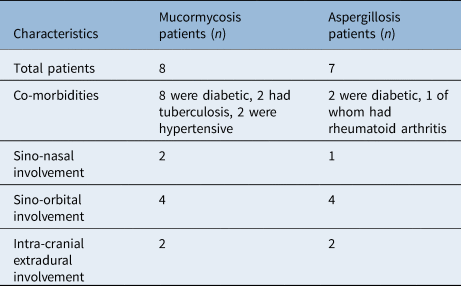
The study comprised a total of 15 patients, 5 females and 10 males, with a mean age of 41 years (range, 23–64 years). Among the included patients, eight had mucormycosis (all of whom had a fulminant or acute invasive disease course), while seven had aspergillosis (all of whom had a chronic disease course). Table 1 summarises the co-morbidities and extent of anatomical involvement among the patients.
Co-morbidities and anatomical involvement in patients with invasive fungal sinusitis at presentation

Proportions of cytokine-producing cells
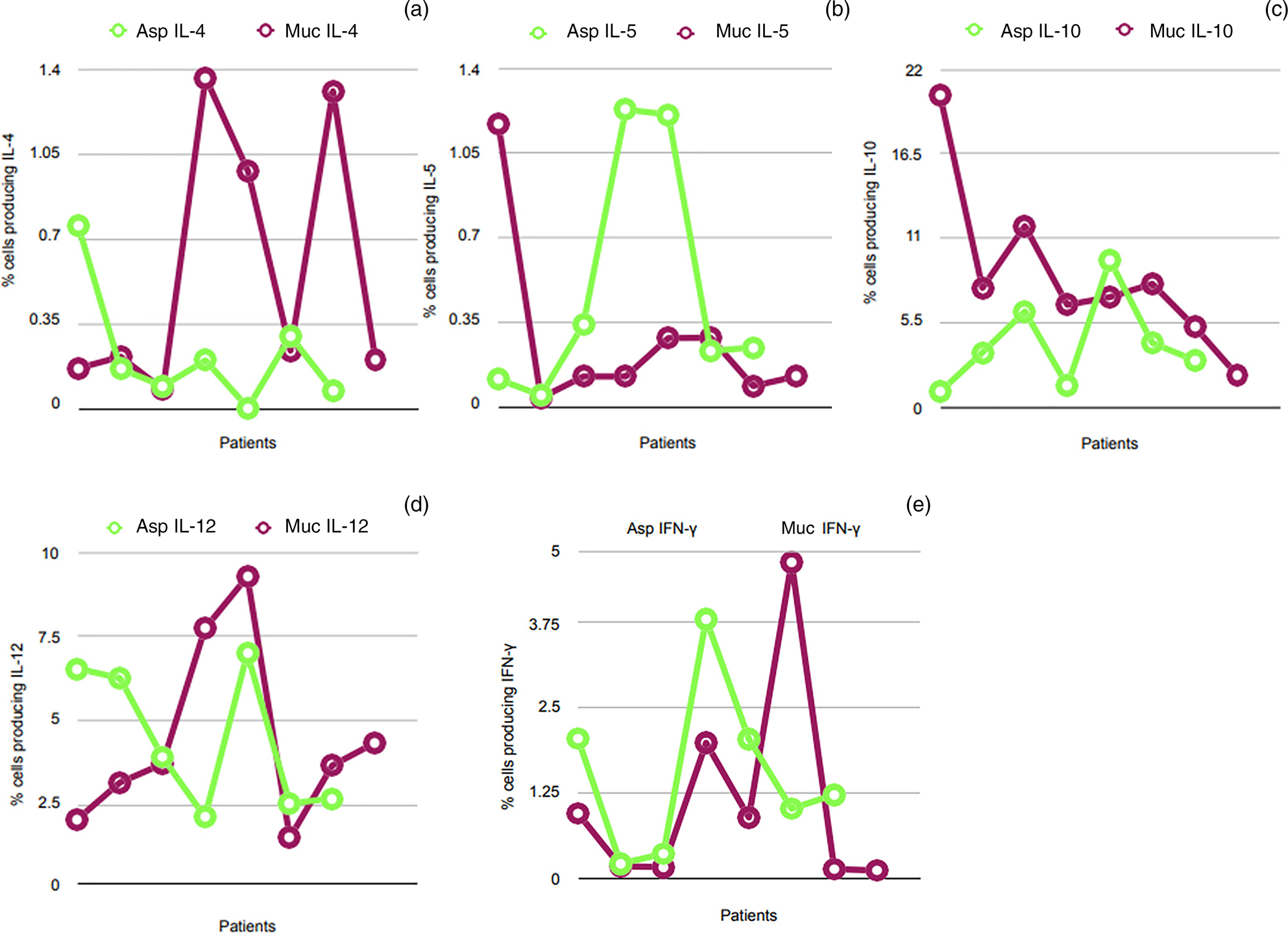
With regard to T-helper 2 cytokines in both groups, our results found that the mean proportion of IL-4 producing cells in the mucormycosis and aspergillosis groups was 0.575 per cent and 0.233 per cent, respectively (p = 0.105), while the proportion of IL-5 producing cells was 0.284 per cent and 0.492 per cent in the same groups, respectively (p = 0.486). Moreover, the proportion of IL-10 producing cells was significantly higher in the mucormycosis group (8.661 per cent) than in the aspergillosis group (4.196 per cent) (p = 0.049). With regard to both T-helper 1 cytokines in both groups, our results found that the mean proportion of IL-12 producing cells in the mucormycosis and aspergillosis groups was 4.460 per cent and 4.466 per cent (p = 0.908), while the proportion of interferon-γ producing cells was 1.134 per cent and 1.533 (p = 0.132) in the same groups, respectively. Figure 2 presents the individual proportions of cytokine-producing cells among all patients.
Proportion of mononuclear cells producing specific cytokines among patients with mucormycosis (Muc) and aspergillosis (Asp). The first three plots show the proportion of mononuclear cells producing T-helper 2 cytokines, namely: (a) interleukin (IL)-4, (b) IL-5 and (c) IL-10. The last two plots show the proportion of mononuclear cells producing T-helper 1 cytokines, namely: (d) IL-12 and (e) interferon (IFN)-γ.
Disease outcome and cytokine expression pattern
Regarding disease outcome after six months, 10 patients (6 from the aspergillosis group and 4 from the mucormycosis group) experienced improvement, 4 patients (1 from the aspergillosis group and 3 from the mucormycosis group) experienced worsening, and 1 patient (mucormycosis group) had died.
Table 2 shows the median proportions of specific cytokine-producing cells among patients categorised as showing improvement, worsening or death. The outcomes of worsening and death were grouped together under an ‘unfavourable’ outcome category because of the small sample size. This unfavourable outcome group had a higher proportion of mononuclear cells producing IL-4 and IL-12 (p = 0.0662 and 0.0373, respectively), and a lower proportion of cells producing interferon-γ (p = 0.0864), compared with the improvement group. Interestingly, IL-5 and IL-10 did not seem to be associated with outcome (p = 0.1101 and 0.4624, respectively). Overall, a significant difference in IL-12 was observed between the favourable and unfavourable outcome groups, while IL-4 and interferon-γ showed only a trend toward significance.
Median proportions of cells producing various cytokines among patients with different outcomes

Data represent percentages. IL = interleukin; IFN = interferon
Discussion
Invasive fungal diseases involving the sino-nasal and skull base regions are still relatively unknown and unexplored among humans and animals. The present study therefore investigated variations in cytokine expression by mononuclear leukocytes, and compared the findings between two groups of invasive fungal infections: fulminant or acute invasive mucormycosis and chronic invasive aspergillosis. Moreover, this study endeavoured to immunologically differentiate both fungal infections in order to understand basic differences in immunity and how they may govern patient outcomes.
Fungi-specific T cells, generated throughout the course of an active fungal disease, produce several cytokines that induce damage to the fungal pathogens.Reference Potenza, Vallerini, Barozzi, Riva, Forghieri and Zanetti10 Antigen recognition by the T-helper cell (which provides signal 1) together with a ‘stimulator cell’ (signal 2), known now as the antigen-presenting cell, activates the immune system.Reference Lafferty, Warren, Woolnough and Talmage11 The response is regulated by the differentiation of T cells into T-helper 1 and 2 cells.
Potenza et al.Reference Potenza, Vallerini, Barozzi, Riva, Forghieri and Zanetti10 investigated Mucorales-specific T cells produced among patients suffering from haematological malignancy. Such cells were produced only among those who had invasive mucormycosis throughout the entire course of the fungal infection, but not before or long after resolution of the infection. These T cells predominantly produced IL-4, interferon-γ, IL-10 and, to a lesser extent, IL-17. Those that produced interferon-γ (T-helper 1 cytokine) were able to directly induce damage to Mucorales hyphae. Tramsen et al.Reference Tramsen, Schmidt, Boenig, Latgé, Lass-Flörl and Roeger12 utilised a method similar to ours for generating functionally active multi-specific T cells that recognise a wide variety of medically relevant fungi in order to form the basis for future clinical trials on immunotherapy among such patients.
In the present study, the mucormycosis group had a higher proportion of cells producing T-helper 2 cytokines IL-4 (p = 0.105) and IL-10 (p = 0.049), though only IL-10 was significantly higher, with a lower proportion of cells producing IL-5 compared with the aspergillosis group (p = 0.486) which was not statistically significant. The higher proportion of IL-5 producing cells in the aspergillosis group might be attributable to an allergic response, given that aspergillus has been known to cause disorders throughout the whole spectrum of immune function from allergic to invasive diseases,Reference Casadevall4,Reference Singh13 unlike Mucorales which characteristically shows angioinvasion. Our results also showed that the proportions of cells producing T-helper 1 cytokines IL-12 and interferon-γ were lower among those with mucormycosis, though both findings were statistically insignificant (p = 0.132 for interferon-γ and p = 0.908 for IL-12).
The T-helper 1 response has been considered proinflammatory or protective, whereas the T-helper 2 response has been considered anti-inflammatory or non-protective, though the T-helper 2 response protects against excessive and harmful effects of immune attacks against the fungi. Various studies have revealed that T-helper 1 cytokines stimulate macrophage release of nitric oxide and reactive oxygen species, causing the arrest of fungal growth,Reference Beaman14–Reference Novak and Koh16 whereas T-helper 2 cytokines promote alternatively activated macrophages, which may permit intracellular fungal growth by decreasing nitric oxide expression.Reference Davis, Tsang, Qiu, Dayrit, Freij and Huffnagle9 The current study found that mucormycosis elicited a higher T-helper 2 response and a lower T-helper 1 response compared with aspergillosis. However, whether such a decrease in cell-mediated immunity against fungi confers a higher risk for mucormycosis, independently of the co-morbidities that these patients usually suffer from, remains highly speculative. This is consistent with the fact that patients with mucormycosis had aggressive disease with a grim prognosis and therefore higher levels of IL-4 and IL-10, which are non-protective; in contrast, those with aspergillosis suffered from an indolent disease course with a favourable prognosis and had higher levels of protective cytokines, namely IL-12 and interferon-γ.
The present study found that increased proportions of IL-4 (p = 0.0662) and IL-12 producing cells (p = 0.0373) were related to poor prognosis, while increased interferon-γ levels (p = 0.0864) were related to favourable outcomes, with trends towards significance. Interestingly, IL-5 and IL-10 showed no relationship with outcomes (p = 0.1101 and 0.4624, respectively). Considering that IL-12 is a T-helper 1 cytokine, its association with negative outcomes was unexpected. Some of these unexpected findings might have been caused by various other factors, such as co-morbidities, which have not been clearly accounted for in this study. In the current scenario, though such evaluations are technically cumbersome and time-consuming, this study surely opens prospects for potential future use in stratifying the prognosis of patients suffering from such diseases according to cytokine expression patterns by mononuclear leukocytes. Simplified, cost-effective diagnostic kits for the same might provide a solution to this potential limitation.
• In general, mucormycosis patients have a T-helper 1 pattern of inflammation, while aspergillosis patients have a T-helper 2 response
• Those with a T-helper 1 response pattern have a better prognosis for invasive fungal disease
• Interferon-γ is an important effector of anti-fungal immune response and can potentially be used for invasive fungal disease treatment
The consistently protective role of interferon-γ has been utilised in therapeutics against invasive fungal diseases, including those involving the head and neck area and systemic cases.Reference Abzug and Walsh17–Reference Grimaldi, Pradier, Hotchkiss and Vincent19 Castellano-Gonzalez et al.Reference Castellano-Gonzalez, Clancy and Gottlieb18 reviewed and analysed the utility of adoptive T-cell therapy among haematopoietic stem cell transplant recipients for both prophylaxis and treatment of fungal diseases, such as invasive aspergillosis, invasive candidiasis, zygomycosis and others. However, the same study warns about the possibility of adverse events, including an immune reconstitution inflammatory response, following such therapy because of an effective and unopposed T-helper 1 response, as well as the possibility of graft versus host disease. On the other hand, Ito conceived the idea of designing vaccines for invasive fungal diseases by considering the protective T-helper 1 response against various fungi.Reference Ito20 Nonetheless, careful animal studies, in which subjects are infected with a fungus and assessed for cytokine profile, would be required to address the aforementioned concerns. Moreover, studies quantifying cytokines before and after treatment, and throughout the course of disease, are warranted to determine exactly how these parameters are related to disease outcome or resolution.
Limitations
Because of the disease rarity, the sample size remained small, despite the study being carried out over a span of two years; this could be a reason for some of the insignificant p-values. The IL-5 and IL-10 findings, which showed no relationship with outcome, and the association of IL-12 with a negative outcome, despite it being a T-helper 1 cytokine, might also be attributed to inadequate sample size. Moreover, certain co-morbidities that might have had an impact on the immunological profile have not been statistically taken into account. A limited number of cytokines were quantified. We propose pre- and post-treatment cytokine profiles, with a larger panel of cytokines, for larger multicentric future studies.
Conclusion
The present study determined that patients with aspergillosis and mucormycosis exhibited differing adaptive cell-mediated immunity against invasive fungal sinusitis. Those with mucormycosis were found to have a lower proportion of IL-12 and interferon-γ producing cells, and a greater proportion of IL-4 and IL-10 producing cells, compared with those with aspergillosis. Moreover, our results showed that a higher proportion of IL-4 and IL-12 producing cells, and a lower proportion of interferon-γ producing cells, were associated with poor outcomes. Overall, our findings suggest that interferon-γ is an important effector of anti-fungal immune response, and can be potentially used for the successful treatment of invasive fungal diseases.
Acknowledgements
We would like to thank Mr Hem Sati for statistical analysis. We would like to express our gratitude to Mr Tarachand and Mr Ganesh for technical help during the immunological experiments. We would also like to thank Enago (www.enago.com) for the English language review.
Competing interests
None declared