Introduction
Non-suicidal self-injury (NSSI) refers to the intentional destruction of one's own body tissue without suicidal intent and for purposes not socially sanctioned (Nock & Prinstein, Reference Nock and Prinstein2004, Reference Nock and Prinstein2005; Muehlenkamp, Reference Muehlenkamp2005; Klonsky, Reference Klonsky2007; Klonsky & Olino, Reference Klonsky and Olino2008). Common forms of NSSI include cutting, burning, scratching, banging, hitting, biting and interfering with wound healing (Nock et al. Reference Nock, Joiner, Gordon, Lloyd-Richardson and Prinstein2006; Whitlock et al. Reference Whitlock, Eckenrode and Silverman2006; Klonsky & Olino, Reference Klonsky and Olino2008). Historically, NSSI has been viewed as a symptom of borderline personality disorder (BPD; APA, 1994, 2000). However, studies have documented NSSI in numerous non-BPD samples (Ross & Heath, Reference Ross and Heath2002; Klonsky et al. Reference Klonsky, Oltmanns and Turkheimer2003; Laye-Gindhu & Schonert-Reichl, Reference Laye-Gindhu and Schonert-Reichl2005; Whitlock et al. Reference Whitlock, Eckenrode and Silverman2006) and there is considerable diagnostic heterogeneity among those who self-injure (Klonsky & Olino, Reference Klonsky and Olino2008; Whitlock et al. Reference Whitlock, Muehlenkamp and Eckenrode2008). NSSI is associated with a variety of psychological problems, including depression, anxiety, suicidality and several personality disorders (Klonsky et al. Reference Klonsky, Oltmanns and Turkheimer2003; Andover et al. Reference Andover, Pepper, Ryabchenko, Orrico and Gibb2005). Consequently, NSSI has come to be viewed as a significant public health problem in its own right. Many have suggested that NSSI be regarded as a distinct behavioral syndrome (Muehlenkamp, Reference Muehlenkamp2005) and the American Psychiatric Association's DSM-5 Child and Adolescent Disorders Workgroup has proposed that NSSI be classified as its own diagnostic entity (APA, 2010) when DSM-5 is published in 2013.
Although much is now known about NSSI (for reviews, see Klonsky, Reference Klonsky2007; Klonsky & Muehlenkamp, Reference Klonsky and Muehlenkamp2007; Nock, Reference Nock2009), there is a notable lack of epidemiological data. Two relevant studies of note have examined NSSI in North American youth. Whitlock et al. (Reference Whitlock, Eckenrode and Silverman2006) found a lifetime rate of 17% in US college students and Nixon et al. (Reference Nixon, Cloutier and Jansson2008) found a lifetime rate of 16% in a population-based survey of youth in Victoria, British Columbia, Canada. However, only Briere & Gil (Reference Briere and Gil1998) have examined NSSI in a population-based sample of US adults. They examined NSSI in a stratified random sample of 927 adults from the US as part of a larger study on the Trauma Symptom Inventory (TSI). The TSI included a single item assessing NSSI: ‘Intentionally hurting yourself (e.g. by scratching, cutting or burning) even though you weren't trying to commit suicide’. The item was rated on a scale of 0 (never) to 3 (often) over the last 6 months. Briere & Gil found that 4% of participants endorsed a 1, 2 or 3 on this item, including 0.3% who endorsed a 3. Numerous studies have cited Briere & Gil (Reference Briere and Gil1998) in support of a 4% rate of NSSI in adults (e.g. Klonsky et al. Reference Klonsky, Oltmanns and Turkheimer2003; Nock & Prinstein, Reference Nock and Prinstein2004, Reference Nock and Prinstein2005; Andover et al. Reference Andover, Pepper, Ryabchenko, Orrico and Gibb2005; Prinstein, Reference Prinstein2008). No other studies have examined prevalence of NSSI in a similarly diverse sample of US adults, although Klonsky et al. (Reference Klonsky, Oltmanns and Turkheimer2003) is frequently cited in support of a 4% rate of NSSI (e.g. Nock & Prinstein, Reference Nock and Prinstein2005; Prinstein, Reference Prinstein2008) because they examined a geographical and demographical diverse US sample of military recruits.
While Briere & Gil (Reference Briere and Gil1998) provide valuable data, additional epidemiologic research on NSSI is necessary for several reasons. First, the data analyzed by Briere & Gil (Reference Briere and Gil1998) were collected as part of a mid-1990s normative sample for a trauma questionnaire and thus are approximately 15 years old. Their findings likely still have relevance, but more recent data are required to identify trends regarding the increase, decrease or constancy of NSSI rates. Second, Briere & Gil were not able to address many important aspects of NSSI. These include methods of NSSI utilized (e.g. cutting, burning, scratching, biting, etc.), contextual features (e.g. experience of suicidal ideation during NSSI, use of drugs or alcohol during NSSI), clinical characteristics (e.g. proportion of injurers who receive mental health treatment) and functions (e.g. why people engage in NSSI). Such information could substantially improve efforts to understand, prevent and treat NSSI.
The present study was designed to address these gaps in the literature and provide much-needed information about NSSI in the US adult population. Structured interviews about NSSI were administered to 439 US adults, recruited via a random-digit dialing procedure. Data were obtained regarding NSSI prevalence, sociodemographics, methods, clinical and contextual features and functions.
Method
Participants and procedure
In July and August of 2008 a random-digit dialing procedure was used to contact individuals across 48 US states (excluding Alaska and Hawaii). Respondents were told the following:
I am calling from the State University of New York at Stony Brook. We are conducting a survey of Americans regarding their views on several important issues being researched here at the university. To make sure we obtain an accurate cross-section of local residents, we need to speak to the person in your household who is 18 years of age or older and who had the most recent birthday. Is that you?
Once the respondents were selected, they were told the following:
This survey is funded by the State University of New York at Stony Brook and only takes about 10 to 15 min. Your telephone was dialed by a random process. We will skip over any questions you don't want to answer, and all answers will be kept confidential. You do not have to participate in this study if you do not want to. Now with your permission, let's begin.
Independent review board approval was obtained by the relevant review board at Stony Brook University.
The interviews were conducted via telephone by the Stony Brook University Center for Survey Research. The random digit-dialing sample that was utilized for this project can be best characterized as a single-stage equal probability selection method (see Sturgis, Reference Sturgis, Breakwell, Hammond, Fife-Schaw and Smith2006) sample of all residential telephone numbers (including listed, unlisted and unpublished numbers) in the defined sample frame. Up to nine contact attempts were made at various times of the day and week for each household phone number. Of 1557 eligible households reporting an eligible participant, 442 agreed to complete the interview. An additional three refused to answer the questions about self-injury, resulting in useable data from 439 respondents. Thus, data were analyzed from 28.2% of eligible participants, consistent with analysis rates in previous US-based epidemiologic studies of NSSI (e.g. 34.6% in Whitlock et al. Reference Whitlock, Eckenrode and Silverman2006). Because self-injurious behaviors can be a sign of mental distress and suicide risk, at the end of the survey all participants were provided with contact information for mental health services, including the phone number of a national crisis line.
Measures
A 40-question structured interview was administered to assess characteristics of NSSI, sociodemographics and history of mental health treatment. Sociodemographic questions about gender, ethnicity, age, educational history, household income and marital status were administered to all participants. Regarding NSSI, the survey used the following gateway question: ‘In your lifetime, how often have you intentionally hurt yourself – for example, by scratching, cutting, or burning – even though you were not trying to commit suicide?’ This question was similar to the item used in Briere & Gil (Reference Briere and Gil1998) to assess 6-month prevalence of NSSI in US adults, except that the item asked about ‘lifetime’ rather than 6-month NSSI and used the following more specific response options: (a) 0 times; (b) between one and four times; (c) between five and nine times; (d) between 10 and 50 times; (e) >50 times.
Those endorsing anything other than the response ‘0 times’ to the gateway NSSI question were administered additional questions about NSSI. Specifically, items from the Self-injurious Thoughts and Behaviors Interview (SITBI; Nock et al. Reference Nock, Holmberg, Photos and Michel2007) – a reliable and valid measure of self-injurious thoughts and behaviors – were utilized to assess: (a) methods of NSSI (e.g. cutting, burning); (b) age of onset and most recent NSSI; (c) time between the urge to engage in NSSI and the act; (d) whether medical treatment is required after NSSI; (e) use of alcohol or drugs during NSSI; and (f) four functions of NSSI. In addition to the four functional items from the SITBI, two functional items were included from the Inventory of Statements about Self-injury (Klonsky & Glenn, Reference Klonsky and Glenn2009), a reliable and valid measure of NSSI functions, because they represent functions that have been frequently endorsed in past research (Klonsky, Reference Klonsky2007; Klonsky & Glenn, Reference Klonsky and Glenn2009). These items were: ‘to release emotional pressure that had built up inside of you’ and ‘to punish yourself’. The structured interview also included a question asking what percent of time NSSI was performed while ‘feeling suicidal’, utilizing wording similar to a SITBI item assessing use of alcohol/drugs during NSSI. Finally, all participants were administered two questions from the National Comorbidity Survey assessing history of mental health treatment and history of treatment for alcohol or drug use (see Kessler et al. Reference Kessler, Borges and Walters1999).
Results
Sociodemographics
Age ranged from 19 to 92 years, with a mean of 55.5 (s.d.=16.6). Participants were 61% female; 86.1% of participants were Caucasian, 6.4% African American, 3.0% Hispanic/Latino, 1.4% Asian, 1.4% Native American, 3.6% other or refused to answer. Altogether, 94.5% of participants had graduated high school, 68.1% reported at least some college and 50.4% reported a household income of <$60 000. All 48 states from the continental US were represented in the sample. Regarding region, 35.1% of participants were from the Southern US, 25.1% from the Midwest, 22.3% from the Northeast and 17.5% from the West. Compared with data from the US Census Bureau for the year in which data were obtained (i.e. 2008), the sample contained a higher proportion of women (61·3% sample v. 50.7% census), adults aged >64 years (28.8% v. 12.8%) and high-school graduates (94.5% v. 86.6%) and a lower proportion of African Americans (6.4% v. 12.8%) and Latinos (3.0% v. 15.4%).
NSSI prevalence
In the 439 participants who agreed to answer questions about NSSI, lifetime prevalence of NSSI was 5.9% (n=26); specifically, 3.2% had self-injured between one and four times, 1.4% between five and nine times and 1.3% ⩾10 times. The 12-month prevalence was 0.9%. χ2 tests revealed no relationship of either gender or ethnicity (Caucasian versus non-Caucasian) to lifetime NSSI (p's>0.54). In addition, point-biserial correlations revealed no relationship of either household income or educational history to NSSI (p's>0.09). However, there was a correlation (r pb=−0.25, p<0.001) between NSSI and age, such that younger individuals were more likely to report NSSI than older individuals. Viewed categorically, endorsement of NSSI was considerably higher among those aged ⩽30 years (18.9%) compared with those aged >30 years (4.8%). Finally, NSSI was more often reported by unmarried (9.2%) than married (3.3%) individuals [χ2(1)=6.6, p=0.01].
Regarding specific NSSI methods, of those endorsing any form of NSSI, 35% reported cutting, 35% scraping or scratching skin, 31% burning, 31% hitting, 31% biting, 23% interfering with wound healing and 19% skin picking. Fifty percent of injurers had utilized more than one method; mean number of methods was 2.0 (s.d.=1.7). Among those endorsing lifetime NSSI, there were no gender, age or ethnicity differences in choice of method (details available from author upon request), with one exception. Women who had injured were more likely than men who had injured to report cutting [53% v. 9%; χ2(1)=5.5, p=0.02].
NSSI clinical and contextual characteristics
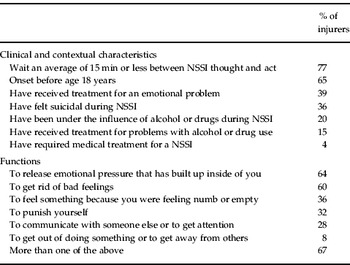
Table 1 summarizes findings regarding NSSI clinical and contextual characteristics and functions. Mean age of onset was 16.1 (s.d.=6.9, median=14) and mean age of most recent NSSI 24.9 (s.d.=12.1, median=20). Individuals endorsing NSSI were more likely to report having received mental health treatment (38.5%) than those not endorsing NSSI [21.8%; χ2(1)=3.9, p<0.05]. Similarly, individuals endorsing NSSI were more likely to report having received treatment for alcohol or drug problems (15.4%) than those not endorsing NSSI (3.4%; χ2(1)=9.0, p<0.005). Regarding context of NSSI, 20% of injurers reported having engaged in NSSI while using alcohol or drugs and 36% reported having engaged in NSSI while feeling suicidal. Altogether, 77% of injurers reported that ⩽15 min typically elapsed between the thought to self-injure and the performance of NSSI. Only one (3.8%) reported requiring medical treatment as a result of physical harm caused by NSSI. None of the clinical or contextual characteristics related to gender, age or ethnicity.
Clinical and contextual characteristics and functions of NSSI

Data based on the 26 of 439 participants who endorsed non-suicidal self-injury (NSSI).
NSSI functions
Regarding functions of NSSI, 64% of injurers reported that they engaged in NSSI ‘to release emotional pressure that has built up inside of you’, 60% ‘to get rid of bad feelings’, 36% ‘to feel something because you were feeling numb or empty’, 32% ‘to punish yourself’, 28% ‘to communicate with someone else or to get attention’ and 8% to ‘to get out of doing something or to get away from others’. In total, 67% of injurers endorsed more than one functional item. Women were more likely to endorse the functions ‘to get rid of bad feelings’ [80% v. 33%; χ2(1)=5.2, p=0.02] and ‘to release emotional pressure that has built up inside of you’ [80% v. 40%; χ2(1)=4.2, p=0.04].
Discussion
The present study is the second to examine NSSI in a regionally and sociodemographically diverse sample of US adults and the first to do so with more than a single item assessing NSSI (i.e. Briere & Gil, Reference Briere and Gil1998). In addition to overall prevalence, specific methods, contextual and clinical characteristics and functions of NSSI were assessed. Therefore, many of the findings are novel and important.
Analyses suggest that the lifetime prevalence of NSSI in the US is approximately 6%, including just over 1% who reported having self-injured ⩾10 times. Lifetime prevalence was notably higher, 19%, among those aged ⩽30 years, consistent with other figures in young adults (Whitlock et al. Reference Whitlock, Eckenrode and Silverman2006). The most common forms of NSSI endorsed were cutting and scraping or scratching skin, followed by burning, hitting, biting and interfering with wound healing – a pattern generally consistent with studies of university students (Whitlock et al. Reference Whitlock, Eckenrode and Silverman2006) and psychiatric patients (Briere & Gil, Reference Briere and Gil1998). Half of the injurers had utilized more than one method. Results might be viewed as roughly comparable with Briere & Gil (Reference Briere and Gil1998), who reported a 4% rate for 6-month prevalence, including 1% who reported ‘often’ engaging in NSSI. Results are also similar to Klonsky et al. (Reference Klonsky, Oltmanns and Turkheimer2003), who found a lifetime rate of 4% in a sample of US young adults from diverse geographic and demographic backgrounds.
Individuals in the present study reporting NSSI were more likely to report having received mental health treatment, including treatment for problems with alcohol or drugs. This pattern is not surprising, given that NSSI is associated with a variety of clinical disorders (Klonsky et al. Reference Klonsky, Oltmanns and Turkheimer2003; Andover et al. Reference Andover, Pepper, Ryabchenko, Orrico and Gibb2005). Median age of onset in this study, 14 years, was consistent with previous studies, which report onset between ages 12 and 14 years (Herpertz, Reference Herpertz1995; Nock et al. Reference Nock, Joiner, Gordon, Lloyd-Richardson and Prinstein2006). Results were also consistent with research suggesting that NSSI begins at or after age 18 years in approximately one-third of cases (Whitlock et al. Reference Whitlock, Eckenrode and Silverman2006). In the present study, 35% of participants reported onset at or after age 18 years. In addition, median age of offset was 20 years, suggesting that NSSI continues beyond adolescence in ⩾50% of cases. NSSI occurred beyond age 25 years in 30% of cases.
Regarding functions of NSSI, the majority of injurers in the present study endorsed reasons related to the regulation of negative affect (e.g. to release emotional pressure, to stop bad feelings) and, to a lesser extent, reasons related to self-punishment and interpersonal influence. This pattern is consistent with previous work, suggesting that US adults engage in NSSI for similar reasons as adolescents (e.g. Nock & Prinstein, Reference Nock and Prinstein2004; Laye-Gindhu & Schonert-Reichl, Reference Laye-Gindhu and Schonert-Reichl2005), university students (e.g. Klonsky, Reference Klonsky2009) and adult psychiatric patients (Briere & Gil, Reference Briere and Gil1998).
Results regarding the context of NSSI are also consistent with previous work. Most injurers in the present study reported that only a few minutes typically elapse between the urge to self-injure and the act of NSSI. Similar findings have been reported for adolescents and adults who self-injure (Favazza & Conterio, Reference Favazza and Conterio1989; Nock & Prinstein, Reference Nock and Prinstein2005; Klonsky & Olino, Reference Klonsky and Olino2008). In addition, similar to studies of adolescent samples (Nock et al. Reference Nock, Prinstein and Sterba2009), the present study found that NSSI in US adults infrequently occurs in the context of suicidal thoughts or use of alcohol or drugs. Nock et al. (Reference Nock, Prinstein and Sterba2009) make two important points that apply to findings both in their study and the current study. First, because NSSI typically occurs without suicidal ideation, results suggest that NSSI is not a form of suicidal behavior. Second, results suggest that NSSI most often occurs while people are sober, even though injurers in this study are likely to report problems with substance or alcohol use.
Finally, in the present study, few sociodemographic variables related to endorsement of NSSI. Notable exceptions were associations of NSSI with younger age and being unmarried. Ethnicity and gender were not related to NSSI. This pattern of associations between NSSI and sociodemographics is comparable with that found in a large study of university students (Whitlock et al. Reference Whitlock, Eckenrode and Silverman2006). In addition, two relationships in the present study were also noted in the only study to examine NSSI in a population-based sample of US adults: like the present study, Briere & Gil (Reference Briere and Gil1998) found that NSSI was related to younger age, but not gender. The relationship with younger age may suggest that NSSI is becoming more common. However, it is also possible that this finding is accounted for by a recall bias. Since NSSI is most often performed in adolescence and young adulthood, younger individuals may be more likely to recall that they engaged in NSSI.
The primary limitation of this study is the sample size. Whereas a sample size of 439 is considered large by some standards, a larger sample is needed to enhance generalizability of findings to the broad population of US adults. In addition, the present study did not include measures of mental disorders, which could help determine the extent to which NSSI is associated with severe psychopathology, as well as the types of psychopathology most likely to co-occur with NSSI. Both limitations can be addressed if future large-scale epidemiological mental health studies, such as the National Comorbidity Survey (Kessler et al. Reference Kessler, Berglund, Demler, Jin, Merikangas and Walters2005), include NSSI in their assessment batteries.
Acknowledgements
The author thanks the Stony Brook University Center for Survey Research for their financial and practical support, and especially Dr Leonie Huddy.
Declaration of Interest
None.