Growing up in poverty significantly increases the likelihood that children will start school well behind their advantaged peers in key areas of language development and emergent literacy skills (Zill et al., Reference Zill, Resnick, Kiim, O'Donnell, Sorongon and McKey2003). Perhaps even more critically, many will start school without the social–emotional maturity and classroom behaviors that foster “readiness to learn,” impeding their rate of progress once in school, and contributing to gaping disparities in school performance, high school graduation rates, and long-term employment potential (Campbell & von Stauffenberg, Reference Campbell, Stauffenberg, Crouter and Booth2008; McClelland, Acock, & Morrison, Reference McClelland, Acock and Morrison2006; Ryan, Fauth, & Brooks-Gunn, Reference Ryan, Fauth, Brooks-Gunn, Spodek and Saracho2006). Rates of child poverty are on the rise in the United States, now affecting nearly one out of five children (Children's Defense Fund, 2005), making the problem of understanding and promoting school readiness a national priority.
Recent efforts to promote school readiness for children growing up in poverty have focused on improving the instructional content of preschool programs, particularly Head Start programs, to enhance children's acquisition of key emergent literacy skills (such as letter identification and phonemic sensitivity) that are strong predictors of later achievement (Lonigan, Burgess, & Anthony, Reference Lonigan, Burgess and Anthony2000). Although important, instructional strategies that focus narrowly on promoting the memorization of discrete content may “miss the mark” developmentally. The long-term impact of preschool interventions may depend on the degree to which they foster the development of mental systems that support learning and adaptive learning behaviors (Blair, Reference Blair2002). For this reason, the Committee on Integrating the Science of Early Childhood Development (Shonkoff & Phillips, Reference Shonkoff and Phillips2000) and others have underscored the importance of promoting self-regulation and social competence in preschool programs as a means to foster the motivation, cooperation, and focused persistence needed for social and academic success in school (see also Denham & Burton, Reference Denham and Burton2003; McClelland et al., Reference McClelland, Acock and Morrison2006; Normandeau & Guay, Reference Normandeau and Guay1998).
Conceptually, the skills associated with cognitive and behavioral readiness for school are highly dependent upon the development of the executive regulatory systems during the preschool years (Blair, Reference Blair2002). Rapid growth in executive control skills between ages 3 and 5 enables children to organize their thinking and behavior with increasing flexibility, decrease their reactive responding to contextual cues and contingencies, and engage in self-regulated and rule-governed behavior (Barkley, Reference Barkley2001). Executive function (EF), as manifest in the capacity to inhibit a prepotent or dominant response and choose an alternative response, improves concordantly, enabling children to better regulate the emotions that motivate and inform their exploration of their physical and social worlds (Derryberry & Rothbart, Reference Derryberry and Rothbart1997; Kochanska, Murry, & Harlan, Reference Kochanska, Murray and Harlan2000). In this paper, we use the term EF skills to refer to a complex but well-delineated set of cognitive regulatory processes (Friedman et al., Reference Friedman, Miyake, Corley, Young, DeFries and Hewitt2006) that underlie adaptive, goal-directed responding to novel or challenging situations (Hughes & Graham, Reference Hughes and Graham2002.)
Despite their potentially central role in fostering school readiness, EF skills have received little explicit attention in the design and evaluation of school readiness interventions for socioeconomically disadvantaged children. However, on the basis of findings with older children, it is hypothesized that EF skills may serve as outcomes, moderators, and mediators of school-based preventive interventions. In the present study we examine how measures of EF are related to a year-long school readiness intervention. The intervention involved a randomized-controlled trial of research-based curricula and teaching strategies that were integrated into Head Start programs to promote language/emergent literacy and social–emotional skills associated with school readiness (Head Start REDI [Research-Based, Developmentally Informed]; Bierman et al., Reference Bierman, Domitrovich, Nix, Gest, Welsh and Greenberg2007). Given findings on the relations among EF skills, early reading skills, and social–emotional competencies, we hypothesized that an intervention that focused on self-regulation (teaching children ways to calm down), emotional awareness, and social problem solving would lead to changes in EF skills, as well as the relation of EF skills to outcomes. In this study, we address four key questions:
1. Did children's EF skills at the beginning of the prekindergarten year enhance their development in areas of cognitive and social–emotional school readiness?
2. Did these skills moderate their response to the Head Start REDI intervention?
3. Did the intervention improve children's EF skills?
4. Did improvements in child EF skills mediate child outcomes in areas of cognitive or social–emotional school readiness?
What Is School Readiness?
Children who start kindergarten with strong emergent literacy and numeracy skills are at an advantage in terms of initial school adjustment and learning to read (Lonigan et al., Reference Lonigan, Burgess and Anthony2000). In particular, a growing body of research evidence highlights the importance of the skills acquired during the preschool years that serve as precursors to the development of later reading and writing (Lonigan, Reference Lonigan2006; Snow, Burns, & Griffin, Reference Snow, Burns and Griffin1998). For example, in a meta-analyses conducted by the National Early Literacy Panel (2005), phonological sensitivity (the capacity to detect and manipulate sounds and parts of words) and alphabet knowledge both showed robust predictive associations with later reading decoding and comprehension skills (correlations = .39–.50). Oral language skills, including vocabulary and syntax, also support reading comprehension. In addition, they foster children's abilities to understand and comply with the behavioral demands of school (Catts, Fey, Zhang, & Tomblin, Reference Catts, Fey, Zhang and Tomblin1999). These findings underscore the value of focusing on oral language and emergent literacy skills in Head Start programs to enhance children's cognitive school readiness (Lonigan et al., Reference Lonigan, Burgess and Anthony2000).
Equally important is the acquisition of the social–emotional competencies that support adaptive behavioral adjustment to school and mature approaches to learning (Hughes & Kwok, Reference Hughes and Kwok2006). During the preschool years, growth in inhibitory control skills promotes the capacity to follow classroom rules, sit still, and learn on demand through listening and watching (McClelland et al., Reference McClelland, Acock and Morrison2006). Increases in goal-oriented motivation foster learning initiative and sustained, independent attempts at problem solving and skill mastery (Normandeau & Guay, Reference Normandeau and Guay1998). Concurrently, emotion regulation skills and social competence show significant growth during the preschool years. Empathy and altruism emerge, as children recognize and differentiate a broader array of emotions, and begin to understand that their actions can cause feelings in other people that are different from their own. Prosocial behaviors, such as helping, sharing, and taking turns, increase as children begin to understand the “golden rule” principles of social exchange and reciprocity (Howes, Hamilton, & Philipsen, Reference Howes, Hamilton and Philipsen1998). Rates of aggression show corresponding declines, as children gain the self-regulatory skills that allow them to inhibit reactive aggression in favor of socially appropriate alternatives (Cole, Usher, & Cargo, Reference Cole, Usher and Cargo1993). The acquisition of these social competencies (emotion regulation, prosocial skills, and aggression control) represent another important facet of school readiness, predicting kindergarten and elementary school engagement and academic success, as well as positive peer relations (Coolahan, Fantuzzo, Mendez, & McDermott, Reference Coolahan, Fantuzzo, Mendez and McDermott2000; Ladd, Price, & Hart, Reference Ladd, Price and Hart1988; Vitaro, Gagnon, & Tremblay, Reference Vitaro, Gagnon and Tremblay1990).
Biological Basis of EF
Conceptually, the development of the executive regulatory system (encompassing an array of EF skills) plays a central role in supporting the preschool child's acquisition of adaptive approaches to learning and social–emotional competencies (Blair, Reference Blair2002). Considered as a set of interrelated cognitive processes, the executive regulatory system organizes and regulates information and behavior in response to complex task demands (Blair, Reference Blair2002; Diamond, Reference Diamond, Stuss and Knight2002). The neural areas that underlie EF capacities include structures in the dorsolateral prefrontal, anterior cingulate, and parietal cortex, which have extensive interconnections with the ventral medial frontal and limbic brain structures associated with emotional reactivity and regulation. In combination, these cortical and limbic structures support the emotion–arousal systems associated with behavioral inhibition in reaction to punishment or novelty and those associated with behavioral approach in reaction to reward; they are also involved in reactions to threat and stress (Blair, Zelazo & Greenberg, Reference Blair, Zelazo and Greenberg2005; Gray, Reference Gray1982). The self-regulation processes that develop in the prefrontal cortex serve to modulate, either by enhancing or inhibiting, the reactive state of these arousal systems (Derryberry & Rothbart, Reference Derryberry and Rothbart1997). As such, the executive regulatory system directly influences and is influenced by emotional and autonomic responses to stimulation. It plays a central role in the developing ability to regulate attention, emotion, and behavior during the preschool years (Rueda, Posner, & Rothbart, Reference Rueda, Posner and Rothbart2005).
Social Basis of EF
Although the development of EF skills depends upon biological maturation, the process appears heavily influenced by environmental experiences and input (Blair, Reference Blair2006; Ceci, Reference Ceci1991; Cicchetti, Reference Cicchetti2002). Children who experience extreme adversity in their early years, such as maltreatment or severe neglect, show increased levels of attention problems, emotion dysregulation, and language delays (Cicchetti, Reference Cicchetti2002; O'Connor, Rutter, Beckett, et al., Reference O'Connor, Rutter, Beckett, Kreppner and Keaveney2000). The experience of traumatic events affects neuroendocrine and autonomic stress reactivity, increasing the demands on executive regulatory systems (Cicchetti, Reference Cicchetti2002). In addition, EF development depends, in part, upon sensitive-responsive caregiving and opportunities for guided exploration of the social and physical environment, fostering sustained joint attention, emotional understanding, planning, and problem-solving skills (Goldsmith & Rogoff, Reference Goldsmith and Rogoff1997; Lengua, Honorado, & Bush, Reference Lengua, Honorado and Bush2007; Kochanska et al., Reference Kochanska, Murray and Harlan2000). When children experience the factors associated with family poverty, including maternal depression, low levels of social support, stressful life events, and exposure to violence, they are more likely to display delays in the development of EF (Goldsmith & Rogoff, Reference Goldsmith and Rogoff1997; Lengua et al., Reference Lengua, Honorado and Bush2007; Li-Grining, Reference Li-Grining2007). For these reasons, school readiness interventions designed to reduce the delays associated with socioeconomic disadvantage may need to attend more carefully to EF development to better understand and maximize intervention impact.
Measuring EF Skill Development in the Preschool Years
Based on extensive measurement research primarily with adults and older children, three distinct but interrelated components of EF have been identified. These include working memory, inhibitory control, and attention shifting or flexibility (Friedman et al., Reference Friedman, Miyake, Corley, Young, DeFries and Hewitt2006; Miyake et al., Reference Miyake, Friedman, Emerson, Witzki, Howerter and Wagner2000). No consensus has yet emerged regarding the degree to which these three components of EF can be separately measured in preschoolers (Carlson, Reference Carlson2005; Davidson, Amso, Anderson, & Diamond, Reference Davidson, Amso, Anderson and Diamond2006) or the extent to which the precise measurement of these component processes, or of behaviors that are dependent upon them, predict to specific aspects of school readiness.
Working memory allows the child to hold and act on mental representations. Working memory may foster the acquisition of academic knowledge by allowing children to hold more information for a longer period of time, engage in mental rehearsal, and thereby increase opportunity for consolidation of information into long-term memory (Bull & Scerif, Reference Bull and Scerif2001). Working memory can also support social–emotional competence by allowing children to create mental templates that guide delayed imitation and support rule-governed behavior. The elaborated play of older preschool children, including their ability to sustain synchronized, thematic play, and negotiate turn taking and resource sharing, reflects their growing capacity to mentally represent and follow social scripts, tracking social exchange as they go (Barkley, Reference Barkley2001; Nelson, Reference Nelson, Fivush and Haden2003). Working memory is often assessed with fairly discrete cognitive tasks, such as backward word span (Davis & Pratt, Reference Davis and Pratt1996), in which a child must hold words in mind and repeat them in backward order.
Inhibitory control involves the capacity to interrupt a prepotent, habitual, or reactive response and enact an alternative less salient, subdominant response associated with goal attainment. Miyake et al. (Reference Miyake, Friedman, Emerson, Witzki, Howerter and Wagner2000) and Barkley (Reference Barkley2001) both suggest that inhibitory control plays a central role in fostering self-regulation, by creating a delay in responding that enables behavioral flexibility and makes possible the strategic selection of alternative behaviors. Inhibitory control may play a critical role in academic learning, as well, by promoting children's capacity to think about multiple dimensions of or perspectives on a problem, rather than being “stuck” in their initial perceptual set (Diamond, Carlson, & Beck, Reference Diamond, Carlson and Beck2005).
Although often described as a single process, several studies suggest that cognitive and motor inhibitory control represent distinct, although related, processes. For example, Carlson and Moses (Reference Carlson and Moses2001) found that the EF tasks they administered to preschool children to assess inhibitory control formed two factors. One factor, Conflict, involved tasks that required children to select a novel response in the face of a conflicting prepotent response. The other factor, Delay, was defined by tasks that required children to delay or slow down a prepotent response. Also working with preschool children, Li-Grining (Reference Li-Grining2007) found two very similar factors. One factor, Executive Control, required children to delay behavior and remember complex rules, such as tapping a pencil once when the experimenter tapped twice and tapping twice when the experimenter tapped once. The other factor, Delay of Gratification, involved more straightforward behavioral control, such as slowing down when asked to walk a line slowly. These two dimensions of inhibitory control were correlated in both studies but were differentiated in factor analyses, reflecting the different demands they create for cognitive versus behavioral inhibition.
A third EF skill that develops rapidly during the preschool period involves the capacity to shift and sustain attention. This capacity fosters learning by allowing children to strategically focus and disengage attention, maintain concentration, resist interference, and ignore distractions (Posner & Petersen, Reference Posner and Peterson1990; Rothbart, Posner, & Hershey, Reference Rothbart, Posner, Hershey, Cicchetti and Cohen1995). Young preschool children show strong “attentional inertia,” finding it difficult to think about the same thing in two different ways or to change from one perspective to another (Diamond et al., Reference Diamond, Carlson and Beck2005). With development, enhanced attentional flexibility supports both the regulation of arousal and the maintenance of information in working memory (Chang & Burns, Reference Chang and Burns2005; Derryberry & Rothbart, Reference Derryberry and Rothbart1997). Attention set shifting is often measured with tasks such as the dimensional change card sort (DCCS), in which children learn to sort cards according to one criteria, such as color, and then are asked to switch and sort by a second criteria, such as shape (Frye, Zelazo, & Palfai, Reference Frye, Zelazo and Palfai1995).
EF tasks often utilize more than one EF skill; for example, DCCS performance relies on working memory and inhibitory control, as well as attention set shifting. Considerable research has been focused on identifying the discrete cognitive skills involved in various tasks requiring EF, in order to better understand how these specific skills develop and affect performance (Zelazo, Muller, Frye, & Marcovitch, Reference Zelazo, Muller, Frye and Marcovitch2003).
A second type of research question, particularly salient for programs designed to foster school readiness, involves research clarifying the relations among various EF skills and adaptive functioning in the school context. Conceptually, the EF skills associated with the ability to hold ideas in working memory, demonstrate inhibitory control, and flexibly deploy attention should all have high relevance for academic and behavioral adaptation at school (Diamond, Reference Diamond, Stuss and Knight2002). This may be particularly true for early mathematical ability, as several studies have shown predictive relations between working memory, inhibitory control, and attention shifting measures of EF and math skill acquisition in preschool and the early elementary grades (Blair & Razza, Reference Blair and Razza2007; Bull & Scerif, Reference Bull and Scerif2001; Espy et al., Reference Espy, McDiarmid, Cwik, Stalets, Hamby and Senn2004). Several studies also suggest, however, that EF skills assessed via behavioral measures may relate particularly well to behavioral measures of school readiness. For example, when Brophy, Taylor, and Hughes (Reference Brophy, Taylor and Hughes2002) compared “hard to manage” 4-year-olds with normative peers, they found no deficits in cognitive performance tasks assessing set-shifting or working memory skills, but they did observe behavioral deficits in the degree to which the hard to manage children followed rules and showed perseverative errors on EF tasks. Their findings are consistent with those of White et al. (Reference White, Moffitt, Caspi, Bartusch, Needles and Stouthamer-Loeber1994), who found that measures of cognitive and behavioral impulsivity factored separately, with the behavioral impulsivity measures showing higher associations with measures of aggressive behavior. These findings suggest that EF skills require further study, using a range of EF measures to better understand how various dimensions of EF relate to learning and social–emotional behavior at school. Potentially, measures that assess the integrative functioning of the executive regulatory system on complex performance tasks with both cognitive and behavioral inhibitory control demands predict school adaptation more effectively than measures that assess discrete EF skills.
The Present Study
Little is known about how the developing EF skills of preschool children affect and are affected by school readiness interventions. The present study explored this issue, within the framework of a school readiness intervention designed for socioeconomically disadvantaged 4-year-olds. We assessed a range of cognitive and behavioral performance tasks reflecting EF skill development, and explored alternative hypotheses regarding the degree to which these skills might be improved with intervention, and might moderate or mediate intervention effects on cognitive and social–emotional indices of school readiness.
EF as a moderator of preschool learning
One hypothesis was that delays in EF development among children growing up in poverty might limit their capacity to respond to preschool instructional curricula. Prior research suggests that delays in EF skills increase the likelihood that children will experience adjustment and learning problems in the elementary school context. For example, following first- and second-grade children, Riggs, Blair, and Greenberg (Reference Riggs, Blair and Greenberg2003) found that cognitive performance tasks reflecting EF skills (sequencing abilities on the Wechsler Intelligence Scale for Children—Revised coding subtest and inhibitory control on the Stroop) predicted changes in externalizing problems (reported by parents and teachers) and internalizing problems (reported by parents) over the course of the school year, with initial academic ability and behavior controlled. In a second study with a larger sample, similar cognitive performance tasks (trails and the Stroop Test) predicted teacher ratings of positive social competencies (Nigg, Quamma, Greenberg, & Kusche, l999).
Although these studies focused on elementary students, it is possible that EF skills also affect the degree to which younger children benefit from their preschool experiences. Without sufficient attentional and behavioral regulation skills, some preschool children may benefit less from classroom lessons and interactions with teachers, and may not engage effectively in structured academic or social learning opportunities. These children may also be more likely to develop negative perceptions of the early learning environment and of themselves as learners.
In the present study, we examined the impact of child EF skills at the start of the prekindergarten year on responsivity to the REDI intervention. We anticipated that, in nonintervention classrooms, children with higher levels of EF skills would learn more during the Head Start year than children who started the year with low levels of EF skills. However, we anticipated that the REDI intervention might help children with low-EF skills engage more effectively in classroom learning, thus improving their gains. Alternatively, it was also possible that, as a classroom-level intervention, REDI would be of most benefit to children with higher initial levels of EF skills. Evidence of moderation in this latter direction would have important policy implications, as it could suggest that children with low levels of EF skill development may need more intensive and individualized support than children with greater cognitive maturity in order to benefit from classroom-based programs.
EF as a mediator of preschool intervention
It is also possible that effective school readiness interventions promote the development of EF skills (Greenberg, Reference Greenberg2006), which in turn, promote the development of other academic and social skills. For example, Riggs, Greenberg, Kusche, and Pentz (Reference Riggs, Greenberg, Kusche and Pentz2006) found that the promoting alternative thinking strategies (PATHS) curriculum, implemented in second and third grade, improved children's inhibitory control (assessed with the Stroop Test) and verbal fluency. Furthermore, improvements in these skills predicted lower rates of internalizing and externalizing behavior problems (by teacher report) at the 1-year follow up, and mediated intervention effects on reduced behavior problems.
There are several reasons to expect that the Preschool PATHS (Domitrovich, Cortes, & Greenberg, Reference Domitrovich, Cortes and Greenberg2007) curriculum, which we used in the Head Start REDI intervention, might similarly foster the development of EF skills among preschool children. Preschool PATHS focuses on the EF-related goals of self-regulation, self-awareness, and social problem solving, and promotes the use of these skills in social interactions. Preschool PATHS begins by establishing classroom rules and routines and introducing a daily compliment activity, increasing the level of warm support and predictable social order in the classroom. Lessons and activities in the friendship unit provide explicit instruction, modeling, discussion, and practice in the skills and rewards of social exchange (helping, sharing, taking turns). Lessons in the feelings unit illustrate different feelings with photos, stories, discussions, and role plays, which combined with teacher “emotion coaching,” enhances children's abilities to recognize and label their own feelings and those of others. These activities could foster the development of EF skills by promoting the development of perspective taking and empathy and fostering the understanding of learning routines, self-awareness, extended social scripts, and cause–effect relations.
Lessons in the Preschool PATHS Self-Control unit teach children a strategy for emotion regulation (“doing turtle”). Based upon a modeling story, children are shown how they can calm down when they are upset or overly excited; they can stop their behavior, go into their shell (hug themselves), take a deep breath to calm down, and state the problem and how they feel. This explicit behavioral sequence is modeled and reinforced extensively as teachers intervene when children are aroused by a disagreement or frustration, and support them in using self-calming (“turtle”) and social problem-solving strategies to work out a plan. Conceptually, these cognitive and behavioral experiences should enhance the maturation of executive control capacities, by supporting the effortful control of emotion and behavior (Greenberg, Reference Greenberg2006).
In addition, the Head Start REDI program utilized an interactive reading program (Wasik, Bond, & Hindman, Reference Wasik, Bond and Hindman2006; Whitehurst et al., Reference Whitehurst, Arnold, Epstein, Angell, Smith and Fischel1994) that also may support EF skill development. In this program, teachers used questions, discussion, and story retelling to encourage child recall and narrative comprehension of stories. Teachers also were taught to use active listening, language expansions, and decontexutalized talk to encourage child reasoning, memory, and planning skills, which are essential elements of EF. Thus, a central goal of the current study was to determine whether EF skills were affected by the Head Start REDI intervention and, if so, to determine whether changes in these skills mediated intervention effects on other outcomes.
Study design and hypotheses
In the present study, 44 Head Start classrooms were randomly assigned to an enriched intervention Head Start (Head Start REDI) or to “usual practice” classrooms. The enrichment program included the Preschool PATHS Curriculum and components targeting language and emergent literacy skills. Assessments tracked the progress of 356 4-year-old children over the course of the prekindergarten year. It was hypothesized that children's initial EF skills would enhance children's acquisition of social–emotional and emergent literacy skills during the prekindergarten year, and would serve as moderators of child response to the REDI intervention. It was further hypothesized that the REDI intervention would promote EF skill development during the prekindergarten year. Finally, we anticipated that improvements in EF skills promoted by the intervention would partially mediate intervention effects on other school readiness outcomes.
Methods
Design overview
Head Start Programs in three counties participated in this trial. Using a stratified randomization process, classes were divided into groups based on demographic characteristics of the population served, location (e.g., central or southeastern Pennsylvania), and length of school day (e.g., full day, half day, year round). Within stratified groups, centers were randomly assigned to intervention or control conditions. Although classrooms contained 3- and 4-year-old children, only 4-year-olds participated in this evaluation. Prior to the trial, some children had attended Head Start as 3-year-olds (58% in the intervention condition, 61% in the control condition), and preintervention test scores were used when possible to statistically control for initial differences in child skills.
Participants
Participants included 356 children in 44 Head Start classrooms (17% Hispanic, 25% African American, 42% European American; 54% girls). They were recruited via brochures sent home at the beginning of the school year. Only 14 eligible families declined to participate, but an additional 40 families were unable to complete the assessments (e.g., could not be reached or withdrew early from Head Start). Overall, 86% of the eligible children participated. At the beginning of the Head Start year, children were, on average, 4.49 years old (SD = 0.31, range = 3.72–5.65). On the Block Design Scale of the Wechsler Preschool and Primary Scale of Intelligence—III, a measure of nonverbal cognitive ability that is highly correlated with full scale IQ (r = .72; Wechsler, Reference Wechsler2002), children received an average standard score of 7.98 (SD = 2.88), approximately 0.66 standard deviations below the national mean of 10 (comparable to similar samples of children growing up in poverty).
Intervention design
The intervention was delivered by classroom teachers, integrated into their ongoing classroom programs (High Scope or Creative Curriculum). It included curriculum-based lessons, center-based extension activities, and training in “coaching strategies” to support generalized skill development. Teachers attended training workshops (a total of 4 days) and received weekly mentoring that was provided by local educational consultants. Extensive monitoring of program implementation indicated that teachers were able to deliver the intervention with relatively high levels of fidelity (see Bierman et al., Reference Bierman, Domitrovich, Nix, Gest, Welsh and Greenberg2007, for details).
Language/emergent literacy skill enrichment
Four language and emergent literacy skills were targeted in REDI: (a) vocabulary, (b) syntax, (c) phonological sensitivity, and (d) print knowledge. An interactive reading program was developed, based upon the shared reading program of Wasik and Bond (Reference Wasik and Bond2001; Wasik et al., Reference Wasik, Bond and Hindman2006) and the dialogic reading program of Whitehurst et al. (Reference Whitehurst, Arnold, Epstein, Angell, Smith and Fischel1994). Teachers read two books per week using interactive strategies, targeted vocabulary with illustrative props, and utilized story retelling to encourage child recall and narrative comprehension. “Sound games” included brief activities taught three times per week, which led children through a developmentally sequenced set of phonological sensitivity skills (e.g., listening, rhyming, alliteration, words and sentences, syllables, and phonemes; based upon Adams, Foorman, Lundberg, & Beeler, Reference Adams, Foorman, Lundberg and Beeler1998). To foster print knowledge, teachers utilized a set of letter-learning activities in their alphabet centers.
Social–emotional skill enrichment
The Preschool PATHS Curriculum (Domitrovich et al., Reference Domitrovich, Cortes and Greenberg2007) was used to foster social–emotional skill development. This 33-lesson curriculum targeted four skill domains: (a) prosocial friendship skills, (b) emotional understanding and emotional expression skills, (c) self-control, and (d) social problem solving skills. Teachers presented skill concepts using modeling stories, puppet characters, photographs, and role-play demonstrations. Coordinated extension activities (e.g., cooperative projects and games) provided opportunities for skill practice. Teachers were also encouraged to use positive classroom management practices, “emotion coaching,” and induction strategies to support appropriate self-control. To enhance the integration of language/literacy and social–emotional programs, the interactive reading program used a PATHS book each week (e.g., on friendship, feelings, self-control, or social problem solving), and feeling words were included in the vocabulary prompts.
Parent take-home materials
Three “take-home” packets were mailed to parents during the course of the year, each containing a modeling videotape, with parenting tips and learning activities to use at home. In addition, parents received regular PATHS handouts.
Assessment procedures
Child assessments were conducted at school by trained interviewers, during two individual “pull-out” sessions (30–45 min each). Assessments began 3 weeks after school started and continued through the end of October. End of year child assessments were conducted in March and April. In April teachers were asked to complete ratings on each child in the study (and were compensated $7 for each). One lead and one assistant teacher in each classroom provided independent ratings of child behavior. Beginning in April, each child was also observed during two 12–15-min play sessions, held on 2 separate days. Classmates were taken in random groups of three to a separate space and given the opportunity to play with an interesting and novel toy together. Observers, who were naive concerning the intervention–control status of the children, rated children's social competence and aggression.
Measures of EF
Cognitive performance tasks
Three cognitive performance tasks were used to assess EF skills. On the backward word span task, which assessed working memory, children were asked to repeat a list of words in backward order (Davis & Pratt, Reference Davis and Pratt1996). The practice list and the first list each contained two words, and subsequent lists gradually increased to a total of five words. A child's score represented the highest number of words he/she repeated accurately.
In the peg tapping task (Diamond & Taylor, Reference Diamond and Taylor1996), which assessed working memory and inhibitory control, children were asked to tap their peg twice when the interviewer tapped once, and visa versa. Scores represented the correct number of trials out of 16 (α = .87 and .84 in the fall and spring, respectively).
The third EF task, DCCS (Frye et al., Reference Frye, Zelazo and Palfai1995), involved target cards that varied along the dimensions of color and shape (e.g., red and blue, rabbits and boats). After learning to sort the cards according to one dimension (shape or color), the children were asked to sort the cards according to the other dimension. This task utilizes working memory, inhibitory control, and set shifting skills. The score represented the number of trials (out of six) in which the child correctly shifted sets after the sorting criteria changed (α = .94 and .93 in the fall and spring, respectively).
Behavioral performance tasks
We also utilized two behavioral performance measures of EF skills. Whereas the cognitive performance measures tapped discrete cognitive functions associated with EF, these behavioral performance measures reflected a more diffuse assessment of the child's organizational capacity and effortful control, in which EF skills play a central role. The walk-a-line slowly task (Kochanska, Murray, Jaques, Koenig, & Vandegeest, Reference Kochanska, Murray, Jacques, Koenig and Vandegeest1996) assessed behavioral inhibitory control on a motor task. Children were asked to walk along a 6 ft.-long piece of string taped to the floor as the examiner timed them. Children were then asked to repeat the task twice, walking as slowly as they could. Total scores represented the average percentage by which children were able to reduce their speed on successive trials. Those scores were log-transformed to achieve a more normal distribution.
The final behavioral measure reflected the child's capacity to sustain a focused task orientation during the testing sessions (Smith-Donald, Raver, Hayes, & Richardson, in press). After administering the child assessment battery, interviewers rated 13 items reflecting the child's capacity to sustain attention to the tasks (“pays attention to instructions and demonstrations,” “sustains concentration; willing to try repetitive tasks”), demonstrate self-regulation (“can wait during and between tasks,” “modulates and regulates arousal level”), and engage actively to achieve a goal (“shows pleasure in accomplishment and active task mastery,” “careful, interested in accuracy”). Each item was rated on a 4-point scale, with clear behavioral descriptors (α = .93). Scores from the two assessment sessions were averaged (r = .57, p < .001, and r = .62, p < .001, for fall and spring, respectively).
Measures of school readiness
The outcomes examined in this study included cognitive school readiness (direct tests of child language and emergent literacy skills) and social–emotional school readiness (teacher and observer ratings of social competence, and aggressive–disruptive behaviors).
Language and emergent literacy
The Expressive One-Word Picture Vocabulary Test (Brownell, Reference Brownell2000) was used to assess children's vocabulary. Children were asked to give the word that best described pictures they were shown. Past research has demonstrated high levels of internal reliability and predictive validity for this test (α = .94).
The Blending and Elision Scales of the Test of Preschool Early Literacy (TOPEL; Lonigan, Wagner, Torgesen, & Rashotte, Reference Lonigan, Wagner, Torgesen and Rashotte2007) were used to assess phonological sensitivity. The blending task required children to combine different parts of a word, such as “hot” and “dog” or “b” and “air,” and point to the corresponding picture or name the correct word (α = .86). The Elision Scale required children to deconstruct different parts of words and point to the correct picture, or say the correct word, such as, “snowshoe” without “snow” (α = .83). Scores on the Blending and Elision Scales were standardized and averaged to form one index of phonological sensitivity (r = .50, p < .001).
The Print Knowledge Scale of the TOPEL assessed children's familiarity with written text. In this scale, children identified pictures of letters or words and named letters (α = .97).
Social–emotional regulation
The nine items of the Social Competence Scale (Conduct Problems Prevention Research Group, 1995) were rated on a 6-point Likert scale (never to almost always) and included prosocial behaviors such as sharing, helping, understanding other's feelings, as well as items describing emotion regulation, such as being able to calm down when upset and resolving peer problems independently (α = .94). Ratings provided by lead and assistant teachers were averaged (r = .56, p < .001). Observers used the same rating scale to describe child behavior after each of the play observation sessions (α = .88). Interrater reliability was assessed for 23% of the play sessions, and demonstrated adequate agreement (intraclass correlation coefficient [ICC] = .70). Ratings collected after each of the two different play-group sessions were averaged (r = .24, p < .001).
Seven items from the Teacher Observation of Child Adaptation—Revised (TOCA-R; Werthamer-Larsson, Kellam, & Wheeler, Reference Werthamer-Larsson, Kellam and Wheeler1991) assessed overt aggression (e.g., stubborn, yells, fights). Six items from the Preschool Social Behavior Scale—Teacher Form (Crick, Casas & Mosher, Reference Crick, Casas and Mosher1997) assessed relational aggression (e.g., “tells other kids he/she won't be their friend unless they do what he/she wants”). Items from both measures were rated on a 6-point Likert scale (almost never to almost always, α = .88 and .93, respectively). Ratings from lead and assistant teachers were averaged (r = .68, p < .001, for overt aggression and r = .51, p < .001, for relational aggression), and overt and relational ratings were combined to form a total aggression score (r = .58, p < .001). After each of the two play groups, observers completed the seven items from the TOCA-R (α = .93 and .92, respectively). Interrater agreement among observers was acceptable (ICC = .74), and ratings were averaged across the two sessions (r = .42, p < .001).
Results
Preliminary analyses
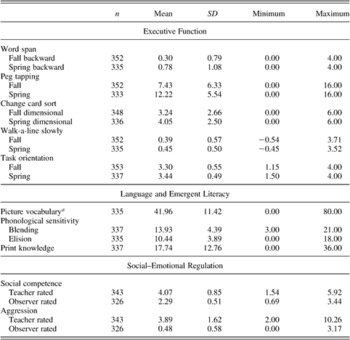
Table 1 presents descriptive statistics for the study variables. Measure raw scores are presented in the table, but standardized scores (M = 0, SD = 1) were used in all analyses. Although this kind of linear transformation does not affect statistical tests, it establishes a common scale for the metrics across measures and provides guidance for interpreting the magnitude of effects. For example, a coefficient of .25 represents 0.25 standard deviation.
Descriptive statistics of executive function measures and outcomes

aExpressive One-Word Picture Vocabulary Test.
In general, children who were older at the beginning of the Head Start year performed better on the preintervention assessments of EF skills. Correlations with child age were .13 for backward word span, .32 for peg tapping, .27 for DCCS, and .17 for task orientation (all ps < .01). Only performance on walk a line slowly was unrelated to age, r = .00.
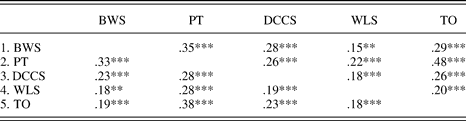
Relations among the measures of EF skills, controlling for the age of children, are presented in Table 2. All of these relations were significant and moderate in magnitude, with an average correlation of .24 and .27 in the fall and spring of Head Start, respectively.
Relations among measures of executive function
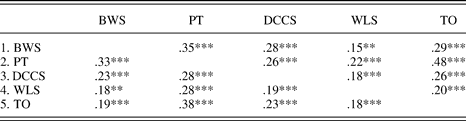
Note: BWS, backward word span; PT, peg tapping; DCCS, dimensional change card sort; WLS, walk-a-line slowly; TO, task orientation. Relations below the diagonal are for preintervention measures; relations above the diagonal are for end of year measures. Child's age is controlled.
**p < .01. ***p < .001.
Predicting gains in school readiness during the prekindergarten year
In the first stage of analyses, we examined the impact of children's EF skills at the very beginning of the prekindergarten year on their acquisition of academic skill gains and their behavioral outcomes at the end of the year. Our hypothesis was that children who began the prekindergarten year with higher EF skills would show better school engagement and benefit more from classroom lessons and experiences than preschool children who began the year with lower levels of EF skills. Hierarchical linear models were estimated, accounting for the nesting of children within classrooms. Child gender, race, age, nonverbal cognitive ability (block design), and preintervention scores on the EF measures were included as Level 1 independent variables. Preintervention scores for vocabulary, phonological sensitivity, and print knowledge also were included as Level 1 variables, but preintervention scores were not available for teacher or observer ratings of social competence or aggression. Program location, cohort, and intervention status were included as Level 2 variables.
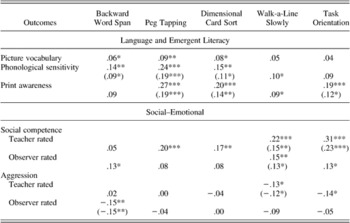
Initially, the contribution of each of the five EF measures was examined separately. As shown in Table 3, EF skills at the start of the year predicted significant gains in each of the language/emergent literacy skills and also predicted end of year behavioral outcomes. The cognitive performance EF skills (backward word span, peg tapping, DCCS) were particularly consistent predictors of gains in language/emergent literacy skills and teacher-rated social competence (10 of the 12 correlations were significant). In contrast, the behavioral performance EF skills (walk-a-line slowly, task orientation) were consistent predictors of social–emotional outcomes (6 of the 8 correlations were significant), and also predicted gains in print knowledge. It is important to note that these analyses are conservative, given that they control for block design, which may also utilize EF skills.
Executive function skills predicting growth in cognitive and behavioral competencies

Note: The numbers in parentheses represent unique contributions, when other executive function measures are controlled. Analyses also control for nonverbal IQ and child age.
*p < .05. **p < .01. ***p < .001.
To determine whether the separate EF tasks were accounting for shared or unique variance in outcomes, we reestimated these hierarchical linear models with all five EF measures simultaneously included as predictors. These results are also presented in Table 3. When an EF measure made a statistically significant unique contribution to the prediction of a school readiness outcome, the parameter estimate is shown in parentheses. The cognitive performance EF measures were more likely to account for unique variance in the growth of language and emergent literacy skills across the school year, whereas the behavioral performance EF measures were more likely to account for unique variance in social–emotional outcomes.
Exploring moderation of the Head Start REDI intervention effects
In the second stage of data analyses, we examined the impact of children's initial EF skills on their response to the Head Start REDI intervention. We anticipated that the intervention might be particularly helpful to children with lower levels of initial EF skills, as it might enhance their engagement in the classroom and subsequent learning. Alternatively, children with low levels of initial EF skills might not benefit from an intervention program like REDI delivered at the classroom level. To test for moderation, we reestimated our hierarchical linear models (described earlier) and added an interaction term, calculated as the product of the preintervention score on each EF measure and intervention status (REDI = 1, control = 0).
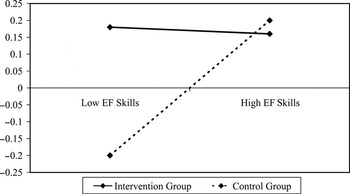
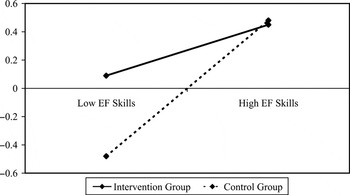
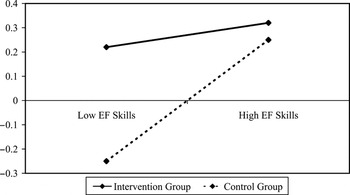
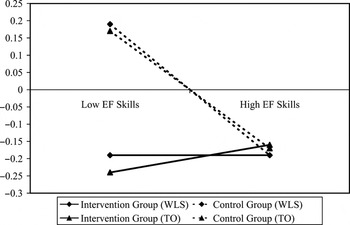
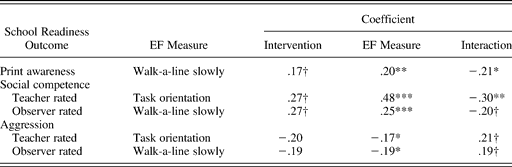
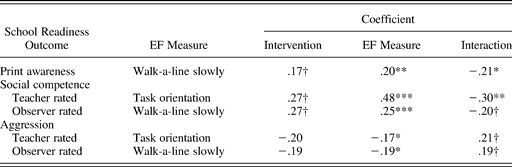
Altogether, 21 hierarchical linear models were estimated for the cognitive performance measures of EF (seven school readiness outcomes × three cognitive performance measures of EF) and none of these were statistically significant (all ps > .10). Fourteen hierarchical linear models were then estimated for the behavioral performance measures of EF (seven school readiness outcomes × two behavioral performance measures of EF). In this case, two of the interactions were statistically significant, and three were marginally significant (see Table 4). The direction of moderation was similar for all outcomes. Children with lower preintervention skills on the behavioral performance measures of EF (Walk a line slowly and task orientation) showed higher levels of social competence, reduced aggression, and improved print knowledge at the end of the year if they were in a Head Start REDI classroom rather than a regular Head Start classroom. In contrast, children with higher skills on these behavioral performance measures of EF at the start of the year did equally well (in terms of social competence, aggression, and print knowledge) whether they were in the REDI or “usual practice” Head Start classrooms. The findings are illustrated in Figures 1–4, which show the predicted outcome scores for children in the intervention versus control condition, who were one standard deviation above and below the sample mean on the relevant EF measure (walk-a-line slowly or task orientation) at the start of the year.
The initial performance on walk-a-line slowly moderates the intervention effect on print awareness.

The initial task orientation moderates the intervention effect on teacher-rated social competence.

The initial performance on walk-a-line slowly moderates the intervention effect on observer-rated social competence.

The initial performance on walk-a-line slowly and task orientation moderate the intervention effect on observer-rated aggression.

Executive function (EF) moderation of intervention effects on school readiness
† p < .10. *p < .05. **p < .01. ***p < .001.
Intervention effects on EF skills
In the third stage of data analyses, we tested whether the Head Start REDI intervention affected the development of children's EF skills. We again estimated hierarchical linear models that controlled for child gender, race, age, nonverbal cognitive ability, preintervention scores on each EF measure, location, and cohort. Because the distribution of scores on backward word span was so unusual (most children received a score of 0, and only a few children received scores of 2, 3, or 4) we estimated a random effects ordered probit model for that measure.
No significant intervention effects emerged for backward word span, peg tapping, or walk a line slowly, with coefficients of .01, .06, and −.11, respectively (all ps > .10). However, a marginally significant (p = .06) intervention effect emerged on DCCS, with children in the intervention classrooms showing gains in DCCS that were comparable to an effect size of .20. In addition, a significant intervention effect emerged on task orientation (p < .05), with children in the intervention classrooms exhibiting gains that were comparable to an effect size of .28. Thus, intervention effects were evident on two aspects of EF, a cognitive performance task (DCCS) and a behavioral performance task (task orientation).
EF skills as mediators of intervention effects
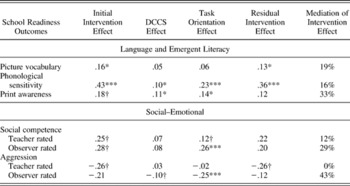
Finally, we examined whether changes in EF skills mediated Head Start REDI's intervention effect on the school readiness outcomes. In these analyses, we included only the two measures of EF skills that showed intervention effects themselves: DCCS and task orientation (Baron & Kenny, Reference Baron and Kenny1986). To test for this multilevel mediation (Krull & MacKinnon, Reference Krull and MacKinnon2001), we again estimated hierarchical linear models. We included children's preintervention scores on DCCS and task orientation as Level 1 covariates, along with the other Level 1 and Level 2 covariates. For each outcome, we first estimated the intervention effect without the postintervention scores for DCCS and task orientation, and then we reestimated the intervention effect in the presence of these two scores. The difference between those estimates indicated the degree to which improvements in the EF skills mediated the intervention effect. We used the Sobel test to assess the statistical significance of the mediation (Sobel, Reference Sobel and Leinhardt1982, Reference Sobel and Tuma1986).
Results are presented in Table 5. The REDI intervention effect on DCCS and task orientation accounted for 19, 16, and 33% of the REDI intervention effect, respectively, on vocabulary, phonological sensitivity, and print knowledge. When examined separately, DCCS was not a significant independent mediator of the intervention effect on any of these three outcomes. Task orientation was a significant mediator of the intervention effect on phonological sensitivity and a marginally significant mediator of the intervention effect on print knowledge.
Executive function skills as mediators of intervention effects

Note: Intervention effects differ slightly from those reported in Bierman et al. (Reference Bierman, Domitrovich, Nix, Gest, Welsh and Greenberg2007) because preintervention scores on the dimensional change card sort (DCCS), task orientation, age, and block design were included in these models. The first three columns show the initial effect of intervention, the effect of DCCS on the outcome, and the effect of task orientation on the outcome, respectively. The final two columns show the degree to which the intervention effect on each outcome is accounted for by changes in the two executive function skills.
†p < .10. *p < .05. **p < .01. ***p < .001.
Examining the social–emotional outcomes, the REDI intervention effect on DCCS and task orientation accounted for 12 and 29% of the intervention effect on teacher-rated and observer-rated social competence, respectively, and it accounted for 0 and 43% of the intervention effect on teacher-rated and observer-rated aggression, respectively. DCCS was not a significant independent mediator of any of these effects. Task orientation was a significant mediator for observer-rated social competence and observer-rated aggression. Given that the initial intervention effect on observer-rated aggression was not significant (p = .20), this latter finding suggests the possibility of more complex relations, including moderated mediation (Baron & Kenny, Reference Baron and Kenny1986).
Discussion
Theorists have speculated that the development of EF skills provides a critical biological foundation for cognitive and social–emotional school readiness (Barkley, Reference Barkley2001; Blair, Reference Blair2002). Prior research has documented relations among measures of EF and school outcomes in kindergarten and the early elementary grades (Blair & Razza, Reference Blair and Razza2007; Bull & Scerif, Reference Bull and Scerif2001). Adding to this research base, we found that EF skills assessed at the beginning of the prekindergarten year emerged as important predictors of the acquisition of language/emergent literacy skills and social–emotional competencies (prosocial behavior and aggression control), with age and nonverbal IQ controlled.
Of central importance, we demonstrated that preventive intervention can foster the development of the executive regulatory system. The REDI intervention promoted improvements on two EF measures: DCCS and task orientation. The effect sizes were relatively small (.20 for DCCS; .28 for task orientation), and the effect for DCCS was only marginally significant (p < .06). Nonetheless, these findings are valuable because they suggest that these important executive regulatory skills can be promoted with strategic, classroom-level preventive intervention. They also illustrate a breadth of intervention impact, reflected on a cognitive performance task that utilized working memory, inhibitory control, and attention set-shifting skills (DCCS), as well as impact on a more comprehensive measure of self-regulatory functioning in the context of academic challenges (task orientation). In terms of behavioral outcomes, the provision of intervention appeared particularly beneficial to children who started the year with low levels of behavioral inhibitory control (e.g., difficulties delaying motor responding and sustaining effortful task engagement). The support provided by REDI apparently compensated for these EF deficits, promoting the social–emotional competence and aggression control of these less-skillful children who struggled in “usual practice” classrooms. Furthermore, improvements in EF skills, particularly task orientation, partially mediated REDI intervention effects on emergent literacy and social–emotional competencies that prior research has linked with enhanced kindergarten adjustment and future achievement (Lonigan et al., Reference Lonigan, Burgess and Anthony2000; McClelland et al., Reference McClelland, Acock and Morrison2006). These results validate the importance of EF skills for school readiness. They highlight the potential of intervening in ways that compensate for delays in EF skills associated with socioeconomic disadvantage, as well as promoting EF skill development during the prekindergarten year to foster school readiness.
Cognitive development during the preschool years is often conceptualized as the acquisition of domain-specific content, punctuated by the construction of new ways of thinking about acquired knowledge made possible by the capacity to activate and coordinate multiple pieces of information at the same time (Edwards, Reference Edwards, Nuttall, Romero and Kalesnik1999). However, this characterization of cognitive growth as a set of skills proceeding in an isolated fashion from social–emotional and self-regulatory capacities may not correctly characterize these developments. Rather, EF skills, which regulate attention and self-control, and coordinate emotion, cognition, and behavior, appear to play a central role in fostering the focused and goal-oriented behavior that supports both cognitive learning and social–emotional adjustment. Conceptually, EF skills (including working memory, inhibitory control, and attention set shifting) support the actions of planning (generating and following mental guides, sequencing actions, maintaining a behavioral set), problem solving (generating, evaluating, flexibly altering strategies for goal-attainment), and intentional learning (sustained attention, resistance to interference; Barkley, Reference Barkley2001; Blair, Reference Blair2006; Diamond, Reference Diamond, Stuss and Knight2002). These capacities enable children to approach learning tasks more effectively and efficiently, as well as enhance their capacity to coordinate social behavior in a way that sustains collaborative and mutually rewarding relationships with teachers and peers.
The findings of the present study revealed an impressive pattern of cross-domain prediction across the prekindergarten year, linking start of year EF skills to end of year measures of cognitive and social–emotional school readiness. For example, a child's performance on peg tapping and DCCS (which assess working memory, cognitive inhibitory control, and set shifting) significantly predicted his/her acquisition of language/emergent literacy skills and also predicted teacher ratings of his/her end of year social competence. The behavioral performance EF tasks, such as walk a line slowly and task orientation, were consistently predictive of behavioral measures of school readiness (social competence and aggression), but also contributed significantly to the prediction of print knowledge.
These cross-domain associations are consistent with a conceptualization of the central regulatory actions of EF skills and developing prefrontal functions. In this conceptualization, the primary facets of the executive regulatory system (working memory, inhibitory control, and set shifting) that develop during the preschool years enhance goal-oriented, rule-governed behavior that fosters both social and cognitive adaptation and learning. In general, these skills allow children to better regulate the emotions that motivate and inform their exploration and understanding of their physical and social worlds (Derryberry & Rothbart, Reference Derryberry and Rothbart1997).
Cognitive versus behavioral performance measures of EF skills
Although the cognitive performance versus behavioral performance EF tasks showed consistent interrelations, they also accounted for consistent differences in their prediction of the domains of school readiness. When examined separately, each of the EF skills played a key role in promoting multiple domains of school readiness. However, the unique variance that each measure accounted for showed a more differentiated pattern. For example, whereas peg tapping and DCCS made consistent, unique contributions to the prediction of the emergent literacy skills, they did not make any unique contributions to the prediction of social competence or aggression. The attention, working memory, and prepotent cognitive response inhibition assessed in peg tapping and DCCS might be particularly important for academic learning. In direct contrast, walk a line slowly, which requires the delay of a prepotent motor response, accounted for unique variance in teacher-rated social competence and aggression and observer-rated social competence, but not in any of the emergent literacy measures. Consistent with prior findings of Li-Grining (Reference Li-Grining2007) and Carlson and Moses (Reference Carlson and Moses2001), these findings support the importance of distinguishing between the cognitive inhibitory control required for academic learning and the behavioral inhibitory control required for effective social functioning.
In the moderation analyses, the EF tasks that assessed cognitive performance also operated differently than the behavioral performance tasks. None of the cognitive performance tasks emerged as significant moderators of the REDI intervention effect. In contrast, the two behavioral performance EF tasks, walk-a-line slowly and task orientation, moderated intervention effects, primarily on outcomes reflecting social–emotional regulation (e.g., teacher and observer ratings of social competence and aggression).
It is possible that the differences observed in the unique correlates of the cognitive performance versus behavioral performance EF tasks reflect the multidetermined nature of behavioral inhibition, in particular. That is, demonstrating self-control may be highly affected by individual differences in temperament, particularly activity level and extraversion. Developing the capacity for behavioral control in the classroom may be particularly challenging for children who are highly active (Victor, Halverson, & Montague, Reference Victor, Halverson and Montague1985). Relevant to this point, prior investigators have often found gender differences in measures of behavioral inhibition, but not on measures of cognitive inhibition, suggesting some differences in the factors that influence development in these two areas of inhibitory control (Bjorklund & Kipp, Reference Bjorklund and Kipp1996).
Conceptually, EF skills are regulatory abilities that develop and organize the emotion–arousal systems associated with behavioral inhibition and behavioral approach, as well as to organize reactivity to threat and stress (Blair et al., Reference Blair, Zelazo and Greenberg2005). One tension in studies of EF skills is to increase precision in measurement, by selecting tasks that require specific cognitive activities to more effectively isolate the dimension of EF being studied. The corresponding countertension is to utilize tasks that assess EF as an “organizational construct,” such as our ratings of task orientation, examining a child's performance under challenge conditions that require a more complex regulation of emotion, behavior, and cognitive control. The importance of the behavioral performance measures of EF that emerged here as predictors, moderators, and mediators of school readiness intervention underscore the value of measures that tap the “organizational” capacity of the executive control system. Continued study of discrete cognitive capacities involved in effective EF is important, but explaining, predicting, and fostering improvements in child school functioning may also require a broader focus on children's “organizational” executive capacities. These capacities may be affected by factors such as temperament and motivation, as well as cognitive control, thereby reflecting “effortful control” that relies on the executive regulatory systems but is multiply determined. Certainly, more research is needed to understand the factors that foster EF skills on cognitive tasks, those that foster inhibitory control and self-regulation in behavioral adaptation, and the potential transactional relations between these two strands of preschool skill development.
Aggression control
Compared with social competence, aggressive behavior showed less consistent associations with the EF tasks. Whereas each of the cognitive performance EF tasks (backward word span, peg tapping, DCCS) predicted gains in at least one measure of social competence (teacher or observer ratings), only one relation between a cognitive performance EF task and aggression was significant. These findings are consistent with the findings of Brophy et al. (Reference Brophy, Taylor and Hughes2002), who found that hard to manage 4-year-olds did not differ from their normative peers on cognitive performance tasks assessing set shifting or working memory skills. Rather, the hard to manage children showed difficulties with behavioral inhibition: following rules and avoiding perseverative errors on EF tasks. In the present study, the two behavioral performance measures (walk a line slowly and task orientation) moderated intervention effects on aggression, and changes in task orientation mediated intervention effects on observer-rated aggression. Hence, preschool children who show high levels of aggressive behavior may require special support developing behavioral inhibitory control, which appears somewhat distinct from the cognitive inhibitory control assessed by many EF tasks.
In addition, aggressive–disruptive behavior is multiply determined, and may reflect deficits in self-regulation less often during the preschool period than in later years. As Vaughn and others have pointed out (Vaughn, Vollenweider, Bost, Azria-Evans, & Snider, Reference Vaughn, Vollenweider, Bost, Azria-Evans and Snider2003), aggressive behaviors emerge and peak during the early preschool years. Instrumental aggression, in particular, is often used by socially effective preschool children to access resources and influence play. Vaughn et al. (Reference Vaughn, Vollenweider, Bost, Azria-Evans and Snider2003) noted that highly sociable preschool children naturally encounter more frequent conflicts, leading to elevated rates of aggression, than children who are less engaged socially. Hence, for some children, elevated aggression in preschool may reflect elevated levels of social engagement and social dominance.
The relation between EF skill deficits and aggression may grow stronger over time, as aggressive behavior becomes less normative and more strongly indicative of socialization deficits or difficulties in self-control. Children who continue to show high rates of aggression through kindergarten and first grade are likely to also show difficulties in areas of emotion regulation and social adjustment, increasing their risk for stable school adjustment difficulties (Campbell & von Stauffenberg, Reference Campbell, Stauffenberg, Crouter and Booth2008; Nigg et al., Reference Nigg, Quamma, Greenberg and Kusche1999). Indeed, Moffitt (Reference Moffitt1993) has suggested that the chronic behavioral problems and concurrent academic difficulties of children who show early-onset conduct problems may stem from deficits in aspects of cognition that are dependent upon or closely related to executive abilities (i.e., abstract reasoning, concept-formation, problem-solving behavior, planning, and sustained attention). Other investigators have similarly found deficits in EF skills, such as working memory, among adolescent delinquents (Cauffman, Steinberg, & Piquero, Reference Cauffman, Steinberg and Piquero2004). Developmental follow-up studies of the current sample are needed to determine whether a predictive link between early cognitive performance EF skills and later aggression will emerge over time. Based on prior literature, one would predict that aggressive children with higher levels of EF skill will gain control over their aggression as they move into kindergarten when aggressive behavior is less acceptable to peers, whereas aggressive children with low EF skills will show stable behavioral adjustment difficulties.
Conceptualizing and measuring the executive regulatory system
One of the greatest challenges to the current study and to future studies in this area of investigation involves the measurement of EF skills. Existing EF measures were designed primarily to document developmental changes in specific cognitive capabilities. To use them longitudinally as measures of individual differences, particularly with the goal of assessing intervention effects, stretches beyond the purpose of their original design (Blair et al., Reference Blair, Zelazo and Greenberg2005). The measures that performed best in this study, in terms of their capacity to predict changes in individual behavior and their sensitivity to intervention effects, tended to be the more complex cognitive performance measures (DCCS) or the behavioral performance measures. Some may debate the value of a measure like task orientation as an index of EF skill because it reflects a complex set of processes and cannot be tied directly to discrete cognitive capabilities. Yet, it had superior distribution properties and greater capacity to capture individual differences and change over time than the more discrete cognitive performance measures, such as peg tapping.
There is some controversy in the field about how EF skills develop and correspondingly, how they should be assessed. It is not clear whether there is gradual assimilation, which should result in a normal distribution of the underlying characteristics, or rapid accommodation, which should result in a clear bimodal distribution. Many of the commonly used measures have odd distributions that do not conform clearly to either pattern, making it difficult to interpret midrange scores. Hence, further development is needed both in conceptual models that define developmental processes involved in the acquisition of EF skills over time and in measurement models that can track development longitudinally and support intervention studies testing processes of change.
Intervention designs to promote EFs and self-regulation
Given the central role that EF skills play in promoting school readiness, they deserve greater attention in the design and evaluation of preschool interventions. To the extent that one considers the development of EF skills to be driven primarily by early interpersonal learning experiences, intervention approaches might focus on creating interpersonal learning environments that enhance the protective factors and reduce the risk factors identified in longitudinal research as central to EF development. Alternatively, intervention might target EF skills directly, using an educational approach to build cognitive capacity (Rueda et al., Reference Rueda, Posner and Rothbart2005). At this point in time, it is unclear which approach (or combination of approaches) is most likely to be effective in promoting EF skills, in particular, and school readiness, more broadly. Both warrant further exploration and study.
Targeting social–emotional learning environments
Prior research has documented links between exposure to highly stressful early environments and delays in EF development (Cicchetti, Reference Cicchetti2002; Lengua et al., Reference Lengua, Honorado and Bush2007; O'Connor, Rutter, Beckett, et al., Reference O'Connor, Rutter, Beckett, Kreppner and Keaveney2000), possibly because of the impact of early stress on developing neuroendocrine responsiveness and stress reactivity (Pollack, Cicchetti, & Klorman, Reference Pollak, Cicchetti and Klorman1998; Sanchez, Ladd, & Plotsky, Reference Sanchez, Ladd and Plotsky2001). Similarly, developmental researchers have hypothesized that the delays in EF development associated with growing up in poverty may have their roots in early social–emotional experiences, specifically in low rates of sensitive-responsive caregiving that reduce the child's exposure to opportunities for sustained joint attention, language input, and effective scaffolding of early emotion regulation (Goldsmith & Rogoff, Reference Goldsmith and Rogoff1997; Lengua et al., Reference Lengua, Honorado and Bush2007). Adult responses to child emotional arousal may be particularly important, as supportive adult responses may promote emotional understanding and provide the child with external regulation that can be imitated and internalized (Havighurst, Harley, & Prior, Reference Havighurst, Harley and Prior2004; Kochanska et al., Reference Kochanska, Murray and Harlan2000). One also might hypothesize that an environment that is more ordered in terms of social sequences, interpersonal cues and contingencies, and opportunities for participation in reciprocal and coordinated social exchanges fosters the understanding of cause–effect sequences and planning skills that are central to EF (Barkley, Reference Barkley2001; Bodrova & Leong, Reference Bodrova and Leong2007).
Programs like Preschool PATHS and the additional interactive reading program incorporated in Head Start REDI focus on changing the social–emotional learning environment in ways that might foster self-regulatory development. PATHS was specifically developed based on the goals of developing neurocognitive control both vertically (i.e., frontal control of emotion and arousal) and horizontally (i.e., language use in the service of emotion regulation) (Greenberg, Kusche, & Riggs, Reference Greenberg, Kusche, Riggs, Zins, Weissberg, Wang and Walberg2004). Presumably, the improved social–emotional functioning produced by this program reflects gains in the biological substrates that support self-regulation, such as improvements in children's abilities to imitate and store representations of social–emotional scripts, tolerate delays and frustrations, regulate feelings under conditions of excitement or conflict, anticipate the future consequences of alternative responses, and plan out behavior before acting (Barkley, Reference Barkley2001; Edwards, Reference Edwards, Nuttall, Romero and Kalesnik1999; Greenberg & Kusche, Reference Greenberg and Kusche1993).
Explicit EF training
More recently, investigators have begun to explore the value of direct instruction and practice on cognitive tasks that utilize EF skills. The hypothesis is that direct training in cognitive tasks that utilize working memory, inhibitory control, and attention set shifting may strengthen these cognitive capacities in ways that foster more generalized regulatory control over emotion, behavior, and attentional focus in the classroom (Rueda et al., Reference Rueda, Posner and Rothbart2005). Initial studies suggest that practice sessions have a strong effect on children's performance on EF tasks (Rueda et al., Reference Rueda, Posner and Rothbart2005). In addition, initial evidence suggests that computer-based training focused on inhibitory control and attention set shifting may benefit children with attention-deficit/hyperactivity disorder, promoting gains in EF skills and behavioral control (Klingberg et al., Reference Klingberg, Fernell, Olesen, Johnson, Gustafsson and Dahlstrom2005). The approach appears promising, although well-controlled, larger scale trials are needed to determine the degree to which gains in attentional functioning generalize more broadly to functional improvements in academic school readiness, particularly in the behavioral domains of social competence and aggression control.
Conclusions
This study provides compelling data to support the importance of developing EF skills to children's school readiness, and their relevance to the planning and evaluation of school readiness interventions. EF skills appear widely related to development in academic and social domains. They predict children's response to school curricula and partially explain the mechanisms of learning and development. Hence, understanding more about how EF skills affect and are affected by preventive preschool interventions may allow us to refine and strengthen intervention approaches. A high priority for prevention research should be to develop interventions that improve EF skills to better prepare children to succeed in school and thereby reduce the achievement gap associated with socioeconomic disadvantage.