


Introduction
The social contract theory of (Rousseau, Reference Rousseau1762) suggests that society arises from an implicit consensus on principles that guide individual conduct. This has been extended to business contexts to model the relationship between firms and society (Rawls, Reference Rawls1971). Similar to the ’Invisible Hand’ (McMahon, Reference McMahon1981), where self-interest promotes both morality and community welfare, a key question arises: ’Why should firms, as private entities, have greater obligations to the community than ordinary citizens?’ This question highlights the concept of social responsibility (Westman et al., Reference Westman, Luederitz, Kundurpi, Mercado, Weber and Burch2019). In this regard, establishing a social contract between business and society becomes crucial to address the growing challenges of sustainability (Hampton et al., Reference Hampton, Blundel, Eadson, Northall and Sugar2023). Climate change, in particular, has intensified the interdependence between economic activity, social behaviour, and institutional governance, increasingly framing environmental protection as a global public good that requires collective action (Khan and Munira, Reference Khan and Munira2021). Addressing these challenges therefore involves the coordinated interaction of multiple actors, including policy-makers (Geissdoerfer et al., Reference Geissdoerfer, Santa-Maria, Kirchherr and Pelzeter2023), citizens (Huttunen et al., Reference Huttunen, Ojanen, Ott and Saarikoski2022), and firms (Chatzistamoulou and Tyllianakis, Reference Chatzistamoulou and Tyllianakis2022). This creates a complex system where corporate decision-making is closely linked to the broader social landscape.
Following this perspective, in this paper, we seek to identify the existence of a Green Social Contract between firms and society. Drawing on institutional, social, and market theories, we empirically examine the extent to which small-and medium-sized enterprises (hereafter SMEs) adopt environmentally sustainable practices by greening their products and services in response to key contextual factors. Specifically, we analyse how (1) state-based formal institutions, (2) socially embedded informal institutions rooted in social capital and community expectations, and (3) market-based peer pressure driven by inter-firm interactions influence SMEs’ green practices, while controlling for other drivers.
From the first two research streams, institutional and social scholarship has increasingly emphasized the role of formal and informal institutions in shaping a wide range of socioeconomic outcomes, from aggregate economic development (e.g., Casson et al., Reference Casson, Della Giusta and Kambhampati2010) to corporate behaviour (e.g., Balzano et al., Reference Balzano, Marzi and Turzo2025; Campbell, Reference Campbell2007; DiMaggio et al., Reference DiMaggio and Powell1983; Scott, Reference Scott2013). Formal institutions, such as laws, regulations, and governance structures, define the ‘rules of the game‘ within which firms operate, shaping corporate behaviour through monitoring, enforcement, and compliance mechanisms (DiMaggio, Reference DiMaggio1998; North, Reference North1990). Informal institutions, by contrast, comprise socially shared norms, values, and expectations that shape firms’ actions through concerns for legitimacy and social approval (DiMaggio et al., Reference DiMaggio and Powell1983; Powell and DiMaggio, Reference Powell and DiMaggio2012). These informal forces, which may include values related to social and environmental responsibility (e.g., Graafland and Smid, Reference Graafland and Smid2017), are often sustained and reproduced through social capital – understood as networks of trust-based relationships and norms of reciprocity that support cooperation towards collective goals (Coleman, Reference Coleman1994; Dasgupta and Serageldin, Reference Dasgupta and Serageldin2000; Putnam, Reference Putnam1993). Overall, new institutionalism conceptualizes firms as embedded in formal rules and informal norms that jointly shape organizational behaviour and the pursuit of legitimacy (DiMaggio et al., Reference DiMaggio and Powell1983; Scott, Reference Scott2013). In the SME context, Balzano et al. (Reference Balzano, Marzi and Turzo2025) provide a systematic synthesis of this literature, emphasizing how these institutions spheres shape SMEs strategies in different areas, including environmental sustainability, innovation, and internationalization.
Beyond institutional and social dimensions, we also draw on insights from the literature emphasizing the role of market competition and inter-firm imitative dynamics in shaping firms’ eco-friendly behaviour (Marshall and Parra, Reference Marshall and Parra2019; Qi et al., Reference Qi, Jia and Zou2021). These market-based peer pressures may interact with institutional forces, particularly given the presence of environmental externalities and the high costs associated with green actions (e.g., Arfi et al., Reference Arfi, Hikkerova and Sahut2018; Morone et al., Reference Morone, Caferra, D’Adamo, Falcone, Imbert and Morone2021). Ignoring such pressures would therefore provide an incomplete picture of firms’ incentives to engage in sustainable practices.
On the basis of these research perspectives, the central objective of our study is to examine how the contextual forces of state, community, and market jointly explain firms’ green actions, operationalized as their engagement in green product and service offerings. Beyond estimating the direct effects of these contextual forces, we further investigate whether and how the influence of informal institutions and market peer pressures is conditioned by the strength of formal regulatory capacity. While many studies draw on pairwise links across the corresponding research streams, as far as we know, no paper highlights the joint influence of state, community and market on promoting the SMEs’ green behaviour. For the purposes of our study, we combine Eurobarometer survey data on European SMEs with institutional, cultural, and economic indicators drawn from the World Governance Indicators, the World Values Survey, and the World Bank. Although Europe is widely recognized for its environmental policy ambitions, substantial heterogeneity persists in both policy design and implementation across regions within countries (Kostetckaia and Hametner, Reference Kostetckaia and Hametner2022; Steurer and Hametner, Reference Steurer and Hametner2013) and across Northern, Southern, Eastern, and Western Europe (Jordan and Liefferink, Reference Jordan and Liefferink2004). This cross-sectional variation allows us to provide new evidence on how key contextual factors jointly structure the incentives and constraints shaping firms’ environmental engagement. Moreover, focusing on SMEs is particularly pertinent in the European context. Representing around 98% of all firms and approximately two-thirds of total employment, SMEs are central to the achievement of sustainability objectives (e.g., European Commission, 2018; Graafland and Smid, Reference Graafland and Smid2017). Yet they typically operate with lean organizational structures and limited financial slack, which constrains their ability to absorb the fixed costs associated with environmental compliance and green investments (Aragón-Correa et al., Reference Aragón-Correa, Hurtado-Torres, Sharma and García-Morales2008; Calogirou, Reference Calogirou2010). Importantly, SMEs are often deeply embedded in local communities, maintaining close ties with customers, suppliers, and other stakeholders (e.g., Amaeshi et al., Reference Amaeshi, Adegbite, Ogbechie, Idemudia, Kan, Issa and Anakwue2016; Graafland and Smid, Reference Graafland and Smid2017). These structural features make SMEs a relevant setting to investigate how institutional and market forces jointly influence green production decisions.
The remainder of the paper is organized as follows. Section Literature review and hypotheses presents relevant literature, outlines the contribution of our study, and develops the hypotheses. Section Empirical analysis describes the data, methodology, and results. Section Results concludes by discussing the main findings, policy implications, and limitations.
Literature review and hypotheses
Formal institutions - institutional quality
Historically, formal institutions and the quality of regulations governing economic activities have an impact on economic growth (see, among others, Acemoglu and Johnson, Reference Acemoglu and Johnson2005; Acemoglu et al., Reference Acemoglu, Johnson and Robinson2001; Miguel et al., Reference Miguel, Gertler and Levine2006). This theory is based on the idea that pressure exerted by institutions, sometimes referred to as coercive pressure, influences the actions of organizations operating within the market (DiMaggio et al., Reference DiMaggio and Powell1983). In other words, by defining the ‘rules of the game‘ (North, Reference North2005), institutions affect firms’ decision-making and behaviours. In particular, the quality of governance generates regulatory pressure that encourages market actors to maintain the same quality, an attitude generally known as institutional isomorphism (DiMaggio et al., Reference DiMaggio and Powell1983). In addition, the quality of institutions is an important facilitator of overall business activities. As reported in several studies (Farla, Reference Farla2014; Lee et al., Reference Lee, Wang and Ho2020; Madani et al., Reference Madani, Mannai and Ben Ameur2026), the quality of national governance, through appropriate governance and corruption control, can promote transparency in business investment processes. All these aspects are in line with the notion of rational action neo-institutionalism where firms comply with the standard of quality defined by formal institutions (Balzano et al., Reference Balzano, Marzi and Turzo2025).
Adapting this to sustainable context, as the pro-environmental orientation characteristic of high-quality institutions becomes stronger, green activities are increasingly viewed as an attractive option for firms (Hosseini and Kaneko, Reference Hosseini and Kaneko2013). Consequently, the quality of formal institutions can play a crucial role in promoting firms’ green actions.
When following a top-down approach, government intervention can create a ‘trickle-down effect,‘ where policies and actions that primarily benefit the wealthy or businesses eventually lead to benefits ‘trickling down‘ to the broader population, thereby improving overall economic well-being. In this context, the quality of formal institutions and related policy interventions can promote firms’ engagement in green production in several ways: enhancing stability and fostering high levels of cooperation for emissions reduction (Galanis et al., Reference Galanis, Ricchiuti and Tippet2022); facilitating firms’ access to credit (Osei-Tutu and Weill, Reference Osei-Tutu and Weill2023); and supporting a stable political environment along with green finance projects to reduce the carbon footprint (Numan et al., Reference Numan, Ma, Sadiq, Bedru and Jiang2023).
Informal institutions – social capital
In the literature, informal institutions are commonly conceptualized through a broad notion of social capital, encompassing not only social networks but also shared social norms and values. Social capital theory (Coleman, Reference Coleman1994; Putnam, Reference Putnam1993) defines it as a set of virtuous social norms – such as trust and reciprocal commitment – that underpin social cohesion and coordinated action. These values foster cooperation among individuals, encouraging them to act for the collective good. Numerous studies have explored how these characteristics can influence economic outcomes, including the provision of public goods (Epper et al., Reference Epper, Fehr and Senn2020), equitable access to resources, and sustainable economic development (Baliamoune-Lutz, Reference Baliamoune-Lutz2011).
One of the most complex aspects related to social capital is its measurement due to the multiplicity and multidimensionality of the factors influencing moral values within a society (Paldam, Reference Paldam2000). In the simplest case, social capital can be measured by social trust or other social preference measures (Epper et al., Reference Epper, Fehr and Senn2020; Fehr and Fischbacher, Reference Fehr and Fischbacher2002; Thöni et al., Reference Thöni, Tyran and Wengström2012). It is precisely this approach that we adopt in our work. Specifically, we combine measures of social preferences with environmental preferences, referred to as pro-environmental preferences. This is in line with a social-constructionist neo-institutionalist perspective (Balzano et al., Reference Balzano, Marzi and Turzo2025), emphasizing how socially constructed norms, rules, and cultural values influence socioeconomic structures and dynamics. There is, in fact, an important branch of literature showing a clear link between social and environmental preferences, a connection that is easy to assume, as environmental protection constitutes a public good and thus contributes to collective well-being. Several studies demonstrate that environmental concern itself constitutes a dimension of social capital (Dietz et al., Reference Dietz, Fitzgerald and Shwom2005; Heinz and Koessler, Reference Heinz and Koessler2021; Schultz and Zelezny, Reference Schultz and Zelezny1998). Following this view, in our paper, social capital is a combination of environmental (e.g., Caferra et al., Reference Caferra, Colasante and Morone2021; Xu et al., Reference Xu, Li, Wang and Shan2024) and social preferences (Panzarella et al., Reference Panzarella, Turcanu, Abelshausen and Cappuyns2023; Rothstein and Uslaner, Reference Rothstein and Uslaner2005).
As a result, informal institutional drivers could also shape green actions, following a bottom-up approach. Recent studies have started to examine the influence of social values on firms’ sustainable choices (Aghion et al., Reference Aghion, Bénabou, Martin and Roulet2023). In a similar vein, in recent years, a significant number of citizen-led initiatives to promote sustainable actions have been observed (Huttunen et al., Reference Huttunen, Ojanen, Ott and Saarikoski2022). This has made citizens key players in creating a demand push to promote the introduction of eco-friendly products (Caferra et al., Reference Caferra, Colasante and Morone2021). Thus, the quality of the social fabric can be a key factor in influencing the company’s strategy (Kaufmann et al., Reference Kaufmann, Andre and Kőszegi2024). Therefore, the level of social capital can improve the efficiency of society by facilitating coordinated actions’ (Putnam, Reference Putnam1993). Consequently, the more social capital available within a region the better the region economic prospers (Putnam, Reference Putnam1993) developing a virtuous environment for the SMEs contributing to the common good (Spence and Schmidpeter, Reference Spence and Schmidpeter2003). Additionally, the coexistence of the institutional pressure from formal entities, alongside the one deriving from the social capital characterizing the informal institutions, plays a key role. To this end, it is interesting to analyse whether the two models are complements or substitutes in such processes (Ahlerup et al., Reference Ahlerup, Olsson and Yanagizawa2009), where social institutions de facto can compensate for the lack of consolidation of formal institutions de iure. In cases where formal institutions reach full maturity and are characterized by high quality, they inherently encompass the attributes of social institutions (i.e the informal ones), thereby reducing the additional contribution that social institutions can provide. Conversely, when formal institutions are still weak, strong informal or social institutions can compensate for their shortcomings. This can be linked to mediated-conflict neoinstitutionalism, which emphasizes the role of political institutions in contexts where formal institutions are weak or inconsistent. Under such conditions, SMEs’ strategies can be largely shaped by the strength of informal institutions.
Market pressure
Over time, traditional institutions have been complemented by economic institutions such as private property rights and markets, which have been shown to promote economic growth (see, Casson et al., Reference Casson, Della Giusta and Kambhampati2010; Rodrik, Reference Rodrik2005). Within market context, the concept of ‘peer pressure‘ (Manski, Reference Manski1993) can lead to spatial dependencies, where the imitative pressure resulting from the actions of peers can significantly impact the firm’s green decisions (Fikru, Reference Fikru2016). This pressure, often arising from a firm’s competitors or industry peers, can encourage the company to adopt similar green practices as its counterparts (Carter and Rogers, Reference Carter and Rogers2008), especially considering the reduced uncertainty on the green investment due to its large-scale adoption (Schumpeter, Reference Schumpeter1942; Dasgupta and Stiglitz, Reference Dasgupta and Stiglitz1980; Qi et al., Reference Qi, Jia and Zou2021). Peer companies could encourage others to adopt similar sustainable practices to stay competitive, in line, for instance, with market-driven innovation theories (Yang et al., Reference Yang, Li and Liu2024). Furthermore, a high concentration of green-focused firms might suggest agglomeration effects, where companies gain from knowledge spillovers, shared learning, and localized interactions (Audretsch and Feldman, Reference Audretsch and Feldman2004). Such pressure can also foster greater collaboration in efforts to reduce emissions (Galanis et al., Reference Galanis, Ricchiuti and Tippet2022). Inter-firm and industry networks play a crucial role in fostering industrial symbiosis and shaping herding behaviour among firms (e.g., Agudo et al., Reference Agudo, Bezerra, Gobbo and Paes2022; Ramkumar et al., Reference Ramkumar, Mueller, Pyka and Squazzoni2022; Wang et al., Reference Wang, Zhao and Zhu2022).
In light of this, it is important to consider whether market dynamics, the resulting strategic interactions, and information diffusion can enhance or undermine the morality of actors (Dewatripont and Tirole, Reference Dewatripont and Tirole2024), leading to either clean or dirty market competition (Aghion et al., Reference Aghion, Bénabou, Martin and Roulet2023). As demonstrated by Marshall and Parra (Reference Marshall and Parra2019), competition in the product market can either incentivize or discourage green activities, affect firms’ profits, and influence consumer welfare. These factors justify the inclusion of this type of pressure in our analysis, with particular emphasis on eco-product supply and market exchanges.
Internal factors
Several are the internal factors contributing to firms’ activities. For instance, existing literature highlights the importance of firm age, size (Bianchi and Noci, Reference Bianchi and Noci1998), sector (Uhlaner et al., Reference Uhlaner, Berent-Braun, Jeurissen and de Wit2012), and turnover (Vasilescu et al., Reference Vasilescu, Dimian and Gradinaru2023). Regarding age and size, empirical studies suggest a positive correlation between firm growth, age, and the level of eco-friendly activities (Perrini, Reference Perrini2006; Uhlaner et al., Reference Uhlaner, Berent-Braun, Jeurissen and de Wit2012). Empirical evidence also indicates a positive relationship between firm size and environmental practices, specifically related to small firms and green product support (Block and Wagner, Reference Block and Wagner2014; Ettlie and Rubenstein, Reference Ettlie and Rubenstein1987; Fritsch and Meschede, Reference Fritsch and Meschede2001). The sector of activity is also crucial. So, for instance, several studies analyse the role of sector tangibility and, consequently, the tangibility of the products offered. Industry-specific circumstances pose different environmental threats and opportunities, influencing firms’ environmental practices, including SMEs (Aragón-Correa et al., Reference Aragón-Correa, Hurtado-Torres, Sharma and García-Morales2008; Hoogendoorn et al., Reference Hoogendoorn, Guerra and Van Der Zwan2015). A positive relationship exists between sector tangibility and SMEs’ environmental behaviour, with resource-intensive industries facing higher costs and environmental damage. These firms are more closely monitored by stakeholders, increasing the likelihood of adopting environmental strategies. This highlights the importance of greening product and services offerings, as the tangibility of products raises interest from various stakeholders, including consumers.
Research framework and hypotheses
Our paper aims to provide novel evidence on the single and combined influence of the previously mentioned contextual forces on the SMEs’ green support in Europe. The focus on green product and service offerings is in line with recent studies (Hoogendoorn et al., Reference Hoogendoorn, Guerra and Van Der Zwan2015; Horbach and Rammer, Reference Horbach and Rammer2025), and it emphasizes the firms’ involvement in supporting the outcomes of green product activities. Methodologically, we apply a multilevel mixed-effects ordered probit model. This model allows us to take into account the nested nature of the available data, acknowledging that firms’ behaviour could depend on internal characteristics and contextual factors at different levels, within regions and countries. Although similar approaches have been applied in relevant studies examining the role on firms’ general activity of multilevel factors and their interactions (e.g., López-Bazo and Motellón, Reference López-Bazo and Motellón2018; Naz et al., Reference Naz, Niebuhr and Peters2015; Srholec, Reference Srholec2010), from our knowledge, it is not the prevailing trend in research on SMEs’ green behaviour, where the coexisting role of different internal and contextual factors, and the possible synergies or trade-offs between them, have remained underexplored.
As previously explained in the introduction section, our analysis focuses on the European context. On the one hand, Europe has positioned itself as a progressive global player in environmental and sustainable development policies. On the other hand, however, it has failed to level out the considerable heterogeneity within and between countries, which hinders the achievement of the green goals set out in the 2030 Agenda (Steurer and Hametner, Reference Steurer and Hametner2013) and (Kostetckaia and Hametner, Reference Kostetckaia and Hametner2022). This is because EU countries are still addressing the Sustainable Development Goals in different ways, depending on the trade-offs between strengths and weaknesses at the state level, which results in heterogeneous outcomes (Kostetckaia and Hametner, Reference Kostetckaia and Hametner2022). According to (Steurer and Hametner, Reference Steurer and Hametner2013), the observed variance in the socio-political context can be attributed to the North–South and West–East divides in environmental policy-making across Europe (Jordan and Liefferink, Reference Jordan and Liefferink2004), as well as to differences in welfare state models. Although our empirical setting consists predominantly of developed economies, it nonetheless exhibits substantial heterogeneity that allows us to examine how state, social, and market contexts shape firms’ decisions regarding the provision of green goods and services. Next, we develop a set of hypotheses, which are summarized in Figure 1.
Main framework of the hypotheses. The Green Social Contract among firms, institutions, and community is the subselected green area.

First, considering the top-down approach and the role played by formal institutions, as discussed in subsection 2.1, we test whether formal governance conditions provide the necessary regulatory frameworks and incentives for businesses to adopt sustainable practices.
-
• H1. Formal institutional quality can favour the green behaviour of SMEs.
Second, considering the bottom-up approach, in line with Section 2.2 we analyse whether citizens’ attitudes concerning climate change, social inequalities, and interpersonal trust – which can be understood as related to social capital through their reflection of shared norms, collective expectations, and trust – can promote firms’ green behaviour.
-
• H2. High levels of social capital among citizens can generate demand-side pressures that support SMEs’ green behaviour.
Third, we examine the interrelationship between top-down and bottom-up approaches in shaping firms’ environmentally sustainable production. Specifically, we consider how the influence of citizens’ attitudes on the greening of firms’ product and service offerings may be shaped by the strength of formal institutions. While much of the economic development literature suggests that informal norms can compensate for weak formal institutions (e.g., Ahlerup et al., Reference Ahlerup, Olsson and Yanagizawa2009), other studies point to complementarities between the two (e.g., Payen and Rondé, Reference Payen and Rondé2025). We contribute to this debate by examining these interactions in the context of firms’ environmental practices.
-
• H3. Social capital among citizens works as substitute of formal institutional quality in encouraging environmentally sustainable practices among SMEs.
Additionally, regarding the market dynamics arising from interactions within a firm’s network, existing studies highlight that imitative pressure from peer firms can stimulate the diffusion of support for green offerings, as discussed in Subsection Market pressure. This hypothesis suggests that SMEs operating in an environment where their peers actively participate in green activities are more likely to invest in their own green initiatives. The presence of environmentally conscious peers is expected to foster a competitive drive towards sustainability within the SME sector.
-
• H4. A higher level of green product and service offerings by peers leads to greater individual SME support for green practices.
Finally, we also examine whether market peer pressures can compensate for weak formal institutions or whether market mechanisms lose effectiveness in such environments. From the perspective of a sustainable action, the latter scenario is particularly concerning, as it implies the absence of alternative drivers, where neither institutional frameworks nor market forces are sufficient to promote change. Therefore, we investigate whether peer influence can help offset formal institutional shortcomings and substitute for State governance capacity in advancing the green transition. Evidence on this issue can contribute to the broader literature, where findings remain mixed. For instance, while some studies suggest that peer effects on corporate decisions are stronger in weaker institutional environments (e.g., Machokoto et al., Reference Machokoto, Gyimah, Kadzima and Kamuriwo2025), other studies find that unstable policy frameworks may dampen these effects in specific contexts (e.g., Liu et al., Reference Liu, Yang, Zheng and Jin2022).
-
• H5. Peer pressure can act as a substitute for formal institutional quality in driving SMEs’ green behaviour.
Empirical analysis
To test the hypotheses developed above, we examine how SMEs’ green engagement, proxied by the provision of green products and services, responds to key contextual forces, while controlling for firm-and country-level characteristics. Our empirical framework combines firm-level observations with three contextual variables: formal institutional quality (proxied by a country-level composite governance measure), informal institutional quality (operationalized through a regional composite measure of citizens’ climate and inequality concerns and generalized trust), and market-based peer pressure (proxied by the country-level prevalence of green activity among firms operating within the same country-sector environment). In this section, we outline the data sources, the construction of variables, the multilevel econometric approach, and the empirical results.
Data
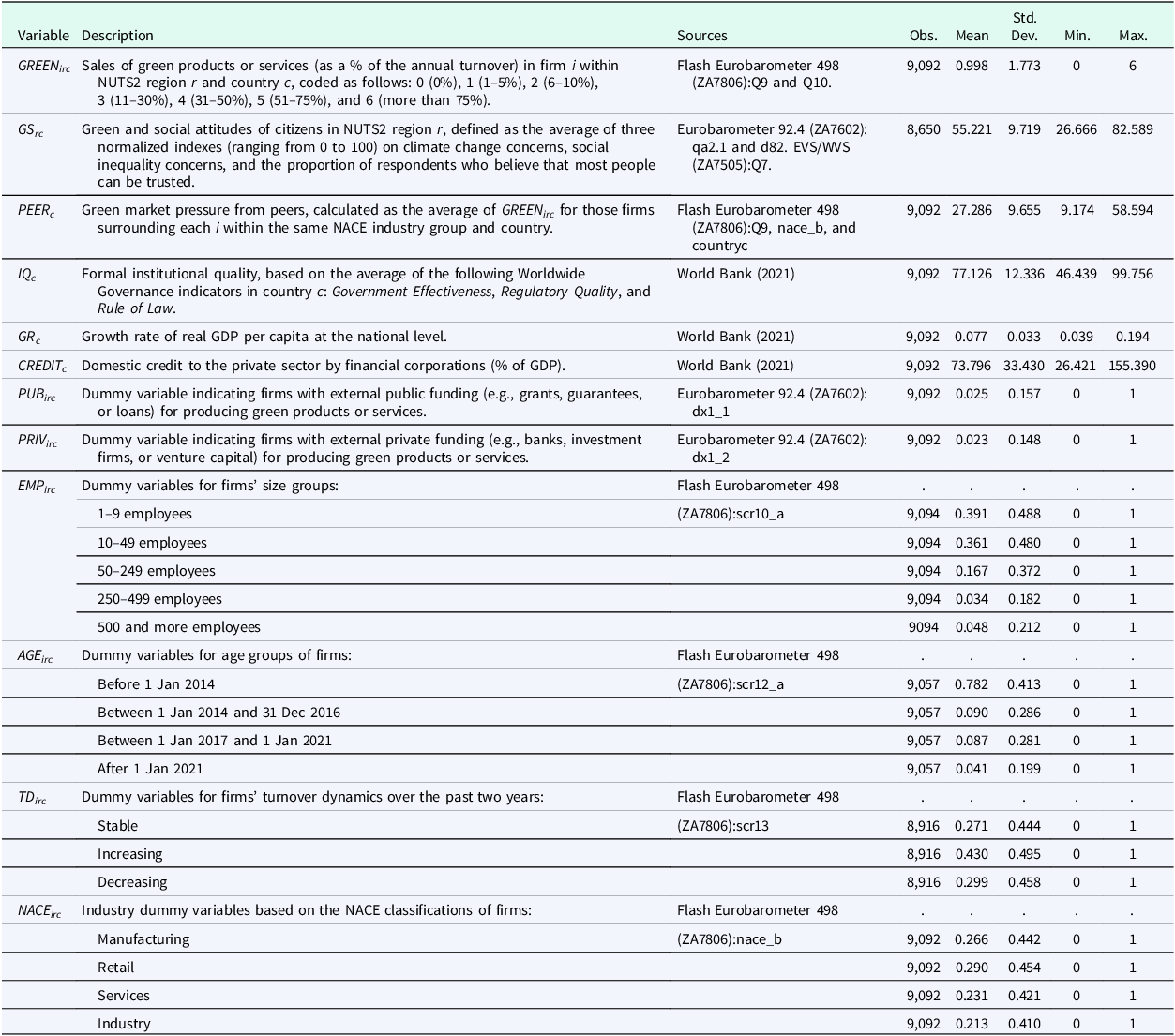
The dataset used in this study includes cross-sectional information on firms, regions, and countries across Europe. Our core dataset is sourced from the Flash Eurobarometer 498 of the (European Commission, 2022) (ZA7806: SMEs, resource efficiency, and green markets, wave 5), which comprises 9,092 firm-level observations from European countries in 2021,Footnote 1 including information about their green decisions and characteristics.Footnote 2 In addition to firm-level data, we also use micro-level information on citizens from the Eurobarometer 92.4 of the (European Commission, 2020) (ZA7602: Attitudes of European citizens towards the Environment and the Corruption) and the combined dataset of the European Value Survey (EVS) and the World Values Surveys (WVS) for the period 2017–2021 (ZA7505). Finally, we also use data from the World Bank to construct measures of macroeconomic conditions at the country level and rely on the World Bank Governance Indicators to proxy the institutional quality of the countries where the sampled firms operate. In the following subsections, we detail the construction of the specific variables employed in our empirical analysis, which are summarized in Table 1.
Summary statistics

Table 1. Long description
The table presents summary statistics for various variables related to firms, regions, and countries across Europe. It includes 11 rows and 7 columns. The columns are labeled Variable, Description, Sources, Obs., Mean, Std. Dev., Min., and Max. Each row provides detailed information about a specific variable, including its description, sources, number of observations, mean, standard deviation, minimum, and maximum values. The variables cover aspects such as sales of green products, green and social attitudes of citizens, green market pressure from peers, formal institutional quality, growth rate of real GDP per capita, domestic credit to the private sector, external public and private funding for green products, firm size groups, age groups of firms, turnover dynamics, and industry classifications.
Dependent variable
The dependent variable in this study aims to measure the extent of firms’ engagement in green economic activity. Specifically, we proxy this engagement using the share of annual turnover obtained from green products and services by firm i within NUTS2 region r and country c (GREEN irc ). The outcomes are coded into seven ordinal levels based on the available data: 0 (0%), 1 (1–5%), 2 (6–10%), 3 (11–30%), 4 (31–50%), 5 (51–75%), and 6 (more than 75%). This information is derived from questions Q9 and Q10 of the Flash Eurobarometer 498 survey, where green products and services are defined as those primarily aimed at reducing environmental risks, minimizing pollution, and conserving resources (including products with environmental features, such as organically produced, eco-labelled, with significant recycled content, or eco-designed).Footnote 3 Although GREEN irc captures a realized commercial outcome that may be jointly shaped by demand-side conditions and firms’ strategic positioning, the available data do not allow us to disentangle these channels. However, as an ordinal indicator of green turnover intensity, it reflects the observable relative economic importance of green activities within each firm’s annual turnover, thereby facilitating cross-firm comparability. Accordingly, the variable allows us to understand how contextual forces may be associated with differences across SMEs in the commercial integration of green activities, as institutions, consumers, and markets exert pressures on the supply side within a given geographical area.Footnote 4 In this sense, GREEN irc provides a reasonable observable proxy for the commercial integration of green activities into firms’ business models, while remaining consistent with indicators used in prior studies examining SMEs’ environmental practices related to products and services (e.g., Hoogendoorn et al., Reference Hoogendoorn, Guerra and Van Der Zwan2015).
Independent variables
First, within the top-down approach, we use a country-level measure of formal institutional quality (IQ c ), proxied by the average of three Worldwide Governance Indicators (WGI) from the World Bank: Government Effectiveness, Regulatory Quality, and Rule of Law. This operationalization closely aligns with the notion of economic institutions, understood as the formal rules and enforcement mechanisms through which the state designs, implements, and upholds the legal and regulatory framework that shapes firms’ incentives and constraints. Specifically, Government Effectiveness captures the quality of public services and policy implementation; Regulatory Quality reflects the ability of the state to formulate and enforce sound policies that support private-sector activity; and Rule of Law measures the extent to which agents have confidence in the enforcement of contracts and property rights. Overall, these components provide a coherent proxy for the institutional environment most directly relevant to firm behaviour. A national-level measure seems appropriate in this context as the formal governance framework shaping regulatory incentives and constraints is generally designed and applied uniformly by national central institutions.Footnote 5
Second, for the bottom-up approach, we construct a proxy for the green and socially engaged outlook of citizens within each region (GS rc ) based on selected survey questions from Eurobarometer 92.4 (ZA7602) in 2019,Footnote 6 and the joint EVS/WVS (ZA7505) from 2017 to 2021. Specifically, the indicator is computed as the NUTS2-level average of three normalized components (rescaled to a 0–100 range): (i) concern about climate change (qa2_1, a 10-point scale from the Eurobarometer); (ii) concern about social inequality (d82, a reversed 4-point scale from the Eurobarometer); and (iii) the share of respondents reporting that most people can be trusted (Q7, percentage from the EVS/WVS).Footnote 7 This aggregated measure of citizens’ green and social attitudes aims to capture a multifaceted and comprehensive perspective on sustainability by integrating three core pillars: pro-environmental attitudes (e.g., Caferra et al., Reference Caferra, Colasante and Morone2021; Xu et al., Reference Xu, Li, Wang and Shan2024), preferences for social equality (e.g., Rothstein and Uslaner, Reference Rothstein and Uslaner2005; Cozzolino, Reference Cozzolino2011), and social capital, which can facilitate the achievement of collective societal goals (e.g., Panzarella et al., Reference Panzarella, Turcanu, Abelshausen and Cappuyns2023). By combining these pillars, this multidimensional framework enables a holistic assessment of informal institutions, reflecting citizens’ commitment to social and environmental sustainability at the regional level. More egalitarian societies tend to be more cohesive, exhibit greater trust, and show stronger respect for others and the environment.Footnote 8 In this case, measuring this composite at the regional rather than national level allows us to capture meaningful subnational variation in the shared values shaping firms’ social environment, particularly for SMEs whose reputational exposure and relational networks are predominantly local (Putnam, Reference Putnam1993; Tabellini, Reference Tabellini2010).
Finally, under the peer-influence approach, we define a country-level proxy for market peer effects (PEER c ) as the average percentage of green products or services (measured as a share of turnover) sold by neighbouring enterprises within the same country and NACE sector (manufacturing, retail, services, or industry). This approach is in line with other empirical studies, such as (Leary and Roberts, Reference Leary and Roberts2014) and (Kelchtermans et al., Reference Kelchtermans, Neicu and Teirlinck2020). The resulting metric serves as a potential indicator of competitive pressure, as a higher prevalence of green offerings among peer firms may incentivize companies to adopt similar sustainable practices to remain competitive, aligning with the literature on market-driven imitative approach (Yang et al., Reference Yang, Li and Liu2024). Additionally, a strong presence of green-oriented firms may also signal agglomeration effects, where firms benefit from knowledge spillovers, collective learning, and localized interactions (Audretsch and Feldman, Reference Audretsch and Feldman2004). The use of a country-level proxy is appropriate, as firms frequently interact across regions within national markets and operate under shared regulatory frameworks that shape their competitive environment and strategic decisions. Additionally, incorporating NACE sector classifications accounts for sectoral heterogeneity, recognizing that peer influences vary across industries.
Control variables
We follow the existing studies on the issue in considering different control variables to characterize the sampled firms (e.g., Hoogendoorn et al., Reference Hoogendoorn, Guerra and Van Der Zwan2015). On the one hand, we include different dummy variables to take into account the sector where each firm operates (NACE irc ), their turnover dynamics (TD irc ), as well as the employees number and age (AGE irc ). Several studies (Bianchi and Noci, Reference Bianchi and Noci1998) have highlighted the influence of firm size on environmental strategies, since small firms might lack of internal resources to invest in green activities. On the same line, young firms might be reluctant in this investment where there is uncertainty about the future profitability and market share (Hockerts and Wüstenhagen, Reference Hockerts and Wüstenhagen2010).
Additionally, we control for firms’ access to external financial support for green activities. Although not a prerequisite for engaging in green production, external funding can be considered a facilitating resource that influences the scale and scope of such activities. Consistent with prior research emphasizing the role of financial and organizational resources in initiating and expanding environmental activities (Horbach, Reference Horbach2008; Rennings, Reference Rennings2000), we include two dummy variables indicating whether firms received public support (e.g., grants, guarantees, or loans) (PUB irc ) or private support (e.g., banks, investment firms, or venture capital funds) (PRIV irc ). These variables allow us to account for differences in firms’ financial constraints that may condition their green performance.
Finally, we account for macroeconomic conditions that may shape firms’ engagement in sustainable practices beyond firm-level characteristics and market dynamics (Chen et al., Reference Chen, Lyulyov, Pimonenko and Kwilinski2024). Specifically, we include two country-level variables for 2021: the growth rate of real GDP per capita (GT c ) and domestic credit to the private sector as a percentage of GDP (CREDIT c ). The former captures overall economic dynamism, which shapes investment opportunities, while the latter reflects financial development and access to credit, both of which are particularly relevant given the green investments often require substantial upfront costs and long-term financing (e.g., IEA, 2022).
Econometric specification and estimation strategy
To conduct our empirical analysis, we use a multilevel mixed-effects ordered probit model, given the categorical nature of our dependent variable and the hierarchical structure of the data (i.e., firms are nested within regions, which are themselves nested within countries). More specifically, we consider the following specification, for i = 1, …, n firms in r = 1, …, R regions and c = 1, …, C countries:
 $$GREE{N}_{irc}^{{\rm *}}=\alpha +\beta _{1}GS_{rc}+\beta _{2}PEER_{c}+\beta _{3}IQ_{c}+X{'}\gamma +\delta _{c}+\zeta _{rc}+\epsilon _{irc}$$
 $$GREE{N_{irc}} = \left\{ {\matrix{ {{\!\!\!\!\!\!\!\!\!\!\!\!\!\!\!\!\!\!\!\!\!\!\!\!\!\!\!\!}{\rm{0\;if\;}}GREEN_{irc}^{\rm{*}} \le {\theta _0}{\rm{\;(0\%{\,\,}of\;eco - production)}}} \cr {{\!\!\!\!\!\!\!\!}{\rm{1\;if\;}}{\theta _0} \lt GREEN_{irc}^{\rm{*}} \le {\theta _1}{\rm{\;(1 - 5\%{\,\,}of\;eco - production)}}} \cr {{\!\!\!\!\!}{\rm{2\;if\;}}{\theta _1} \lt GREEN_{irc}^{\rm{*}} \le {\theta _2}{\rm{\;(6 - 10\%{\,\,}of\;eco - production)}}} \cr {{\!\!}{\rm{3\;if\;}}{\theta _2} \lt GREEN_{irc}^{\rm{*}} \le {\theta _3}{\rm{\;(11 - 30\%{\,\,}of\;eco - production)}}} \cr {{\!\!}{\rm{4\;if\;}}{\theta _3} \lt GREEN_{irc}^{\rm{*}} \le {\theta _4}{\rm{\;(31 - 50\%{\,\,}of\;eco - production)}}} \cr {{\!\!}{\rm{5\;if\;}}{\theta _4} \lt GREEN_{irc}^{\rm{*}} \le {\theta _5}{\rm{\;(51 - 75\%{\,\,}of\;eco - production)}}} \cr {{\rm{6\;if\;}}GREEN_{irc}^{\rm{*}} \gt {\theta _5}{\rm{\;(more\;than\;75\%{\,\,}of\;eco - production)}}} \cr } } \right.$$
where GREEN irc * represents an unobserved latent variable underlying the ordered and categorical variable GREEN irc , which takes values from 0 to 6 depending on the firms’ survey responses regarding the sales intensity of their green products and services. Regarding the independent variables, the model includes the contextual and firm-level factors described in the previous section. Specifically, we consider the proxies for the green and social attitudes of citizens at regional level (GS rc ),Footnote 9 , the green peer pressure at country level (PEER c ), the institutional quality at country level (IQ c ), and a vector of control variables X′, including the measures of economic growth (GR c ) and domestic credit (CREDIT c ) at country level, and the different firm-level characteristics. Finally, ϵ irc represents the error term, and δ c and ζ rc are country and region random effects, respectively, which allows for within-region and within-country correlations. This approach provides correct standard errors by taking into account the clustering information (Goldstein, Reference Goldstein2011). The parameters θ 0, θ 1, …, θ 5 are unknown thresholds in the distribution of GREEN irc *, which will be estimated with the remaining parameters in equation (1), subject to the constraints that θ 0 < θ 1 < … < θ 5.
An estimation concern regarding equation (1) is the potential endogeneity that could arise mainly from simultaneity between the dependent variable of green production (GREEN irc ) and the two independent variables: GS rc and PEER c . First, heightened environmental and social awareness among citizens may incentivize firms to adopt greener practices in response to consumer demand and societal expectations. Conversely, firms’ visible commitment to environmentally friendly activities can shape public attitudes by raising awareness and influencing societal perceptions, thereby creating a mutually reinforcing relationship between citizen attitudes and corporate green practices. Second, firms’ green economic activities may be interdependent, with corporate sustainability efforts influenced by the green practices of neighbouring firms within the same sector and region.Footnote 10
In order to prevent potential endogeneity issues, we adopt an instrumental-variables strategy. Citizens’ green and social attitudes (GS rc ) are instrumented using two plausibly exogenous sources of variation. First, drawing on the EVS 2008–2010, we use the regional share of individuals who reported participation in voluntary associations related to (i) conservation, environment, ecology, and animal rights and (ii) local community action (e.g., poverty, employment, housing, or racial equality). Citizens’ past participation in these associations likely facilitated the diffusion of pro-environmental and prosocial values across the territory, shaping subsequent citizens’ attitudes. While such forms of civic engagement may have persistent cultural effects, they are unlikely to influence firms’ current green behaviour through channels other than citizens’ attitudes themselves. Second, we use terrain ruggedness from Nunn and Puga (Reference Nunn and Puga2012), measured as the share of a country’s land area that is moderately to highly rugged. This measure captures the idea that sufficiently rugged terrain shapes the cultural diffusion and long-run formation of social trust, cohesion, and norms, while remaining exogenous to contemporary firm-level behaviour and economic activity (e.g., Nunn and Puga, Reference Nunn and Puga2012; Khalifa, Reference Khalifa2016). In addition, following Di Porto et al. (Reference Di Porto, Parenti, Paty and Abidi2017), Kelejian and Prucha (Reference Kelejian and Prucha1998) and Kelejian and Prucha (Reference Kelejian and Prucha1999), the variable PEER c is instrumented using the spatially lagged values of the remaining independent variables – that is, the average of these covariates among neighbouring firms operating in the same industry and country.
To use the instrumental variables, we adopt the control function approach (CFA) proposed by Wooldridge (Reference Wooldridge2015), which consists in two steps. First, we regress each potentially endogenous variable (i.e., GS rc and PEER c ) on its corresponding instruments and the remaining independent variables by using ordinary least squares. Subsequently, the residuals obtained in these first stages are then included as an extra regressor in the main model from equation (1), which is estimated using MLE with heteroskedasticity-robust standard errors. This instrumental-variables approach not only helps mitigate the endogeneity bias in the second stage but also leverages the first-stage residuals included in the main model to test the null hypothesis of non-endogeneity (i.e., the coefficients associated to the first-stage residuals are jointly equal to zero).
On the basis of the considerations made, the coefficients β 1, β 2, and β 3 from equation (1) are associated, respectively, with the hypotheses concerning bottom-up pressure from citizens’ green and social attitudes (H2), peer market pressure for green firms’ practices (H4), and top-down pressure from formal institutions (H1). To assess this, we analyse whether such coefficients are positive and statistically significant. Furthermore, to explore how formal institutional quality at the country level might modulate the influence of the remaining contextual factors (i.e., regional green and social attitudes and green market pressure), we subsequently enhance our analysis by estimating two extended versions of equation (1). The first version incorporates an interaction term between IQ c and GS rc , while the second one includes the interaction between IQ c and PEER c . Thus, for instance, in the first extended specification, decreasing marginal effects of green and social citizens’ attitudes at higher levels of institutional quality would indicate a substitutive relationship between formal and informal institutions (i.e., H3). Similarly, in the second extended specification, weaker peer effects in more institutionally stable countries would suggest that peer pressure may serve as a substitute for formal institutional mechanisms (i.e., H5).
Results
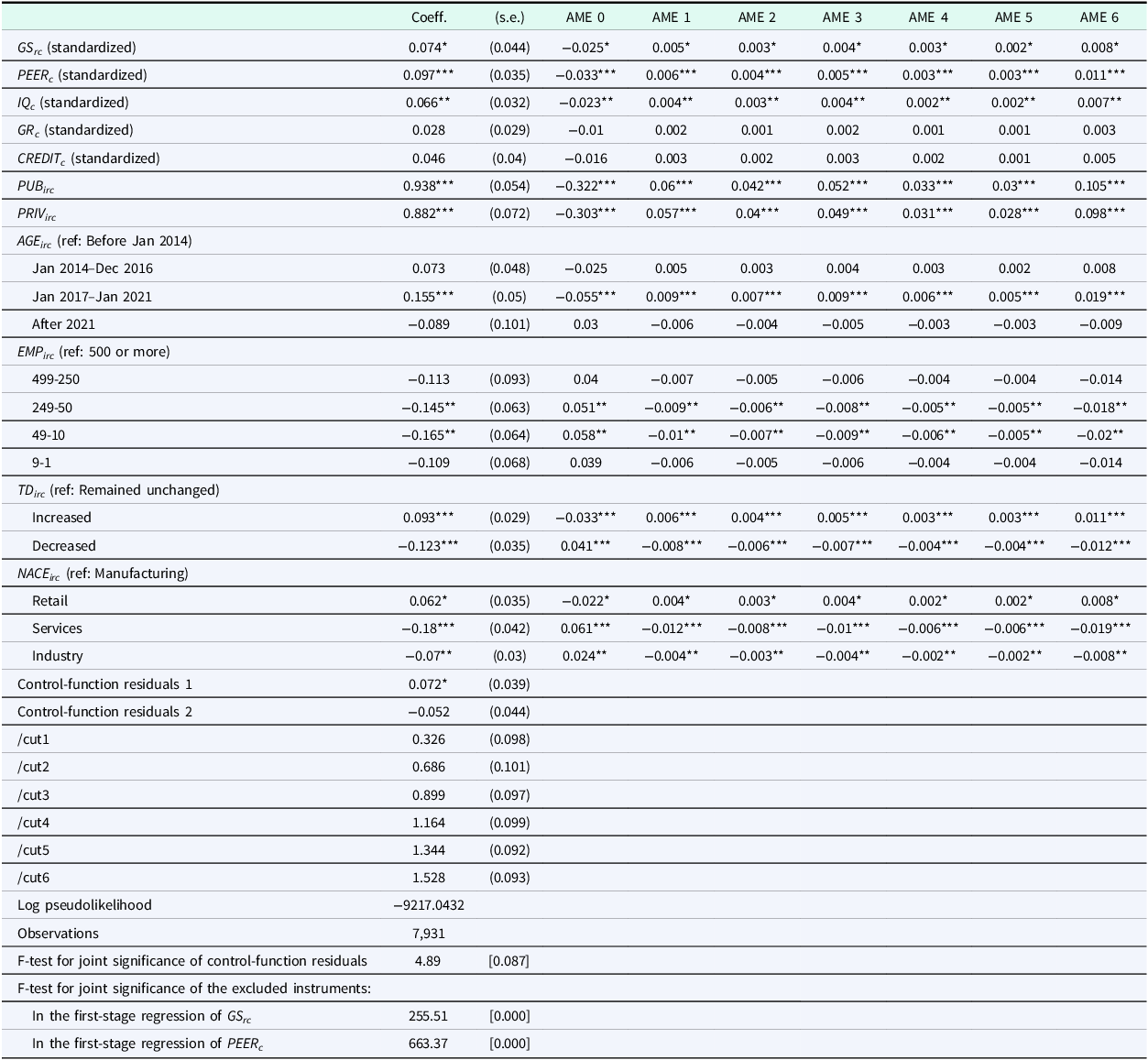
Table 2 presents the CFA estimated results from equation (1), where the contextual independent variables (i.e., GS r , PEER c , IQ c , GR c and CREDIT c ) have been previously standardized to facilitate a straightforward comparison of their estimated effects. To provide a scale interpretation of the results, we also report in Table (2) the corresponding average marginal effects over all observations in the sample, for each level of share of turnover from green products and services, ranking from 0 to 6 as shown in GREEN.Footnote 11 The results suggest that the main contextual factors influencing the probability of being eco-producer are, in descending order of importance: the peers’ pressure, the citizens’ attitudes, and the formal institutional quality. All three are statistically significant at the 10% level, supporting hypotheses H1, H2, and H4. This is consistent with related evidence in other contexts (see Madani et al., Reference Madani, Mannai and Ben Ameur2026 for H1, Aghion et al., Reference Aghion, Bénabou, Martin and Roulet2023 for H2, and Wang et al., Reference Wang, Zhao and Zhu2022 for H4). Conversely, the estimated effects of the real GDP per capita growth rate and the domestic credit to the private sector are smaller in magnitude and both remain statistically insignificant at any level. According to the estimated average marginal effects of the relevant contextual factors, our results suggest that one additional standard deviation of the peers’ pressure decreases by 3.3% the firms’ probability of belonging to the non-eco-producer group, while it increases by 0.6%, 0.4%, 0.5%, 0.3%, 0.3% and 1.1% the firms’ probability of belonging to the remaining 6 groups of eco-producers. Regarding the formal institutional quality, it is found that a comparable standard deviation rise in such variable reduces by 2.3% the firms’ probability of being non-eco-producers, while it enhances by 0.4%, 0.3%, 0.4%, 0.2%, 0.2%, and 0.7% the firms’ likelihood of belonging to the different levels of eco-products. Finally, one additional standard deviation of citizens’ attitudes increases (decreases) the probability of being eco-producer (of not being eco-producer) by around 0.42% on average (2.5%). To better illustrate the magnitude of these effects, we compare the two regions in our sample with the lowest and highest levels of green and social citizens’ attitudes: Toscana, Italy (26.666) and Aragón, Spain (82.589). According to our estimates, raising citizens’ attitudes in Toscana to the level observed in Aragón would, on average, increase the probability of being an eco-producer by approximately 2.42% and decrease the probability of not being an eco-producer by 14.4%.Footnote 12
CFA estimates of the multilevel mixed-effects ordered probit from equation (1)

Table 2. Long description
The table presents CFA estimates of multilevel mixed-effects ordered probit. It includes coefficients, standard errors, and average marginal effects for various standardized variables across different levels of green product and service turnover. The table has 49 rows and 9 columns. Column headers are Coeff., s.e., AME 0, AME 1, AME 2, AME 3, AME 4, AME 5, and AME 6. Row labels include variables like GS_rc, PEER_rc, IQ_c, GR_c, CREDIT_c, PUB_rc, PRIV_rc, AGE_rc, EMP_rc, TD_rc, and NACE_rc, along with their respective categories and time periods. The table also includes control-function residuals, cut points, log pseudolikelihood, observations, and F-tests for joint significance. Each row provides specific values for the coefficients, standard errors, and average marginal effects for each level of green product and service turnover.
Heteroskedasticity-robust standard errors (s.e.) are reported in parentheses and p-values in brackets. AME refers to the average marginal effects for the seven different levels of green sales: 0 (0%), 1 (Up to 5%), 2 (6–10%), 3 (11–30%), 4 (31–50%), 5 (51–75%), and 6 (More than 75%). *** p < 0.01, ** p < 0.05, * p < 0.1. Control-function residuals 1 and 2 correspond to the residuals obtained in the first stage by regressing GS rc and PEER c , respectively, on the exogenous variables and their associated instruments. Specifically, GS rc is instrumented using (i) the regional share of individuals participating in voluntary associations related to conservation, environment, ecology, and animal rights (VOLUNTE rc ); (ii) the regional share of individuals participating in voluntary associations related to local community action (VOLUNTL rc ); and (iii) the percentage of the country’s land area that is highly rugged (RUGGED_PC c ). In turn, PEER c is instrumented with the average values of the remaining independent variables among neighbouring firms operating in the same industry and country.
To delve even deeper into the economic relevance of the contextual factors of interest, in Figure 2 we present the average predicted probabilities of reporting different levels of green production, considering varying values of green and social attitudes of citizens, peers’ pressure, and formal institutional quality, based on the CFA estimates from equation (1). As can be seen, the predicted probability of being an eco-producer at level 1, 2, 3, 4, 5 or 6 (not being an eco-producer at level 0) slightly increases (decreases) with the improvement in the three considered contextual factors, as shown by shifting towards the right side of the x-axis. The effects of peer pressure are the most pronounced.
Average predicted probabilities of reporting different levels of green production, according to contextual factors of interest, based on the CFA estimates of the multilevel mixed-effects ordered probit of equation (1). The coloured lines represent the predicted probabilities of firms to report the different levels of green production (outcomes 0, 1, 2, 3, 4, 5, and 6), while shadows are the corresponding 95% confidence bands. The x-axis labels have been arranged differently in each case, according to the maximum and minimum values of the standardized scores of the main contextual variables of interest (green and social attitudes, peers’ pressure, or institutional quality). These figures are based on the results presented in Table 2.

Figure 2. Long description
The image contains three sets of line graphs labeled Panel A, Panel B, and Panel C. Each panel shows multiple line graphs representing the average predicted probabilities of firms reporting different levels of green production. The x-axis in each graph represents standardized scores of different contextual variables, while the y-axis represents the average predicted probability. Panel A shows the relationship between green and social attitudes of citizens and the predicted probabilities of different levels of green production. Panel B illustrates the impact of peers’ pressure on the predicted probabilities of green production levels. Panel C depicts the influence of institutional quality on the predicted probabilities of green production levels. Each graph includes lines representing different outcomes (0 to 6) and corresponding 95% confidence bands. The trends in the graphs indicate how these contextual factors influence the likelihood of firms adopting various levels of green production.
Regarding the CFA estimated coefficients associated to the control variables at firm level, their estimated signs are consistent with the literature, and most of them are statistically significant. Examining the characteristics of firms, we observe that size and age are relevant factors in green decision-making. Larger and mid-aged firms are inclined to adopt green investments. Regarding market dynamics, they play a key role, as downturns (i.e., decreasing turnover) reduce firms’ capabilities and attitudes towards eco-behaviour. Additionally, both public and private support prove critical in sustaining enterprises.Footnote 13
Finally, in order to test the hypotheses H3 and H5, as explained in the previous section, we additionally estimate by CFA two extended versions of the equation (1), in order to compute the average marginal effects of the contextual factors of interest, conditioned to different values of formal institutional quality. The estimates from these extended specifications are presented in Table B1 in Online Appendix B, available at the following link, while Figure 3 reports the corresponding average marginal effects of GS rc and PEER c on firms’ green offerings, considering varying values of the IQ c variable. This visualization evidences the presence of a substitution effect between the influence of informal networks and institutional stability, supporting H3. Specifically, according to the estimates of the first extended specification (Figure 3a), we can observe, for outcome 0, a noteworthy reduction in the likelihood of not pursuing environmentally friendly actions as green and social citizens’ attitudes increase in contexts of low institutional quality. As we shift towards the right side of the figure, corresponding to higher levels of formal institutional quality, this effect fades away and becomes statistically insignificant. Conversely, for outcomes from 1 to 6, we find positive average marginal effects for the citizens’ attitudes on the likelihood of reporting environmentally friendly activities in contexts characterized by poor institutional quality, but they lose their statistical significance as institutional quality improves. This pattern is consistent with the substitution effect between formal and informal institutions shown by Ahlerup et al. (Reference Ahlerup, Olsson and Yanagizawa2009) for aggregated economic development. Moreover, a similar pattern emerges in our estimates from the second extended specification (Figure 3b), where peer pressure exerts a statistically significant influence in weak institutional contexts but becomes insignificant in stronger institutional settings, where SMEs operate under more stable regulatory conditions. This latter finding supports our H5 and aligns with specific empirical evidence showing that peer effects play a stronger role in shaping firms’ eco-activities in contexts with weak formal institutions (e.g., Machokoto et al., Reference Machokoto, Gyimah, Kadzima and Kamuriwo2025).
Average marginal effects of the contextual factors of interest, conditioned to different values of institutional quality, based on the CFA estimates of two extended versions of the multilevel mixed-effects ordered probit of equation (1). (a) Average marginal effects of green and social citizens’ attitudes (standardized), based on the extended equation (1), including the interaction GS rc × IQ c . (b) Average marginal effects of peers’ pressure (standardized), based on the extended equation (1), including the interaction PEER c × IQ c . The coloured lines represent the average marginal effects, while the shadows are the corresponding 95% confidence bands. These figures are based on the results presented in Table B1 of Online Appendix B, available at the following link.

Figure 3. Long description
The image contains two sets of graphs labeled (a) and (b), each consisting of six line graphs. Panel A shows the average marginal effects of green and social citizens’ attitudes, while Panel B shows the average marginal effects of peers’ pressure. Each graph has institutional quality on the horizontal axis and average marginal effect on the vertical axis. The colored lines represent the average marginal effects, and the shaded areas are the corresponding 95% confidence bands. In Panel A, the graphs show varying trends of green and social citizens’ attitudes across different levels of institutional quality. In Panel B, the graphs illustrate the impact of peers’ pressure on institutional quality. Each graph in both panels represents different outcomes, ranging from 0% to more than 75%. The trends indicate how these contextual factors influence institutional quality differently across various outcomes.
Discussion and conclusions
This study has attempted to reconstruct the sustainability puzzle by identifying the relationships between specific firms and their surrounding communities. The central focus has been the identification of the roles of three key contextual actors – the State, the market, and the community – in shaping business decisions and defining a ‘Green Social Contract’ between firms and society.
Our results show that, after controlling for other factors, the share of firms’ turnover from green offerings is significantly shaped by contextual drivers. Specifically, both formal institutions (regulations and public incentives) and informal institutions (citizens’ social and environmental attitudes) exert positive effects, highlighting the importance of governmental support and community engagement. Moreover, we find that peer-related business pressures (peer effects) also play a key role, alongside formal and informal institutional influences. Beyond these direct effects, our interaction analyses indicate that citizens’ attitudes and market-based peer pressures can partially offset weaker formal institutional support, helping sustain firms’ green initiatives even where top-down institutional capacity is limited.
These findings have clear policy implications. In regions with strong institutions, regulations and incentives, including funding instruments, directly support corporate environmental practices. In weaker institutional contexts, combining formal measures with peer market influence and citizen engagement is essential. Policymakers can foster this environment through transparency, benchmarking, and information sharing in business networks, while also promoting citizen awareness and participation. While long-term institutional development remains critical, strengthening peer dynamics and social capital offers complementary, more immediate levers for advancing the green behaviour. Consequently, neoinstitutionalism in all its forms is highly important and influential in determining market behaviour and promoting environmentally friendly activities. This aligns with evidence that SMEs in regions with weaker formal institutions, such as Southeastern Europe, often rely on informal networks to access resources and manage risks from regulatory uncertainty, operational disruptions, and limited financing (Narooz and Child, Reference Narooz and Child2017; Balzano et al., Reference Balzano, Marzi and Turzo2025). Our findings also inform EU programmes, particularly Cohesion Policy instruments like the European Regional Development Fund and green transition initiatives (Commission, 2023). While these programmes aim to reduce disparities and promote sustainability, their effectiveness depends on local institutional and social contexts. In strong institutional regions, EU incentives can directly boost green engagement, whereas in weaker settings, success depends on local networks, peer effects, and community participation. Integrating bottom-up dynamics, such as SME collaboration and citizen engagement, can enhance firms’ absorptive capacity and improve the long-term impact of EU green funding, especially in less developed regions.
Our analysis is not without limitations, which in turn suggest directions for future research. First, our empirical analysis is limited to SMEs operating in European countries, which may constrain the external validity of our findings. Extending the analysis to a broader international context, particularly to developing and less industrialized economies, would introduce greater institutional and socioeconomic heterogeneity, potentially uncovering additional drivers and patterns of firms’ green behaviour. However, such an expansion critically depends on the quality and availability of firm-level data. Existing datasets often rely on self-reported measures and lack cross-country comparability. Progress towards standardized green accounting and harmonized sustainability reporting frameworks would be essential to enable more robust and generalizable global analyses.
Second, some limitations to causal inference remain, although we employ an instrumental-variables strategy to mitigate endogeneity concerns (mainly from simultaneity) and include multiple contextual and firm-level controls. The instruments are theoretically grounded and perform well in standard statistical diagnostics, but the exclusion restriction (requiring that they affect firms’ green engagement solely through the endogenous regressors) cannot be directly verified, which is an inherent challenge in observational research. In addition, the cross-sectional nature of the data limits our ability to better address time-invariant unobserved heterogeneity and to assess the potential persistence of effects over time. While longitudinal firm-level data are rarely available in survey-based studies, future work would benefit from richer panel datasets, where feasible, to better control for time-invariant unobserved factors and explore dynamic responses. Combining longitudinal information with broader international coverage would also facilitate the identification of natural experiments, such as staggered institutional reforms or regulatory changes, enabling the use of designs like difference-in-differences or similar designs. These approaches would provide a valuable complement to the empirical strategy employed in this study.
Supplementary material
The supplementary material for this article can be found at https://osf.io/mdhgb/overview?view_only=19e3742811c442faa3914eec1d6b5890.
Authors contributions
The authors equally contribute.
Funding statement
The present research was funded as a GRINS project by the European Union Next-Generation EU (National Recovery and Resilience Plan – NRRP, Mission 4, Component 2, Investment 1.3).
Conflict(s) of Interest
The authors declare no competing interests.



 Open access

