Although vancomycin is regarded as first-line therapy in moderate to severe Clostridium difficile infections, increasing failures suggest the need for new therapeutic interventions.Reference Cohen, Gerding and Johnson 1 , Reference Vardakas, Polyzos, Patouni, Rafailidis, Samonis and Falagas 2 An in vitro study demonstrated that fidaxomicin inhibited C. difficile spore production at levels below minimum inhibitory concentrations more than vancomycin did,Reference Babakhani, Bouillaut, Gomez, Sears, Nguyen and Sonenshein 3 and an in vivo study observed lower spore burden among patients who responded to fidaxomicin versus vancomycin early in therapy.Reference Louie, Cannon and Byrne 4 Herein, we sought to compare the number of C. difficile vegetative cells and spores in stool among patients receiving fidaxomicin or vancomycin as treatment of their first C. difficile infection episode.
METHODS
This was a single-center, prospective, open-label, randomized trial conducted from October 17, 2012 through December 15, 2014, at Hartford Hospital, a tertiary care medical center in Hartford, Connecticut. The institutional review board approved the protocol (NCT01818141) and patients provided written informed consent. Eligible patients were at least 18 years old and infected with their first episode of C. difficile infection (≥3 episodes of unformed stool in a 24-hour period and positive C. difficile polymerase chain reaction test using GeneXpert [Cepheid]). Patients were excluded if they had received more than 24 hours of treatment against C. difficile, had hypersensitivity to study medications, were pregnant or breast-feeding, had a history of ulcerative colitis or Crohn’s disease, were unable to take oral medications, or had participated in another study within the previous month. Patients were not permitted to receive concomitant therapy against C. difficile or any anti-peristaltic agents. Patients were randomized to vancomycin 125 mg by mouth 4 times a day or fidaxomicin 200 mg by mouth twice a day for 10 days.
Stool samples were obtained from patients at the following prespecified time points for quantitative cultures: baseline, midpoint of treatment (day 3–5), within 72 hours after the end of treatment (day 10–13), and 2 weeks following treatment completion (±5 days, day 19–29). Quantitative assessment was conducted as previously described.Reference Housman, Banevicius, Lamb and Nicolau 5
The primary study end point was the percentage of patients who achieved at least 2 log10 colony-forming units (CFU)/g reductions of spores from baseline by the end of therapy (days 10–13). Secondary end points included CFU reductions from baseline at prespecified time points for spores and vegetative cells and clinical cure, defined as the resolution of diarrhea (≤2 unformed stools for 2 consecutive days), with maintenance of resolution during therapy. Clinical failure was defined as continued diarrhea or worsening symptoms that mandated a treatment change. Clinical recurrence was defined as symptomatic diarrhea following a successful course of study medication. Patients with positive C. difficile cultures following treatment without symptoms were considered colonized. Sustained clinical response (SCR) was defined as initial clinical cure without recurrence over the 28-day period following the end of treatment (day 38).
Appropriate statistical tests were used to report all data (t test and χ2 test). Analyses were performed using SigmaPlot, version 12.5 (Systat Software).
RESULTS
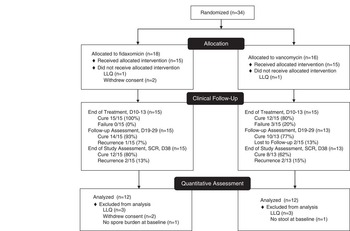
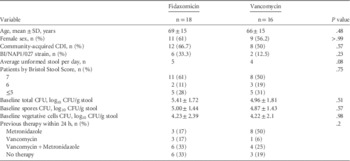
Thirty-four patients were enrolled. A flow chart is provided in Figure 1 and describes clinical outcomes. Adherence to study medication was 90% or greater. Baseline characteristics were similar (Table 1). All 15 patients (100%) who received fidaxomicin completed therapy and had clinical cure at the end of treatment; of these 15 patients, 3 (20%) developed recurrence and 12 (80%) experienced SCR. One patient who developed recurrence was also receiving cefazolin and then cefadroxil during the study for treatment of group B streptococcal sepsis. Among the 15 vancomycin-treated patients, 12 (80%) achieved clinical cure at end of therapy. Two patients in the vancomycin group developed recurrence and 2 were lost to follow-up. This resulted in 8 who experienced SCR (62%) of 13 patients. Three patients received concomitant antibiotics during the study and experienced clinical cure throughout the study.
Consolidated Standards of Reporting Trials flow diagram for patients enrolled and randomized. D, day; LLQ, below the lower limit of quantitation for assessment of Clostridium difficile on stool culture; SCR, sustained clinical response.

Demographic Information for Patients Enrolled by Randomization

NOTE. Community-acquired CDI, Clostridium difficile infection diagnosis in patients who had not been discharged from a healthcare facility in the previous 12 weeks; CFU, colony-forming units.
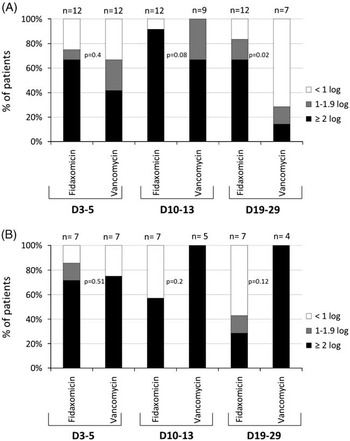
Of the 13 patients who received fidaxomicin, 12 contributed to the quantitative culture assessment because 1 patient had no baseline spore growth and two withdrew consent. Of the 15 patients, 2 were eliminated due to no viable burden and 1 because no stool was available at baseline. Following therapy, 3 patients were eliminated before the end of treatment visit owing to clinical failure and receipt of non-study antibiotics. Following the end of treatment visit, 2 patients were lost to follow-up, leaving 7 patients. Figure 2 describes the percentage of patients who achieved the categorical reductions in spores and vegetative cells. At day 3–5, spore and vegetative cell reductions were similar between treatment groups (P≥.4). More patients receiving fidaxomicin treatment (8/12 [67%]) achieved at least 2 log10 CFU/g reduction in spores compared with those receiving vancomycin (1/7 [14%], P=.02). In the fidaxomicin arm, patients who were below the lower limit of quantitation at midpoint, end of treatment, and follow-up were 7/12 (58%), 11/12 (92%), and 7/12 (58%), whereas patients in the vancomycin group were 4/12 (33%), 5/9 (56%), and 1/7 (14%), respectively. Vegetative cell reductions at all time points were similar (P≥.12). Within the fidaxomicin group, 6 (50%) of 12 patients with clinical cure at the end of study were defined as colonizers versus 6 (75%) of 8 in the vancomycin group.
Percentage of patients with Clostridium difficile infection treated with vancomycin or fidaxomicin achieving a reduction of (A) spores and (B) vegetative cells at prespecified time points.

DISCUSSION
In vitro and clinical data have indicated that fidaxomicin’s enhanced SCR may be due to a reduction of sporesReference Babakhani, Bouillaut, Gomez, Sears, Nguyen and Sonenshein 3 and preservation of gut microbiota.Reference Louie, Cannon and Byrne 4 Within our study, clinical cure at the end of treatment was similar to previously published clinical trials.Reference Cornely, Crook and Esposito 6 , Reference Louie, Miller and Mullane 7 Numerically, fidaxomicin did have a higher proportion of patients with SCR compared with vancomycin. Within both groups, vegetative cells were eliminated within 3 to 5 days. Of note, many patients did receive less than 24 hours of therapy with vancomycin or metronidazole before study enrollment. Spore burden and total C. difficile burden were slower to decrease. Against spores, a higher proportion of patients receiving fidaxomicin than vancomycin had at least 2 log10 CFU/g reductions by day 3–5, 8/12 (67%) versus 5/12 (42%), respectively. At the end of therapy, most patients in both the fidaxomicin and vancomycin groups were able to reduce spore burden by at least 2 log10CFU/g, whereas by the follow-up culture only 1 (14%) of 7 patients maintained at least 2 log10 CFU/g reduction after receiving vancomycin versus 8 (75%) of 12 patients receiving fidaxomicin. Fewer fidaxomicin patients had less than 1 log10 CFU/g spore reductions at the follow-up (day 19–29) compared with vancomycin, and 6 (50%) of 12 fidaxomicin patients and 1 (14%) of 7 vancomycin patients were below the lower limit of quantitation.
In vitro work by Babakhani and colleaguesReference Babakhani, Bouillaut, Gomez, Sears, Nguyen and Sonenshein 3 assessed the impact of subinhibitory concentrations of fidaxomicin, OP-1118, the active metabolite of fidaxomicin, vancomycin, and metronidazole on C. difficile cells in the early stationary phase. The authors observed fidaxomicin and the active metabolite inhibited sporulation more significantly than comparators. Louie and colleaguesReference Louie, Cannon and Byrne 4 studied the major microbiota components following treatment with fidaxomicin and vancomycin for C. difficile infection. Fidaxomicin was able to maintain levels of Bacteroides and Prevotella group organisms whereas vancomycin caused further reductions in CFU. The investigators also evaluated quantitative cultures of C. difficile following treatment with fidaxomicin or vancomycin, among patients who were clinical responders. Total quantitative cultures of C. difficile were similar for patients treated with fidaxomicin or vancomycin. However, spore cultures were significantly lower at day 4 for fidaxomicin compared with vancomycin, 2.0±0 versus 2.7±1.1 (P=.001), respectively. Moreover, a study by Biswas et alReference Biswas, Patel and Otter 8 observed significantly fewer C. difficile–positive environmental samples presumably owing to less spore shedding in rooms when patients were treated with fidaxomicin compared with metronidazole and/or vancomycin (17.3% vs 25.8%, P=.02).
Our in vivo investigation observed similar clinical responses to published literature. Vancomycin and fidaxomicin therapy resulted in rapid decreases in vegetative C. difficile counts throughout therapy; however, in these patients, fidaxomicin resulted in greater reductions in spore counts.
ACKNOWLEDGMENTS
We thank the staff and fellows at the Center for Anti-Infective Research and Development for their work conducting this study.
Financial support. Cubist Pharmaceuticals.
Potential conflicts of interest. D.P.N. reports that he has received grant support and is on the speaker’s bureau for Cubist Pharmaceuticals. J.L.K. reports that he is a clinical trial investigator and has participated in advisory boards for Cubist Pharmaceuticals. All other authors report no conflicts of interest relevant to this article.