1. INTRODUCTION
Impartiality is one of the principal virtues of public institutions. That judges, civil servants or politicians may act partially in their private lives (for example, by favouring their children over the children of others) is perfectly legitimate. In contrast, that they act in a biased, partial manner in their respective positions to either benefit themselves or family and friends, or even to harm others, is wholly illegitimate. It should come as no surprise, then, that heated debates are launched in the public arena when impartiality is threatened, especially when scarce resources are to be distributed. Scarce jobs, scarce medical care or scarce unemployment benefits are expected to be delivered by taking into account only unbiased and unprejudiced principles.
In spite of the key importance of impartiality in social, political and economic life, there are frequent doubts concerning the best mechanisms to ensure impartial decisions. The aim of this paper is to study experimentally three different abstract mechanisms to achieve impartiality in matters of distributive justice, viz., the veil of ignorance, detached observer and involved spectator devices. Discussing the virtues of abstract mechanisms can help us to better understand the background theories and improve real impartial devices.
In the next section, the main theoretical and experimental contributions to the topic of impartiality are reviewed. We study three mechanisms to achieve impartiality. The first mechanism, the veil of ignorance, defines impartiality as uncertainty about an individual's own identity in a distributive problem. The other two mechanisms, the involved spectator and the detached observer, rely on external observers who are not involved in the situation that they are asked to judge. The main difference between these two third-party mechanisms is that, whereas involved spectators are embedded in the unjust situation they have to judge and thus could develop an empathic feeling toward the stakeholders, detached observers do not belong to the society to be judged. They are going to be completely unaffected by their decisions, playing the role of an outsider umpire, just like an external auditor.
The veil of ignorance has received a good deal of attention in the experimental literature. In contrast, there are far fewer experimental studies on third-party observers. To the best of our knowledge, this is the first attempt to compare the three observers experimentally.
Our results suggest that there are similarities, but also important differences between the mechanisms. We find that the three methods induce a fair amount of redistribution. However, the levels of redistribution achieved are significantly different across mechanisms. We provide tentative explanations about why the three mechanisms produce these different levels. In line with previous philosophical accounts, individual personal traits influence subjects' decisions. More specifically, individual risk attitude and favouritism partly explain the outcomes reached by the different methods.
2. THEORETICAL AND EXPERIMENTAL BACKGROUND
Regarding distributive justice, impartiality demands that we give equal or, at least, adequate, consideration to the interests of all concerned parties (Barry Reference Barry1995; Dworkin Reference Dworkin2002; Jollimore Reference Jollimore2011). However, different theories of distributive justice solve the ‘impartiality question’ differently. Typically, they first determine who is going to choose the principles of justice, that is, the stakeholders themselves (first-person impartiality devices) or an unaffected third party (third-party impartiality devices). After choosing the decision perspective, the theories have to establish the informational setting or prerequisite. On the one hand, some distributive justice theories have used either a thicker or a lighter veil of ignorance to exclude the influence of personal interests (Harsanyi Reference Harsanyi1953, Reference Harsanyi1955; Rawls Reference Rawls1971, Reference Rawls2001; Dworkin Reference Dworkin2002). On the other hand, there are theories that have resorted to an unveiled, well-informed first or third person whose decisions take the interest of all parties into account (Smith Reference Smith1976 [1759]; Firth Reference Firth1952; Scanlon Reference Scanlon1998).
Assuming that the veil of ignorance produces impartial results, much of the experimental work has investigated whether real decision makers behind a veil of ignorance would choose the Rawlsian difference principle or another principle of justice (Frohlich and Oppenheimer Reference Frohlich and Oppenheimer1992; Scott et al. Reference Scott, Matland, Michelbach and Bornstein2001; Michelbach et al. Reference Michelbach, Scott, Matland and Bornstein2003). Depending on how the experiments are designed, the conclusions are of the most varied kind, from those that support Rawls to those that do not find experimental support for his theory. However, some argue that, behind the experimental veil, subjects, depending on their attitude toward risk, choose a ‘package’ of principles in which merit, equality, efficiency and needs are assigned greater or lesser weight (Michelbach et al. Reference Michelbach, Scott, Matland and Bornstein2003).
Philosophers have also cast doubts on the veil of ignorance per se. Critics consider that the veil is either useless or even an obstacle for the agents to rationally choose principles of justice, because they do not know their particular values and goals (Barry Reference Barry1995; Roemer Reference Roemer2002; Freeman Reference Freeman and Zalta2012). This criticism is in line with the experiment reported in Becker and Miller (Reference Becker and Miller2009), in which the authors show that subjects' behaviour without the veil of ignorance is related to their behaviour behind the veil. From the point of view of impartiality, there seems to be no gain in setting stakeholders behind a thick veil of ignorance, at least empirically. In that respect, in an experiment on income distribution, Herne and Suojanen (Reference Herne and Suojanen2004) show that a larger number of participants make a Rawlsian choice in a situation in which subjects have time to discuss about different principles (without the veil of ignorance) than in a situation in which subjects are placed behind the veil.
There is a vast amount of experimental work about the Rawlsian veil of ignorance and the like, but there is less on third-party mechanisms, either veiled or unveiled (Traub et al. Reference Traub, Seidl, Schmidt and Levati2005). Moreover, the general aim of these studies is to analyse the final distributive result of a variety of impartial mechanisms without questioning the actual impartiality of such mechanisms. Among the experimental studies that focus both on a third-party perspective and on the very question of impartiality, three of them are especially related to our own work.
Amiel et al. (Reference Amiel, Cowell and Gaertner2009) present a questionnaire-experimental view on Harsanyi's utilitarian ethics to compare the distributive decision of two different observers: detached and involved. An involved observer is asked to imagine that she has an equal probability of living in one of the five regions of an imaginary country, Alfaland, suffering the consequences of two different economic policies, A and B, or benefiting from them. In contrast, the detached observer is only asked to evaluate policies A and B from outside. According to Amiel et al.'s experimental design, switching from policy A to B implies to transfer incomes from a richer to a poorer region. The authors claim that in a Harsanyian setting with involved observers, distributive decisions show a degree of partiality that is not present in the decisions taken by detached observers.Footnote 1
James Konow proposes a ‘quasi-spectator model’ that is inspired by Smith's impartial spectator. The quasi-spectator is a real world, third-party observer who is not a stakeholder and is well, but not completely, informed. In a series of experimental and vignette studies, Konow shows that relevant information leads to consensus among the spectators, favours stakeholder consensus and can reduce stakeholder bias to insignificance (Konow Reference Konow2008, Reference Konow2009; Croson and Konow Reference Croson and Konow2009).
Finally, Chavanne et al. (Reference Chavanne, McCabe and Paganelli2010) study the possible emergence of favouritism among third-party decision-makers who share an experience that is similar to, or different from, the experience of the stakeholder. Using a three-player dictator game, the shared experience is related to whether the third-party decision-maker and the stakeholder obtain an amount of money through either an effortful activity or the random selection of a ticket. According to Chavanne et al. ‘shared experience in earning money may not, on its own, bias a distribution . . . In the laboratory, favoritism does not seem to arise solely due to a common experience’ (Reference Chavanne, McCabe and Paganelli2010: 2, 14).
We derive four main conclusions from the review of the experimental literature on first- and third-person impartiality devices and distributive justice: (i) Real veiled stakeholders choose neither Rawlsian nor Harsanyian principles, and even, under certain conditions, unveiled stakeholders could be as impartial as veiled ones. (ii) Risk attitudes can influence distributive decisions made behind the veil. (iii) Stakeholders with relevant information could become more impartial. (iv) Third-party decision-makers who have a stake are less impartial than third-party decision-makers who have not, even when the third-party who has a stake is behind a Harsanyian veil of ignorance.
We build on these conclusions and experimentally compare the redistributive decisions of three different agents: veiled stakeholders, involved spectators and detached observers. Taking into account the existing literature, we suppose that a well-informed third party that is involved in an unjust initial distribution together with a group of veiled stakeholders, but that is unaffected by the redistributive decision she takes, will be as impartial and, hence, as fair as both a detached third party and a veiled stakeholder. We design our involved spectator as a pre-Smithian spectator who is embedded in the unjust situation she has to judge and thus could develop an empathic feeling toward the stakeholders. Empathy should be the base of her impartial redressing decision. Following Amiel et al., our detached observer will have, on the other hand, all the information she needs to make a decision, but she will be not involved in the unjust initial situation. So, unlike the involved spectator, she does not belong to the society to be judged. She is going to be completely unaffected by her decisions, playing the role of an outsider umpire, just like an external auditor.
3. EXPERIMENTAL DESIGN AND PROCEDURES
In the laboratory, groups of four people are formed. Every group consists of three veiled stakeholders and one third-party observer. In different groups, this observer was either a detached observer or an involved spectator. The task of each of the four participants is to individually distribute a surplus among the three stakeholders. Whereas stakeholders perform this task from a first-person perspective, observers do it from a third-person perspective.
The three stakeholders of a group differ with respect to an initial endowment. The stakeholders are assigned a low, a medium or a high relative endowment position. The positions are assigned on an arbitrary basis, i.e. participants do not earn the endowment they received, instead these are determined arbitrarily. In each round of the experiment, each stakeholder receives an actual endowment according to the ranking of the three positions.Footnote 2
The two types of third-party observers also differ with respect to the initial endowment. Detached observers receive a fixed endowment which is the same in each round of the experiment. Involved spectators are assigned an endowment position and receive an actual endowment in each round following the same arbitrary procedure as the stakeholders.
While the stakeholders learn neither their relative endowment position at the beginning of the experiment nor their actual endowment in each round, the spectators are informed about both positions and actual endowments. The instructionsFootnote 3 state that the stakeholders will receive one of the three endowment positions. How much endowment actually goes to each position, and thus the set of actual endowments, is made public in each round. Even though this is public knowledge, stakeholders lack one important piece of information for making their decision on the distribution of the surplus, namely their own endowment position.
Although the sets of actual endowments differed between rounds, the average endowment was kept constant at 40 Experimental Currency Units (hereafter ECU);Footnote 4 an amount which was also equal to the fixed endowment received by detached observers. The endowment sets varied in terms of the inequality between the three endowment positions, which is measured by the standard deviation of the endowment sets.
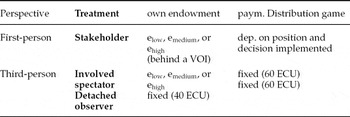
The experiment was run in 12 subsequent rounds with the endowment sets varying in each round. The inequalities ranged from a standard deviation of 0, where each endowment position received 40 ECU, to a standard deviation of 52.91, where low received 0 ECU, medium received 20 ECU and high received 100 ECU. The task for each subject in every round consisted of allocating an additional pie of 180 ECU among the three stakeholders, i.e. relative endowment positions. One of the four decisions in each group was randomly selected and implemented. Veiled stakeholders received the share of the pie that was allocated to their position in addition to their actual endowment, while the spectators and the observers received a fixed payment of 60 ECU for their decision in addition to their endowment, i.e. a fixed initial endowment of 40 ECU in the case of detached observers and the initial endowment of one of the three endowment positions in the case of involved spectators. The experimental design is summarized in Table 1.
Experimental design

Note: In each treatment the group consists of three stakeholders and one spectator. Each group member decides on how to allocate the pie of 180 ECU among the stakeholders. The sum of the endowments equals 120 ECU. Whereas the stakeholders do not know their endowment, the spectators learn it before distributing the pie.
In the second part of the experiment we assessed subjects' individual value orientation using the ‘Ring-test’ (Liebrand Reference Liebrand1984). During this phase of the experiment, subjects made 16 choices between two self–other payoff combinations, which provided the basis for a classification of subjects into aggressive, competitive, selfish, cooperative and altruistic types.Footnote 5 At the end of the experiment, and after providing feedback about the payment, we asked the subjects to fill out a post-experimental questionnaire. We elicited their risk attitude in a non-incentivized way.Footnote 6
The computerized experiment was conducted at a large university in Germany using the z-Tree software (Fischbacher Reference Fischbacher2007). The participants in the experiment were undergraduate students from different disciplines who were recruited using ORSEE (Greiner Reference Greiner2004). None of the participants was informed about the purpose of the experiment, and each was allowed to participate only once. After being seated at separate computer terminals, the subjects received written instructions, which were also read aloud by the experimenter to ensure that they had the same knowledge about the experiment.
The experiment began with a control questionnaire, which the subjects had to complete correctly to ensure that they understood the instructions. The questions were answered individually. Experimental sessions lasted on average 1.5 hours and involved 24 participants, of which 18 were stakeholders and 6 were third-parties. The average earnings per subject were 15€ and ranged from a minimum of 3.95€ to a maximum of 23.75€, including a show-up fee of 2.50€.
4. RESULTS
The data was drawn from eight experimental sessions involving a total of 192 subjects. Each session lasted for 12 periods. In six sessions we used the direct response method, while in two sessions we used the strategy method (Selten Reference Selten and Sauermann1967).Footnote 7 Given that each subject makes 12 decisions, we obtained a total of 2880 allocation decisions, of which 1872 are from veiled stakeholders (hereafter VS), 504 from involved spectators (hereafter IS) and 504 from detached observers (hereafter DO).
4.1 Allocation decisions
Our empirical strategy relies on comparing participants' allocation decisions under the three impartiality conditions. To achieve this end, we first calculate the standard deviation of participants' allocations as a measure of the inequality of the allocation. A standard deviation equal to 0 means an ex-post egalitarian outcome in which the three stakeholders receive the same final amount. The higher the standard deviation was, the less egalitarian was the allocation. 90% of the final distributions range within a standard deviation of 0 and a standard deviation of 40.Footnote 8
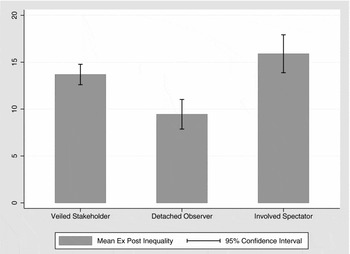
Figure 1 shows the mean ex-post inequality under the three conditions. The average standard deviation of the distributions proposed by observers (9.4) is smaller than the average standard deviation of stakeholders (13.7) and spectators (15.9). The difference between stakeholders and observers, as well as the difference between spectators and observers are statistically significant at any conventional statistical level, using both the parametric t test and the non-parametric Mann–Whitney test.Footnote 9 We find similar results when we concentrate on the number of participants that propose an ex-post egalitarian distribution (standard deviation = 0). The percentages of ex-post egalitarian decisions are 54%, 57% and 68% under IS, VS and DO conditions, respectively. Therefore, DO behave in a more egalitarian way than VS and IS. The proportion of observers who propose an egalitarian distribution is statistically different from both the proportion of stakeholders and the proportion of spectators who propose such a distribution.Footnote 10
Standard deviation of ex-post outcomes for all treatments

Are aggregate differences between the three methods a result of different behavioural patterns at the individual level? We model the decision to propose an ex-post egalitarian distribution and the decision to deviate from that distribution separately. Whereas a random effect probit model is used to model the decision to propose the ex-post egalitarian allocation, a random effect tobit model is used to study the distribution of decisions that lead to a positive standard deviation (inequality).
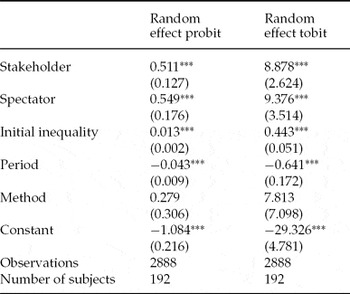
The probit and tobit regressions we run work as follows (see Table 2). In the probit (first column), the dependent variable is a binary variable in which 0 means that the proposed distribution is strictly egalitarian, and 1 that not all the stakeholders receive the same amount. A positive effect of an independent variable means a higher probability of a non-egalitarian distribution. For example, a higher initial inequality increases the probability of the final allocation to be unequal as well. In contrast, the period has a negative effect because the probability of an unequal distribution decreases with time in the experiment.
Probit and tobit models estimates of inequality in outcomes

Note: We report marginal effects of random effect regressions using the standard deviation of participants' allocations as the dependent variable. Stakeholder takes the value 1 if the decision comes from a Veiled Stakeholder, 0 otherwise. Spectator takes the value 1 if the decision comes from an Involved Spectator, 0 otherwise. Initial Inequality is the standard deviation of initial endowments and ranges from 0 (initial endowments are equal) to 52.91. Period takes values 1 to 12 according to the period of the experiment. Method takes the value 1 if the strategy method was used, 0 otherwise. *** denotes significance at the 1% level and ** at the 5% level.
Whereas the probit model estimates whether a participant has proposed a fully egalitarian distribution, the tobit model (second column) focuses on those distributions that are unequal. The dependent variable is the standard deviation of the proposed distribution, and it is then a continuous variable. The higher the value of this variable, the higher the inequality of the distribution. Again, we observe that initial inequality has a positive effect, meaning that the higher the initial inequality, the higher the inequality of the final allocation. We use these two statistical models in this and the following section.
Controlling for the initial inequality, the period and the elicitation method, both stakeholders and spectators are more likely than observers to deviate from the ex-post egalitarian distribution (see the probit model in Table 2). Once deviated from that distribution, VS and IS propose more unequal allocations than DO (see the tobit model in Table 2). Furthermore, we find that subjects are less likely to deviate from the ex-post egalitarian distribution over time and are more likely to allocate more equally in the distribution phase once they deviate.
Result 1. Detached observers are more likely to propose an ex-post egalitarian distribution. Even when they deviate from the ex post egalitarian distribution they propose more equal allocations than IS and VS.
Result 2. Subjects allocate more equally over time.
Why do VS and IS behave in a less egalitarian manner than DO? Next, we explore a first answer to this question. We study whether risk attitude and social orientation affect allocations under the three conditions.
4.2 The effect of risk attitudes and social motives
We now explore some behavioural determinants of participants' decisions. Specifically, we concentrate on the effect of risk attitudes and social value orientation on allocation decisions under the three conditions.
Given that IS and DO have no stake in the allocation, risk attitudes should not matter for them. In contrast, VS risk attitudes may affect their decision. A risk-averse stakeholder would propose an ex-post egalitarian distribution to protect herself against a bad outcome (Rawls Reference Rawls1971). On the contrary, a risk-loving stakeholder would allocate all the pie to the highest endowed position, hoping to be in that position once the veil is lifted.
The effect of social value orientation is not so clear a priori. Using the Ring-test (Liebrand Reference Liebrand1984), we categorized subjects into altruistic, cooperative, selfish, competitive and aggressive types (see section 2 in the Appendix for details). Most of our subjects (80%) were selfish types. Other than that, only the category of cooperative types was large enough to be included in the analysis (19%). VS may have other-regarding preferences over the final distribution of outcomes and, therefore, intuitively cooperative types would propose more equal distributions. IS and DO have no stake in the distribution, therefore a distinction between selfish and cooperative types should not matter much for explaining behaviour. On the other hand, Konow (Reference Konow2009) shows that this outside view, together with being sufficiently informed about the situation, is precisely what enables decision-makers to achieve consensus in choosing what they consider just or fair.
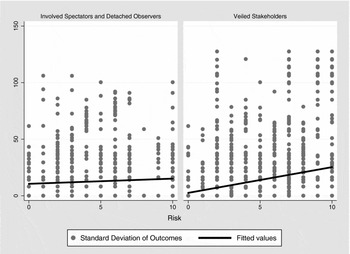
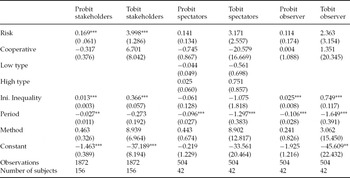
Table 3 shows that risk affects VS, but not IS or DO's decisions. For stakeholders, the more risk averse a subject is, the more egalitarian is the final outcome. Figure 2 plots this relationship in greater detail. The right graph (VS decisions) shows a number of observations in the top-right corner corresponding to high values of the risk variable and high levels of inequalities. This is qualitative evidence of the argument that risk-loving VS allocate a higher proportion of the pie to high-endowed stakeholders.
Influence of subjects' risk attitude on ex-post equality

Probit and tobit models estimates of behavioural determinants

Note: We report marginal effects of random effect regressions using the standard deviation of participants' allocations as the dependent variable. Risk takes values 0–10, where 0 denotes ‘not at all risk taking’ and 10 ‘very risk taking’. Cooperative takes the value 1 when the subject has been classified as a cooperative type in the ring test, 0 otherwise. Low type takes the value 1 when IS receive the lowest endowment, 0 otherwise. High type takes the value 1 when IS receive the higher endowment, 0 otherwise. Initial inequality is the standard deviation of initial endowments and ranges from 0 (initial endowments are equal) to 52.91. Period takes values 1 to 12 according to the period of the experiment. Method takes the value 1 if the strategy method was used, 0 otherwise. *** denotes significance at the 1% level and ** at the 5% level.
Result 3. Risk attitudes affect veiled stakeholders’ decisions. Risk-averse subjects promote ex-post equality. Risk-loving subjects propose more unequal distributions.
We find no relationship between cooperativeness and allocation decisions. This supports the hypothesis that the social preferences of participants do not affect individuals’ decisions under impartiality conditions.
4.3 The effect of information on endowment positions
Thus far we have shown that risk attitudes may explain why VS deviate more often than DO from the ex-post egalitarian distribution. However, we still need to explain why IS and DO behave differently. In this section, we explore the only difference between these two conditions: information about endowment positions. The hypothesis here is that IS may favour stakeholders of their own type (endowment position).
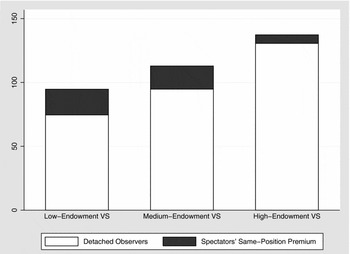
Figure 3 plots the average amount that DO and IS allocate to each of the stakeholder positions.Footnote 11 We compare the DO decisions (white bars) to the amounts allocated by the three spectator positions (black bars). Stakeholders receive considerably more from spectators of their own position. Thus, a low-endowed stakeholder receives on average 20 ECU more from a low-endowed spectator than from a DO, a medium-endowed stakeholder receives on average 18 ECU more from a medium-endowed spectator than from a DO, and a high-endowed stakeholder receives on average 7 ECU more from a high-endowed spectator than from a DO.
Amounts given to stakeholders by detached observers vs. involved spectators

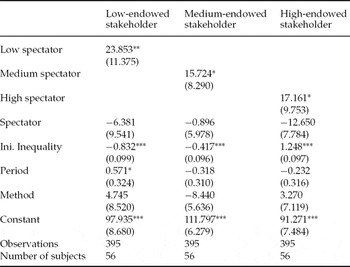
At an aggregate level, when IS deviate from an ex-post egalitarian distribution they seem to favour stakeholders of their own kind. To test whether this result is significant at the individual level, we compare the behaviour of IS and DO using a random effect linear regression on the final amount different stakeholder positions receive (Table 4). We find that spectators significantly favour stakeholders of their own type. The effect is strongest for the low-endowed spectators. This last result is very reasonable given that favouritism and a preference for equality point to the same direction only among low-endowed spectators.Footnote 12 If we focus only on high-endowed and medium-endowed spectators, the result is weaker and only significant at the 10% level.
Random effect linear regression estimates of final amounts given to stakeholders

Note: We report marginal effects of random effect regressions using the final amount different stakeholders receive as the dependent variable. Low, Medium and High spectator take the value 1 if the decision comes from a low-, medium-, or high-endowed spectator, respectively, 0 otherwise. Spectator takes the value 1 if the decision comes from any Involved spectator, 0 otherwise. Initial inequality is the standard deviation of initial endowments and ranges from 0 (initial endowments are equal) to 52.91. Period takes values 1 to 12 according to the period of the experiment. Method takes the value 1 if the strategy method was used, 0 otherwise. *** denotes significance at the 1% level, ** at the 5% level, * at the 10% level.
Result 4. Spectators distribute more to stakeholders of their own position. Even though this effect is strongest for low-endowed spectators, we find this tendency, with marginal significance, also for medium- and high-endowed spectators.
We test the alternative hypothesis that the mere fact of receiving a low, medium or high endowment may lead spectators to behave differently. For instance, low-endowed spectators may support more equal distributions. The third and fourth statistical models reported in Table 3 above show that on average low- and high-endowed spectators do not behave differently from medium-endowed spectators. This result, combined with those presented in Table 4, leads us to conclude that differences between spectators holding different positions are mainly driven by more favourable attitudes of involved spectators towards stakeholders holding their same position.
4.4 Summary of the results
We find substantial differences in the outcome distributions of three different impartiality-inducing methods. Detached observers without a stake in the allocation problem or information about their position in society propose significantly more egalitarian distributions than veiled stakeholders or involved spectators.
To some extent, risk preferences seem to explain why participants who have a stake in the final allocation propose less egalitarian distributions than observers without a stake. In contrast, cooperative preferences do not predict the behaviour of any of the methods studied.
When we compare the behaviour of two different types of third parties, information about their position in society matters. Unlike detached observers, involved spectators who are informed about their position in society tend to favour stakeholders holding the same position. This result is strongest for low-endowed spectators.
5. DISCUSSION
This article has experimentally shown that when rules of distributive justice are to be determined impartially, two procedural features are critical: the perspective (e.g. first- or third-person) and the involvement of the third parties in the problem at hand.
From a purely conceptual standpoint, the differences between the three impartial methods studied are clear. Procedures inspired by Rawls’ veil of ignorance ensure that those who have a stake will not delegate their decision to a non-affected third party. Of course, the price to be paid is the absence of information that might be crucial to guaranteeing that the results will be fair once the veil is lifted. Moreover, risk has a prominent influence on veiled procedures as a group of risk-averse stakeholders would make very different decisions from those of a group of risk-loving stakeholders. This could affect impartiality in a group in which risk-averse or risk-loving subjects are in the minority and the majority imposes the distribution rule on them.
Detached observer and involved spectator procedures have the advantage of using a larger amount of relevant information, but the disadvantage (at least in matters of distributive justice) of excluding stakeholders from a decision that will affect them and only them.
Thus, in line with previous experimental work, stakeholders’ behaviour behind the veil is also influenced by risk attitudes in our experiment. Risk lovers tend to leave everything to chance and act as gamblers interested in maximizing personal gains. In contrast, risk-averse stakeholders tend to act as Rawlsian players who try to ensure a fair portion of the pie for themselves once the veil is lifted. In both cases the impartial procedure is influenced by stakeholders’ psychological attitude towards risk. Thus, the results of any impartial mechanism based on uninformed stakeholders’ decisions may depend on the psychological traits of the focus group members, which may affect the outcomes of these kinds of procedures (Sen Reference Sen2002).
Neither risk nor economic interests affect detached observers and involved spectators by definition. However, our results suggest that these two procedures differ in an interesting way. Whereas the behaviour of detached observers is unimpeachable from the viewpoint of impartiality, the same cannot be said of involved spectators’ behaviour. While we have found that the decisions of detached observers are unbiased, the behaviour of involved spectators is clearly biased as a result of a different degree of empathy towards the different groups of stakeholders. Our detached observers are shown to be a homogeneous group of well-informed individuals who are not affected by risk, economic interests or identification.
We force involved spectators, and not detached ones, to suffer the same arbitrary initial treatment as that of the stakeholders, making them part of the stakeholders’ society. However, unlike Amiel et al.'s involved observer, our involved spectators are not affected by the redistributive decision they take. Hence there was no a priori reason to expect that spectators would favour stakeholders of their own type. In fact, according to the recent experimental literature, third-party decision-makers who have no stake in the allocation decision make impartial decisions.
That is the reason why we could expect that, by having all the information they need to redress the initial allocation in a fair way, our pre-Smithian, involved spectators should behave impartially. Nevertheless, it seems that sharing an unjust initial experience has led to empathy or some kind of social identification and not to impartiality. This bias can be partly explained by the Minimal Group Identity Paradigm, a well-studied phenomenon in social psychology, which predicts implicit ingroup favouritism under minimal conditions (Tajfel Reference Tajfel1970; Dasgupta Reference Dasgupta2004; Devos and Banaji Reference Devos, Banaji, Leary and Tangney2005).
Interestingly, Chavanne et al. (Reference Chavanne, McCabe and Paganelli2010) do not find favouritism in a related paper. They study the behaviour of third parties in a three-player dictator game. In their study, third parties and stakeholders share or do not share the same experience in a previous phase of the experiment depending on the treatment. That experience is related to the source of their initial endowments in the experiment, whether they have earned them or they have received them randomly. They report that third parties do not favour stakeholders with whom they have shared the same experience.
We believe our study goes a step further, in the sense that not only do spectators and stakeholders share the same experience, but they share the same position in the income distribution. Therefore, it seems that it is the relative economic position that leads to favouritism, rather than just sharing the same experience.
The three impartial methods have proven to be rather independent from the social preferences of the individuals. When measured independently, cooperative traits do not play a significant role in individuals’ decisions. The decisions of involved spectators, detached observers and veiled stakeholders do not seem to be influenced by these preferences.
Finally, a limitation of our study lies in the fact that the interaction is extremely structured and the actions available to subjects are severely limited. This makes the situation somewhat unnatural when compared with ‘real world’ situations to which impartiality is meant to apply. Such doubts regarding external validity apply to much of experimental research in the social sciences. The advantage of such structured environments lies in the fact that we can clearly formulate hypotheses in terms of quantifiable behavioural patterns. The disadvantage is that we exclude relevant features of the social environment in which decisions are made.
SUPPLEMENTARY MATERIAL
To view supplementary material for this article, please visit http://dx.doi.org/10.1017/S0266267113000175.