Women's representation in national legislatures varies widely around the world. In 2012, only Rwanda and Andorra had achieved parity in women's representation in the national parliament, with 56% of the Rwandan Chamber of Deputies being female and exactly half the Andorran General Council represented by each sex.Footnote 1 In many other countries, women still have little representation in the national legislature, despite being almost 50% of the population. A large body of research has emerged to try to explain the wide variation across countries, with most of it focusing on cultural, socioeconomic, and electoral explanations (e.g., McDonagh Reference McDonagh2002; Norris Reference Norris1985; Reynolds Reference Reynolds1999; Rule Reference Rule1987; Tripp and Kang Reference Tripp and Kang2008). Recent scholarship, however, has suggested that the legislature itself is a gendered institution that marginalizes women and argues for greater attention to understanding exactly how legislative institutions affect women's representation (Beckwith Reference Beckwith2005; Chappell Reference Chappell2006; Reference Chappell2010; Duerst-Lahti and Kelly Reference Duerst-Lahti and Kelly1995; Hawkesworth Reference Hawkesworth2003; Reference Hawkesworth2005; Krook and Mackay Reference Krook and Mackay2011; Schwindt-Bayer Reference Schwindt-Bayer2010).
In this paper, we examine how one set of institutional differences among legislatures—their political power—influences the gender representativeness of legislatures in a worldwide comparative context. We build on recent work on legislative power in comparative politics by Fish and Kroenig (Reference Fish and Kroenig2009), work on comparative institutions and women's representation (Barnes Reference Barnes2012; Schwindt-Bayer Reference Schwindt-Bayer2010), and the literature on legislative professionalism and gender in American politics (Carroll Reference Carroll1994; Diamond Reference Diamond1977; Rule Reference Rule1981; Sanbonmatsu Reference Sanbonmatsu2002b; Reference Sanbonmatsu2006; Squire Reference Squire1992) to argue that the power of legislatures, as institutionalized in constitutions, legislative rules, and informal legislative norms, is an important but often overlooked explanation for variation in women's legislative representation across countries. Situating the decisions that prospective candidates and parties make about running for office and recruiting candidates into a power framework elucidates that the costs and benefits of election are different in legislatures with more political power. We hypothesize that smaller proportions of women should be elected in more powerful legislatures than in less powerful ones and theorize some reasons for this.
Further, we posit that one particular dimension of legislative power, what we term personal professional power, should be a larger obstacle to the election of political newcomers, such as women, than institutional policy power. Institutional policy power is systemic in nature, tapping the capacity of the legislature, as a whole, to influence policy independent of other branches of government. In contrast, personal professional power accrues to individuals within legislatures and is comprised of legislative rules and resources that increase the ability of individual lawmakers to achieve their goals of reelection or a long-term political career.Footnote 2 Greater institutional policy power makes the legislative policy-making process more influential, but personal professional power increases the incentives for elites to view legislative seats as a vehicle to a political career, in essence turning them into valuable property. It is the latter conception that should provide the greater obstacle to women's descriptive representation because the majority of political elites in nearly every country in the world is male.
We test these notions using Fish and Kroenig's (Reference Fish and Kroenig2009) measure of legislative power that classifies four dimensions of legislative power—the legislature's influence over the executive branch, the legislature's autonomy from other branches of government, the specific policy-making powers assigned to the legislature, and its institutional capacity to function. We classify the first three of these dimensions as measures of institutional policy power and the last one as a measure of personal professional power, and we analyze their effects on women's legislative representation in 149 legislatures in the late 2000s. We find that it is not the composite measure of legislative power or the three individual measures of institutional policy power that affect women's representation. Instead, it is the degree of personal professional power that is critical.
Our study makes several important contributions to comparative legislative research. First, it provides a theoretical framework in which to consider the multidimensionality of legislative power. Second, it explores an important and understudied consequence of legislative power: whether it hinders the election of new or underrepresented groups—in this case, women. Third, it underscores the importance of looking beyond cultural, socioeconomic, and electoral explanations for women's underrepresentation to explore how legislative institutions matter. Recent research has called for greater attention to the obstacles provided by gendered legislative institutions, yet little research has analyzed how legislatures themselves may obstruct women's access to politics. We do so focusing on the institutions that determine the policy and professional power of legislatures.
WOMEN'S LEGISLATIVE REPRESENTATION
Representation of women in national legislatures varies widely, but on average, it is well below parity. Some countries, such as Finland and South Africa, approached 45% of their national legislatures being female in 2012, whereas other countries, such as Brazil and Hungary, failed to elect women to more than 10% of the seats in the legislature. The worldwide average for the percentage of national legislatures that was female was only 20.3%. Given that the concept of representative democracy rests on the full inclusion and representation of all citizens (Pitkin Reference Pitkin1967), understanding why women are not as successful getting elected to legislatures in some countries as in others is crucial.
Scholars have offered an array of explanations.Footnote 3 Some emphasize that cultural dynamics, such as religious traditions, attitudes toward women's equality, and postmaterialism, affect women's access to national political office (Inglehart and Norris Reference Inglehart and Norris2003; Kenworthy and Malami Reference Kenworthy and Malami1999; Norris Reference Norris1985; Paxton and Hughes Reference Paxton and Hughes2007; Reynolds Reference Reynolds1999; Rule Reference Rule1987; Tremblay Reference Tremblay2007; Yoon Reference Yoon2004). Another explanation for women's varying levels of political representation is a country's socioeconomic environment, with more economically developed countries, where women attain educational and workforce experience, having more women in legislative office (Kenworthy and Malami Reference Kenworthy and Malami1999; Norris Reference Norris1985; Oakes and Almquist Reference Oakes and Almquist1993; Randall and Smyth Reference Randall and Smyth1987; Reynolds Reference Reynolds1999; Rule Reference Rule1981; Reference Rule1987) .The type of electoral system a country uses for its national legislature also is thought to influence the number of women elected to office with proportional representation (PR) electoral systems being more favorable to women than majoritarian systems or single-member district plurality rules (Caul Reference Caul1999; Darcy, Welch, and Clark Reference Darcy, Welch and Clark1994; Duverger Reference Duverger1955; Matland and Studlar Reference Matland and Studlar1996; Norris Reference Norris1985; Rule Reference Rule1981; Reference Rule1987; Reference Rule, Zimmerman and Rule1994; Yoon Reference Yoon2004). Finally, the adoption of gender quotas is another determinant of women's legislative representation (Caul Reference Caul1999; Dahlerup Reference Dahlerup2006; Hughes Reference Hughes2011; Krook Reference Krook2009; Paxton, Hughes, and Painter Reference Paxton, Hughes and Painter2010; Tripp and Kang Reference Tripp and Kang2008). In the past 30 years, more than 100 countries have experimented with gender quotas in an explicit effort to augment the number of women serving in legislatures, and many of those countries have increased women's legislative representation.
Although the literature on women's representation has made important advances explaining variation in the number of women holding legislative seats across countries, there is a central variable that is often overlooked—the legislature itself. As gender and politics research increasingly points out, legislatures are gendered institutions (Beckwith Reference Beckwith2005; Chappell Reference Chappell2006; Reference Chappell2010; Duerst-Lahti and Kelly Reference Duerst-Lahti and Kelly1995; Hawkesworth Reference Hawkesworth2003; Reference Hawkesworth2005; Schwindt-Bayer Reference Schwindt-Bayer2010). In other words, they are political entities that operate on formal rules and informal norms that advantage one sex over the other. Yet the ways in which legislative institutions, not just electoral or cultural institutions, may influence women's representation have not been thoroughly studied. The legislature itself may be a potentially important explanation for gender differences in political representation.
Studies on American politics have made this connection through research on legislative professionalization (Carroll Reference Carroll1994; Diamond Reference Diamond1977; Rule Reference Rule1981; Sanbonmatsu Reference Sanbonmatsu2002b; Reference Sanbonmatsu2006; Squire Reference Squire1992). Diamond's (Reference Diamond1977) work argued that women were most often elected to the legislature in states where competition for that position was lower. Subsequent research found that less professionalized legislatures offered better opportunities for female candidates. These ideas, however, have been neither theorized broadly as part of a multidimensional concept of legislative power nor empirically tested outside the United States.
CONCEPTUALIZING LEGISLATIVE POWER
In this study, we focus on one specific characteristic of the legislature, its political power, and the ways that legislative power may constrain women's representation. Political power is the ability to influence the behavior of or to act independently from other actors in the public sphere. Thus, legislatures that are powerful are those with formal and informal rules that allow them to be influential and to act independently to accomplish the tasks required of them—for example, making policy, providing a check on other branches of government, representing constituents, and so forth (Fish and Kroenig Reference Fish and Kroenig2009).
We build a conceptualization of legislative power that draws from an array of existing literature that distinguishes between the policy goals of elected officials and the personal electoral goals of office maximization. In the comparative literature on legislator behavior, for example, scholars often distinguish between personalistic or personal vote-seeking behavior and programmatic or party-disciplined behavior (Cain, Ferejohn, and Fiorina Reference Cain, Ferejohn and Fiorina1987; Carey and Shugart Reference Carey and Shugart1995). In the literature on coalition building and cabinet formation, scholars often distinguish between the policy-seeking and office-seeking behavior of parties trying to form governments (Laver and Shepsle Reference Laver and Shepsle1990; Martin and Stevenson Reference Martin and Stevenson2001; Strom, Budge, and Laver Reference Strom, Budge and Laver1994).
In much the same way, we conceptualize legislatures as having two overarching types of political power—institutional policy power and personal professional power—that illuminate the notion that the power of legislatures is multidimensional and rests on assumptions that both policy- and office-maximizing goals drive legislative politics. In our view, institutional policy power refers to the influence that the legislature, as an organizational entity, has on the policy-making process, specifically in relation to other branches of government.Footnote 4 This power comes from the rules and norms articulated in the country's constitution or legislative code about the kinds of policies that the legislature influences and how the legislature's responsibilities are constrained by or are independent from other branches of government. Specifically, legislatures with strong institutional policy power would have the ability to influence policy on a wide range of issues, such as tax laws, budget legislation, declarations of war, treaty ratifications, and grants of amnesties or pardons, among other things, all with limited oversight by the executive or judicial branch. Legislatures with strong institutional policy powers also have significant influence over other branches of government. They can influence policy by appointing bureaucrats, appointing the chief executive (in parliamentary systems), recalling or impeaching the chief executive, and by conducting executive or bureaucratic oversight. This vision of institutional policy power relates to and builds from research that has conceptualized and measured presidential power as constitutional powers about the role of the president in policy making (Frye Reference Frye1997; Metcalf Reference Metcalf2000; Shugart and Carey Reference Shugart and Carey1992; Siaroff Reference Siaroff2003).Footnote 5
In contrast to institutional policy power, personal professional power refers to legislative rules and norms about the influence of individual legislators on the political and policy-making process. This implies rules about the frequency with which the legislature meets, the capacity to gain reelection, and the resources allocated to representatives to do their jobs, such as salaries and staff. These rules generate personal professional power rather than institutional policy power because they allow legislators, as individuals, to develop political experience and to craft public policy that helps distinguish them from their colleagues and leverage their own political success and future careers. Long or frequent legislative sessions, strong reelection possibilities, large staffs, and ample pay and benefits can provide legislators with incentives and resources to pursue personalistic and party-sponsored policies that they can highlight to promote their individual contributions to politics. Thus, personal professional power can create “professional” legislators by providing them the resources to fulfill their self-interested goals of reelection or otherwise establishing a political career (Carey Reference Carey1996; Mayhew Reference Mayhew1974). As we will argue below, this dimension of legislative power ties into the idea developed in the American politics literature that some legislatures are more professionalized than others.
LEGISLATIVE POWER AND WOMEN'S REPRESENTATION
The powers invested in a legislature have an array of weighty political consequences. Studies have shown that weak legislatures contribute to democratic instability (Shugart and Carey Reference Shugart and Carey1992), and stronger legislatures contribute to the efficiency of policy making (Carey and Shugart Reference Carey and Shugart1998; Cox Reference Cox1987; Morgenstern and Nacif Reference Morgenstern and Nacif2002). The “power of the legislature” also can influence the types of individuals holding office in the legislature, particularly in terms of their political ambition.Footnote 6 Legislatures with less power may entice representatives who view a job in the legislature as a stepping stone toward more powerful political offices or who merely wish to dabble in politics (Jones et al. Reference Jones, Saiegh, Spiller and Tommasi2002; Samuels Reference Samuels2003; Squire Reference Squire2007; Reference Squire2014). What research has been less likely to consider, particularly in comparative politics, are the consequences of legislative power for descriptive representation of traditionally underrepresented groups—such as women.
We argue that powerful legislatures may limit women's representation in three key ways. First, women may opt not to run for office more often than men in more powerful legislatures. Second, even if women are no less inclined to run for office than men, political parties and other influential political actors may be less likely to recruit them.Footnote 7 Third, voters may be less likely to vote for female candidates in elections to more powerful legislatures, particularly in traditional cultures and societies.
Powerful legislatures are those with elections that are more competitive, require greater campaign resources, and require more experience in and stronger connections to political parties (Berkman Reference Berkman1994; Carey, Niemi, and Powell Reference Carey, Niemi and Powell2000; Squire and Moncrief Reference Squire and Moncrief2010, 51–63). As a result, women may find that the time, interest, knowledge, perceived required qualifications, and extensive campaign fundraising necessary to mount a competitive political campaign for a powerful legislature keeps them from considering a run (Lawless and Fox Reference Lawless and Fox2005; Sanbonmatsu Reference Sanbonmatsu2006). In many countries, women have lower levels of political interest, efficacy, political discussion, and knowledge than men, which may discourage them from running for office (Burns, Schlozman, and Verba Reference Burns, Schlozman and Verba2001; Kittilson and Schwindt-Bayer Reference Kittilson and Schwindt-Bayer2012; Verba, Burns, and Schlozman Reference Verba, Burns and Schlozman1997). Additionally, women may be less ambitious than men, particularly in powerful legislative settings where they do not expect to be able to win (Fulton et al. Reference Fulton, Maestas, Maisel and Stone2006). They also may have (mis-) conceptions about the qualifications they need to get elected to powerful legislatures that cause them to not even contemplate a run for office. Research on women's underrepresentation in the United States has found that women do not run because they are less likely to be encouraged to do so, and they tend to think that they are less qualified (Fox and Lawless Reference Fox and Lawless2004; Reference Fox and Lawless2011; Lawless and Fox Reference Lawless and Fox2005). Fox and Lawless' (Reference Fox and Lawless2011) study found that women with similar professional and educational backgrounds to men are less likely to view themselves as having the political and occupational experiences necessary to run for office and so are less likely to do so. This is not to claim that men do not face barriers to entry, but rather that women face an additional set of barriers or face the same obstacles in a different way as a result of their gender.
Women also may opt not to run for office more often than men in more powerful legislatures that promote personal vote seeking because of the fundraising demands and general political risk associated with the more competitive elections that may characterize these legislatures. Comparative gender and politics scholars highlight the financial disadvantages that many women running for political office face (Dahlerup and Freidenvall Reference Dahlerup and Freidenvall2005; Paxton and Hughes Reference Paxton and Hughes2007). In the United States, studies show that women raise as much money as men do for their campaigns, on average, but they also suggest that raising that money is much more difficult for women than for men (Burrell Reference Burrell1994; Carroll and Sanbonmatsu Reference Carroll and Sanbonmatsu2013; Jenkins Reference Jenkins2007). Recent research suggests women may even have some advantages over men when it comes to campaign fundraising in the United States (Crespin and Deitz Reference Crespin and Deitz2010). Moreover, challengers running against incumbents in more powerful legislatures have to professionalize their campaigns by hiring consultants and managers, costing considerable sums of money (Abbe and Herrnson Reference Abbe and Herrnson2003). As Fox and Lawless (Reference Fox and Lawless2011, 70) note about the United States, “Running for office … is a highly competitive endeavor that requires significant levels of entrepreneurship and self-promotion; women may be less comfortable than men competing in this environment.”
The second way in which women's election to legislative office may suffer is discrimination by incumbent elites, who are majority male in nearly every country. In powerful legislatures, members have significant capacity to both influence policy and to advance their political careers. This provides greater incentives for the male-dominant elite establishment to close ranks around those resources and avoid recruiting women to run for office. Empirical research on women's candidacies has indeed found that political parties are less likely to recruit and support women than men as candidates (Carroll and Sanbonmatsu Reference Carroll and Sanbonmatsu2013; Fox and Lawless Reference Fox and Lawless2010; Kittilson Reference Kittilson2006; Lawless and Fox Reference Lawless and Fox2010; Sanbonmatsu Reference Sanbonmatsu2002b), which is critical because women are more likely than men to need to be encouraged by party leaders to run for the legislature (Carroll and Sanbonmatsu Reference Carroll and Sanbonmatsu2013; Moncrief, Squire, and Jewell Reference Moncrief, Squire and Jewell2001, 97–104). In some cases, efforts to minimize women's access to politics may be blatant; male party leaders may intentionally keep women off of the ballot because they may not want to give up their political control (Heath, Schwindt-Bayer, and Taylor-Robinson Reference Heath, Schwindt-Bayer and Taylor-Robinson2005). Women may be particularly disadvantaged because they are not only new to the political arena, but are female. As Kelly and Duerst-Lahti (Reference Kelly, Duerst-Lahti, Duerst-Lahti and Mae Kelly1995, 57) observed, “sexism shapes and curtails the ability of women to act as they might choose and to rise to leadership positions within institutions.” Because powerful legislatures are often an important stepping stone in a politician's career, the male-dominated establishment may not want to threaten its own political survival by sharing space on party ballots with women whom they may perceive as less likely to win (Nelson and Chowdhury Reference Nelson and Chowdhury1994; Niven Reference Niven1998; Rodríguez Reference Rodríguez2003). Such behavior may be less evident in less powerful legislatures where a legislative career does not provide the same vehicle to a high-level political career.
In other places discrimination may be more subtle, whereby women are overlooked because party leaders do not think about women when they contemplate the sorts of individuals who may have the qualities, contacts, and ambition needed for a political career. Parties are likely to seek highly qualified candidates with extensive political experience for elections to powerful legislatures—characteristics that they may not attribute to women (Sanbonmatsu Reference Sanbonmatsu2006). This does not mean that women are not highly qualified and have no political experience. But, party elites may not associate those qualities with female aspirants because of longstanding stereotypes and women's traditional absence from politics. Indeed, party elites often seek candidates from their traditional political networks, networks that women may not have infiltrated (Camp Reference Camp1995; Fox and Lawless Reference Fox and Lawless2010; Kittilson Reference Kittilson2006; Sanbonmatsu Reference Sanbonmatsu2006). Female politicians may enter politics from different occupational backgrounds—leaders of community groups, educators, women's movement leaders—which give them different formal and informal linkages (Carroll and Sanbonmatsu Reference Carroll and Sanbonmatsu2013). If women do not operate in the same political circles as men, their “invisibility” to party leaders could make it less likely that they would recruit women in more powerful legislatures.
The third obstacle for women may be voters. Women may be less likely to win seats in more powerful legislatures because of voter bias against female candidates. Although some studies find little evidence of voter bias (Darcy and Schramm Reference Darcy and Schramm1977; Matland Reference Matland1994; Norris, Vallance, and Lovenduski Reference Norris, Vallance and Lovenduski1992), others have shown that women are less likely to win legislative office than men, in some settings (Dolan Reference Dolan2004; Engstrom Reference Engstrom1987; Sanbonmatsu Reference Sanbonmatsu2002a; Reference Sanbonmatsu2003; Seltzer, Newman, and Leighton Reference Seltzer, Newman and Leighton1997; Schwindt-Bayer, Malecki, and Crisp Reference Schwindt-Bayer, Malecki and Crisp2010; Smith and Fox Reference Smith and Fox2001). Fulton (Reference Fulton2012) finds that one reason for this is that “women have to work harder at developing greater political quality to be equally competitive.” Another reason may be that voters in more conservative cultures are less likely to vote for women than men while those in progressive cultures favor women over men (Schwindt-Bayer, Malecki, and Crisp Reference Schwindt-Bayer, Malecki and Crisp2010). The power and prominence of the national legislature in a country could condition the extent to which gender bias emerges among voters. If voters are predisposed to view women as less legitimate or unqualified political actors, they may be particularly concerned about electing women to powerful legislatures where they could influence the political process. Women may have a better chance of winning legislative seats when they are running for less powerful political offices that voters may not view as integral to the political system.
We have offered a variety of reasons why legislative power, in general, may hinder women's representation. However, as we suggested earlier, “legislative power” is a nuanced concept, such that the effects of legislative power may be stronger for personal professional power than for institutional policy power. Institutional policy power increases the ease and efficiency by which the legislature, as an institution, exerts political influence (Carey and Shugart Reference Carey and Shugart1998; Cox Reference Cox1987; Morgenstern and Nacif Reference Morgenstern and Nacif2002). The outcome that this kind of power produces is at the system level—national policy—and the outcome is derived from the legislature's autonomy from other branches of government in the policy-making process. Unless legislative and party elites or women themselves believe that women will be inferior autonomous policy makers, a finding with little empirical support, the incentives that institutional policy power generates for elites to discriminate against women or for women to choose not to run should be minimal. Indeed, it is important to stress that because policy power is exercised in the aggregate by parties, factions, or coalitions, men can still dominate decision making while at the same time allowing substantial numbers of women to be members of the governing majority.
In contrast, personal professional power accrues to individuals within the institution. The outcome that it produces affects legislators at the personal level—continuing and enhancing their own prospects for a successful political career. Politicians are likely to be driven by the primacy of reelection and/or ensuring their future political career, and more powerful legislatures provide incentives and resources for legislators to do just that, be it by crafting policy, doing constituency service, or otherwise building a name for themselves. Personal professional power can increase the psychological, political, and financial value of legislative seats as a means for both a viable political career and a lucrative pecuniary life, thus providing a stronger incentive for discrimination against women. It is because the direct benefits of personal professional power accrue to individuals within the legislature, rather than to the institution as a whole, that we argue it is more prone to deterring women's representation. Allowing underrepresented groups access to positions enjoying personal professional power means reducing access for members of the dominant group, a result those who traditionally reap the benefits are likely to resist.
Research on legislative professionalism in the American states reinforces the argument we offer regarding personal professional power because it finds that more professionalized legislatures—those that pay higher salaries, meet for longer sessions, and offer more staff resources (Berry, Berkman, and Schneiderman Reference Berry, Berkman and Schneiderman2000; Moncrief, Neimi, and Powell Reference Moncrief, Niemi and Powell2004; Squire Reference Squire2007)—have fewer women serving in them (Carroll Reference Carroll1994; Diamond Reference Diamond1977; Rule Reference Rule1981; Norrander and Wilcox Reference Norrander, Wilcox, Thomas and Wilcox2005; Squire Reference Squire1992).Footnote 8 Sanbonmatsu (Reference Sanbonmatsu2002b, 795), for example, argues that more professionalized state legislatures deter women “because of increased competition among potential candidates for the office or the higher costs of campaigning in those states.” Additionally, both U.S. and comparative studies of one characteristic of professionalized legislatures—reelection opportunities and incumbency—find that they hinder women's legislative representation (Andersen and Thorson Reference Andersen and Thorson1984; Darcy and Choike Reference Darcy and Choike1986; Norris, Vallance, and Lovenduski Reference Norris, Vallance and Lovenduski1992; Rule and Zimmerman Reference Rule and Zimmerman1994; Schwindt-Bayer Reference Schwindt-Bayer2005; Studlar and McAllister Reference Studlar and McAllister1991; Welch and Studlar Reference Welch and Studlar1996; Young Reference Young and Megyery1991).Footnote 9 Incumbency advantages male legislators in part because it leaves little room for political newcomers, such as women, and because women may choose not to pose a challenge in a legislative election that they perceive they are unlikely to win.
We hypothesize that as the power of legislatures increases, the percentage of those legislatures that is female will decline. However, we expect that disaggregating legislative power into two constituent parts—institutional policy power and personal professional power—will reveal a stronger linkage between personal professional power and women's representation than between institutional policy power and women's representation. Personal professional power should be a larger obstacle to women's representation because the dominant male hierarchy is likely to be more concerned with protecting their own personal advantages than with denying entry to shared policy power at the institutional level. It is important to note here that our intention is not to sort empirically through the myriad reasons why personal professional power may be an obstacle to women. Instead, our goal is to determine whether it is a deterrent and leave to future research an evaluation of which reasons apply to whom and where.
DATA AND VARIABLES
Our data set includes 149 countries—both democracies and authoritarian states, developed and developing countries, and countries with wide variation in the representation of women.Footnote 10 The daunting challenges of measuring the power of legislatures has resulted in there being only one measure of legislative power that includes all countries around the world in a comprehensive manner—Fish and Kroenig's Reference Fish and Kroenig2009 survey of legislatures—and it exists at only one point in time.Footnote 11 Because of this, we provide a cross-sectional rather than a time-serial analysis of the relationship between legislative power and women's representation. The dependent variable is the percentage of the national legislature that is female as of 2009, and it ranges from 0 to 56.3 with a mean of 17.7. We measure all other variables at or before 2009 to provide an appropriate time lag.
We analyze such a broad sample of countries to maximize variation in legislative power and women's representation and increase the generalizability of our findings. Even though the representativeness of a legislature can be functionally irrelevant in authoritarian states, elections in them are often held and can provide the regime useful information (Malesky and Schuler Reference Malesky and Schuler2011), the elected assemblies occasionally exert independent power (Desposato Reference Desposato2001), and women's representation in them is frequently a priority (Dahlerup Reference Dahlerup2006; Krook Reference Krook2009). This last point is demonstrated by the fact that many authoritarian countries have adopted gender quotas, often as a strategic mechanism to increase their international and domestic legitimacy (Krook Reference Krook2009). We ensure that our findings from this analysis are not biased by the inclusion of authoritarian states by analyzing and presenting a set of models that narrow the focus to democracies only.Footnote 12 This approach offers a stronger test of our theory and increases the robustness of our findings.
Legislative Power
Fish and Kroenig (Reference Fish and Kroenig2009) created a measure of legislative power by asking country experts from nearly all countries in the world to answer 32 questions related to four dimensions of legislative power that they created: legislative influence over the executive, institutional autonomy, specified powers, and institutional capacity.Footnote 13 The first two dimensions measure the degree of separation of power in executive-legislative relations. Legislative influence over the executive refers to the strength of the legislature's executive appointment and dismissal powers, its investigatory powers, and its executive oversight powers.Footnote 14 Institutional autonomy measures the legislature's freedom from executive dismissal and oversight as well as the legislature's policy-making independence.Footnote 15 Specified powers assesses the specific policy-making powers held by the legislature: amending the constitution, authorizing war, ratifying treaties, granting amnesties, influencing judicial appointments, and appointing the head of the central bank, and influencing the media. Finally, Fish and Kroenig measure institutional capacity, which captures “whether legislators meet regularly, have staff, are eligible for re-election, seek re-election, and number among their own a significant cohort of experienced colleagues.” From these four dimensions, Fish and Kroenig create a Parliamentary Powers Index (PPI) that measures the overall power of the national legislature.Footnote 16
In this study, we use the Fish and Kroenig (Reference Fish and Kroenig2009) measures of legislative power to assess how the power of national legislatures affects women's representation. We categorize the first three of their dimensions as measures of institutional policy power because they assess the range of policy areas over which the legislature has control and the influence on policy making of the legislature in relation to other branches of government. We consider their institutional capacity dimension to be a measure of personal professional power because it assesses the ability of legislators to influence policy and the rules that help them achieve their primary goals of reelection and a future political career.Footnote 17 We employ their Parliamentary Powers Index for an overarching measure of legislative power.
Each of the five variables of legislative power ranges from 0 to 1.Footnote 18 The empirical correlations between the measures of legislative power illustrate that, while policy power and professional power are distinct concepts, they do fit together under the umbrella of parliamentary power. The three measures of institutional policy power correlate more highly with one another than they do with the measure of personal professional power. The correlations between the three institutional policy power variables average 0.54 (r = 0.43, r = 0.57, r = 0.61) whereas the correlation of the personal professional power measure and the three institutional policy power variables averages 0.42 (r = 0.38, r = 0.40, r = 0.47). The four measures of legislative power also correlate with the PPI at r-values ranging from 0.66 (personal professional power and PPI) to 0.84 (institutional autonomy and PPI).
Legislative power varies widely across the 149 countries in the data set—PPI ranges from 0.06 to 0.84 with a mean of 0.50. By this measure, Germany, Italy, and Mongolia have the most powerful legislatures, whereas Turkmenistan and the United Arab Emirates are the weakest legislatures.Footnote 19 Facial validity for the measure is provided by the fact that authoritarian states have legislatures with significantly less power, on average (mean PPI = 0.36), and democratic states have more powerful legislatures (mean PPI = 0.61). Personal professional power also varies across countries, ranging from 0.17 to 1.00 among all 149 countries, and 0.33 to 1.00 in democracies.
Control Variables
As described above, existing research on women's legislative representation identifies a wide range of explanations for variation in women's legislative representation—cultural, socioeconomic, and electoral. These studies have narrowed the primary explanatory variables down to a key few, which we control for in this study. First, we control for a country's predominant religion.Footnote 20 We include five dummy variables for Protestant, Catholic, Muslim, Eastern (Buddhist and Shinto), and Orthodox, with all other religions and denominations as the excluded category.Footnote 21 We measure the socioeconomic context of a country with two variables. The first measures level of economic development as logged GNI per capita.Footnote 22 The second socioeconomic measure is women's workforce participation (World Bank 2007).Footnote 23 We control for the effect that electoral rules have on women's representation with a categorical variable measuring whether the electoral system is proportional representation, plurality, or mixed.Footnote 24 In the models, the plurality category is the omitted category. Among the countries in the data set, 57 use proportional representation electoral rules, 54 use plurality rules, and 30 are mixed systems.Footnote 25
We also include a control variable for whether (1) or not (0) the country has a gender quota for national legislative elections (legal-candidate quota or reserved-seat quota) or has political parties in office with quotas (www.quotaproject.org).Footnote 26 In our sample of countries, 83 have some type of gender quota, and 66 do not. Finally, we include a measure of electoral democracy in the country from the Polity IV data set to control for any systematic differences in the effect of legislative power on women's representation in more and less democratic states.Footnote 27
In addition to these most common and most consistently significant influences on women's legislative representation, we ran models with several alternative explanatory variables: the effective number of parties, ideology of the governing party, bicameralism, and women's economic rights, as measured by the CIRI Human Rights Data Project. None of these control variables were statistically significant in any of the models and they did not change the substantive results.Footnote 28 We also estimated models with alternative specifications of the final set of control variables (i.e., other measures of culture, socioeconomics, electoral rules, gender quotas). Those are described in detail in the footnotes of the last section. The concise models we present below are robust across all of these alternatives.
FINDINGS
We analyze the effect of legislative power on women's representation using OLS regression with robust standard errors.Footnote 29 Table 1 presents the results for all countries in the data set with six models—one for the overall PPI, one for each of the four dimensions of legislative power, and one that combines all four dimensions in a single model. The results are remarkably robust to alternative specifications and robustness tests including tests for multicollinearity, outliers, and heteroskedasticity.Footnote 30 The first model in the table shows that the PPI has no effect on the percentage of the legislature that is female. The overall degree of combined power that a legislature has does not appear to influence women's representation.
Legislative power as an explanation for the percentage of national assemblies that is female (all countries)

Note: Robust standard errors in parentheses.
*p < 0.10; **p < 0.05; ***p < 0.01.
Once legislative power is disaggregated into its component parts, it becomes clear that legislative power is, in fact, related to women's representation, but only one dimension of legislative power matters.Footnote 31 None of the three measures of institutional policy power exert statistically significant effects on the percentage of the legislature that is female while the measure of personal professional power does. This finding persists and is even stronger in the final model that includes all four aspects of legislative power. Personal professional power decreases the percentage of women elected to national legislatures. Legislatures that meet regularly, that provide at least two staff to legislators, that permit and attract reelection, and that produce highly experienced legislators have fewer women in office. Not only is the effect statistically significant (p = 0.02), but it is substantively strong as well. An increase of 0.10 in the personal professional power measure yields an estimated decrease of women's legislative representation of 0.9%. This translates into a difference of 7.5% between a legislature with a personal professional power score of 1.0 and a legislature with the lowest score of 0.17, all else being equal.
The substantive strength of the personal professional power variable can be better assessed by comparing its effect to the effects of other variables that scholars have long considered to be important explanations for the different levels of women's representation across countries. The models show that several of the control variables have statistically significant effects on the percentage of the legislature that is female. Legislatures that use proportional representation electoral systems, for example, have 4.6% more women than those that use plurality rules, on average. Countries with gender quotas have 6% more women than those without, all else equal.Footnote 32 Muslim countries have only 5% fewer women in office, on average, despite their very traditional views of women's equality. Democracies have almost 3% fewer women represented than nondemocracies, although this coefficient falls short of traditional levels of statistical significance.Footnote 33 Increases in a country's level of economic development and women's participation in the workforce lead to higher levels of women's representation as well. Thus, the increase of 7.5 percentage points across the range of the personal professional power measure is comparable to those generated by other longstanding explanations for women's representation.
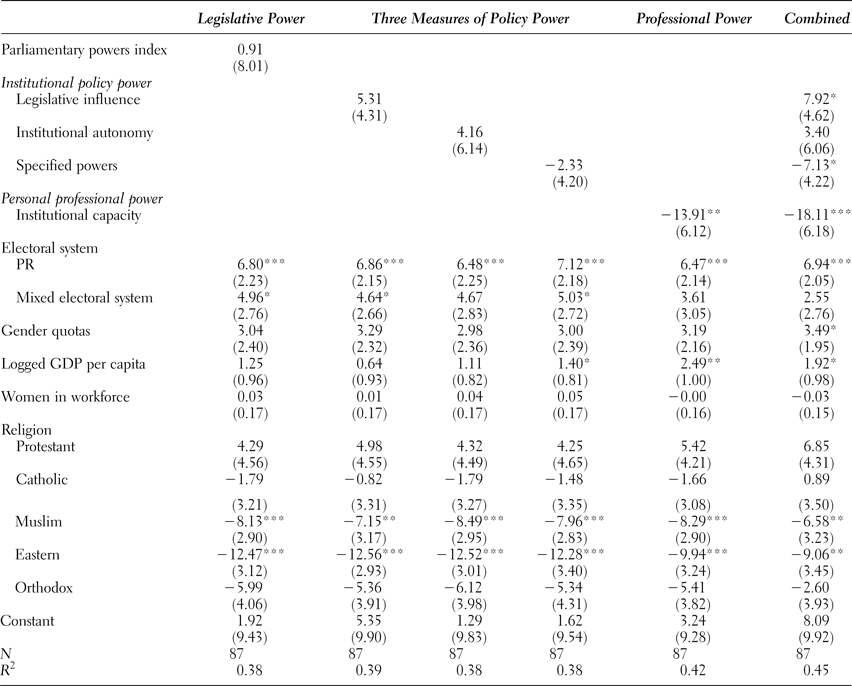
In Table 2, we present the results of models estimated with the restricted sample of 87 democracies. Again, the results are robust to alternative specifications of the models and robustness tests.Footnote 34 Democratic countries are those with at least minimal standards of free and fair elections (scoring 6 to 10 on the Polity IV democracy measure) where we can be relatively confident that women (and men) have legitimate opportunities for election. Again, in democracies, the only measure of legislative power that affects women's representation is the measure of personal professional power (b = −8.81 in the full sample models). This finding persists in the model that estimates the effects of legislative power against one another. Legislatures with greater personal professional power have significantly fewer women in office. Substantively, this translates into democracies with the highest levels of personal professional power (1.0) having 9.3% fewer women in the national legislature than countries with the lowest levels of personal professional power (0.33), after controlling for all other variables that might explain women's levels of representation. The type of electoral system, level of economic development, and religion are again significant predictors of the percentage of the national legislature that is female in democracies, but legislative power in the form of greater personal professional power is clearly an important obstacle to women's election to office.
Legislative power as an explanation for the percentage of national assemblies that is female (democracies only)

Note: Robust standard errors in parentheses.
*p < 0.10; **p < 0.05; ***p < 0.01.
The gender quotas variable does not reach statistical significance in the democracies-only model. This is not surprising, however, for a couple of reasons. First, studies on the effects of quotas have been mixed, particularly cross-national ones; consequently, this finding is not distinct from many others (Caul Reference Caul1999; Htun and Jones Reference Htun, Jones, Craske and Molyneux2002; Kunovich and Paxton Reference Kunovich and Paxton2005; Reynolds Reference Reynolds1999; Tripp and Kang Reference Tripp and Kang2008). Second, the number of countries with gender quotas today has increased so dramatically that the vast majority of countries have some type of quota. In our data set, 59 of the 87 democracies have a gender quota of some sort. These two points have led scholars to emphasize that it is the type of gender quota that matters (Jones Reference Jones2009; Schwindt-Bayer Reference Schwindt-Bayer2009). Yet, there are few studies that compare the effectiveness of reserved seats, voluntary-party quotas, and legal-candidate quotas in part due to the wide differences among these quotas. In our data set, 30 of the democracies with quotas use party quotas, 23 use legal-candidate quotas, and 7 have reserved seats. Indeed, models that distinguish party quotas from legal-candidate and reserved-seat quotas reveal higher levels of statistical significance for quotas in democracies.
Parsing the data set into not just democracies but into advanced industrial democracies strengthens the results for personal professional powers even further.Footnote 35 This isolates countries that share a historical background, high levels of socioeconomic development, and cultural values of gender equality and should provide a stronger test of the legislative power hypothesis. The Parliamentary Powers Index does not have a statistically significant effect on women's representation, but personal professional power has a significant and substantively large effect depressing women's representation by 16.9 percentage points.Footnote 36 This further confirms the importance of legislative power in the form of personal professional power as a driving force in explaining women's representation.
Thus, it is neither the overall level of legislative power nor the amount of institutional policy power in a legislature that limits the election of women. Instead, it is the amount of personal professional power that matters. Women are significantly less represented in legislatures with greater personal professional power. We argue that the likely reasons for this are the fact that higher levels of personal professional powers can increase the competitiveness of elections, raise the corresponding time and resource costs for women, and incentivize male incumbents and party leaders to guard those valuable political resources from newcomers—in this case, women. Future research is needed to determine exactly which of these reasons matter most and in which political contexts, but the finding that professional power is an obstacle to women's representation in legislatures worldwide whereas institutional policy power is not is an important step in considering how legislative institutions themselves can hinder (or not hinder) women's access to political power.
CONCLUSION
Wide variation exists cross-nationally in the number of women elected to national legislatures. In this study, we examine the power of legislatures as an explanation for women's representation, something that previously has been overlooked in comparative politics but is critically important given the highly gendered nature of legislatures. We find that legislative power does hurt women's representation, however, only in the form of personal professional power. It is the institutional rules and norms that accrue to the individuals within the legislature (personal professional power) rather than to the legislature as an institution (institutional policy power) that create a systemic obstacle to women's election.
Reasons for this may be that legislatures with greater personal professional power require significant investments of time from legislators because of long and regular legislative sessions, provide the option and financial rewards for legislators to pursue legislative careers, and give legislators the resources they need to do their jobs. These provide incentives for incumbent politicians to act in ways that preserve legislative seats for themselves and open the door to discrimination against underrepresented groups, such as women, who seek access to the legislature. Legislatures with greater personal professional powers can also generate more competitive, time-intensive, and costly elections, which have been found to deter women from running for office, and thus may lead to lower levels of women's representation.
In contrast, greater institutional policy power has little effect on women's representation. Legislatures with a wide array of policy-making powers and the ability to pass those policies largely independent of the executive branch do not appear to produce incentives for legislators to discriminate against female newcomers or produce conditions that deter women from running. As we argued, this is to be expected given that the benefits of policy power accrue to the legislature as an institution and its capacity to make policy relative to the executive rather than from individual legislator to individual legislator. Policy-making autonomy helps to make legislating easier and more efficient, but unless women are viewed as inferior to men and considered incapable of making effective policy, it should not hinder their opportunities for election. Indeed, our results confirm this: women's representation is not significantly different in countries with different levels of institutional policy power.
As one of several contributions, this research is critical for better understanding the obstacles to women's representation. Countries with relatively few women in office are, by definition, countries where representative democracy has not reached its full potential. Studies examining women's presence in national legislatures have tended to focus on culture, socioeconomic environment, and electoral rules for explanations. We have shown here, however, that characteristics of the legislature itself can influence women's election to office. The personal professional power of the legislature is an obstacle to women's representation. This is particularly important because research on gender and politics has increasingly highlighted the fact that institutions, such as legislatures, are gendered and argues for greater attention to understanding the causes and consequences of this (Beckwith Reference Beckwith2005; Chappell Reference Chappell2006; Reference Chappell2010; Duerst-Lahti and Kelly Reference Duerst-Lahti and Kelly1995; Hawkesworth Reference Hawkesworth2003; Reference Hawkesworth2005; Krook and Mackay Reference Krook and Mackay2011; Mackay, Kenny, and Chappell Reference Mackay, Kenny and Chappell2010). As women and politics scholars further explore the ways in which legislative institutions condition women's political representation, both descriptive and substantive, legislative power clearly must be part of the explanation.
This research is also important because the finding that legislative professionalism deters women's representation corroborates what studies of U.S. state legislatures have found (Carroll Reference Carroll1994; Diamond Reference Diamond1977; Norrander and Wilcox Reference Norrander, Wilcox, Thomas and Wilcox2005; Rule Reference Rule1981; Squire Reference Squire1992). However, this study goes above and beyond that work in two key ways. First, it analyzes the relationship between personal professional power and women's election to office at the national level and in a large-n context, increasing the generalizability of the findings. Recent work by Fish and Kroenig (Reference Fish and Kroenig2009) provides a mechanism to operationalize and measure this personal professional power across a large number of national legislatures. Our use of it in this study shows that legislatures with more personal professional power have fewer women in office worldwide and among democratic countries, more specifically.
Second, this study conceptualizes the singular dimension of personal professional power as one part of the larger concept of legislative power. Studies have long shown that the balance of power between the executive and the legislature has consequences for the types of policies produced, the efficiency of policy making, democratic stability, and the career paths of politicians. However, legislative power is derived not only from policy influence but from the influence that legislatures give to individual legislators. It is important to consider how personal professional power in comparison to the institutional policy powers of legislatures influences not just the descriptive representativeness of legislatures but legislator career paths, the legislature's relationship with other branches of government, and perhaps even democratic longevity. Institutional policy power is just one dimension of legislative power that can have important political consequences. Personal professional power may be equally, if not more important and certainly is for women's representation.
Finally, there is the question of what, if any, prescriptions we can offer based on these findings. There are good reasons for legislatures to enhance personal professional power. Doing so offers the prospect that individual lawmakers can better focus their efforts on their legislative activities and can greatly enhance their individual and collective policy-making capacity. Thus, it seems to us that the lesson to learn from this study is not to reduce personal professional power in an effort to increase the number of women serving in the legislature. Instead, more attention needs to be directed toward women to encourage them to run and to provide more resources and training to them, such that they have the opportunity to succeed in competitive electoral arenas.
APPENDIX
Countries and their legislative power scores