INTRODUCTION
For the adult speaker, there is a rich body of research on word production which includes details about both the temporal sequencing of different processes as well as the brain networks involved in single-word production. This research indicates that word production involves a sequence of distinct processes (e.g. Dell, Reference Dell1986; Levelt, Reference Levelt1999), starting out by formulating and conceptually encoding a preverbal message followed by lemma selection, morphological encoding, phonological encoding, and finally motor execution and articulation. The adult speaker has also been found to rely on focused left-lateralized brain networks for word production (Indefrey & Levelt, Reference Indefrey and Levelt2004). By contrast, remarkably less research is available on the temporal sequencing of word production processes in child speakers, and on how the corresponding brain networks develop from child to adult. A number of neurophysiological studies have reported developmental changes with respect to the brain networks involved in word production, for example, that the focused brain networks controlling silent naming in adults emerge from bilateral networks during late childhood and adolescence (e.g. Everts et al., Reference Everts, Lidzba, Wilke, Kiefer, Mordasini, Schroth and Steinlin2009; Lidzba, Schwilling, Grodd, Krägeloh-Mann & Wilke, Reference Lidzba, Schwilling, Grodd, Krägeloh-Mann and Wilke2011).
The current study examines morphological encoding in language production and its neural correlates in children and adults. There are (to our knowledge) only two previous studies on this topic, both examining inflected word forms of English with a (silent) ERP production paradigm (Budd, Paulmann, Barry & Clahsen, Reference Budd, Paulmann, Barry and Clahsen2013, Reference Budd, Paulmann, Barry and Clahsen2015). Budd et al. (Reference Budd, Paulmann, Barry and Clahsen2013) found a more negative-going waveform in the adult group for the production of regular -ed past tense forms (relative to irregular ones) in a time-window from 300–450 ms post onset. This ERP effect was also obtained for a group of ten- to twelve-year-old children, albeit with a longer duration (300–550 ms), whereas a younger group of seven- to nine-year-olds did not show any reliable differences for regular versus irregular past tense forms. The second study, Budd et al. (Reference Budd, Paulmann, Barry and Clahsen2015), also revealed an enhanced negativity in the 300–450 ms time-window in the adult group for word forms produced from regular -s plurals (compared to irregular plurals). This negativity was also found for eight- to twelve-year-old children, but with a considerably later onset (viz. 800–900 ms) and a broader scalp distribution than for adults. The enhanced negativities obtained in these studies were interpreted as reflecting morphological encoding processes, specifically the composition of a stem plus an affix, as required in regular -ed past tense and -s plural forms (compared to irregular ones) in English. Note, however, that due to the particular properties of English inflection, it is possible that the observed ERP effect reflects phonological (rather than morphological) differences between irregulars and regulars. In English, regular past tense and plural forms have segmentable affixes (-ed and -s, respectively) and no phonological changes to the verbal stem, whereas irregular forms are typically affixless but require phonological changes; compare walk–walked vs. give–gave. Hence, it is not clear whether the ERP effect signals processes involved in affixation or whether it reflects phonological differences.
Here we present new findings on German inflection from both children and adults using the same ERP paradigm as Budd et al. (Reference Budd, Paulmann, Barry and Clahsen2013, Reference Budd, Paulmann, Barry and Clahsen2015). We specifically examine past participle forms in German, which allow us to compare regular and irregular inflection while keeping phonological changes minimal. The critical stimuli to be produced were regular vs. irregular participle forms, e.g. geöffnet ‘opened’ vs. geschlafen ‘slept’, all of which have segmentable endings (-t or -n) and none of which have any phonological stem changes. In this way, we can determine effects of morphological encoding more directly than for English past tense or plural forms.
MORPHOLOGICAL ENCODING IN ADULTS AND CHILDREN
The main function of morphology, specifically inflectional morphology, is to link form level (orthographic and phonological) codes to a word's grammatical properties. In models of language production, this is referred to as ‘morphological encoding’. Levelt (Reference Levelt1989) proposed, for example, that at the lemma level a word is represented in abstract terms as a lemma (e.g. work) plus diacritical slots for its morphosyntactic feature specifications (e.g. tense, number, etc.), and at the form level in terms of its morphological exponents (e.g. stems and affixes) and morphological frames to spell out the lemma and its diacritics. One way of conceptualizing the link between the lemma and form level is in terms of a slots-and-fillers account (e.g. Janssen, Roelofs & Levelt, Reference Janssen, Roelofs and Levelt2002). If, for example, a lemma for a verb such as walk is additionally specified for the morphosyntactic feature [+past], an inflectional frame for a regularly inflected word form with two slots (stem+affix) will be generated, each of which is filled with a form level code, one for the stem and one for the past tense affix. Previous studies with adults have identified morphological encoding as part of a sequence of steps during word production. On the basis of a meta-analysis of eighty-two picture-naming experiments, Indefrey and Levelt (Reference Indefrey and Levelt2004) identified morphological encoding as taking place between approximately 250 and 330 ms after the visual stimulus, which is after semantic encoding (~250 ms) but before phonological encoding (~330–450 ms).
A number of more recent electrophysiological studies have confirmed the temporal sequencing of different processes during language production, with a similar timeline for morphological encoding as suggested by Indefrey and Levelt (Reference Indefrey and Levelt2004). Examining the production of Dutch compounds in a primed picture-naming task, Koester and Schiller (Reference Koester and Schiller2008) reported ERP responses to morphological encoding from 350 ms onwards after the visual stimulus. Measuring local field potentials using intracranial electrophysiology during the production of inflected vs. uninflected words, Sahin, Pinker, Cash, Schomer, and Halgren (Reference Sahin, Pinker, Cash, Schomer and Halgren2009) obtained neural signal modulations of morphological encoding between 320 ms and 450 ms after cue onset, preceded by markers of lexical access (~200 ms). Two further ERP studies used a silent production-plus-delayed-vocalization task (Budd et al., Reference Budd, Paulmann, Barry and Clahsen2013, Reference Budd, Paulmann, Barry and Clahsen2015) and also reported an ERP effect signalling morphological encoding in a similar time-window, i.e. between 300 and 450 ms after cue onset. Finally, Lavric, Pizzagalli, Forstmeier, and Rippon (Reference Lavric, Pizzagalli, Forstmeier and Rippon2001) combined ERP recording and low-resolution electro-magnetic tomography (LORETA) during the generation of past tense forms in English. ERP signals of morphological encoding were found earlier than in other studies, between 288 and 321 ms, and deep source localization indicated more activity in the right frontal and temporal areas for regular -ed forms, while irregular forms elicited more activity in left temporal areas and the anterior cingulate cortex. Lavric et al. (Reference Lavric, Pizzagalli, Forstmeier and Rippon2001) interpreted their results as evidence for a regular/irregular dissociation of English past tense production.
While for adults ERP studies have yielded reproducible results and insights into the timing of morphological encoding during language production, previous research on the production of morphologically complex words in children has mainly relied on off-line data, most commonly corpora of children's speech. Several other studies have examined production latencies in both children and adults, to gain insight into the production of inflected word forms in real time (e.g. Clahsen, Hadler & Weyerts, Reference Clahsen, Hadler and Weyerts2004; Fleischhauer & Clahsen, Reference Fleischhauer, Clahsen, Biller, Chung and Kimball2012; Prado & Ullman, Reference Prado and Ullman2009). In the speeded production task, participants read or hear verb stimuli (e.g. walk) and are asked to produce a corresponding inflected word form, e.g. its past tense form, as quickly and as accurately as possible. Production latencies are calculated from the presented verb stimuli to the onset of the participant's response. One common finding from these studies is that production latencies are sensitive to an inflected word form's frequency, with longer production latencies for low- than for high-frequency forms. This contrast (which was found for both children and adults) was more pronounced for irregular past tense forms and less so for regular ones, suggesting that irregularly inflected forms are accessed as full forms while regulars are composed from their component parts. Furthermore, production latencies were found to decrease with age. In Clahsen et al.'s (Reference Clahsen, Hadler and Weyerts2004) study, for example, five- to seven-year-olds had a mean overall production latency of 1,238 ms, eleven- to twelve-year-olds of 1,086 ms, and adults of 963 ms for inflected word forms. Note, however, that the latencies measured in speeded production experiments do not only reflect morphological encoding per se, but also include the time needed for recognizing the verb presented.
A more informative approach to investigating the development of morphological encoding during language production is the recording of event-related brain potentials. Due to their excellent temporal resolution, ERPs provide detailed insight into whether and how the timecourse of morphological encoding changes from child to adult, and, through their topographical distribution on the scalp, ERPs may help to identify potential child/adult differences of the neural substrates involved. As mentioned above, there are two previous studies on English (Budd et al., Reference Budd, Paulmann, Barry and Clahsen2013, Reference Budd, Paulmann, Barry and Clahsen2015) that compared processes involved in morphological encoding in school-age (seven- to twelve-year-old) children and adults. Both studies employed the same task, viz. silent-production-plus-delayed-vocalization. Budd et al. (Reference Budd, Paulmann, Barry and Clahsen2013) first presented their participants with written infinitive forms (e.g. to walk, to fall), followed by a picture cue prompting them to silently produce the corresponding inflected forms, e.g. walked or fell. A subsequently presented loudspeaker cue asked participants to overtly produce the required inflected word form. ERPs were recorded during participants’ silent productions of inflected words. The ERP results of both studies revealed an enhanced negativity for the production of regularly inflected word forms, albeit with longer durations, later onset latencies, and/or different (less frontal) scalp distributions in children than in adults. In a third study, Festman and Clahsen (Reference Festman and Clahsen2016) examined late bilinguals (viz. advanced adult learners of English with German as their native language) using the same silent-production-plus-delayed-vocalization ERP paradigm. Festman and Clahsen also obtained an enhanced negativity for the production of regular -ed forms (relative to irregular ones) for their group of late bilinguals.
THE PRESENT STUDY
The main purpose of the experiments reported below was to contribute new findings from neurophysiological measures on morphological encoding in children (and adults). We investigated an inflectional system of German, viz. past participle formation, that has a number of advantageous properties for examining processes involved in morphological encoding. As events in the past are normally expressed in German through a periphrastic form consisting of a finite auxiliary (in the present tense) and a non-finite (past participle) form, participle forms are common in both adult and in child speech. Past participles consist of the augment ge-, the verb stem, and the endings -t or -n. The distribution of the ge- is prosodically determined by primary word stress, not by morphological structure. The augment is inserted if the stem is stressed on the first syllable (which is most commonly the case in German). If, however, primary word stress occurs on a different stem syllable, the participle form appears without ge-, e.g. übersétzen – übersétzt ‘to translate – translated[+participle]’. The particular benefit of the ge- augment for our purposes is that the materials in the critical conditions all begin with the same segment, thereby avoiding potential effects of different word onsets on morphological encoding. Furthermore, unlike the English past tense, all past participle forms of German carry one of two endings, -t and -n. The -t participle suffix is highly productive and readily applies to novel verbs (Clahsen, Reference Clahsen, Booij and Van Marle1997), irrespective of whether they are similar to existing verbs. By contrast, verbs that take -n participles represent a lexically restricted closed class of items, and -n participle formation only generalizes to novel words that are similar to existing strong verbs (Weyerts & Clahsen, Reference Weyerts and Clahsen1994). Finally, regular so-called ‘weak’ participle forms are suffixed with -t and do not exhibit any stem changes (e.g. öffnen – geöffnet ‘to open – opened’), whereas irregular so-called ‘strong’ forms have the ending -n and sometimes but not always undergo (phonologically unpredictable) stem changes (e.g. gehen – gegangen ‘to go – gone’, schlafen – geschlafen ‘to sleep – slept’). The particular advantage of this system for the current study is that we can elicit regularly vs. irregularly inflected word forms (e.g. geöffnet vs. geschlafen), both of which have overt endings (-t vs. -n) without any phonological stem changes.
To allow for comparisons of our results to previous findings on English, we tested children (in addition to an adult control group) in the same age range as Budd et al. (Reference Budd, Paulmann, Barry and Clahsen2013, Reference Budd, Paulmann, Barry and Clahsen2015). We also employed the same ERP paradigm, i.e. cued silent production followed by delayed vocalization. One advantage of this task is that because ERPs are time-locked to the silent production of a given word form, it reduces potential artefacts from speech-muscle movements during articulation (Jansma, Rodriguez-Fornells, Möller & Münte, Reference Jansma, Rodriguez-Fornells, Möller, Münte, Pechmann and Habel2004). An alternative task to avoid vocalization artefacts that has been used in a number of previous ERP studies is to ask participants to covertly name a picture stimulus followed by judgements or other kinds of implicit responses (Schmitt, Münte & Kutas, Reference Schmitt, Münte and Kutas2000; Rahman, Van Turennout & Levelt, Reference Rahman, Van Turennout and Levelt2003). However, since the covert naming task does not provide any kind of overt linguistic output, it is not clear whether the EEG (Electroencephalogram) record directly reflects processes involved in producing the targeted word forms. Another advantage of the cued silent production task is that it allows us to directly tap into processes involved in morphological encoding. Recall that models of language production distinguish between lemma level and form level encoding (Janssen et al., Reference Janssen, Roelofs and Levelt2002). Since in our production experiment both the lemmas (i.e. the visually presented verb stems) and the picture cues (for the targeted inflected forms) are given to participants before the brain responses are measured, the time-locked ERP data provide a record of brain processes involved in generating the targeted morphological forms rather than being affected by lemma access and retrieval. Furthermore, the ERP data are also not affected by motor execution and articulation, as overt vocalizations are only elicited after a second picture cue.
The results of the present study are expected to shed new light on the nature and the development of morphological encoding in language production. If there is a ‘morphological encoding’ negativity signalling processes involved in regular stem + affix composition during language production – as suggested by Budd et al. (Reference Budd, Paulmann, Barry and Clahsen2013) – our current study should yield the same negativity for regularly inflected (-t) participle forms relative to irregular ones of German. If, on the other hand, the ERP effect reported by Budd et al. (Reference Budd, Paulmann, Barry and Clahsen2013, Reference Budd, Paulmann, Barry and Clahsen2015) reflects phonological differences, we should not find any comparable ERP effect for German regular vs. irregular participles without stem changes (e.g. geöffnet vs. geschlafen). Furthermore, given previous ERP studies with children, we expect to find ERPs with longer durations, delayed onset latencies, and broader scalp distributions for children than for adults.
METHOD
Participants
Fifty-seven monolingual German-speaking children between the age of 8;0 and 13;4 were tested. Two children were excluded, one due to data loss, another due to an error rate of above 50%. The remaining children were split into two groups according to age, twenty-seven children were in the younger age group, ‘children 8–10’ (mean age: 9·44 years, range: 8;0–10;5, SD: 0·69, 13 girls), and twenty-eight children were in the older age group, ‘children 11–13’ (mean age: 11·95 years, range: 11;1–13;4, SD: 0·68, 14 girls). Child groups were comparable regarding their parental educational background (‘children 8–10’: eighteen children with at least one parent with academic background, nine children with at least one parent with a Realschulabschluss ‘General Certificate of Secondary Education’; ‘children 11–13’: twenty-two children with at least one parent with an academic background, six children with at least one parent with a Realschulabschluss). Children were recruited via a child participant database of the Linguistics Department of the University of Potsdam and came from the region of Berlin and Brandenburg.
Thirty-three monolingual adult native speakers of Standard German also took part in the experiment. Two adult participants were excluded due to data loss and a high rate of artefacts. The remaining thirty-one adults had a mean age of 24·34 (range: 19;7–33;10, SD: 4·02, 27 female) and were students at the University of Potsdam.
All participants were right-handed, had normal or corrected-to-normal vision, and were paid for their participation. At the beginning of the experimental session, adult participants and parents of child participants read an information letter with general information on the EEG method and on the experimental task and were asked to give written consent by signing a consent form.
Materials
We decided to present verb stems rather than infinitive forms as visual stimuli, for the following reasons: first, infinitive forms are fully contained in one of the targeted participle forms (viz. -n participles) but not in the other (viz. -t participles), which causes an unwanted confound (compare, for example, schlafen – geschlafen ‘sleep – slept’ vs. machen – gemacht ‘do – done’). Second, -n is subject to considerable syncretism in the German verb paradigm. It is not only the infinitive suffix but also encodes first and third person plural present tense (wir/sie schlafen ‘we/they sleep’), which means that some participants may have interpreted the presented stimulus as an infinitive and others as a finite verb form. Third, by using bare stems as visual stimuli, we ensured that the presented verb stimuli from which the targeted inflected forms had to be produced did not require any morphological analysis, which would not have been the case for infinitive forms such as schlaf + en or mach + en.
Each participant was presented with 200 German stems, 100 stems of weak verbs and 100 stems of strong verbs as illustrated in Table 1. For half of the stems, participants were asked to produce the past participle form. For the other half of the stems, participants were asked to produce the second person singular present tense form. These latter forms are entirely regular and require -st suffixation for all (weak [2a] and strong [2b]) verbs tested. The production of second person singular present tense forms serves as a control condition to test for potential lexical differences between the verbs included in the current study. We only selected past participle forms and second person singular present tense forms which do not require any stem changes. Weak verbs do not undergo stem changes, neither in participle nor in second person singular present tense. The same weak verbs were therefore presented twice, once to elicit a second person singular present tense form (henceforth ‘present-weak’, e.g. spiel – spielst ‘play – play[2nd sg.]’), and once to elicit a participle form (henceforth ‘participle-weak’, e.g. spiel – gespielt ‘play – played’). By contrast, strong verbs may undergo stem changes, either in the second person singular present tense or the participle form or both. There are only five strong verbs that do not require any stem changes in these two inflected forms. These were used to elicit both second person singular present tense form (henceforth, ‘present-strong’, e.g. hau – haust ‘hit – hit[2nd sg.]’), and to elicit participle forms (henceforth ‘participle-strong’, e.g. hau – gehauen ‘hit – hit[participle]). In addition, we selected different sets of strong verbs to elicit the targeted verb forms, e.g. verbs such as greif – greifst ‘grab – grab[2nd sg.]’ for the present tense condition and verbs such as schlaf – geschlafen ‘sleep – slept[participle]’ for the participle condition. Although these verbs have stem changes in other inflected forms, none of them require stem changes in the forms participants had to produce. For the critical ‘participle-strong’ condition, we used thirty-two verbs, none of which require any stem change in their participle form. The participle forms of these verbs were matched to those of thirty-one verbs of the ‘participle-weak’ condition with respect to frequency and length. The thirty-one ‘present-weak’ forms verbs were matched to thirty ‘present-strong’ verbs. To enlarge the set of present tense items, twenty verbs were used twice (for the participle conditions: nineteen (weak) and eighteen (strong)), so that there were fifty items per condition; see the ‘Appendix’ for a complete list of verb stimuli.
Example stimuli for the experimental conditions

As mentioned above, the items in the four conditions were closely matched on both word-form frequency and word length, the fifty participle-strong to the fifty participle-weak items and the fifty present-strong to the fifty present-weak ones. Frequency counts were taken from the German Children's Book Corpus (childLex, corpus size: 196,447 tokens; Schroeder, Würzner, Heister, Geyken & Kliegl, Reference Schroeder, Würzner, Heister, Geyken and Kliegl2015), in which frequency is defined as the total word-form frequency across children's reading books (target age six to twelve years) divided by the number of occurrences of words in the database multiplied by one million. The participle-weak items had a mean word-form frequency of 22 per million (SD: 17·03) and the participle-strong ones a mean word-form frequency of 32 per million (SD: 53·96). The present-weak items had a mean word-form frequency of 3 per million (SD: 8·70) and the present-strong ones a mean word-form frequency of 4 per million (SD: 0·85). Independent-sample t-tests showed no significant difference on the log-transformed childLex word-form frequencies for participle forms or for present tense forms (all ts <1). To check the reliability of the childLex frequency measure, the childLex frequencies were compared with two other frequency databases: first, the Forschungs- und Lehrkorpus Gesprochenes Deutsch (Research and teaching corpus of spoken German, FOLK, corpus size: 965,652 tokens), which takes the frequency of occurrence in everyday conversation, and second, the Deutsche Umgangssprache: Pfeffer-Korpus (German colloquial language: Pfeffer corpus, DU-PF, corpus size 646,492 tokens), which measures the frequency of words in German speakers’ spoken narrations. Both corpora are part of the Datenbank für Gesprochenes Deutsch (Data Base of Spoken German; Schmidt, Dickgießer & Gasch Reference Schmidt, Dickgießer and Gasch2013). The natural logarithms of all the word-item frequency measures (augmented with 1 to avoid a log of zero) were taken for statistical analyses. There were significant correlations between the three log-transformed measures of word-form frequency (childLex – FOLK: r = ·732, p < ·001; childLex – DU-PF: r = ·783, p < ·001; FOLK – DU-PF: r = ·754, p < ·001), which indicates that the childLex frequency measures of word-form frequency are comparable to these two other measures of word-form frequency.
With respect to length matching, independent-sample t-tests showed no significant difference between the stems of ‘participle-weak’ and ‘participle-strong’ items in terms of number of letters (participle-weak: mean = 3·88, SD: 0·72, participle-strong: mean = 3·98, SD: 0·91, t < 1) and syllables (all stems = 1 syllable). Likewise, there were no significant differences between the stems of ‘present-weak’ and ‘present-strong’ items in terms of number of letters (present-weak: mean = 3·88, SD: 0·72, present-strong: mean = 4·10, SD: 0·78, t(98) = 1·45, p = ·148) and syllables (all stems = 1 syllable). It was not possible, though, to match the length of the participle forms in terms of letters, because the ending of strong participles consists of two letters (e.g. geschlaf-en ‘slept’), whereas most (albeit not all) weak verbs simply add /t/ without the additional letter /e/; compare gerett-et ‘saved’ vs. geleb-t ‘lived’.
Procedure
The procedure was parallel for children and for adults except that a parent was in the room with the child during the set-up of the EEG cap. Participants were tested in a quiet EEG laboratory at the University of Potsdam. Participants sat in front of a computer screen at a distance of approximately 100 cm. The experiment was presented on a 15-inch screen using Presentation® (version 14.9 07.09.11). Each trial began with a fixation cross in the centre of the screen for 100 ms, followed by the verb stem presented in the centre of the screen for 1,000 ms in black, 96-point Comic Sans font on a white background. Three dots were inserted before and after the stem to indicate that the stem is an incomplete form (e.g. …mach… ‘do’). The stimulus was followed by a blank screen which varied in duration (250 ms, 500 ms, or 750 ms). A picture of a dog was presented (as a present-day animal) to cue the silent production of present tense forms (e.g. machst ‘do[2nd sg.]’). A picture of a dinosaur was presented (as a past-time animal) to cue the silent production of participle forms (e.g. gemacht ‘done’). Each picture stayed on screen for 2,000 ms. The silent production cue was followed by a 2,000 ms presentation of a picture of a loudspeaker to cue overt production of the stem's participle form or present tense form. Finally, a smiley face (☺) was presented for 2,000 ms on screen before the next trial started.
Before the experiment, participants were given written instructions to silently read the presented stems (e.g. …mach… ‘do’), to think of the participle form and present tense form, respectively, when they saw the silent production cue (dinosaur and dog, respectively), to say the target form aloud when they saw the vocalization prompt (loudspeaker), and to minimize eye-movements and muscle movements until they saw the smiley face. The experimenter also showed to the participants on the recording computer screen how their eye-movements and muscle movements affected the EEG recording. Participants had the opportunity to ask the experimenter questions. When participants felt confident in their ability to successfully carry out the task, the participants proceeded to the practice trials.
The only difference between the instruction for adults and for children was that the experimenter orally introduced the task to the children before the children read the written instruction. In the oral instructions for children, the experimenter introduced the relevant word forms (e.g. participle form: machen… du hast gemacht ‘do… you have done’, present tense form: greifen… du greifst ‘grab… you grab’, stem: ‘a short verb form’). Children then practiced the format of the task with the experimenter giving spoken examples of verb stems together with one of the picture cards (dog or dinosaur) as cues for producing second person singular or participle forms. After the oral instruction, children read the written instruction which served as a summary of what had been orally explained before. Except for one child who was excluded due to high error rates, children understood the task format without any difficulty. Both adult and child participants received eight practice trials before the experiment (half to elicit a present tense form, half to elicit a participle form) to familiarize them with the visual stimuli and the silent production task.
For the experiment, stems were divided into two blocks of 100 items each. The two verb types, i.e. weak verbs and strong verbs, and the two verb forms, i.e. present tense forms and participle forms, were counterbalanced across the two blocks. Trials in each block were fully randomized. Half of the participants started with block one. The other participants started with block two. Participants took a short break between the blocks, which the participants could end at their will. The experiment took about 30 minutes, including the break in between the two blocks and the practice trials. Participants’ spoken responses were recorded using a digital audio-recorder.
Electrophysiological recording and data analysis
The EEG was recorded with Brain Products’ Vision Recorder from thirty-one electrode sites (Fp1, Fp2, F7, F3, Fz, F4, F8, FC5, FC1, FC2, FC6, T7, C3, Cz, C4, T8, TP9, CP5, CP1, CP2, CP6, TP10, P7, P3, Pz, P4, P8, PO9, O1, O2, PO10) using active electrodes embedded in an elastic cap (ActiCap, EASYCAP). In addition, vertical electro-oculograms (VEOGs) were recorded for artefact correction purposes. Signals were recorded continuously with an on-line band-pass filter between 0·1 and 70 Hz and digitized at 500 Hz. Electrode impedances were kept below 25k Ω (according to the guidelines for using ActiCaps). Electrodes were off-line re-referenced to the left and right mastoids. Recordings were off-line band-passed filtered between 0·1 and 30 Hz for the adult groups, and (due to a reduced signal-to-noise ratio) between 0·5 and 30 Hz for the two child groups (see Kappenman & Luck, Reference Kappenman and Luck2010). EEG data were processed with Vision Analyzer 2·0. Epochs were extracted from 200 ms before the onset of the silent production cue up to 1,200 ms after cue onset, resulting in 1,400 ms epochs (–200 ms to 1,200 ms) and were baseline-corrected using a 200 ms pre-stimulus baseline.
ERP data processing and analyses were restricted to trials in which participants had produced correct responses to the overt production cue. Trials with erroneous overt responses were excluded from the analysis of the EEG data. To remove muscle and eye-movement artefacts from the scalp recordings, an independent component analysis (ICA) algorithm (Infomax) was applied to the EEG data. Epochs containing additional artefacts were identified with the semi-automatic rejection option of the Analyzer software and rejected after visual inspection. In sum, 83·8% of all trials were included in the statistical analysis. Similar numbers of trials were included in the present tense (84·4%) and participle (83·2%) conditions, as well as for the ‘participle-weak’ (83·8%) and the ‘participle-strong’ (82·6%) conditions.
For statistical analyses, we used the software ‘R’, version 2.15.2 (R Development Core Team, 2012 and R's lme4 package (Bates, Sarkar, Bates & Matrix, Reference Bates, Sarkar, Bates and Matrix2007). The accuracy rates of participants’ overt responses were first transformed into log-odds which were used as a dependent variable of an overall ANOVA with the factors Group (‘adults’, ‘children 11–13’, ‘children 8–10’) and Condition (‘participle-strong’, ‘participle-weak’, ‘present-weak’, ‘present-strong’). For step-down analyses, a generalized linear mixed model with the untransformed counts included either the two present tense or the two participle conditions as within- and Group as between-subject factors.
For analyzing the ERP data, twenty-seven electrodes were grouped into nine regions of interest (ROIs): frontal-left (F7, F3, FC5), frontal-central (FC1, Fz, FC2), frontal-right (F4, F8, FC6), temporal-left (T7, C3, CP5), mid-central (CP1, Cz, CP2), temporal-right (C4, T8, CP6), posterior-left (P7, P3, PO9), posterior-central (O1, Pz, O2), and posterior-right (P4, P8, PO10). Mean ERP amplitudes were entered into the ezANOVA function of R. Due to the fact that the time-windows identified were different across the three participant groups, we conducted separate ANOVAs with the four-level factor Condition (‘participle-strong’, ‘participle-weak’, ‘present-weak’, ‘present-strong’) and the nine-level factor ROI for the three groups (adults, children 11–13, children 8–10) separately.
To allow for comparisons with Budd et al.'s (Reference Budd, Paulmann, Barry and Clahsen2013) study, we chose the same time-windows for mean amplitude quantification for our adult and older child group. As regards the younger age groups of children in the two studies, ours was slightly older (mean ages: 9·44 vs. 8.5; age ranges: 8;0–10;5 vs. 7;2–9;10). We therefore relied on visual inspection to identify time-windows in our younger child group, which indicated contrasts most prominently between 800 and 1,000 ms after the onset of the silent production cue.
RESULTS
Behavioural responses
Table 2 presents mean percentages of correct responses for the four conditions and the three participant groups. While the accuracy rates in participants’ overt spoken responses were high, indicating that both adults and children were able to correctly perform the production task, the scores for the two groups of children, particularly for the younger one, were overall lower than those of the adult group.
Mean percentages of correct responses

The overall ANOVA revealed main effects of Group (F(2,83) = 65·4, p < ·001) and Condition (F(3,249) = 7·14, p < ·001), but no reliable interactions. With respect to the main effect of Group, follow-up analyses confirmed significantly higher overall accuracy scores for adults vs. older children (β = –1·13, z = –5·73, p < ·001), adults vs. younger children (β = –2·27, z = –11·2, p < .001), and older vs. younger children (β = –1·15, z = –5·55, p < .001). The main effect of condition is due to overall lower accuracy rates of the ‘participle-strong’ condition for all three groups (‘present-weak’ = 88·1%, ‘present-strong’ = 89·3%, ‘participle-weak’ = 88·2%, ‘participle-strong’ = 86·8%).
These results confirm that overall adults performed more accurately than children, that older children performed more accurately than younger children, and that the production of strong (-n) participles elicited more errors than the production of weak (-t) participle forms. Errors were extremely rare in the adult group. In the two child groups, truly morphological errors were also not very common. There were few overapplications of -t to strong verbs (older children: 4·3%; younger children: 6·6%) and even fewer -n overapplications to weak verbs (older children: 2·6%; younger children: 2·5%). Instead, the most common inappropriate response types were null responses (2·15–9·7%) and lexical errors (1·2–5%), i.e. cases in which a different lexical item was produced, and both these errors were more common amongst the younger children. In addition, there were also errors due to confusion of the picture cue and the production of non-targeted forms such as infinitive forms in the younger age group of children. Hence the reduced accuracy scores for the younger (compared to the older) children are primarily due to other (rather than morphological) errors, suggesting that the (silent-production-plus-delayed-vocalization) task is perhaps more challenging for them than for the older children.
In comparison to Budd et al.'s (Reference Budd, Paulmann, Barry and Clahsen2013) experiment on English, the accuracy scores are similar for both the adult group and the older child group, whereas the younger age group of German children performed better than the English one, with higher accuracy scores for irregular verb forms (74·9% vs. 71%) and lower over-regularization rates (6·6% vs. 17%). These differences are likely to be due to our group of ‘children 8–10’ being slightly older than Budd et al.'s ‘Ch-8’ group.
ERP data
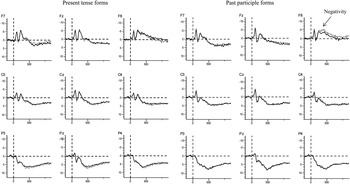
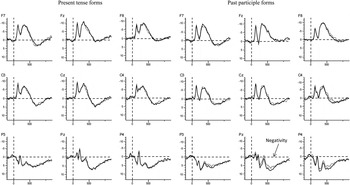
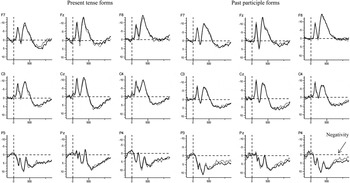
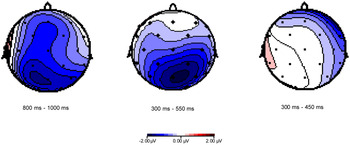
The grand average ERP waveforms are displayed in Figures 1–3. Topographic maps of the difference waveforms between the two critical conditions, -t (=‘weak’) vs. -n (=‘strong’) participles, are shown in Figure 4.
Grand average ERPs of the adult group for the production of verbs in the present tense form (left panel) and the past participle form (right panel). Forms of ‘weak’ verbs (dotted line) are plotted against forms of ‘strong’ verbs (solid line). ERPs are time-locked to the onset of the silent production cue. The unit of the horizontal axis is milliseconds (ms), the unit of the vertical axis in microvolts (πV), with negative voltage plotted upwards.

Grand average ERPs of the older (eleven- to thirteen-year-old) child group for the production of verbs in the present tense form (left panel) and the past participle form (right panel). Forms of ‘weak’ verbs (dotted line) are plotted against forms of ‘strong’ verbs (solid line). ERPs are time-locked to the onset of the silent production cue; negative voltage (πV) is plotted upwards.

Grand average ERPs of the younger (eight- to ten-year-old) child group for the production of verbs in the present tense form (left panel) and the past participle form (right panel). Forms of ‘weak’ verbs (dotted line) are plotted against forms of ‘strong’ verbs (solid line). ERPs are time-locked to the onset of the silent production cue; negative voltage (πV) is plotted upwards.

Topographic maps of the difference between the production of -t (‘participle-weak’) and -n (‘participle-strong’) forms in the three participant groups. From left to right: children 8–10, children 11–13, adults.

As can be seen from Figures 1–3, there were no differences between weak and strong verbs in the present tense conditions. For the participle conditions, however, Figures 1–3 show that more negative waveforms were observed for the ‘weak-participle’ condition (relative to the ‘strong-participle’ one) in the three participant groups. Figure 4 also suggests that, in the adult group, this contrast appears earlier and more focused to right frontal sites than in the older (eleven- to thirteen-year-old) children, where the negativity had a longer duration and a broader (posterior) distribution. Finally, for the younger (eight- to ten-year-old) children, the same contrast can be seen from Figures 1 and 2, albeit in a much later time-window (from approximately 800 ms onwards), again in posterior regions.
For the statistical analysis of the ERP data from the adult group, we used the same time-window as in Budd et al. (Reference Budd, Paulmann, Barry and Clahsen2013), which was between 300 and 450 ms after the onset of the silent production cue. The repeated-measures ANOVA revealed a significant interaction of ROI and Condition (F(24,720) = 1·65, p = ·026) in this time-window. After splitting up the four-level factor Condition, subsequent ANOVAs revealed a significant interaction of ROI and the two participle conditions (-t and -n) in the 300–450 ms time-window (F(8,240) = 3·3, p < ·001), but no such interaction with the present tense conditions. Step-down analyses revealed an enhanced negativity for the ‘participle-weak’ compared to the ‘participle-strong’ condition, which was significant for right-frontal (F(1,30) = 6·39, p = ·017) and marginally significant for right-temporal electrode sites (F(1,30) = 3·37, p = ·07). In summary, adults’ silent production of -t participles elicits a more negative-going waveform than the production of -n participles 300–450 ms after cue onset, whereas the production of present tense forms of the same verbs does not yield any measurable difference.
For the analysis of the ERP data from the older group of children, we also used the same time-window (= 300–550 ms) as Budd et al. (Reference Budd, Paulmann, Barry and Clahsen2013). We again found a significant interaction of ROI and Condition (F(24,648) = 3·43, p < ·001) in this time-window, as in the adult group. In addition there was an interaction of ROI and the two participle conditions (-t and -n) that was approaching significance (F(8,216) = 1·77, p = ·08), and no reliable interaction with the present tense conditions. To test whether the contrasts obtained in the adult group between the two participle conditions also hold for the older child group, we directly compared the ‘participle-weak’ to the ‘participle-strong’ condition. This comparison revealed an enhanced negativity for the ‘participle-weak’ condition, which was significant for posterior-central (F(1,27) = 7·16, p = ·01) and marginally significant for mid-central (F(1,27) = 4·1, p = ·053) and posterior-right electrode sites (F(1,27) = 3·68, p = ·06). These results show that brain potentials of the older child group were similar to those of the adult group with an enhanced negativity for the production of -t (relative to -n participles), but that the children's negativity had a longer duration and a broader (more posterior) distribution.
For the younger group of children, there were no significant differences between conditions in the early 300–550 ms time-window. However, visual inspection of the ERP plots suggests an enhanced negativity in a later time-window for this age group of children, from 800 ms to 1,000 ms after the onset of the silent production cue, again for -t (relative to -n) participles. Statistically, there was a main effect of ROI (F(8,208) = 8·13, p < ·001), with a significant negativity for -t (compared to -n) participles at posterior-right electrode sites in this time-window (F(1,26) = 5·51, p = ·03) without any corresponding contrast for the present tense forms of the same verbs.
DISCUSSION
The current study examined processes involved in encoding morphologically complex words in children and adults, using both behavioural and neurophysiological measures. We found that children were not only getting more accurate in producing morphologically complex words but, more importantly, that children's brain potentials associated with morphological encoding also became more adultlike with age. Developmental changes were specifically obtained with respect to the duration, the onset latency, and the topography of the ERP responses. In the following, we will discuss the functional significance of the brain potentials and how they develop from child to adult.
Morphological encoding in children and adults
The linguistic phenomenon we examined was German past participle formation, which involves a highly productive lexically unconstrained process of -t affixation and a number of lexically restricted patterns for so-called ‘strong’ verbs with participle forms ending in -(e)n. We found an enhanced negativity for the production of -t participles compared to the production of strong participle forms in all participant groups.
Psycholinguistic accounts of language production posit a number of subcomponents for language production, including conceptual encoding, lemma selection, form level (lexical, phonological, morphological) encoding, motor execution, and articulation (Indefrey & Levelt, Reference Indefrey and Levelt2004). Given these different subcomponents, we suggest that the enhanced negativity for -t (relative to strong) participle forms signals form level encoding processes. Conceptual encoding and lemma selection processes are most probably not responsible for this brain response, since all relevant conceptual and lemma information was already available from the visually presented stimulus words prior to the actual participle production task. Likewise, motor execution and articulation processes were not performed during the silent production phase when ERPs were recorded. Furthermore, of the three kinds of form level encoding processes (lexical, phonological, morphological), lexical level properties are also an unlikely cause for the observed ERP effects, because the lexical items in the two participle conditions were closely matched and the present tense control conditions did not yield any measurable ERP difference.
This leaves us with phonological and/or morphological encoding processes as potential sources for the enhanced negativity. In previous studies on English (Budd et al., Reference Budd, Paulmann, Barry and Clahsen2013, Reference Budd, Paulmann, Barry and Clahsen2015; Festman & Clahsen, Reference Festman and Clahsen2016), this factor was difficult to rule out, because irregular past tense and plural forms in English – unlike regular ones – typically involve stem changes (sing → sang) which have to be phonologically encoded during production. The German data from the current study allow us to resolve this issue. Recall that, unlike in the English studies, none of the inflected (participle) forms of German that were tested in the present study involve any stem changes. Hence, potential phonological encoding processes for producing stem alternations such as those in English (e.g. sing → sang, mouse → mice) cannot explain the ERP differences between -t and -n participle forms. This leaves with us with morphological encoding as the source for this ERP effect. Following Budd et al.'s (Reference Budd, Paulmann, Barry and Clahsen2013, Reference Budd, Paulmann, Barry and Clahsen2015) and Festman and Clahsen's (Reference Festman and Clahsen2016) proposals for English, we interpret the enhanced negativity as reflecting the composition of a regularly inflected word form through affixation, which is required for weak but not for strong participle formation in German. Given this interpretation, the current findings replicate the contrasting brain responses previously seen for regular vs. irregular past tense and plural formation in English for another language.
There is yet another potential alternative that needs to be considered before accepting this interpretation, which is due to the fact that – unlike in familiar ERP studies using oddball or violation paradigms – the design of our experiment did not render a particular condition as deviant, marked, or incorrect. Hence, instead of interpreting the observed ERP effect as a negativity for -t participles, the effect may instead be taken as a positivity caused by strong participle forms. In ERP research on language production with adults, an early positivity with the amplitude increasing as a function of decreasing word frequency has indeed been proposed for single-word production (e.g. Strijkers Holcomb & Costa, Reference Strijkers, Holcomb and Costa2011). It is unlikely, however, that the effect we obtained for German participle forms represents a positivity of this kind. Note, first, that the peak latency of the ERP effect for participles was between 300 and 450 ms in the adult group, i.e. substantially later than the peak latency of the positivity that Strijkers et al. (Reference Strijkers, Holcomb and Costa2011) reported which was found between 150 and 200 ms post onset. Second, unlike in Strijkers et al.'s (Reference Strijkers, Holcomb and Costa2011) study, in which word frequencies were manipulated across conditions, our materials were closely matched with respect to frequency, with similar lemma and word-form frequencies for the items used in the critical conditions. Third, the shape of the waveforms we obtained (see Figures 1 to 3) indicates a negative deflection for the -t participle condition from the relatively steady waveforms for the strong participle condition, rather than vice versa. The same contrast can be seen for the waveforms in the earlier studies on English (Budd et al., Reference Budd, Paulmann, Barry and Clahsen2013, p. 351; Budd et al., Reference Budd, Paulmann, Barry and Clahsen2015, Figure 1). We conclude that the observed brain response represents an enhanced negativity for -t participle forms.
Finally, we note that an earlier ERP study (Penke, Weyerts, Gross, Zander, Münte & Clahsen, Reference Penke, Weyerts, Gross, Zander, Münte and Clahsen1997) using the ERP violation paradigm also reported an increased negativity in response to -t participle formations, in this case to -t over-regularizations (e.g. *geschlaft instead of geschlafen ‘slept’), but not to overapplications of strong participle forms. Penke et al. (Reference Penke, Weyerts, Gross, Zander, Münte and Clahsen1997) interpreted this contrast as an index of combinatorial morphological processing, specifically the incorrect application of the -t participle affix to a strong verb of German. Lück, Hahne, and Clahsen (Reference Lück, Hahne and Clahsen2006) obtained similar findings for noun plurals. In terms of its latency and polarity, the enhanced negativity we obtained in the present study is similar to the previously reported one for morphological over-regularizations, suggesting that it does not only signal responses to violations but also taps into morphological encoding of grammatically correct word forms.
Developmental changes
The present study documents age-related changes for eight- to thirteen-year-old children compared to adults, not only in their overt spoken productions of participle forms but also with respect to their brain responses signalling the morphological encoding of these inflected word forms. Consider first the behavioural data.
Overall accuracy rates for overtly produced participles were high (app. 75–98% correct) and were in the same range as in previous studies on English that employed the silent-production-plus-delayed-vocalization task (Budd et al., Reference Budd, Paulmann, Barry and Clahsen2013, Reference Budd, Paulmann, Barry and Clahsen2015), indicating that the task is suitable to examine children's morphological encoding in this age range. Accuracy rates significantly differed between conditions, with strong participle formation attracting more errors than -t participle production, a contrast that was most pronounced in the younger child group. Amongst the incorrect responses, -t over-regularization errors to strong verbs, e.g. *geschlaft instead of geschlafen ‘slept’, were more common than -n overapplications to weak verbs, with more -t over-regularizations in the younger than the older group of children. This pattern of overapplication errors is in line with previous reports from spontaneous speech and from elicited production data of German children (Weyerts & Clahsen, Reference Weyerts and Clahsen1994; Elsen, Reference Elsen, Fabri, Ortmann and Parodi1998; Lindner, Reference Lindner, Fabri, Ortmann and Parodi1998; Clahsen et al., Reference Clahsen, Hadler and Weyerts2004; Szagun, Reference Szagun2011; Fleischhauer & Clahsen, Reference Fleischhauer, Clahsen, Biller, Chung and Kimball2012).
The ERP data showed age-related differences, with respect to the duration, the latency, and topographical distribution of the enhanced negativity for -t participle formations. Recall that this ERP effect had a longer duration in the older child group than in adults and that the onset of the negativity was substantially delayed in the younger child group, i.e. 800 ms after the visual cue as opposed to 300 ms for the older child group and the adults. This is consistent with a number of previous reports showing delayed morphological encoding in children of this age range. Of the two ERP silent production studies on English that compared children and adults, Budd et al. (Reference Budd, Paulmann, Barry and Clahsen2015), also found the negativity signalling morphological encoding 500 ms later in children than in their adult group, i.e. between 800 and 900 ms after cue onset. Budd et al. (Reference Budd, Paulmann, Barry and Clahsen2013) only obtained this negativity for their adult group and the older children (age range: 10;7–12;11), with the latter showing a longer-lasting negativity than the adult group, i.e. 300–550 ms after cue onset as opposed to 300–450 ms for the adult group. Beyond ERP studies testing silent production, temporal delays of children's morphological encoding have also been reported in behavioural studies that used overt production latencies as a dependent measure. Clahsen et al. (Reference Clahsen, Hadler and Weyerts2004), testing German participle forms in a speeded production task, reported mean production latencies that were 285 ms longer for five- to seven-year-old children and 123 ms longer for eleven- to twelve-year-old children than for adults. These contrasts were confirmed by Fleischhauer (Reference Fleischhauer2014) in a follow-up study with new subgroups of children in the same age range who also showed delayed participle production latencies of the same magnitude relative to adults. In the current study, only the younger child group's ERPs had a delayed onset whereas the older children's ERPs had the same onset latency as the adult group with a slightly longer duration. These results are indicative of late developments suggesting that children's morphological encoding processes become as efficient as in adults only after ten years of age.
The current study also revealed child/adult differences with respect to the topographical distribution of the ERP signatures of morphological processing; see Figure 4 for illustration. While the enhanced negativity for the production of -t participles had a more posterior distribution in children's brain responses, with significant effects at posterior-central and posterior-right electrode sites, the adult group's negativity had a more fronto-temporal distribution. This finding is in line with previous results from a number of brain-imaging studies that reported neuroanatomical changes (e.g. neuron pruning, myelination) in the fronto-temporal cortex of eight- to twelve-year-old children that are thought to lead to more efficient neuronal communication in this brain area (Casey, Galvan & Hare, Reference Casey, Galvan and Hare2005; Blakemore, Reference Blakemore2012). The developmental trajectory of the brain responses for morphological processing obtained in the current study, from a more posterior-central negativity to a fronto-temporal one, may be attributed to these brain maturation processes. Similar results have been reported by Budd et al. (Reference Budd, Paulmann, Barry and Clahsen2015), who obtained a broadly distributed negativity for eight- to twelve-year-old children and a more focal frontal negativity for adults. Likewise, Clahsen, Lück, and Hahne (Reference Clahsen, Lück and Hahne2007), examining brain responses to incorrect (over-regularized) plural forms of German relative to correct ones, also reported a developmental trajectory that went from a broadly distributed negativity in their younger child group to a focal left-frontal negativity in adults for over-regularized plural forms.
For morphologically simplex words, on the other hand, topographical differences between children and adults seem to be less pronounced. In a recent picture-naming study with two age groups of children (seven- to eight-year-olds, ten- to twelve-year-olds) and an adult control group, Laganaro, Tzieropoulos, Frauenfelder, and Zesiger (Reference Laganaro, Tzieropoulos, Frauenfelder and Zesiger2015) reported that while latencies were delayed in children's brain responses relative to those of adults, topographical differences between children and adults were only found in a very early time-window (<200 ms) affecting ERP components (N1/P1) that signal prelinguistic processing. After 200 ms for adults and 300 ms for children, there were no reliable child/adult differences in global topography anymore (albeit differences in latency). While these results indicate that in school-age children and in adults, processes involved in producing simplex words (viz., lexical access, semantic encoding, phonological encoding, articulation) rely on the same mental operations, studies examining morphologically complex words suggest that brain networks involved in morphological processing are still subject to developmental changes in this age range, both with respect to the timecourse and the topography. We should acknowledge, however, that although previous ERP studies of children's morphologically complex words have yielded consistent results, ERPs have a rather low spatial resolution, and that conclusions about neural sources based on topographical differences of ERP signatures should be made with caution. Clearly, future studies using more sensitive techniques for detecting neural generators are required to determine whether the brain networks responsible for morphological encoding do indeed show the developmental trajectory suggested by the ERP data reported in the current study.
CONCLUSION
This study seeks to elucidate developmental changes of the neurocognitive mechanisms involved in producing morphologically complex words. To this end, we recorded ERPs from groups of eight- to thirteen-year-old children and adults, all of whom were native speakers of German, while they were (silently) producing inflected participle forms of German. Although the development of participle formation in German child language has been the subject of a number of previous corpus and (behavioural) experimental studies, the current study is the first to investigate children's brain responses for this phenomenon. We found an enhanced negativity for both age groups of children and for the adult control group during the (silent) production of regular -t participle forms relative to the production of irregular -n participle forms, which had a longer duration, later onset latency, and a more posterior scalp distribution in children than the fronto-temporal negativity seen for adults. We interpret the negativity as reflecting combinatorial morphological encoding processes involved in forming regular (-t) participle forms and conclude that both children (in the age range tested) and adults employ these processes. The observed age-related differences indicate that morphological encoding takes time to develop and is less efficient as well as more resource-demanding in school-age children than in adults. Finally, we note that ERP studies of morphological encoding using the silent-production-plus-delayed-vocalization task (Budd et al., Reference Budd, Paulmann, Barry and Clahsen2013, Reference Budd, Paulmann, Barry and Clahsen2015; Festman & Clahsen, Reference Festman and Clahsen2016; this study) have yielded replicable results for different kinds of morphological phenomena (past tense, plurals, participles), different languages (English, German), and different populations (children and adults, native and non-native speakers). We conclude that this ERP paradigm is a useful technique to investigate morphological encoding during language production in both children and adults.
APPENDIX