Chlorhexidine (CHG) is a topical antiseptic agent with broad-spectrum antimicrobial activity.Reference Milstone, Passaretti and Perl1 Multiple studies have found that daily bathing with CHG decreases the incidence of healthcare associated infections (HAIs) due to gram-positive bacteria, including methicillin-resistant Staphylococcus aureus (MRSA) and vancomycin-resistant Enterococcus (VRE).Reference Vernon, Hayden, Trick, Hayes, Blom and Weinstein2–Reference Gould, MacKenzie, MacLennan, Pacitti, Watson and Noble4 However, the effect of daily CHG bathing on preventing and controlling infections caused by gram-negative organisms is unclear.Reference Noto, Domenico and Byrne5–Reference Derde, Dautzenberg and Bonten9
Previous meta-analyses reporting on the positive impact of CHG bathing on reducing HAIs in intensive care unit (ICU) settings have focused largely on the intervention’s effects on central-line–associated bloodstream infections (CLABSIs) or ventilator-associated pneumonia (VAPs), but they did not group the pathogens based on their gram stain status.Reference Kim, Lee, Na, Roh, Shin and Kim10–Reference Frost, Alogso and Metcalfe12 A systematic review evaluating the evidence on the effectiveness of CHG bathing on colonization and infection concluded that there was a paucity of data on gram-negative infections among the 7 included studies.Reference Derde, Dautzenberg and Bonten9 A more recent meta-analysis of randomized crossover trials evaluating the impact of CHG bathing on hospital acquired bloodstream infections grouped the data into gram-positive and gram-negative microorganisms as part of a subgroup analysis. Although they found a reduction in gram-positive HAIs with CHG bathing, the study did not find a significant reduction in gram-negative HAIs among the 4 included studies.Reference Afonso, Blot and Blot13 However, the studies on the topic were limited by the study design and a smaller number of studies was included. We conducted a systematic review and meta-analysis of all published observational and randomized trials with the primary objective of better understanding the effect of daily CHG bathing in the ICU setting on the rate of infections with gram-negative bacteria.
Methods
All study procedures adhere to the Preferred Reporting Items for Systematic Review and Meta-Analysis (PRISMA) statement guidelines.Reference Moher, Liberati, Tetzlaff, Altman and Group14 We prospectively developed a study protocol that clearly identified our study objective, search strategy, inclusion/exclusion criteria, plan for data extraction, and statistical analyses.
Eligibility criteria
Two investigators (A.P. and P.P.) independently searched the literature in a systematic way using the following inclusion criteria: individual or cluster randomized controlled trials and quasi-experimental studies, both published and unpublished, that evaluated the efficacy of daily bathing with CHG versus soap and water or standard care to prevent healthcare-associated infections in ICUs and non-ICUs. The following exclusion criteria were applied: studies using CHG bathing perioperatively for the purposes of reducing surgical site infections, studies evaluating colonization rates, studies presenting data based on events and not the number of actual patients, and pediatric studies. Review articles and editorials were not included in the search list.
The search was performed in November 2015 and was updated in July 2018. The following databases were searched from inception to July 2018: PubMed, EMBASE, Web of Science, and Scopus. We used the terms “chlorhexidine bathing” as the search term in all 4 databases without any language restrictions. The electronic PubMed search strategy is available in the supplemental appendix online. Reference lists of all included studies and previous meta-analyses on similar topics were manually searched for additional publications.
Study selection
A list of retrieved articles that met the inclusion criteria was reviewed by 2 investigators independently (A.P. and P.P.). Any disagreement about a particular study was resolved by consensus with a third investigator (A. Deshpande). The PRISMA flow diagram was used to present the study selection process through its different phases (Fig. 1).
Flow diagram of study selection process.

Data extraction
Data were extracted by 2 investigators independently (A.P. and P.P.) using a standard data extraction form. The data collected included year of publication, country of origin, study design, study population, duration, study setting, intervention, comparator, cointervention, and patient demographics. Information relating to specific gram-negative etiology was also collected where available. Any disagreement was resolved by consensus with a third investigator (A. Deshpande). Study authors were contacted if relevant information was not available for a particular study.
The primary outcome of interest was the risk of developing gram-negative infections in patients undergoing daily bathing with and without CHG. Secondary outcomes of interest included the risk of developing infections related to specific gram-negative bacteria.
Quality assessment
We used the Newcastle-Ottawa scale (NOS) for determining the quality of the observational studies.Reference Wells, Shea and O’Connell15 The NOS uses 2 different tools for case-control and cohort studies, and it consists of 3 parameters of quality: selection, comparability, and outcome assessment. A NOS score ≥7 indicates a high-quality study. We assessed the risk of bias of the randomized controlled trials (RCTs) according to the Cochrane Risk of Bias tool. The tool assesses 7 specific domains: (1) random sequence generation, (2) allocation concealment, (3) blinding of participants and personnel, (4) blinding of outcome assessment, (5) incomplete outcome data, (6) selective outcome reporting, and (7) other issues. For each RCT, each item was described as low risk of bias, high risk of bias, or unclear risk of bias by 2 independent investigators (A. Dunn and A. Deshpande).
Data synthesis and analysis
For each of the studies, we calculated the risk ratio for developing gram-negative infections (primary and secondary outcomes) and their 95% confidence intervals (CIs). The Mantel-Haenszel method with random-effects modeling was then used to calculate the pooled risk ratios (RRs) and their 95% CIs. We evaluated statistical heterogeneity using the Cochran χ2 test and the I2 statistic.Reference Higgins and Thompson16 I2 values of 40%–60% were considered to represent a moderate level of heterogeneity.Reference Deeks, Higgins, Altman, Higgins and Green17 A P value < .10 for χ2 was defined as indicating the presence of heterogeneity. We utilized Review Manager software (RevMan, version 5.3 for Windows, Oxford, UK; The Cochrane Collaboration, 2008) and Comprehensive Meta-Analysis version 2.0 software (Biostat, Englewood, NJ) for all statistical analyses.
Assessment of risk of bias
To evaluate publication bias, we generated funnel plots and used Egger’s regression asymmetry test. Where asymmetry was detected, we assessed the potential impact of publication bias using the Duval and Tweedie nonparametric “trim and fill” method.Reference Egger, Smith, Schneider and Minder18, Reference Duval and Tweedie19 We performed influence analyses to determine whether any single study had a disproportionate impact on the pooled estimates and heterogeneity (analyses was repeated omitting one study at a time). To assess the influence of time (temporal trend) on the effect estimate, we also performed a cumulative meta-analysis.
Results
Study characteristics
Our search identified 820 publications (Fig. 1). After removing duplicates and screening study titles, 42 articles were selected based on relevance to the study topic. After screening the abstracts of these potentially relevant articles based on their relevance, 26 were selected for full-text review (Fig. 1). In total, 15 articles were included in the systematic review. The reasons for exclusion of the remaining 11 articles are listed in Figure 1. Of the 15 included studies, 3 studies exclusively examined the effect of CHG bathing on risk of infection with Acinetobacter baumanii; the other 12 included studies examined the effect of CHG bathing on risk of infection with all gram-negative organisms. Therefore, 12 studies were meta-analyzed for the primary outcome of interest and the number of included studies varied for the secondary outcomes related to specific gram-negative bacteria. Table 1 summarizes basic characteristics of the included studies. A total of 34,895 patients (range, 38–9,340) were included in the meta-analysis. Among the included studies, 7 were prospective cohorts,Reference Cassir, Thomas and Hraiech6, Reference Bleasdale, Trick, Gonzalez, Lyles, Hayden and Weinstein21, Reference Apisarnthanarak, Hsu, Lim and Mundy20, Reference Chung, Kim and Lee22, Reference Martínez-Reséndez, Garza-González and Mendoza-Olazaran25, Reference Montecalvo, McKenna and Yarrish26, Reference Urbancic, Martensson and Glassford28 4 were randomized controlled trials,Reference Climo, Yokoe and Warren3, Reference Noto, Domenico and Byrne5, Reference Boonyasiri, Thaisiam and Permpikul7, Reference Camus, Bellissant and Sebille8 and 4 were retrospective cohorts.Reference Gould, MacKenzie, MacLennan, Pacitti, Watson and Noble4, Reference Dicks, Lofgren, Lewis, Moehring, Sexton and Anderson23, Reference Evans, Dellit, Chan, Nathens, Maier and Cuschieri24, Reference Hong, Jang and Bak27
Basic Characteristics of the Included Studies

Note. ICU, intensive care unit; MICU, medical ICU; SICU, surgical ICU; CICU, cardiovascular ICU; BMT, bone marrow transplant; TICU, trauma ICU; MSICU, medical-surgical ICU; NICU, neurological ICU; PC, prospective cohort; RCT, randomized controlled trial; RC, retrospective cohort; NOS, Newcastle-Ottawa Scale.
Quality assessment
Based on the NOS scale, 8 of 11 included observational studies were deemed high quality, and the remaining 3 were deemed moderate quality (Supplemental Table 1 online). All included studies clearly identified the study population (cases and controls). However, there was variation in the type of culture used for assessment of the study outcome (Table 1). Studies also varied in whether they controlled for variables including age and sex (Supplemental Table 1 online).
The risk of bias was low for most items assessed by the Cochrane risk of bias tool (Supplemental Table 2 online). When no specific descriptions were available, we chose the answer of unclear risk.
Effect of CHG bathing on risk of infection with gram-negative organisms
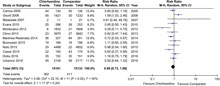
Overall, our meta-analysis of 12 studies (n = 30,234) to assess the impact of CHG bathing did not show a significant reduction in risk of gram-negative infections (GNI) in patients receiving CHG bathing compared to control patients (RR, 0.89; 95% CI, 0.73–1.08; P = .24) (Fig. 2). Heterogeneity was moderate across these studies (I2 = 50%). Influence analysis (ie, excluding 1 study at a time) showed that no particular study affected the pooled effect size. Cumulative meta-analysis showed that the RRs were consistent over time. A subanalysis of high-quality observational studies and RCTs, did not show a significant reduction in risk of GNI in patients receiving CHG bathing compared to control patients (RR, 0.90; 95% CI, 0.74–1.09; P = .27).
Forest plot illustrating the risk of overall gram-negative infections (GNIs) with chlorhexidine (CHG) bathing versus comparator. The vertical line corresponds to the no difference point between the 2 groups. Squares, the size of which indicates the proportion of information given by each study, correspond to risk ratios. Horizontal lines represent the 95% confidence intervals. The diamond indicates the pooled relative risk ratios. Note. df, degrees of freedom; M-H, Mantel-Haenszel.

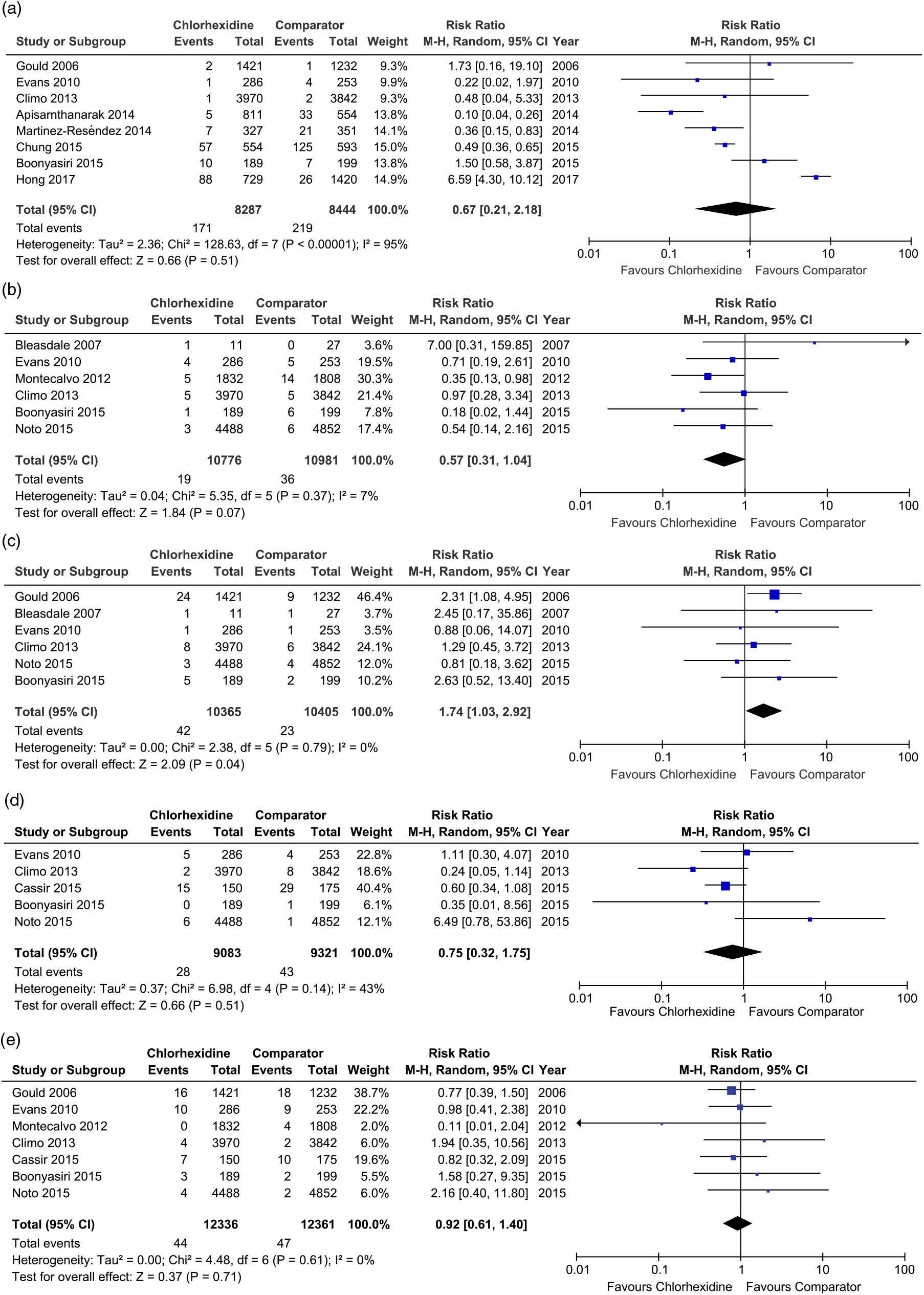
Acinetobacter: Meta-analysis of 8 studies (n = 16,731) did not show a significant reduction in the risk of infection with Acinetobacter in patients receiving CHG bathing compared to controls (RR, 0.67; 95% CI, 0.21–2.18; P = .51) (Fig. 3a). Heterogeneity was high across these studies (I2 = 95%). An influence analysis showed that no particular study affected the pooled effect size.
(a) Forest plot illustrating the risk of Acinetobacter infection with chlorhexidine (CHG) bathing versus comparator. (b) Forest plot illustrating the risk of Klebsiella spp infection with chlorhexidine (CHG) bathing versus comparator. (c) Forest plot illustrating the risk of E. coli infection with chlorhexidine (CHG) bathing versus comparator. (d) Forest plot illustrating the risk of Enterobacter infection with chlorhexidine (CHG) bathing versus comparator. (e) Forest plot illustrating the risk of Pseudomonas infection with chlorhexidine (CHG) bathing versus comparator. The vertical line corresponds to the no difference point between the 2 groups. Squares, the size of which indicates the proportion of information given by each study, correspond to risk ratios. Horizontal lines represent the 95% confidence intervals. The diamond indicates the pooled relative risk ratios. Note. df, degrees of freedom; M-H, Mantel-Haenszel.

Klebsiella: Our meta-analysis of 6 studies (n = 21,757) did not show a significant reduction in risk of infection with Klebsiella in patients receiving CHG bathing compared to controls (RR, 0.57; 95% CI, 0.31–1.04; P = .07) (Fig. 3b). Heterogeneity was low across these studies (I2 = 7%). Influence analysis showed that excluding the study by Bleasdale et alReference Bleasdale, Trick, Gonzalez, Lyles, Hayden and Weinstein21 yielded a decreased risk of infection with Klebsiella in patients receiving CHG bathing (RR, 0.53; 95% CI, 0.29–0.93; P = .03).Reference Bleasdale, Trick, Gonzalez, Lyles, Hayden and Weinstein21
Escherichia coli: The meta-analysis of 6 studies (n = 20,770) did not show a significant reduction in risk of infection with E. coli in patients receiving CHG bathing compared to controls. There was a significant increase in risk of infection with E. coli in patients receiving CHG bathing (RR, 1.74; 95% CI, 1.03–2.92; P = .04) (Fig. 3c). There was no heterogeneity across these studies (I2 = 0%). Influence analysis showed that the exclusion of the studies by Gould et alReference Gould, MacKenzie, MacLennan, Pacitti, Watson and Noble4 and Boonyasiri et alReference Boonyasiri, Thaisiam and Permpikul7 yielded an increase in the risk of E. coli infections in patients receiving CHG bathing [(RR, 1.36; 95% CI, 0.67–2.76; P = .85) and (RR, 1.66; 95% CI, 0.96–2.87; P = .07), respectively] but these increases were not statistically significant.
Enterobacter: Our meta-analysis of 5 studies (n = 18,404) did not show a significant reduction in risk of infection with Enterobacter in patients receiving CHG bathing (RR, 0.75; 95% CI, 0.32–1.75; P = .51) (Fig. 3d). Heterogeneity was moderate across these studies (I2 = 43%). Influence analysis showed that exclusion of the study by Noto et alReference Noto, Domenico and Byrne5 yielded a decrease in the risk of infection with Enterobacter in patients receiving CHG bathing (RR, 0.59; 95% CI, 0.36–0.97; P = .04).
Pseudomonas: The meta-analysis of 7 studies (n = 24,697) did not show a significant reduction in risk of infection with Pseudomonas in patients receiving CHG bathing (RR, 0.92; 95% CI, 0.61–1.4; P = .71) (Fig. 3e). There was no heterogeneity across these studies (I2 = 0%). An influence analysis showed that no particular study affected the pooled effect size.
Publication bias
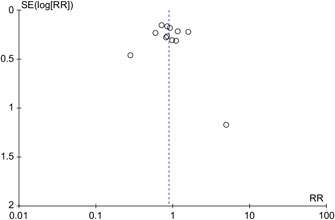
We evaluated publication bias over all GNIs. A funnel plot of the 12 included studies is shown in Figure 4. On visual inspection, the funnel plot appears symmetric. As per Egger’s method, there was no evidence of publication bias (intercept = 0.44; t = 0.37; 1-tailed P = .36). Adjustment using Duval and Tweedie’s trim-and-fill procedure resulted in a similar imputed RR of 0.88 (95% CI, 0.71–1.07). For each of the specific gram-negative bacteria, we did not formally assess publication bias because the number of included studies was <10. Egger’s linear regression test is unreliable when there are <10 included studies. However, we constructed the funnel plots, which are available as supplementary material online.
Funnel plot illustrating the risk of overall gram-negative infections with chlorhexidine bathing versus comparator. Dashed line indicates pooled relative risk of 0.89.

Discussion
In this systematic review and meta-analysis of 15 studies with 34,895 ICU patients, daily CHG bathing was not associated with reduced risk of infection with gram-negative bacteria. Subgroup analysis demonstrated that daily CHG bathing did not significantly reduce the risk of gram-negative infections caused by Acinetobacter, E. coli, Klebsiella, Enterobacter, or Pseudomonas spp.
Daily CHG bathing has been shown to be effective at reducing the risk and transmission of gram-positive infections, including MRSA and VRE.Reference Vernon, Hayden, Trick, Hayes, Blom and Weinstein2–Reference Gould, MacKenzie, MacLennan, Pacitti, Watson and Noble4 Our meta-analysis suggests that this intervention may not be effective at reducing the risk of gram-negative infections in the ICU. Chlorhexidine is a cationic biguanide that has broad-spectrum antimicrobial activity attributable to disruption of cytoplasmic membranes, with higher in vitro activity against gram-positive bacteria than gram-negative bacteria.Reference Pittet, Allegranzi and Boyce29 Although several studies have demonstrated that gram-negative bacteria have a higher minimum inhibitory concentration (MIC) for CHG than gram-positive bacteria, the amount of CHG applied to the skin is many fold higher than the MIC for both gram-negative and gram-positive bacteria.Reference Hassan, Jackson and Penesyan30, Reference McDonnell and Russell31 However, the effectiveness of CHG application varies based on hospital antiseptic practices (ie, frequency, area of application, method of application), is often identified as suboptimal, and can lead to relatively low concentrations of CHG on skin that may be insufficient to inhibit gram-negative bacteria.Reference Supple, Kumaraswami and Kundrapu32 Furthermore, most of the gram-negative bacilli collected from the skin in 1 randomized controlled trial were from the perianal area, which suggests the gram-negative bacteria might have shed from the gastrointestinal tract. Although daily CHG bathing can help reduce skin contamination originating from the gut, it is unlikely that they affect the colonization of the gastrointestinal tract.Reference Boonyasiri, Thaisiam and Permpikul7 In ICUs, a substantial proportion of infections due to gram-negative bacilli may attributable to translocation of organisms from the intestinal tract.Reference Camus, Bellissant and Sebille8
Our subgroup analyses of individual gram-negative bacteria also demonstrated that CHG bathing did not significantly reduce the risk of gram-negative bacterial infections. On the contrary, the risk of infections with E. coli was significantly higher in patients receiving CHG bathing group compared to controls. However, because of the smaller number of included studies, the results of the subgroup analyses should be interpreted with caution. With a small number of included studies, the larger studies among them can be influential, as was demonstrated in our influence analyses. Also, not all studies were designed specifically to evaluate the effect of CHG bathing on the rate of gram-negative infections.
The findings of this meta-analysis are in agreement with a prior meta-analysis of 4 studies (sample size = 22,850 patients). Afonso et alReference Afonso, Blot and Blot13 concluded, following secondary subgroup analyses of 4 studies, that there was no reduction in gram-negative infection with CHG bathing; however, the primary objective of the study was to assess the effect of CHG on CLABSIs and other hospital-acquired bloodstream infections.Reference Afonso, Blot and Blot13 Other meta-analyses have focused on the impact of CHG on MRSA and VRE, or general HAIs, without directly evaluating the impact of CHG on gram-negative bacteria.Reference Kim, Lee, Na, Roh, Shin and Kim10–Reference Frost, Alogso and Metcalfe12 Our meta-analysis, therefore, built upon prior meta-analyses to further examine the effect of CHG bathing on gram-negative bacteria in an ICU setting. The goal of our study was not only to combine the statistical analyses of observational studies but also to systematically assess the impact of CHG bathing on gram-negative infections and on infection with specific gram-negative bacteria, as well as to assess heterogeneity across studies. The meta-analysis of observational studies is challenging because it includes greater focus on study quality and ensuring low heterogeneity across included studies. The strengths of our study include the following: our findings are consistent with previous studies; our study included a significantly large population of patients; we utilized the NOS scale for quality analysis; and we strictly followed PRISMA guidelines for systematic reviews (Supplemental Table 2 online).
Our study has several limitations. First, the studies in our meta-analysis vary in terms of study design, diagnostic microbiologic cultures used to detect infection, and follow-up period. There was significant variability in the choice and definition of study outcome, including but not limited to bloodstream infections, ventilator-associated pneumonia, and urinary tract infections. The setting of included studies also varied, ranging from medical ICUs to bone marrow transplant units. Data regarding these variations were largely insufficient to permit subgroup analysis beyond looking at specific gram-negative bacteria. Also, we used the traditional methods for conducting our meta-analysis, although some have recommended using the Bayesian method of meta-analysis when the included studies are either small or the relative risks are close to 0 or 1.Reference Warn, Thompson and Spiegelhalter33 Second, although a relatively limited number of studies were included in our meta-analysis, the included studies were the product of a comprehensive literature search and had a large sample size of almost 35,000 subjects. Third, several of the included studies were observational or quasi-experimental and, consequently, were subject to residual confounding. Also, we excluded studies that focused on colonization acquisition of gram-negative pathogens. A fourth limitation of this meta-analysis is that it employed a random-effect model, which may place greater emphasis on smaller studies with lower quality data, compared to a fixed-effects model. Finally, as many of the included studies were observational or quasi-experimental, this meta-analysis did not establish causality with regard to CHG bathing as an intervention.
Multiple institutions have implemented CHG bundles as part of their efforts to reduce the infections and transmission of multidrug-resistant gram-positive and gram-negative bacteria. However, it appears that there are insufficient data and evidence to support these practices for gram-negative bacteria. The current evidence may be skewed because very few studies have reported the rates of compliance with CHG bathing in their ICUs, and other studies have reported no detectable CHG on the skin of patients after CHG bathing. Therefore, there is an urgent need for studies specifically designed to evaluate the impact of CHG bathing on the rates of gram-negative infections while also monitoring the rate of compliance with CHG bathing procedures and the skin levels of CHG after bathing. Future studies should explore alternative approaches for the prevention of infection with gram-negative organisms in an ICU setting.
Supplementary material
To view supplementary material for this article, please visit https://doi.org/10.1017/ice.2019.20.
Acknowledgments
Financial support
No financial support was provided relevant to this study. J.A.O. would like to acknowledge support from the National Institute for Health Research Health Protection Research Unit in Healthcare-Associated Infections and Antimicrobial Resistance at Imperial College London in partnership with Public Health England, and the Imperial College Healthcare Trust NIHR Biomedical Research Centre.
Conflicts of interest
Abhishek Deshpande has received research support from Clorox not related to this study. Curtis J. Donskey has received research support from Clorox, GOJO, PDI, Avery Dennison, and Ecolab unrelated to this study. Jonathan A. Otter is a consultant to Gama Healthcare and Pfizer. Priyaleela Thota is a consultant for Vancive Medical Technologies. All other authors report no conflicts of interest relevant to this article.