As bilingual children learn to speak their two languages, they must also develop language control, the ability to regulate which language they use each time they produce a word. By age two, bilingual children are able to adjust their relative use of each language to accommodate the language of their conversation partner, although they still produce some words in the non-target language (e.g., Genesee, Boivin & Nicoladis, Reference Genesee, Boivin and Nicoladis1996; Genesee, Nicoladis & Paradis, Reference Genesee, Nicoladis and Paradis1995; Lanza, Reference Lanza1992; Nicoladis & Genesee, Reference Nicoladis and Genesee1996). Eventually, bilingual children gain the ability to exercise complete language control, whereby they are able to restrict their production to one language or the other and to switch easily between them. Many theoretical accounts (e.g., Inhibitory Control Model [Green, Reference Green1998]; Adaptive Control Hypothesis [Green & Abutalebi, Reference Green and Abutalebi2013]; Control Processes Model of Code-switching [Green & Wei, Reference Green and Wei2014]; cognitive–linguistic interactive processing framework [Jia, Kohnert, Collado & Aquino-Garcia, Reference Jia, Kohnert, Collado and Aquino-Garcia2006]; representation-control framework [Craik & Bialystok, Reference Craik and Bialystok2006]) have posited that the ability to exercise language control relies on the same domain-general cognitive control skills as the ability to control choices between any two competing tasks. However, empirical examinations of the link between domain-general cognitive control and language control have yielded inconsistent findings, with some studies confirming the possibility of a shared mechanism and some studies suggesting separate or only partially overlapping mechanisms.
There are two aspects of prior work that we believe have contributed to this inconsistency. First, prior studies have measured language control in various ways. Some studies have examined cross-language errors, which reflect a breakdown in the control of language selection. Others have used naming speed (e.g., overall naming speed, switching costs, mixing costs) to measure the efficiency of lexical selection under conditions when language control is taxed (e.g., mixed-language environment). These measures may index distinct processes associated with language control, which may in turn recruit cognitive control to different degrees. Second, prior research has focused largely on bilingual adults, in whom cognitive control and language control have already reached peak levels of development (Huizinga, Dolan & van der Molen, Reference Huizinga, Dolan and van der Molen2006; Zelazo, Craik & Booth, Reference Zelazo, Craik and Booth2004; Hernandez & Kohnert, Reference Hernandez and Kohnert1999; Gollan, Sandoval & Salmon, Reference Gollan, Sandoval and Salmon2011). Therefore, for adult bilinguals, the ability to observe relationships between language and cognitive control measures may be highly contingent on the particulars of language use, language environment, and task difficulty (e.g., Kroll, Bobb & Wodniecka, Reference Kroll, Bobb and Wodniecka2006; Calabria, Branzi, Marne, Hernández & Costa, Reference Calabria, Branzi, Marne, Hernández and Costa2015; Green & Abutalebi, Reference Green and Abutalebi2013). Testing children may yield clearer insights into the relationship between cognitive control and language control because children exhibit greater variability in both of these developing skill sets (e.g., Kohnert, Bates & Hernandez, Reference Kohnert, Bates and Hernandez1999; Kohnert, Reference Kohnert2002; Jia et al., Reference Jia, Kohnert, Collado and Aquino-Garcia2006; Davidson, Amso, Anderson & Diamond, Reference Davidson, Amso, Anderson and Diamond2006; Huizinga et al., Reference Huizinga, Dolan and van der Molen2006; Zelazo et al., Reference Zelazo, Craik and Booth2004). The goal of the present study, therefore, was to examine the contribution of cognitive control to the exercise of language control (indexed both by cross-language errors and naming speed) in early school-age (i.e., 5–7 year old) bilingual children.
Several bilingual processing models (e.g., Inhibitory Control Model [Green, Reference Green1998], Adaptive Control Hypothesis [Green & Abutalebi, Reference Green and Abutalebi2013], Control Process Model of code-switching [Green & Wei, Reference Green and Wei2014]; Bilingual Interactive Activation + Model [BIA+, Dijkstra & Van Heuven, Reference Dijkstra and van Heuven2002]; see Declerck & Philipp, Reference Declerck and Philipp2015 for a review) include a task schema level outside the language system that is posited to help control language selection during production and/or comprehension. These language schemas (e.g., “speak in first language [L1]” or “speak in second language [L2]”) are similar to the “task sets” described in the general task-shifting literature (e.g., Monsell, Reference Monsell2003; Monsell, Yeung & Azuma, Reference Monsell, Yeung and Azuma2000), which are a compilation of ‘settings’ necessary to accomplish a task (which aspects of stimulus to attend to, what kind of response to make, etc.). Thus, switching between L1 and L2 schemas may be governed by the same domain-general processes that govern any type of task-shifting. Therefore, logically, were domain-general cognitive control involved in language control, it would be at the language selection stage of bilingual production. However, bilingual word production also involves a lexical selection process during which activation levels of individual lexical representations in both languages must be regulated so that the correct lexical form in the correct language is produced (e.g., Christoffels, Firk & Schiller, Reference Christoffels, Firk and Schiller2007; Gollan, Kleinman & Wierenga, Reference Gollan, Kleinman and Wierenga2014; Green, Reference Green1998). That is, once the L1 schema has been selected, competing L2 lexical representations may still have been activated by bottom-up processes and must be suppressed to ensure production of the target word in L1. Furthermore, within L1, competing lexical representations may have been activated because they were related to the target word or were evoked by the visual stimulus, and the activation level of the target L1 lexical representation must exceed that of its L1 competitors to ensure production of the correct lexical item. Although it may be possible for domain-general control processes to be recruited during the process of lexical selection (e.g., Liu, Rossi, Zhou & Chen, Reference Liu, Rossi, Zhou and Chen2014; Liu, Liang, Zhang, Lu & Chen, Reference Liu, Liang, Zhang, Lu and Chen2015), language-specific mechanisms may be more likely to regulate activation levels of lexical representations within a language.
Some of the most compelling empirical support for the recruitment of domain-general cognitive control for language control has come from neuroimaging work. Studies conducted in adult bilinguals have revealed activation in brain areas associated with cognitive control during language switching (e.g., Abutalebi, Della Rosa, Ding, Weekes, Costa & Green, Reference Abutalebi, Della Rosa, Ding, Weekes, Costa and Green2013; de Bruin, Roelofs, Dijkstra & Fitzpatrick, Reference de Bruin, Roelofs, Dijkstra and Fitzpatrick2014; Garbin, Costa, Sanjuan, Forn, Rodriguez-Pujadas, Ventura, Belloch, Hernandez & Ávila, Reference Garbin, Costa, Sanjuan, Forn, Rodriguez-Pujadas, Ventura, Belloch, Hernandez and Ávila2011; Guo, Liu, Misra & Kroll, Reference Guo, Liu, Misra and Kroll2011; Luk, Green, Abutalebi & Grady, Reference Luk, Green, Abutalebi and Grady2012; Wang, Kuhl, Chen & Dong, Reference Wang, Kuhl, Chen and Dong2009; Wang, Xue, Chen, Xue & Dong, Reference Wang, Xue, Chen, Xue and Dong2007; Weissberger, Gollan, Bondi, Clark & Wierenga, Reference Weissberger, Gollan, Bondi, Clark and Wierenga2015). Furthermore, activation in areas associated with cognitive control has been documented when bilingual adults performed a task in a single language under conditions designed to increase interference from the non-target language (e.g., Guo et al., Reference Guo, Liu, Misra and Kroll2011; Rodriguez-Fornells, ver der Lugt, Rotte, Britti, Heinze & Münte, Reference Rodriguez-Fornells, van der Lugt, Rotte, Britti, Heinze and Münte2005). However, behavioral examinations of the relationship between performance on nonlinguistic cognitive control and language control tasks in the same set of participants have yielded inconsistent findings.
Positive support for a link between language control and cognitive control has come from studies examining cross-language errors (i.e., unintentional switches into the non-target language). Bilingual adults who produced more cross-language errors were found to perform more poorly on nonlinguistic measures of cognitive control including the Wisconsin Card Sorting Task (Festman & Münte, Reference Festman and Münte2012), Trail Making (Gollan & Goldrick, Reference Gollan and Goldrick2016), a color/shape switching task (Prior & Gollan, Reference Prior and Gollan2013), Flanker (Festman & Münte, Reference Festman and Münte2012; Gollan et al., Reference Gollan, Sandoval and Salmon2011 in older bilinguals only; Soveri, Rodriguez-Fornells & Laine, Reference Soveri, Rodriguez-Fornells and Laine2011), Go-NoGo (Rodriguez-Fornells, Kramer, Lorenzo-Seva, Festman & Münte, Reference Rodriguez-Fornells, Kramer, Lorenzo-Seva, Festman and Münte2012; Festman, Rodriguez-Fornells & Münte, Reference Festman, Rodriguez-Fornells and Münte2010), and a divided attention task (Festman et al., Reference Festman, Rodriguez-Fornells and Münte2010).
Conversely, studies examining language control in terms of naming speed have yielded mixed findings. A number of studies have reported associations between naming speed and cognitive control measures (e.g., de Bruin et al., Reference de Bruin, Roelofs, Dijkstra and Fitzpatrick2014; Klecha, Reference Klecha2013; Linck, Schwieter & Sunderman, Reference Linck, Schwieter and Sunderman2012; Prior & Gollan, Reference Prior and Gollan2011, Reference Prior and Gollan2013; Woumans, Ceuleers, Van der Linden, Szmalec & Duyck, Reference Woumans, Ceuleers, Van der Linden, Szmalec and Duyck2015). For instance, studies that targeted nonlinguistic task-shifting skills to index cognitive control (e.g., Klecha, Reference Klecha2013; Prior & Gollan, Reference Prior and Gollan2013) revealed associations with naming speed measures of language control, although findings varied in terms of whether the relationship was observed for language mixing costs (slower naming in a dual-language than a single-language context) or language switching costs (slower naming when switching languages than when staying within the same language). Similarly, studies that targeted inhibition skills (as measured by a Simon task) to index cognitive control revealed relationships with language switching costs (e.g., de Bruin et al., Reference de Bruin, Roelofs, Dijkstra and Fitzpatrick2014; Linck et al., Reference Linck, Schwieter and Sunderman2012; Prior & Gollan, Reference Prior and Gollan2011; Woumans et al., Reference Woumans, Ceuleers, Van der Linden, Szmalec and Duyck2015), although the consistency of this relationship varied with the direction of the switch (i.e., into L2 vs. into L1; de Bruin et al., Reference de Bruin, Roelofs, Dijkstra and Fitzpatrick2014; Linck et al., Reference Linck, Schwieter and Sunderman2012) and the bilinguals tested (i.e., balanced vs. unbalanced; Woumans et al., Reference Woumans, Ceuleers, Van der Linden, Szmalec and Duyck2015).
However, other studies have failed to find relationships between cognitive control and speed measures of language control or have found only partial overlap. For example, while Gollan and colleagues (Reference Gollan, Kleinman and Wierenga2014) found correlations between linguistic and nonlinguistic switching tasks for intrusion errors, there were few correlations for switching costs in speed. Several other studies have reported null correlations between linguistic and nonlinguistic switching costs when speed measures were targeted (e.g., Branzi, Calabria, Boscarino & Costa, Reference Branzi, Calabria, Boscarino and Costa2016; Calabria, Branzi, Marne, Hernández & Costa, Reference Calabria, Branzi, Marne, Hernández and Costa2015; Calabria, Hernández, Branzi & Costa, Reference Calabria, Hernández, Branzi and Costa2011; Magezi, Khateb, Mouthon, Spierer & Annoni, Reference Magezi, Khateb, Mouthon, Spierer and Annoni2012). Furthermore, work with older bilinguals has revealed greater age-related decline in cognitive control than in language control, as well as different patterns of age-related changes in switching and mixing costs (Calabria et al., Reference Calabria, Branzi, Marne, Hernández and Costa2015; Weissberger, Wierenga, Bondi & Gollan, Reference Weissberger, Wierenga, Bondi and Gollan2012). These dissociations have been taken as evidence that language control is at least partially independent from domain-general cognitive control.
Thus, prior studies in adult bilinguals suggest two major trends. First, the consistency with which relationships are observed between domain-general cognitive control and language control varies with the measures used. Language control indexed by cross-language errors (i.e., at the level of language selection) has been more consistently related to nonlinguistic measures of cognitive control. However, when language control is indexed by costs in naming speed, relationships to measures of cognitive control are more variable. Second, we see variation in the relationship between cognitive control and language control at different points in development. Gollan and colleagues (Gollan et al., Reference Gollan, Sandoval and Salmon2011; Gollan & Goldrick, Reference Gollan and Goldrick2016) suggested that sufficient variability in cognitive control may be necessary to observe a relationship with language control. Although Gollan and colleagues were focusing on the aging population, the same may be true of children. That is, wider variability in both cognitive control and language control in developing bilinguals may yield more robust relationships than in young adults who are at their cognitive and linguistic peak.
With regard to naming speed, studies have identified different patterns and degrees of age-related decline for cognitive control vs. language control (e.g., Calabria et al., Reference Calabria, Branzi, Marne, Hernández and Costa2015; Weissberger et al., Reference Weissberger, Wierenga, Bondi and Gollan2012), which may reflect mechanistic changes in these cognitive domains over the lifespan. It has been suggested that independence between language control and cognitive control may develop with time as individuals become more experienced and skilled in exercising language control (Weissberger et al., Reference Weissberger, Wierenga, Bondi and Gollan2012, Reference Weissberger, Gollan, Bondi, Clark and Wierenga2015). This suggestion leaves open the possibility that language control may be more closely related to cognitive control during earlier phases of development. Such a relationship has been implied indirectly in developmental work by Kohnert and colleagues (Jia et al., Reference Jia, Kohnert, Collado and Aquino-Garcia2006; Kohnert et al., Reference Kohnert, Bates and Hernandez1999; Kohnert, Reference Kohnert2002) in which children ages 5–16 completed a language-switching task while naming pictures. Children made more cross-language errors and were slower to name pictures in the more challenging mixed-language condition than in the single-language conditions. Furthermore, the number of errors during mixed-language naming, including cross-language errors, decreased with age, as did naming speed. The authors attributed this developmental pattern in children's performance on language control measures to maturing cognitive control skills. However, direct examinations of both cognitive control and language control in children have not yet been undertaken, either in terms of cross-language errors, or in terms of naming speed.
The goal of the current study, therefore, was to examine whether nonlinguistic cognitive control skills would predict language control abilities in bilingual children. Five-to-seven year old Spanish–English bilingual children completed a nonlinguistic cognitive control task (the Dimensional Change Card Sort [DCCS] task; Zelazo, Reference Zelazo2006) and a language control task (a cued-switch picture-naming task). We selected the DCCS, a task-shifting paradigm, as a nonlinguistic measure of cognitive control because it is a complex task that, similar to language switching, involves both shifting between dimensions and inhibiting responses to the non-target dimension. For the language switching task, we measured language control both in terms of cross-language errors, which reflect the selection of the incorrect language, and naming speed for the correctly named items, which reflects the efficiency with which the lexical item is selected and produced. We hypothesized that domain-general cognitive control would be more robustly involved in the process of language selection than in the process of selecting a specific lexical item within the target language.
Method
Participants
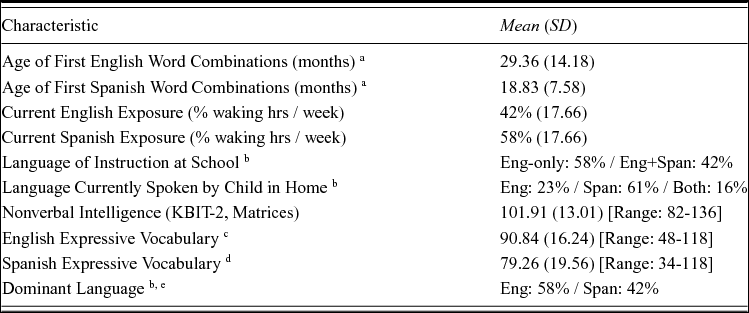
The participants were 43 Spanish–English bilingual children (20 boys) between the ages of 5 and 7 (MAge = 6.15 years, SD=0.79) drawn from a larger project (Gross & Kaushanskaya, Reference Gross and Kaushanskaya2015). The children in the current study acquired Spanish from family members before age 3 and learned English either simultaneously with Spanish (30 children) or at preschool/school entry (13 children). The majority of the children (37) were born in the United States, while the rest of the children were born in Colombia, Mexico, Guatemala, Argentina, or Spain. All children had at least one parent who identified as Hispanic/Latino. Socio-economic status (SES), as measured in total years of education completed by the primary caregiver, varied from 6 to 30 years, but on average caregivers completed at least some college (M SES=15.91 years, SD=5.79). Table 1 presents the language background characteristics of the sample.
Language background characteristics for participants (n = 43) based on parent report.

a Acquisition was indexed by the age in months at which the child began producing two-word phrases in each language, according to parent report.
b Percentages reflect the percent of the sample in each category.
c Woodcock-Johnson III, Picture Vocabulary
d Batería III Woodcock-Muñoz, Vocabulario sobre dibujos
e Dominant Language was determined by relative performance on the English and Spanish expressive vocabulary measures.
Exclusionary criteria included diagnosed language impairment, learning disabilities, psychological/behavioral disorders, neurological impairment, and other developmental disabilities. One child without a formal diagnosis of language impairment was excluded due to very low expressive vocabulary scores in both languages (< 70) and parent concerns. All children passed a bilateral pure tone hearing screening at 25 dB at 1000 Hz, 2000 Hz, and 4000 Hz in the testing room.
Procedure
The children participated in 3 one-hour testing sessions. To assess language control, they completed a picture-naming task in three blocks: 1) English naming, 2) Spanish naming, and 3) cued switching between English and Spanish. The single-language blocks were administered in the first session, with the order of languages counterbalanced. The cued-switch block was administered at least two weeks later in the third session. To assess nonlinguistic task-shifting ability, the children completed the DCCS task in the first or second session. The DCCS always occurred before the cued-switch block of the picture-naming task.
In addition to these experimental measures, the children were administered the Visual Matrices subtest of the Kaufman Brief Intelligence Test (KBIT-2, Kaufman & Kaufman, Reference Kaufman and Kaufman2004) as a measure of nonverbal intelligence. To assess their expressive vocabularies and determine language dominance, the children also completed the Picture Vocabulary subtest of the Woodcock-Johnson III Tests of Achievement (Form A) (Woodcock, McGrew & Mather, Reference Woodcock, McGrew and Mather2001) and the Vocabulario sobre dibujos subtest of the Woodcock-Muñoz Batería III Pruebas de aprovechamiento (Muñoz-Sandoval, Woodcock, McGrew & Mather, Reference Muñoz-Sandoval, Woodcock, McGrew and Mather2005). Children's scores on these standardized measures are presented in Table 1. Parents provided information about their education level and language background by completing the Language Experience and Proficiency Questionnaire (LEAP-Q, Marian, Blumenfeld & Kaushanskaya, Reference Marian, Blumenfeld and Kaushanskaya2007). In addition, they were interviewed about their child's developmental history, education, language use and exposure, relevant medical history, and family background.
Picture-naming task
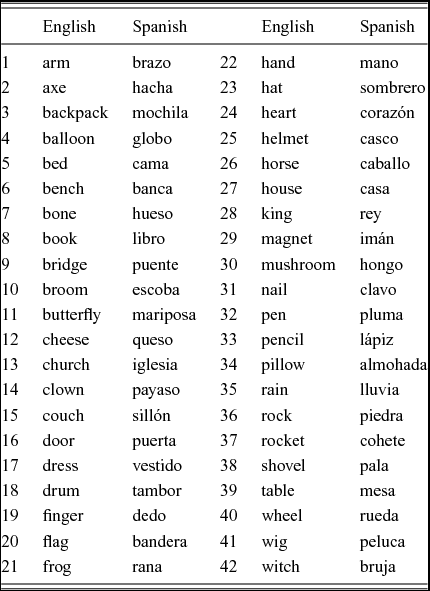
The picture-naming task included 42 pictures selected from the International Picture-Naming Project (IPNP), which were either downloaded directly from the IPNP website (Center for Research in Language, accessed 2011), or purchased from the Snodgrass set (Snodgrass & Vanderwart, Reference Snodgrass and Vanderwart1980). Picture selection criteria included concreteness (Wilson, Reference Wilson1988), no more than two alternate names in each language (Bates, D'Amico, Jacobsen, Székely, Andonova, Devescovi, Herron, Lu, Pechmann, Pléh, Wicha, Federmeier, Gerdjikova, Gutierrez, Hung, Hsu, Iyer, Kohnert, Mehotcheva, Orozco-Figueroa, Tzeng & Tzeng, Reference Bates, D'Amico, Jacobsen, Szekely, Andonova, Devescovi, Herron, Lu, Pechmann, Pléh, Wicha, Federmeier, Gerdjikova, Gutierrez, Hung, Hsu, Iyer, Kohnert, Mehotcheva, Orozco-Figueroa, Tzeng and Tzeng2003), similar age of acquisition in English and Spanish (IPNP online database, Center for Research in Language, accessed 2011), similar frequency of use in English and Spanish (Davies, Reference Davies2008; Davies, Reference Davies2002), and phonological overlap of no more than two phonemes for English and Spanish translation equivalents. See Appendix for the English and Spanish names for the picture stimuli.
The same set of 42 pictures appeared in each of the three blocks but in a different pseudo-randomized order (Research Randomizer, Urbaniak & Plous, Reference Urbaniak and Plous2011). In the cued-switch block, children were cued to name half of the pictures in English and the other half in Spanish; these picture-language assignments were reversed in a counter-balanced version. Half of the trials in the cued-switch block were in the same language as the previous trial and half of the trials required a language switch.
For each trial, children saw a fixation cross for 200 ms, followed by a blank screen for 500 ms; then the picture appeared simultaneously with an auditory cue (say or diga) and remained on the screen for four seconds. There was a 500 ms interval between trials. Responses were audio recorded for later coding. For the English single-language block, the children were instructed to name each picture in English as fast as they could after they heard the cue say. For the Spanish block, they were to name each picture in Spanish as fast as possible after the cue diga. For the cued-switch block, they were told to name the pictures in English if they heard say and in Spanish if they heard diga. There were four practice trials for each of the single-language blocks and eight practice trials for the cued-switch block.
Each trial was coded for context (single-language vs. cued-switch) and for language. Language was coded based on each child's dominant/non-dominant language (a well-accepted practice; e.g., Gollan et al., Reference Gollan, Kleinman and Wierenga2014; Prior & Gollan, Reference Prior and Gollan2011; Weissberger et al., Reference Weissberger, Wierenga, Bondi and Gollan2012), rather than as English/Spanish, because children varied in language dominance. For children who received a higher standard score for expressive vocabulary in English than in Spanish (n = 25), English naming trials were coded as dominant and Spanish trials were coded as non-dominant, and vice versa for children who received a higher score in Spanish (n = 18).
Responses were coded for cross-language errors and naming speed. A response was coded as a cross-language error if the child's response language did not match the cue (e.g., naming the picture in English after the cue diga). Cross-language errors included both correct picture names in the non-target language (i.e., translation equivalents, 84% of total cross-language errors), and incorrect picture names in the non-target language (16%). Naming speed was measured only for correct trials that contained no dysfluencies, hesitations, or intervening words (including articles) before the target response. Correct trials were defined as responses produced within four seconds that matched the target picture name in the cued language or represented an appropriate synonym, dialectal variant, or morphological variant. For two children, naming speed measures were not available for English single-language naming due to a recording failure. To measure naming speed, the latency from the onset of the auditory cue to the onset of the child's response was computed using Praat (Boersma & Weenink, Reference Boersma and Weenink2011). Naming speed data were trimmed by removing outliers for each child that exceeded 2.5 standard deviations from the mean for each language within each context. This procedure resulted in the exclusion of 2.3% of trials. Prior to analysis, all naming speed data were log-transformed.
Dimensional Change Card Sorting (DCCS) task
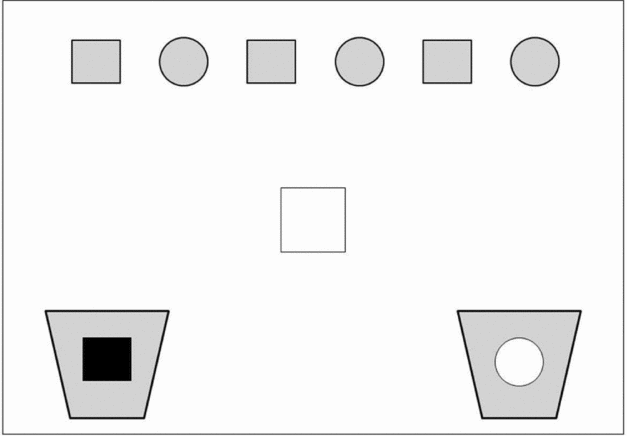
The DCCS task in the current study was based on the DCCS task used by Zelazo (Reference Zelazo2006) and on the color-shape game used by Bialystok and Martin (Reference Bialystok and Martin2004), but was designed to minimize linguistic involvement. The stimuli were simple red circles and blue squares, initial verbal instructions were presented with visual support, and the sorting cues on each trial were presented nonverbally at the top of the screen (a row of amorphous color patches or a row of grey circles and squares). To reduce working memory demands, the cues remained on the screen throughout each trial.
The task began with a practice phase in which children were taught to sort the stimuli by one dimension (e.g., color) and completed four practice trials. If a child responded incorrectly on more than one practice trial, the instructions and practice trials were repeated. Then the child completed the 10 pre-switch trials. In the post-switch phase, the new sorting dimension (e.g., shape) was introduced with an example of how to sort each of the two stimuli. The children completed the 10 post-switch trials with no practice. Finally, the children were told they would play both games at once in the mixed phase (40 trials) and were instructed to look at the cues at the top of the screen each time to know which game to play. The mixed phase contained an equal number of color and shape trials. Half of the trials required children to switch dimensions and half followed the same sorting rule as the previous trial. Children were cued to switch between sorting rules in an unpredictable pseudo-randomized sequence.
For each trial, children saw a fixation cross for 200 ms, followed by a 500 ms inter-stimulus interval, and then the sorting cue (shape or color) appeared at the top of the screen for 1000 ms. The cue remained on the screen while the stimulus (a red square or blue circle) appeared in the center and grey response buckets appeared at the bottom, marked with a red square and a blue circle. Children were instructed to press the button under the bucket into which they wanted to put the stimulus. The cue, stimulus, and response buckets remained on the screen until the child responded or for up to 4000 ms. Figure 1 shows a visual schematic of the task.
Visual set-up for a shape sorting trial in the Dimensional Change Card Sort (DCCS) Task. Black and white represent red and blue, respectively, in the actual experiment.

Accuracy and reaction time data were collected for each trial. Accuracy during the mixed phase was selected to index children's nonlinguistic shifting ability in the analysesFootnote 1 because prior work on cognitive control in young children has suggested that accuracy may better index performance than reaction time (e.g., Davidson et al., Reference Davidson, Amso, Anderson and Diamond2006). Overall accuracy during the mixed phase was selected rather than switching and mixing cost variables. Overall accuracy reflects variability in absolute performance on the task, while difference scores index relative performance and are less robust because they encompass measurement error from both conditions used to calculate the costs. For completeness, we did conduct analyses using mixing and switching cost variables from the DCCS to index task-shifting. These did not yield any main effects of the DCCS on cross-language error rates or naming speed or any significant interactions with language switching or language mixing effects.Footnote 2
Analyses
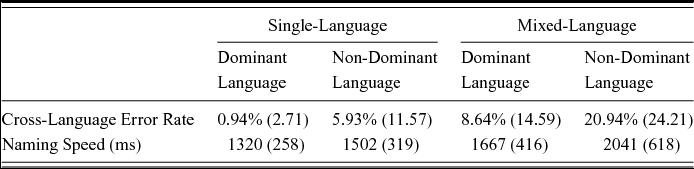
Mixed-effects logistic regression models (lme4 package, Bates, Maechler, Bolker & Walker, Reference Bates, Maechler, Bolker and Walker2015) evaluated the contribution of nonlinguistic task-shifting (i.e., accuracy during the mixed phase of the DCCS) to the control of language selection, as indexed by cross-language errors. A second set of mixed-effects linear regression models evaluated the contribution of nonlinguistic task-shifting to the efficiency of lexical selection, as indexed by naming speed for correct responses. In each set of analyses, the base model included the task-level categorical predictors (language, context). A deviation coding scheme (-0.5/0.5) was used to measure main effects of each categorical predictor collapsed across levels of the other predictor (Mirman, Reference Mirman2014). Continuous predictors were centered around the group mean. Subject-level control variables (SES, nonverbal IQ, language exposure) were each added individually to the base model. Control variables that had a significant effect on the outcome variable were retained in model 2, in which task-shifting skills were added as the predictor of interest. In model 3, cross-level interactions were included to assess whether the contribution of task-shifting differed across contexts (single-language vs. mixed-language) and/or across languages (dominant vs. non-dominant). Model comparisons assessed whether the model containing cross-level interactions fit the data better than the model containing only the main effect of task-shifting. Following Barr's “keep it maximal” approach (Barr, Levy, Scheepers & Tily, Reference Barr, Levy, Scheepers and Tily2013), all models included random intercepts for both participants and items, random by-participant slopes for within-participant variables (i.e., language, context, language X context), and random by-item slopes for within-item variables (i.e., language, context, language X context, and language X context X task-shifting). Following the advice of Barr (Reference Barr2013) to address difficulties with convergence, when task-shifting was added in Models 2 and 3, a random by-items slope was included for the highest-order interaction among the three within-item variables (i.e., language X context X task-shifting) but not for the main effect and lower-order interactions for task-shifting. For the analysis of cross-language errors, the binary outcome variable necessitated the use of logistic regression to evaluate the extent to which predictors increased or decreased the likelihood (log-odds) of making a cross-language error. For all analyses, effects with a t-value (or z-value for the logistic regression analyses) greater than 1.96 were considered significant (p < .05); values between 1.65 and 1.96 were considered marginally significant. Table 2 presents raw data for performance on the picture-naming task, and Tables 3 and 4 present the findings from the mixed-effects models.
Mean (SD) for cross-language errors and naming speed in each condition.

Note: These values were calculated from by-subject means, while analyses were conducted at the level of individual trials.
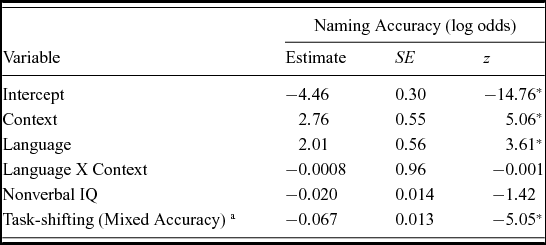
Mixed-effects model for cross-language errors.

* p < .05
a Proportion correct in the mixed phase of the Dimensional Change Card Sort (DCCS) task.
Mixed-effects model for naming speed.

* p < .05
a Proportion correct in the mixed phase of the Dimensional Change Card Sort (DCCS) task.
Results
Contributions of nonlinguistic task-shifting to language selection
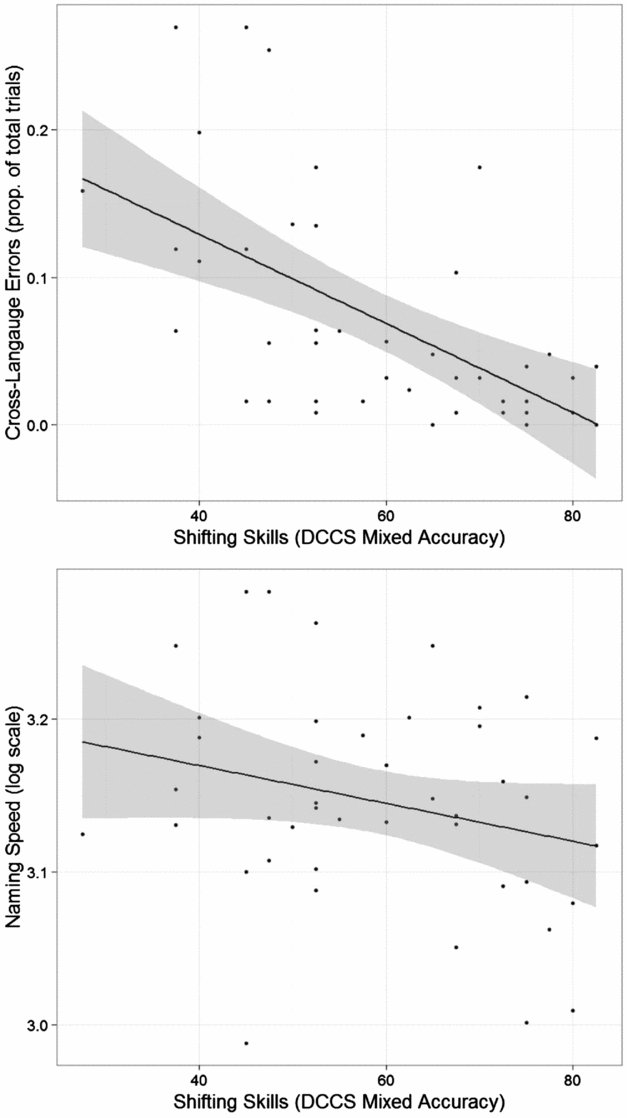
The analysis of cross-language errors included 5413 observations for 43 participants and 42 items. The base model revealed that children were more likely to produce cross-language errors in their non-dominant language (z = 2.62). Children were also more likely to produce cross-language errors in a mixed-language context than in a single-language context (z = 4.43). There was no significant interaction between language and context (z = 0.39). Of the subject-level control variables, only nonverbal IQ had a significant effect; children with higher nonverbal IQs were less likely to make cross-language errors (z=−2.00). In model 2, after controlling for nonverbal IQ, task-shifting skills significantly predicted cross-language errors (z=−5.05), such that children with better task-shifting skills produced fewer cross-language errors. The significant effects of language (z=3.61) and context (z=5.06) persisted in this model. Adding cross-level interactions for task-shifting in model 3 did not significantly improve the model (χ2(3)=4.96, p=.175), indicating that the effect of task-shifting skills on the likelihood of producing cross-language errors did not differ significantly across languages or contexts. The optimal model, model 2, is shown in Table 3, and the effect of task-shifting skills on cross-language errors is depicted in Figure 2 (top).
Cross-language error rate (top) and naming speed (ms log10 scale, bottom), as a function of task-shifting ability. These figures present the bivariate correlations from the raw data; they are not derived from the mixed-effects models. Each point represents a participant. Gray shading indicates 95% confidence interval.

Contributions of nonlinguistic task-shifting to efficiency of lexical selection
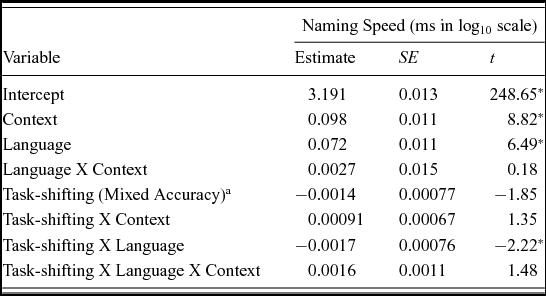
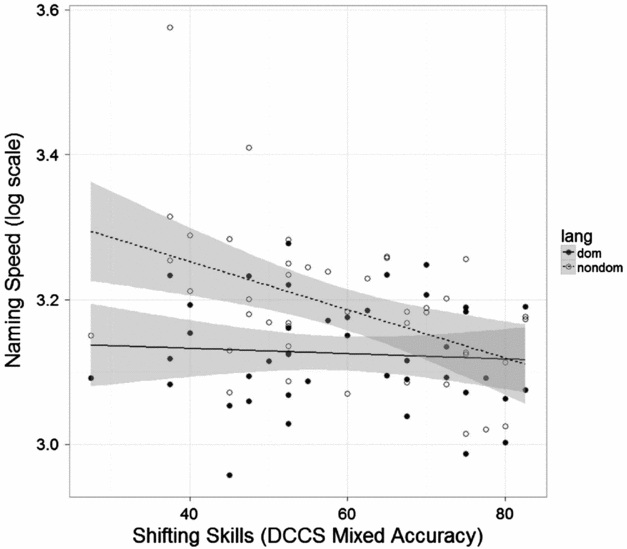
The naming speed analysis included 2525 observations for 43 participants and 42 items. The base model revealed that children were slower to correctly name pictures in their non-dominant language than in their dominant language (t = 6.20) and in a mixed-language context than in a single-language context (t = 8.90); there was no significant interaction between language and context (t = 0.22). None of the subject-level control variables had a significant effect on naming speed. When task-shifting was added in model 2, it had a significant main effect on naming speed (t = −2.87), such that children with better task-shifting skills were faster to name pictures overall. This main effect is depicted in Figure 2 (bottom). When cross-level interactions were added in model 3 (shown in Table 4), they significantly improved the model (χ2(3)=8.55, p=.036). The main effects of language (t = 6.49) and context (t = 8.82) persisted, but the main effect of task-shifting became marginal (t=−1.85). A significant interaction between task-shifting and language (t=−2.22) suggested that the effect of task-shifting on naming speed was greater in the non-dominant language than in the dominant language.Footnote 3 This interaction is depicted in Figure 3. Follow-up analyses were conducted by re-coding language as (0,1) and adjusting the reference category to examine the simple effect of task-shifting in each language. When the dominant language was coded as the reference category, there was no significant main effect of task-shifting (b=−0.00055, SE=0.00086, t=−0.65). When the non-dominant language was coded as the reference category, there was a significant main effect of task-shifting (b=−0.0022, SE=0.00086, t=−2.60).
Naming speed (ms log10 scale), as a function of task-shifting ability, separately for each language. This figure presents the bivariate correlation from the raw data; it is not derived from the mixed-effects model. Each point represents a participant. Gray shading indicates 95% confidence interval.

Discussion
The goal of the current study was to examine the contributions of nonlinguistic task-shifting skills, as measured by the DCCS task, to language control in Spanish–English bilingual children. Language control was measured in two ways: 1) as cross-language errors indexing language selection; 2) as naming speed indexing the efficiency of lexical selection. Nonlinguistic task-shifting skills were a significant predictor of cross-language errors, such that better task-shifters were more successful in controlling language selection. This relationship did not vary by language or context; task-shifting skills contributed to successful language selection in both languages and in single-language and mixed-language contexts. The findings for naming speed were more nuanced in that task-shifting skills predicted faster naming speed only in the non-dominant language.
The divergent findings for cross-language errors and naming speed are consistent with proposals in the literature that language control may occur at multiple levels during bilingual word production (e.g., Christoffels et al., Reference Christoffels, Firk and Schiller2007; Declerck & Philipp, Reference Declerck and Philipp2015; Kroll et al., Reference Kroll, Bobb and Wodniecka2006) and that domain-general cognitive control may be recruited to a greater or lesser extent at different levels. The clear relationship between nonlinguistic task-shifting skills and cross-language errors suggests that domain-general control plays a consistent role at the level of language selection. This finding is in line with models of bilingual language processing that propose a task schema level outside the language system at which schemas for “speak in English” and “speak in Spanish” compete with each other in the same manner as schemas for “sort by color” and “sort by shape” (e.g., Declerck & Philipp, Reference Declerck and Philipp2015). The absence of an interaction between task-shifting and language suggests that the involvement of domain-general cognitive control in selecting a language schema is not affected by relative proficiency in each language. Although children made more cross-language errors in their non-dominant language, poorer task-shifting was not more associated with cross-language errors in one language than the other. The absence of an interaction between task-shifting and context was more surprising, as a mixed-language context poses a greater challenge for controlling language selection than a context in which all words are to be produced in the same language. Although children made more cross-language errors in the mixed-language context than in the single-language context, nonlinguistic task-shifting predicted correct language selection in both contexts. This finding suggests that task-shifting skills contribute both to the ability to switch between languages and to the ability to stay within a single language. One cautionary note to this interpretation is that both language control and task-shifting were measured using only a single task. To ensure that the relationships obtained in the current study were not driven by task-specific effects, further work should include multiple measures of each construct.
Once a language is selected, language control also involves modulating the activation levels of lexical representations in the target and non-target language (e.g., Christoffels et al., Reference Christoffels, Firk and Schiller2007; Gollan et al., Reference Gollan, Kleinman and Wierenga2014; Green, Reference Green1998). Although the term ‘inhibition’ has been used to describe the suppression process that occurs within the language system, it is less clear whether this inhibition of lexical items draws on domain-general cognitive control skills. Our finding of a significant relationship between nonlinguistic task-shifting and naming speed specifically in the non-dominant language may implicate domain-general control in the ability to inhibit competing lexical representations from the dominant language. However, it is possible that this finding may be driven by how we defined language dominance.
Language dominance is a complex construct and can vary by receptive vs. expressive skills (e.g., Gibson, Oller, Jarmulowicz & Ethington, Reference Gibson, Oller, Jarmulowicz and Ethington2012) and measures used (e.g., Bedore, Peña, Summers, Boerger, Resendiz, Greene, Bohman & Gillam, Reference Bedore, Peña, Summers, Boerger, Resendiz, Greene, Bohman and Gillam2012). Because the experimental picture-naming task was a production task, a measure of dominance based on expressive vocabulary was deemed the most appropriate. However, it should be noted that the standard scores from the Woodcock-Johnson III (Woodcock et al., Reference Woodcock, McGrew and Mather2001) and Woodcock-Muñoz Batería III (Muñoz-Sandoval et al., Reference Muñoz-Sandoval, Woodcock, McGrew and Mather2005) are derived from different standardization samples and thus may not be directly comparable. Future work may want to consider different ways of measuring dominance. However, our findings are entirely in line with other studies that have considered language dominance (and defined it in ways that are distinct from ours) when examining the relationship between language and cognitive control. For example, Linck and colleagues (Reference Linck, Schwieter and Sunderman2012) observed a relationship between nonlinguistic inhibitory control and overall naming speed in participants’ weakest L3. Similarly, Prior and Gollan (Reference Prior and Gollan2013) found that training in nonlinguistic task-shifting resulted in reduced language mixing costs specifically in the non-dominant language. We therefore conclude that domain-general control may play less of a role in suppressing competitors from the weaker language when bilinguals are producing words in their stronger language.
One caveat to our interpretation of the relationship between cognitive control and naming speed is that it is not entirely clear which processes are reflected by naming speed. Thus far we have been interpreting naming speed to index the efficiency of the lexical selection process. However, given that naming speed was measured from the moment the child heard the language cue and saw the picture, it could encompass both the process of selecting the correct language schema and the process of selecting the correct lexical item. Thus, a relationship identified between naming speed and nonlinguistic task-shifting could be driven by the language schema selection process. Although task-shifting did not interact with target language in its effect on cross-language errors (i.e., the accuracy of schema selection), it is possible that children with poorer task-shifting skills were slower to select the language schema particularly for the non-dominant language. That is, while the relationship between task-shifting and naming speed in the non-dominant language suggests that selecting and producing words in the non-dominant language depends on domain-general skills, it cannot be fully determined whether poorer task-shifting slows down selection of the non-dominant language schema and/or the selection of the particular lexical representation. What we can conclude, however, is that task-shifting ability has a more restricted influence on the efficiency of lexical production, with the relationship observed in only the weaker language, than it does on the success with which the correct language is selected. Crucially, this relationship between task-shifting and naming speed in the non-dominant language was not restricted to the more challenging mixed-language context. This finding suggests that, for children, the ability to name pictures quickly in their non-dominant language draws on domain-general resources even without the additional demands of being asked to switch languages.
The patterns of results observed in children in the current study are similar to what has been observed in adults, with measures of language selection showing a consistent relationship to domain-general control (Festman et al., Reference Festman, Rodriguez-Fornells and Münte2010; Festman & Münte, Reference Festman and Münte2012; Gollan & Goldrick, Reference Gollan and Goldrick2016; Gollan et al., Reference Gollan, Sandoval and Salmon2011., Reference Gollan, Kleinman and Wierenga2014; Prior & Gollan, Reference Prior and Gollan2013; Rodriguez-Fornells et al., Reference Rodriguez-Fornells, Kramer, Lorenzo-Seva, Festman and Münte2012; Soveri et al., Reference Soveri, Rodriguez-Fornells and Laine2011) and measures of the efficiency of lexical selection showing a more variable/conditional relationship (de Bruin et al., Reference de Bruin, Roelofs, Dijkstra and Fitzpatrick2014; Klecha, Reference Klecha2013; Linck et al., Reference Linck, Schwieter and Sunderman2012; Prior & Gollan, Reference Prior and Gollan2011, Reference Prior and Gollan2013; Woumans et al., Reference Woumans, Ceuleers, Van der Linden, Szmalec and Duyck2015 vs. Branzi et al., Reference Branzi, Calabria, Boscarino and Costa2016; Calabria et al., Reference Calabria, Hernández, Branzi and Costa2011, Reference Calabria, Branzi, Marne, Hernández and Costa2015; Magezi et al., Reference Magezi, Khateb, Mouthon, Spierer and Annoni2012; Weissberger et al., Reference Weissberger, Wierenga, Bondi and Gollan2012). However, while the basic patterns of findings for children and adults may indeed be similar, the strength of the relationship between domain-general cognitive control and language control may change over the course of development.
Weissberger and colleagues (Reference Weissberger, Wierenga, Bondi and Gollan2012, Reference Weissberger, Gollan, Bondi, Clark and Wierenga2015) suggest that as language control becomes a more ‘expert’ task with increased experience, language-specific mechanisms may develop to support language control so that its overlap with domain-general control is only partial. This suggestion fits within the larger debate about whether control of conflict is centrally processed or whether it is managed by separate domain-specific systems (e.g., Egner, Reference Egner2008). In children, for whom both cognitive control and language control are still developing, it is possible that cognitive functions may be more closely associated with each other than in adults. In general, children tend to show less specialization of cognitive processes than adults (e.g., Johnson & Munakata, Reference Johnson and Munakata2005), and this is particularly true of executive control, which has been shown to load onto a single factor in three year olds (Wiebe, Sheffield, Nelson, Clark, Chevalier & Espy, Reference Wiebe, Sheffield, Nelson, Clark, Chevalier and Espy2011), but on multiple factors in older children (e.g., Lehto, Juujärvi, Kooistra & Pulkkinen, Reference Lehto, Juujärvi, Kooistra and Pulkkinen2003) and adults (e.g., Miyake & Friedman, Reference Miyake and Friedman2012). It may be that early in the development of executive control, when children are also still building their vocabularies and grammatical knowledge of each language, language control may rely more heavily on domain-general cognitive control skills than in adults who have had more experience managing their two languages.
Further investigation of shifts in the relationship between cognitive control and language control over the course of development would require longitudinal work beginning at age two in order to trace how changes in executive control skills contribute to language control as it develops. Such a longitudinal approach would also address the issue of directionality. In the current study, we used nonlinguistic task-shifting skills to predict language control measures, but the relationship could also suggest that language control abilities contribute to domain-general cognitive control. A longitudinal examination of how developments in cognitive control contribute to language control and how improvements in language control contribute to cognitive control would better illuminate the relationship between these two key skill sets in bilingual development.
Dominanta English and Spanish names for picture stimuli.