Introduction
It is generally accepted that employment is associated with lower levels of psychiatric morbidity than unemployment (Dooley et al. Reference Dooley, Catalano and Wilson1994; Ford et al. Reference Ford, Stansfeld, McManus, Harris and Clark2010) and that as people move from unemployment into work their mental health improves (Thomas et al. Reference Thomas, Benzeval and Stansfeld2005). This belief underlies work-first policies that focus on moving those who are unemployed into any job as quickly as possible. However, there is also a large body of research showing that work lacking in adequate psychosocial quality is associated with poor mental health (Karasek, Reference Karasek1979; Siegrist, Reference Siegrist1996; Stansfeld & Candy, Reference Stansfeld and Candy2006; Stansfeld et al. Reference Stansfeld, Pike, McManus, Harris, Bebbington, Brugha, Hassiotis, Jenkins, Meltzer, Moran and Clark2012). In fact, cross-sectional research has shown that those in the poorest quality jobs (a combination of psychosocial job adversities such as high job demands, low job control and poor job security) have similar or higher risk of psychological distress than those who are unemployed (Broom et al. Reference Broom, D'Souza, Strazdins, Butterworth, Parslow and Rodgers2006). More recent analysis of longitudinal data showed that transitions to poor quality jobs were associated with greater decline in mental health than transitions to unemployment or remaining unemployed (Leach et al. Reference Leach, Butterworth, Strazdins, Rodgers, Broom and Olesen2010b) and that the health benefits of becoming employed depended on the quality of the job obtained (Butterworth et al. Reference Butterworth, Leach, Strazdins, Olesen, Rodgers and Broom2011). Whereas transitions to high-quality jobs bestowed a psychological benefit, transitions from unemployment to the poorest psychosocial quality jobs were more detrimental to mental health than remaining unemployed.
There remain, however, limitations and restrictions in this previous research. First, the research cited was based on Australian data. It may be that these previous findings reflect specific and unique aspects of Australia's labour market and/or social policy system. Perhaps more importantly, the previous research has used general measures of psychological distress and counts of depressive/anxiety symptoms. Such scales may underestimate social inequalities in depression/mental health compared to diagnostic schedules (Lorant et al. Reference Lorant, Deliege, Eaton, Robert, Phillippot and Ansseau2003). There is, therefore, a need to contrast the effects of psychosocial job quality and unemployment using a diagnostic assessment of mental illness. This analysis uses data from the 2007 English Adult Psychiatric Morbidity Survey (APMS) to develop a global measure of psychosocial job quality, drawing on established scales assessing job demands, job control, perceived job security and job esteem. The aim of the current study was to contrast the mental health of those who are unemployed (and actively looking for work) with those in jobs of differing (psychosocial) quality using a measure of common mental disorders (CMDs) from a structured diagnostic interview.
Method
Data
In the current study we analysed data from the 2007 APMS, a stratified multi-stage representative sample of private households in England. The initial stage in sample selection involved random selection of postcode sectors stratified by region and socio-economic classification. Households were then randomly selected from within these postal sectors and finally, within each selected household, one person (aged ≥16 years) was randomly chosen to participate in the survey. Interviews were conducted by trained interviewers from the National Centre for Social Research using a procedure of computer-assisted personal interviews. The APMS received ethical approval from the Royal Free Hospital and Medical School Ethics Committee. Further details of the APMS are available elsewhere (Jenkins et al. Reference Jenkins, Meltzer, Bebbington, Brugha, Farrell, McManus and Singletone2009; McManus et al. Reference McManus, Meltzer, Brugha, Bebbington and Jenkins2009).
Overall, 7461 participants from a potentially eligible population of 13 171 households took part in the phase one survey (which is the focus of this analysis; a response rate of 57%). As this particular analysis was concerned with the association between work-force experience and mental health, it was restricted to those respondents who either (i) had worked in the past week (employees excluding the self-employed) or (ii) were unemployed and actively looking for work with the definition of unemployment matching that of the International Labour Organization. All respondents who were economically inactive (those not working but also not looking for work) were excluded from the current analysis. In addition, the current analysis is restricted to respondents aged over 20 and under 55 years of age so as to minimize the influence of normative transitions into and out of the workforce (Melzer et al. Reference Melzer, Buxton and Villamil2004; Butterworth et al. Reference Butterworth, Gill, Rodgers, Anstey, Villamil and Melzer2006). Analysis showed that labour-force participation of respondents beyond these ages (i.e. those 20 years or younger, and 55 years or older) was below 65%. The final sample size for this analysis was 2603.
Measures
Psychiatric assessment
A standardized clinical interview, the Revised Clinical Interview Schedule (CIS-R; Lewis et al. Reference Lewis, Peosi, Araya and Dunn1992), was used to assess neurotic symptoms in the past week and thereby determine the presence of non-psychotic psychiatric disorders matching ICD-10 criteria. This analysis considers a summary measure of CMDs that could potentially be a consequence of adverse employment circumstances, namely generalized anxiety disorder, mixed anxiety and depression, and depressive episode.
Sociodemographic factors
The APMS collected data on a range of personal and household characteristics. For this analysis the covariates considered were: age (treated as a continuous measure), sex (male used as the reference category), partnered status (reference category no cohabitation versus those in married or cohabitating relationships), housing tenure (owner occupier, social renter, private renter), and social class. The previous Australian analysis controlled for economic differences associated with employment status through a measure of financial hardship. For this analysis we used a count of the number of debts that assessed similar characteristics (e.g. debt over the past year associated with utilities, mortgage or rent; for similar measures see Jenkins et al. Reference Jenkins, Bhugra, Bebbington, Brugha, Farrell, Coid, Fryers, Weich, Singleton and Meltzer2008; Meltzer et al. Reference Meltzer, Bebbington, Brugha, Jenkins, McManus and Dennis2011). In addition, for imputation of missing data we used data on highest educational qualifications, equivalized income, self-rated health, resilience, general practitioner (GP) visits in 12 months for physical or mental health reasons, body mass index, current smoking status, alcohol consumption measured by the Alcohol Use Disorders Identification Test (AUDIT; Saunders et al. Reference Saunders, Aasland, Babor, Dela Fuente and Grant1993), gambling participation, suicidal thoughts, verbal intelligence estimated from the National Adult Reading Test (NART; Nelson & Willison, Reference Nelson and Willison1991), size of social network of friends/family, and need to borrow money in the past year.
Psychosocial work characteristics
Several different dimensions of the psychosocial work environment were assessed in the APMS based on the Job Demands – Control (JD-C; Karasek, Reference Karasek1979) and the Effort–Reward Imbalance (ERI; Siegrist, Reference Siegrist1996) models. This analysis draws on data from a short version of the ERI questionnaire (Siegrist et al. Reference Siegrist, Wege, Puhlhofer and Wahrendorf2009) that provides measures of the demanding aspects of the work (three items), job security (two items), and a measure of esteem from colleagues, clients, customers and managers (four items). The analysis also uses a measure of job control (two items) drawn from an adaptation of the JD-C model used in the Whitehall II Study (Stansfeld et al. Reference Stansfeld, Fuhrer, Shipley and Marmot2002). Scores from the items within each of these scales were summed and, apart from the security scale, showed reasonable reliability: job demands/effort (α = 0.79), job control (α = 0.74), job security (α = 0.58), and job esteem (α = 0.72). Further details of the construction, scoring and psychometric properties of the scales of work characteristics in the APMS are provided by Clark et al. (Reference Clark, Pike, McManus, Harris, Bebbington, Brugha, Jenkins, Meltzer, Weich and Stansfeld2012) and Stansfeld et al. (Reference Stansfeld, Pike, McManus, Harris, Bebbington, Brugha, Hassiotis, Jenkins, Meltzer, Moran and Clark2012). Although other aspects of the psychosocial work environment included in the APMS, such as workplace support, job prospects and overcommitment, are important workplace determinants of health, they were not considered to be direct measures of job quality.
We conceptualized psychosocial job quality as a multidimensional construct and used a composite indicator approach (OECD, 2008). The estimate of overall psychosocial job quality is based on four scales, reflecting the experience of low control, high demands, job insecurity and low job esteem (Strazdins et al. Reference Strazdins, D'Souza, Lim, Broom and Rodgers2004; Leach et al. Reference Leach, Butterworth, Rodgers and Strazdins2010a; Butterworth et al. Reference Butterworth, Leach, Strazdins, Olesen, Rodgers and Broom2011). For each scale, respondents with scores in the quintile of the distribution corresponding to greatest adversity (e.g. high job demands, low job control, high insecurity and low job esteem) were categorized as experiencing that psychosocial job adversity. The summary measure of psychosocial job quality was constructed by summing the reported number of adverse work conditions experienced. Because of the small number of respondents reporting all four job adversities, this summary scale was top coded at three and thus produced four categories ranging from zero (optimal jobs) to three or more psychosocial adversities (poorest quality jobs). The robustness of the current results were assessed by analyses using a different cut-point (based on tertiles of subscale distributions), which replicated the pattern of results reported here.
Analysis
Analyses used sample weights and the Taylor Series Linearization method to take account of sample selection, response bias and the complex survey design. Overall missingness on most measures included in the models was low (see Table 1). Less than 1% of working respondents had missing data on any of the scales of psychosocial job quality. Missing data were imputed with the Stata ice procedure, a process of multiple imputation by chained equations (Royston, Reference Royston2004), and analysis based on 20 imputed datasets.
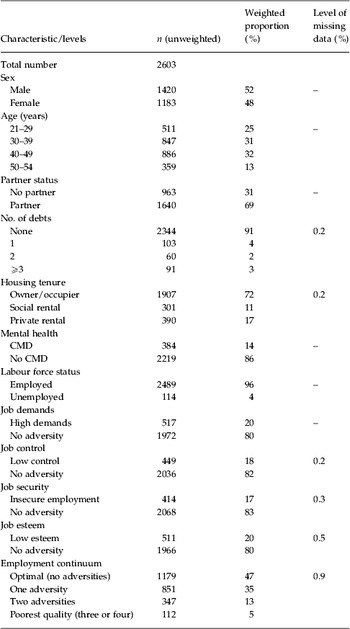
Demographic characteristics of the sample

CMD, Common mental disorder.
An initial set of analyses considered the inter-relationships among the different markers of psychosocial job quality using tetrachoric and polychoric correlation coefficients to assess the relationships among binary and ordinal variables. Having constructed a scale of overall job quality based on the number of adverse characteristics, the specific project aims were assessed using logistic regression models. The initial models sought to replicate established findings of an association between employment status (employed versus unemployed) and CMD and the association between the gradient of job quality and risk of CMD. Further analyses focused on evaluating whether the mental health of those respondents in the poorest quality jobs differed from those who were unemployed. One possible criticism of the current study is that psychosocial job quality and unemployment may be confounded by socio-economic factors such as the financial circumstances of respondents and/or selection effects. To address these concerns, analyses considered the association between job quality, unemployment and key socio-economic measures (debt, income and social class) and the final model was repeated considering the interaction with, and analyses stratified by, debt (no debt, any debt), equivalized household income (top two quintiles, bottom quintile) and social class [contrasting those with a professional or managerial background (social class 1 or 2) and those with an unskilled or semi-skilled background (social classes 4 and 5)] to assess whether the pattern of results was consistent across these characteristics.
Results
Descriptive data
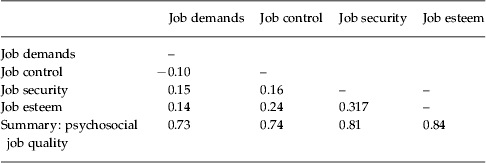
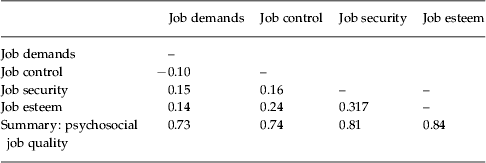
Table 1 presents an overview of the sample. The (weighted) prevalence of CMD was 14% and 4% of respondents were unemployed and looking for work. To evaluate the independence of the different aspects of psychosocial job quality and ascertain whether each factor made a unique contribution to the overall summary of job quality, the correlations between the dichotomous job quality measures and the overall scale of job quality were considered (Table 2). The results demonstrated weak correlations between each of the subscales but, as expected, showed that each was moderately associated with the summary measure of psychosocial job quality. A series of simple logistic regression models showed that each aspect of psychosocial job quality was significantly associated with increased risk of CMD [job demands: odds ratio (OR) 2.54, 95% confidence interval (CI) 1.88–3.44. p < 0.001; job control: OR 1.75. 95% CI 1.27–2.41, p = 0.001; job security: OR 2.12, 95% CI 1.55–2.89, p < 0.001; job esteem: OR 2.27, 95% CI 1.70–3.04, p < 0.001]. These results support the decision to sum the four separate measures to create an overall measure of psychosocial job quality.
Tetrachoric and polychoric correlation coefficients between measures reflecting adverse psychosocial job characteristics and overall job quality
Employment status, job quality and CMD
Logistic regression models confirmed the well-established relationship between employment status and CMD. The prevalence of mental disorders among those who were unemployed (33.1%) was significantly greater than among those who were employed (12.9%; OR 3.34, 95% CI 2.06–5.42, p < 0.001). This association was moderately reduced when covariates were included in the model (OR 2.78, 95% CI 1.57–4.91, p < 0.001). Considering those respondents who were employed and treating the number of adverse job characteristics (on the four-point scale) as a continuous measure, logistic regression analysis showed that the risk of CMD increased as the number of adverse psychosocial work characteristics increased (OR 1.87, 95% CI 1.63–2.14, p < 0.001). Each additional adverse job condition increased the risk of reporting CMD by more than 80%. This effect was little changed by the inclusion of covariates (OR 1.85, 95% CI 1.62–2.12, p < 0.001).
Employment continuum and CMD
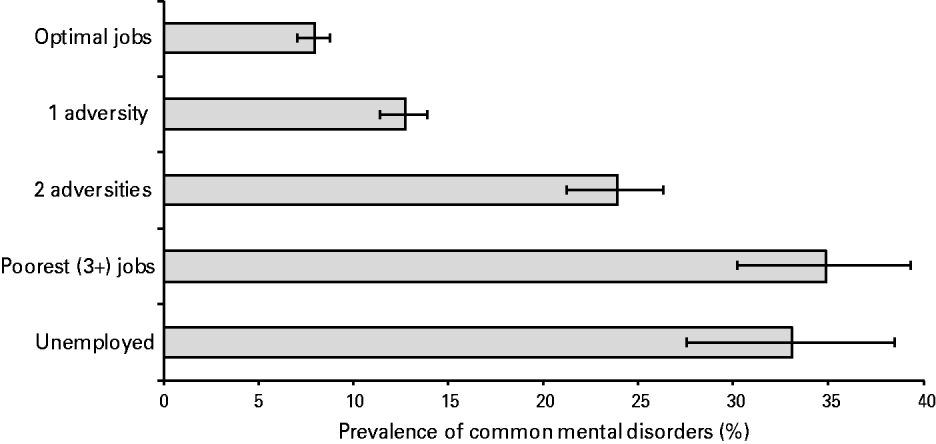
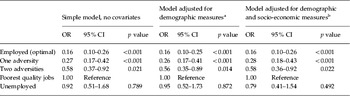
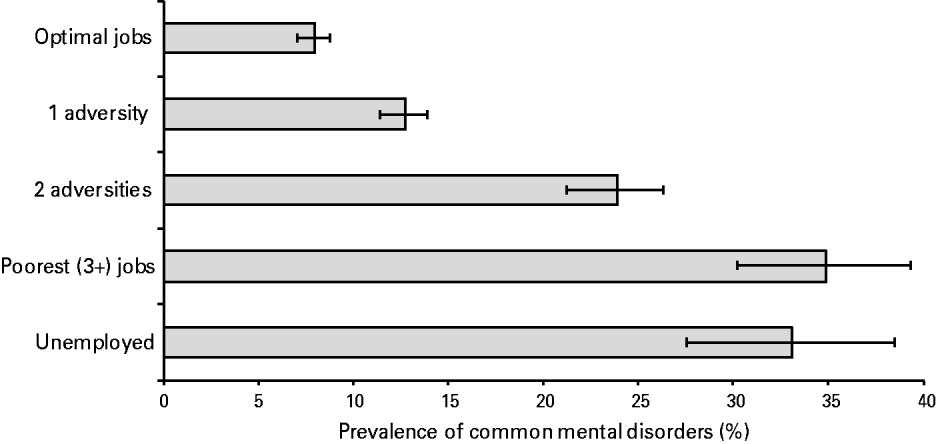
The employment continuum was constructed by combining the four-point job quality scale with an indicator of those respondents who were unemployed. The prevalence of CMD across these categories is presented in Fig. 1 and the results of the logistic regression models, using poorest quality jobs as the reference category, are presented in Table 3. It is evident that higher quality jobs were associated with better mental health (lower prevalence of CMD) than poor quality work. The analysis also shows that there was no difference in the prevalence of CMD between those in the poorest quality jobs and those who were unemployed in both the analysis with employment status alone and the model incorporating all covariates. A series of additional analyses, including demographic covariates and then demographic and socio-economic measures, demonstrated the same pattern of results. The final model showed that unemployment was associated with higher risk of CMD compared with optimal jobs (OR 4.81, 95% CI 2.73–8.50, p = 0.001) and jobs with one adversity (OR 2.87, 95% CI 1.57–5.26, p = 0.001), but was associated with no greater risk of CMD than jobs with two adversities (OR 1.37, 95% CI 0.73–2.55, p = 0.321). Repeating the analyses without data imputation (i.e. omitting cases with missing data) or with fewer imputed datasets (n = 5) replicated the reported pattern of results.
Prevalence of common mental disorders (and standard errors) by employment circumstances.
Odds ratios (ORs) and 95% confidence intervals (CIs) from logistic regression models assessing the relationship between employment circumstances and common mental disorders (CMDs)

a Covariates were age, sex, partner status.
b Covariates were age, sex, partner status, debt and housing tenure.
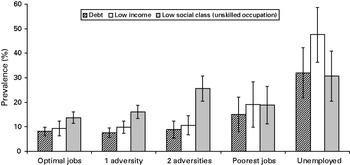
Figure 2 presents details of the association between measures of social adversity and the employment continuum to assess whether this could account for the observed pattern of results. It is evident that the prevalence of social adversity (debt, low household income, unskilled occupational background) increased as job quality decreased. However, it was also evident that unemployment was associated with greater adversity than the poorest quality work, although the effect for occupational background did not reach the threshold for statistical significance (debt: OR 2.64, 95% CI 1.31–5.35, p = 0.007; low income: OR 3.88, 95% CI 1.79–8.40, p = 0.001; unskilled occupational background: OR 1.89, 95% CI 0.96–3.72, p = 0.067). Thus the finding that those in poor quality jobs had comparable mental health to those who were unemployed occurs despite their poorer social circumstances, lower income and greater debt.
Measures of social disadvantage (experience of debt, lowest quintile of household income, and unskilled occupational background; and 95% confidence interval) by employment circumstances.

To further assess the robustness of the results, a series of analysis showed that the interaction between the employment continuum and each of these three socio-economic measures was not significant (Wald test that interaction coefficients differ from 0 gave p = 0.436 for social class; p = 0.898 for household income; and p = 0.236 for debt). This was consistent with the results of analyses stratified by social class, household income and debt. No difference was evident in the prevalence of CMDs between those in the poorest quality jobs and those who were unemployed for respondents identified with an unskilled background (n = 430; OR 0.62, 95% CI 0.13–2.91, p = 0.54) or those with a professional background (n = 1222; OR 0.51, 95% CI 0.16–1.68, p = 0.267), whereas those in optimal quality jobs reported lower rates of CMDs than those in the poorest quality work in both of the subpopulations (OR 0.26, 95% CI 0.09–0.74, p = 0.012 and OR 0.17, 0.08–0.37, p < 0.001). The same pattern was observed, with the prevalence of CMDs similar for those in the poorest quality jobs and those who were unemployed in analyses stratified by debt (no debt: OR 0.76, 95% CI 0.33–1.74, p = 0.512; debt: OR 0.79, 95% CI 0.20–3.04, p = 0.727) and income (high income: OR 0.19, 95% CI 0.02–1.61, p = 0.127; low income: 0.45, 95% CI 0.09–2.14, p = 0.311).
Discussion
Study findings
There was no difference in the rates of CMD between those who were unemployed and those who were in the poorest quality jobs. Both of these groups of individuals were more likely to experience a CMD than those who were in high quality work. This pattern remained evident after controlling for relevant demographic and socio-economic covariates and was evident for those with unskilled and professional backgrounds, suggesting that the results do not simply reflect confounding. The experience of debt, household income and lower social class did not account for the observed pattern of results, showing that those who were unemployed had no worse mental health than those employed in the poorest quality jobs. The results provide support for the hypothesis that the mental health benefits of work are restricted to good quality jobs, and that the poorest quality work is comparable to unemployment as a risk factor for poor mental health.
Comparison with prior literature
The findings of the current study are consistent with those reported previously using Australian data. Using wave 1 of the Personality and Total Health (PATH) through Life project, a longitudinal community survey assessing the health and well-being of the residents of Canberra and Queanbeyan (NSW) in Australia, Broom et al. (Reference Broom, D'Souza, Strazdins, Butterworth, Parslow and Rodgers2006) found no difference in depression symptoms between those who were unemployed and those with jobs of the poorest psychosocial quality. Subsequent analysis using three waves of PATH data also found no differences between these two groups on measures of depressive and anxiety symptoms (Leach et al. Reference Leach, Butterworth, Strazdins, Rodgers, Broom and Olesen2010b). Analysis of data from a longitudinal national household panel survey, using different measures of job quality and mental health, also found that jobs with poor psychosocial attributes were no better, and in some cases had even more adverse effects on mental health, than unemployment (Butterworth et al. Reference Butterworth, Leach, Strazdins, Olesen, Rodgers and Broom2011). All of these previous studies also showed a linear relationship between job quality and mental health, such that, as the number of psychosocial job adversities increased, levels of depression and anxiety also increased. Uniquely, the current study demonstrates that these findings persist when diagnostic measures of psychiatric disorders are considered, and confirms that the findings extend to the English employment market.
In comparison to the similarity between the English and Australian findings, Grzywacz & Dooley (Reference Grzywacz and Dooley2003) found that, in the USA, jobs with poor psychosocial conditions were associated with somewhat better mental health than unemployment or working in jobs with inadequate pay and health benefits. Although this may reflect methodological and/or measurement differences between studies, it could also be a consequence of societal differences. The broad political and economic context is argued to shape citizens' exposure to the social determinants of health through the influence of economic and labour-market policies, workplace relations policy, occupational health and safety laws, and the availability and adequacy of social welfare programmes (Bartley et al. Reference Bartley, Blane and Montgomery1997; Bambra & Eikemo, Reference Bambra and Eikemo2009; Bambra, Reference Bambra2011; Dragano et al. Reference Dragano, Siegrist and Wahrendorf2011). Cross-national comparisons show that the strength of association between unemployment and poor health and between exposure to adverse psychosocial work conditions (e.g. insecurity, low control, effort–reward imbalance) and poor health is greater in countries with less regulated economies and more modest or fragmented welfare systems (Bambra & Eikemo, Reference Bambra and Eikemo2009; Dragano et al. Reference Dragano, Siegrist and Wahrendorf2011). It is plausible, therefore, that poor quality jobs would be associated with better mental health than unemployment in circumstances in which people do not have the support from an adequate social safety net. Although the UK, the USA and Australia are generally grouped together in classifications of welfare state regimes (Eikemo & Bambra, Reference Eikemo and Bambra2008), differences exist in terms of the universality and duration of benefits, and the role of insurance versus non-contributory programmes. The International Labour Organization, using data from 2006 to 2008, estimated that the effective coverage of unemployment benefits (the percentage of unemployed people who receive unemployment benefit) was 38% in the USA compared to 51% in the UK and 69% in Australia (International Labour Office, 2010). It is also important to recognize, however, that the current analysis showed that unemployment was associated with much poorer social circumstances (debt, income, social class) than poor quality work, suggesting that the observed results are not simply a consequence of comparable levels of material deprivation.
Practical implications
The current study has implications for employment, health and social policy in the UK and internationally. A common component of many governments' social inclusion, participation and economic agendas is promoting work for those who are unemployed. Unemployment is commonly viewed as an important indicator of social exclusion and many advocate that increasing participation in work will boost social inclusion, be associated with better health outcomes, and will reduce the need for health services (Morgan et al. Reference Morgan, Burns, Fitzpatrick, Pinfold and Priebe2007). In reporting on a cross-governmental strategy to improve the mental health and well-being of all citizens in the UK, a recent publication by the Department of Health (2011) makes reference to the mental health benefits of employment, with employment rates identified as a key indicator of success. However, there is little reference to the importance of the psychosocial quality of work and/or the impact of work stress on mental health. The results of the current study suggest that strategies that focus on the mental health benefits of employment should be accompanied by an important caveat: that these benefits only apply to those jobs with a positive psychosocial environment. This is an important qualification that also needs to be considered when advocating a workfirst policy approach (OECD, 2005). Interventions and re-employment programmes designed to decrease unemployment should recognize that any job is not necessarily better than no job, and that there should be an emphasis on high quality work.
On a positive note, the current results suggest that good quality work is associated with lower rates of psychiatric disorders. This provides policy makers, coordinators of workplace programmes and employers with a potential tool or leverage point for improving mental health in the community. Namely, the improvement of psychosocial work conditions, such as reducing job demands and increasing job control, security and esteem, should flow on to improvements in employees' mental health and reduce the burden of illness on public health systems. Although the current cross-sectional analyses do not provide data concerning changes in work quality and mental health, our previous longitudinal research provides evidence of a causal association (Leach et al. Reference Leach, Butterworth, Strazdins, Rodgers, Broom and Olesen2010b; Butterworth et al. Reference Butterworth, Leach, Strazdins, Olesen, Rodgers and Broom2011).
Limitations
Several limitations should be noted. First, as outlined previously, cross-sectional data preclude conclusions regarding the direction of causation or selection, although previous work conducted in this area can be used in conjunction with the current findings to inform policy and intervention decisions that may be based on assumptions of causation. Nonetheless, health selection remains an alternative explanation, with individuals who experience mental disorders potentially less engaged with the workforce and more reliant on poor quality work. It could also be that the onset of mental disorders during adolescence and early adulthood disrupts educational attainment and skill development, limiting future career prospects (e.g. Leach & Butterworth, Reference Leach and Butterworth2012). Second, there is a possibility of response bias or endogeneity, as much of the APMS is self-report; that is, those with mental illnesses may perceive and rate the same work environment more negatively than those without a disorder. This possibility was minimized by adjusting for potential confounders and the use of psychometrically sound diagnostic assessments of mental illness. Third, it is difficult to manage missing data when asking questions about employment and mental health. Each of these factors is likely to have some association with missing data, and therefore how missing data are dealt with may have some influence over the results obtained. However, missing data were minimal in the APMS and the current study adopted advanced statistical imputation in addition to secondary analyses without this imputation, to provide a comprehensive picture of how missing data may influence the findings. Fourth, the analysis focused on the psychosocial quality of work and did not consider all possible non-work risk and protective factors for CMDs. However, recent analysis of the APMS data has shown that psychosocial work stressors and non-work stressors are independently associated with CMDs (Clark et al. Reference Clark, Pike, McManus, Harris, Bebbington, Brugha, Jenkins, Meltzer, Weich and Stansfeld2012) and we replicated our current results in models that included a more extensive range of non-work factors (e.g. social support, social network size and experience of significant life events; results not reported). Fifth, the context of a large epidemiological survey necessitated the use of abbreviated scales of the psychosocial work environment. However, our analysis demonstrated that the reliability all scales, apart from the two-item scale of job security, was acceptable. Finally, the measure of psychosocial job quality was a relative measure, with adversity on the four aspects of job quality defined by reference to the distribution of scale scores in the population. Furthermore, we defined cut-points on each scale (around the first quintile) to derive similar numbers of respondents in the categories of unemployed and poorest quality jobs. Although the identification of policy-relevant subgroups through relative measures is a common approach (e.g. the setting of poverty levels; Sutherland et al. Reference Sutherland, Sefton and Piachaud2003), future research could seek to identify absolute levels of unacceptable psychosocial job circumstances against which to benchmark the effectiveness of policies and interventions. It is important to recognize, however, that the current findings are robust and the same pattern of results was obtained from analysis using the first tertile of the subscales as the cut-point.
Summary
The current study is the first to use nationally representative data from England to compare the mental health of those who are unemployed with those in jobs of differing psychosocial quality. The findings build considerably upon a growing body of research highlighting the need to address the psychosocial aspects of work environment as part of national government plans to reduce mental illness in the community.
Acknowledgements
The APMS data are available from the Economic and Social Data Service, a collaboration between the Universities of Essex and Manchester. P.B. and L.L. are funded by Australian National Health and Medical Research Council (NHMRC) Fellowships nos 525410 and 1035803. The sponsor had no role in the design, the collection, analysis and interpretation of data, in the writing of the report, or in the decision to submit the article for publication.
Declaration of Interest
None.