


Stirred yoghurt is produced by fermentation of the yoghurt mix until pH 4·6, followed by mixing, pumping, cooling and filling. Many studies have aimed at understanding the rheological properties of set yoghurt, but comparatively little work has been done on stirred yoghurt. As the set gel is sheared during the process, the network is therefore broken down into a concentrated dispersion of small pieces of gel made of protein particles (Van Marle, Reference Van Marle1998). These pieces of gel retain the whey fraction; they are held by intra-particle interactions and establish inter-particle interactions, so that a new network forms during storage. The viscoelastic moduli of the set gel decrease on shearing and the viscoelastic solid turns into a complex fluid, with low viscosity values and a non-Newtonian behaviour. The improvement of the texture of stirred yoghurt, known as rebodying, is characterized by a large increase in viscosity or viscoelastic properties. Viscoelastic properties of stirred gels largely increase during the first hours after stirring (short-term rebodying) and over more than 10 d (long-term rebodying). However, the recovery is only 30% of G′ after 20 h (Arshad et al. Reference Arshad, Paulsson and Dejmek1993; Afonso & Maia, Reference Afonso and Maia1999; Cayot et al. Reference Cayot, Fairise, Colas, Lorient and Brulé2003; Sodini et al. Reference Sodini, Remeuf, Haddad and Corrieu2004). Little is known concerning the mechanisms for this texture recovery. Short-term rebodying is thought to be due to cooling and formation of elastic bonds between protein particles, while long-term rebodying is ascribed to over-acidification (Martens, Reference Martens1972), syneresis, protein hydration and exopolysaccharides (EPS) production (Rasic & Kurmann, Reference Rasic and Kurmann1978; Afonso & Maia, Reference Afonso and Maia1999; Sodini et al. Reference Sodini, Remeuf, Haddad and Corrieu2004).
The interactions formed in stirred yoghurt may have the same nature as those found in set yoghurts. Rheological properties of stirred yoghurt are actually dependant on those of set-style yoghurts (Van Marle & Zoon, Reference Van Marle and Zoon1995; Van Marle, Reference Van Marle1998; Ozer et al. Reference Ozer, Stenning, Grandison and Robinson1999; Cayot et al. Reference Cayot, Fairise, Colas, Lorient and Brulé2003; Lee & Lucey, Reference Lee and Lucey2006) and the same factors can be used to improve the texture of both set and stirred yoghurts. Set yoghurt formation involves repulsive and attractive electrostatic, hydrogen, hydrophobic interactions and disulphide bridges (Roefs & Van Vliet, Reference Roefs and Van Vliet1990; Lucey et al. Reference Lucey, Van Vliet, Grolle, Geurts and Walstra1997a, Reference Lucey, Van Vliet, Grolle, Geurts and Walstrab; Lefebvre-Cases et al. Reference Lefebvre-Cases, Gastaldi, Vidal, Marchesseau, Lagaude, Cuq and Tarodo de la Fuente1998; Alting et al. Reference Alting, Hamer, de Kruif and Visschers2000; Cayot et al. Reference Cayot, Fairise, Colas, Lorient and Brulé2003; Vasbinder et al. Reference Vasbinder, Alting, Visschers and de Kruif2003). Calcium bridges are thought not to be involved since calcium is almost completely soluble at pH 4·4, but according to Le Graet & Brulé (Reference Le Graet and Brulé1993), only pH values of 3·5 led to the complete solubilisation of calcium. Some studies have reported an increase in stirred yoghurt viscosity when low incubation temperatures are used (Martens, Reference Martens1972; Skriver et al. Reference Skriver, Roemer and Qvist1993; Martin et al. Reference Martin, Skokanova, Latrille, Beal and Corrieu1998, Reference Martin, Skokanova, Latrille, Beal and Corrieu1999; Van Marle, Reference Van Marle1998; Lee & Lucey, Reference Lee and Lucey2004), but the opposite result has also been observed (Schellhaass & Morris, Reference Schellhaass and Morris1985; Lankes et al. Reference Lankes, Ozer and Robinson1998; Skriver et al. Reference Skriver, Roemer and Qvist1993 cited in Sodini et al. Reference Sodini, Remeuf, Haddad and Corrieu2004). Rebodying is only partially explained by over-acidification, cooling or using ropy bacteria and hydrophobic interactions were found not to be involved (Renan et al. Reference Renan, Guyomarc'h, Arnoult-Delest, Pâquet, Brulé and Famelart2008b). Opposite effects of the incubation temperature on the texture changes in set and stirred gels furthermore showed that at least some of the interactions formed in these gels must be different (Renan et al. Reference Renan, Guyomarc'h, Arnoult-Delest, Pâquet, Brulé and Famelart2008b).
The aim of the study was therefore to complete the identification of bonds that are responsible for the rebodying of stirred yoghurt. Using a yoghurt gel prepared in constant conditions and stirred at the same pH value, the effects of changes in the physicochemical conditions at stirring on the rheological properties of stirred yoghurt were studied. The involvement of electrostatic interactions, calcium binding and disulphide bonds were investigated by changing the ionic strength (IS), adding calcium chloride or citric acid, or by adding N-ethyl maleimide (NEM) at stirring, respectively. Another hypothesis was that rebodying was due to the completion of ionic equilibrium during and after stirring. Indeed, a set gel at pH 4·4 is not in a physicochemical equilibrium, and reaching the final equilibrium during and after stirring may provoke rebodying, whereas reaching this equilibrium before stirring could prevent it. Therefore, rheological properties of stirred gels obtained from set gels stored for 0 or 7 d before stirring were compared.
Materials and Methods
Preparation of set-style yoghurts
Milk was reconstituted from ultra low heat skim milk powder as described in Renan et al. (Reference Renan, Arnoult-Delest, Paquet, Brulé and Famelart2008a) at 140 g dry matter per kg for samples with no further addition or at 147 g per kg for samples where salt or reagent addition induced a slight dilution of yoghurt. Milk was heat-treated as described in Laligant et al. (Reference Laligant, Famelart, Brulé, Piot and Paquet2003). Set acid gel was produced as in Renan et al. (Reference Renan, Arnoult-Delest, Paquet, Brulé and Famelart2008a). Its formation was monitored by low amplitude dynamic oscillation (LADO) until pH 4·6 as in Renan et al. (Reference Renan, Arnoult-Delest, Paquet, Brulé and Famelart2008a). Elastic modulus G′ and tanδ at pH 4·6 and 38°C were 655±82 Pa and 0·258±0·015, respectively.
Reduction in IS was obtained by centrifugation of 200 g set gel at 2400 g for 10 min at 20°C in a Beckman centrifuge J2-21 (Roissy, France). For the control sample, the pellet and the supernatant were mixed together, while for the IS− sample, 50 g of supernatant were replaced by 50 g of 106·1 g/kg lactose solution of the same viscosity as the supernatant (1·15±0·02 mPas) and the pellet was mixed with this new aqueous phase. This yielded an estimated 29% dilution of the aqueous phase of the gel. The final gel was ≈140 g dry matter per kg and ≈47·70 g proteins per kg, as the reduction in protein content was less than 0·7% of total.
Preparation of stirred yoghurts
First, acid gels at pH 4·4 (pH 4·3 when stated) were forced under compressed air through a steel tube of 70 cm high and 3·5 cm internal diameter ended with a mesh of 350–400 μm-holes mesh as in Renan et al. (Reference Renan, Arnoult-Delest, Paquet, Brulé and Famelart2008a). Then, except for IS− and ‘equilibrium’ samples, various solutions were added at the beginning of stirring performed in a home food processor (Magimix, Vincennes, France) for 10 s at 300 rpm as in Renan et al. (Reference Renan, Arnoult-Delest, Paquet, Brulé and Famelart2008a).
For samples with increased IS (IS+), NaCl (4·4 mol/kg) and NaOH (0·5 mol/kg) were added as described above to reach a IS increase of 0·2 mol/kg and 47·9 g/kg proteins. NaOH addition maintained the pH at 4·4.
To increase calcium addition (CA+), CaCl2 (233·1 g/kg), NaOH (5 and 0·5 mol/kg) and deionised water were added to yoghurt to reach 66·6 mmol/kg added calcium and 47·9 g/kg proteins.
To increase citric acid content (CA−) and therefore reduce ionic calcium content, monohydrated citric acid (551·6 g/kg) and NaOH (10 mol/kg) were added to yoghurt to reach 100 mmol/kg added citrate and 47·45 g/kg total proteins.
For the trial on disulphide bonds (NEM+), NEM (105 mmol/kg) was added to yoghurt to reach 5 mmol/kg NEM and 47·9 g/kg proteins. Comparable dilutions of control samples with deionised water were performed.
The effect of the completion of physico-chemical equilibria during and after stirring in the acid gel was tested by storage of the set gels. Fermentation was stopped at pH 4·3 and set gels were either stirred at once as described above (control), or cooled at 4°C within 30 min, stored at 4°C for 7 d and stirred as described above after a thermal equilibrium at 38°C for 75 min (ST+). The lower pH of 4·3 limited over-acidification.
Characterisation of the stirred gels
Viscoelastic properties during short-term rebodying
Thirty seconds after stirring, gels were characterised by LADO during 20 h at 4°C using an AR1000 rheometer (Guyancourt, France). No equilibration time was applied. An acrylic cone of 6 cm-diameter and 3°59′ angle was used at 0·1% strain and 1 rad/s. Gels were covered with paraffin oil to prevent evaporation. Values of elastic modulus and loss tangent at 0 h (G′t0, tant0) and at 20 h (G′20 h, tan20 h) were calculated.
Viscosity during long-term rebodying
Viscosity measurements were performed in triplicate on each stirred gel with a steel cone (2° – 5 cm diameter) in a VT550 viscometer (Haake, Thermo Electron, Cergy-Pontoise, France). Measurements were carried out for 5 min at the constant shear rate of 64 1/s at 4°C just after stirring (η d0) until 28 d (η d28). The apparent viscosity and thixotropy of stirred gels were defined as the viscosity value at 10 s and the viscosity loss after 5 min shearing, respectively.
pH
pH values were measured from 0 to 28 d with a pH meter CG837 Schott (Mainz, Germany) equipped with a Inlab 415 probe (Mettler Toledo S.A., Viroflay, France).
Confocal microscopy of stirred gels
Confocal microscopy was performed as in Renan et al. (Reference Renan, Arnoult-Delest, Paquet, Brulé and Famelart2008a). Briefly, Rhodamine B isothiocianate (20 mg/kg, RITC, Sigma) was added to milk prior to starter addition. Stirred yoghurts of control and CA+ samples, just after stirring and 24 h after stirring were laid on a conclave slide covered by a coverslip held in place with nail varnish, stored at 4°C before observation and introduced to the confocal microscope (Leica TCS NT, leica microsystèmes SAS, Rueil-Malmaison, France). Two slides were observed for each sample. On each slide, 3 images at ×40 and 3 images at ×63 were taken at ≈5·6 μm depth from the coverslip. The experiment, including milk preparation and acidification, was performed twice on each 2 samples.
Bound calcium in stirred gels
Stirred gels (control, CA+ and CA−) were centrifuged at 3000 g for 15 min at room temperature. Supernatants were then filtered on Vivaspin ultrafiltration units (molecular weigh cut-off 10 000 Da, Vivascience, Hannover, Germany) at 1800 g for 1 h at 20°C. Calcium and dry matter were respectively measured in the stirred gel and in its ultrafiltrate by atomic absorption spectrometry (SpectraAA 220 FS, Varian France SA, Les Ulis, France) according to Brulé et al. (Reference Brulé, Maubois and Fauquant1974) and by the FIL-IDF standard method (International Dairy Federation, 1987). The concentration of soluble calcium in the gel was estimated by:
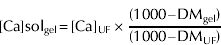
with DM: dry matter in g/kg. Bound calcium was estimated by the difference between total and soluble calcium.
Calculations
IS and salt contents in the aqueous and colloidal phases of stirred yoghurt at pH 4·4 have been estimated using a software modified by Holt et al. (Reference Holt, Dalgleish and Jenness1981) and upgraded by Mekmene et al. (Reference Mekmene, Le Graet and Gaucheron2008). At pH 4·40, colloidal calcium phosphate was assigned to zero.
Significance was tested with Student t-test (P<0·05). It should be noticed that a sample can be compared with its control within a trial, but that controls cannot be compared with each other, as they were made in different conditions.
Results
Changing IS during the stirring of set yoghurt
Calculated IS for the control, the IS+ and the IS− samples were 166, 334 and 118 mmol/kg, respectively. On the whole set of experiments, pH values in stirred gels were shown to decrease during storage, due to over-acidification (Table 1). Reducing IS in stirred yoghurt (IS−) significantly decreased the pH value of stirred yoghurt at 7 d and 28 d of storage at 4°C as compared with control samples. This may be due to the replacement of a part of the aqueous phase of yoghurt by water and the subsequent reduction in buffering compounds. During storage of all samples, apparent viscosity (Table 1) and thixotropy (not shown) increased, and the higher increase was observed during the first 7 days. Viscosity of IS− sample was significantly lower (P<0·05) until 14 d storage compared with its control and was not different afterwards. Conversely, increasing IS (IS+) significantly increased the stirred gel pH at 21 d (P<0·05) compared with the control sample. The final pH value for the IS+ sample at 28 d was 4·26±0·01, one of the highest pH values found in this work. The IS+ stirred yoghurt was the only one that showed a lower viscosity value at 28 d than at 0 d, meaning that this product did not show any long-term recovery, contrary to the others.
pH values and apparent viscosity (ηapp, in mPa·s) measured at 64 s−1 of stirred yoghurt stored from day 0 (d0) to day 28 (d28) at 4°C according to different physico-chemical conditions applied during stirring such as ionic strength changes (IS− decrease in ionic strength at 118 mmol · Kg−1; IS+ increase in ionic strength at 334 mmol · Kg−1), addition of 67 mmol · Kg−1 CaCl2 (CA+) or 100 mmol · Kg−1 citrate (CA−), addition of 5 mmol · Kg−1 N-ethyl maleimide (NEM+). For each modification, a control without any addition and at 166 mmol · Kg−1 ionic strength is given. Set yoghurt was stirred immediately after fermentation or stored 7 d at 4°C before stirring (ST+). Each measurement is a mean of ≈5 measurements and 3 measurements on 2–3 yoghurts prepared on different days for pH and viscosity, respectively

a,b Means between the control and modified samples with different superscripts differ (P<0·05)
† sd: standard deviation
Changing calcium contents during the stirring of set yoghurt
Calculations with the software showed that CaCl2 addition to set gels on stirring increased CaCl, CaH2PO4+, CaHPO4, Ca++ and CaPSer (calcium bound to phosphoserine) contents compared with the control sample, while citrate addition increased CaH2Cit (calcium citrate), CaHCit, and CaCit contents and reduced that of CaPSer and Ca++ compared with the control sample.
Bound calcium was not significantly different between samples (≈3·9 mm) due to large standard deviations of calcium concentration measurements (≈1 mm).
Up to 7 d of storage at 4°C, the pH values in CA+ and CA− samples were lower than the pH of the control sample, probably because of uncompleted ion equilibrium (Table 1). These differences were attenuated on longer storage at 4°C.
CA− sample showed the greater viscosity increase during the 28 d storage (215 mPa·s against ≈109 mPa·s for the control sample; Table 1), because the viscosity at day 0 for CA− sample was significantly lower than the control sample. However, these results on the total viscosity increase in control, CA+ and CA− samples were not significantly different, due to very large standard deviations (>100 mPa·s). Similarly, the thixotropy of samples with citrate addition showed higher values compared with the control (from 1·04- to 2·12-fold that of the control sample), thought not significantly different. Furthermore, when drawing the thixotropy versus the viscosity for all samples at all storage period (Fig. 1), the thixotropy value represented ≈44% of the viscosity value, except for the CA− samples, for which the thixotropy was much higher for a given viscosity (≈63%).
Thixotropy versus viscosity for overall samples at every storage time. The samples are stirred yoghurt stored from day 0 to day 28 at 4°C according to different physico-chemical conditions applied during stirring: control samples without any addition (control, +), ionic strength decrease (IS−, □), or increase (IS+, ■), addition of CaCl2 (CA+, ▲), addition of citrate (CA−, △), addition of N-ethyl maleimide (NEM+, ○), set yoghurts stored 7 d at 4°C before stirring (ST+, X).

The G′ of CA+ and CA− samples just after stirring was lower than that of the control sample (Table 2), probably in relation with the lower pH value. The ΔG′ during rebodying for the CA+ sample was 60% of that of the control sample; that of the CA− sample tended to be higher (113%), though not significantly different. The tanδ, just after stirring and at 20 h, were in the order CA+<control<CA−. They were only significantly different at 20 h. This means that CaCl2 addition reduced the short term rebodying (lower ΔG′) and gave a more solid-like gel at 20 h (lower final tanδ), with more permanent bonds, while citrate addition gave a more liquid-like gel at 20 h (higher tanδ). The increase in G′ during the whole rebodying was significantly lower for CA+ samples compared with the 2 other conditions as shown in Fig. 2. The second part of the increase, beginning after ≈2 h of storage, was the most affected one.
Viscoelastic modulus (a: G′) and loss tangent (b: tanδ) during the rebodying of stirred yoghurt monitored by low amplitude dynamic oscillation at 4°C for 20 h. Control sample: ——; CA+:  ; CA−:
 .

Elastic modulus in Pa and loss tangent of gels measured just after stirring (G′t0; tant0) and 20 h after stirring (G′20 h; tan20 h), and ΔG′ (G′20 h-G′t0) according to different physico-chemical conditions applied on stirring: ionic strength decrease (IS−), IS increase (IS+), addition of CaCl2 (CA+) or citrate (CA−), addition of N-ethyl maleimide (NEM+), storage before stirring (ST+). Each measurement is the mean of at least 2 experiments performed on 2 yoghurts prepared on different days

a,b means of modified samples and its control on the same row with different superscripts differ significantly (P<0·05)
† sd: standard deviation
Stirred yoghurt as shown by confocal laser scanning microscopy appeared as protein clusters surrounded by serum phase, probably corresponding to small pieces of gel generated during stirring. The observed structures of control and CA+ samples were very heterogeneous but similar (result not shown). Neither CaCl2 addition, nor the moment of sampling had significant effects on the microstructure. This was confirmed by principal component analysis on texture analysis characteristics (not shown).
Completion of equilibrium before stirring
Set gels were stirred on day 0 or after 7 d of storage at 4°C (ST+). The pH on stirring of the set gel stored for 7 d before stirring was significantly lower (4·25±0·03) than when stirred immediately (4·30±0·03), due to over-acidification during storage at 4°C. However, pH values and rheological properties of the stirred gels were not significantly different for the 2 samples during the following 28 d (Table 1). Actually, the ST+ sample seemed to have a higher viscosity than the control (Table 1), but the t-test concluded that the viscosity of ST+ and control sample were not significantly different, because of large standard deviations.
Discussion
The aim of the present study was the identification of interactions responsible for structure and rebodying of stirred yoghurt. It is worth mentioning that, due to irreproducibility of the rheological measurements, very few effects were significant. But since the included levels of additives are far beyond naturally encountered variations, if they did not have significant effects at these levels, they were unlikely to influence stirred yoghurt properties anyway.
The most important point is that changes in IS on stirring had no influence on short-term gel rebodying. The only yoghurt that did not show any increase in viscosity during 28 d of storage was the IS+ sample, which also showed the highest pH values (4·26). Increasing IS decreased the apparent pK values of weak acid and it may be possible that in the yoghurt at the highest pH, proteins may have a residual negative charge. Indeed, too much repulsive electrostatic repulsion may prevent attractive interactions. The positive effect of low pH values on the viscosity of yoghurts has been reported (Martens, Reference Martens1972; Ronnegard & Dejmek, Reference Ronnegard and Dejmek1993; Martin et al. Reference Martin, Skokanova, Latrille, Beal and Corrieu1998; Renan et al. Reference Renan, Guyomarc'h, Arnoult-Delest, Pâquet, Brulé and Famelart2008b). Electrostatic interactions are involved in acid gel formation (Renan et al. Reference Renan, Guyomarc'h, Arnoult-Delest, Pâquet, Brulé and Famelart2008b), but the present results showed that electrostatic attractions were probably not involved in the rebodying during storage.
The absence of difference between gels stirred on day 0 or after 7 d storage at 4°C furthermore indicates that completion of ion equilibriums did not play any significant role on yoghurts gel rebodying. The present study also showed that disulphide interactions were not involved in rebodying of stirred yoghurt. Moreover, hydrophobic interactions seem not to be involved (Renan et al. Reference Renan, Guyomarc'h, Arnoult-Delest, Pâquet, Brulé and Famelart2008b).
Unlike the above types of interactions, this study showed that changing the concentrations of different forms of calcium had an effect on gel rebodying. The binding of calcium on the casein phase has been shown by calculations, but not experimentally confirmed, because of large standard deviations for calcium measurements. Calcium binding to phosphoserine could have been attributed to the negative charge of this group at pH 4·4 (pK≈2·2; Cordeschi et al. Reference Cordeschi, Di Paola, Marrelli and Maschietti2003). Moreover, part of acid residues in proteins such as carboxylic functions of aspartic and glutamic acids are dissociated, as their pK are near or lower than pH 4·4. Calcium addition could have led to calcium bridges between these residues and could participate in the reinforcement of stirred gel. Conversely, citrate addition reduced the content in calcium bound to casein, according to the software calculations. While CaCl2 addition limited the rebodying after 2 h and reinforced the solid-like character of the stirred gel (a lower tanδ), CA− sample showed a greater viscosity increase during the 28 d storage. IS increase by NaCl addition in the same range as the one due to CaCl2 did not have such an effect. However, these different abilities in rebodying had no influence on stirred gel microstructure. Addition of citrate to the stirred yoghurt favoured the long-term rebodying, as this stirred yoghurt had one of the higher increases in viscosity within 28 d. Moreover, it led to reduced calculated calcium bound to phosphoserine and to a trend of increased thixotropy. The viscosity of the CA− stirred yoghurt probably increased thanks to interactions that were destroyed during shearing.
This study clearly demonstrates that the interactions responsible for the rebodying of stirred yoghurts were not those that were involved in set yoghurts. Further studies are needed to conclude on constructive interactions in stirred yoghurt. The methodology of using specific dissociating agents according to Lefebvre-Cases et al. (Reference Lefebvre-Cases, Gastaldi, Vidal, Marchesseau, Lagaude, Cuq and Tarodo de la Fuente1998) may be performed on stirring to prove the contribution of interactions.
Forming a constant set-style gel and changing conditions only on stirring proved to be a very useful approach to study the nature of interactions responsible for rebodying. With the addition of only 15 ml solution of salts, chemical and previously determined NaOH quantities in 300 g samples, it is easy to promote or impede a type of interaction and study the stirred yoghurt. However, very large standard deviations in rheological measurements were observed. Nevertheless, this approach can be applied to further study yoghurt rebodying. It is likely that a combination of both a pH value and an ionic composition may promote the yoghurt rebodying, as electrostatic repulsion, ionic screening and calcium dissociation can certainly be optimised.



