


1. Introduction
The last two decades have seen proliferation of information-based environmental regulation in the form of two types of information disseminating programs. The first type, which is known as ‘pollutant release transfer registries’, merely reports the emission data without utilizing them to rate the industrial units; the US Toxic Release Inventory (TRI) is one such kind of program.Footnote 1 The second type of information disseminating program both reports the emission data and utilizes them to rate the industrial unit's environmental performance. The second type of program has been more prevalent in developing countries; some examples include Indonesia's Program for Pollution Control, Evaluation and Rating (PROPER), China's Green Watch program, Vietnam's Black and Green Books initiative, the Philippines’ Eco Watch program, and India's Green Rating Project (GRP) (Powers et al., Reference Powers, Blackman, Lyon and Narain2008).
These information disseminating programs are based on the contention that reactions to environmental information dissemination involve citizens, non-governmental organizations, consumers and investors as stakeholders who can respond to it through channels like the product market, capital market and labor market to achieve desirable environmental outcomes. If correct information regarding the environmental impact of an economic activity can be disseminated among these stakeholders, then they can individually or collectively create pressure through their responses and bring about desirable environmental changes in the economic activities. Information in such cases acts as an informal environmental regulation in the form of information disclosure for achieving stipulated environmental goals (Kathuria, Reference Kathuria2007).
Dissemination of environmental information in a product market is important because it involves consumers as one of the stakeholders whose responses are reflected in their purchasing decisions. An information-providing agent can convert difficult technical information regarding the environment-intensiveness of a product into an easily comprehensible symbolFootnote 2 and disseminate it among the consumers. Based on this information dissemination, when a consumer buys an environmentally benign green product in contrast to a polluting variant, she produces a positive externality and helps preserve the environment. So the diffusion of environmental information reduces the detrimental impact of an economic activity through a consumer's conduit in a product market.
Consumers consider environment-friendliness as a particular quality attribute of the product they purchase and it contributes to the consumer's utility like other quality attributes. Environmental quality, however, exhibits a certain characteristic that defines the role of information dissemination in its context. Unlike other quality attributes, it falls under the category of credence attribute, the presence of which cannot be ascertained by the consumer either before or after the consumption of a product. Neither search nor experience can assist a consumer in ascertaining its presence in a product. However, if information ascertaining its presence in a product is disseminated, consumers can internalize this information in their final purchasing decision and generate environmentally benign consumption patterns in the product market.
Besides being a credence attribute, an environmental quality is also generally accompanied by a price premium or a green premium that the buyers of the environmental quality have to pay when purchasing a green product. This green premium arises because of a firm's internalization of the increasing cost of acquiring a high environmental quality. Moreover, since environmental quality is a credence attribute, in the absence of environmental information dissemination a green firm fails to justify the price premium attached to its product, which consequently gets reflected in its decreased market share in contrast to a cheaper polluting variant. Information dissemination by an information agent, therefore, assists the consumers of both the green and the polluting variant to internalize information regarding environment content of a product in their purchasing decision and justify the price premium for the green product. This increases its market share in contrast to the polluting variant. The current paper rationalizes this fact and develops a simple model to theoretically analyze the impact of environmental information dissemination in a product market duopoly.
In this paper, an information agent in a duopoly performs the task of disseminating information regarding a green and a polluting firm's environmental profile. Footnote 3 The demand side comprises consumers differing in their preference for the two products and unaware of the environmental profile of the product they are consuming. With an intention to lower the environmental damage accrued to the society by the polluting firm and to encourage the consumption of green products among consumers, an information agent disseminates information regarding the environmental profiles of both firms. Environmental information dissemination by the information agent, therefore, acts as an informal environmental regulation in the duopoly.
The information agent collects and makes the two sets of information available to the consumers. Consumers of the two products, however, internalize them differently. Consumers of the green firm internalize the information regarding the green firm's environmental profile by experiencing a warm glow effect which enhances their willingness to pay for the green product.Footnote 4 Consumers of the polluting firm, on the other hand, experience a direct loss in utility when they receive information that they are not purchasing an environmentally benign product available in the market. Additionally, when the information regarding the polluting firm's environmental profile is disseminated, it affects the polluting firm's consumers non-uniformly, as the consumers having a higher preference for the polluting product experience more utility loss than the other consumers of the polluting product. Information dissemination regarding the environmental profiles of both firms, therefore, negatively affects the utility of the polluting firm's consumers in the form of a bad conscience effect which increases the generalized price of purchasing the polluting product.
On solving for the Nash equilibrium in prices, it is found that the green firm always charges a higher price. In the presence of information dissemination, however, it earns justification as the green premium. Given the Nash equilibrium prices, equilibrium market shares and profits for both firms are subsequently determined. It is found that, in the absence of information dissemination, the polluting firm earns a higher market share in contrast to its green counterpart which necessitates informational intervention by an information agent. Moreover, in the absence of information dissemination regarding the environmental profile of the polluting firm, complete information dissemination regarding the green firm's environmental profile is sufficient to generate a higher market share for the latter. However, in the absence of information dissemination regarding the green firm's environmental profile, complete information dissemination regarding the polluting firm's environmental profile is not sufficient to generate a higher market share for the green firm when the marginal cost of the polluting firm's production is very low. In such a case, there is a need to disseminate information regarding the green firm's environmental profile as well.
The current paper also explores the impact of enhanced diffusion of environmental information on the prices, market shares and environmental damage accrued to the society. It is found that an increase in the diffusion of both firms’ environmental profile information increases the market share of the green firm and decreases that of the polluting firm, thereby decreasing the environmental damage accrued to the society. This consequently results in an increase in the consumption of the green product in the presence of environmental information dissemination. Lastly, the case of an eco-efficient firm is explored and it is shown that when a green firm is also cost efficient in its production practices, then there is no need for informational intervention to increase its market share. An eco-efficiency drive is, therefore, shown to be self-corrective.
Literature exploring the issue of environmental information comprises empirical examination of different information disseminating programs functioning the world over, some of which include Konar and Cohen (Reference Konar and Cohen1996), Wang et al. (Reference Wang, Bi, Wheeler, Wang, Cao, Lu and Wang2004), Dasgupta et al. (Reference Dasgupta, Hong, Laplante and Mamingi2005), Gupta and Goldar (Reference Gupta and Goldar2005), Garcia et al. (Reference Garcia, Sterner and Afsah2007) and Powers et al. (Reference Powers, Blackman, Lyon and Narain2008). Literature pertaining to theoretical examination of environmental information dissemination as a regulatory policy, however, is sparse. Kennedy et al. (Reference Kennedy, Laplante and Maxwell1994) and Petrakis et al. (Reference Petrakis, Sartzetakis and Xepapadeas2005) have both examined the efficacy of environmental information dissemination with respect to environmental taxation as a market-based policy in a theoretical structure. Kennedy et al. (Reference Kennedy, Laplante and Maxwell1994) examine the circumstances under which a government should provide information regarding a polluting activity. They identify a market failure in the provision of information regarding the polluting activity of a product and find that there is a role for information dissemination when no other policy instrument is available. However, the role of information is diminished when corrective taxation as an alternative policy instrument is available. Petrakis et al. (Reference Petrakis, Sartzetakis and Xepapadeas2005) examine information dissemination as an alternative as well as a complementary policy instrument to environmental taxation and show that information provision in the absence of any other policy instrument is welfare improving. But taxation dominates information provision if the cost of information provision is high.
The current paper differs from both Kennedy et al. (Reference Kennedy, Laplante and Maxwell1994) and Petrakis et al. (Reference Petrakis, Sartzetakis and Xepapadeas2005) because it does not extend the comparison between the efficacies of information dissemination with respect to taxation as a regulatory policy tool. Instead, like Kennedy et al. (Reference Kennedy, Laplante and Maxwell1994), it finds a scope for environmental information dissemination in the form of informal regulation when no other policy instrument exists in the market. The scope of information dissemination in the paper, however, is a result of consumers’ failure to internalize the information regarding environmental profiles of both products in their purchasing decision and because of the high cost of production of the green product. Moreover, the current paper does not treat the green and the polluting firms’ consumers’ internalization of environmental information uniformly. Instead, the fact that information regarding the green and the polluting firm's environmental profile would affect the purchasing decisions of consumers of both firms’ products non-uniformly has been taken into account. Also, unlike Kennedy et al. (Reference Kennedy, Laplante and Maxwell1994) and Petrakis et al. (Reference Petrakis, Sartzetakis and Xepapadeas2005), the current paper considers environmental information dissemination regarding both green and polluting firms’ environmental profiles. A better representation of the second type of information disseminating program as given by PROPER of Indonesia and GRP of India, both of which report the environmental profile data and utilize them to rate the industrial unit's environmental performance, such that consumers of both the green and the polluting firm take into account both firms’ production activity in their respective purchasing decisions. Additionally, the current paper contributes to the existing literature by discussing the role of information in the context of an eco-efficient firm.
The rest of the paper is organized as follows. Section 2 develops the model. Section 3 solves for the Nash equilibrium prices, market shares and profits for the two firms. Section 4 explores the market behavior and impact on the environmental damage accrued to the society in the presence of increased environmental information dissemination by the information agent. Section 5 discusses the role of information dissemination in case of an eco-efficient green firm. Lastly, section 6 discusses the main results and concludes the paper.
2. Model
The supply side of the model comprises of two firms where a green firm 1 offers a brand which causes lower environmental damage, while a polluting firm 2 offers a brand which causes higher environmental damage. Let, e i denote the environmental degradation caused by a unit production of firm i. The assumptions pertaining to environmental degradation are stated below.
 $${\bf A.1.}\quad e_{i} \gt 0 \quad \forall \, i=1\comma \; 2.$$
A unit increase in the production of firm i increases the environmental degradation caused by firm i.
 $${\bf A.2.} \quad e_{1} \lt e_{2}.$$
Environmental degradation caused by a unit production of the green firm is less than that of the polluting firm.
Firm 1 and firm 2 are located at the two ends of a unit interval, at locations 0 and 1, respectively. Consumers are unaware of the environmental profile of the two productsFootnote 5 and differ in their preferences for the characteristics other than the environmental profile of both products. Consider, for example, the product being paper differing in texture. In the model, some consumers would have a preference for firm 1’s paper texture and some would have a preference for firm 2’s paper texture. Therefore, preference for a product is modeled as a horizontal attribute. Following standard location models of product differentiation, consumers’ preference for the product is represented by a parameter x which is uniformly distributed on the unit interval. A consumer's location in this model represents her preference for the product. If a consumer is closely located to firm 1’s end, then the consumer has a strong preference for firm 1’s product. Conversely, if located close to the other end, the consumer has a higher preference for firm 2’s product. Finally, the travelling or the transportation cost of the standard Hotelling model here would signify a consumer's aversion to buying something different from her most preferred product.Footnote 6 It therefore stands for the strength of a consumer's personal preference for the product.
On the demand side, the (indirect) utility, U, of a consumer located at x when buying from firm 1 is defined as
 $$U\lpar p_{1}\semicolon \; x\rpar =v-{p_{1} \over \theta \lpar y\rpar +\eta\lpar \rho\rpar }-tx.$$
The (indirect) utility when buying from firm 2 is defined as
 $$U\lpar p_{2}\semicolon \; x\rpar =v-{p_{2} \over \theta \lpar y\rpar }-t\lpar 1-x\rpar -f\lpar x\rpar.$$
In the two utility expressions, v stands for the gross intrinsic utility that a consumer derives from consuming the product and is the same for both products. It is assumed that v > 0 and is high enough to ensure that the consumers purchase the products. Each consumer purchases at least a unit of either of the two products being offered in the duopoly. In both the utility expressions, p i stands for the respective prices. Transportation cost is denoted by t and without loss of generality is normalized to 1. Following Arora and Gangopadhyay (Reference Arora and Gangopadhyay1995), 1/θ(y) in expression (2) is the marginal utility of income and is inversely related to income, y. In other words, θ (y) can be interpreted as the income-induced willingness to pay for the polluting product and acts as a deflator of its price. As income level rises, willingness to pay for the product increases and the valuation of p falls, such that at a constant price the loss in utility is less. For simplicity, it is assumed that
 $$\theta \lpar y\rpar =\beta y\comma \;$$
where β > 0 and is defined as the change in the willingness to pay due to a unit change in the consumer's income. In expression (1), the price of the green product is deflated by both income-induced willingness to pay and a warm glow effect of purchasing a green product. Eriksson (Reference Eriksson2004) describes the warm glow effect as a feel-good factor experienced by consumers of the green product by doing their bit to improve the environment when purchasing a green good in contrast to a polluting variant. It consequently has an impact on the consumer's valuation of environmental quality by translating into a higher willingness to pay for the environmental quality attribute.
In the current paper, the warm glow effect enhances the green product consumer's willingness to pay for the green product, but the effect exists only in the presence of information dissemination regarding the environmental profile of the green product. In the expression (1), warm glow effect is denoted by η (ρ) is a function of ρ, which signifies disseminated information regarding the environmental profile of the green product.Footnote 7 The total willingness to pay for the green firm's product, therefore, is generated by income, and additionally by the aforementioned warm glow effect. The total willingness to pay for the green product is given as
 $$\theta \lpar y\rpar +\eta \lpar \rho\rpar =\beta y+\eta \rho\comma \;$$
where η > 0 and is defined as the change in the willingness to pay induced due to a unit change in the information dissemination regarding the environmental profile of the green firm as provided by the information agent.Footnote 8
Finally, in expression (2), f(x) denotes the bad conscience effect of purchasing a polluting product. Conrad (Reference Conrad2005) describes the bad conscience cost of not having purchased an environmentally benign product as a deduction from the utility function of the consumers who do not purchase the most environmentally benign product available in a market. In the current paper, the bad conscience effect results because of non-consumption of the environmentally benign product available in the product market duopoly, but the effect exists only in the presence of information dis-semination regarding the environmental profiles of both firms. In the expression (2), this is given as
 $$f\lpar x\rpar =\rho +\mu x.$$
In expression (3), ρ denotes the information regarding the environ-mental profile of the green firm while μ signifies the information regarding the environmental profile of the polluting firm, as disseminated by the information agent. The information regarding the green firm's environmental profile is postulated to uniformly affect consumers of the polluting product, as all of them experience a bad conscience effect for not having purchased an environmentally benign product already existing in the market.Footnote 9 Additionally, information regarding the environmental profile of the polluting firm is postulated to affect its consumers non-uniformly depending upon their preference level for the polluting product. Specifically, the more a consumer's preference is biased towards the polluting product, the more is the loss in utility experienced by her post information dissemination when purchasing the polluting product.Footnote 10 The bad conscience effect of purchasing a polluting product as captured by the function f(x) increases the generalized price of buying from the polluting firm.Footnote 11
The timeline of the model proceeds as follows. First, the information agent does the task of disseminating information regarding the environmental profiles of both the green and the polluting firm. Two sets of information, having been made available to the entire consumer population, are eventually internalized in the purchasing decisions of the consumers of both firms. However, the way consumers of the two firms internalize it differs. Consumers of green firm internalize the information regarding the environmental profile of the green firm by experiencing a warm glow effect which enhances their willingness to pay for the green product. Consumers of the polluting firm, on the other hand, experience a direct loss in utility when they receive the information that they are not purchasing an environmentally benign product available in the market. Additionally, when the information regarding the polluting firm's environmental profile is disseminated, it affects the polluting product's consumers non-uniformly, as the consumers having a higher preference for the polluting product experience more utility loss than the other consumers of the polluting product. Consequently, once the information regarding the polluting firm's environmental profile is disseminated by the information agent, the bad conscience effect would negatively affect the utility of these consumers more in contrast to the other consumers of the polluting product. Dissemination of both firm's environmental profile information, therefore, increases the generalized price of purchasing the polluting product.
The information-specific assumptions of the model are stated next.
 $${\bf A.3.} \quad \rho \epsilon \lsqb 0\comma \; 1\rsqb \, \hbox{and} \, \, \mu \epsilon \lsqb 0\comma \; 1\rsqb .$$
The information dissemination regarding both the green and the polluting firms’ environmental profiles is assumed to lie in the interval 0 and 1. When ρ = μ= 0, it implies that there is no information dissemination regarding the environmental profiles of the two firms. When ρ = μ= 1, then there is complete information dissemination regarding both firms’ environmental profiles.Footnote 12 Complete information dissemination can be viewed as covering information regarding the entire supply chain of the final product based on a life cycle approach to measure the pollution content of the final product. However, information dissemination by the information agent can be partial when ρϵ (0,1) and μϵ (0,1), which implies that information is disseminated only regarding a firm's own production process. Partial information dissemination in contrast to complete information dissemination, therefore, would not cover the hidden pollutants in the form of the raw materials bought from the polluting suppliers.
Consider, for instance, a pulp and paper manufacturing unit which uses a less pollution intensive substitute than chlorine to bleach its product, but is heavily dependent upon trees from virgin forests for the raw material instead of an agro-residue. Under complete information dissemination regarding this unit, the information agent would collect and spread information regarding both the bleaching and the raw material aspects, whereas under partial information dissemination, the information agent would collect and spread information about either the bleaching or the raw material aspect. The reason for considering partial information dissemination along with the no and complete information dissemination arises from the fact that, in practice, information agents are confronted with resource constraints, and accordingly, they collect and disseminate information among the stakeholders. Consequently, even if the information agent wishes to collect and disseminate complete information, it might only be able to do so partially.
 $${\bf A.4.} \quad \beta y \gt \eta \rho.$$
For the green product, willingness to pay induced through income outweighs the willingness to pay induced through the warm glow effect.Footnote 13
There is a consumer at some intermediate value of x who is indifferent between purchasing from firm 1 or firm 2. The location  $\hat{x}$ of this consumer is given by
 $U\lpar p_{1}\semicolon \; \hat{x}\rpar =U\lpar p_{2}\semicolon \; \hat{x}\rpar $.
Solving for  $\hat{x}$ using (1) and (2), the location of the indifferent consumer is obtained as
 $$\hat{x}=\left({1+\rho \over 2-\mu}\right)-{1 \over \lpar 2-\mu \rpar }\left[{p_{1} \over \lpar \beta y+\eta \rho\rpar }-{p_{2} \over \beta y} \right].$$
Consumers are uniformly distributed; therefore, those to the left of  $\hat{x}$ purchase from firm 1 while those to the right of
 $\hat{x}$ purchase from firm 2. Consequently, market shares for the two firms are given by
 $$\eqalign{D_{1}\lpar p_{1}\comma \; p_{2} \rpar &=\hat{x}=\left({1+\rho \over 2-\mu} \right)-{1 \over \lpar 2-\mu \rpar }\left[{p_{1} \over \lpar \beta y+\eta \rho \rpar }-{p_{2} \over \beta y} \right]\cr D_{2}\lpar p_{1}\comma \; p_{2} \rpar & =1-\hat{x}=\left({1-\rho -\mu \over 2-\mu} \right)+{1 \over \lpar 2-\mu \rpar }\left[{p_{1} \over \lpar \beta y+\eta \rho \rpar }-{p_{2} \over \beta y} \right].}$$
The market shares are a function of the information regarding the environmental profiles of both firms as disseminated by the information agent. In the absence of information dissemination, if both firms charge the same price, then they would split the market in half. Therefore, there is a scope for informational intervention to encourage the consumption of the green product in the duopoly.
On the supply side, cost of production for both firms is considered. The total cost of production differs for the two firms as the green product is assumed to be more expensive to produce.Footnote 14 The total cost expression for both firms is given as
 $$TC_{i}=c_{i}D_{i}\lpar p_{i}\comma \; p_{j}\rpar \comma \;$$
where c i denotes the marginal cost of production for firm i. Let c 1 = kc and c 2 = c, respectively, be the marginal cost of production of the green and the polluting firm. The cost specific assumptions are stated below.
 $${\bf A.5.} \quad c \gt 0.$$
The marginal cost of producing the polluting product is strictly positive.
 $${\bf A.6.} \quad k \gt 1.$$
The marginal cost of producing the green product is higher than that of the polluting product.
 $${\bf A.7.}\quad kc \lt \beta y.$$
The marginal cost of producing a green product is less than the consumer's income induced willingness to pay for the green product. This logically ensures that the transaction between the consumers of the green product and the green firm occurs.
3. Equilibrium
In this section, Nash equilibrium of the model is determined. Profit functions for the two firms in the duopoly are defined as
 $$\eqalign{\pi_{1}&=\lpar p_{1}-kc \rpar \left\{\left({1+\rho \over 2-\mu} \right)-{1 \over \lpar 2-\mu \rpar }\left[{p_{1} \over \lpar \beta y+\eta \rho \rpar }-{p_{2} \over \beta y} \right]\right\}\cr \pi_{2}&={\lpar p}_{2}-c\rpar \left\{\left({1-\rho -\mu \over 2-\mu} \right)+{1 \over \lpar 2-\mu \rpar }\left[{p_{1} \over \lpar \beta y+\eta \rho\rpar }-{p_{2} \over \beta y} \right]\right\}.}$$
The first-order conditions for a profit-maximizing strategy yield reaction functions as
 $$\eqalign{p_{1}&=p_{1}^{R}\lpar p_{2}\rpar ={1 \over 2}\left[kc+\lpar 1+\rho\rpar \lpar \beta y+\eta \rho\rpar +p_{2}\left(1+{\eta \rho \over \beta y} \right)\right]\cr p_{2}&=p_{2}^{R}\lpar p_{1}\rpar ={1 \over 2}\left[c+\lpar 1-\rho -\mu \rpar \beta y+p_{1}\left({\beta y \over \beta y+\eta \rho} \right)\right].}$$
Solving the reaction functions for p 1and p 2 yields the equilibrium prices as
 $$\eqalign{p_{1}^{\ast}&={1 \over 3}\left[\lpar 3+\rho -\mu \rpar \lpar \beta y+\eta \rho\rpar +c\left(1+2k+{\eta \rho \over \beta y}\right)\right]\cr p_{2}^{\ast}&={1 \over 3}\left[\lpar 3-\rho -2\mu\rpar \beta y+c\left(2+k{\beta y \over \beta y+\eta \rho} \right)\right].}$$
These expressions of equilibrium prices reveal that the consumer's respective willingness to pay for the green and the polluting product enhances the price premium charging propensities of both firms.
Proposition 1
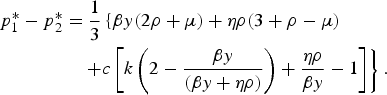
p 1* > p 2* $\forall \, \rho \epsilon \lsqb 0\comma \; 1\rsqb $ and
 $\mu \epsilon\lsqb 0\comma \; 1\rsqb $.
Proof: See Appendix.
At equilibrium, the green firm charges a price premium for the green attribute which is a result of the green firm's internalization of the higher marginal cost of production. In the presence of information dissemination, however, this green premium is justified since the market is comprised of consumers who are willing to pay for the green attribute. This enhanced willingness to pay arises due to the dissemination of information regarding the environmental profile of the green firm by the information agent. The result supports the trend evident in the developed countries market where the presence of environmentally conscious consumers ensures that the green firm manages to charge a green premium for its product.Footnote 15
Evaluating the indifferent consumer from expression (4) at the equilibrium prices yields the market shares for the two firms as
 $$\eqalign{D_{1}^{\ast}&={1 \over 3\lpar 2-\mu\rpar }\left[\lpar 3+\rho -\mu\rpar -{c\left(k-1-{\eta \rho \over \beta y} \right)\over \lpar \beta y+\eta \rho \rpar }\right]\cr D_{2}^{\ast}&={1 \over 3\lpar 2-\mu\rpar }\left[\lpar 3-\rho -2\mu \rpar +{c\left(k-1-{\eta \rho \over \beta y} \right)\over \lpar \beta y+\eta \rho \rpar }\right].}$$
At equilibrium, the green cost adversely affects the market share of the green firm, but positively contributes to the market share of the polluting firm. Additionally, willingness to pay for the green product positively contributes to the green firm's market share, but adversely affects the market share of the polluting firm.
Proposition 2
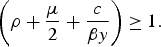
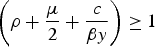
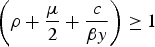
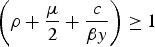
D 1* > D 2*iff 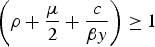 $\left(\rho +{\mu \over 2}+{c \over \beta y}\right)\ge 1$.
Proof: See Appendix.
At equilibrium, if information dissemination regarding the green and the polluting firms’ environmental profiles is sufficiently high, then the green firm's market share is higher than that of the polluting variant. Informational intervention by an information agent and the marginal cost of the polluting firm's production raise the chances of the green firm increasing its market share in contrast to its polluting counterpart. Corollary 1 surmises an important finding from proposition 2.
Corollary 1
(i) When ρ = 0 and μ = 0, D 1* < D 2* always.
(ii) When ρ = 1 and μ = 0, D 1* > D 2* always.
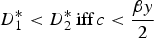
(iii) When ρ = 0 and μ = 1, D 1* < D 2* iff
 $\Big(c<{\beta y \over 2}\Big)$.
(iv) When ρ = 1 and μ = 1, D 1* > D 2* always.

Proof: See Appendix.
In the absence of information dissemination, the green firm earns a lower market share in contrast to its polluting counterpart. This necessitates the information agent's intervention as an informal regulator for disseminating information regarding the environmental profiles of both firms. The reason for the lower market share can be traced to the fact that the price of the green product is higher than that of the polluting product because of the high marginal cost of green production. In the absence of information dissemination, consumers cannot internalize the information regarding the environmental profiles of both firms in their purchasing decisions and justify the green premium. This results in a lower market share for the green firm. In the presence of information dissemination, however, if the two sets of disseminated information are sufficiently high, as shown in Proposition 2, then the green firm earns a higher market share than the polluting firm. This is because consumers of the green product and those of the polluting product internalize the environmental information in their purchasing decision to increase the market share of the green firm. Also, in the absence of information dissemination regarding the environmental profile of the polluting firm, complete information dissemination regarding the green firm's environmental profile is sufficient to generate a higher market share for the latter. But in the absence of information dissemination regarding the environmental profile of the green firm, complete information dissemination regarding the environmental profile of the polluting firm is not sufficient to induce a higher market share for the green firm when the marginal cost of the polluting firm's production is very low. In such a case, there is also a need to disseminate information regarding the green firm's environmental profile. Both firms’ environmental profile information, together, would increase the generalized price of buying the polluting variant sufficiently to balance out the decline in price resulting from the internalization of the very low marginal cost of the polluting firm's production and increase the market share of the green firm.
The reason for the outcome is attributable to the fact that the polluting firm's environmental profile information is internalized only by its consumers, while the green firm's environmental profile information is internalized by both the green and the polluting firms’ consumers. Therefore, if an information agent is confronted with a limited resources constraint for collection and dissemination of information, then channeling limited resources towards complete information dissemination regarding the green firm's environmental profile is sufficient to lower the market share of the polluting firm. However, if the information agent channels limited resources towards complete information dissemination regarding the environmental profile of the polluting firm in the absence of information dissemination regarding the green firm's environmental profile, then the desired outcome of higher market share for the green firm in contrast to that of the polluting firm is not attainable, specifically when the marginal cost of the polluting firm's production is very low. Low marginal cost of production gets reflected in a comparatively low quoted price for the polluting variant which necessitates information provision about the green firm's environmental profile along with complete information dissemination about the polluting firm's environmental profile. Finally, if the information agent is not confronted by any resource constraints and is able to disseminate complete information regarding the environmental profiles of both firms, then it would lead to a certain increase in the market share of the green firm in contrast to that of the polluting variant.
The equilibrium profit functions of both firms are given by
 $$\eqalign{\pi_{1}^{\ast}&={\left[\beta y\lpar \beta y+\eta \rho \rpar \lpar -1-\rho +\mu \rpar -c\left(k-1-{\eta \rho \over \beta y} \right)\right]^{2} \over 9{\lpar \beta y\rpar }^{2}\lpar \beta y+\eta \rho\rpar \lpar 2-\mu\rpar } \gt 0\semicolon \; \cr \pi_{2}^{\ast}&={\left[\beta y\lpar \beta y+\eta \rho \rpar \lpar -3+\rho +2\mu \rpar -c\left(k-1-{\eta \rho \over \beta y} \right)\right]^{2} \over 9\beta y\lpar \beta y+\eta \rho \rpar ^{2}\lpar 2-\mu\rpar } \gt 0.}$$
At equilibrium, both firms earn positive profit.
4. Information dissemination, market behavior and environmental damage
This section checks the responsiveness of prices, market shares and environmental damage to an increase in information dissemination regarding the environmental profiles of both firms.
4.1. An increase in information dissemination regarding the environmental profile of the green firm
4.1.1. Impact on prices
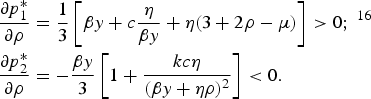
In this subsection, the impact of a change in information dissemination regarding the environmental profile of the green firm on the pricing behavior of both firms is determined.
 $$\eqalign{{\partial p_{1}^{\ast} \over \partial \rho}&={1 \over 3}\left[\beta y+c{\eta \over \beta y}+\eta \lpar 3+2\rho -\mu \rpar \right]>0\semicolon \; ^{16}\cr {\partial p_{2}^{\ast} \over \partial \rho}&=-{\beta y \over 3} \left[1+{kc\eta \over \lpar \beta y+\eta \rho\rpar ^{2}}\right]< 0.}$$
An increase in information dissemination regarding the environmental profile of the green firm increases the price of the firm as it charges a green premium for offering the green attribute in its product. This is because consumers of the green product internalize information regarding the environmental profile of the green firm in their utility function by exhibiting an enhanced willingness to pay for the green attribute, as the information regarding the green product's environmental profile is provided to them. Specifically, their willingness to pay for the green attribute increases as the green firm's environmental profile information is disseminated. Simultaneously, as this information reaches consumers of the polluting variant, they experience a direct loss in utility for not having purchased an environmentally benign product existing in the market. This results in a decline in the price of the polluting product, as the polluting firm tries to retain its market share by offering a low-priced product.
4.1.2. Impact on market shares
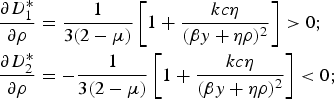
Next, impact of a change in information dissemination regarding the green firm's environmental profile on both firms’ market shares is determined.
 $$\eqalign{{\partial D_{1}^{\ast} \over \partial \rho}&={1 \over 3\lpar 2-\mu \rpar }\left[1+{kc\eta \over \lpar \beta y+\eta \rho \rpar ^{2}} \right]>0\semicolon \; \cr {\partial D_{2}^{\ast} \over \partial \rho}&=-{1 \over 3\lpar 2-\mu \rpar } \left[1+{kc\eta \over \lpar \beta y+\eta \rho \rpar ^{2}} \right]< 0\semicolon \; }$$
and,
 $$\left\vert {\partial D_{1}^{\ast} \over \partial \rho} \right\vert = \left\vert {\partial D_{2}^{\ast} \over \partial \rho} \right\vert .$$
An increase in the diffusion of information regarding the green firm's environmental profile increases the market share of the green firm and reduces that of the polluting firm. The reason for an increase in the market share of the green firm can be traced to the fact that an increase in information dissemination regarding the green firm's environmental profile results in a direct loss in utility for some consumers who, prior to information dissemination, were purchasing from the polluting firm, but as the information regarding the green firm's environmental profile is disseminated, it results in switching some of these consumers to the greener variant. This, therefore, results in an increase in the market share of the green firm and a corresponding loss of the polluting firm's market share. Consequently, as information regarding the green firm's environmental profile is disseminated, it results in an increase in the number of green product consumers and a decline in the number of polluting product consumers. This increases the market share of the green firm. This supports the contention that information dissemination regarding the green firm's environmental profile leads to an increase in environmental concern among the consumers as reflected in their purchasing decisions.
4.1.3. Impact on the environmental damage
Next, environmental damage for the model is defined to check for its response to an increase in information dissemination regarding the green firm's environmental profile. The environmental damage is defined as
 $$\eqalign{ED&=e_{1}D_{1}^{\ast}\lpar p_{1}^{\ast}\comma \; p_{2}^{\ast}\rpar +e_{2}D_{2}^{\ast}\lpar p_{1}^{\ast}\comma \; p_{2}^{\ast} \rpar \cr ED&={e_{1} \over 3\lpar 2-\mu \rpar }\left[\lpar 3+\rho -\mu \rpar -{c\left(k-1-{\eta \rho \over \beta y} \right)\over \lpar \beta y+\eta \rho \rpar } \right]\cr &\quad+{e_{2} \over 3\lpar 2-\mu \rpar }\left[\lpar 3-\rho -2\mu \rpar +{c\left(k-1-{\eta \rho \over \beta y} \right)\over \lpar \beta y+\eta \rho \rpar } \right].}$$
Corollary 2
 $${\partial ED \over \partial \rho}={-\lpar e_{2}-e_{1}\rpar \over 3\lpar 2-\mu \rpar } \Big[1+{kc\eta \over \lpar \beta y+\eta \rho\rpar ^{2}} \Big]<0.^{17}$$
An increase in information dissemination regarding the green firm's environmental profile decreases environmental damage. This follows from the fact that, with an increase in information dissemination regarding the environmental profile of the green firm, the market share of the polluting firm decreases while that of the green firm increases.
4.2. An increase in information dissemination regarding the environmental profile of the polluting firm
4.2.1. Impact on prices
In this subsection, the impact of a change in information dissemination regarding the polluting firm's environmental profile on both firms’ pricing behavior is analyzed.
 $${\partial p_{1}^{\ast} \over \partial \mu}=-{1 \over 3}\left[\beta y+\eta\rho \right]< 0\semicolon \; \quad {\partial p_{2}^{\ast} \over \partial \mu}=-{2\beta y \over 3}< 0\semicolon \;$$
and,
 $$\left\vert {\partial p_{1}^{\ast} \over \partial \mu}\right\vert < \left\vert {\partial p_{2}^{\ast} \over \partial \mu} \right\vert .$$
An increase in the propagation of information regarding the polluting firm's environmental profile decreases the prices of both firms, but the decline in price is less sharp for the green firm in contrast to its polluting counterpart. This is because the polluting firm's environmental profile information is targeted specifically at its consumers. Moreover, internalization of the information occurs non-uniformly since the consumers having a higher preference for the polluting product experience more utility loss than the other consumers of the polluting product. The polluting firm, therefore, lowers its price to retain its consumers. The green firm does so to attract some of the consumers of the polluting product who are closer to being indifferent between the two products. Such consumers in the vicinity of the indifferent consumer have a lower preference for the polluting product; they therefore can switch to the greener variant if the green firm offers its product at a reduced price. Information dissemination regarding the environmental profile of the polluting firm, therefore, intensifies the price competition between the two firms as both firms post information dissemination undercut their prices. The green firm does so to attract consumers of the polluting variant who are in the neighborhood of being indifferent, while the polluting firm does so to retain its consumers.
4.2.2. Impact on market shares
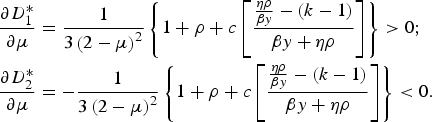
Next, the impact of a change in information dissemination regarding the environmental profile of the polluting firm on both firms’ market shares is determined.
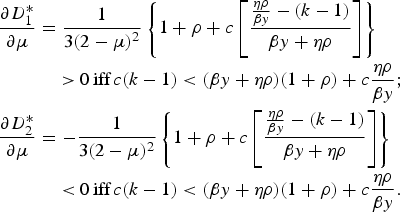
 $$\eqalign{{\partial D_{1}^{\ast} \over \partial \mu}&={1 \over 3\left(2-\mu \right)^{2}}\left\{1+\rho +c\left[{{\eta \rho \over \beta y}-\lpar k-1\rpar \over \beta y+\eta \rho} \right]\right\}>0\semicolon \; \cr {\partial D_{2}^{\ast} \over \partial \mu }&=-{1 \over 3\left(2-\mu \right)^{2}}\left\{1+\rho +c\left[{{\eta \rho \over \beta y}-\lpar k-1\rpar \over \beta y+\eta \rho} \right]\right\}< 0.}$$
Proof: See Appendix.
And, 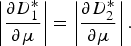 $\left\vert {\partial D_{1}^{\ast} \over \partial \mu} \right\vert =\left\vert {\partial D_{2}^{\ast} \over \partial \mu} \right\vert .$
An increase in the dissemination of information regarding the environmental profile of the polluting firm increases the market share of the green firm and reduces that of the polluting firm. An increase in the information dissemination regarding the polluting firm's environmental profile results in a loss of utility for the consumers of the polluting variant, some of whom switch to the green product's consumption. This results in lowering the market share of the polluting firm and, subsequently, increasing that of the green firm.
4.2.3. Impact on the environmental damage
In this subsection, the impact of a change in information dissemination regarding the environmental profile of the polluting firm on the total environmental damage accrued to the society is determined.
Corollary 3
 $${\partial ED \over \partial \mu }={-\lpar e_{2}-e_{1}\rpar \over 3{\lpar 2-\mu \rpar }^{2}}\left\{1+\rho +c\left[{{\eta \rho \over \beta y}-\left(k-1 \right)\over \beta y+\eta \rho} \right]\right\}<0.^{18}$$
An increase in the dissemination of information regarding the polluting firm's environmental profile decreases the environmental damage accrued to the society. This follows from the fact that, with an increase in information dissemination regarding the environmental profile of the polluting firm, the market share of the polluting firm decreases while that of the green firm increases. Therefore, an increase in the propagation of information regarding both the green and the polluting firms’ environmental profiles diminishes the environmental damage accrued to the society as reflected in the reduced market share of the polluting firm in contrast to that of the greener variant.
5. The case of an eco-efficient firm: role of information
An eco-efficient firm is green and cost efficient in its production. Whether or not a firm is an eco-efficient firm depends on its mode of greening the industrial production. Greening of the industrial production is possible through technological eco-innovations.Footnote 19 Technological eco-innovations can be differentiated into curative and preventive technologies. Curative technologies repair the environmental damage while preventive technologies try to prevent it. Preventive technologies include additive and integrated technologies. Additive or end-of-the pipe technologies address pollution after the actual production process has taken place, while integrated or cleaner technologies address the cause of pollution during the production process itself (Rennings, Reference Rennings2000). A firm can green its production process by relying solely on the increased abatement efforts of depending on an additive or end-of-pipe technology. A reliance on an additive technology, however, leads to an increasing cost of production since it involves investment in an end-of-pipe treatment machine which, coupled with the operational and management costs, adds substantially and increasingly to its marginal cost of production. The firm can also take the alternative route to greening through an integrated technology or a cleaner production initiative. The earlier concept of cleaner production entailed an expensive technological switch for greening the production which – although it managed to decrease the marginal cost in the long run – was not economically feasible to begin with, owing to the high fixed-cost investment. Numerous financial constraints that firms generally face impose additional constraints. However, cleaner production under an integrated technological regime is also possible through techniques like waste minimization and green productivity, which develop an environment-friendly product in a cost-effective manner in sync with eco-efficiency.Footnote 20 Both of these, therefore, encourage cleaner production and simultaneously tackle the economic constraints faced by firms while opting for greener production. The waste minimization technique promotes better environmental outcomes of a production process by stressing the reduction of wastes and emissions at the source, thereby leading to a successful greening of a firm in a cost-effective manner. The green productivity methodology, on the other hand, stresses increasing productivity by a more efficient use of resources, energy and raw materials. Both of these promulgate the idea of eco-efficiency.
To ascertain the role of information in the context of an eco-efficient firm, the impact on equilibrium prices and market shares is evaluated when the assumption (A.6.), i.e., k > 1 is relaxed and, instead, it is assumed that k < 1. When k < 1, it implies that the marginal cost of producing the greener variant is lower than the marginal cost of producing the polluting variant, i.e.,  $c_{1}=kc<c_{2}=c$. The green firm, therefore, is an eco-efficient firm. Propositions 1 and 2 are revisited in the light of this assumption to check if there is still a role for information dissemination regarding the environmental profiles of both variants by an information agent. For this purpose, prices and market shares of both firms are compared in the absence of information dissemination regarding environmental profiles of both the green and the polluting firm.
At equilibrium, when the green firm is cost efficient in the greening of production, its product is priced lower than that of its polluting counterpart. An efficient mode of greening the production aids the green firm to charge a price lower than that of the polluting variant.
At equilibrium, when the green firm is cost efficient in production, its market share is higher than that of the polluting firm even in the absence of information dissemination. Since the two firms are competing in prices in the duopoly, an efficient mode of green production allows the green firm to charge a price lower than that of the polluting counterpart. This allows the green firm to retain its own consumers and also attract some of the consumers of its polluting counterpart because of its quoted lower price. The result holds both in the absence of information dissemination and also when there is information dissemination by the information agent. Eco-efficiency, therefore, is self-corrective as no informational intervention is required to increase the market share of the green firm in contrast to that of the polluting counterpart. Therefore, the role of environmental information dissemination is pronounced only when the mode of greening the industrial production is cost inefficient in comparison to that of the polluting variant.
6. Conclusion
As environmental regulation moves to information-based informal regulation, there has been an upsurge of information-disseminating programs the world over. This paper theoretically analyzes the scope of environmental information dissemination in a product market duopoly. An information agent in the paper performs the task of disseminating information regarding the environmental profiles of a green and a polluting firm to informally regulate the activity of the latter and generate a greener consumption pattern among consumers. Consumers of both firms internalize the environmental information which gets reflected in their respective purchasing decisions. The green firm's consumers internalize its environmental profile information in the form of a warm glow effect inducing enhanced willingness to pay for it, while the polluting firm's consumers internalize both firms’ environmental profile information in the form of a bad conscience effect, which increases the generalized price of purchasing from the polluting firm. In the absence of environmental information dissemination, the green firm earns a lower market share which necessitates the information agent's intervention to control pollution and encourage consumption of the green product among consumers. In the presence of both firms’ environmental profile information, the green firm earns a higher market share. Moreover, in the absence of information dissemination regarding the polluting firm's environmental profile, complete information dissemination regarding the green firm's environmental profile is sufficient to generate a higher market share for the latter. But, in the absence of information dissemination regarding the green firm's environmental profile, complete information dissemination regarding the environmental profile of the polluting firm fails to generate a higher market share for the green firm, when the marginal cost of producing the polluting variant is very low. The comparative static analysis reveals that an increase in information dissemination regarding either kind of firm's environmental profile significantly affects the pricing behavior of both firms, which eventually gets reflected in an increased market share for the green firm in contrast to the polluting variant. This, consequently, lowers the environmental damage accrued to the society and encourages a greener consumption pattern among consumers.
Investments in environmental information dissemination can indeed aid in controlling the consumption and, consequently, the production of a polluting firm. An increased diffusion of either kind of environmental information would aid the green firm in gaining a higher market share in contrast to the polluting variant. Moreover, if these investments are to be prioritized between complete information dissemination regarding the green and the polluting firms’ environmental profile, then investment in the provision of information regarding the complete environmental profile of the green product is sufficient to regulate the consumption of the polluting product and encourage that of the green firm.
Lastly, an eco-efficiency drive is shown to be self-corrective as it completely negates the need for any informational intervention to regulate the activity of the polluting firm and encourage the consumption of the green product. Consequently, an efficient mode of greening the industrial production should be stressed as an essential policy measure to increase the consumption of the green product and regulate the consumption and production of the polluting firm.
Appendix
Proof of Proposition 1.
 $$\eqalign{p_1^{\ast} - p_{2}^{\ast} & ={1 \over 3} \left\{\beta y\lpar 2\rho +\mu \rpar + \eta \rho \lpar 3 + \rho - \mu\rpar \right. \cr & \left. \quad + c \left[k \left(2 - {\beta y \over \lpar \beta y + \eta \rho\rpar } \right)+ {\eta \rho \over \beta y} - 1 \right]\right\}.}$$
From A.6., k > 1 and from A.3.,  $\rho \epsilon \lsqb 0\comma \; 1\rsqb \comma \; \mu \epsilon \lsqb 0\comma \; 1\rsqb $.
Therefore,  $p_{1}^{\ast}-p_{2}^{\ast} \gt 0$.
 $\Longrightarrow \, p_{1}^{\ast} \gt p_{2}^{\ast}.$
Proof of Proposition 2.
 $$D_{1}^{\ast}-D_{2}^{\ast}={1 \over 3\lpar 2-\mu \rpar }\left[\lpar 2\rho +\mu \rpar -{2c\left(k-1-{\eta \rho \over \beta y} \right)\over \lpar \beta y+\eta \rho \rpar } \right].$$
Therefore,  $D_{1}^{\ast}>D_{2}^{\ast}\, \hbox{iff} \, kc<\lpar \beta y+\eta \rho \rpar \left(\rho +{\mu \over 2}+{c \over \beta y}\right)$.
From assumption A.7.,  $kc<\lpar \beta y+\eta \rho \rpar \lsqb \hbox{Since}\comma \; kc<\beta y<\lpar \beta y+\eta \rho\rpar \rsqb $.
Therefore,  $kc<\lpar \beta y+\eta \rho \rpar \le \lpar \beta y+\eta \rho\rpar \left(\rho +{\mu \over 2}+{c \over \beta y}\right)$ would ensure that D 1* > D 2*.
Therefore,  $D_{1}^{\ast} \gt D_{2}^{\ast} \, \hbox{iff} \, \lpar \beta y+\eta \rho \rpar \le \, \lpar \beta y+\eta \rho \rpar \left(\rho +{\mu \over 2}+{c \over \beta y}\right)$.
 $\Longrightarrow D_{1}^{\ast} \gt D_{2}^{\ast}\, \hbox{iff} \, 1\le\left(\rho +{\mu \over 2}+{c \over \beta y}\right)$.
i.e.,  $D_{1}^{\ast} \gt D_{2}^{\ast}\, \hbox{iff} \, \left(\rho+{\mu \over 2}+{c \over \beta y}\right)\ge1$.
Proof of Corollary 1.
From assumption A.3,  $\rho \epsilon \lsqb 0\comma \; 1\rsqb \, \hbox{and}\, \mu \epsilon \lsqb 0\comma \; 1\rsqb $.
Also, from proposition 2,  $D_{1}^{\ast} \gt D_{2}^{\ast}$ iff
 $\left(\rho +{\mu \over 2}+{c \over \beta y}\right)\ge 1.$ Therefore,
(i) When ρ = 0 and μ = 0 then the condition
$\left(\rho +{\mu \over 2}+{c \over \beta y} \right)\ge 1$ is not met. This implies that $D_{1}^{\ast} \lt D_{2}^{\ast}$ always.(ii) When ρ = 1 and μ = 0 then the condition
$\left(\rho +{\mu \over 2}+{c \over \beta y} \right)\ge 1$ is met. This implies that $D_{1}^{\ast} \gt D_{2}^{\ast}$ always.(iii) When ρ = 0 and μ = 1 then the condition
$\left(\rho +{\mu \over 2}+{c \over \beta y} \right)\ge 1$ is met only when $c\ge {\beta y \over 2}$. This implies that $D_{1}^{\ast} \lt D_{2}^{\ast}\, \hbox{iff} \, c \lt {\beta y \over 2}$.(iv) When ρ = 1 and μ = 1 then the condition
$\left(\rho +{\mu \over 2}+{c \over \beta y} \right)\ge 1$ is met. This implies that $D_{1}^{\ast} \gt D_{2}^{\ast}$ always.




Proof of the impact of an increase in the dissemination of the polluting firm's environmental profile information on market shares.
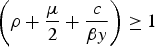
 $$\eqalign{{\partial D_{1}^{\ast} \over \partial \mu }&={1 \over 3\lpar 2-\mu \rpar ^{2}}\left\{1+\rho +c\left[{{\eta \rho \over \beta y}-\lpar k-1\rpar \over \beta y+\eta \rho} \right]\right\}\cr &\quad>0\, \hbox{iff} \, c\lpar k-1\rpar <\lpar \beta y+\eta \rho \rpar \lpar 1+\rho \rpar +c{\eta \rho \over \beta y}\semicolon \; \cr {\partial D_{2}^{\ast} \over \partial \mu }&=-{1 \over 3\lpar 2-\mu \rpar ^{2}}\left\{1+\rho +c\left[{{\eta \rho \over \beta y}-\lpar k-1\rpar \over \beta y+\eta \rho} \right]\right\}\cr &\quad< 0 \, \hbox{iff} \, c\lpar k-1\rpar <\lpar \beta y+\eta \rho \rpar \lpar 1+\rho \rpar +c{\eta \rho \over \beta y}.}$$
From A.7., kc < β y. Additionally, c < kc follows from A.6.
Combining these two yields, c < kc < β y.
 $\Longrightarrow \lpar kc-c \rpar <kc<\beta y$ [This follows from A.5.]
 $\Longrightarrow c\lpar k-1 \rpar <\beta y$.
 $\Longrightarrow c\lpar k-1 \rpar <\lpar \beta y+\eta\rho \rpar \lpar 1+\rho \rpar +c{\eta \rho \over \beta y}$ [This follows from A.3, A.5 and β, y, η > 0].
Therefore, 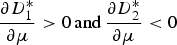 ${\partial D_{1}^{\ast} \over \partial \mu}>0 \, \hbox{and} \, {\partial D_{2}^{\ast} \over \partial \mu}<0$.
Proof of Proposition 3.
 $$\eqalign{p_{1}^{\ast}-p_{2}^{\ast}&={1 \over 3}\left\{\beta y\lpar 2\rho +\mu \rpar +\eta \rho \lpar 3+\rho -\mu \rpar \right.\cr &\quad+\left. c\left[k\left(2-{\beta y \over \lpar \beta y+\eta \rho \rpar } \right)+{\eta \rho \over \beta y}-1 \right]\right\}.}$$
In the absence of information dissemination, ρ = μ= 0, therefore,
 $$p_{1}^{\ast}-p_{2}^{\ast}={1 \over 3}\lcub c\lpar k-1\rpar \rcub .$$
When k < 1, p 1* − p 2* < 0.
 $\Longrightarrow p_{1}^{\ast}<p_{2}^{\ast}$.
Proof of Proposition 4.
 $$D_{1}^{\ast}-D_{2}^{\ast}={1 \over 3\lpar 2-\mu \rpar }\left[\lpar 2\rho +\mu \rpar -{2c\left(k-1-{\eta \rho \over \beta y} \right)\over \lpar \beta y+\eta \rho \rpar } \right].$$
In the absence of information dissemination, ρ = μ= 0, therefore,
 $$D_{1}^{\ast}-D_{2}^{\ast}={1 \over 6}\left[-{2c\lpar k-1 \rpar \over \beta y} \right].$$
When k < 1,  $D_{1}^{\ast}-D_{2}^{\ast} \gt 0$.
 ${\Longrightarrow D}_{1}^{\ast} \gt D_{2}^{\ast}$.


