Introduction
In many Western societies, loneliness among seniorsFootnote 1 is a cause for concern – some even speak of a ‘scourge’ – and is increasingly drawing the attention of public authorities. For instance, the United Kingdom (UK) recently created a department dedicated to combating loneliness, ‘a phenomenon which is now considered as acute a public health problem as smoking and alcoholism’ (Paré, Reference Paré2018). Loneliness among seniors is a cause of concern because it has deleterious effects on health. Studies show, for example, that seniors who suffer from loneliness are more likely to also suffer from mental health problems and depression (Bekhet and Zauszniewski, Reference Bekhet and Zauszniewski2012; Drageset et al., Reference Drageset, Espehaug and Kirkevold2012), hypertension (Hawkley et al., Reference Hawkley, Thisted, Masi and Cacioppo2010), Alzheimer's and dementia problems (Wilson et al., Reference Wilson, Krueger, Arnold, Schneider, Kelly, Barnes, Tang and Bennett2007; Holwerda et al., Reference Holwerda, Deeg, Beekman, Tilburg, Stek, Jonker and Schoevers2012) and to be admitted to care facilities (Russell et al., Reference Russell, Cutrona, de la Mora and Wallace1997). Nevertheless, loneliness is a complex phenomenon, and given the scant literature on the subject, it is far from evident that a majority of seniors suffer from it severely, in the same way and continuously. While living alone continues to be considered a major risk factor for loneliness among seniors (Havens et al., Reference Havens, Hall, Sylvestre and Jivan2004; Wenger and Burholt, Reference Wenger and Burholt2004; De Jong Gierveld et al., Reference De Jong Gierveld, Fokkema and van Tilburg2011), particularly among those facing social, economic or health vulnerabilities, solo housing is now a widespread residential modality and, in fact, the most common in Canada, regardless of age group. The 2016 census shows that 25.7 per cent of adults aged 65 or over lived alone in Canada – 30.1 per cent of them in the province of Quebec (Statistics Canada, 2016) – and that many more had a low income.Footnote 2 The percentage of solo living is higher among women and people who are very old. In 2016, in Quebec, 38.7 per cent of women and 21.2 per cent of men aged 65 or over lived alone. In seniors aged 85 or over, the percentages were 56 per cent among women compared to 29 per cent among men in the same age group (Rose, Reference Rose2019). Faced with the rise in the phenomenon of solo living, it seems well-advised to examine the experience of loneliness among these seniors, particularly as surveys have found that the link between solo living and loneliness remains partially misunderstood (Victor et al., Reference Victor, Scambler, Bond and Bowling2000) or even refuted (Bowling and Browne, Reference Bowling and Browne1991; Foxall et al., Reference Foxall, Barron, Von Dollen, Shull and Jones1993). Identified as risk factors for loneliness (Jylhä, Reference Jylhä2004; Wenger and Burholt, Reference Wenger and Burholt2004; Penning et al., Reference Penning, Liu and Chou2014), both ageing and living alone call for a more in-depth and nuanced reflection on the phenomenon. In particular, by focusing excessively on the loneliness of seniors, we fail to take into account other factors, such as a person's lifecourse or socio-economic status, that go well beyond the question of ageing (Valtorta, Reference Valtorta2016).
This article presents the main results of a study we conducted with Quebec seniors living alone. We used a qualitative research approach to understand better their experiences and the diversity of these experiences. Several questions guided our approach: How do seniors perceive loneliness? How do they perceive living alone? What about their intimate, family and daily social lives within their community? What strategies do they employ to deal with loneliness? After defining the notion of loneliness – which is often confused with social isolation – and the concept of experience, and reviewing the literature, we describe the methodological framework within which this research was conducted. We then present the results of our analysis and our conclusions.
The experience of loneliness: some concepts and notions to be defined
This article analyses the experience of loneliness from the perspective of the main people concerned: seniors who live alone. First, the notion of loneliness requires a few clarifications. In the scientific literature, dominated as it is by psychological research, loneliness is recognised as a subjective experience that is most often negative and undesirable (Weiss, Reference Weiss, Peplau and Perlman1982, Reference Weiss, Hojat and Crandell1989; Walker and Beauchene, Reference Walker and Beauchene1991; Bowling, Reference Bowling1997), and that is variously interpreted and lived by each person (Peplau and Perlman, Reference Peplau and Perlman1982; Rook, Reference Rook1984; Bekhet and Zauszniewski, Reference Bekhet and Zauszniewski2012). According to De Jong Gierveld et al., who are renowned researchers in the field, loneliness
reflects an individual's subjective evaluation of his or her social participation or social isolation and is the outcome of the cognitive evaluation of having a mismatch between the quantity and quality of existing relationships on the one hand and relationship standards on the other. (De Jong Gierveld et al., Reference De Jong Gierveld, Fokkema and van Tilburg2011: 41–42)
In keeping with the fundamentals of this definition, Victor (Reference Victor2012: 638) adds that ‘Loneliness is a dynamic state that varies across the life course and is influenced by the resources available to individuals and their socio-environmental context as well as individual personality traits’. While often interrelated, loneliness and social isolation are two distinct problems. Thus, whereas loneliness refers to an individual's subjective assessment of his or her social contacts and relationships, social isolation refers rather to an objective measure of the amount of social contacts and relationships maintained by an individual (Havens et al., Reference Havens, Hall, Sylvestre and Jivan2004): it is characterised by a minimum of interpersonal relationships, social contacts and roles, or by a low level of social participation (Wenger et al., Reference Wenger, Davies, Shahtahmasebi and Scott1996; Keefe et al., Reference Keefe, Andrew, Fancey and Hall2006; Nicholson, Reference Nicholson2009).
The concept of experience is inspired by the work of the sociologist F. Dubet (Reference Dubet1994) and refers to the way in which individuals perceive, reflect on and react to their reality through different individual and collective practices. According to Dubet (Reference Dubet1994: 15, free translation), experience is a notion involving several related dimensions: it ‘refers to the individual and collective behaviours dominated by the heterogeneity of their constituent principles, and by the activity of individuals who have to give meaning to their practices within this heterogeneity’. Its relevance lies in the fact that it reflects the complex and never-ending dynamic interplay between objective social conditions and the degree to which individuals – in this case, seniors living alone – are autonomous, by taking into account their subjectivity and reflexivity. This concept is part of a broader theory called the ‘sociology of experience’ (Dubet, Reference Dubet1994), which views the individual as being driven by various ‘logics of action’ (or rationales) that underlie his or her experience of social reality and his or her identity. Dubet identifies three main logics of action: integration, strategy and subjectivation, the definition and articulation of which lie outside the purview of this article. In each of the logics of action, the individual puts into play a definition of himself,Footnote 3 namely his relationship to himself (principle of identity), his relationship to others (principle of opposition) and his relationship to society (principle of totality) (Dubet, Reference Dubet1994: 105–111). Understood in these terms, experience varies from one individual to another according to their social and personal history, situation and social environment, along with their constraints and norms. Similarly, the experience of individuals will often be marked by their own heterogeneity, as they evolve in different social environments, just as a diversity of references, identities and cultural models shape their actions, aspirations, objectives and interests, which are themselves subject to tensions (Dubet, Reference Dubet1994). In the Findings section of this article, our analyses of the experiences of seniors living alone apply certain key elements of this theoretical framework by highlighting how older people (a) perceive, (b) reflect on and (c) react to their reality of loneliness.
Loneliness among seniors
According to international surveys, only a minority of seniors – generally between 7 and 10 per cent – tend to report experiencing ‘severe’ loneliness, that is, feeling alone ‘always’ or ‘most of the time’ (Boldy et al., Reference Boldy, Iredell and Grenade2005; Victor et al., Reference Victor, Grenade and Boldy2005; Steed et al., Reference Steed, Boldy, Grenade and Iredell2006; De Jong Gierveld et al., Reference De Jong Gierveld, Fokkema and van Tilburg2011). In Canada, the survey by De Jong Gierveld et al. (Reference De Jong Gierveld, Keating and Fast2015), conducted among a representative sample of 3,799 Canadian seniors, reported that a small minority of them experienced ‘severe’ loneliness, and, in general, experienced it less acutely than seniors in other countries (i.e. UK, France, Germany, The Netherlands, Russia, Bulgaria, Georgia and Japan) (De Jong Gierveld and van Tilburg, Reference De Jong Gierveld and van Tilburg2010; Victor, Reference Victor2011; Department of Health, 2012). On the other hand, Statistics Canada (2012) estimated that 19 per cent of individuals aged 65 or over and 50 per cent of those aged 80 or over lack companionship or feel neglected or isolated.
Like studies conducted in the rest of North America, Europe and Australia, studies conducted in Canada have thus far mainly approached loneliness as a primarily individual and psychological phenomenon, based on a quantitative analysis of its main risk factors. This literature states in particular that, for a senior, the facts of living alone (De Jong Gierveld et al., Reference De Jong Gierveld, Fokkema and van Tilburg2011; Wenger and Burholt, Reference Wenger and Burholt2004; Havens et al., Reference Havens, Hall, Sylvestre and Jivan2004), being very old (Jylhä, Reference Jylhä2004; Wenger and Burholt, Reference Wenger and Burholt2004; Penning et al., Reference Penning, Liu and Chou2014), being a womanFootnote 4 (Aartsen and Jylhä, Reference Aartsen and Jylhä2011; Beaumont, Reference Beaumont2013), having physical or mental health problems or perceiving oneself as such (Grenade and Boldy, Reference Grenade and Boldy2008; Beaumont, Reference Beaumont2013; De Jong Gierveld et al., Reference De Jong Gierveld, Keating and Fast2015), being single (De Jong Gierveld et al., Reference De Jong Gierveld, Fokkema and van Tilburg2011; Beaumont, Reference Beaumont2013), having an unsatisfactory social network (Victor et al., Reference Victor, Scambler, Bond and Bowling2000; Pinquart, Reference Pinquart2003) as well as being socio-economically disadvantaged or ‘perceiving oneself as poor’ (Ajrouch et al., Reference Ajrouch, Blandon and Antonucci2005; De Jong Gierveld et al., Reference De Jong Gierveld, Keating and Fast2015) expose individuals to the risk of experiencing loneliness. In addition, a much smaller body of research has examined seniors’ experiences of loneliness through qualitative research methods (McInnis and White, Reference McInnis and White2001; Hall et al., Reference Hall, Havens and Sylvestre2003; Sand and Strang, Reference Sand and Strang2006; Dahlberg, Reference Dahlberg2007; Pettigrew and Roberts, Reference Pettigrew and Roberts2008; Hauge and Kirkevold, Reference Hauge and Kirkevold2010; Campéon, Reference Campéon2011; Sullivan et al., Reference Sullivan, Victor and Thomas2016). In this regard, some authors stress the need for future studies to provide more qualitative analyses that can shed light on the meaning that seniors give to ‘their’ loneliness, as well as on their social conditions, which are commonly referred to as their main risk factors (Victor et al., Reference Victor, Scambler, Bond and Bowling2000; British Columbia Ministry of Health, 2004; Hauge and Kirkevold, Reference Hauge and Kirkevold2010; Sullivan et al., Reference Sullivan, Victor and Thomas2016). To our knowledge, no such studies have been conducted among seniors in Quebec, Canada.
Methodology
The results presented in this article are based on a study that was subsidised by the Quebec government and conducted primarily in the Montreal (Quebec, Canada) region.Footnote 5 It was carried out by an inter-disiplinary team of researchers (social work, economics, sociology, law and social communication) in partnership with recognised community organisations working with older adults.Footnote 6 The aim of the study was to understand the diversity of the experiences of seniors living alone, ultimately to improve interventions with this population. More specifically, the objectives were to learn about solo living experiences, social links on a day-to-day basis (or isolation) and loneliness; to analyse the effects of gender and certain living contexts; and to make recommendations regarding promising practices and policies. The entire research protocol was itself the subject of a study and an ethical approval process.Footnote 7 This article focuses specifically on the experiences of loneliness among the seniors living alone whom we met in the context of this study.
Approach and method of data collection
A qualitative approach that allowed the seniors to tell their stories in their own words, without imposing any preconception or prior definition of loneliness, was adopted. An interview guide consisting of open-ended questions was developed to ensure that three core themes were addressed by all respondents: (a) their residential background (circumstances and representations of solo living); (b) their daily solo living conditions, in terms of housing (maintenance, organisation of meals, etc.), social/family relationships and loneliness; and (c) their resources and strategies for dealing with the constraints of living alone and loneliness. All the interviewers, who were graduate students in social work or sociology, had experience working with vulnerable seniors. A total of 43 people aged 65–93 living alone in urban areas, mainly in Montreal, were interviewed, mostly at home, while a few (three) preferred to be interviewed at the university. At the end of the interview, participants were invited to fill out a short questionnaire in order to collect socio-demographic information. Participants were recruited through online advertisements and community organisations. Thanks to the involvement of the community organisations and the magnitude of their networks, we were able to meet seniors who otherwise would have been hard to reach due to their isolation, poverty, immigration status or very advanced age. Moreover, following the interviews, all the participants were given a list of the contact information of the main support and referral services for seniors.
Sampling and respondents
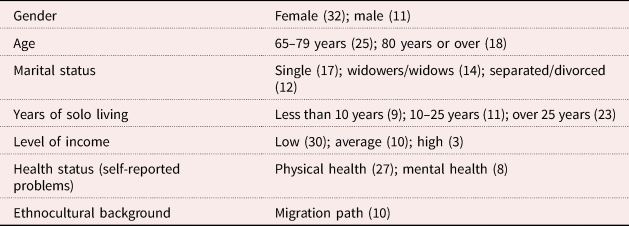
Throughout the recruitment process, significant efforts were made to reach seniors with a wide range of characteristics and living conditions. The final sample was composed of 43 seniors living alone and who had diversified characteristics in terms of several variables, including gender (32 women, 11 men), age or generation, marital status, number of years of solo living and residential arrangements. The seniors we met had lived alone for a period ranging from four months to over 60 years. As shown in Table 1, in accordance with the research objective, we constructed our sample by favouring heterogeneous socio-demographic profiles and varied lifecourses in terms of family contexts, ethnocultural backgrounds and socio-economic conditions. In this regard, like the elderly population of Quebec, the majority of the respondents (30) had an income level that can be described as low,Footnote 8 while ten had average incomes and three had high incomes. With respect to health, 30 seniors reported having physical health problems (e.g. arthritis, osteoarthritis, diabetes, cancer, hemiplegia (stroke) or mobility) and one reported having eight of the mental health problems related to anxiety, depression and intellectual disability. These self-reported health problems had varying impacts on the participants’ daily lives, resulting in minimal to major losses of autonomy but not affecting their capacity to give their consent and participate in the study.
Diversification criteria for the sample of seniors living alone

Notes: N = 43. The number of seniors in each category is given in parentheses.
The seniors we met lived in various types of housing, including apartments, single-family homes, low-rent housing, and subsidised or non-subsidised seniors’ residences. Only six of the 43 seniors owned their place of residence. Those living in a nursing home or long-term care facility were excluded from the study. Lastly, it should be noted that living alone was not the result of a deliberate choice for all of the seniors met. For many, it was the result of various life circumstances (such as the loss of a spouse or late departure of children). Nevertheless, the vast majority of respondents specified that they no longer wished to live with someone.
Method of analysis
The individual interviews, which lasted approximately one and a half hours each, were all recorded, transcribed, coded and analysed using NVivo data-processing software. The data analysis grid was built gradually and supplemented by participants’ accounts of their experiences, i.e. approximately 15 in-depth individual analyses. We drew inspiration for this process from the grounded theory approach (Paillé, Reference Paillé1994; Paillé and Mucchielli, Reference Paillé and Mucchielli2003), which makes it possible to generate analyses based on the meanings that participants give to their experience, thereby avoiding the imposition of prebuilt categories. The analysis was carried out in three stages: (a) a first thematic analysis identified the main and secondary themes addressed during the interviews; (b) a second analysis consisted of grouping the thematic data by creating conceptual categories; and (c) a third cross-sectional analysis tabulated the data collected with the various social factors (e.g. gender, age, socio-economic conditions, marital status and lifecourse). To ensure the validity of our results, throughout the analysis process we used a data triangulation method that Denzin (Reference Denzin1978) calls investigator triangulation: every interview was analysed by two lead researchers. As mentioned, the findings were discussed and then validated against the results of the focus groups.
Findings
In this section, we present the main results of our qualitative study, focusing on the experiences of the solo-living seniors who participated in our study, including the various ways in which they perceived and reflected on loneliness, as well as the plurality of strategies they employed to react to it. All names used for the participants are pseudonyms.
How did the seniors perceive their loneliness?
As varying between dynamic and static experiences
The seniors we met perceived loneliness most of the time as a ‘dynamic’ state, in that it tended to fluctuate in time (Victor et al., Reference Victor, Sullivan, Woodbridge and Thomas2015), according to temporalities (e.g. evening or winter) and circumstances (e.g. weekends, summer holidays, Christmas or Mother's Day). This form of loneliness is similar to the so-called ‘occasional’ or ‘moderate’ loneliness reported in the scientific literature, as mentioned above. The case of Odette, who lived in a modest one-room apartment on the sixth floor, illustrates how these periods, which are identified as particularly conducive to the experience of loneliness, are part of a senior's life story and of moments commonly recognised as best lived in the company of others or socially shared. These periods of loneliness are thus amplified by the memories they may awaken, but also, as Van de Velde (Reference Van de Velde and Rosanvallon2011) correctly notes, by the social differences of which they are the hallmark:
I'm chronic. I mean, the holidays. December. Then there's July … That's two things in my head. It's going to be like that my whole life … That is because in July, my husband always used to take a vacation. My whole family, everyone. Several years ago … Now I'm here, I've worked so hard on myself, it doesn't hurt anymore. But the whole month of July, I cried so much, … I love lakes, because I used to have cottages, then I had a trailer. Always been drawn to water … Then the month of December, well I hate it … Yes, I would like to be frozen, until my birthday (laughs) … Because December is a painful month. It's the presents, the music, the family. It's about all getting together, but now I don't have family anymore. You know, I mean. I'm all alone during the holidays. When my daughter is not with me, when my son is not there, well I suffer from that. It's family … Other than that, the rest [of the time] I don't feel alone. (Odette, 79 years old, widow with children, 27 years of solo living)
The accounts given by the seniors we met revealed that they sometimes experienced several forms of loneliness, although not necessarily contingent on specific times. These first observations are consistent with Campéon's findings regarding French seniors, which showed that ‘the feeling of loneliness occurs in phases, namely that it can be “activated” or more severely feared at particular times of the day or in certain places’ (Campéon, Reference Campéon2011: 221, free translation). Conversely, only a few of the seniors we met reported experiencing ‘static’ loneliness. This type of loneliness was found to be either non-existent – as in the case of Edith, a woman who remained actively involved in and enjoyed several activities – or ‘permanent’, i.e. meaning a perception that almost never seemed to leave them, as in the case of Thy (Victor, Reference Victor2012).
Edith: I don't have time to get bored with my activities. There's also my little garden. I started it a few weeks ago, the seeds. It's a pleasure to see it grow. It warms my heart … I'm actually quite busy. I have some friends. I don't have many, but it's not necessary to have many either. I also have my children, who visit me regularly. If they don't come, they call me. Still, if they haven't called me for two weeks to tell me how they are doing, I know it's because they are busy, so it doesn't bother me.
Interviewer: So, your loneliness…
Edith: …doesn't weigh on my heart … I also have my boyfriend who does a lot in my life. We share a lot of things together that we are similar. It's been 20 years and we're still together… (Edith, 70 years old, widow with children, 25 years of solo living)
Always. Because I'm always alone. In my apartment there is nothing but four walls. How do I do it? I just have to put up with it. I've got to endure the loneliness … My whole life. (Thy, 88 years old, widower with children, 35 years of solo living)
The experience of Thy, a man of Vietnamese origin who had lived alone for 35 years, illustrates the latter situation and is similar to what is characterised in the scientific literature as ‘severe’ loneliness.
As chosen or circumstantially imposed experiences
The seniors’ discourse also revealed their recognition of the different origins of their experience of loneliness. In addition, the respondents differentiated between chosen or desired solitude, which they perceived very positively, and circumstantially imposed ‒ not chosen ‒ loneliness, which they perceived much more negatively.
For the respondents, chosen solitude referred to activities that they did alone and voluntarily. Some pursued genuine passions, to which they devoted several hours a week and often each day. They did so through regular reading, artistic, meditation and intellectual activities, such as genealogy as in the case of Gaston, who at 67 years of age had always lived alone, and tai chi as in the case of Lin, a 72-year-old widow who decided to remain alone in Montreal when her only daughter and son-in-law returned to China. Claudette, 81 years old, single, with a track record of sustained civic involvement, had a blog to debate current political issues. As the example of Jules shows, these older adults each sought and valued the experience of a ‘chosen’ solitude, which they considered vital to their wellbeing:
Loneliness, my solitude doesn't bother me. Then, when I read books, my book is there, eh. So, in that sense, I'm not alone. That's why I don't like it when I don't have a book with me, because then I would be alone. … At the moment I am with Charles Taylor. It's very beneficial! (laughs). (Jules, 82 years old, single with no children, 37 years of solo living)
Most of these seniors had social characteristics in common: high levels of education, celibacy and solo living for over 35 years. For them, loneliness took the form of an experience that they regarded above all as voluntary or ‘chosen’ (Schurmans, Reference Schurmans2003).
At the same time, some of the other seniors tended to see the origin of their loneliness as the combined impact of various social factors (e.g. age, socio-economic status, marital status or health status) that deprived them, more or less severely and in the long term, of significant social ties. Denise, an 81-year-old woman suffering from chronic illnesses and living in poverty, identified ageing (‘the golden age’ as she dubbed it sarcastically) and her marital status as a single woman with no children as the main sources of the loneliness she experienced. Several studies have shown that while loneliness increases in some cases with age, as a general rule, it is not strictly speaking due to ageing but rather because ageing is often accompanied by an increase in individual disabilities, a shrinking of the social network and the loss of social roles, as well as reduced involvement in the community (Hovaguimian et al., Reference Hovaguimian, Grab and Stuckelberger1988; Carstensen, Reference Carstensen1995; Victor et al., Reference Victor, Scambler, Bond and Bowling2000; Jylhä, Reference Jylhä2004; Sullivan et al., Reference Sullivan, Victor and Thomas2016).
In any case. I might as well die … Ah, sometimes I think, well, some people are certainly better off than I am, but then others are also worse off … Of course some of them have children and all that, but they don't see them, so it's no better. Some people tell me sometimes: ‘Oh yes, we have children, but we don't see them.’ (Denise, 81 years old, single with no children, 30 years of solo living)
These ways of describing loneliness thus implied, in each case, the combined impact of social factors leading more or less gradually and definitively to the breakdown of the significant social ties hitherto maintained by the seniors. Those who mentioned this breakdown often referred either to the regrettable and deeply felt absence of others from their lives, or to a time and space that they felt were too vast to occupy solely with themselves. Marco, an 81-year-old divorced man who no longer saw his children and struggled with social isolation, drew on these two registers to describe the forms that this loss of significant others took in his life, and the personal and psychological toll it has taken on him:
If someone said to me, ‘I live alone, and I want to live alone. I'm going to continue living alone. I don't think about finding someone, getting married again’, something like that. Well, [I'd say,] ‘Do you have any friends? Any hobbies? So you don't fall into depression or anxiety. To distract yourself from thinking about the good times in the past because it weighs you down, as they say.’ Anxiety takes over, to the point of ending up in the hospital like I did. ‘Keep yourself busy 24 hours a day … It takes activities, it takes something to replace what is missing. If you miss your wife, your children, a social life you don't have … You've got to have something else, otherwise you're gonna lose it. And then it hurts like hell.’ (Marco, 81 years old, widower, with children, 40 years of solo living)
It thus seemed appropriate to speak of circumstantially imposed loneliness to describe the experience of loneliness that was the product of the combined impact of social factors, and hence beyond the control of the seniors involved and reflected in every aspect of their lives by the more or less sudden and definitive loss of most of their significant social ties. Furthermore, as we will see, many of the seniors we met employed various strategies, with varying results, precisely to alleviate their painful experiences of loneliness.
How did the seniors reflect on their loneliness?
The seniors we met who reported experiencing loneliness said that it was intimately linked to the more or less marked transformation of their relationship to themselves, to others (their social ties) or to the world. In each case, one or another of these dimensions – which correspond to the principles of experience (Dubet, Reference Dubet1994) – coloured our participants’ way of speaking about ‘their’ loneliness. We will now describe and illustrate these various forms of loneliness using the comments collected. Some of these forms of loneliness, which are not mutually exclusive, reflected a relationship to the self marked by a degree of social withdrawal (solitude). Other forms implied relationships to other people that were experienced as unsatisfactory (family (and friends) loneliness and loneliness in love), while still other forms referred to a relationship to the world that the respondents experienced as alien to themselves (existential loneliness, aloneness).
Their experiences of their relationship to themselves
Solitude. Some of the seniors we met viewed their experience of loneliness through the prism of identity. Indeed, for them, loneliness was the result of an individual trait that they interpreted either as ‘innate’ or as acquired over time and along their lifecourse, as illustrated by the example of Claudette, 81 years old, who described herself as a ‘loner’; Odette, 79 years old, who said ‘me, I'm chronic’; and Jules, 82 years old, who considered himself ‘a little mystical’.
First, some of the seniors saw loneliness as involving a very intimate relationship to themselves that was disconnected from others, with a frequency and intensity that fluctuated throughout the course of their life. This experience of solitude, which is marked by the absence of others, unlike the state of aloneness discussed below, was generally seen as ‘dynamic’ and ‘chosen’, as Claudette described it:
Well, I would say, I've always been a loner. I love people, but I'm very reclusive, I very much like to be in my own world … And at one point I met poets and all that … I also played a lot of music … But I was very withdrawn. So, it's a little bit like that. Despite my deep desire, because I have been in groups of poets and musicians, despite everything, I withdraw, and I want to be a part of society but still stay apart from it. (Claudette, 81 years old, single with no children, over 50 years of solo living)
In their own ways, they described solitude as a means of personal fulfilment or as an opportunity to maintain a privileged relationship with themselves. In relation to our conceptual framework, this experience of solitude among the seniors we met reflects the principle of integrity described by Dubet (Reference Dubet1994: 105), which involves the way in which seniors define themselves.
Their experiences of their relationship to others
Family (and friends) loneliness. For the solo-living seniors we met, the experience of loneliness was mainly associated with the absence of relatives (family members, friends, etc.). While most of them appreciated the autonomy, freedom and independence that comes with living alone and said they wished to maintain a fair distance from their loved ones, they nevertheless regretted when the latter were absent for excessively long periods of time. In this regard, the seniors tended to place as much importance on relationships with family members as they did on relationships with friends when discussing the links between their social network and their experience of loneliness. Irene's and Armand's comments illustrate the latter point:
I would say that sometimes there are periods when I don't see my friends because they're busy. Distances that mean I'm alone for a little longer than usual … These are short periods of loneliness. (Irène, 66 years old, single, with no children, 40 years of solo living)
Interviewer: We talked a bit about your relationship to loneliness. Is it something you experience sometimes?
Armand: At times yes. I wish this or that person had come to visit me, like my son, I would like that. But I don't think about it too often. It doesn't do any good … I felt that right away. He didn't serve in the army, alright. We don't share the same principles. He doesn't see things the way I do. But sometimes I wish … I have old friends who are still alive, but they stay in the veterans’ block. They're too old and they can't come all the way here. And I don't feel like going that far. So we don't see each other. We meet from time to time at the grocery store. Very rarely… (Armand, 78 years old, separated with children, 40 years of solo living)
At times, the experience of loneliness was also rooted in a conjugal life that was felt to be unsatisfactory. Many seniors regretted not having anyone with whom to share meals, bedtime or outdoor activities (such as dancing or walking). Some of them longed to meet a person with whom to share the intimate sphere of their lives and thus put an end to their feeling of loneliness in love.
Loneliness in love. In general, like Lea, all the seniors we met reflected more on loneliness in love than on family (and friends) loneliness:
What I like very much is that when I have visitors, when I have friends or family over, they find that I have a beautiful piece of land. I like that. What I don't like as much is the evening. Umm … Around dinner time, from the time I have to prepare my dinner alone, when I settle down for the evening and umm … That time of the day, that's when I miss having a man I'd like in my life, and to go to bed with, too. That too. (Lea, 70 years old, single with no children, over 40 years of solo living)
Conjugual loneliness appeared to be more pronounced for men than for women. This finding concurs with research showing that the beginning of a life without a spouse has neither the same meaning nor the same consequences for men and women. While the departure of the spouse tends to free women from some of the burden of household chores, for men it often entails taking on new responsibilities. As Pan Ké Shon and Duthé put it:
it is mainly due to the fact that after the separation, and by extension after the death of the spouse, women suffer from the reduction in their standard of living and men from loneliness (Gerstel, Riessman and Rosenfield, Reference Gerstel, Riessman and Rosenfield1985; Umberson, Wortman and Kessler, Reference Umberson, Wortman and Kessler1992; Fokkema and Dykstra, Reference Fokkema and Dykstra2002). (Pan Ké Shon and Duthé, Reference Pan Ké Shon and Duthé2013: 239)
In fact, among the male seniors we met, the experience of loneliness in love most often took shape at the end of married life (due to death, divorce or separation) and for which they still felt a sense of nostalgia, sometimes even after 30 years of widowhood, as in the case of Thy, 88 years old, who confessed that he had never found a woman like his deceased wife and ‘always thinks of her’. The interview with Elias also illustrates such an experience of loneliness. This immigrant man, who had lived alone in Quebec for 30 years, occasionally visited his wife who had stayed behind to live her life in Lebanon. He said he felt a great deal of solitary love-longing, especially since her death four years earlier. He was eager to find a partner and believed that the interviewer could help him in this regard:
Too difficult, it's too difficult to live alone. I can tell it's not natural … Loneliness is very difficult … You know, I'm trying to find a partner. (Elias, 86 years old, widower, with children, 30 years of solo living)
For their part, many of the women met – following the loss of their spouse and a period of adjustment to their life as widows or ‘singles’ – chose to concentrate on the remainder of their social network rather than on their love life. They did so by investing greater energy in friendships and neighbourhood relations, or by developing new ones, as Pennec (Reference Pennec and Pitaud2010) also reported. These observations are consistent with research showing that the change in marital status and a lack of friendships factor more in loneliness than the absence of a spouse (Dykstra, Reference Dykstra1995; De Jong Gierveld et al., Reference De Jong Gierveld, Keating and Fast2015). Other studies on gender differences (Blau, Reference Blau1981) have already concluded that women suffer less from loneliness than do men since women are more likely to cultivate close interpersonal relationships outside their family environment, while for a man, his wife is often his only confidant. Friendships and opportunities for interpersonal social activities often help make the absence of a companion much less difficult for women to bear, without, however, erasing all sense of loneliness in love. The case of Evelyne, a native of Haïti who divorced several years ago, illustrates the latter context:
Of course, sometimes I say if there was a man, I could go out dancing, go … But it's not something that, how can I say this, obsesses me, so I … No. No … Ah. Pfff. Then (laughs), it lasts maybe 15–20 minutes, and then I already, pfff, well no. But no, and then, and then I have a lot of girlfriends I go out with too. We go out to eat and, during the winter, we go to things, the Snow Festival, and then, so that's why I don't get bored. (Evelyne, 71 years old, divorced with children, five years of solo living)
Their experiences of their relationship to the world
Existential loneliness. Some of the seniors reported experiencing forms of loneliness that stemmed from their acute and often painful awareness of their relationship to the world and the transience of human life. For some, this loneliness was existential in nature. While no one can completely escape this existential loneliness, since each person is ultimately alone in the face of life and death, some of the seniors had greater difficulty living with this dimension of loneliness. Some, like Claudette, had long sought to accept this existential loneliness. Others, such as Yvonne, 73 years old, who had been particularly affected by life and cancer recurrences, expressed how loneliness occurs and recurs as we get older and nearer to the end:
But, so, if we talk about loneliness, obviously, it's quite difficult to, I try to imagine what I could say about it, because I've always loved being alone. I am a person who … I've never been bored on my own. So, of course I'm getting older. For me there's … I recognise myself as someone who, not because I'm afraid of loneliness, but I recognise that my fear of loneliness, let's call it that, that is the loneliness that comes with being human. (Claudette, 81 years old, single with no children, over 50 years of solo living)
These accounts by the seniors interviewed recall the research of Caradec (Reference Caradec2007), which showed that old age, particularly ‘great age’, is often accompanied by the experience of a more or less painful loss of control over the world, which, as we get older, becomes ‘alien’ to us. In the cases of Yvonne and Claudette, their existential loneliness reflected not so much the experience of a world they no longer recognised, as a relationship between the world and the self with which they struggled to come to terms.
Aloneness. Regarding this ‘cross-dynamic’ relationship between the world and the self, some of the seniors spoke of experiencing an even deeper loneliness, embedded within a feeling of exclusion and alienation in a society where they struggled to find their place. Sometimes this aloneness manifested itself in the weary passage of time and days going by without purpose, as well as in the silence of everyday life. In the words of Pauline, an 85-year-old woman who had children and friends in her life but whose recent loss of her three sisters had plunged her into depression, ‘It's empty … You know, because if there is no noise, there is nothing.’ However, for some, this feeling of aloneness was coupled with an even more obvious sense of exclusion, as in the case of Lisa and Gedeon, who were cut off from almost any social bond, with no one to talk to or confide in on a daily basis. In their own way, both found themselves alone, isolated and confronted with a society from which they felt excluded. Lisa, who had lived alone only since her mother recently moved into a nursing home or long-term care facility after several years of co-habiting with her, and Gedeon, who was very socially isolated, articulated a lonesome individual's painful experience of silent aloneness:
Ufff. That … I don't know. I have no one to talk to, to express myself to, to share moments with, a coffee or something. To share a quiet moment with someone, have a good conversation. The [memories of the] noises in the house when my mother was still around, that's all I have left. It's too much silence. (Lisa, 65 years old, widow, single with children, four years of solo living)
Well, now, I'm, like, almost dead. Because, my family is gone … I have one sister left, in Trois-Rivières. That's all. Besides, we're not in contact … We, I come from the North Shore … I find that Montrealers are always distant, as if they're afraid of people they don't know. I've been here 35 years and I don't know anybody. (Gedeon, 88 years old, single with no children, over 60 years of solo living)
The above cases illustrate experiences of severe loneliness where several factors of vulnerability and social exclusion are compounded due to financial precariousness, the absence of a social and family network, and difficult life transition events (such as Lisa's mother's move into a nursing home, recent or upcoming relocation). In addition, the aloneness experienced by Lisa, originally from Argentina, intersected with the challenges of her migratory journey.
How did the seniors react to their loneliness?
Faced with multiple forms of loneliness, many of the seniors we met proactively employed strategies to improve the quality of their life. These strategies tended to vary, depending on the above-mentioned types of loneliness and logics of action, as either marked by an unsatisfactory relationship to others or rooted in a relationship to the world that had become ‘alien’ to the self. In line with previous research (McInnis and White, Reference McInnis and White2001; Pettigrew and Roberts, Reference Pettigrew and Roberts2008), these strategies were based in part on activities and interactions with others (e.g. socialising with relatives, community organisations and public places), and on the practice of solitary activities (e.g. computer, television and rest). These strategies, like those documented in the systematic review by Karicha et al. (Reference Karicha, Manthorpe, Iliffe, Davies and Walters2018), were based either on an action involving the self alone or an action involving others. By contrast, the strategies identified by some of the seniors were not positively framed, and revealed a sense of powerlessness in the face of loneliness. In addition, the diversity of strategies employed by the seniors to alleviate their loneliness concealed differences in means, which were partly due to the sometimes imperceptible impact of social factors (e.g. physical and health limitations, social network, gender, socio-economic conditions and ageing). These factors affected the ability of some of the seniors to use strategies to overcome loneliness, at times positively and at times negatively.
Preventing and alleviating loneliness on their own
Among the seniors who associated their loneliness with social ties that had become unsatisfactory over time, many relied on the creation of boundaries between themselves and a seemingly endless present to ease their loneliness. Campéon (Reference Campéon2011) observed similar behaviour among French seniors, which he described as ‘an individual's ability to internalise symbolic bonds that provide a framework of constraints as a safeguard against individual straying’. He provided several examples, including a rich past life, faith, memory and reminiscences of a deceased spouse. The accounts of the seniors we met suggested that these safeguards can be something other than symbolic bonds. For some, as we have seen, it could be reading, and for others, music or gardening. Some were passionate about a hobby (e.g. writing, music or genealogy) and many spent a great deal of time on the computer. In short, devoting oneself to one's passion draws boundaries between oneself and an interminable present that is sometimes entirely cut off from others. Lastly, a few seniors reported having had great difficulty finding ways to alleviate their loneliness on their own. Some had turned to the health and social services system for help, as in the case of Denise, 81 years old, who was followed by the same social worker as Jules.
Jules: There was a … I had a habit, when I saw the Christmas season coming, at the beginning, when November was coming. Then I would get depressed, until January 2.
Interviewer: Were you doing anything to counter that depression?
Jules: Ah, I took antidepressants. I talked about it with the nurse at the CLSC [local community service centre]. (Jules, 82 years old, single with no children, 37 years of solo living)
Preventing and alleviating loneliness with others
Many of the seniors chose to alleviate their loneliness by taking advantage of all possible relational opportunities (e.g. to meet a future spouse, spend time with their relatives or meet stimulating people or ‘strangers’). The ability to take advantage of the opportunities that presented themselves or to initiate new ones highlighted inequalities. Elias and Fernand, 86 and 77 years old, respectively, hoped to end their loneliness in love by meeting a new spouse, but faced different limitations: physical and health-related in one case, and financial, in the other:
Despite everything, I love people. I'm not talking about society, but I love people. I'm in love with people. I always said when I was younger that I was in love with people. That's why I'm telling you that if I was rich right now, I'd have a lot of girlfriends. Yes, it can help in a lot of ways. Hey, poverty, find me something positive in here. (Fernand, 77 years old, single with no children, 8 years of solo living)
Others, such as Georgette, a single woman in her nineties with no children, instead sought to talk to or associate with their loved ones, whether family members or friends. In their case, the idea was to seize any good opportunity or invitation that allowed them to ‘keep busy’ (Sullivan et al., Reference Sullivan, Victor and Thomas2016: 174), and to get out of their home and ‘out of themselves’. For other seniors, alleviating the loneliness associated with the experience of unsatisfactory relationships to others required the presence of others in their life, not so much for the affectivity or familiarity of the ties that bound them, but for the intellectual stimulation that these people provided. Pauline, an 85-year-old woman, told us, for instance, that she preferred the company of younger people who ‘push [her] to be curious’, while Armand, 78, regretted the absence, in seniors’ residences, of interesting people who shared his cultural capital and social class. Some even insisted that relying on stimulating and healthy company alone was desirable. In other words, while the loneliness associated with the intensely felt absence of others could be heavy and even painful at times, it was still better to be alone than overwhelmed by the company of boring or troubled people, as Irene argued:
I would rather be left alone than in the bad company of people who drain my energy. No, I have only one life, I think, so I'd rather be alone. (Irene, 66 years old, single with no children, 40 years of solo living)
The strategies employed by the seniors in our study to deal better with loneliness rooted in the experience of unsatisfactory relationships to others, had a common dependency – if they were to succeed – on the strength and size of their social network. However, it was not uncommon for the seniors, whether by choice or due to the smallness (or even non-existence) of their social network, to seek the company of previously ‘unknown’ people. Attending community organisations or seniors’ associations and volunteering were ways they found to initiate and develop new relationships, which could sometimes evolve into true friendships and, as in the case of Yvonne, acted as a balm on the experience of loneliness. The seniors therefore employed various means to alleviate the loneliness they experienced as a result of relationships to others that they perceived as unsatisfactory. While undoubtedly the personality and ability of certain seniors to connect with others sometimes gave them an advantage over others, their physical and health-related limitations, socio-economic conditions and social network were social factors that also influenced their ability to employ some of these strategies.
Being helpless in the face of loneliness
Living on the margins of society, affected by severe isolation and faced with numerous difficulties in establishing meaningful social ties, some of the seniors maintained only utilitarian relationships with others, in particular, customers and employees in the service sector (such as restaurants and retail stores). This was the case for Marco and Gedeon, who both suffered from a deep sense of aloneness that was linked to their condition of social exclusion. Deprived of virtually any social network, they wandered in places they knew were very popular with the public, such as shopping malls, big box stores and restaurants. Feeling alienated, they continued to circulate within society but had great difficulty in belonging to it other than through commercial ties:
Even if the people around me won't even look at me. Just the fact that I am no longer alone, that there are people around me … Very often people don't even talk to me. And yet everyone knows me. The little waitress, she knows my name. (Marco, 81 years old, widower with children, 40 years of solo living)
When I want to meet people, the only time, the only way, I take the bus, the subway, the bus … That's it. I shop. And these people are paid to be there. Then they have to show that they're in a good mood, so they talk to me to try to sell me something … Then often I let myself be lured by their sales pitch. (Gedeon, 88 years old, single with no children, over 60 years of solo living)
With very few opportunities and hampered by numerous obstacles, such as cultural barriers, some mentioned feeling extremely helpless in the face of their feeling of aloneness, the pain of which they were no longer able to alleviate. This was the case with Thy, who claimed to have been alone since his wife died 50 years earlier. He admitted that he had become the shadow of his former self in terms of physical abilities and no longer recognised his social environment, from which he had long felt radically estranged. Deprived of the means to alleviate the burden of his loneliness, Thy found himself thinking more and more about death, and secretly hoped – without knowing all the strict conditions of access – to be able to benefit from assisted death legislation:
Thy: Yes, I'm always thinking, if the government, especially the hospital, has something to help older people like me, people who are excessively lonesome, when I get depressed, I don't want to live any more. I'm totally depressed. I don't see myself staying like this every day.
Interviewer: How long have you been thinking like that?…
Thy: It's been several years already. It's not just today, I'd say I've been thinking about death for several years now because I know that if I stay like this every day, there's nothing in it for me and I have nothing good to contribute to society. You have to let me make room for others. (Thy, 88 years old, widower with children, 35 years of solo living)
Moreover, Dubet (Reference Dubet1994: 18, free translation) underscores this about the social experience: ‘feelings of suffering and alienation are experienced by the actors when they are no longer able to control the diversity of the logics of action that guide them’.
Conclusion
What lessons can be learned from this study?
The stories we collected from seniors living alone impel us to take a nuanced look at the complex links between loneliness, ageing and solo living. First, it is important to emphasise that the 43 solo-living seniors whom we met did not perceive, or very rarely perceived, loneliness as a static state. Their experiences of loneliness, whether circumstantially imposed or chosen, were dynamic, fluid or occasional at certain times of the day, week or year. In this regard, our data support the literature in that a limited percentage of the seniors we met suffered from permanent and severe loneliness. However, we might well ask what the case will be in today's exceptional context of COVID-19, where the mandatory confinement of seniors spans over many months?
Another noteworthy finding of our study is that, while the loneliness reported by seniors is indeed an individual experience, it is also inextricably linked to several social conditions that are rooted, in particular, in one's relationship to oneself, to others and to society. In this regard, Dubet's (Reference Dubet1994) sociology of experience helps show and improve our understanding of the heterogeneity of lonelinesss and why loneliness is sometimes more difficult to endure. Furthermore, the concept of experience is particularly relevant if we are to understand how social factors such as age, health status, gender, marital status, social network and socio-economic conditions, generally regarded as risk factors in the literature, modulate experiences of loneliness and expose seniors unevenly to different forms of loneliness.
This study also offers insight into the resilience and resourcefulness demonstrated by seniors on a daily basis in their efforts to manage loneliness, as well as into their unequal means for doing so, particularly as a result of the combined impact of social factors. Our data highlight gender differences in the experience of loneliness and in the strategies used to alleviate it. In general, our findings show that men suffer more from loneliness in love, while women have an easier time developing friendly and neighbourly relationships that foster intimacy and solidarity, especially among women (Pennec, Reference Pennec and Pitaud2010). Regarding socio-economic conditions, their effects are felt most strongly by the more affluent seniors, who are more likely to experience chosen solitude, leading to self-fulfilment through various activities, including intellectual and artistic activities, as well as by the more disadvantaged and isolated seniors, who struggle instead with aloneness, leading to a sense of powerlessness, even alienation. Our findings also suggest that attention should be paid to men of very advanced age and to single people with no children who find themselves in financially and socially precarious situations. Based on the few interviews (N = 10) we conducted with solo-living immigrant seniors, further research is warranted with a greater focus on their condition. It should be noted that, as we age, the crumbling of our social network and the obstacles impeding its renewal, especially when combined with other vulnerabilities (e.g. health and mobility problems, poverty and migration) can lead to a situation of intense isolation that can potentially worsen loneliness. This finding applies to those living alone, particularly in urban and metropolitan areas. However, the results of our study cannot be extrapolated to seniors living alone in rural areas or in developing countries.
The challenge remains to draw lessons from these conclusions by applying them to the social mechanisms needed to reduce loneliness among vulnerable groups of seniors and to focus our interventions on those who suffer from it. Like Van de Velde (Reference Van de Velde and Rosanvallon2011: 37), we believe that the answers needed should not be limited to a ‘surplus of interactions’. The heterogeneity of the forms of living alone and of loneliness calls for the development of various social interventions (at micro, meso and macro levels), with a view to reducing the marginalisation and social exclusion of seniors. Only then will we be able to act on the social inequalities that determine and exacerbate the different forms of loneliness experienced by seniors.
Author contributions
The two authors each made a substantial contribution to the conception and design of the study, literature search, data extraction, analysis and interpretation of the information. They both approved the final version of the article.
Financial support
This work was supported by the Québec Ami des Aînés (QADA) programme of the Ministère de la Famille of the provincial government of Quebec, Canada. The financial sponsor played no role in the study design, execution, analysis and interpretation of data or in the writing of this article.
Conflict of interest
The authors declare no conflicts of interest.
Ethical standards
This study was approved by the Université du Québec à Montréal Ethics Committee.