INTRODUCTION
The Manila clam, Ruditapes philippinarum (Adams & Reeve, 1850) is indigenous to sub-tropical and temperate coastal waters of the western Pacific and Indian oceans from the Sea of Okhotsk to the South China Sea and as far west as Pakistan (Humphreys et al., Reference Humphreys, Herbert, Roberts and Fletcher2011). While the adult clam lives buried in coastal sediments, natural dispersal is achieved during a planktonic larval stage. At metamorphosis the animal settles on the seabed from the intertidal to shallow sub-littoral zones. The species is euryhaline to the extent that even the more vulnerable larval stages can achieve growth in estuarine salinities as low as 12 (Lin et al., Reference Lin, Wu and Huang1983).
The Manila clam is a high-value seafood species. Since the early 20th century, due to activities related to the aquaculture and fishing industries, the species has become established along the Pacific coast of North America, the Atlantic coast of Europe, the Mediterranean Sea and elsewhere. In the first such introduction, Japanese clams were taken to the Hawaiian Islands (Bryan, Reference Bryan1919; Yap, Reference Yap1977). Other Japanese clams reached the North American Pacific coast in the 1930s, as an accidental introduction with stocks of Pacific oyster (Quayle, Reference Quayle1949). They now extend from California to British Columbia (Magoon & Vining, Reference Magoon and Vining1981). European introduction commenced in the 1960s when eastern Pacific clams were introduced to France where they are today cultivated on both Mediterranean and Atlantic coasts (IFREMER, 1988; Flassch & Leborgne, Reference Flassch and Leborgne1992). They have also been introduced for aquaculture into the Italian Adriatic and the coasts of Germany, Spain, Ireland and Norway (Humphreys et al., Reference Humphreys, Herbert, Roberts and Fletcher2011).
Ruditapes philippinarum was the latest of a number of commercially significant non indigenous bivalve species purposefully introduced into British waters, the others notably including the American hard-shelled clam Mercenaria mercenaria (Linnaeus, 1758) (Mitchell, Reference Mitchell1974) and the Pacific oyster Crassostrea gigas (Thunberg, 1793) (Humphreys et al., Reference Humphreys, Ningsheg, Quyang and Yan2014). The Manila clam was first brought to Britain in 1980 by the then UK government's Ministry of Agriculture, Fisheries and Food (MAFF). Motivated by potential economic benefits from aquaculture, MAFF imported a consignment of Manila clams from the US Pacific coast. After quarantine procedures, experimental work and field trials, the species was made available to commercial growers (Humphreys, Reference Humphreys2010). This ignited what was described in the national press as a ‘full scale row’ between MAFF and the Nature Conservancy Council (the statutory conservation agency) concerning the introduction of an ‘alien monster’ (Daily Telegraph, 29 April 1989). The first reported naturalized population in Britain occurred in Poole Harbour on the central south coast of England (Jensen et al., Reference Jensen, Humphreys, Caldow, Grisley and Dyrynda2004).
Here we report on the pattern of Manila clam dispersal from 1980 to 2010, its first 30 years in Britain. We relate this to collated information from various sources on licensed introductions and examine the implications of this relationship in terms of invasiveness, dispersal and future British distribution.
METHODS
Historical introductions
The pattern of licensed introductions since the initial importation of broodstock in 1980 has been established from: archived file materials held by the UK Joint Nature Conservation Committee (JNCC); aquaculture records provided by the British government's Centre for Environment, Fisheries and Aquaculture Science (Cefas); Parliamentary papers and Hansard (the record of proceedings of the British parliament); Government reports and aquaculture guidelines from the 1980s and journal papers reporting field experiments and trials.
Definition of wild clams
We define wild Manila clams as individuals which have not been introduced directly during aquaculture activity but which have settled naturally as spat from parents which have successfully reproduced in British waters. Therefore wild clams as we define them may or may not be feral, in the sense of deriving directly from anthropogenically introduced parents. Nevertheless, in line with Williamson (Reference Williamson1996), we apply the terms established and naturalized only to persistent self-sustaining populations which are not dependent on seeding from aquaculture operations.
Identification
A degree of taxonomic volatility has led to a number of synonyms for Ruditapes philippinarum, some of which are still used by biologists and which are commonly found in the literature on the species. Notable among these are the genus synonyms Tapes and Venerupis. Here we refer to all species in line with the accepted binomials as specified in the World Register of Marine Species (WoRMS, 2014).
As a non-indigenous species the Manila clam is not yet included in widely used British identification keys and can consequently be mistaken for related native species with which it can be sympatric: notably another venerid bivalve Ruditapes deccusatus (Linnaeus 1758). Wimbledon (Reference Wimbledon2003) has provided a useful photographic guide comparing the gross shell morphology and colouration of the two species, but phenotypic shell variation is such that these features alone are not always sufficient to definitively separate them. Therefore we have based our identifications also on siphon anatomy. In particular we distinguish the separate inhalant and exhalent siphons of R. deccusatus from those of R. philippinarum which are joined for most of their length (see Humphreys, Reference Humphreys2010). A third native clam Venerupis corrugata (Gmelin, 1791), which can be sympatric with R. philippinarum towards the seaward end of British estuaries also has fused siphons, but can be distinguished on the basis of shell shape and much larger pallial sinus, a feature of the inside of the shell.
Distribution and abundance
The progress of dispersal of the species was determined from a number of sources. Malacological Society of London records, grey literature searches and informal reports and specimens provided by colleagues from universities and government fishery agencies all provided useful information over the period in question. In all cases, such initial reports were followed up and substantiated in terms of both species and location by our own field visits and observations. In addition opportunities presented by our own funded research and commissioned surveys have also been useful in tracking the clam's dispersal (Jensen et al., Reference Jensen, Humphreys, Caldow, Grisley and Dyrynda2004; Humphreys et al., Reference Humphreys, Caldow, McGrorty, West and Jenson2007; Caldow et al., Reference Caldow, Stillman, Durell, West, McGrorty, Goss-Custard, Wood and Humphreys2007; Herbert et al., Reference Herbert, Ross, Hübner and Stillman2010).
Dates of first arrival of wild populations have been determined where possible on the basis of our own field monitoring, if necessary extrapolating from the oldest age group in a recently established population when first discovered. Occasionally unpublished reports have also proved useful in this respect.
While this paper is primarily about dispersal and gross distribution we have also made some attempt to report abundance in such a way to allow comparisons over time and between locations. Although all reported occurrences were substantiated by us, our information on abundance is derived from many different sources, surveys and projects over the 30-year period. Our own methods, for example, ranged from shore-based sediment sampling, boat-based core, hand dredge and grab sampling, to using commercial dredges from larger fishing and research vessels. In one case our historical evidence consists of records (by R.H.) of shell fragments resulting from predation by gulls and crows. Since these approaches varied by locality and time we cannot with confidence provide comparative information on abundance in terms of population densities, but as an alternative we have presented approximate comparative abundance estimations according to the SACFOR scale (Hiscock, Reference Hiscock1996).
Names and locations of coastal sites
The names and numbers of coastal sites referred to in this paper are in accordance with the estuaries review conducted by the Nature Conservancy Council (NCC) and published in Davidson et al. (Reference Davidson, d'A Laffoley, Doody, Way, Gordon, Key, Pienkowski, Mitchell and Duff1991). That report includes a comprehensive list of British estuaries defined broadly enough to include extensive areas of soft tidal sediment at the marine end of the estuarine continuum, but located outside river mouths. Davidson's report therefore provides a useful catalogue of coastal locations within which Manila clam habitat types would be present. As well as providing exact site locations and names, Davidson's catalogue has proved useful in provoking us to confirm the apparent absence of the species from ostensibly compatible estuaries.
RESULTS
Earliest British introductions
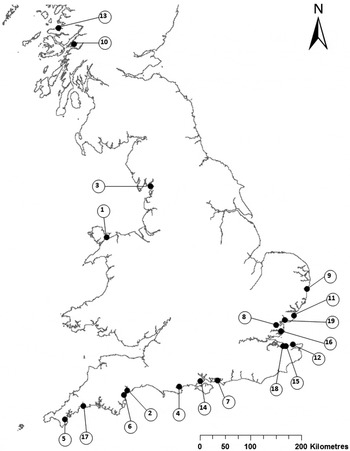
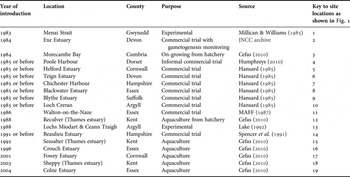
The initial consignment of imported Manila clams reached the MAFF Fisheries Laboratory at Conwy, North Wales in 1980. The near-by Menai Strait provided the location for the first documented introduction into UK coastal waters in 1983. In 1984 the Conwy laboratory provided broodstock to the Seasalter Shellfish Company which operated hatchery sites in Reculver (outer Thames estuary) and Walney Island (Morecambe Bay). The earliest record of a commercial licence to deposit Manila clams (under mesh) in British waters was given to the Walney Island hatchery for the purpose of on-growing clams for sale as a part-grown alternative to smaller and more vulnerable hatchery spat. These and Guernsey Sea Farms, a third hatchery in the Channel Islands, commenced the supply of juvenile Manila clams for aquaculture enterprises, both in the UK and abroad. Between 1984 and 2010 the Manila clam was introduced under licence into 18 further British coastal locations from the west of Scotland to southern England. Table 1 provides a chronological record of earliest licensed introduction by estuary. The locations of these sites are shown in Figure 1.
Map of Britain showing the approximate positions of sites of licensed Manila clam introduction for aquaculture between 1980 and 2010 (see also Table 1).

Industry-related Manila clam introductions in Britain, 1980–2010. In chronological order of initial introduction to site.

Distribution
For the period 1980–2010, Malacological Society of London records contained no suggestion of the existence of wild Manila clam populations north of the southern and south-east coasts of England. Moreover, although we know of licensed introductions further north of these areas (Figure 1), our own searches on both the east and west coasts of Britain corroborated this absence.
Wild Manila clam populations were found to be present in two regions of England: The central south coast from the Exe Estuary in the west to Chichester Harbour in the East, and the Kent and Essex coasts from the Thames estuary northwards to the Stour estuary.
Patterns of introduction and spread
SOUTH COAST
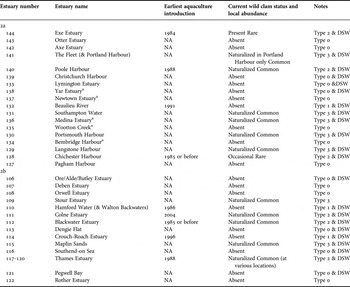
The English coastline extending from the Exe estuary east to Pagham Harbour includes 18 estuaries, five of which are on the Isle of Wight (Table 2a). Poole Harbour, one of the mainland estuaries, contains the UK's first reported naturalized Manila clam population (Jensen et al., Reference Jensen, Humphreys, Caldow, Grisley and Dyrynda2004). Here wild clams appeared about 2 years after the initial (1988) licensed introduction for aquaculture by Othniel Oysters Ltd. Subsequently the population extended its distribution within the harbour and, between 2002 and 2009, increased its mean intertidal population density from 5 to 12 individuals per m2 (Herbert et al., Reference Herbert, Ross, Hübner and Stillman2010). By 2010 wild Manila clams had also naturalized in six other south coast estuaries (Table 2a).
UK distribution of Manila clams by 2010, showing estuaries of (a) the south and (b) the south-east coasts of England. Estuaries are numbered in line with Davidson et al. (Reference Davidson, d'A Laffoley, Doody, Way, Gordon, Key, Pienkowski, Mitchell and Duff1991).
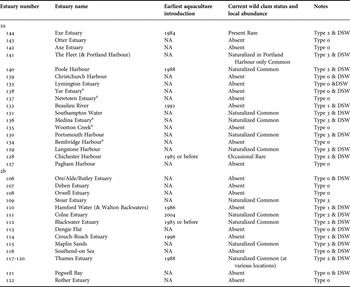
Key: Types 0–3 estuaries are as defined in the text. DSW signifies an estuary containing a government designated shellfish water. aSignifies an Isle of Wight estuary, all others being on the mainland. NA signifies not applicable. The words rare and common are defined in terms of the SACFOR scale (Hiscock, Reference Hiscock1996).
The earliest and currently most extensive of these new populations is in Southampton Water which lies about 48 km east of Poole Harbour. We estimate that the species arrived in Southampton Water in 2002: By 2004 relatively small specimens (length up to 21 mm) were found ranging from the Itchen and Test rivers of the upper estuary to the lower reaches of the north shore of Southampton Water proper. By 2005 larger specimens of up to 45 mm were commonplace on both north and south sides of the estuary.
Opposite Southampton Water on the north coast of the Isle of Wight, observations of bird-predated shells indicated that wild Manila clams arrived in the Medina Estuary in 2003. Naturalization here has resulted in a persistent population which has occasionally been exploited by clam boats from other Solent harbours and by hand gathering at low tide (Herbert, Reference Herbert2009).
Immediately to the east of Southampton Water are Portsmouth, Langstone and Chichester harbours which are connected by tidal creeks in their upper reaches. Despite anecdotal reports of clams in Portsmouth Harbour around 2005, an extensive benthic survey in 2006 revealed none. Nevertheless by 2010 our dredging of the upper reaches of the harbour confirmed the presence of a population with length up to 52 mm and age up to 5 years, which now attracts a local fishing effort.
Continuing east to Langstone Harbour, an anecdotal report of Manila clams in 2005 was followed by a single specimen report to the Malacological Society of London in 2006. The estuary now contains a persistent wild population with densities sufficient to attract a fishing effort including clam boats from adjacent estuaries. In the neighbouring Chichester Harbour our searches in 2004 and 2005 failed to find any Manila clams. In 2006 however a systematic survey turned up a single clam of age 3–4 years (Emu, 2007). Further searches in the vicinity of the find again failed to reveal more clams although a small number of shells were recovered. It appears that although the species could be found occasionally, the evidence suggests no significant naturalized population there before 2010. The next estuary to the east, Pagham Harbour has its entrance about 12 km to the east of Chichester Harbour with the headland of Selsey Bill lying between. We found no documentary or field evidence of the Manila clam.
Taking Poole Harbour as the site of the pioneer Manila clam population, the above timescales indicate an inferred average rate of spread eastwards of approximately 4.5 km per year.
Approximately 45 km to the west of Poole Harbour is the next estuarine system of Portland Harbour and The Fleet. The Harbour and the adjacent Weymouth Bay are protected from prevailing south-westerly winds by the limestone outcrop of Portland. Consequently the area is popular with scuba divers and snorkelers who by 2003 were known to be collecting Manila clams (McTaggart et al., Reference McTaggart, Tipple, Sherlock, Cogan, Joyce and Clyne2004). This population does not yet extend significantly into The Fleet although a single Manila clam was found there in a thorough 2010 survey by one of our students (Short, Reference Short2010). Although the Manila clam has been introduced at three south coast sites further west we only found Manila clams in one of these sites, namely the Exe estuary, where it was first introduced in 1984 and was considered naturalized by 1995 by local fishermen. However the exact status of the clam in the Exe remains uncertain.
EAST COAST
Davidson et al. (Reference Davidson, d'A Laffoley, Doody, Way, Gordon, Key, Pienkowski, Mitchell and Duff1991) identifies 17 estuaries from the north Kent coast, north to Felixstowe, four of which flow into the outer Thames area. For simplicity on Table 2 and Figure 2 we conflate these into a single reference to the Thames Estuary, the outer reaches of which contain various Manila clam populations as detailed below.
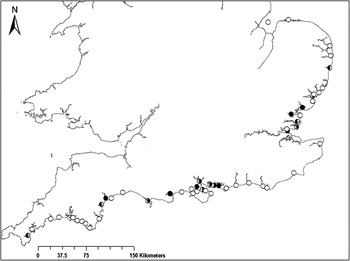
South and south-east coasts of Britain showing sites of introduction and 2010 wild clam distribution (information from Table 2). Circles represent the relationship between licensed introductions and the presence of wild populations up to 2010 (see discussion). Key to circle shading. Unshaded – Type 0 estuary: no introduction and no wild population; Left shaded – Type 1 estuary: introduction but no wild population; Fully shaded – Type 2 estuary: introduction and wild population present; Right shaded – Type 3 estuary: no introduction but wild population present.

The south shore of the outer Thames Estuary around Whitstable has a long tradition of bivalve production and was a significant site in the history of British Manila clam introduction, due to the presence of the commercial bivalve hatchery at Reculver. Having received broodstock for the production and distribution of spat the hatchery company subsequently established two local aquaculture sites, at Reculver in 1988 and Seasalter in 1992. These sites remained licensed for deposition of Manila clams for every year up to (and beyond) 2010. A third site on the Isle of Sheppy has been licensed since 2003. By 2010 wild clams could be found from The Swale (which separates Sheppy from the Kent mainland) to Reculver and evidence of dead shells suggests a wider distribution along this coast.
North of the Outer Thames area is the Crouch-Roach estuary whose complex system of tidal channels separates Foulness Island from the Essex mainland. This estuary system was licensed for Manila clam deposits off Paglesham for nine of the years between 1996 and 2009. Although we did not find wild Manila clams in the Crouch estuary system (prior to 2010) they were found on the large area of sediment seaward of Foulness known as Maplin Sands. This area can also be thought of as the seaward limit of the outer Thames Estuary: An estuary in which wild Manila clams are now extensively distributed and well established.
Further north again is the Blackwater Estuary which shares its outer reaches with the smaller Colne Estuary. Since 1992 Manila clam deposition has been licensed at five sites and the species has become naturalized. However it appears not to support a commercial fishery here, although it is caught and sold in small numbers as by-catch from a Pacific oyster fishery.
Hamford Water and the estuaries of the Stour and Orwell rivers discharge into a bay lying approximately between the towns of Walton-on-the-Naze and Felixstowe. Wild Manila clams can be found in this area from the shore off Walton to the upper reaches of the Stour by Mistley. Here the species density is sufficient to support a local fishing effort with techniques ranging from raking sediment approached from the shore to dredging from boats. Although there have been licensed deposits of Manila clams further north on this coast we found no evidence or reports of wild clams.
In the 26 years since the Manila clam was first introduced on the east coast, it has established wild populations from Whitstable to Felixstowe, a direct north–south distance of around 80 km.
Relationship between licensed introductions and wild clam presence
In order to reflect on the relative importance of natural and anthropogenic means of dispersal in Britain, we have in Table 2 categorized the south and east coast estuaries considered above according to the relationship they demonstrated between licensed introduction and wild Manila clam presence between 1980 and 2010. These relationship types are provided below:
Type 0. Sites with no history of licensed introduction and no wild clam presence.
Type 1. Sites with a history of licensed introduction but no wild clam presence.
Type 2. Sites which combine a history of licensed introduction with a wild clam presence.
Type 3. Sites with no history of licensed introduction but with wild clams present.
Between 1980 and 2010 the Manila clam became naturalized in 11 British estuaries. Figure 2 provides a map on which the estuaries from Table 2 along with other south and south-east coast estuaries are marked according to our type categories. It is clear from this map that there is no simple relationship between licensed introduction and the presence of wild Manila clams. Type 1 and 2 sites demonstrate that while naturalization could follow licensed introduction (e.g. Poole Harbour and the Thames Estuary), this result was not inevitable. (e.g. the Crouch-Roach Estuary) at least within the timescale we are considering. Type 3 sites such as Portsmouth Harbour and the Stour Estuary demonstrate effective dispersal other than through licensed introduction for aquaculture. Ostensibly this suggests natural larval dispersal however anthropogenic explanations other than licensed introduction are also possible as discussed below.
DISCUSSION
Climate compatibility
In the 1980s MAFF scientists believed that the British coastal environment, while favourable for the rapid growth of small but matured clams, was too cold to support breeding and recruitment (Spencer et al., Reference Spencer, Edwards and Millican1991). Their opinion on the incompatibility of British sea temperatures and Manila clam naturalization was informed by evidence from experimental work in the Menai Strait, Wales during 1983 and 1984. Despite unusually warm summer sea temperatures spawning did not occur (Millican & Williams, Reference Millican and Williams1985). Nevertheless this opinion was contentious. In particular the UK's statutory agency for conservation was concerned about the possibility of the clams successfully spawning to produce self-sustaining wild populations, with implications for indigenous ecology and biodiversity. This controversy has been detailed elsewhere (Humphreys, Reference Humphreys2010).
The discovery of naturalized Manila clams in Poole Harbour on the British south coast demonstrated the erroneous nature of the Ministry's position. However, Poole Harbour is a unique marine environment by virtue of the extent to which it combines large size, micro-tidal regime, lagoonal character (due to a double high water effect; Humphreys, Reference Humphreys, Humphreys and May2005) and relatively warm southern position (Humphreys & May, Reference Humphreys and May2005). Consequently it remained uncertain whether naturalization there was a peculiar event or whether a further extension of the clam's British distribution might be expected (Jensen et al., Reference Jensen, Humphreys, Caldow, Cesar, Humphreys and May2005a). We must now recognize a more general compatibility between British estuarine habitats, including sea temperature regimes, and the requirements of the Manila clam, at least on the south and south-east coasts of England.
Nevertheless it remains unlikely that the species can naturalize in currently colder British waters significantly north of our reported wild populations. In Morecambe Bay for example, despite annual licensed deposits throughout the 1990s, there are no wild Manila clams. This absence of established wild populations in northern Type 1 sites suggests that the government's original position was only valid for northern coasts.
Invasiveness and the dynamics of naturalization
The naturalization of non-indigenous species requires more than just their introduction into physically compatible habitats. In this respect it is informative to focus on the south and east coast locations where our evidence demonstrates that temperature is not a limiting factor.
In the context of efforts to discriminate relatively benign arrivals from serious ecological threats, the concept of biological invasion has been refined over recent years. Once defined simply as a case of ‘any sort of organism arriving somewhere beyond its previous range’ (Williamson, Reference Williamson1996), not all non-indigenous species are now regarded as invasive and the term is often restricted to alien arrivals with the ability to ‘spread aggressively’ (Maynard & Nowell, Reference Maynard, Nowell, Clout and Williams2009), by which is meant causing serious ecological change such as the decline or extinction of endemic species and altering the structure of communities (Clout & Williams, Reference Clout and Williams2009).
A readily dispersed life cycle stage and high fecundity are regarded as adaptations associated with species invasiveness. These characteristics can exert a combined effect referred to as ‘propagule pressure’, defined as the number of individuals released into a region to which they are not native (Lockwood et al., Reference Lockwood, Cassey and Blackburn2005). In addition to having a planktonic larval stage, Manila clams have considerable reproductive potential: Large clams in good condition can spawn up to 8 million eggs (Spencer Reference Spencer2002). Such reproductive effort will increase the probability of success by improving the chances of sufficient numbers finding suitable habitat and surviving predation. Consequently propagule pressure is regarded as of fundamental importance to invasive population growth and range expansion, both generally (Grice, Reference Grice, Clout and Williams2009) and in the particular case of marine molluscs in estuarine ecosystems (Miller et al., Reference Miller, Ruiz, Minton and Ambrose2007).
Conversely both abiotic and biotic factors, collectively referred to as invasion or environmental resistance (Williamson, Reference Williamson1996), will tend to limit the success of the potentially invasive population. For example, fecundity in bivalves can be significantly affected by food supply, temperature, salinity, parasites and water contamination. Moreover mortality, especially in the early stages of the life cycle can be prodigious. During their planktonic larval stages both active predators and non-selective filter feeders contribute to bivalve larval mortality rates as high as 99% (Gosling, Reference Gosling2003). Manila clams are no exception, and even settled specimens as large as 10 mm length can be consumed by the indigenous shore crab Carcinus maenas (Linnaeus, 1758) at rates up to 50 clams per crab per day (Spencer, Reference Spencer2002). In Poole Harbour, Caldow et al. (Reference Caldow, Stillman, Durell, West, McGrorty, Goss-Custard, Wood and Humphreys2007) have recorded oystercatchers (Haematopus ostralegus Linnaeus 1758) consuming Manila clams at rates typical of their consumption of native bivalves.
In stable ecosystems environmental resistance will provide a relatively consistent challenge to potential invader species. However estuaries are recognized as challenging environments prone to wide fluctuations in the abundance of many constituent species (e.g. Boesch et al., Reference Boesch, Wass, Virnstein and Wiley1976; Kaiser et al., Reference Kaiser, Attrill, Jennings, Thomas, Barnes, Brierley, Polunin, Raffaelli, Williams and le2005; McLusky & Elliot, Reference Mclusky and Elliot2004). In a meta-analysis of invasibility, Colautti et al. (Reference Colautti, Grigorovich and MacIssac2006) found a significant positive association with community disturbance. This suggests that natural volatility in the benthic communities of temperate estuaries must from time to time present opportunities to alien species. The suggestion by Spencer (Reference Spencer2002) that harsh winters can lead to good years for Manila clam settlement by suppressing the abundance of the predator C. maenas (a phenomenon which has been demonstrated for bivalves in the Wadden Sea (Beukema & Dekker, Reference Beukema and Dekker2014)), exemplifies this possibility. In Poole Harbour the naturalization of the Manila clam in the 1980s followed an earlier decline in the abundance of the bivalves Scrobicularia plana (da Costa 1778) and Macoma baltica (Linnaeus, 1758) attributed to tri-butyl tin pollution (Caldow et al., Reference Caldow, McGrorty, West, Durell, Stillman, Anderson, Humphreys and May2005; Humphreys et al., Reference Humphreys, Caldow, McGrorty, West and Jenson2007).
The existence of Type 1 sites in climate-compatible areas suggests that even in southern Britain propagule pressure and environmental resistance was finely balanced, sometimes favouring establishment such as in Poole Harbour and the Stour Estuary, sometimes preventing it, and occasionally, such as in The Fleet and Chichester Harbour, leaving isolated individuals as relics of otherwise unsuccessful spatfalls. Moreover even when naturalization does occur, reported population densities are far below those recorded in some more southerly European sites such as on the Italian Adriatic coast (Breber, Reference Breber, Leppakoski, Gollasch and Olenin2002; Humphreys et al., Reference Humphreys, Caldow, McGrorty, West and Jenson2007).
Moderate population densities may also explain the current lack of evidence that naturalized Manila clam populations cause the decline or local extinction of indigenous species, even with regard to Ruditapes decussatus, the closest native relative with which it is sympatric, and which therefore might be the best candidate for competitive exclusion effects. Indeed in the Bay of Santander on the Atlantic coast of Spain where the two co-exist (a phenomenon we have also observed in Poole Harbour), their respective abundances do not show any significant negative correlation. Consequently it has been concluded that interspecific competition for space or resource between the two species is not intense (Juanes et al., Reference Juanes, Bidegain, Echavarri-Erasun, Puente, García, García, Bárcena, Álvarez and García-Castillo2012) and it appears that predation rather than competition limits the density of both (Bidegain & Juanes, Reference Bidegain and Juanes2013).
In summary our evidence suggests that the Manila clam is not currently an aggressively invasive species in British waters and appears not to present a significant direct risk to indigenous ecosystem diversity or function.
Mechanisms of dispersal
Using hydrodynamic and larval behaviour modelling we have (with colleagues) demonstrated a correspondence between predicted larval dispersal and wild clam densities within Poole Harbour (Herbert et al., Reference Herbert, Willis, Jones, Ross, Huebner, Humphreys, Jensen and Baugh2012). However the spread between estuaries represents a more challenging phenomenon as pelagic larvae must drift on coastal currents to the next suitable estuarine habitat, overcoming natural barriers such as headlands and off-shore currents. In modelling this phenomenon on the south coast we found high levels of predicted larval retention within Poole Harbour and increasing hydrodynamic depletion of larval density with increasing distance from the harbour mouth (Herbert et al., Reference Herbert, Willis, Jones, Ross, Huebner, Humphreys, Jensen and Baugh2012). The implication of this effect in terms of propagule pressure in an adjacent estuary makes it questionable that natural dispersal can account for wild clams in all British estuaries with no history of licensed introduction (Type 3 sites, Figure 2). Consequently, notwithstanding the assertion by Breber (Reference Breber, Leppakoski, Gollasch and Olenin2002) that natural larval dispersal explains the clam's spread along the Italian Adriatic coast, we are sceptical that this fully accounts for dispersal in Britain's northern European waters. In seeking alternative explanations we have looked more closely into anthropogenic mechanisms of dispersal.
The combination of high value and volatile supply of estuarine bivalves generates a repertoire of responses from necessarily versatile and opportunistic fishers. As the supply of a species declines in one area fishers will switch to other species or areas. Despite the size of in-shore bivalve boats (generally less than 10 m length), neighbouring estuaries at least 50 km away from the home port can and will be fished (Jensen et al., Reference Jensen, Carrier, Richardson, Humphreys and May2005b).
In this context various fishing practices can lead to the seeding of new estuaries. Commonly selling-on the catch involves periodic sale to wholesalers on the quayside, or transport by the fisher to a wholesale operation. Either way, sales are not typically conducted daily and accumulating catch may therefore be stored, commonly by suspension under a boat or floating platform. Spawning at this time can add prodigious numbers of larvae to the few adults that may be lost overboard by accident. Such events represent anthropogenic mechanisms in which licensed fishers inadvertently create connectivity between estuaries.
Furthermore the relatively low capital costs of Manila clam fishing also attracts unlicensed fishers from outside the legitimate fishing community. Despite the efforts of regulatory authorities such informal enterprises can be a major problem (Jensen et al., Reference Jensen, Carrier, Richardson, Humphreys and May2005b). In this competitive and lucrative context anecdotal evidence suggests that the illegal introduction of Manila clams for the purpose of establishing new fisheries represents a further dispersal mechanism.
In any event we postulate that, through these various mechanisms of dispersal, in combination with warming sea temperatures, it must be expected that the species will continue its spread in British waters, thereby further extending the northern boundary of its European distribution.
Policy, naturalization and climate change
In Poole Harbour the assertion in 1980 that the Manila clam posed no risk by virtue of its inability to naturalize at British water temperatures proved incorrect within 2 years of its introduction. This and the subsequent spread we have reported here makes the case of the Manila clam instructive in considering various aspects of the relationship between science and policy, not least when conflicting scientific opinions are available. We have elsewhere begun to examine how the case of the Manila clam elucidates the role of science in the policy process (Humphreys, Reference Humphreys2010). However in the context of this paper the most significant ecological question stems from our prediction that the spread we have reported will continue: What will be the long-term impact of the species in British waters?
It is possible, given current climate change predictions (UKCPO9) that the Manila clam could significantly threaten native community composition. Conversely however, in the same context of warming seas, the species will become an important asset if boreal species of similar niche retreat northwards. Elsewhere we have reported a benefit of the Manila clam in terms of a reduction of predicted overwintering oystercatcher (Haematopus ostralegus Linnaeus 1758) mortality (Caldow et al., Reference Caldow, Stillman, Durell, West, McGrorty, Goss-Custard, Wood and Humphreys2007); a finding which suggests the clam could help reduce the negative effect of habitat loss as a consequence of sea level rise (Dit Durell et al., Reference Dit Durell, Stillman, Caldow, McGrorty, West and Humphreys2006). Such considerations illustrate the complexity of the issues that climate change presents for conventional conservation approaches.
In any event the current status of the Manila clam in British and other northern European waters is unlikely to remain constant. In this context continued monitoring is necessary, along with further research on its dispersal and interactions within indigenous European estuarine communities.
ACKNOWLEDGEMENTS
We are grateful to Natural England for making archived Nature Conservancy Council files available and funding some of the benthic surveys that provided evidence for this paper. Thanks also to Cefas Weymouth for providing their records of licensed Manila clam deposits, the National Archive for providing relevant government records, The Malacological Society of London for access to their Manila clam records and a number of fisheries officers, growers and fishermen for invaluable local information.
Note: The authors would be interested to receive both historical and contemporary information from readers on the distribution of wild Manila clam populations in British and northern European waters. Please contact the corresponding author.