Introduction
Despite improved recognition and diagnosis of later-life depression, adherence to antidepressant medication remains low (Datto et al., Reference Datto, Oslin, Streim, Scheinthal, Difilippo and Katz2002). Studies suggest that upwards of 40% to 75% of older adults do not take prescribed antidepressants or terminate treatment prematurely (Kales et al., Reference Kales2013; Burnett-Zeigler et al., Reference Burnett-Zeigler2014; Kales et al., Reference Kales2016). Non-adherence to treatment has been linked to worsening depression outcomes, increased health care utilization, decreased functional status, and increased morbidity in older adults (Kales et al., Reference Kales2013).
A potentially crucial time for medication adherence is in the early treatment phase. Receipt of an antidepressant, often in the primary care setting, is often a patient's first encounter with and point of entry into the mental healthcare system. Stopping a medication early in treatment may prevent patients from further engaging in care. The acute treatment phase thus serves a critical role in establishing patient adherence and is also a high-risk period for patient suicide (Valenstein et al., Reference Valenstein2009). Given the high rates of non-adherence to antidepressant medications, a better understanding of the potentially modifiable factors that influence treatment adherence in the early treatment period is needed.
In our previous work, we examined the impact of potentially modifiable and non-modifiable factors on antidepressant medication adherence in later-life depression (Kales et al., Reference Kales2013; Burnett-Zeigler et al., Reference Burnett-Zeigler2014; Kales et al., Reference Kales2016). We found that there were significant racial and gender differences in antidepressant adherence in older adults, with non-adherence higher among African-American females. In the present study, we sought to further examine the associations between the race–gender differences in adherence we previously found and the modifiable factor of social support.
Social support is the physical and emotional reassurance provided to people by those they associate within their daily lives (Schaefer et al., Reference Schaefer, Coyne and Lazarus1981). Its protective effects are well documented in the literature regarding its role in maintaining health and decreasing vulnerability to physical and mental illnesses in older adults (Hays et al., Reference Hays, Steffens, Flint, Bosworth and George2001; Holt-Lunstad et al., Reference Holt-Lunstad, Smith and Layton2010). The positive influence of social support on depression outcomes has been documented in the literature as well as its ability to buffer the adverse psychological effects created by stress (Kurlowicz, Reference Kurlowicz1993). Social support is now known to be a critical part of recovery from depression with positive outcomes, including improvement in depressive symptomatology and lessening time to remission (George et al., Reference George, Blazer, Hughes and Fowler1989; Bosworth et al., Reference Bosworth, Hays, George and Steffens2002).
Studies have demonstrated that there are gender differences in the importance of social support, with women typically having larger support networks and maintaining more supportive relationships than men (Krause, Reference Krause2006). Women without such supports have been found across several studies to be more sensitive to the depressogenic effects of low social support (Olstad et al., Reference Olstad, Sexton and Soggard2001; Kendler et al., Reference Kendler, Meyers and Prescott2005). In women exposed to stressful life events, social support appears to reduce the risk of development of subsequent depressive symptoms to a greater degree as compared to men (Elliott, Reference Elliott2001; Dalgard et al., Reference Dalgard2006).
While the evidence demonstrates that social support is an important factor in preventing both the onset and progression of depression in later-life (Blazer, Reference Blazer2005), less is known regarding the role of social support on antidepressant medication adherence (Voils et al., Reference Voils, Steffens, Flint and Bosworth2005; Lee et al., Reference Lee2010). Subjective social support has been found in one study (Voils et al., Reference Voils, Steffens, Flint and Bosworth2005) to be associated with greater antidepressant adherence in older patients with depression. Higher levels of perceived social support have previously been shown to be significantly associated with increased adherence with non-psychiatric medications for conditions, such as diabetes, heart disease, hypertension, and HIV (Voils et al., Reference Voils, Steffens, Flint and Bosworth2005; Wu et al., Reference Wu, Frazier, Rayens, Lennie, Chung and Moser2013). Given the importance of social support on multiple facets of the depression trajectory in older adults, we predicted that social support would be associated with the ability of older participants to adhere to antidepressant treatment. Factors such as feeling supported during depression recovery, sense of family and friend involvement in treatment, and access to additional support services may underlie these results.
The goal of this study was to evaluate the role of perceived social support on adherence to new antidepressant medication prescriptions in the acute treatment phase of later-life depression. It was hypothesized that higher perceived social support would be positively associated with antidepressant adherence. Given our previous finding of racial and gender differences in adherence to antidepressant medications and studies demonstrating gender differences in social support mitigating depressive symptoms, in sub-analyses we were interested in further evaluating potential race–gender differences in perceived social support and antidepressant adherence. It was hypothesized that women without these supports would be less adherent to antidepressant medication treatment.
Methods
Study design
Data for this study were obtained by combining samples from two concurrent prospective observational studies focused on examining the effect of various factors on antidepressant medication adherence within the acute treatment phase (first four months). Patients were assessed over two time points, at baseline and at four-month follow up. This study was approved by and in accordance with the University of Michigan Medical School, the VA Ann Arbor Healthcare System, and Wayne State University institutional review boards.
Setting
In the first study (National Institute of Mental Health, 5R21MH073002), participants were recruited from 13 primary care clinics affiliated with the University of Michigan Health Care System (N = 183). These clinics were located in Ann Arbor, Michigan and surrounding communities. In the second study (Veterans Affairs Health Services Research & Development, IIR 04-104-2), participants were recruited from three Veterans Affairs Medical Centers located in Michigan (N = 269), from both primary care and mental health clinics. Each study had identical inclusion and exclusion criteria, similar protocol including baseline and four-month follow up measures, and occurred concurrently. Study participants were recruited between 2007 and 2011. This study design has been previously described (Kales et al., Reference Kales2013; Reference Kales2016).
Selection of participants
Study participants were age 60 years or older, diagnosed with depression (Patient Health Questionnaire 9 [PHQ-9] score ≥5), and given a new antidepressant prescription by their primary care provider or psychiatrist. A lower PHQ-9 cut-off score was used given the observation that older adults as well as certain subgroups (e.g. African-Americans and men) may be prone to deny depression (Gallo and Rabins, Reference Gallo and Rabins1999). In order to have an inclusive sample of depressed older adults, a lower PHQ-9 score indicative of mild depression together with a physician decision to prescribe an antidepressant was considered clinically significant depression. Participants were excluded if they suffered from another serious mental illness, including psychosis or bipolar disorder, cognitive impairment (≥3 errors on Six-Item Screener) (Callahan et al., Reference Callahan2002), had a legal guardian, or were actively suicidal. All the remaining participants were eligible for study participation.
Data collection and processing
Study assessments were conducted at study entry and at a four-month follow up. The four-month follow up was chosen because the early phase of treatment is a particularly critical time period with an increased risk of treatment discontinuation as well as vulnerability to suicide (Valenstein et al., Reference Valenstein2009). Assessments were conducted by research assistants and all participants provided written informed consent prior to study participation.
Measures
A structured telephone interview at baseline included assessment of both modifiable and non-modifiable factors shown to potentially influence depression treatment adherence. Demographic variables were collected, including age, race, gender, marital status, and education. Illness burden of depression was assessed with the PHQ-9 and past antidepressant use. Anxiety was assessed by the Hospital Anxiety and Depression Scale (HADS-A) and Anxiety Severity Index (ASI-R). Functional status assessment was based on instrumental and basic (Katz ADL) activities of daily living, perceived global functioning measured by the 12-Item Short-Form Health Survey (SF-12) physical component scale (PCS), mental health component scale (MCS), and executive function was measured by the Wechsler letter-number sequencing. Participants were given the telephone interview as soon as possible after the antidepressant recommendation; the mean time to initial interview from treatment recommendation date was 47 ± 15 days.
The Duke Social Support Index (DSSI) is a 35-item battery developed for the NIMH Epidemiologic Catchment Area (ECA) Program that measures social support (George et al., Reference George, Blazer, Hughes and Fowler1989; Landerman et al., Reference Landerman, George, Campbell and Blazer1989; Hughes et al., Reference Hughes, Blazer and Hybels1993). This index is designed to assess the social network of older adults and the support provided by that network. Five dimensions of social support are included: satisfaction with social support, perceived social support, frequency of social interaction, size of the social network, and instrumental support. In the present study, only a 10-item subscale of the DSSI focusing on perceived social support was measured (ex. feeling useful, listened to, satisfied with relationships, etc.). As in prior research, “inadequate” or “low” social support was defined as a score of ≤23 (determined on the basis of population norms from the ECA study, representing 13.5% of the ECA sample) (George et al., Reference George, Blazer, Hughes and Fowler1989; Hughes et al., Reference Hughes, Blazer and Hybels1993). Scores greater than 23 indicated adequate levels of perceived social support.
At the four-month follow up, adherence was measured using the validated self-report adherence question from the Brief Medication Questionnaire that asks the participants how consistently they took medication in the week prior (Svarstad et al., Reference Svarstad, Chewning, Sleath and Claesson1999). An adherence of less than 80% was considered to be inadequate, with those missing two or more daily doses in a given week considered non-adherent (Krivoy et al., Reference Krivoy2015). For veterans within our study who received prescriptions through the VA (N = 255), these data were used to calculate Medication Possession Ratios (MPRs) for patients to provide an objective measure of antidepressant coverage over the study period. The MPR is the number of days of medication supplied divided by the number of days in the time interval. An MPR threshold of less than 80% was considered inadequate coverage (Fortney et al., Reference Fortney2011).
Data analysis
Descriptive analyses included means and standard deviations for continuous variables and frequencies for categorical variables. Unadjusted comparisons of continuous and categorical baseline demographic and clinical variables between those with inadequate versus adequate social support were performed using t-tests and χ 2-tests, respectively. Logistic regression analysis was also used to compare four-month adherence across perceived social support by race-by-gender subgroups, after adjusting for baseline characteristics previously shown or thought to potentially influence depression treatment adherence (Zivin and Kales, Reference Zivin and Kales2008). Covariates included demographics (age, education, marital status), illness burden (determined by any prior use of an antidepressant, PCS, MCS, PHQ-9, HADS-A, ASI), cognitive function (IADLs, Weschler), treatment site (psychiatry vs. primary care), and veteran status. Baseline covariates were organized as sets of variables and entered hierarchically in a predefined order with the potentially confounding contextual variables entered first in order to sequentially to assess their influence on adherence and to control for their effects on the relationship between adherence and social support by race-by-gender. Demographic characteristics were entered first, followed by treatment and illness burden variables, then cognitive function variables, treatment site, and finally veteran status, and the final model kept all variables in the model. To assess for concern that the time lag between treatment recommendation and initial interview might have affected the results, we examined the relationship between initial PHQ-9 score and length of time between treatment recommendation and initial interview. All statistical analyses were done using SAS 9.3 (SAS Institute Inc., Cary NC).
Results
Sample characteristics
A total of 458 participants met eligibility criteria for the study. One participant was excluded given that site of care (psychiatry vs. primary care) was unclear and five participants were excluded due to missing items on the DSSI. Of the remaining 452 participants, the study cohort was predominantly male (76%), white (75%), married/partnered (55%), with a mean age of 66. Sixty-seven percent of participants in this sample were veterans. The mean PHQ-9 score among the study sample was 12 (SD ± 6.0).
Of eligible participants, 67% (N = 305) reported they were adherent to antidepressant medications at four-month follow up by the BMQ self-report. Using the MPR among the veteran sample, adherence was found to be much lower at 53% (N = 134/255). There was no association between initial PHQ-9 score and time between treatment recommendation and initial interview. Initial PHQ-9 score did not differ between non-adherent and adherent participants in adjusted analyses.
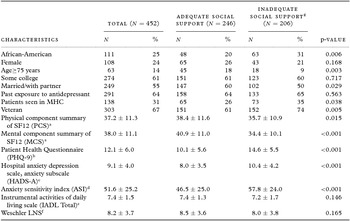
The mean DSSI score was 23 (score of ≤23 considered inadequate; SD = 4.2), with 46% of the participants reporting inadequate social support. Significant baseline characteristics of participants reporting low social support include age<75, single, African-American, lower self-rated physical and mental health (PCS/MCS), and higher self-ratings of depression (PHQ) and anxiety (HADS-A and ASI; Table 1).
Characteristics of sample, percent of group, and mean scores

a Possible component summary scores on the 12-item Short-Form Health Survey (SF-12) range from 0 to 100, with higher scores indicating a greater health.
b Possible scores on the 9-item Patient Health Questionnaire (PHQ-9) range from 0 to 27, with higher scores indicating greater depression.
c Possible scores on the anxiety subscale of the Hospital Anxiety and Depression Scale (HADS) range from 0 to 21, with higher scores indicating more severe anxiety symptoms.
d Possible scores on subscales 1 and 4 of the Anxiety Sensitivity Index-Revised (ASI-R) range from 0 to 105, with higher scores indicating greater anxiety.
e Possible scores on the Instrumental Activities of Daily Living (IADL) Scale range from 0 to 8, with higher scores indicating better functioning.
f Possible scores on the Wechsler letter-number sequencing (LNS) subscale range from 0 to 21, with higher scores indicating better executive functioning.
g “Inadequate social support” was defined as a score of a DSSI score of ≤23.
Main results
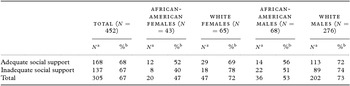
Logistic regression analysis of the overall study sample demonstrated no significant relationship between perceived social support and four-month adherence. However, after stratifying the sample by race and gender, a significant relationship between race, gender, social support, and treatment adherence emerged (Table 2). African-American participants (N = 111) had significantly lower four-month antidepressant adherence than white participants (N = 341; χ2 =7.42, df = 1, p = 0.006). Among those with inadequate social support, analyses across the race by gender subgroups showed that African-American females had the lowest adherence rates (40%), followed by African-American males (51%), white males (74%), and white females (78%; χ2 = 15.44, df = 3, p = 0.002).
Adherence by social support by gender by race subgroups, percent

a Number of patients adherent to antidepressant medication at four-month follow up.
b Percent of patients adherent to antidepressant medication at four-month follow up.
As shown in Table 2, African-American men and women with low social support have lower adherence to antidepressant medications as compared to African-American men and women with adequate social support, although this trend was not significant. Interestingly, this pattern was reversed for white participants, with those with low social support having higher adherence and those with adequate support demonstrating lower antidepressant medication adherence.
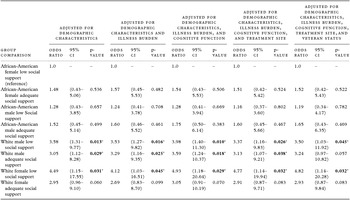
In logistic regression models (Table 3) using African-American females with inadequate social support as the reference group and controlling for baseline covariates in a sequential fashion, African-American females with low social support consistently showed significantly lower odds of adherence as compared to white females with inadequate support and white males with inadequate support. Even after controlling for all covariates, African-American females with low social support showed 4.8 times (95% CI = 1.14-20.28, p = 0.032) lower odds of antidepressant medication adherence as compared to white females with inadequate support. African-American females with adequate social support showed no significant differences from other groups. African-American males did not differ significantly from any of the groups regardless of level of social support.
Antidepressant adherence comparison across social support by race by gender subgroups

*p < 0.05.
“Low social support” was defined as a DSSI score of ≤23.
Logistic regression models controlled for demographics (age, education, marital status), illness burden (determined by prior use of an antidepressant, PCS, MCS, PHQ-9, HADS-A, ASI), cognitive function (IADLs, Weschler), treatment site (psychiatry vs. primary care), and Veteran status. Each set of covariates were added sequentially into the model.
Discussion
The present study demonstrates that roughly a third of older adults from our sample reported non-adherence to antidepressant medications within the early phase of treatment. It appears that there is a significant relationship between race, perceived social support, and antidepressant adherence. African-Americans with inadequate social support had lower levels of antidepressant adherence in the early treatment phase as compared to white older adults. There also appeared to be an interaction of race and gender as well. African-American females who reported inadequate social support had the lowest adherence to medications among all groups and may represent a particularly vulnerable population in regards to antidepressant treatment adherence. Of interest, the trend was reversed with white females, in that those with low levels of social support actually had improved medication adherence (78% adherent with low support vs. 69% adherent with adequate support, NS).
Previous studies have demonstrated varying perspectives on antidepressant and mental health treatment efficacy with African-American patients reporting higher perceived levels of stigma toward mental health diagnoses and treatment, resulting in less engagement in care (Prins et al., Reference Prins, Verhaak, Bensing and Van Der Meer2008). Studies have demonstrated that African-Americans may be more likely to view antidepressant medications as non-efficacious or potentially addictive and less likely to adhere to treatment (Burnett-Zeigler et al., Reference Burnett-Zeigler2014).
Studies have suggested that there are also gender differences in the importance of social support variables, with women typically having larger social support networks and maintaining more supportive relationships (Krause, Reference Krause2006). Women without these supports have been shown to be at greater risk of developing depressive symptoms (Olstad et al., Reference Olstad, Sexton and Soggard2001; Kendler et al., Reference Kendler, Meyers and Prescott2005). A sense of community and social network, both family and spiritual, is very important to the African-American community. For African-American women, there may be greater acceptance of utilizing support from relatives, friends, partners/spouses, and religious organizations as opposed to more formal mental health treatment services. African-American women without these supports may be at considerably higher risk than whites for subsequent non-adherence. The idea of the “strong black woman” may lead African-American women to believe that they do not have the time to seek treatment for depression, that depression is a normal part of aging, or that they should “go it on their own.” Low levels of social support in African-American women may also serve as a proxy for other disparities in access to mental healthcare, including lack of health insurance, availability of transportation, and cost of treatment, which may further impact medication adherence.
It remains unclear why white women with low social support had a trend of greater medication adherence rates within this study. One hypothesis may be that these individuals with low support find their interaction with the physician to be more socially rewarding, have an increased perceived benefit from medication treatment, and are therefore more likely to comply with treatment recommendations in an effort to be a “good patient.” Further, it has been shown that caregiver and family beliefs about depression treatment can impact adherence both positively and negatively. More family support and involvement is not always helpful at times, especially if family is encouraging patients not to take medications or adhere to treatment.
There are several limitations to the current study. The sample was drawn from outpatient clinics associated with VA medical centers and university primary care clinics in southeastern Michigan. It is possible that the results of our study may have differed if conducted in another geographic area. Additionally, our measure of adherence was provided by self-report for the university study and it is possible that pharmacy records or pill counts may have yielded alternative results. However, as shown in our veteran sample, use of MPRs predicted even greater rates of non-adherence than self-report (54% by MPR vs. 33% by BMQ), suggesting our results may be underestimated within the university sample.
Our current study only assessed a measure of perceived social support. It may be that other aspects of social support (instrumental support, size of social network, or frequency of social contacts) may have a greater overall influence on medication adherence and could be areas of future inquiry. While we attempted to account for many factors, such as demographics, illness burden, cognitive function, veteran status, and site of care, it is possible that unobserved confounding variables might mitigate the difference in antidepressant medication adherence, social support, and race found in our study. One such factor may be perceived benefit from treatment. Given the small sample size within race by gender subgroups, it is possible that our study is not sufficiently powered to evaluate these subgroup effects. Last, a single measure of social support only does not address the potential impact of change in social support or adherence over time.
Given the importance of the early treatment phase, great care should be taken to identify patients at risk for non-adherence in order to establish these patients in treatment. Our results of lower antidepressant adherence rates in African-American women with low social support suggest the need for culturally sensitive, gender-specific, depression care interventions that are sensitive to race and gender differences. Targeted interventions for those individuals with low levels of support could include social skills training, assessment of quality and quantity of relationships, and encouragement of participation in community and patient advocacy groups may help to improve adherence. Utilization of tailored interventions, such as the Treatment Initiation and Participation Program (TIP) focused in primary care patients, may help address these barriers to adherence (Sirey et al., Reference Sirey, Bruce and Kales2010). Future research on the specific variables and factors within social support that most influence treatment adherence could be helpful in better targeting these interventions.
Conclusions
The present study demonstrates a significant relationship between race, gender, perceived social support, and antidepressant medication adherence among older adults. African-American women with low social support had the lowest rates medication adherence and may represent a particularly vulnerable population in regards to depression treatment adherence. Targeted interventions for individuals with low social support should be sensitive to racial and gender differences.
Conflict of interest
None.
Description of author's roles
All authors have made substantive contributions to the study, and all authors endorse the data and conclusions. Study concept and design: Gerlach, Kales, Kavanagh. Acquisition, analysis, or interpretation of data: Gerlach, Chiang, Kim. Drafting of the manuscript: Gerlach, Kales, Watkins. Critical revision of the manuscript for important intellectual content: All authors. Statistical analysis: Chiang, Kim.
Acknowledgments
Grant support provided by the National Institute of Mental Health (5R21MH073002) and Veterans Affairs Health Services Research & Development (IIR 04-104-2).