Introduction
As populations age, psychological distress in late life will become of increasing public health importance. People can be expected to experience more distress in late life, due partly to psychosocial stressors and loss, but also due to increasing frailty and physical illness (Vin et al., Reference Vin2009; Glaesmer et al., Reference Glaesmer, Riedel-Heller, Braehler, Spangenberg and Luppa2011). For example, life events such as bereavement or other adverse experiences have been found to be a major trigger for depression and poor mental health (Almeida et al., Reference Almeida, Alfonso and Pirkis2011), although these effects may be less at advanced age and life-stage than earlier in life (Vin et al., Reference Vin2009). Other psychosocial stressors such as lower income and financial stress, loneliness, isolation, and lack of social support may also contribute to psychological morbidity in later life (Almeida et al., Reference Almeida, Alfonso and Pirkis2011; Glaesmer et al., Reference Glaesmer, Riedel-Heller, Braehler, Spangenberg and Luppa2011). Social and family networks might be limited in older age, and the coping mechanisms of older people may not be as robust as they once might have been (Pirkis et al., Reference Pirkis2009). There is also a theory of terminal decline whereby people with relatively stable mental health throughout life experience sudden onset of psychological morbidity toward the end of life (Gerstorf et al., Reference Gerstorf2010).
Comorbid physical conditions also contribute to the prevalence of psychological distress in older age. There is a strong correlation between clinical depression and comorbid physical conditions, and as populations age and chronic disease rates increase, mental health conditions will also rise (Moussavi et al., Reference Moussavi2007). Consequently, it is projected that depression will be the second leading cause of global disease burden by the year 2020 (Moussavi et al., Reference Moussavi2007). However, despite the expected increasing prevalence of psychological morbidity with population aging, there is little consensus about the prevalence or correlates of psychological conditions in late life. Some studies suggest anxiety may be more prevalent than depression in older age (Bryant et al., Reference Bryant, Jackson and Ames2008). However, distinguishing between anxiety and depression in epidemiological studies is difficult as anxiety and depression are often comorbid (Lenze et al., Reference Lenze2005) and their measures are highly correlated (Koloski et al., Reference Koloski, Smith, Pachana and Dobson2008).
A limitation of many studies of psychological factors in late life is the small numbers of people at very old ages (for example, Glaesmer et al., Reference Glaesmer, Riedel-Heller, Braehler, Spangenberg and Luppa2011); however, the oldest old represent the fastest growing population group in developed countries (Christensen et al., Reference Christensen, Doblhammer, Rau and Vaupel2009), and therefore more information is vital in planning for their needs. Most of what we know about people at these older ages comes from studies in residential care or clinical settings (Brodaty et al., Reference Brodaty2003), or from smaller community samples (Djernes, Reference Djernes2006).
Another limitation is that many studies of psychological morbidity in older age do not investigate differences by gender. Studies of depression at younger ages report higher rates for females than for males (for example, Trollor et al., Reference Trollor2007), and similar effects have been found among older samples (Djernes, Reference Djernes2006). However, this gender difference in late life was not found by Pirkis et al. (Reference Pirkis2009) who speculate that gender difference in depression may be negligible among older adults. The study by Leach et al. (Reference Leach2008) reported that the gender difference in rates of depression between men and women (aged 60–64 years) was mediated by a higher level of physical symptoms, lower level of physical activity, and a higher degree of some psychological and interpersonal factors reported by women, relative to those reported by men. Other studies have observed that gender differences relate not so much to the prevalence of symptoms but to the higher probability of diagnosis of depression and anxiety among women in general (Bertakis et al., Reference Bertakis, Helms, Callahan, Azari, Leigh and Robbins2001) and the higher risk of suicide among older men (Li, Reference Li1995; Wai-chi Chan et al., Reference Wai-chi Chan2009).
In this study, we aimed to explore the prevalence of psychological distress among a very large sample of older adults to determine the impact of age and gender, and the modifying effect of these factors on the associations between measures of psychological distress and sociodemographic and comorbid conditions. We hypothesized that the prevalence of high levels of psychological distress will increase at older ages, and that age and gender will modify associations between psychological distress and other covariates.
Methods
Study population
The 45 and Up Study is a large-scale study of healthy aging and involves 266,848 individuals living in New South Wales, Australia, aged 45 years and over. The sample was randomly selected from the Medicare Australia database, which provides virtually complete coverage of the general population, with twofold oversampling of individuals aged 80 and over and those residents in rural areas. Participants completed a postal questionnaire and provided written consent to follow their health in the long term, through repeat questionnaires, linkage to health records, and additional more detailed data collection. Recruitment into the study began in February 2006 and was completed in December 2008. Further explanations of selection criteria, sampling, cohort profiles, and study details are available at www.45andUp.org.au.
The 45 and Up Study received ethics approval from the University of NSW Human Research Ethics Committee.
Data
All of the variables used in this study were derived from self-reported data from the 45 and Up Study questionnaire (available at www.45andUp.org.au). The outcome measure used in these analyses was the Kessler Psychological Distress Scale (K10) (Furukawa et al., Reference Furukawa, Kessler, Slade and Andrews2003). The K10 is a widely used and well-validated tool which measures symptoms of psychological distress experienced over the past four weeks (Furukawa et al., Reference Furukawa, Kessler, Slade and Andrews2003). High K10 scores correlate well with current CIDI diagnoses of depression and anxiety (Andrews and Slade, Reference Andrews and Slade2001). A five-value response scale is used for each question – all of the time, most of the time, some of the time, a little of the time, and none of the time. The maximum score is 50 indicating severe distress, and the minimum score is 10 indicating no distress. In keeping with the National Survey of Mental Health and Wellbeing (Furukawa et al., Reference Furukawa, Kessler, Slade and Andrews2003), the National Health Survey (Australian Bureau of Statistics, 2009), and the New South Wales Population Health Survey (New South Wales Department of Health, Centre for Epidemiology and Research, 2010), in the following analyses we have considered K10 scores of 22 and above to be indicative of high levels of psychological distress and scores of 30 and above to indicate very high levels of distress.
The survey also included information on sociodemographic factors (highest level of education, marital status, housing type, language spoken at home, income, and employment) as well as self-reported diagnoses of common conditions (stroke, diabetes, Parkinson's disease, cancer, heart attack, other heart disease, high blood pressure, high cholesterol, blood clots, asthma, arthritis, osteoporosis, thyroid condition) and reported need for help with any form of disability. A simple comorbidity score was constructed by counting the number of self-reported conditions.
Area of residence was determined by the postal address (postcode) and classified using the Accessibility/Remoteness Index for Australia (ARIA+) (Australian Bureau of Statistics, 2010) as major city, inner regional, outer regional, remote, and very remote. Since few people live in very remote areas, the remote and very remote categories were collapsed for analysis.
Data management and analyses
Two sequential approaches were used to substitute missing responses on the K10 and thereby minimize the effect of missing data on K10 scores. First, Questions 2 and 3 (nervous and so nervous), questions 5 and 6 (restless and so restless), and questions 7 and 9 (depressed and so sad), were treated such that the missing response from the second question in each pair could be assumed to be “none of the time” if the response to the first question was also “none of the time”; second, where data remained missing for only one question, the missing value was imputed by taking the participant's mean score across the other nine questions. K10 scores were assumed to be missing for participants with more than one missing score, after substitution of missing responses outlined above.
K10 scores were calculated and categorized, and the proportions of people reporting high and very high scores (K10 score of 22 or higher) for each five-year age range were calculated separately for males and females. Associations between high K10 scores and sociodemographic and health variables (self-reported conditions, need for help with daily tasks because of disability, and comorbidity) were examined for the whole study population and in four age and sex categories: males aged under 80; males 80 and over; females under 80; and females 80 and over. Odds ratios (OR) and 99% confidence intervals (CI) for high/very high psychological distress in relation to health variables were adjusted for demographic factors and identified statistical interactions. These were calculated overall and in each specific age/gender subgroup. Statistical interaction was tested for using the maximum likelihood ratio test for the model with and without the age (<80, ≥80) and gender interaction term. Because of the large numbers of participants, interpretation of statistical interaction was based on both statistical significance and the magnitude of the variation in the ORs.
Results
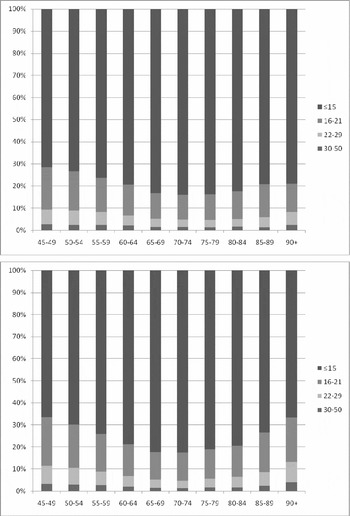
Due to missing data on K10 items, scores could not be calculated for all participants, leaving 236,508 participants with valid K10 scores for this analysis. The median age of the participants was 61 years for males, and 58 years for females. The oldest male participant was aged 102 years and the median age of the 80 years and over male group was 82; the oldest female was 106 years and the median age of the 80 years and over female group was 83 years. Prevalence of high and very high scores decreased with age up to age 80, and was lower for men than for women at all ages (see Figure 1).
Prevalence of low, medium, high, and very high K10 scores for 111,268 men (top) and 125,240 women (bottom).

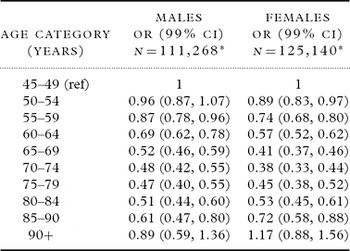
For both genders and compared to those aged 45–49 years, the odds of having depression were significantly lower for all age groups from 55–59 to 85–90 (see Table 1). Wider 99% confidence intervals for odds ratios for those aged 90 years or over reflect lower precision in these age groups. Overall, among those aged <80 years, 7.0% of men had high/very high K10 scores compared with 8.4% of women; among those aged 80 years or more 5.2% of men and 7.6% of women had high/very high scores.
Odds ratios and 99% confidence intervals for high/very high K10 by age

* Number of valid K10 scores.
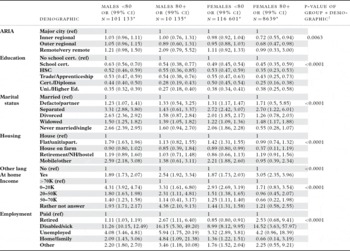
The results of logistic regression models to determine the association between gender and age and higher risk of psychological distress are shown in Table 2. In these models, four groups were created to represent the males aged under 80 years, males 80 years and over, females under 80 years, and females 80 years and over. Separate models were run for each demographic factor, with age/gender group, demographic factor, and the interaction between group and demographic factor included in each model. The interaction between group and demographic factor was significant in all models, indicating that age and sex were significant effect modifiers.
Odds ratios and 99% confidence intervals for high/very high K10 scores showing effect modification of age and gender on demographics

* Number of valid k10 scores.
† All p-values for the interaction between group and demographic indicate that the association between each demographic and psychological distress is mediated by age and gender.
cert. = certificate; HSC = Higher School Certificate; NH = nursing home.
Higher education was associated with lower risk of psychological distress compared to having no qualifications, in all four groups. Area of residence had little relationship with the odds ratios for high scores, except for women over 80 years, where those in regional areas were significantly less likely to be depressed than those in urban areas. Speaking a language other than English was associated with increased risk of psychological distress, particularly at older ages. Among men under 80 years of age, those with categories of marital status other than married were more likely to have high/very high scores compared to married men. This effect was not seen among the 80 years and over group, except for widowed men. A similar effect was observed for women, where all women under 80 years of age with categories of marital status other than married were more likely to have high/very high scores; separated or widowed women also carried a higher risk of psychological distress at older ages. Living in an apartment or mobile home carried higher risk than living in a house for younger men and women, but not those aged 80 years or over. Income and employment status appeared to affect men in both age groups, but only affected women in the less than 80 years age group.
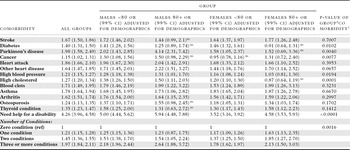
For all age groups combined, a significantly increased risk of high psychological distress was observed for each condition examined, compared to individuals without the specific condition. However, this increased risk was not seen consistently in all four age/gender groups. The age/gender interaction was significant for six of the conditions (diabetes, Parkinson's disease, cancer, high blood pressure, high cholesterol, and needing help for a disability) (see Table 3). Among the 80 years and over female group, the effect was attenuated for diabetes, high blood pressure, and high cholesterol. The association of psychological distress with need for help with daily tasks was less strong for women under 80 years than for women 80 years or over, and for men at any age.
Sociodemographic adjusted odds ratios and 99% confidence intervals for high/very high K10 scores for comorbidities for males and females, less than 80 and over 80

† If nonsignificant, refer to the OR for “All groups” since a nonsignificant interaction between group and comorbidity indicates that the association between the comorbidity and psychological distress is not mediated by age and gender.
If the interaction is significant, refer to the specific odds ratios for each subgroup.
In general, the risk of being depressed increases with increasing number of conditions. However, the interaction between age/sex group and number of conditions is statistically significant, with odds ratios for females aged less than 80 years tending to be lower than the all group estimate.
Discussion
This study provides information on psychological distress scores, measured by the K10, for a large population sample of community dwelling individuals and including substantial numbers of very old participants. The data show that while the overall prevalence of psychological distress is lower at older ages, there is a gradual increase in the proportions with high or very high scores for those aged 80 years or over. The data also show that the finding of women having higher scores than men persists at older ages, and that relationships between psychological distress and associated demographic factors and physical morbidities vary significantly by age and gender.
Among men and women, the age relationship was such that the associations between unmarried marital status and housing was greater in the younger age group than for those in the older age group. These associations may reflect more recent bereavements, and/or adjustments to changes in housing, social networks, and neighborhood settings, or difficulties associated with living alone, decreased income, and loneliness. The 45 and Up Study does not include date of death or loss of spouse, or duration of housing tenure, so it is not possible to test these effects statistically. However, other research indicates that men and women experience depression following bereavement (Byrne et al., Reference Byrne, Raphael and Arnold1999; Djernes, Reference Djernes2006; Almeida et al., Reference Almeida, Alfonso and Pirkis2011). Single marital status is also correlated with lower income (McGarry and Schoeni, Reference McGarry and Schoeni2005), and this may be another reason for higher rates of psychological distress among unmarried people. In our data, there is a strong association between lower income and higher psychological distress for all groups except for women aged 80 years or over.
The lived experience following death of a spouse has so far been given greater emphasis in studies of women than those of men. However, there are some studies that suggest that men are at increased risk of suicide and overall mortality in the first six months after the loss of a spouse, compared to married men, whereas this effect is not seen for women (for example, Li, Reference Li1995). Men are also more likely than women to suffer from depression, mental illness, increased alcohol intake, and physical health problems after the death of a spouse (Byrne et al., Reference Byrne, Raphael and Arnold1999; van den Brink et al., Reference van den Brink2004).
The association between physical comorbidities and psychological distress has been documented in a number of studies (Djernes, Reference Djernes2006; Moussavi et al., Reference Moussavi2007; Almeida et al., Reference Almeida, Alfonso and Pirkis2011; Glaesmer et al., Reference Glaesmer, Riedel-Heller, Braehler, Spangenberg and Luppa2011; Nicolosi et al., Reference Nicolosi2011). However, many studies lack data on people at very old ages. For instance, the Australian National Survey of Mental Health and Wellbeing surveyed adults aged 18–85 years only; it therefore does not provide information on very old people (Australian Bureau of Statistics, 2007). Also, studies that report depressive symptoms provide higher estimates than those reporting psychiatric disorders or diagnoses (Djernes, Reference Djernes2006), as do those involving older people in institutional settings or clinical settings compared to studies involving community samples (Dozeman et al., Reference Dozeman2010). Limited consensus about the prevalence or correlates of psychological conditions in late life prevails, with estimates of depression at age 65 years and over ranging from 1% to 49% across 122 studies (Djernes, Reference Djernes2006). The community survey by Pirkis et al. (Reference Pirkis2009) of 22,251 patients aged 65 years and over attending GP clinics across Australia found that the age-adjusted prevalence of clinically significant depression was 8.2% (95% CI = 7.8–8.6), with a male:female rate ratio of 1.1. A concerted effort to provide more robust estimates of the prevalence of depression and related conditions in later life has also been undertaken in Europe. The EURODEP study combines data from 14 community-based studies on depression in later life in nine western European countries to create a total study sample of 22,570 respondents aged 65 years and older (Braam et al., Reference Braam2005). A meta-analysis of harmonized measures from across these studies yielded a mean prevalence of depression of 12.3% (95% CI 11.8–12.9): 14.1% for women (95% CI 13.5–14.8) and 8.6% for men (95% CI 7.9–9.3) (Copeland et al., Reference Copeland, Beekman and Braam2004).
In this study, there are strong age/gender interactions for some conditions, indicating that these effects are not equal across all groups. In general, the main difference appeared to be weaker associations for women in the older age group. The reasons for this interaction are not clear, but may reflect survivor bias or better coherence with personal and community expectations of older age. These effects are not evident for older men, but older men generally tend to have lower rates of disability than older women (Giles et al., Reference Giles, Cameron and Crotty2003), and may have greater expectations for their physical well-being based on past performance or compared to their peers.
As in other studies (for example, Braam et al., Reference Braam2005), the association of depressive symptoms with need for help with functional disability was stronger than the association with any of the chronic physical conditions. Again, this association was less strong for women aged 80 years or over than for other age groups.
A different age/gender pattern was observed when considering the number of conditions reported by the participants, with associations being less strong for females under 80 years, after adjustment for demographic factors. These counts included conditions with low or non-significant association with psychological distress, and were not weighted for the severity of the condition, its seriousness, nor its effects on quality of life. Interestingly, the number of comorbid conditions appeared to be associated with higher psychological burden among older age groups for both genders, indicating the double impact of age and overall illness burden.
While the strengths of this study include the very large population sample and large numbers of very old people, the study is limited by the narrow range of variables included in the omnibus health survey, and the reliance on a single brief survey measure such as the K10 for the ascertainment of psychological distress. Within this data set, it is not possible to ascertain psychological caseness, or to differentiate between depression and anxiety as the basis of psychological distress. Nonetheless, the study does provide an indication of age-associated increases in distress at older ages. The findings point to the need for further in-depth studies of mental health and changes in mental health among community-dwelling older people. The increased risk of psychological distress in some particularly vulnerable subgroups of older people (such as those requiring help because of disability and those with multiple comorbid health conditions) is of particular concern. Overall, the findings of the study point to the wider need for health professionals to be aware of the issue of psychological distress in older people and to have the necessary skills to identify, assess, and intervene to reduce the mental health burden in this growing segment of the population.
Conclusion
This analysis of psychological distress and its relationship to age, gender, and other factors indicates that, although overall prevalence of psychological distress is lower at older ages, the prevalence does begin to increase after 80 years of age and in association with physical disabilities. As populations age, the impact of depression among very old people will become of increasing social significance. Healthcare providers and policy-makers cannot afford to remain unaware of the specific needs of people in these older age groups.
Conflict of interest
None.
Description of authors' roles
Julie Byles conceived this study, interpreted results, and prepared the paper. Lucy Gallienne provided analysis and interpretation of data and contributed to the paper. Fiona Blyth and Emily Banks also conceived this study, interpreted results, and contributed to the paper.
Acknowledgments
This project was supported by beyondblue: the national depression initiative. Emily Banks is supported by the Australian National Health and Medical Research Council.
This research was completed using data collected through the 45 and Up Study (www.45andUp.org.au). The 45 and Up Study is managed by The Sax Institute in collaboration with major partner the Cancer Council New South Wales and with the following other partners: the National Heart Foundation (NSW Division); NSW Health; beyondblue: the national depression initiative; Ageing, Disability and Home Care, NSW Department of Human Services; and Uniting Care Ageing. This research was funded by beyondblue.
We thank the many thousands of people participating in the 45 and Up Study.
We also thank Sue Gherdovich for her review and feedback, and Cassie Curryer for her assistance with preparation of the final paper.