Transcatheter closure of the patent ductus arteriosus is considered the first choice for most elderly patients who experience pharmacological closure failure, and it is still the primary choice for pre-term newborns and infants. Reference Shah, Bhalodiya, Rawal and Nikam1–Reference Kang, Morgan, Forsey, Tometzki and Martin6 Moreover, some patients with a giant patent ductus arteriosus have begun to receive transcatheter closure, but they should always undergo surgical ligation. Reference Malekzadeh-Milani, Akhavi and Douchin2,Reference Kim, Schechter and Manning7 However, apart from some common complications, Reference Gupta and Rao8 we noticed that thrombocytopenia occasionally occurred following closure in some cases of patent ductus arteriosus; a long duration was needed for recovery, and the patients remained in a dangerous condition. Reference Jin, Liang and Wang5,Reference Po Zhang and Xian-yang9 In addition, thrombocytopenia has always been observed in patients who receive devices with large sizes. However, no precise definition of giant patent ductus arteriosus was identified during a literature review. Here, we aimed to identify cases of patent ductus arteriosus requiring occluders with a size of more than 10/12 mm for giant patent ductus arteriosus.
Unfortunately, there is no related research focusing on this issue to describe the exact incidence of, natural history of, treatment efficacy of, or associated risk factors for thrombocytopenia post-procedure, resulting in major difficulties in clinical management. According to our clinical observations, thrombocytopenia usually occurs among patients who receive a closure device with a size exceeding 10/12 mm. Therefore, we first carried out a retrospective cohort of children who underwent transcatheter closure of a giant patent ductus arteriosus by receiving an occluder with a size exceeding 10/12 mm to determine the overall incidence of and associated risk factors for thrombocytopenia after transcatheter closure of the giant patent ductus arteriosus. This research was approved by the ethics committee of the West China Second University Hospital, Sichuan University.
Methods
Patient population
All the patients receiving ductal occluders to close the giant patent ductus arteriosus were retrospectively recruited between January 2013 and June 2019 at the West China Second University Hospital of Sichuan University. This research strictly follows the Strengthening the Reporting of Observational studies in Epidemiology statement. All patients were diagnosed with a patent ductus arteriosus by transthoracic echocardiography confirmed during the transcatheter procedure by angiography. Prior to the closure procedure, chest radiography and electrocardiography were performed to identify pulmonary and cardiovascular concerns, and angiography was used to confirm the shape and size of the patent ductus arteriosus.
Inclusion and exclusion criteria
To enrol candidates for further analysis, we used a patent ductus arteriosus diagnosed by transthoracic echocardiography and confirmed by angiography, the size of the received occluder was more than 10/12 mm, all patients received symmetric Amplatzer-type occluders manufactured by AGA Medical (Golden Valley, Minnesota, United States of America) or SHAMA (Shanghai, China), which share the same materials (nitinol alloys) and symmetric double-disk structure with similar functional features. According to our previous studies and other studies that enrolled both types of devices, the devices were treated similarly, indicating no significant difference in therapeutic or prognostic issues; patients with detailed records of laboratory examinations pre- and post-procedure, including patient weight, angiographic patent ductus arteriosus minimal diameter, occlusion device used, sheath size required, haemodynamic data, operation duration, procedural complications, and hospitalisation stay. The exclusion criteria included patients with any other cardiac malformation, the occurrence of severe complications, such as embolism of the device, patients with residual shunting for more than 24 hours or with a shunt diameter larger than 2 mm due to potential mechanical injuries to blood components, patients who were voluntarily discharged from the hospital without final data to demonstrate the duration of platelet restoration, and patients with incomplete clinical data. These criteria are consistent with the guidelines of transcatheter closure for patent ductus arteriosus. Reference Schneider and Moore10 Informed consent was obtained from all patients or their guardians. This research was approved by the ethics committee of the West China Second University Hospital, Sichuan University, No. 2014-037. Written consent forms were obtained from the parents of all participants.
Procedure
Patent ductus arteriosus closures were performed under general anaesthesia in children <10 years old and local anaesthesia in older children. The transcatheter closure procedure was highly restricted to the guidelines of transcatheter treatment for CHD. Reference Feltes, Bacha and Beekman11 Dynamic electrocardiogram monitoring was applied during and on the 1st day after the procedure. Right and left cardiac catheterisation was performed via the percutaneous transfemoral route. The haemodynamics of the pulmonary vessels were measured, and pulmonary vessel resistance was evaluated before final occlusion. Pulmonary artery resistance (wood units) was calculated as [average pulmonary artery pressure (mmHg) − average pulmonary capillary pressure (mmHg)]/pulmonary circulating blood flow (L/min). Once the pulmonary artery resistance was identified to be greater than 8 woods, the criteria for occlusion were considered to be missed. However, once the pulmonary artery resistance was calculated to be between six and eight woods, 30 minutes of observation of pulmonary pressure was performed before finally releasing the device from the delivery wire. Echocardiography imaging was performed during the procedure to assess the profile patent ductus arteriosus in the left ventricular long-axis oblique view. The size and shape of the patent ductus arteriosus were further confirmed by angiography. The size of the device was usually selected to be 1–2 mm larger than the ductus measured by angiocardiography. Larger devices (approximately 3–4 mm larger than the diameter of the defects) were chosen in patients with an aneurysm or when complete closure could not be achieved using a device with a regular diameter. Heparin (100 U/kg) was administered to all patients after successful femoral artery access. Aspirin was given for 6 months after the procedure, but it should be avoided in thrombocytopenia patients. The discharge criteria were that the level of platelets stayed above 80 × 109/L for 2 days after increasing from baseline, without any sign of haemorrhage.
Risk factor analysis
At first, the basic clinical characteristics of the enrolled patients were recorded, including age, weight, patent ductus arteriosus size, occluder disc size, operation time, and hospitalisation stay. In addition, changes in blood components (red blood cells, white blood cells, platelets, etc.) and coagulation function were compared between pre- and post-transcatheter closure times.
Then, univariate analyses were performed between thrombocytopenia and non-thrombocytopenia patients. Additionally, complications, such as haemolysis and arrhythmia related to the intervention procedure, were recoded. Then, receiver operating characteristic curves were used to identify the predictive value of risk factors that were found by comparison.
Moreover, the abnormal haemodynamics of the giant patent ductus arteriosus lead to enlargement of the left cardiac chambers, so captopril was always applied to help restore cardiac function. Steroids were provided as the haemoglobin or platelet levels dropped to reduce the mechanical stress injuries due to contact between the high-speed blood flow in the aorta and the fabric surface of the device. Platelet transfusion was applied once the platelet counts dropped below 20 × 109/L. According to this protocol, steroids, captopril, and platelet transfusions were thought to be beneficial for reducing hospitalisation. Therefore, we tested whether there was an impact between medication treatment and hospitalisation stay. During this analysis, we used the unit of the ratio of disc size of the occluder and body weight so that we could normalise the hospitalisation stay by this unit of the ratio of occluder size and weight.
Statistical analysis
Data analysis was conducted using SPSS 21.0 (SPSS Inc., Chicago, Illinois, United States of America). Quantitative data are presented as the mean ± standard deviation, while qualitative data are expressed as n. Differences between two groups were assessed using independent t-tests or Mann–Whitney U-tests for continuous variables and the chi-squared test or Fisher’s exact test for categorical variables. The predictive validity of candidate risk factors for thrombocytopenia was determined by receiver operating characteristic curve analysis. The ratio of occluder size and body weight for hospitalisation stay and the corresponding 95% confidence intervals were determined by a linear regression model. Statistical significance was defined by p values < 0.05.
Results
Among 536 candidate patients who underwent patent ductus arteriosus closure procedures between January 2013 and June 2019, a total of 353 patients were excluded as follows: 344 patients had a ductal occluder size <10/12 mm, 6 patients had incomplete data according to the predefined criteria, and 3 patients suffered from severe complications and residual shunting lasting more than 24 hours. Finally, 183 patients who received occluders >10/12 mm in size were enrolled for this research, with ages ranging from 2 to 281 months and body weights ranging from 4.25 to 48.5 kg. Among them, 32 patients suffered from thrombocytopenia, and 151 patients did not.
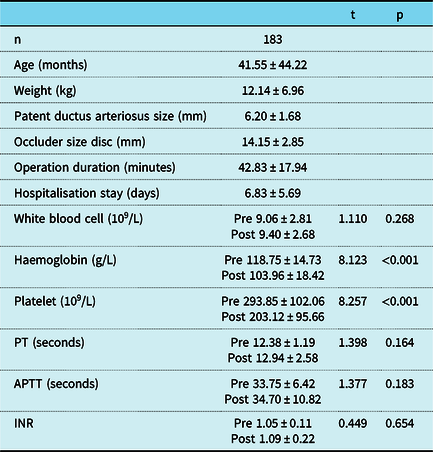
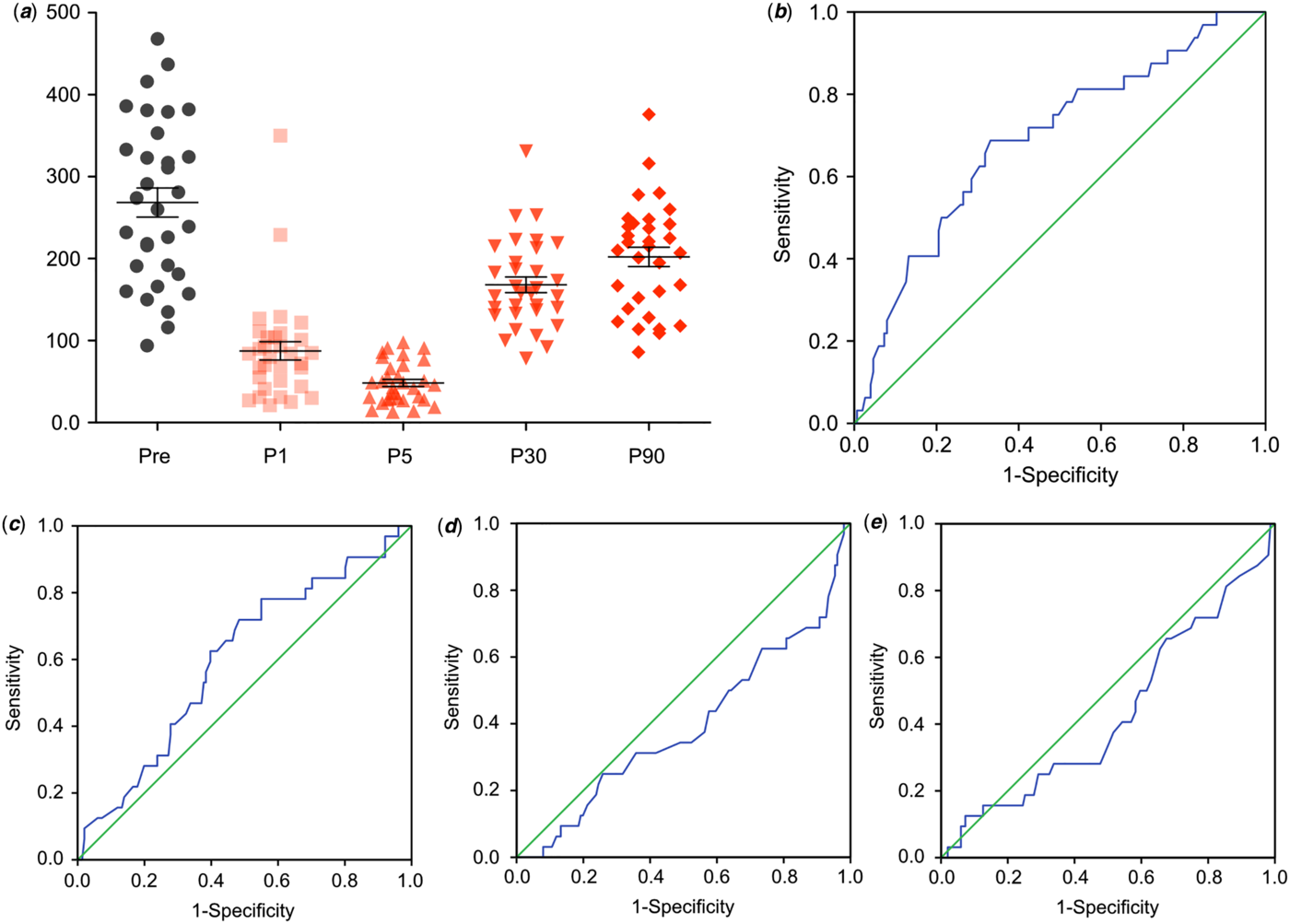
We analysed the characteristics of blood components and coagulation function (Table 1). Accordingly, platelets were significantly reduced to a low level, which reached the diagnostic criteria for thrombocytopenia (Table 1). In addition, haemoglobin also decreased between the pre- and post-procedure tests due to the acute loss of blood during the procedure, mainly with a large sheath delivery system (Table 1). The decrease in platelets was identified on the 1st day post-procedure (87.34 ± 63.55 × 10⁹/L n = 32) and dropped to baseline levels on approximately the 5th day after closure (48.28 ± 25.00 × 10⁹/L n = 32). Then, the level of platelets increased slowly (168.10 ± 53.90 × 10⁹/L n = 32, 30 days post-closure), reaching close to the pre-closure count on the 90th day of follow-up (202.10 ± 66.69 × 10⁹/L n = 32) (Fig 1a).
Baseline data of enrolled cohort

APTT = Activated partial thromboplastin time; INR = international normalized ratio; PT = prothrombin time.
All the blood tests were completed at 1 day before and 1 day after procedure. Although the decrease of haemoglobin has been demonstrated between pre- and post-procedure test, no haemolysis patient has been identified during the cohort hospitalisation and follow-up. So the decrease of haemoglobin was considered due to the loss of blood during procedure mainly with large sheath delivery system.
The platelet level among enrolled patients from pre-operation to the 90th day post-closure (a) and the receiver operating characteristic curves for ratio of occluder size and weight, (b), the ratio of occluder size and age (c), weight (d), age (e), respectively.

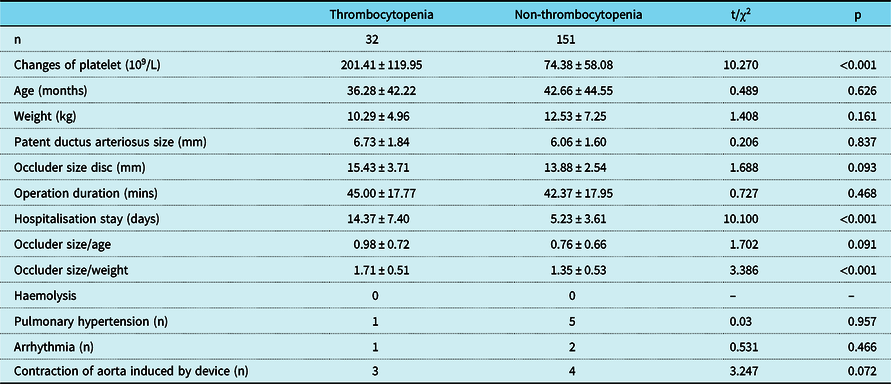
A total of 32 (17.5%) of 183 patients satisfied the criteria for thrombocytopenia, with an average change of 201.41 ± 119.95 × 10⁹/L between the pre- and post-procedure tests and with the lowest change (Table 1). Univariate analysis revealed the ratio between occluder disc size (mm) and body weight (kg) (1.71 ± 0.51 versus 1.35 ± 0.53) as an independent predictive factor for thrombocytopenia after closure. However, no significant difference was confirmed in terms of the parameters of occluder size, weight, and age independently (Table 2). All the enrolled thrombocytopenia patients were excluded for the potential of heparin-induced thrombocytopenia. In receiver operating characteristic analysis, the area under the curve of the ratio of occluder size and weight for predicting thrombocytopenia post-closure was 0.691 (95% confidence interval: 0.589–0.792, p = 0.001), while the ratio of occluder size and age revealed an area under the curve of 0.602 (95% confidence interval: 0.496–0.707, p = 0.071). Youden’s test provided the best cut-off value for the ratio of occluder size and weight of 1.5895, demonstrating a diagnostic sensitivity and specificity of 68.8 and 66.9% for thrombocytopenia, respectively. In addition, the results demonstrated a lower predictive value only when using the occluder disc size (area under the curve = 0.494, 95% confidence interval: 0.388–0.600, p = 0.917) or body weight (area under the curve = 0.432, 95% confidence interval: 0.320–0.544, p = 0.227) independently as predictive factors (Fig 1d and e).
Univar analysis between thrombocytopenia and non-thrombocytopenia patients

All the PH patients received the ET-1 inhibitor (bosentan) therapy, and the pressure of pulmonary artery decreased after 1 year follow-up. No aggressive increased PH occurred.
All the cases suffered contraction of aorta post-closure were considered due to the comparable enlargement of the device. However, all the contraction failed to be recorded after 6 months follow-up due to the growth of body weight and the size of aorta.
Two patients confirmed bradycardia and one patient demonstrated complete right bundle branch block within 1 week after occluder implantation. All of them disappear in 2 months electrocardiogram examination.
The changes of platelet were calculated with the data recorded at 1 day before and 1 day after procedure.
Only one of six patients with pulmonary hypertension suffered from thrombocytopenia after the procedure, and all of them received endothelin-1 inhibitor (bosentan) therapy, while the pressure of the pulmonary artery decreased during the 1-year follow-up. No aggressive increase in pulmonary hypertension was observed. In seven patients, contraction of the aorta post-closure was considered to be due to the comparable enlargement of the device, and three of them presented with thrombocytopenia. However, all contractions failed to be recorded again after 6 months of follow-up due to the increase in body weight and the circumference of the aorta. Three patients showed arrhythmias post-procedure, and two of them had confirmed bradycardia, while the other patient demonstrated complete right bundle branch block within 1 week after occluder implantation. All arrhythmias disappeared after 2 months of electrocardiogram examination. Therefore, pulmonary hypertension is not a risk factor for thrombocytopenia, and thrombocytopenia is not associated with cardiovascular complications (Table 2).
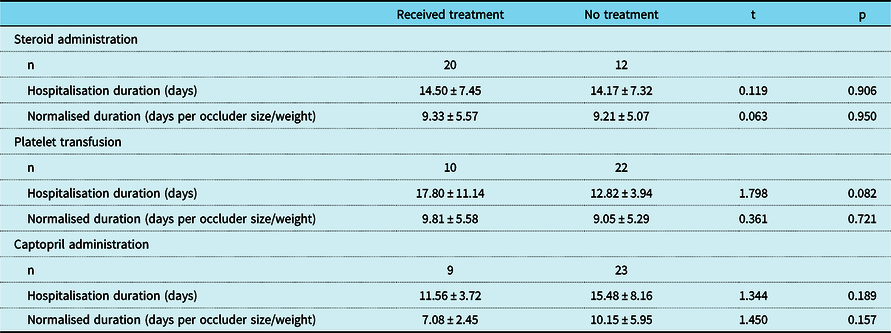
Commonly, the length of hospitalisation stay is related to the severity of thrombocytopenia after the procedure, and the ratio of occluder size and weight is associated with the duration of hospitalisation. The average hospital stay was 14.37 ± 7.40 days for thrombocytopenia patients and 5.23 ± 3.61 days for other giant patent ductus arteriosus cases. Herein, we set a unit as the ratio of occluder size and weight, in which clinical outcomes could be normalised by the units of the ratio of occluder size and weight. The linear regression revealed that each unit predicted an average hospitalisation stay of 2.856 days (Y = 2.777 + 2.856X, 95% confidence interval: 1.380–4.332, p < 0.001). According to our therapeutic strategy, we analysed whether any treatment protocols among steroid administration, platelet transfusion, and captopril administration in our cohort could shorten the hospitalisation stay. We compared the exact data and the normalised data by the unit of the ratio of occluder size and weight. All the results showed that the aforementioned treatments could not benefit patients fighting thrombocytopenia to reduce the duration of hospitalisation, but we still consider that some treatments may help patients avoid severe complications from thrombocytopenia, such as intracranial haemorrhage (Table 3).
Potential treatment to reduce the hospitalisation

According to our analysis, the hospitalisation duration was related to the ratio of occluder size and their body weight. So that we used these data to normalise the duration time.
Discussion
Over the past three decades, transcatheter occlusion of the patent ductus arteriosus has evolved to be the primary choice with rare complications, such as embolisation, contraction, left pulmonary artery stenosis, and haemolysis. Reference Ghasemi, Pandya and Reddy12,Reference Vavuranakis, Tzannos, Thanopoulos, Vlasis and Stefanadis13 With the increasing number of transcatheter closures of the patent ductus arteriosus, thrombocytopenia has been reported in some studies. Reference Jin, Liang and Wang5,Reference Po Zhang and Xian-yang9 Due to the lack of understanding of the natural history of and risk factors for thrombocytopenia after the procedure, it is difficult to make a precise clinical management decision.
In this study, we found that approximately 17.5% of patients had thrombocytopenia; the decrease in platelets after transcatheter occlusion of the patent ductus arteriosus was most obvious on the 1st–5th day post-procedure and was restored to normal levels on the 90th day after closure. The ratio of occluder size and weight was an obvious risk factor for thrombocytopenia in our cohort. Inconsistent with the previous study, which reported that a larger occluder diameter contributed to a higher prevalence of thrombocytopenia, Reference Po Zhang and Xian-yang9 our findings concluded that thrombocytopenia was not independently associated with the occluder size but was associated with the ratio of occluder size and weight. However, the conclusion of a previous study was made according to the results from six cases. Our results demonstrated the largest cohort focusing on this issue, which makes our conclusion more convincing.
More importantly, this study was the first to identify that the ratio of occluder size and weight was also related to the duration of hospitalisation stay. Once the ratio of occluder size and weight increased by one unit, the hospitalisation stay was prolonged by 2.856 days (95% confidence interval: 1.380–4.332). The linear regression equation could help clinicians better clarify the hospitalisation stay of patients to their parents or guardians. We further found that the treatment of steroid administration, platelet transfusion, and captopril administration could not reduce the length of hospitalisation stay, although the study pointed out that glucocorticoids may maintain the stability of platelets. Reference Po Zhang and Xian-yang9
Study limitations
Despite the first identification of risk factors for thrombocytopenia after transcatheter closure of the patent ductus arteriosus, we are also aware of some study limitations. We retrospectively analysed the data of patients with ≥10/12 mm occluders, leading to the exclusion of 64.7% of cases. We reported that the ratio of occluder size and weight was an indicator of both thrombocytopenia post-procedure and the length of hospitalisation stay. However, additional large, prospective, multi-centre, and well-designed studies are required to contribute to a better understanding of the risk factors associated with thrombocytopenia post-procedure.
Conclusion
In conclusion, thrombocytopenia post-procedure was caused by the formation of stable thromboses in and surrounding occluders, which would consume a large number of platelets. Transcatheter closure of the giant patent ductus arteriosus could induce severe thrombocytopenia, and the ratio of occluder size and weight could help predict the severity of thrombocytopenia and hospital stay. Based on our data, no severe complications occurred by careful platelet monitoring and activity restriction. Medication treatment did not reduce the hospitalisation stay or benefit platelet restoration, but it was considered to prevent severe complications related to thrombocytopenia. Commonly, device closure of the patent ductus arteriosus is an effective and safe treatment strategy that helps with a more favourable and economical clinical decision.
Acknowledgements
None.
Financial Support
All phases of this study were supported by a National Key R&D Program of China (2018YFC1002301). The funders had no role in study design, data collection and analysis, decision to publish, or preparation of the manuscript.
Conflicts of Interest
None.
Ethical Standards
This research has been approved by the ethics committee of the West China Second University Hospital, Sichuan University. No. 2014-037.