I. INTRODUCTION
In 2013, two and a half years after the start of the Civil War, polio cases began to appear in northern Syria. The virus had been all but eradicated in the country in the 1990s, with no new cases reported since 1999.Footnote 1 But amidst the conflict the combination of inaccessible medical facilities and supplies alongside poor water and sanitation conditions created fertile ground for new outbreaks of the poliovirus in cities such as Aleppo.Footnote 2 The United Nations (UN) and ‘non-governmental organisations’ (NGOs) requested permission to provide relief. However, the Syrian government refused to consent to assistance from international humanitarian organisations in northern Syria.Footnote 3 Infection rates began to rise as the immunisation gap continued to grow.
For aid organisations looking to curb the spread of polio, the absence of consent from the Syrian government represented a significant, yet familiar, legal barrier. In contexts ranging from Sri LankaFootnote 4 to Sudan,Footnote 5 aid organisations have had to navigate the ‘international humanitarian law (IHL)’ requirement that parties to a conflict consent to assistance. This requirement has frustrated relief efforts across a number of ‘international and non-international armed conflicts (IAC and NIAC)’. Yet from the perspective of the State, having the discretion to deny assistance often represents an attempt to safeguard sovereignty amidst fears that humanitarian assistance could aid an insurgency.
What resulted from the refusal of consent in Syria was a patchwork of responses from humanitarian organisations. Whilst UN agencies such as the World Health Organization (WHO) accepted the government's decision and so did not undertake vaccination programmes in areas of the country where it had not been authorised to do so,Footnote 6 NGOs such as Mercy Corps and Médecins Sans Frontières (MSF) did undertake such programmes in northern Syria nonetheless—often with the approval of non-State actors such as Jabhat Al Nusra or factions of the Free Syrian Army.Footnote 7 This diversity of responses raises a number of questions concerning the nature of the consent requirement. Who decides if external relief enters the borders of a country engaged in a non-international armed conflict? Does the State have the final word? What legal frameworks can help answer these questions given concerns about sovereignty?
This article argues that agency law, as developed by the common law, can offer a fresh perspective on the challenge of consent to humanitarian assistance. Agency law is a legal domain that engages instances where an agent, acting on behalf of a principal, establishes bonds between that principal and a third party. It is suggested that agency law can provide a legal explanation of seemingly political decisions as well as provide a de lege ferenda justification for the provision of humanitarian assistance in instances where consent is either entirely absent or provided by a non-State armed group. Furthermore, agency law offers an approach that only minimally interferes with State sovereignty.
Section II explores the literature concerning humanitarian access. It delves into the legal basis for the ‘consent requirement’ and unpacks some complexities of this requirement in the context of NIAC. Section III presents legal exceptions to consent and the notion of arbitrarily withheld consent. It draws together what these different exceptions reveal about the consent rule itself. Section IV turns to the law of agency, a legal domain that has not previously been applied to the question of consent for humanitarian relief. It outlines the key features of agency relationships and presents several ways that these relationships come into being. Finally, Section V discusses how agency law could help to reconsider consent-related challenges. It asks how agency law might have a place in the consent debate and outlines elements of agency law that may provide helpful insights into the challenges of consent in NIAC.
As the title of this article suggests, it focuses on humanitarian access in the context of NIAC rather than IAC and the Syrian Civil War will be used as an example. The Syrian conflict, involving a non-democratic regime and many types of actors present in the territory, displays a number of features which illustrate the challenges and complexities of humanitarian access and consent for relief. While the classification of this conflict as a NIAC has been the subject of considerable debate,Footnote 8 this article takes the position that the conflict is at least a mixed conflict involving a NIAC dimension. It is this NIAC dimension that is focused on. ‘Humanitarian assistance’ and ‘humanitarian relief’ are used interchangeably to refer to a breadth of possible life-saving and emergency activities undertaken by international aid organisations. The work of national aid organisations will not be considered.
II. HUMANITARIAN ACCESS: EXPLORING THE CONSENT REQUIREMENT
While some have argued that the differences between IAC and NIAC are beginning to ‘blur’,Footnote 9 case lawFootnote 10 and scholarshipFootnote 11 suggests that NIAC is a distinct context with a particular set of challenges. The difficulties of navigating humanitarian access where non-State armed groups are prominent and a sole powerful State demands respect for its sovereignty is an example of this. Indeed, Kretzmer et al. have proposed that the central objective of common article three of the Geneva Conventions (GC CA 3) was to open ‘the door for the [International Committee of the Red Cross] ICRC to offer its services to the parties involved in an internal armed conflict, without this being regarded as interference in the internal affairs of the State.’Footnote 12 In this NIAC context, humanitarian access is a politically charged and legally complex issue.
In the context of NIAC, persons not taking part in hostilities have a right to humanitarian assistance and the parties to a conflict are, in the first instance, those who are obligated to meet these needs.Footnote 13 Prior to any consideration of external humanitarian assistance, responsibility resides with these actors.Footnote 14 GC CA 3 indicates generally that those persons not actively participating in hostilities need to be treated ‘humanely’.Footnote 15 Beyond IHL, this obligation to provide assistance has also been derived from ‘International Human Rights Law (IHRL)’, for instance through a State's obligation to provide food and water in cases of natural or other disasters under the International Covenant on Economic Social and Cultural Rights (ICESCR).Footnote 16 Though commonly ascribed to the State, Akande and Gillard note that in NIAC, non-State armed groups with effective territorial control have the same responsibility to civilians in such territory, provided the State is unable to provide relief or otherwise fails to fulfill that obligation.Footnote 17
Where there is a gap between the needs of the population and what the parties can provide, aid organisations may offer to provide humanitarian assistance. These actions must adhere to the humanitarian principles of humanity, impartiality, independence and neutrality.Footnote 18 In Syria humanitarian needs have been considerable, reflecting a large gap between what the parties are able to provide and what is required. In 2018, an estimated 11.7 million people were in need of humanitarian relief, five million of whom were in acute need.Footnote 19
And yet while aid organisations may offer relief, as this article explores in detail, their ability to do so is conditioned by a number of barriers. While some barriers may be self-imposed by the aid organisations upon themselves—security regulations that isolate aid organisation staff from communities leading to poor local perceptions or disconnects between needs and programmingFootnote 20—there are also a wealth of externally imposed barriers, ranging from the operational—difficult ‘gatekeepers’ or insecurityFootnote 21—to the legal. Of these legal barriers, consent is often a primary challenge. In Syria, despite the high level of humanitarian need, access has proven difficult; nearly three million people live in hard-to-reach areas,Footnote 22 a situation compounded by the numerous refusals of the Syrian State to consent to the provision of humanitarian assistance.Footnote 23 As regards international law and NIAC, it should be noted from the outset that whilst Syria is a party to the Geneva Conventions and is also bound by norms of customary international law, it has not ratified Additional Protocol II to the Geneva Conventions which pertains specifically to NIAC.Footnote 24
A. Who Gives Consent?
As a general rule, the consent of a party to a conflict is required for humanitarian assistance—subject to the caveat that consent may not be arbitrarily withheld. Interconnected as it is with questions of State sovereignty, this requirement has been described as a major stumbling block.Footnote 25 The need for consent is set out in a number of legal sources. These include the Geneva Conventions and Additional Protocols and rules of customary international humanitarian law. A close look at these sources, however, reveals more questions than answers. In the context of NIAC, who gives consent? Can only the High Contracting Party (the State) give consent, or, can the parties to the conflict more generally (including non-State armed groups) do so? Who receives consent? Do all the actors who are potential recipients of that consent perceive it in the same way? The answers to these questions have considerable implications for the consent requirement of humanitarian assistance in NIAC where non-State actors may have effective control over large swaths of territories.
GC CA 3, which focuses on conflicts that are ‘not of an international character’. seems to provide a basis for consent to be given by either State or non-State parties to a conflict. It notes,
In the case of armed conflict not of an international character occurring in the territory of one of the High Contracting Parties, each Party to the conflict shall be bound to apply, as a minimum, the following provisions
…
An impartial humanitarian body, such as the International Committee of the Red Cross, may offer its services to the Parties to the conflict (emphasis added)Footnote 26
Distinguishing between ‘High Contracting Parties’ and ‘Parties to the conflict’ indicates that the obligations in question apply to both State and non-State parties to a conflict. As Bouchet-Saulnier suggests, ‘[b]y referring separately to the “High Contracting Parties” and to the “Parties to the conflict”, IHL acknowledges the possible non-State nature of some parties to the conflict’.Footnote 27 Still, while GC CA 3 notes that humanitarian bodies may offer services to these parties, it does not explicitly indicate that these parties are authorised to give consent.
Rules 55 and 56 of the ICRC's Customary IHL Database similarly detail the parties’ obligations regarding humanitarian assistance. Like GC CA 3, these Rules refer to ‘the parties’ generally, rather than focusing on the High Contracting State. These rules read as follows:
Rule 55: Access for Humanitarian Relief to Civilians in Need. The parties to the conflict must allow and facilitate rapid and unimpeded passage of humanitarian relief for civilians in need, which is impartial in character and conducted without any adverse distinction, subject to their right of control.
Rule 56: Freedom of Movement of Humanitarian Relief Personnel. The parties to the conflict must ensure the freedom of movement of authorized humanitarian relief personnel essential to the exercise of their functions. Only in case of imperative military necessity may their movements be temporarily restricted (emphasis added).Footnote 28
While these Rules are themselves silent on the question of consent, the associated commentary to Rule 55 acknowledges the consent requirement. Making no reference to the State or High Contracting Party, but instead concentrating on ‘the parties’ more generally, its concern is more practical, stressing that it is ‘self-evident that a humanitarian organisation cannot operate without the consent of the party concerned’.Footnote 29 Though State practice does not explicitly mention the consent requirement of Rule 55, military manuals, official statements, State practice and reported State practice speak of the obligation to allow free passage of relief supplies and the right of civilians to humanitarian relief in IAC and NIAC contexts, which in practice requires consent.Footnote 30
The most explicit references to the consent requirement for humanitarian assistance are found in the Additional Protocols to the Geneva Conventions. Additional Protocol I (AP I) Article 70(1) makes general reference to ‘the parties’, indicating that humanitarian relief is ‘subject to [their] agreement’.Footnote 31 While this Article suggests that consent can be given by non-State actors, it should be recalled that AP I applies to struggles against colonialism and apartheid and not to the domestic insurgencies that characterise many contemporary NIACs.Footnote 32 Additional Protocol II (AP II) which is directed specifically to the protection of victims of NIAC,Footnote 33 suggests a different response to the question of who needs to give consent. Article 18(2) of this protocol reads:
If the civilian population is suffering undue hardship owing to a lack of the supplies essential for its survival, such as foodstuffs and medical supplies, relief actions for the civilian population which are of an exclusively humanitarian and impartial nature and which are conducted without any adverse distinction shall be undertaken subject to the consent of the High Contracting Party concerned (emphasis added).
In contrast to GC CA 3 and the ICRC customary rules, AP II Article 18(2) focuses exclusively on the ‘High Contracting Party’ and not the more general ‘Parties’.
The text of AP II Article 18(2) presents a challenge to the argument that non-State parties to a conflict can offer consent to humanitarian relief. Its focus on ‘High Contracting Parties’ rather than the more general ‘Parties’ found elsewhere in the Geneva Conventions and Additional Protocols, suggests that only the State can consent to humanitarian assistance in a NIAC. However, a number of scholars have engaged with this challenging language by focussing on the notion of effective control.
Taking a textual approach, Bothe suggests that when reading AP II Article 18(2) emphasis should be put on the qualification that consent be given by the High Contracting Party concerned (emphasis added). Making a link with the IAC context, Bothe argues that a State is only concerned when relief enters, or traverses, territory under its control:Footnote 34 where the State does not control the territory, it is not concerned and accordingly its consent is not needed.Footnote 35 Sassòli also makes reference to this line of reasoning.Footnote 36 This position, however, has been critiqued by Akande and Gillard who note,
In the first place, the suggestion that a State is not ‘concerned’ by humanitarian relief operations taking place on its territory, even if it is in areas beyond its effective control, appears contrary to basic considerations of territorial sovereignty. Second, this interpretation would suggest that there may be circumstances where no High Contracting Party is concerned by a humanitarian relief operation, making the express reference to the consent of ‘the’ High Contracting Party in Article 18(2) AP II redundant.Footnote 37
Challenging the legal basis of Article 18(2) through a textual reading is further undermined by the predecessor to this Article in the Draft Protocols, which referred to ‘the parties to the conflict and any High Contracting Party’Footnote 38 but which was eventually replaced with the more restrictive ‘the High Contracting Party’ in the final version.
Ultimately, the sources do not provide a clear answer to the question of who gives consent. GC CA 3 and the ICRC customary rules lean towards the possibility of both the State and non-State armed groups being able to give consent. By contrast, AP II Article 18(2) offers an opposing perspective according to which only the State can provide consent. In the Syrian context, given that the State has not ratified AP IIFootnote 39 and thus the scope of its NIAC obligations fall under GC CA 3 and rules of customary international law, a stronger case can potentially be made that both the State and non-State armed groups may be able to give consent.
B. Who Receives Consent?
To fully grasp the issue of consent, it is important to look beyond the question of who gives consent to ask the related question of who receives consent. Though from the perspective of a State party to a NIAC, this question may be conditioned by who is offering the aid and whether they were supporters of the State regime—Syria, for instance, at times selectively issued humanitarian visas to Sudanese nationalsFootnote 40 whilst denying visas to American, Canadian, British and French aid workersFootnote 41—looking at this question from the perspective of aid organisations can give added texture to our understanding of consent. It emerges that there are divergent perspectives between different classes of actors, corresponding in part to how fully these actors are prepared to prioritise State sovereignty in questions of consent.
One class of actors providing humanitarian assistance, and to whom the question of consent applies, are ‘Intergovernmental Organisations (IGOs)’ such as the UN and its agencies. In addition to the IHL sources listed above, individual UN bodies have further consent requirements flowing from their own mandates and internal regulations. The foundational resolution for the ‘UN Office for the Coordination of Humanitarian Affairs (OCHA)’, for instance, provides that,
3. The sovereignty, territorial integrity and national unity of States must be fully respected in accordance with the Charter of the United Nations. In this context, humanitarian assistance should be provided with the consent of the affected country and in principle on the basis of an appeal by the affected country.Footnote 42
4 … the affected State has the primary role in the initiation, organization, coordination, and implementation of humanitarian assistance within its territory Footnote 43 (emphasis added).
These provisions strongly prioritise State sovereignty as regards consent to humanitarian relief. Indeed, the Syrian regime has often invoked these provisions as a basis for asserting its sovereignty, such as by compelling the UN to base its operations in Damascus.Footnote 44 A similar set of constraints also bears upon State-led providers. As Bouchet-Saulnier notes, the need for State consent ‘weighs more heavily on relief operations led by States or international organisations than on those led by private humanitarian organisations. Indeed, respect for sovereignty is a core principle of international law that is binding on States in their interactions with other States.’Footnote 45
NGOs are another class of actors that provide humanitarian assistance. State consent seems to be less of an imperative for these private organisations and, in the past, they have demonstrated a willingness to provide unauthorised relief where other classes of relief actors have been unwilling.Footnote 46 In Syria, it has been common for NGOs to provide relief without the consent of the Assad regime, relying on the support of non-State armed groups instead. MSF, for instance, openly requested government consent for the provision of medical relief while nonetheless providing assistance in non-government-controlled territory when State consent was not granted.Footnote 47 Far from a clandestine enterprise, MSF's approach of operating without consent while simultaneously and continuously requesting State consent was both public and transparent.Footnote 48 Mercy Corps also operated in areas of Syria without government consent. In contrast to MSF, it took the approach of securing government consent to operate in and around Damascus whilst covertly providing cross-border assistance in territories not controlled by the Assad government.Footnote 49 When the covert provision was uncovered, the government issued an ultimatum to Mercy Corps that it cease its unauthorised relief efforts or it would have its permission to operate out of Damascus revoked. Mercy Corps refused this condition, which led to the closure of its Damascus operations.Footnote 50 Its northern Syria operations continued without State consent.
The ICRC, which is something of an NGO/IGO hybrid,Footnote 51 is still required to receive State consent in ways similar to IGOs. As Okimoto notes, whilst Article 81(1) of AP I provides the ICRC with broad scope to provide humanitarian assistance, it also reinforces the consent requirement.Footnote 52 Although the ability of a sovereign State to prevent the ICRC providing assistance is limited, it still exists.Footnote 53 In the Syrian context, when MSF decided to rely on the medical nature of their assistance to justify their intervention, the ICRC felt obliged by its mandate to intervene only where it had the Syrian government's consent.Footnote 54 It is important to note, however, that a core mandate of the ICRC is assistance to detainees, a form of support which is much more dependent on State consent than the more general provision of medical services.
Canvassing the practice of those humanitarian actors shows there is a patchwork of responses to the need for consent. For an IGO such as OCHA or an organisation such as the ICRC, consent seems necessary and State sovereignty is an imperative consideration in the delivery of humanitarian assistance. For NGOs such as Mercy Corps or MSF, by contrast, the absence of State consent is not determinative, particularly in areas that are not under the control of the State. These distinctions beg the question of whether humanitarian assistance actors are being guided by considerations of IHL or rather simply being influenced by the dynamics of international politics? Ultimately, the tension is whether access can be dissociated from the political choices of those engaged in armed conflict—an issue which reflects the basic questions arising from the establishment of international humanitarian law following the battle of Solferino, whether succour to the enemy wounded is to be considered a hostile act which offers support to that enemy.Footnote 55
Ultimately, what emerges from a survey of the legal sources concerning who needs to give consent, and the different responses from the various classes of aid organisations that seek it, is a fair amount of uncertainty. Is there a legal basis for a position which holds that consent can be given by non-State armed groups, or for a position which suggests that aid actors can ignore State denials of consent? Or, are these actors simply acting on their political preferences? As the following sections will show, the exceptions to the need for consent may provide important additional insights into the nature of the consent rule. Considering those instances when consent is either not needed or cannot be arbitrarily withheld highlights some underlying aspects of the consent requirement that may help explain—in legal rather than political terms—the behaviour of the various actors involved.
III. EXCEPTIONS TO CONSENT AND ARBITRARILY WITHHELD CONSENT
Although IHL provides that consent is required for the provision of humanitarian assistance, it also provides that such consent is not required in a number of instances. Further, the consent requirement is qualified by a general stipulation that it cannot be arbitrarily withheld. This section explores these aspects of the rule and considers their implications.
A. Exceptions to Consent
There are three main exceptions to the requirement for consent to humanitarian assistance. These exceptions relate to instances of occupation, the passage of certain goods and decisions of the UN Security Council (UNSC).
The occupation and passage of certain goods exceptions are derived from the IAC rather than the NIAC context and do not bear on the focus of this article. Therefore, they will not be discussed in detail.Footnote 56
The exception concerning UNSC decisions, however, is relevant to the NIAC context. The UNSC is able to circumvent the consent requirement by adopting resolutions under Chapter VII of the UN CharterFootnote 57 which dispense with the need for parties to a conflict to consent to the provision of humanitarian assistance.Footnote 58 In the Syrian context, the approach is exemplified by UNSC Resolution 2165 in July 2014. Despite ‘reaffirming its strong commitment to the sovereignty’Footnote 59 of Syria, the UNSC indicates in this Resolution that it is ‘deeply disturbed’ by what it describes as ‘continued, arbitrary and unjustified withholding of consent’.Footnote 60 Accordingly, the UNSC ‘decides’ both that humanitarian agencies are authorised to enter the country and that ‘all Syrian parties to the conflict shall enable the immediate and unhindered delivery of humanitarian assistance’.Footnote 61 Such action by the UNSC undermines the State's discretion to refuse humanitarian assistance, suggesting that State sovereignty in this context might not be absolute.
B. Arbitrarily Withheld Consent
Even where consent is required for an aid organisation to provide humanitarian assistance this is still subject to an important condition. Provided that the assistance is necessary and that the aid organisation is capable of providing relief in a manner that accords with the humanitarian principles of humanity, impartiality, independence and neutrality,Footnote 62 consent cannot be arbitrarily withheld.
The ‘cannot be arbitrarily withheld’ requirement is well established and based on statutory interpretations of IHL treaty texts, the drafting history of these treaties and State practice.Footnote 63 Where consent is arbitrarily withheld, those parties refusing consent are potentially liable for crimes such as the war crime of ‘wilfully impeding relief supplies’.Footnote 64 Nonetheless, the precise meaning of ‘arbitrary’ in this context is not clearly defined.
One approach is to consider a party's decision in relation to procedural rights and practices. A denial of consent without giving substantiating reasons might be deemed arbitrary.Footnote 65 Similarly, a denial of consent might be considered to be arbitrary where the refusing party has not undertaken a robust assessment of the humanitarian needs.
Another approach is to draw inspiration from IHL and IHRL principles. Military necessity—the notion that ‘a party may do what is necessary to achieve the objective and no more’Footnote 66—is one potentially relevant principle. On this basis, even where a refusing State provides a reasonable explanation for withholding its consent, that withheld consent may be deemed arbitrary where the reasons given do not amount to a military necessity.Footnote 67 Denial of consent to the delivery of medical supplies for fear they would fall into enemy hands, for instance, would probably be impossible to justify on the basis of military necessity in any circumstances.
Proportionality—a given means proportionate to the end sought—may also bear on what constitutes arbitrariness.Footnote 68 Proportionality analysis may mean that denials of consent which might otherwise be acceptable become arbitrary for being disproportionate in terms of duration or geographic scope.Footnote 69 In the Syrian context, a blanket denial of consent by the Syrian regime for the whole country for the entire duration of the conflict may be deemed arbitrary, whereas a denial of consent in relation to a given location for the duration of a military siege might be considered proportionate and thus not arbitrary—in the sense that it may be possible to offer a rational justification for the latter but not for the former.
C. Implications of Exceptions and Arbitrarily Withheld Consent
These exceptions and the caveat concerning arbitrarily withheld consent, taken together, have a number of implications for the rule that consent is required for humanitarian assistance.
First, the discretion of a State to exclude relief is far from absolute. Decisions of the UNSC may circumvent the need for consent, as might determinations that such consent is being withheld arbitrarily.Footnote 70 The picture is hardly one of unimpeded State sovereignty but one in which sovereignty can be tempered where the needs of the population are great.
Further, a State has responsibilities towards its population. Analysis of the arbitrary withholding of consent suggests that States are obliged in times of conflict to provide assistance to their civilians in need. The next section will explore how this obligation of a State towards its population may be understood as a fiduciary obligation.
Collectively, this all points to a vision of the consent requirement which emphasises responsibilities towards a civilian population, in which State sovereignty is tempered by those obligations and in which territorial gaps in State control do not excuse the failure of the State to respect its obligations owed to civilians in need. An IGO such as OCHA operating solely out of Damascus might be focused on the State's responsibility for its citizens. An NGO such as MSF which acts of the basis of consent given by a non-State armed group, may be influenced by the potential legal implications of that actor having effective control over the territory in question. Such approaches may provide legal rather than political explanations for the conduct of actors in such situations. The following section outlines how agency law may be able to help provide a legal explanation for this.
IV. A PLACE FOR AGENCY LAW?
Although it is an area of law that originates far from battlefields and conflict zones, agency may be able to provide a legal explanation of the consent requirement, as well as a de lege ferenda justification for the provision of humanitarian assistance in instances where consent is either entirely absent or is provided by a non-State armed group. A principal–agent perspective has been advanced by Benvenisti and Cohen as a means of explaining the logic of IHL more generally.Footnote 71 In the specific narrower context of consent for humanitarian assistance, it is suggested that agency law theories may provide descriptive insights into the behaviour of various actors that stretches beyond amorphous evocations of ‘politics’, offering legally-inspired avenues for aid organisations to offer assistance in a manner that only minimally infringes the sovereignty of the State. It should be stressed that this approach is not an interpretation of the current lex lata of IHL concerning the consent requirement. Instead, it is a consideration of the law as it could be, offered to stimulate critical reflection by the parties concerned and on the interests at stake in the authorisation of humanitarian assistance.
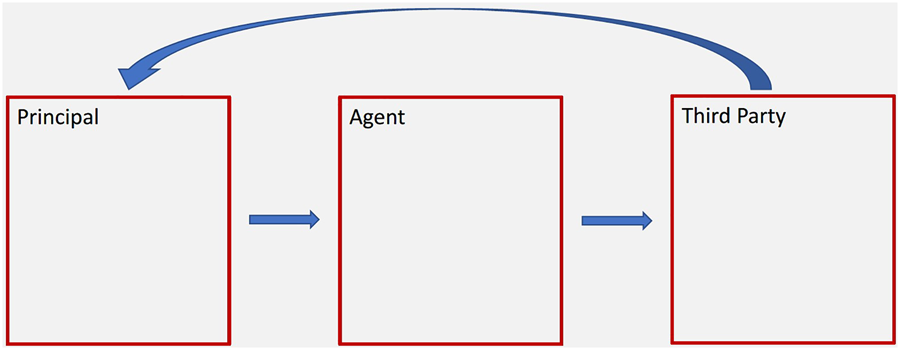
Agency law deals with situations where an agent, acting on behalf of a principal, establishes legal bonds between that principal and a third party. Acting for the benefit of a principal, agency enables an ‘individual's legal personality [to be] multiplied in space’.Footnote 72 As illustrated in Figure 1, the basic agency relationship is one in which the agent acts as an extension of the principalFootnote 73 and interacts with a third party accordingly. Agents can make agreements with the third party that create rights for the principal, or which subject them to obligations.
The Basic Agency Relationship

Agency is typically associated with private law. It can, however, have public law implications. Hastings v Semans Village (Saskatchewan, Canada),Footnote 74 for instance, concerned a woman who was hit by a car at night, tended to by a physician at his office and then taken by the physician to a private hospital for further care. The woman was indigent and a municipal act provided that indigent persons who were residents of the village and fell ill or required medical attendance were owed a duty by the village for care and treatment. The case focused on whether the physician was an agent of the village enabled to take the woman to the hospital. The court found that an agency relationship had emerged in part due to the municipal statute, highlighting a public law dimension to the agency described in the case. RudolfFootnote 75 has argued, and Ryngaert has echoed,Footnote 76 that in public international law agency may have bearing on the situation of non-State actors in the context of weak and failing States, as will be discussed further below.
An agent owes a number of duties to their principal. These include the duty to obey instructionsFootnote 77 and the duty, in most circumstances, to not delegate authority—an agent generally cannot sidestep their agency relationship by substituting an alternative agent in their place.Footnote 78 But deeper still, an agent also has fiduciary obligations towards the principal. Given both the trust vested in the agent and the agent's power to bind the principal to third parties, an agent is obliged to act with ‘single-minded loyalty’ towards the principal.Footnote 79 An agent must not be in a conflict of interest with the principal,Footnote 80 or take advantage of their position for profit.Footnote 81 How does such an agency relationship come into being?
A. Forming the Agency Relationship
The most common way for an agency relationship to form is through consent. A principal can agree to be represented by an agent either expresslyFootnote 82 or implicitly.Footnote 83 The vast majority of agency law relationships emerge in this way, leading some to claim that ‘consent lies at the heart of agency’.Footnote 84 However, though consent is the most common way for an agency relationship to arise, it is not the only way: ‘ostensible authority’ and ‘agency of necessity’ offer alternative pathways.
Ostensible authority arises where although an agent does not actually have authority, the principal's actions or statements makes it appear as though the agent did so. In order for ostensible authority to be established, it is necessary for a third party to detrimentally rely on that representation.Footnote 85 Under such circumstances, the principal is estopped from claiming the agent had no authority.Footnote 86
Agency of necessity arises where an emergency occurs and communication with the principle is not possible. It allows an agent to take action in excess of their original instructions from the principal. Under such circumstances an agent is entitled to act in ways which exceed their original grant of authority. This frequently arises in cases concerning carriage of goods by sea where decisions often have to be made urgently and communication with a principal may not be possible. Garriock v Walker, for instance, was a case in which a ship carrying whale blubber was waylaid by inclement weather. It was unsafe to continue the voyage and, while waiting, the blubber began to decompose. The only reasonable option available to the shipmaster in order to mitigate significant loss was to land the cargo and cask the deteriorating blubber. The court decided that since the operation was necessary and had proved beneficial to the cargo owner, that whilst there had been no instructions, the shipmaster had agency to use his best judgment through agency of necessity.Footnote 87 As a result, the principal was obliged to reimburse the shipmaster.
Agency of necessity can arise in other contexts. In Hastings v Semans Village, described above,Footnote 88 as the actions were necessary and reasonable in the circumstances, communication with the principal was not possible and the actions were taken bona fide in the interest of the parties, an agency of necessity had arisen. Great Northern Railway Co v Swaffield Footnote 89 concerned a railway stationmaster who stabled a horse arriving at night despite not having instructions from the owner to do so. The court decided that the emergency circumstances warranted this, thus highlighting that a pre-existing agency relationship is not necessary for an agency of necessity to arise, if the provided person acts reasonably and out of necessity.
B. Implications of Agency Formation for Consent
As both ostensible authority and agency of necessity show, agency need not arise through consent. This has led some theorists to argue that the heart of the agency relationship is not consent but a power–liability relationship. Fridman writes, ‘the law of agency is therefore concerned with the powers and liabilities of principal and agent, ie, the powers of the agent and the liabilities of the principal.’Footnote 90 Elsewhere this power–liability paradigm is presented as the ‘nucleus of the relation of principal and agent’.Footnote 91
This power–liability perspective of agency law may be useful in establishing a more nuanced perspective on the consent requirement for humanitarian assistance. Is State consent the only pathway through which humanitarian assistance may be authorised (other than by the UNSC) or might the factual nature of a non-State actor exercising territorial control or an aid organisation's practical ability to provide assistance be sufficient to justify the provision of relief? The following section suggests that agency law, understood as a power–liability paradigm, offers a fresh perspective on the legality of providing humanitarian relief without the consent of the State in such instances.
V. AGENCY LAW AND HUMANITARIAN ASSISTANCE
It should again be stressed that agency does not represent lex lata as regards the consent requirement nor does it currently provide the justification for humanitarian assistance in IHL. IHL confers rights and duties primarily upon belligerent parties and as shown by the debates concerning GC CA 3, rules of customary international law and AP II Article 18(2), consent is currently required from the belligerent parties. To that extent, what follows are reflections on what the law could be, rather than what it is.
A. Explaining the Consent Requirement: Consent on Behalf of Whom?
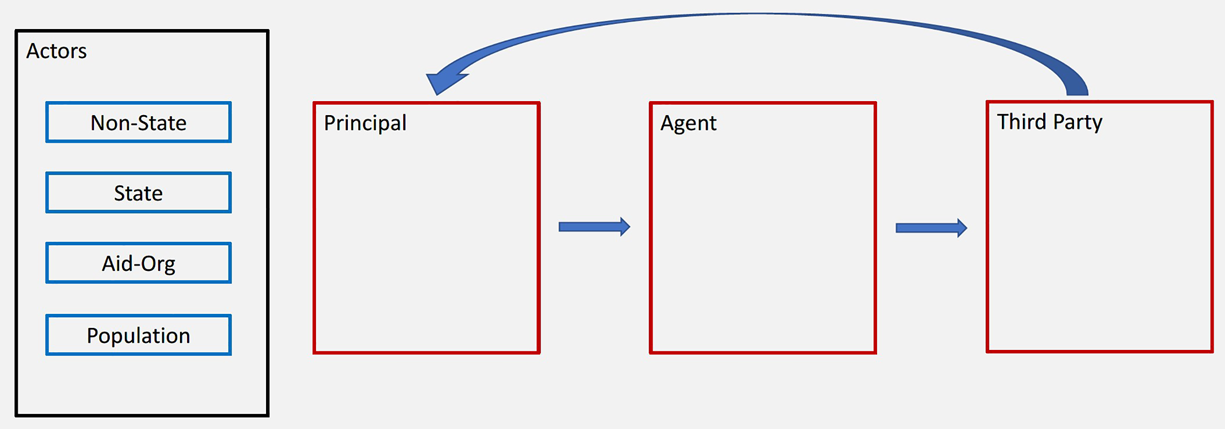
If consent to humanitarian assistance in NIAC is to be based on an agency relationship, it is essential to establish who is the agent, who is the third party and who is the principal. Figure 2 sets out the basic agency relationships and NIAC actors—namely the non-State armed group, the State, the aid organisation and the population.
Basic Agency Relationship and NIAC Actors

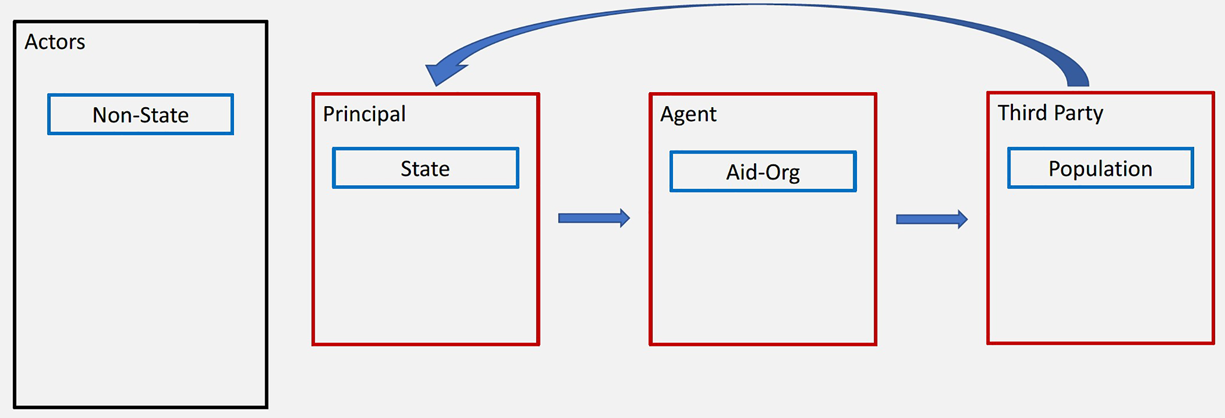
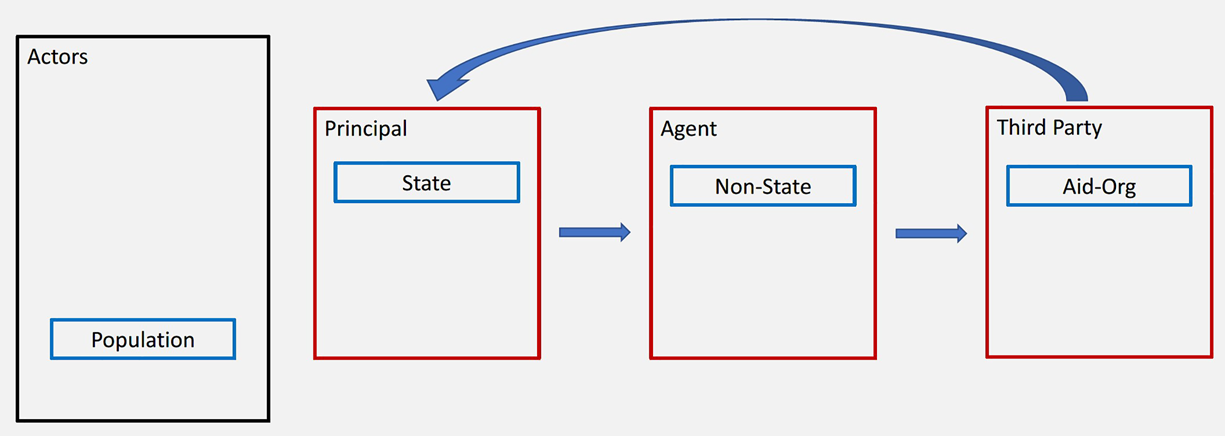
One possibility, illustrated in Figure 3, is that the State is the principal and the aid organisation its agent, meaning that the aid organisation interacts with the population (the third party) on behalf of the State. In the Syrian context, an example could be OCHA acting only out of Damascus in accordance with its authorisation from the Assad regime. It is, however, a considerable (and ultimately unreasonable) leap to infer from the fact that the aid organisation respects the limited authorisation it has been granted that there is a fiduciary obligation between them. Indeed, this would directly contradict the humanitarian principles of neutrality and independence to which they adhere.Footnote 92
The State as Principal

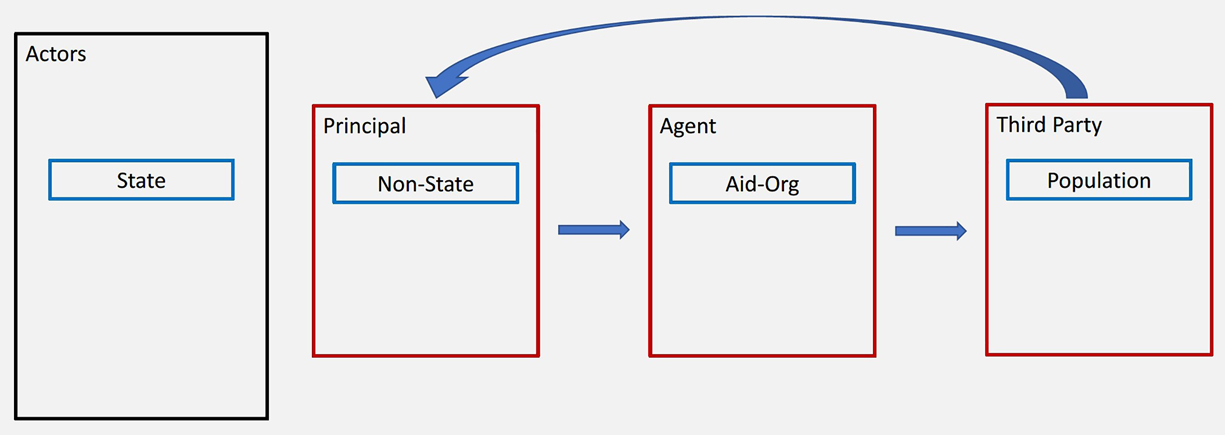
Similar problems arise in the situation illustrated in Figure 4, where the aid organisation is seen as an agent of a non-State armed group. Mercy Corps does not act solely on the basis of the authority of the Free Syrian Army simply because it has consented to its providing humanitarian assistance.
The Non-State Armed Group as Principal

Another possibility, illustrated in Figure 5, is to consider the non-State armed group as an agent of the State, on the basis that where non-State armed groups have control over territory and exercise governmental functions they have become agents of necessity and so can consent to humanitarian assistance by aid-organisations (third party) on behalf of the State (principal).Footnote 93 On this model, the Free Syrian Army would be acting as agent of the Assad regime when consenting to the provision of humanitarian assistance by MSF (third party). However, it seems odd to conclude that a non-State belligerent is an agent of the State with whom it is it conflict. Indeed, since this would imply that the non-State armed group was acting in the best interests of the State with whom it is fighting, this approach seems untenable.
The Non-State Armed Group as the Agent of the State

An alternative approach, and the most compelling, builds on the work of scholars such as Criddle, Fox-Decent and Benvenisti, who have argued that ‘States serve as fiduciaries for their people, and, collectively, for humanity at large.’Footnote 94 Dismissing the notion that sovereignty is a function of ‘exclusive jurisdiction’, they propose a ‘relational theory’ in which the source of sovereignty is the fiduciary bond between a State and its people.Footnote 95 Elsewhere, King adopts a similar position in relation to the subject of ‘odious debt’.Footnote 96 The ‘responsibility to protect (R2P)’ also reflects the idea that State sovereignty is tied to the obligations that a State owes to their population.Footnote 97
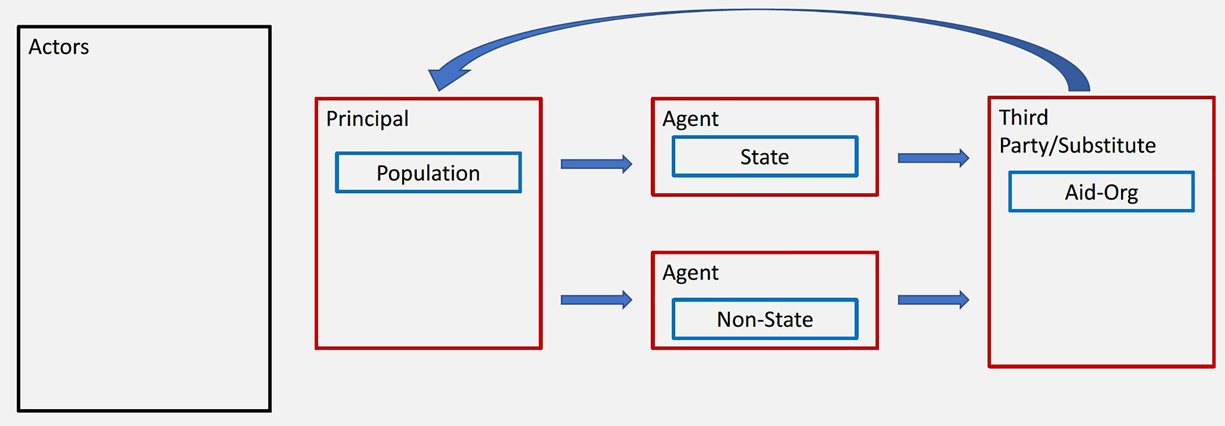
This suggests that sovereignty may be ‘defined and constrained’ by a fiduciary relationship, giving States the ‘authority to exercise sovereign powers, but only in the name and for the benefit of the people subject to those powers’.Footnote 98 On this basis, a State may be viewed as an agent, with its population representing a principal. Alternatively, and as discussed below, where a non-State armed group has effective control over a given territory, they may be understood to be in a similar position of agency as regards the population, taking on the role of principal. Where these fiduciary obligations are breached, the agency relationship may be terminated.
Although the idea that a population may be a principal might chafe against a consent-based understanding of agency law, it is far less problematic if agency is understood from a fiduciary or power–liability perspective. Moreover, since one is now dealing with ostensible authority and agency of necessity, it is not at all clear that it is necessary for the principal to have legal capacity,Footnote 99 as is assumed by American understandings of agency law.Footnote 100
This is illustrated in Figure 6, where the population is the principal, the State (or, alternatively, the non-State armed group) is the agent and the aid organisation is the third party. In this model, the State or non-State armed group acts as an agent of the population by consenting to the third-party aid-organisation providing it with humanitarian assistance. In the Syrian example, both the Assad regime and an actor such as the Free Syrian Army would be capable of consenting to humanitarian assistance provided by OCHA or Mercy Corps as agents of the Syrian population. The possibility of both the State or non-State group being able to offer consent as an agent aligns with the doctrinal positions of Gillard, Sassòli and Bouchet-Saulnier who argue that non-State armed groups can offer consent.Footnote 101
The Population as Principal, Consent Given

Looking at the position of the actors involved in the provision of humanitarian assistance through the lens of agency law provides an alternative legal explanation for what occurs when consent for relief is given or refused. The following subsections argue that non-consent-based approaches to the formation of agency bonds could help reframe legal avenues for the provision of assistance in the absence of State consent.
B. Effective Control—A Space for Ostensible Authority?
Viewing State or non-State armed groups as agents potentially reflects the complex dynamics of power on the ground. In conflicts such as that in Syria, patterns of effective control over some areas may frequently—and rapidly—change whilst control over others remain relatively stable. In such contexts, absolute State sovereignty is a relative concept.
A number of authors have suggested that effective territorial control provides a basis for consent. Gillard proposes that where a non-State group has territorial control, excludes the government and operates in a State-like fashion, their ‘consent may be both necessary and sufficient’.Footnote 102 Similarly, in an editorial focussed on humanitarian access in Syria, a group of high-profile lawyers and scholars assert that where a State lacks effective control the consent of those who do so is sufficient to allow the provision of relief.Footnote 103 Somalia is another example of a situation where the effective territorial control of the Federal Government is limited and so the consent of others exercising effective control may be sufficient.Footnote 104 Even if consent is not given by a non-State party, the absence of effective control by the State may be adequate to legitimise the provision of humanitarian relief without State consent in the area in question.Footnote 105 As Bouchet-Saulnier suggests, ‘[t]he rationale is not to defend State sovereignty and territorial integrity but to bind all authorities (legitimate or de facto) using armed force or exerting control over territory to remind them of their obligations’.Footnote 106
What might be the legal basis in IHL for this approach?Footnote 107 Gal suggests that where an armed group has effective territorial control, the law of occupation might be applied ‘mutatis mutandis as regards humanitarian access’.Footnote 108 This approach focuses on the ‘factual circumstances’ rather than the ‘status of the armed groups’Footnote 109 and in practice, it may indeed be the non-State armed group that has the power to grant or refuse consent.Footnote 110
Gal is mindful that sovereignty might be undermined if non-State armed groups with effective control have the power to grant consent and that others have argued that only the sovereign can do so, even if it has lost territorial control.Footnote 111 In response, Gal notes that the obligation of an occupier to accept relief probably ‘reflects the fact that the occupying power is not the legal sovereign of the territory it occupies, but merely exercises its jurisdiction there. In other words, the occupier is effectively a substitute for the legal sovereign of the territory but is not the sovereign itself.’Footnote 112 Bhuta also notes the ‘paradox’ of an occupier being in position to use sovereign rights while lacking sovereign authority.Footnote 113 Nevertheless, the occupier is not really choosing to consent since, as discussed earlier, occupiers have an obligation to allow humanitarian assistance; obligatory consent is hardly consensual.
Another potential legal basis for consent in situations of effective control might be the law of agency, and specifically the principle of ostensible authority. As seen above, ostensible authority allows for the creation of legal obligations where an agent enters a contract with a third party on behalf of a principal, even though the agent did not have the actual authority to bind the principal. In this situation, the third party is operating on a reasonable (though ultimately incorrect) understanding that the agent has actual authority to form that relationship on the basis of representations made and replied on.
In the NIAC context, the fact of effective control by a non-State armed group combined with an absence of opposition from the population could arguably amount to a representation that the non-State armed group (as agent) has authority to make decisions for the population (as principal) of that territory. An aid organisation, observing that representation, might rely on the consent given by, for instance, the Free Syrian Army to provide humanitarian assistance. With a representation in place and reliance on that representation, withdrawal of consent for relief might be subsequently estopped. This fact-based perspective reflects the power–liability paradigm described above. It is indeed the fact of power that allows non-State armed group to act as agent on behalf of the population (principal).
This argument based on ostensible authority is similar to that based on occupation. Both look to the fact of effective control and its implications for the granting of consent. Importantly, and like the occupation argument, sovereignty is not necessarily adversely affected. The principal does not cease to be the principal: rather, the authority of one agent is temporarily passed to another. Unlike the occupation argument, however, the non-State armed group acting on the basis of ostensible authority is in a position to confirm or deny consent, which is more in accord with the general rule of the consent requirement for the provision of humanitarian relief under IHL than is the case under the approach based on occupation where consent is obligatory. Further, such an approach can be applied without the need to extend the law of occupation into the NIAC context, something which might be strongly resisted by both States and non-State (or self-styled liberation) armed groups.
C. Emergency and Need—A Space for Agency of Necessity?
Another potential means of justifying humanitarian assistance in the absence of State consent is the principle of agency of necessity. This possibility has been advanced by Beate Rudolf who, suggests that where non-State actors hold and exercise power, and where the State is either weakened or failed, such actors might have particular obligations on the basis of agency law. She notes, ‘any non-State actor that exercises power instead of the State in a situation of necessity, ie where State action is missing but required, must respect the substantive and procedural governance norms by which the State is bound’.Footnote 114 The agent—here the non-State actor—is required to fulfil the obligations of the original agent—the State.
Rudolf's argument is built principally on Article 9 of the International Law Commission's (ILC) Draft Articles on Responsibility of States for Internationally Wrongful Acts. Article 9 and its commentary concerns situations where a government has lost effective control over a territory and an exercise of authority is required.Footnote 115 The commentary refers to agency of necessity, connecting it with the notion of levée en masse or ‘self-defence of the citizenry in the absence of regular forces’.Footnote 116 For instance, the actions of the Revolutionary Guard in performing customs and immigration duties at the Airport in Tehran following the Iranian Revolution.Footnote 117
Rudolf does not focus on IHL, NIAC, or the specific issue of consent to the provision of humanitarian relief. It is also recognised that there are significant differences between the actions and context of the Revolutionary Guard in Iran and rebel forces in Syria. Still, referencing this work, Ryngaert raises in passing the possibility of agency of necessity arising in the NIAC context and its having a bearing on the question of consent. Though he does not provide further explanation, Ryngaert suggests ‘to the extent that non-State actors take over governance functions and control portions of the State's territory as “agents of necessity” […] humanitarian actors may have to seek the consent of [those] armed group, as both a practical and a legal imperative’.Footnote 118 This warrants further inquiry.
As has been seen, the principle can apply in the public law field: if a doctor can act as an agent of necessity for a village, or the revolutionary guard as an agent of necessity in post-revolution Iran's border services, why not a non-State armed group in the NIAC context? Further, agency of necessity need not depend on a pre-existing agency relationship. If a stationmaster does not need a pre-existing relationship to become the agent of a horse-owner whose horse had been deposited at his station, perhaps a non-State actor does not need a pre-existing relationship to be an agent of necessity for a population facing a polio outbreak.
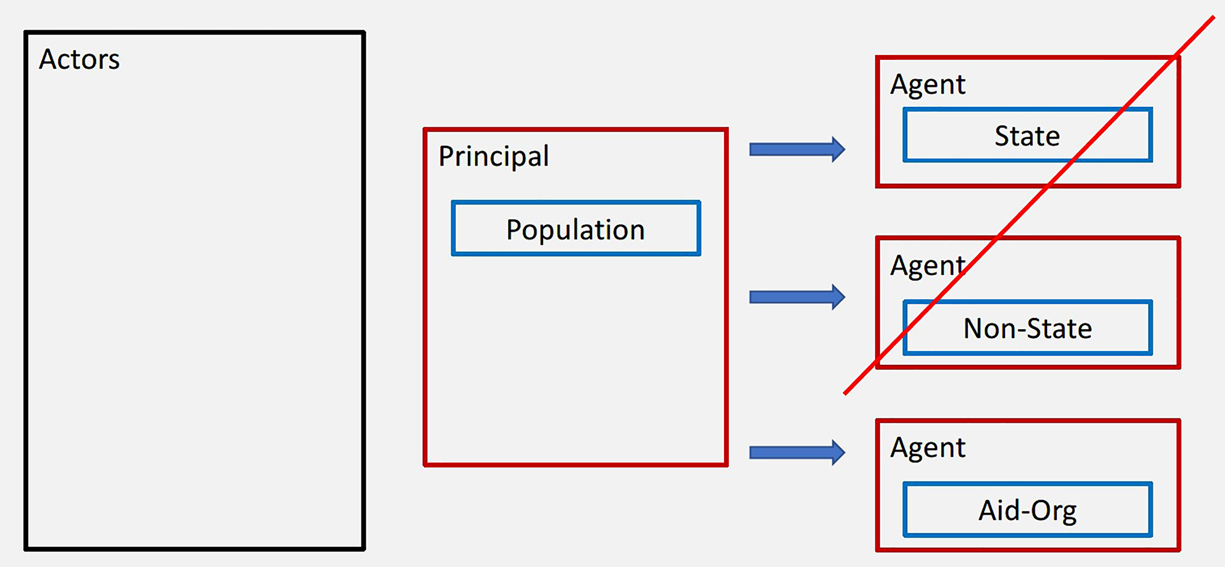
This is illustrated in Figure 7, in which an aid organisation may step in to act as an agent of the population in providing assistance where there is significant humanitarian need. As with a shipmaster who is in a position to provide necessary assistance to a cargo owner, so too might an aid organisation like MSF provide assistance to a population in northern Syria that is both necessary and in the population's best interest.
The Aid Organisation as Agent of Necessity

However, other elements of the principle of agency of necessity are more difficult to fulfil in the NIAC context. Cases like Garriock v Walker and Hastings v Semans Village illustrate that agency of necessity requires an inability to communicate with the principal. Though a polio outbreak in northern Syria may present a situation of necessity, what does communication (or failure to communicate) with the principal look like in this context?
Where a State or non-State group is silent as regards consent, Garriock v Walker might suggest that, in order to avoid serious loss, an aid organisation could use its best judgment to provide assistance. Where consent is actually refused by the State or non-State armed group, it might constitute a breach of their fiduciary duty as agent to the population, effectively terminating that agency relationship. In such situations, where the agent is unable or unwilling to provide consent, the aid organisation might step in to act as agent in their place. In the absence of a clear representative, it may then be easy to show that it was not possible to communicate with the principal (the population at large). While legally feasible, such an approach could prove challenging to implement given the reality of the power dynamics on the ground.
Overcoming the consent bottleneck through the principle of agency of necessity may only minimally impair State sovereignty, given its exceptional and limited nature. An agent of necessity does not become an agent for the principal in all things nor for an indefinite period of time. Instead, their mandate is confined to the emergency and for the duration of that emergency. MSF occupying the role of agent of necessity during a polio outbreak would be restricted to the provision of assistance for that emergency and for the period in which such relief was necessary. Sovereignty is not fundamentally undermined by allowing the fiduciary obligations owed to the population for humanitarian assistance to be fulfilled.
VI. CONCLUSION
After nearly nine years the Syrian Civil War remains an intractable and evolving conflict in which the requirement for consent to humanitarian assistance continues to be a challenge. The same is true of other, similar, situations.
Agency law can provide a valuable approach for explaining the consent requirement and for reimagining legal justifications for the provision of aid by relief organisations where State consent is absent or denied. As a descriptive tool, agency law can provide a legal account of the behaviour of various actors that stretches beyond mere politics. As a justificatory instrument, agency law offers principles such as ostensible authority and agency of necessity that prompt reflections on a lex ferenda of aid organisation assistance that only minimally infringes the sovereignty of the State.
As aid organisations look for a legal basis to provide assistance in future NIAC, the law of agency may offer helpful insights. Indeed, might such approaches potentially apply more broadly again, such as to non-occupying third States, implying that they also have a duty to consent to assistance? Though hardly a panacea, when access is often quagmired in operational and legal barriers, agency might provide a potent means of overcoming a major bottleneck.