1 Introduction
Demonstratives, like definite articles, convey definiteness; and like adverbs such as here or there, they also express deixis. The latter meaning is usually considered to be their defining characteristic: ‘Demonstrative pronouns and demonstrative adjectives, like the English “this” and “that” . . . are primarily deictic’ (Lyons Reference Lyons1977: 646). However, demonstratives may convey other meanings besides definiteness and deixis, as shown in studies of languages other than English (see, for example, Yulong Reference Yulong1987; Kirsner & Van Heuven Reference Kirsner and Van Heuven1988; Lichtenberk Reference Lichtenberk1988; Grenoble Reference Grenoble1994; Herring Reference Herring1994; Keusen Reference Keusen1994, amongst others). In particular, these studies have shown that demonstratives often possess discourse-pragmatic functions relating to broad narrative-level considerations, such as the topicality or importance of referents.
This articleFootnote 1 will examine the use of the Old English distal demonstrative determiner se in Beowulf. I will show that, in addition to its more commonly recognized meanings (deictic distinctions and definiteness), determiner se is also used to indicate episode boundaries, topic continuity, or the importance of a participant in the narrative context. While se typically occurs with referents that are presumed to be familiar or identifiable (definite) in some manner, referent identifiability is neither necessary nor sufficient for determining when se will occur in the text. Noun phrases referring to clearly identifiable participants often appear in Beowulf with no demonstrative (or with no determiner at all); moreover, determiner se occasionally occurs in NPs whose referents are not identifiable.
The article is organized as follows: section 2 describes the data that will be analyzed here and provides some basic background on the Old English distal demonstrative; section 3 discusses the use of se to convey the relative importance of referents, comparing its usage with both major and minor participants; section 4 shows that the demonstrative determiner can indicate the topicality of a referent, especially topic persistence over a portion of the text (in the sense of Givón Reference Givón and Givón1983); section 5 demonstrates that se can serve as a marker of chapter boundaries, often occurring in noun phrases appearing at either the end of a chapter or the beginning of a new one; finally, section 6 concludes the article by presenting a summary of the findings along with some questions for future research.
2 Background considerations
It is not clear exactly when the Beowulf manuscript, from which the data in this article are drawn, was composed. According to Bjork & Obermeier (Reference Bjork, Obermeier, Bjork and Niles1997: 13), some scholars favor a relatively early date (c. 650–800), while others date the text to the late ninth or early tenth centuries (see Bjork & Obermeier Reference Bjork, Obermeier, Bjork and Niles1997 for detailed discussion). I have chosen to examine this particular text because ‘Beowulf appears to represent, in respect of the article, an older stage than any other literature in the Old English period’ (Christophersen Reference Christophersen1939: 86). The demonstrative determiner se ultimately developed into the definite article the in English;Footnote 2 because of the relatively archaic nature of the language of Beowulf, we should expect se to display properties that are maximally different from those of Modern English the (as well as that). A detailed analysis of the earliest stages of English demonstrative (and article) usage may help cast new light on their modern counterparts.
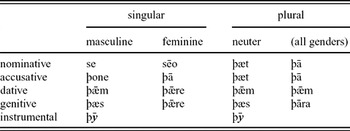
Most scholars argue that there are no articles yet in Old English (see, for instance, Traugott Reference Traugott and Hogg1992: 171–3, Philippi Reference Philippi, van Kemenade and Vincent1997: 84–8, van Gelderen Reference Gelderen2007: 297; for a dissenting view, see Christophersen Reference Christophersen1939: 86, 92). The main Old English demonstratives are the proximal þes ‘this’ and the distal se ‘that’. The latter is inflected for five cases, in three genders and two numbers (see table 1 for the different forms of se). Mitchell (Reference Mitchell1985: 128–35) describes two uses of se, independent (i.e. pronominal) and dependent (i.e. a noun modifier); this article focuses only on the discourse functions of se in its dependent use, that is, as a determiner.
Forms of se in Old English

With respect to their semantic and pragmatic functions, Diessel (Reference Diessel1999: 2) defines demonstratives in general as ‘deictic expressions . . . primarily used to focus the hearer's attention on objects or locations in the speech situation . . . demonstratives are often used to keep track of prior discourse participants’. Similarly, most previous work on the Old English demonstratives concentrates on their deictic and definite uses, as well: ‘The functions of the two OE demonstratives . . . may be defined respectively as specifying and deictic. The first merely particularises, singles out from the generality, indicates and identifies the known and expected’ (Quirk & Wrenn Reference Quirk and Wrenn1957: 69).
The variety of terms employed here (and elsewhere) to describe the concept of definiteness (‘particularise’, ‘single out’, ‘identify’) is typical. There is an extensive literature on definiteness and the terminology found in these works is not consistent (see, for example, Christophersen Reference Christophersen1939; Hawkins Reference Hawkins1978; Du Bois Reference Du Bois and Chafe1980; Heim Reference Heim1982; Kadmon Reference Kadmon1990; Gundel, Hedberg & Zacharski Reference Gundel, Hedberg and Zacharski1993; Lyons Reference Lyons1999; Epstein Reference Epstein2001; Abbott Reference Abbott, Horn and Ward2004). For the purposes of this article, we will say that a definite noun phrase is one whose referent is identifiable. A referent is identifiable if the addressee is able ‘to distinguish it from all other individuals in the universe of discourse’ (Lyons Reference Lyons1977: 179). Several sorts of factors may lead a speaker to assume that the addressee can identify a referent and, thus, to employ a formally definite NP (e.g. a pronoun, an NP with a demonstrative or a definite article) when speaking about that referent. The principal factors that may justify an assumption of identifiability are: first, the referent has already been mentioned in the prior discourse; second, it is physically present in the speech context; or third, it constitutes common knowledge amongst the members of a speech community (e.g. the President, the cat next door).
Studies of Old English se naturally focus on its well-known use as a marker of definiteness: ‘It shows the same variety of uses as MnE “the/that”. Thus it may point forward . . . or back . . . It may refer to something which has already been indirectly introduced . . . or to something for which the reader must rely on outside knowledge’ (Mitchell Reference Mitchell1985: 133). In Beowulf, as elsewhere, se is indeed nearly always employed in noun phrases whose referents are identifiable (more precisely, 98.2 percent of NPs with se in Beowulf refer to entities that are identifiable in some way):Footnote 3
- (1)
(a)

(b)

In (1a), the wine-hall is identifiable because it has previously been mentioned in the text (the hall is named Heorot); in (1b), though the bottom of the lake (mere) has not yet been mentioned in the narrative, it is nonetheless identifiable because it is common knowledge that all lakes have a bottom.Footnote 4
This use of se with identifiable referents closely parallels the way definites are used in Modern English. At the same time, though, many scholars have noted that the distribution of se frequently diverges from Modern English patterns. For instance, Mitchell writes: ‘there is no regular correspondence between OE and MnE usage. Se is found where we would not use “the/that” . . . It can be absent where we would use “the/that”’ (1985: 134–5). And Traugott (Reference Traugott and Hogg1992: 172) remarks of se that: ‘In many ways it covers the domains of both the demonstrative that and the definite article the in PDE. However, there are some differences . . . se is often not present where an article or demonstrative might be expected in PDE. This is especially true of the early poetry.’ These differences between Old and Modern English can be seen in Beowulf:
- (2)
(a)
(b)
In (2a), the hoard (and the barrow, too) had already been mentioned several times in the preceding text (one such prior occurrence, from line 2768, is shown here, as well), but the NP hord (line 2773) does not occur with se in the Old English version; in contrast, the Modern English version does require some determiner, either that or the. In (2b), the Geatish man in question is Beowulf, who has of course been mentioned many times in the story by this point and is easily identifiable. Nevertheless, se does not occur in this NP.
Though the existence of such differences between Old English se and Modern English that/the is well known, they have yet to be studied in detail. One goal of this article is to explain some of these differences. I will argue that it is not possible to account for the distribution of the demonstrative determiner se using the sole criterion of identifiability. As we will see in section 3, there are some cases in which Old English NPs with non-identifiable referents occur with se. And, more importantly, it was very common in Old English – unlike in Modern English – for noun phrases with identifiable referents to occur without any determiner at all (see the examples in (2) above). At this (early) stage in the history of English, it appears that the preference is for an NP to have no determiner (in effect, this is the default case). Christophersen (Reference Christophersen1939: 87), in discussing the use of se in Beowulf, notes ‘there is a certain aversion to using the word very often in the poem. The zero-form standing for something definite is exceedingly common.’ Indeed, Beowulf consists of 3182 lines, yet by my count, there are only 379 occurrences of se as a determiner,Footnote 5 a relatively low number, especially in light of the extremely high frequency of the in Modern English. For determiner se to occur in early English poetry (at least, as exemplified in Beowulf), its referent should generally have some other properties besides simply being identifiable. The remainder of this article is devoted to describing and analyzing aspects of the discourse structure, beyond identifiability, that are relevant to the use (or omission) of determiner se.
Before moving on, a brief mention should be made of another factor that is sometimes claimed to be relevant for the use of se, namely, meter (see, for example, Christophersen Reference Christophersen1939: 86). In this view, the demonstrative determiner may be used because an extra syllable (or two) is needed to make a line fit one of the allowable metrical types. While it is possible that metrical considerations do influence some uses of se, I have not found any examples in Beowulf where the stress pattern alone is responsible for an occurrence of the demonstrative (Christophersen, for instance, does not cite any). In contrast, it is easy to find examples of se that cannot be explained at all in terms of meter, as seen in the contrast between (3a) and (3b):
- (3)
(a)
(b)
The first half-line in (3a) contains a noun phrase with se, but the demonstrative is not needed there merely because of the stress pattern. If it had been omitted, the resulting half-line (Siððan fǣhðe) would still be a metrically permitted type, as shown by the parallel half-line in the second part of (3b), syððan hātan. Meter, therefore, does not play any role here; more likely, this occurrence of the demonstrative – like the other examples discussed in this article – is motivated by the meaning it conveys. The ‘feud’ mentioned in line 470 is identifiable because it is the same one introduced eleven lines earlier, in 459 (Geslōh þīn fæder f ǣhðe mǣste ‘Your father brought about a great feud’). In fact, it appears that every token of the demonstrative determiner in Beowulf can be explained in semantic/pragmatic terms, so that there is no need to invoke the notion of meter in this regard.
3 Importance of the referent
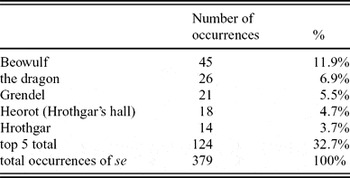
One factor that influences the choice of se is the relative importance of the referent of a noun phrase. This possibility was raised by Christophersen, who noted that ‘the extended use of the resumptive pronoun is only found with the chief characters and localities or things belonging to them’ (Christophersen Reference Christophersen1939: 87). And in Beowulf, the more important a referent is in the overall narrative context, the more likely it is to occur in NPs with se. In other words, the demonstrative determiner occurs most frequently in NPs referring to major participants, that is, the ones that play the most important roles in the story; minor participants,Footnote 6 i.e. less important characters, tend to occur more often in NPs without any determiner. Evidence for this tendency is given in table 2, which lists the five participants mentioned most frequently by means of NPs taking se. These NPs make up nearly one-third of all occurrences of the distal demonstrative determiner in Beowulf (32.7 percent); it is not surprising to find that the three most frequent referents represent the main characters (Beowulf, the dragon and Grendel) and that the fourth most frequent referent with se represents the setting where much of the action takes place (Heorot). By way of illustration, the character Beowulf is variously referred to as se gōda ‘the good (man)’ (line 205), se eorl ‘the nobleman’ (1512), ðæs hildfruman ‘the war-chief’ (2835), with each NP containing a form of the distal demonstrative determiner.
Participants occurring most frequently in NPs with se Footnote 7

One might argue that se occurs more often in the aforementioned NPs not because these participants are more important, per se, but simply because they are the most common NPs in the text (presumably because they refer to major participants). This objection seems wrong, however, because high-frequency nouns referring to minor participants rarely occur with se. For example, according to Bessinger & Smith (Reference Bessinger and Smith1969: 339), the most common noun in Beowulf is Gēata ‘Geat’ (the tribe to which Beowulf belongs, in genitive plural form). This noun appears 39 times in the text, but never with se (it also appears twice in the nominative/accusative singular form Gēat, five times in the dative plural Gēatum, and once in the dative singular Gēate, without se in all instances). The noun Gēat is used here mostly to refer to the Geatish people, usually in phrases of the sort Gēata dryhten ‘lord of the Geats’ (as in line 1831; for another example with Gēata, see (2b) above), in which the referent ‘Geats’ is identifiable (having been mentioned many times previously) but not a major participant in the story. In comparison, Modern English genitive NPs like the Geats routinely occur with a definite article in similar contexts, regardless of the importance of their referents.
Minor participants typically do not occur in NPs with se, even after the participants have been introduced into the story and become identifiable. To illustrate further, let us look at the noun phrases employed to refer to a specific minor participant, namely, the watchman who guards the coast in the service of Hrothgar, the Danish King, and whom Beowulf and his men encounter when their ship first lands on the Danish shore. As expected, the first mention of the watchman in the text does not include se:
(4)
However, the next two lexical NPsFootnote 8 referring to the watchman do not use se, either, even though the character is now identifiable. At this point in the story, Beowulf and his men have come ashore and have explained to the guard who they are and why they are there; the guard then begins his reply to them (5a).Footnote 9 Next, the guard escorts them from their ship to meet Hrothgar in his hall (5b):
- (5)
(a)
(b)
Much later in the story, after Beowulf has accomplished his task and is ready to return home with his men, they go back to their ship and once again encounter the watchman; still, se does not appear in the NP Landweard:
(6)
Only in the very last full noun phrase referring to the watchman does se occur:
(7)
The example in (7) shows that NPs referring to minor participants are sometimes found with se. The demonstrative occurs in some of these cases to emphasize the importance, or discourse prominence, of the participant in the local narrative context (as opposed to the global context of the entire story; other reasons for using se with minor participants are given in the following sections). A locally important participant plays a prominent role only over a small stretch of the discourse (e.g. a character who accomplishes something especially noteworthy at a specific point in the story). In the context of (7), the watchman is portrayed as a person of special prominence, having performed a noteworthy task (guarding the ship), and he is rewarded for his efforts. The subsequent text confirms the fact that he is an important participant here (though not, of course, within the overall story, i.e. he is not a major participant in Beowulf) by explicitly stating that he was ‘honored’ in later years.Footnote 10
Another set of examples in which se serves to emphasize the discourse prominence of a minor participant is shown in (8). In both of these cases, the demonstrative modifies the noun hafelan referring to Grendel's head, which was cut off by Beowulf after the fight with Grendel's mother:
- (8)
(a)
(b)
In (8a), the importance of the head can be inferred from the fact that, despite the presence of many treasures in the cave of Grendel's mother, Beowulf only takes with him the head (along with the hilt of the sword that he used to kill Grendel's mother and behead Grendel's corpse). It is clearly a valuable prize for Beowulf. The lines in (8b) occur as part of a speech given by Hrothgar after Beowulf returns in triumph to Heorot. The king rejoices at the sight of the head and gives thanks to God. The powerful emotions expressed by Hrothgar, as well as the vivid description of the head, support the analysis of the head as discourse prominent here.
As usual, however, these examples of NPs with se are not the norm in Beowulf. Most mentions of nouns meaning ‘head’ (hafela, hēafod) occur with no determiner in the text, even when the referents are identifiable. Some examples are given in (9):
- (9)
(a)
(b)
The demonstrative se does not occur in these mentions of Grendel's head because no special importance is attributed to them in these contexts. In (9a), the focus of the passage is Beowulf's revenge (by disfiguring the corpse), not the head itself. In (9b), Beowulf is merely recounting the events after he has returned to his home; there is no special focus on the head, nor is it mentioned again.Footnote 11
It is worth pointing out that just as it is not obligatory for se to mark all identifiable referents, it is also not obligatory for se to appear in all NPs whose referents may potentially be construed as discourse prominent. For instance, Beowulf's companions are depicted in (10) as struggling to carry Grendel's head back to Hrothgar's hall, yet no determiner appears with hafelan here:
(10)
On the face of it, it might seem that Grendel's head is as central to this scene as it is to the passages in (8). Nevertheless, se does not occur here. This state of affairs is not surprising, given that morphemes in the early stages of grammaticalization tend to be optional; only as they grammaticalize further do they eventually become obligatory (Lehmann Reference Lehmann1985). Along these same lines, Greenberg (Reference Greenberg, Greenberg, Ferguson and Moravcsik1978: 61), in defining his cycle of the definite article, argues that ‘[t]he point at which a discourse deictic becomes a definite article is where it becomes compulsory and has spread to the point at which it means “identified” in general’.
One more way in which the concept of importance influences demonstrative usage can be seen in (11). These examples concern the use of se with the superlative form sēlest ‘best’. In Modern English, NPs with superlatives nearly always require a definite article because they represent unique referents (e.g. the smartest girl in school refers to only one girl; see Hawkins Reference Hawkins1978: 233–6). In Old English, though, superlatives did not systematically occur with a demonstrative determiner, and in Beowulf, many instances of NPs with sēlest did not, either, as seen in (11a):
- (11)
(a)
(b)
In Beowulf, when referring to inanimates (as in 11a), NPs with sēlest never take se, but all six occurrences of sēlest that have human referents do occur with se (as in (11b)).Footnote 12 This result is consistent with other well-known grammatical phenomena connected with animacy, in which human referents in general are more likely than inanimate objects to receive special grammatical treatment because people are more highly salient – that is, important – in our experience of the world than things (see Timberlake Reference Timberlake and Li1977; Comrie Reference Comrie1981).
In addition to these types of importance, se can also be used for foreshadowing, in which an event or a character is introduced in a manner that calls attention to its importance at a subsequent time. Such cases provide evidence that se could occur in Old English NPs whose referents were not yet identifiable. Some examples are shown in (12):
- (12)
(a)
(b)
Many different formal techniques can be employed to hint at what will happen later in the story. One is the use of se to introduce an entity that readers do not yet know about, in order to allude to the future importance of the entity. For instance, in (12a), the compound noun ecghete occurs with se even though it has not yet been mentioned in the text and cannot yet be identified (Klaeber Reference Klaeber1950: lvii and Chickering Reference Chickering1977: 282 both cite this case as an example of foreshadowing). The demonstrative alludes to the destruction of the building, as if we already knew about it. In (12b), the NP se ellengæst provides the first mention of Grendel in Beowulf. Since addressees have not yet met him at this early stage of the text, the unusual technique of introducing the character with a formally definite NP foregrounds the important role he will go on to play in the story. Of course, this technique of employing the definite article for foreshadowing purposes can still be seen in modern-day literature.Footnote 13
So the notion of importance influences the use of se in several ways. First, major participants, by virtue of their intrinsic importance in the story, are more likely to occur with se than minor ones. Next, on a more local scale, an NP may take se to indicate that its referent is discourse prominent. Finally, some NPs take se to suggest that their referents will be important later on (foreshadowing).
4 Topic persistence
We saw in the previous section that although the distal demonstrative determiner occurs most often in NPs referring to major participants, nevertheless, it does not systematically do so. Major participants do not routinely occur with se; even many NPs referring to Beowulf himself take no determiner (recall that NPs with no determiner seem to be the default case in Old English; see section 2). What other factors, besides local discourse prominence, cause some mentions of identifiable major (or minor) characters to take se? In this section, I will argue that another discourse function of se is to mark highly topical referents.
We may define a topic as ‘the participant most crucially involved in the action sequence’ (Givón Reference Givón and Givón1983: 8). Givón has identified several characteristics of topics. First, topical participants are mentioned more often than non-topical participants: ‘More important discourse topics appear more frequently in the register, i.e. they have a higher probability of persisting longer in the register’ (Givón Reference Givón and Givón1983:15). Second, in many languages, ‘topical referents are most commonly given special grammatical marking, while non-topical ones are left unmarked’ (Givón Reference Givón, Gernsbacher and Givón1995: 65). The distal demonstrative determiner is one such special marker in Old English.
As Givón has demonstrated, one way to identify topics is to measure persistence, or the number of recurrences of a referent in the following text. The more highly topical a referent, the more frequently it should be mentioned again after it is first introduced in a section of the discourse. In several studies, Givón argues that a topic persistence measurement of less than two should be considered low; greater than two is considered high (see Wright & Givón Reference Wright and Givón1987: 23, Givón Reference Givón, Gernsbacher and Givón1995: 66). In other words, a referent that recurs more than twice in the ten clauses following its appearance in a passage should be considered highly persistent, which is an indication of high topicality. A referent that recurs only once or twice, or never again, is not highly persistent and thus, not a topic.
To see if se is used in Beowulf to mark highly topical referents, I measured the persistence of the referents of noun phrases with se by counting how often these referents recur in the ten lines following every mention of an NP with se.Footnote 14 A recurring mention of the same referent can take one of several different forms: a lexical noun (either the same noun or a synonymous one), a pronoun, or zero anaphora. Some illustrations of highly persistent topics, where the first in the chain of coreferential mentions is an NP containing se, are given in (13):Footnote 15
- (13)
(a)
(b)
In the passage cited in (13a), Beowulf is first mentioned as se æðeling ‘the prince’ (line 2715). In the next line, he is mentioned again in the form of the pronoun he; in the following clause, he is understood to be the elliptical subject of the verb seah ‘saw’ (zero-anaphora; line 2717); he is mentioned in 2720 with the pronoun hyne ‘him’; finally, there are two more recurrences using lexical nouns, both meaning ‘lord’ (þēoden in 2721 and winedryhten in 2722). In (13b), the topic is Beowulf's men on their ship as they arrive at the land of the Danes. After they are mentioned with an NP containing se (221), they recur several times shortly afterwards, first with a lexical noun (lēode ‘men’ 225), then as the elliptical subjects of the verbs sǣldon ‘fasten’ (226), hyrsedon ‘shook’ (226), and þancedon ‘thanked’ (227), and lastly, with the pronoun him ‘them’ (228).
Overall in Beowulf, 28.8 percent of NPs with se (109 out of 379) have a persistence value of three or higher (thus, introduce highly topical referents). The average persistence of all NPs with se is 1.84. According to Givón's studies, this latter figure falls around the dividing line between high and low topicality. However, it should be borne in mind that this number includes all examples with se, even those in which se indicates identifiability, discourse prominence or a paragraph boundary (see below), rather than topicality. In these other functions, referents marked by se are not generally topical and their rate of recurrence is low, especially with minor participants. For instance, the boat-guard in (7) is only mentioned one more time (with the pronoun he) because the passage is not chiefly about him. Rather, it concerns the actions of Beowulf and his men as they prepare to leave (notice that in the main clause in (7), the subject he is Beowulf while the boat-guard appears as indirect object, in dative case, suggesting that Beowulf, not the guard, is the main topic). Furthermore, NPs with nouns representing inanimate, abstract or generic referents make up approximately 10 percent of occurrences of se but are rarely topical (persistent). One such example of an inanimate object that does display a high degree of persistence is shown in (14), but this situation is not typical:
(14)
The necklace in 2172 was last mentioned nearly one thousand lines back (line 1216), but occurs with se in its first mention here to show that it is a new topic of discussion. As usual, subsequent mentions with a lexical noun (lines 2173, 2176) do not take se (nor do those in the examples shown in (13)).
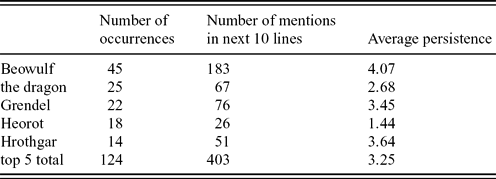
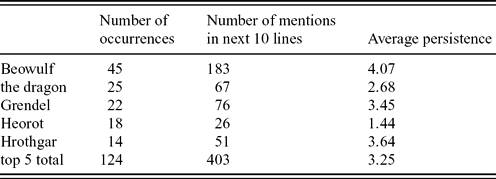
The crucial evidence in support of the conclusion that se can indicate high topicality comes from the fact that while references to major characters do not systematically occur with se (see section 3), when they do occur with se they are highly topical. The persistence of major characters after mentions with se is high. As seen in table 3, the average persistence of the most frequently occurring major characters after they are mentioned in an NP with se is 3.25. This figure rises to 3.56 if we exclude the inanimate referent, Heorot, from our count and include only the animate referents (the participants most crucially involved in the action). The hall is an important setting but not an active participant in the story, so is naturally less inclined to be a topic.
Persistence of most frequent major characters in NPs with se
In (15), I show several more examples of topical major participants introduced with an NP containing se. The topic in (15a) is Grendel; in (15b) it is the dragon. Notice again that mentions with se are often followed by mentions with no determiner, even though the referents of the latter are clearly identifiable (as if it would be considered redundant to identify the same referent more than once).
- (15)
(a)
(b)
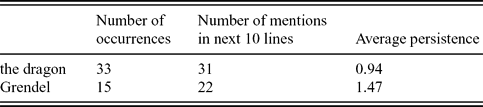
In contrast to the high degree of persistence (topicality) of major participants introduced by NPs with se, the persistence of major participants is low after mentions consisting of a noun with no determiner. However, measuring the persistence of these NPs without se is not a completely straightforward matter. There are many occurrences throughout the text of determiner-less lexical nouns denoting major participants (some examples may be found in (13)–(15) above), but a large number (over one-third) occur within the ten lines following a coreferential NP with se (e.g. fēond mancynnes and atol āngengea in 15a; dracan and Hordweard in 15b). They do not themselves introduce topics but simply form one more link in a topic chain already initiated by the NP with se; and since they follow NPs with se, we should expect them to display a high level of persistence, as well. I therefore excluded them from this text count and measured only the persistence of major participants introduced by determiner-less NPs occurring outside the scope of an NP with se (i.e. not occurring within the ten lines following an NP with se). For the dragon, there were 33 such occurrences (as shown in table 4); in the ten lines following these occurrences, there was a total of only 31 subsequent mentions, for an average persistence of 0.94, considerably lower than the persistence of the dragon after mentions with se (2.68; see table 3). The difference in the number of mentions with and without se is highly significant (χ2 = 25.50, p<.0001).
Persistence of some major characters in NPs without se
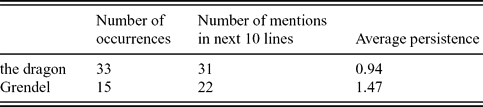
There were 24 mentions of Grendel using NPs with no determiner (and occurring outside the scope of an already existing topic chain initiated by se), followed by 64 subsequent mentions, for an average persistence of 2.67. While this figure is lower than the one for Grendel-references with se (3.45; see table 3), it appears, at first glance, to suggest that mentions of Grendel without se are also highly topical. However, 42 of these 64 recurrences (nearly two-thirds) follow only nine mentions of Grendel. Three of these nine examples occur in the middle of the description of the battle between Beowulf and Grendel, when both characters are, of course, highly topical. While these three NPs do not occur within ten lines after a reference to Grendel containing se, they do nonetheless occur close by (the mention in line 725, fēond ‘fiend’, occurs thirteen lines after a mention with se; that in 750, fyrena hyrde ‘shepherd of sins’, comes eleven lines after a mention with se; the one in 816, atol ǣglǣca ‘terrible wretch’, is found fifteen lines after). Therefore, these three NPs with no determiner are best analyzed as recurrences of a topic introduced by an NP with se (though I have not included them in the text counts shown in table 3 since they do not occur within the stipulated limit of ten lines). They should not be considered examples of employing a determiner-less NP to introduce a highly topical referent; this (incorrect) analysis is an artifact of the methodological choice of using an arbitrary number (ten, in this case) for the purposes of quantifying the notion of persistence.
The other six cases of determiner-less mentions of Grendel followed by a large number of recurrences of the same referent all occur after Beowulf has killed Grendel, in a passage of direct speech (lines 957–79) in which Beowulf recounts the events, the next day, for the entire company in King Hrothgar's hall (lines 962 fēond ‘fiend’; 969 feorhgenīðlan ‘life-enemy’; 970 fēond; 973 fēasceaft guma ‘wretched man’; 974 lāðgetēona ‘hateful criminal’; 978 maga māne fāh ‘guilt-stained man’). In this context, Beowulf's language reflects his own perspective, in which he himself is the topic (the participant most crucially involved in the action) and focus of attention. Accordingly, Grendel's role is de-emphasized – formally, in this passage, Grendel is mentioned frequently but generally appears either as clausal object or as subject of a verb of submission (lie struggling; left his hand; live no longer; etc.), while Beowulf generally appears in subject position:
- (16)
(a)
(b)
Despite the many mentions of Grendel in Beowulf's speech, none of these NPs occurs with se, because Grendel is not topical here (no mentions of Grendel take se in this section of the text until after the conclusion of Beowulf's speech, in line 989, which is the very last clause of that chapter; see next section). So, if we exclude these nine cases from consideration because they are not really examples of topics introduced without se, then (as seen in table 4) we are left with 15 occurrences of Grendel-references without se followed, in the subsequent ten lines, by only 22 recurring mentions, an average persistence of 1.47, much lower than the persistence following mentions with se. In this case, the difference in number of mentions with and without se is again highly significant (χ2 = 13.26, p<.001). In sum, the data strongly suggest that se is used to introduce highly topical referents, in other words, to mark NPs standing at the head of a chain of frequent coreferences in close proximity to one another.Footnote 16
5 Chapter boundaries
We have now seen that se in Beowulf can be used to mark the identifiability, discourse prominence or topicality of a referent. One final discourse function of se is to signal a chapter boundary. In this use, it occurs in noun phrases near the end of a chapter or the beginning of a new one.
It is not unusual for languages to possess elements – demonstratives or otherwise – marking the start or the end of an episode, as noted, for example, by Givón (Reference Givón, Gernsbacher and Givón1995: 74): ‘Some grammatical devices are better described as theme switching or paragraph-initial devices. Rather than coding the re-activated topic, they signal the beginning of a new thematic paragraph.’ And it has already been noted that independent (i.e. pronominal) se had a subject-changing function in Old English, that is, it could indicate that the subject of the current clause is different from that of the previous clause (see Mitchell Reference Mitchell1985: 129; Traugott Reference Traugott and Hogg1992: 171). In a similar manner, determiner se may be used at the level of discourse structure to signal a shift in thematic narrative unit.
Like most lengthy Old English poems, Beowulf is divided formally into chapters, or sections, called fits (or fitts). The start of each chapter is indicated by a Roman numeral and an indentation. There are 42 fitts in Beowulf; the very beginning of the text is not numbered (Roman numeral I comes at line 53). However, the Roman numerals go up to XLIII because there is no indication at all of fitt XXX. With a couple of exceptions, typical chapter length is sixty to ninety lines (all this information is taken from Klaeber Reference Klaeber1950: c–ci; more details on the fitts in Beowulf can be found there, as well). As Klaeber (Reference Klaeber1950: ci) argues, although the boundaries between chapters do not always correspond to modern notions of discourse structure, there are nevertheless too many formal patterns found at chapter boundaries for the divisions to be merely arbitrary. For instance, several chapters end with a summarizing statement; several begin with a reporting clause introducing a speech. In this section, I will show that determiner se is another one of these formal indicators of chapter boundaries. Here are some examples:
- (17)
(a)
(b)
(c)
In (17a), the end of a chapter is marked by the NP þǣm hlæste ‘that cargo’. This chapter dealt with the funeral of King Scyld (the cargo in line 52 refers to his body). The next chapter, fitt I, talks about his successor, Beow. In (17b), the start of fitt III is indicated by the NP ðā mǣlceare ‘the sorrow’. This unusual strategy of employing se with a noun referring to an abstract concept, such as an emotion (in Beowulf, 22 occurrences of se, 5.8 percent, are found with abstract nouns), serves as a clear sign of a change in thematic paragraph. The third fitt begins with a statement summarizing the end of the previous chapter (the helplessness of the Danes before Grendel's attacks), with the Danes’ emotions clearly emphasized by the use of se, before it moves on to a new matter, namely, the introduction of Beowulf and his preparations for helping the Danes. In (17c), both the end of chapter XL and the start of XLI contain NPs with se, in order to help signal the thematic shift from Hygelac (se gōda ‘the hero’ in 2944) to Ongentheow (se gōda in 2949). The new chapter again starts by summarizing the action of the previous one by means of an NP with se (sīo swātswaðu ‘the bloody trail’ left by the two warring nations).
Statistically, a noun phrase containing se occurs near a chapter boundary in 27 of the 42 (64.3%) possible cases in Beowulf. I define the notion of ‘near’ as falling within two clauses of the chapter boundary. Thus, the distal demonstrative determiner occurs within either the final two clauses (e.g. 17a) or the first two clauses (e.g. 17b) of a chapter (or both; see 17c) almost two-thirds of the time. If we take a more restrictive view and define ‘near a chapter boundary’ to mean within only one clause of the boundary, we still find an NP with se in almost half the cases (20 of 42, or 47.6 percent). The frequency with which we find se near chapter boundaries is even more striking when we consider that, as Klaeber noted, there are several other formal techniques for signaling chapter divisions in Beowulf and at least one of these – speeches – is generally incompatible with the use of se. It is quite common for a new fitt to begin with a speech. When this happens, the first clause of the fitt is usually a reporting clause with a speech act verb (typically maþelode ‘said’) and the main verb subject is the name of the character who is about to speak (as in 18a).
- (18)
(a)
(b)
In these types of sentences, we are unlikely to find se at all because names rarely occur with a determiner (nor do appositive NPs, such as bearn Ecgþēowes in (18a), usually take se). Four of the fitts lacking an occurrence of se near their opening sentence take this form (lines 456, 499, 925, 1383). If we exclude this group from consideration, then the percentage of chapter boundaries with se rises to 71.1 percent (27 of 38). By comparison, on the one occasion that a chapter boundary contains a speech act verb whose subject is a lexical noun rather than a proper name, then se does occur (see (18b)).
6 Conclusion
I have argued in this article that a complete account of the meaning and use of the distal demonstrative determiner se in Beowulf cannot be limited to only deixis and identifiability. The determiner se possesses other functions as well, namely, the marking of discourse prominence, high topicality (as characterized by high levels of persistence) and chapter boundaries.
Naturally, much more research remains to be done in the area of Old English demonstratives. The results of the present study should be tested not only by examining epic poems other than Beowulf, but also through careful study of the use of the distal demonstrative determiner in different text genres (e.g. prose). It would also be interesting to examine the use of se as an independent pronoun (meaning either ‘that’ or ‘he’) and compare those findings to the ones described in this article for determiner se; in addition, a comparison of se with the OE proximal demonstrative þes ‘this’ should also be undertaken. Eventually, a better understanding of Old English se, especially its discourse-related functions, is important not only for its own sake, but also because it could help shed light on the thorny problem of the meaning of the definite article in Modern English.