Introduction
Suicide is the tenth leading cause of death in the USA with over 36 000 deaths annually (CDC, 2013), or roughly 100 deaths per day. In 2012, the US Surgeon General released an updated National Strategy for Suicide Prevention, prioritizing suicide research as a key strategic direction towards the goal of reducing suicide (HHS, 2012). In addition to emphasizing the public health impact of suicide, the report recognized the importance of suicide attempts. For each suicide death there are 30 attempts, equivalent to more than 1.1 million suicide attempts annually. Suicide attempts are one of the strongest risk factors for eventual suicide (Tidemalm et al. Reference Tidemalm, Langstrom, Lichtenstein and Runeson2008). Together, suicide and suicide attempts result in direct and indirect costs to society of over US$20 billion annually in the USA, and thus represent a major public health and economic concern (Yang & Lester, Reference Yang and Lester2007). Mental disorders are present in 90% of people who die by suicide and consequently have been a predominant focus of research efforts and clinical attention in suicide prevention (Cavanagh et al. Reference Cavanagh, Carson, Shapre and Lawrie2003). There is a substantial body of evidence implicating several mental disorders, including depression, bipolar disorder, anxiety disorders, substance use disorders and schizophrenia, as all contributing independently to the risk of suicide attempts and completed suicide (Harris & Barraclough, Reference Harris and Barraclough1997; Mortensen et al. Reference Mortensen, Agerbo, Erikson, Qin and Westergaard-Nielsen2000; Bolton & Robinson, Reference Bolton and Robinson2010).
The association between physical disorders and suicidal behavior has received far less attention when compared to mental disorders and social characteristics. Some existing literature shows an increased risk of suicide attempts linked with physical illness (Druss & Pincus, Reference Druss and Pincus2000; Goodwin et al. Reference Goodwin, Marusic and Hoven2003; Goodwin & Eaton, Reference Goodwin and Eaton2005). However, people with physical conditions have elevated rates of mental illness (Scott et al. Reference Scott, Bruffaerts, Tsang, Ormel, Alonso, Angermeyer, Benjet, Bromet, de Girolamo, de Graaf, Gasquet, Gureje, Haro, He, Kessler, Levinson, Mneimneh, Oakley Browne, Posada-Villa, Stein, Takeshima and Von Korff2007; Roy-Byrne et al. Reference Roy-Byrne, Davidson, Kessler, Asmundson, Goodwin, Kubzansky, Lydiard, Massie, Katon, Laden and Stein2008), and once the effects of mental disorders are accounted for, the literature becomes divided, with some studies showing an attenuated risk of suicidal behavior and suggesting that the latter is attributable to mental disorder co-morbidity (Rasic et al. Reference Rasic, Belik, Bolton, Chochinov and Sareen2008; Lossnitzer et al. Reference Lossnitzer, Muller-Tasch, Lowe, Zugck, Nelles, Remppis, Haass, Rauch, Junger, Herzog and Wild2009). Although several studies have specifically examined the relationship between cancer and suicide (Misono et al. Reference Misono, Weiss, Fann, Redman and Yueh2008; Fall et al. Reference Fall, Fang, Mucci, Ye, Andren, Johansson, Andersson, Sparen, Klein, Stampfer, Adami and Valdimarsdottir2009; Robinson et al. Reference Robinson, Renshaw, Okello, Moller and Davies2009; Turaga et al. Reference Turaga, Malafa, Jacobsen, Schell and Sarr2011; Fang et al. Reference Fang, Fall, Mittleman, Sparen, Ye, Adami and Valdimarsdottir2012), studies of other physical illnesses are few, and again find mixed results (Fredrikson et al. Reference Fredrikson, Cheng, Jiang and Wasserman2003; Bronnum-Hansen et al. Reference Bronnum-Hansen, Stenager, Nylev Stenager and Koch-Henriksen2005; Pompili et al. Reference Pompili, Lester, Iliceto, Tatarelli and Girardi2007; Giltay et al. Reference Giltay, Zitman, Menotti, Nissinen, Jacobs, Adachi, Kafato and Kromhout2010; Webb et al. Reference Webb, Kontopantelis, Doran, Qin, Creed and Kapur2012). Two reviews have described an increased risk of suicide among specific disorders, but both noted that existing literature was fraught with methodological limitations, including small clinical samples and a lack of control for confounding factors, especially mental disorders (Harris & Barraclough, Reference Harris and Barraclough1994; Hawton & van Heeringen, Reference Hawton and van Heeringen2009). There are very few matched case–control studies that have systematically adjusted for mental disorder confounders. Furthermore, to our knowledge, there have been no studies that have used balancing score matching to adjust for bias due to covariance with confounding variables.
In this context, we undertook this study with the aim of addressing many of the limitations of previous work. The primary aim of this study was to examine the association between physical disorders and suicide. Secondary objectives included examining the relationship according to time since diagnosis, and also investigating the association between physical disorders and suicide attempts. We used a population-based sample to compare all people who had died by suicide to matched living controls in Manitoba between the years 1996 and 2009. The groups were matched by balancing score on several potentially confounding variables. We examined eight physical disorders as independent predictor variables in models that adjusted for co-morbidity effects and a comprehensive range of mental disorders. All diagnoses were made by physicians. This methodological approach positioned this study to provide the most comprehensive assessment of the relationship between physical illness and suicide to date.
Method
Data sources and sample
The study sample was the population of Manitoba, Canada (n = 1.2 million). Data came from the Population Health Research Data Repository at the Manitoba Centre for Health Policy, within the University of Manitoba. All health contacts are linked by an encrypted personal health information number that provides a longitudinal health profile for almost all residents in the province, and can be linked to several other databases within the repository. Databases used in this study included vital statistics (to identify suicides), the Manitoba Health Registry (physical and mental disorder out-patient diagnoses, hospitalization discharge diagnoses, marital status), and area-level census data (age, sex, income, region of residence). The accuracy of the datasets is excellent (Roos & Nicol, Reference Roos and Nicol1999). The study period was 1996–2009, based on completeness of the datasets from 1996 onwards, and data from 2009 being the most recent available. This study was approved by the Research Ethics Board at the University of Manitoba and the Health Information Privacy Committee of Manitoba Health.
Case identification and balancing matching
All people who died by suicide (n = 2100) during the study period were identified using ICD codes (specific codes listed in the online Appendix). Each decedent was matched by balancing score to three living controls (n = 6300). The balancing score was generated as the predicted probability of dying by suicide based on birth year (grouped by 5-year intervals), sex, marital status (married, not married), region of residence (grouped in 10 provincial regional health authorities), and area-level income (grouped in deciles). After matching, the Kolmogorov–Smirnov test for difference in the distribution of the balancing score was non-significant (KSa = 0.075, p = 1.0). The standard difference between cases and controls after matching was less than 1.5% for all variables. A group of all people who attempted suicide in the study period (n = 8641), identified in medical claims and hospitalization abstracts using established definitions for suicide attempts (Martens, Reference Martens2010), was matched in similar fashion (1:3) to people who had not attempted suicide (n = 25 923). The distribution difference in balancing score between cases and controls was non-significant (KSa = 0.146, p = 1.0) and standard differences between groups were less than 1.8% for all variables after matching. Suicide attempt ICD codes are listed in the online Appendix.
Physical disorders
Physical disorders examined in this study included asthma, chronic obstructive pulmonary disease (COPD), ischemic heart disease, hypertension, diabetes, cancer, multiple sclerosis and inflammatory bowel disease. ICD-9-CM and ICD-10-CA codes were used to identify the physical disorders, based on established disorder definitions validated in the same dataset (Fransoo et al. Reference Fransoo, Martens, Burland, Prior and Burchill2009; see Appendix). Cancer diagnoses included all malignant neoplasms whereas benign neoplasms were excluded. For analyses involving the suicide attempt cohort, only physical disorders that predated the suicide attempt were considered. The timing of first physician diagnosis (within the study period) was also determined for each condition, specifically whether it occurred 1–90, 91–364 or ⩾ 365 days prior to suicide or suicide attempt. If a physical disorder was diagnosed in two or more of these time periods, it was included only in the earliest period and excluded from the more recent time period.
Covariates
Mental disorders
ICD-9-CM and ICD-10-CA codes were used to identify mental disorders of interest, including depression (unipolar and bipolar), anxiety disorders, substance abuse or dependence, schizophrenia and dementia (ICD codes in the Appendix). Mental disorders were based on previously validated definitions using the same dataset (Fransoo et al. Reference Fransoo, Martens, Burland, Prior and Burchill2009). A variable titled ‘other psychosocial disorders’ was also included as a covariate, which included the Johns Hopkins Aggregated Diagnosis Groups (ADGs) 23, 24 and 25, minus the codes used to define the other mental disorders of interest. As was the case for physical disorders, in suicide attempt analyses only mental disorders predating the suicide attempt were considered as confounders.
ADGs
Johns Hopkins ADGs were used to account for medical co-morbidity. ADGs are part of a case-mix system that groups every ICD-9 and -10 diagnosis code assigned to an individual into one of 32 different ADGs. The ADGs are based on clinical and service utilization criteria that include duration, severity and etiology of the condition. Four ADG count categories, based on previous work (Kozyrskyj et al. Reference Kozyrskyj, Lix, Dahl and Soodeen2005), were calculated: 0–2, 3–5, 6–9, 10–32. The physical disorders of interest in this study, along with mental disorder covariates, were removed from the ADG categories.
Statistical analysis
Conditional logistic regression generated odds ratios (ORs) and 95% confidence intervals (CIs) that compared the likelihood of case status (suicide or suicide attempt compared to matched controls) dependent on diagnosed physical disorders. Initial unadjusted models examined main effects of the physical disorder of interest on risk of suicide (or suicide attempt). In the adjusted models, covariates entered into the model included ADG count, all mental disorders and all eight physical disorders of interest. Additionally, three interaction terms were examined (one at a time) in each adjusted model: physical disorder × sex (male v. female), physical disorder × age (> 50 years v. < 50 years) and physical disorder × income tertile (top, middle, bottom). Next, conditional logistic regression was used to examine the association between timing of initial physical disorder diagnosis and risk of suicide (or suicide attempt). In each case group, the outcome of interest (suicide or suicide attempt) was categorized as occurring either 1–90, 91–364 or ⩾ 365 days after the first date of physical disorder diagnosis. These models were also adjusted for ADG score and all mental and physical disorders.
Results
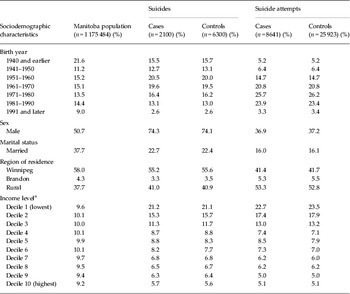
The sociodemographic characteristics of the entire Manitoba population, cases (suicide and suicide attempts) and matched controls are presented in Table 1. Among the suicide cohort, 74.3% were male and 22.7% were married. Of the people who died by suicide, 55.6% lived in Winnipeg, the major urban center of the province. More than one-fifth (21.2%) were in the lowest income decile of the province, and almost half (47.9%) were in the lowest three provincial deciles of income. Among the 8641 people who made suicide attempts, 36.9% were men and 16% were married. A total of 41.4% lived within Winnipeg, and 53.1% had an income level in the lowest three deciles.
Sociodemographic characteristics of the sample

The balancing score was generated with birth year grouped in 5-year intervals and region of residence grouped in 10 regions; categories have been aggregated in this table for presentation.
a Income levels could not be determined for < 3% of the population.
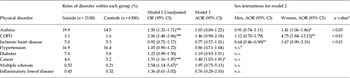
The association between diagnosed physical disorders and suicide is displayed in Table 2. In unadjusted models, asthma, COPD, cancer and multiple sclerosis were associated with increased risk of suicide. After adjusting for the effects of co-morbidity, mental disorders and the other physical disorders, cancer remained significantly associated with elevated suicide risk. There were significant sex interactions for asthma (p < 0.05), COPD (p < 0.01) and ischemic heart disease (p < 0.01). Women with respiratory disease had a significantly increased risk of suicide when compared to their healthy female counterparts. Of note, women with COPD had almost five times the odds of suicide compared to women without COPD (p < 0.01). Men with ischemic heart disease had a lower risk of suicide compared to men without heart disease. Age and income interaction analyses were non-significant for all disorders.
Risk of suicide associated with physical disorders

COPD, Chronic obstructive pulmonary disease; OR, odds ratio; AOR, adjusted odds ratio; CI, confidence interval.
Model 2 adjusted for Aggregated Diagnosis Group (ADG) count, depression, anxiety disorders, substance abuse or dependence, schizophrenia, dementia, other psychosocial disorders, and all physical disorders simultaneously.
Age (< 50 years v. > 50 years) and community-level income (bottom, middle, highest tertiles) interactions were not significant for all disorders.
a p value for interaction term.
b n.s., Interaction term non-significant.
* p < 0.05, **p < 0.01, ***p < 0.001.
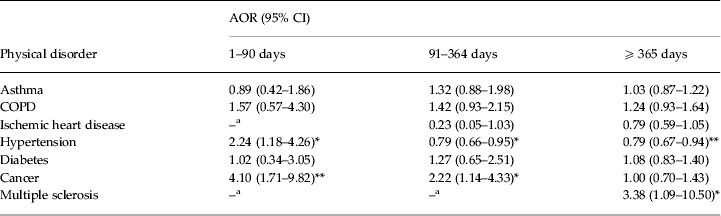
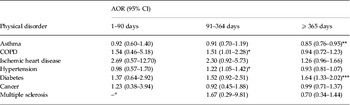
Analyses that examined suicide risk based on time since initial ascertainment of diagnosis in the registry are presented in Table 3. All analyses were adjusted for ADG count and mental disorder co-morbidity. Cancer was associated with an elevated risk of suicide within the first year of diagnosis. In particular, people receiving their initial diagnosis of cancer had a fourfold increased risk of suicide within the next 3 months. Multiple sclerosis showed a risk of suicide beyond the first year of diagnosis. Newly ascertained diagnoses of hypertension were associated with an increased risk of suicide within the first 3 months, but subsequently with a lower risk of suicide after 3 months and beyond the first year.
Risk of suicide by physical disorders according to time since diagnosis

COPD, Chronic obstructive pulmonary disease; AOR, adjusted odds ratio; CI, confidence interval.
AOR compares suicide cohort to controls on likelihood of diagnosis within time frame prior to index date.
Time analyses were not possible for inflammatory bowel disease as all diagnoses were made more than 365 days prior to suicide.
a Suppressed due to low cell size.
* p < 0.05, **p < 0.01, ***p < 0.001.
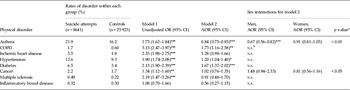
The risk of suicide attempt after physical disorder diagnosis is presented in Table 4. All disorders, with the exception of inflammatory bowel disease, were associated with risk of suicide attempt in unadjusted models. The strength of these associations was attenuated somewhat after adjusting for co-morbidity and mental and physical disorders; however, suicide attempt remained positively correlated with COPD, hypertension and diabetes. Sex interactions were observed with both asthma and cancer (p < 0.01 and p < 0.05 respectively). Men with asthma had a lower likelihood of suicide attempt than men without asthma. Multiple sclerosis was the only disorder that showed an interaction effect with rising income levels (p < 0.05). There were no significant differences when comparing people with and without multiple sclerosis within each income tertile (results not shown). Age interaction analyses were non-significant for all disorders.
Risk of suicide attempts associated with physical disorders
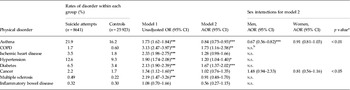
COPD, Chronic obstructive pulmonary disease; OR, odds ratio; AOR, adjusted odds ratio; CI, confidence interval.
Model 2 adjusted for ADG count, depression, anxiety disorders, substance abuse or dependence, schizophrenia, dementia, other psychosocial disorders, and all physical disorders simultaneously.
Age (< 50 years v. > 50 years) interactions were not significant for all disorders. Income (bottom, middle, highest tertiles) interactions were significant only for multiple sclerosis (p < 0.05; results not shown).
a p value for interaction term.
b n.s., Interaction term non-significant.
* p < 0.05, **p < 0.01, ***p < 0.001.
Table 5 displays the risk of suicide attempt across different time intervals since initial ascertainment of diagnosis in the registry files. Hypertension and COPD were associated with an increased risk of suicide attempt within the 91–364-day period of first diagnosis, and for both disorders this risk decreased to non-significance among people who had more than 1 year of illness. Diabetes was associated with increased risk of suicide attempt beyond the first year of diagnosis but not within the first year.
Risk of suicide attempt by physical disorders according to time since diagnosis

COPD, Chronic obstructive pulmonary disease; AOR, adjusted odds ratio; CI, confidence interval.
AOR compares suicide attempt cohort to controls on likelihood of diagnosis within time frame prior to index date.
Time analyses were not possible for inflammatory bowel disease as all diagnoses were made more than 365 days prior to suicide attempt.
a Suppressed due to low cell size.
* p < 0.05, **p < 0.01, ***p < 0.001.
Discussion
This study is the first to examine the risk of both suicide and suicide attempts associated with a broad range of diagnosed physical disorders in a population-based sample. By minimizing sample bias, using physician-based diagnoses, balancing score matching and adjusting for a comprehensive list of confounding mental disorders, this study addressed many limitations of previous work. The main findings are that, although several physical disorders predisposed to suicide attempts, cancer is the only examined illness that increased the risk of dying by suicide for both men and women, once the effects of mental disorders and co-morbidity were taken into accounted. Furthermore, that risk seems to be related to the date of first diagnosis; newly diagnosed persons are at significantly increased risk for the first 3 months, but after the first year of living with cancer the risk is no greater than in matched healthy controls. These results have important implications for clinical work that spans medical disciplines, suggesting that physicians in primary care, oncology and other specialties should consider the risk of self-harm among their patients. It also emphasizes the necessity of collaborative care between psychiatrists and other treatment providers working outside the boundaries of mental health.
These findings corroborate several studies that have demonstrated an elevated risk of suicide following cancer diagnosis (Misono et al. Reference Misono, Weiss, Fann, Redman and Yueh2008; Fall et al. Reference Fall, Fang, Mucci, Ye, Andren, Johansson, Andersson, Sparen, Klein, Stampfer, Adami and Valdimarsdottir2009; Robinson et al. Reference Robinson, Renshaw, Okello, Moller and Davies2009; Turaga et al. Reference Turaga, Malafa, Jacobsen, Schell and Sarr2011; Fang et al. Reference Fang, Fall, Mittleman, Sparen, Ye, Adami and Valdimarsdottir2012). The finding of a particularly increased risk immediately following first ascertainment of diagnosis is also consistent with these studies, many of which showed that the risk of suicide was higher within the first year. Our results show that people who died by suicide were more than four times more likely to have received a new cancer diagnosis within 3 months of their death, compared to living controls. This is an especially concerning finding with direct clinical implications regarding support efforts in the newly diagnosed. Our findings also reveal that respiratory illness carries a risk of suicide in women, but not men. The study by Webb et al. (Reference Webb, Kontopantelis, Doran, Qin, Creed and Kapur2012) also showed that women with COPD were at higher risk for suicide. In general, men die by suicide at a rate 2–4 times that of women (Hawton & van Heeringen, Reference Hawton and van Heeringen2009), and therefore these findings are unusual. The mechanism of these sex-specific differences within certain disorders is unknown but, if consistently replicated, could lead to clinical approaches that are more sex informed. Multiple sclerosis showed positive, albeit non-significant, correlations with suicide. Multiple sclerosis has been linked with suicide in other studies (Fredrikson et al. Reference Fredrikson, Cheng, Jiang and Wasserman2003; Bronnum-Hansen et al. Reference Bronnum-Hansen, Stenager, Nylev Stenager and Koch-Henriksen2005); further studies should examine this association in larger populations, ideally adjusting for the effects of interferon therapy, which has been linked to suicidal behavior in multiple sclerosis (Fragoso et al. Reference Fragoso, Frota, Lopes, Noal, Giacomo, Gomes, Goncalves, de Gama and Finkelsztejn2010). Of note, although these previous studies found a higher risk of suicide within the first year of diagnosis (Fredrikson et al. Reference Fredrikson, Cheng, Jiang and Wasserman2003; Bronnum-Hansen, Reference Bronnum-Hansen, Stenager, Nylev Stenager and Koch-Henriksen2005), our findings suggest that risk is observed after the first year of living with the disorder.
Several examined physical disorders were associated with suicide attempts, even after adjusting for co-morbidity and mental disorders. This was different from the results where suicide was the outcome, yet was not unexpected, given previous research showing that people who attempt and people who complete suicide have some shared characteristics but also different patterns of co-morbidity (Beautrais, Reference Beautrais2001). Previous reports have shown asthma and other lung disease to be linked with suicide attempts (Goodwin et al. Reference Goodwin, Marusic and Hoven2003, Reference Goodwin, Demmer, Galea, Lemeshow, Ortega and Beautrais2012; Goodwin & Eaton, Reference Goodwin and Eaton2005; MacLean et al. Reference MacLean, Kinley, Jacobi, Bolton and Sareen2011). Our results showed COPD, but not asthma, to be associated with suicide attempts. We also found hypertension to be correlated with suicide attempts. We are aware of only one other study that has documented this association, in an epidemiological sample where physicians generated diagnoses at the time of survey (MacLean et al. Reference MacLean, Kinley, Jacobi, Bolton and Sareen2011). Given the high prevalence of hypertension in the population, further study of this potential relationship is warranted because even a modest effect could contribute to a significant number of suicide attempts at the population level. Diabetes was associated with an elevated risk of suicide attempts, and in time analyses this risk was sustained beyond 1 year after diagnosis. The literature on risk of suicidal behavior among people with diabetes is mixed and seems to be influenced by the type of diabetes, sex and age (Radobuljac et al. Reference Radobuljac, Bratina, Battelino and Tomori2009; Batty et al. Reference Batty, Kivimaki, Park and Jee2012).
There are important limitations that should be considered when interpreting these results. This study relied on administrative data for all measures and is therefore subject to the limitations inherent in claims data. Race/ethnicity was not available in the dataset; future investigations that incorporated this variable in the balancing score would be useful. Suicide can be misclassified in mortality records (Kapusta et al. Reference Kapusta, Tran, Rockett, De Leo, Naylor, Niederkrotenthaler, Voracek, Etzersdorfer and Sonneck2011), and coding of suicide attempts has been shown to have low sensitivity in administrative data (Kim et al. Reference Kim, Smith, Stano, Ganoczy, Zivin, Walters and Valenstein2012). Income is imputed based on neighborhood and therefore is not a direct measure. Physical and mental disorder diagnoses are dependent on treatment seeking, and are therefore probably an under-representation of the true population prevalence given discrepancies in the rates of need for treatment and health service utilization observed in survey data (Sareen et al. Reference Sareen, Cox, Afifi, Clara and Yu2005). However, this also highlights a strength of the current study, specifically the use of balancing score to improve matching of cases and controls. A further limitation is that administrative definitions may not capture disorders accurately even among the population presenting for treatment. Nevertheless, this study used established disorder definitions that have been shown to be reliable and valid, and have been used in previous studies (Fransoo et al. Reference Fransoo, Martens, Burland, Prior and Burchill2009). It is important to recognize that the terms ‘newly diagnosed’ and ‘first diagnosis’ used in this study represent the first time that diagnosis was ascertained in the health registries; these physical disorders are chronic conditions and it is entirely possible that they existed prior to the study period. Although this study attempted to reduce bias in many ways, it is important to caution any causative link between physical disorders and suicidal behavior. For example, it could be complications of diabetes (rather than the disorder itself) that account for the increased risk of suicide attempt, especially because the risk is observed only after 1 year. Another limitation is the low cell sizes in analyses stratified by time since diagnosis. Future studies with greater power could clarify the risk of suicidal behavior in shorter time frames, such as the 4-week interval in the study by Fang et al. (Reference Fang, Fall, Mittleman, Sparen, Ye, Adami and Valdimarsdottir2012). Our study cannot comment on the risk of suicide associated with specific types of cancer, and further studies on this risk are warranted. This study did not examine other physical conditions that may be associated with suicide or suicide attempts, and this should be a direction of future work. Future research in this area should also examine the timing of onset of physical and mental disorders to further clarify their independent and combined causal influence on suicidal behavior.
In conclusion, this study provides information on the risk of suicide and future suicide attempt associated with a comprehensive range of physical disorders. Several examined disorders were associated with suicide attempts even after adjusting for mental disorder co-morbidity. The findings showing an elevated risk among diabetes and hypertension were particularly novel. An elevated risk of suicide was observed among people with malignant cancer, especially within the first 90 days following initial diagnosis. Sex influences were also demonstrated, with women having a significantly heightened risk of suicide in asthma and COPD. This study has several methodological strengths, including a large sample size of individuals who died from suicide, the use of population-based registries, physician diagnoses, the absence of recall bias, adjustment for a diverse range of mental disorder co-morbidity and, importantly, balancing score matching, thus addressing many of the limitations of existing studies. These findings contribute to the clinical management of physical disease by raising awareness of suicide among physicians who may not routinely consider risk assessment. They also improve our understanding of suicide risk and contribute to public health efforts in suicide prevention.
Supplementary material
For supplementary material accompanying this paper, please visit http://dx.doi.org/10.1017/S0033291714001639.
Acknowledgments
Preparation of this article was supported by research grants from the Thorlakson Foundation (J.M.B.), Manitoba Health Research Council (J.M.B.), a Manitoba Health Research Council Chair Award (J.S.) and a Canadian Institutes of Health Research New Investigator Award (J.M.B., no. 113589). The funding sources had no role in the design and conduct of the study; no role in the collection, management, analysis and interpretation of data; and no role in the preparation, review and approval of the manuscript. We thank J. Bhaskaran and Y. Wang for their assistance with manuscript preparation.
Declaration of Interest
None.