Introduction
Scandinavia comprises five countries: Denmark, Finland, Iceland, Norway and Sweden. They have many similarities in natural conditions, history and culture. Animal production has long been an important sector of agriculture, and production techniques have been developed also in collaboration between countries. According to Gjelstad (Reference Gjelstad, Gjelstad, Kolstad and Maijala1993) the number of breeds at the end of 1980s were about 22 cattle, 20 horse and sheep, 8 pig and 7 goat. Some native and international breeds occurred in more than one country. Each country had its own native layer breed of hens and several international ones. An analysis made by Kantanen (Reference Kantanen1999) with 29 genetic markers on the genetic distances between 15 indigenous, 2 old imported and 3 commercial Nordic cattle breeds revealed that the Icelandic cattle were related to the three Finnish native cattle breeds and that they have had the last common ancestors with the east-Finnish cattle ca. 400 generations or ca. 2 000 years ago. The study by Tapio (Reference Tapio2006), using mitochondrial control region and autosomal blood protein variation in 76 sheep breeds in northern Europe showed, that the main maternal origin of northern sheep is in the south, and that there were four distinct maternal lines in Europe. The analysis separated long- and short-tailed sheep.
There are many organizations both on the scientific and practical level, for cooperation, e.g. the Scandinavian Association of Agricultural Scientists (SAAS) established in 1918. Nordic experience of conservation of animal genetic resources (AGR) may be of interest to similar groups of countries, which could profit from cooperation. Motives for conservation, principles in choosing breeds for conservation, various problems and other details can be found from earlier reports (Maijala, Ehrenberg and Kolstad, Reference Maijala, Ehrenberg and Kolstad1981; Maijala, Reference Maijala1984, Reference Maijala1985 , Reference Maijala and Wiener1990; Maijala et al., Reference Maijala, Neimann-Sörensen, Adalsteinsson, Kolstad, Danell and Gjelstad1990a, Reference Maijala, Neimann-Sörensen, Adalsteinsson, Kolstad, Danell and Gjelstad1990b, Maijala and Kolstad, Reference Maijala, Kolstad, Sandlund, Hindar and Brown1992).
Development of conservation ideas
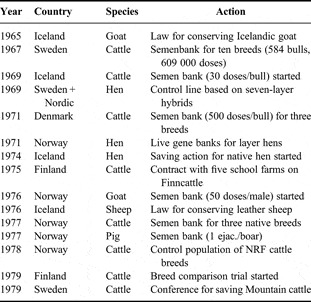
Worries about possible losses of genetic variation in farm animals were expressed in a Nordic cattle breeders’ meeting already in 1954, when possible consequences of using frozen semen in cattle were discussed (Hansson, Reference Hansson1954). In the 1960s, similar worries were raised because of the spread of “hybrid breeding” in layer hens and by the rapid decreases in the population sizes of some native Nordic populations of cattle, horses and sheep (Maijala, Reference Maijala1970). Since then, more and more thought has been devoted to the risks of gene and breed losses in various farm animals in the region. Table 1 shows that isolated conservation activities were started in all the Nordic countries and in several species in the 1960–1970s.
Early Nordic activities serving conservation of AGRs.

The UN Environment Conference in Stockholm in 1972 emphasized the importance of conserving genetic material. Its recommendations included actions, which the different states should undertake for conserving and managing valuable genetic resources: to make inventories of genetic collections, collect and document genetic material of various organisms (including farm animals) in order to establish national and regional gene banks. Following these recommendations, the Nordic Contact Organ for Environment Problems (NCOEP) suggested, in 1973, an arrangement of a joint Nordic conference for discussing problems connected with establishment of Nordic gene banks and for preparing suggestions for concrete actions.
The world conference on AGR conservation and management, arranged by FAO and UNEP in 1980, had also Nordic participants. The author presented there a Scandinavian report on AGR (Maijala, Ehrenberg and Kolstad, Reference Maijala, Ehrenberg and Kolstad1981). The conference gave recommendations to FAO and to its member governments. The author represented Scandinavia in the European AGR working party for 16 years, of which 13 years as chairman. This group collected information on the situation of endangered breeds three times (1982, 1985 and 1988) also in Scandinavia and outlined important principles concerning motives, methods and uses of gene conservation (Maijala et al., Reference Maijala, Cherekaev, Devillard, Reklewski, Rognoni, Simon and Steane1984; Maijala, Reference Maijala1987; Simon, Reference Simon1989).
The Nordic Council of Ministers (NCM) as an assumer of responsibility
In the years 1973–1976, the NCM made preparations for the symposium suggested by NCOEP, by mapping out the situation and by studying the possibilities to coordination. The symposium was held in March 1978 in Helsinki and concerned agricultural, horticultural and forest plants, wild plants and animals, farm animals and fish (SOG, 1978). The reports on farm animals revealed that conservation activities had already been made in all Nordic countries and in several species.
The working party on farm animals discussed the need for conserving genetic variation, the threat situation in different countries and species, activities performed, conservation methods, possibilities for utilizing conserved genes, possible actions, bureaus responsible for conserving AGR, and need and organization of collaboration between countries. It proposed that the ministries of agriculture should have the direct responsibility for the national farm animal breeds that will be conserved. It also suggested that the collaboration between countries should take place by means of an expert group in NCM and the board of the animal section in SAAS. The expert group could assume responsibility for that information on semen banks and threatened animal breeds is collected into a register, which can be utilized by researchers, public authorities, etc. No reason was seen in creating a Nordic gene bank physically as in plants.
At the end of 1979, the NCM decided to finance the activity of a Working Party on Animal Genetic Resources (WPAGR). The grant for the purpose has gradually increased from NOK 40 000 to DKK 500 000. Decisive increases took place in 1984 and 1991, for hiring first a half-time secretary and then a full-time one. Getting a secretary meant that the activities could be really started. There are signs for that understanding of conservation has increased among the public authorities and general public.
Organization of WPAGR and division of responsibilities
WPAGR was established in a board meeting of the animal section of SAAS in the winter 1980, for clarifying the possibilities to coordinate the conservation actions in Scandinavia (Maijala et al., Reference Maijala, Adalsteinsson, Danell, Gjelstad, Vangen, Neimann-Sörensen, Alderson and Bodó1992). It met about three times a year. Besides the salary of the secretary, the cost of travel for him and members of the meetings of WPAGR and for data processing have been the most important cost items. Costs for symposia, extra travel, etc., which are difficult to predict, were covered by grants applied for specifically.
The WPAGR considered that, in principle, each country should take care of the conservation of its own gene resources, since the profit of it can be harvested only in the future and mainly on the national level. Hence, the activities should be divided into two levels:
National level
Each country should organize its own gene bank according to its own circumstances and priorities, and utilize its own existing resources for gene conservation, including semen and embryo stores, and animal institutes and museum farms for maintaining small populations of live animals. It should have an advisory gene bank council with representatives of as wide a society level as possible, e.g. for research in the animal field, animal management, breeding and Artificial Insemination (AI) organizations and cultural–historical as well as nature protection interests.
The council should:
• make proposals for and contribute to legislation in the area;
• create, maintain and supplement gene banks;
• contribute to the utilization of conserved genetic material;
• follow the development in the animal breeds outside the gene banks through contact with various breeding organizations;
• follow developments in conservation methods;
• work for financing the activities;
• work with information about them;
• develop contacts with corresponding international activities;
• register and mediate national base information for furthering it to the Nordic information centre.
Nordic level
A coordinating body, composed of representatives of national gene bank councils, should be created under the NMC. WPAGR should:
• organize and coordinate activities on the Nordic level;
• map out endangered populations;
• initiate formation of and contribute to realization of gene banks;
• collect and mediate information about the activities in the Nordic countries;
• create an information and data processing centre on Nordic level;
• take care of contacts with the EAAP/FAO Global AGR Data Bank:
• maintain contacts with and follow the progress of research on conservation methods, animal breeding, gene technology and culture protection, and work for application of the newest methods in storing genes;
• function as a leading group for projects in the subject area, prioritize, initiate and follow-up them;
• work for active information both on the scientific and popular levels;
• actively search for collection with similar activities on both plant and animal sides, nationally and internationally;
• stimulate and maintain contacts with corresponding international activities.
The coordinating secretary should be placed at some animal breeding institute in Scandinavia, making available the basic resources on data processing, a research environment and knowledge about the latest development in the area. WPAGR got a half-time secretary on 1 July 1984, and, on 1 March 1991, a full-time one, placed at the Institute of Animal Science, Agricultural Research University of Norway.
Mapping out the national situations
WPAGR, in which each Nordic country is represented, sent in March 1981 to the agricultural ministries of all Nordic countries a recommendation to setting up national committees for studying the situation and the present organization, with the following tasks:
• map out the present situation of the animal breeding of the country and the number of animals in the remaining native breeds, their distribution in the country and utilization;
• make clear the available methods for conservation of the gene resources of different farm animal species, and the knowledge and techniques that are available in farm animals;
• review the possibilities of conserving the genetic variation, which is considered necessary from the economic-biological, scientific or cultural-historical viewpoints;
• make proposals for hastening the conservation actions for certain animal materials (rare or endangered breeds);
• plan the gene bank for farm animals and give recommendations for the activity with estimates of financial needs.
Each country appointed a committee or a working party, as shown in Table 2. The Swedish one had been set up already in 1978 and gave valuable lines of thought for those of other countries. Cattle, goat, horse and sheep were considered in five countries, duck, fox, goose and mink in four, polecat, rabbit, raccoon dog and turkey in three and bee and reindeer in two.
National committee reports on AGR in Nordic countries.

Breed situation of ruminant species
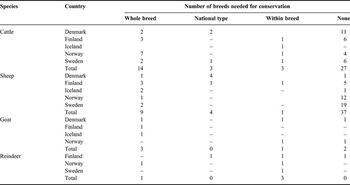
Table 3 gives the situation in ruminants, which have special importance in utilizing feeds not edible by man. Each country has its own native breeds, several of which are endangered:
Conservation needs of Nordic ruminant breeds.

Cattle: Gray Jutland and Red Pied in Denmark, Eastland Red Poll, Telemark, Trönder.
Döle, Westl. Red Poll, Westland Gray Möre and Westland Fjord in Norway, west Finnish and north Finnish in Finland.
Sheep: Landrace in Denmark, landrace in Iceland, wild sheep in Norway, gute in Sweden, finnsheep (grey, brown and blue types) in Finland.
Goat: Landrace in Denmark, Iceland and Norway.
Reindeer: Wild in Norway.
These have a long background of having lived in the northern conditions and thus have special genes for adaptability to these conditions. They were developed as separate breeds since the turn of 1900s, when the theories of breed constancy and local adaptations were still prevailing. Hence, much emphasis was directed to simple visible traits such as colours and horns. Separate herd books were established for different types, and individuals not conforming to the type requirements were excluded. This may have meant losses of valuable genes for physiological and production traits. It is not known, to what extent this has happened and how big are the genetic differences between the breeds.
Also the histories are generally poorly known. However, in some cases it is known that either the background is similar or there has been exchange of breeding material. In cattle this applies, for example, to the Eastland Red Poll of Norway, the Red Poll of Sweden and the west-Finnish cattle (Blomqvist, Reference Blomqvist1989). Similarly, the Swedish Mountain cattle and the north-Finnish cattle have obtained genes from each other. Acceptance of the exchanges by people has been facilitated by the similar colours. It would be important to know, to what extent these similarities reflect similarities in origin and in genetic constitution. Hence, estimation of genetic distances between the Nordic breeds with the aid of DNA and other genetic polymorphisms would be important for planning the conservation and future breeding of the breeds. Since this information has not been available, the national committees have considered it important to save most of the native breeds. This has been justified also for cultural–historical reasons. Fusing similar breeds from several countries may weaken these motives of each group of owners, and may not essentially improve the economic competing ability.
The Icelandic cattle, sheep and goats are of special interest, since they have been isolated from the original Norwegian ancestors for more than 1 000 years. Thus, they can be considered live gene banks as such, especially since no discrimination on the basis of colours and types has taken place (Adalsteinsson, Reference Adalsteinsson1981).
For some breeds (e.g. Danish Blackpied and Red cattle breeds) the question is of preserving genes from the old Danish animals, since the breeds have used largely genetic material from similar American breeds (Holstein, Brown Swiss).
For the part of some major breeds, saving old and present genetic material for unpredictable future needs has been considered important. The Finnish population of Ayrshire is the biggest in the world, and hence Finland has assumed the responsibility for saving its genetic variation. In sheep, there are some special traits or genes, which have been considered to deserve protection, e.g. the leader sheep and the single gene for fertility in the Icelandic sheep, and some colour genes in the Swedish and Finnish landrace sheep. All the countries have landrace sheep belonging to the northern short-tailed group, most types of which are very prolific. They would deserve a special study of genetic relationships and other traits. In goats, there has been exchange of breeding material between the landraces of Norway and Sweden, to some extent also of Finland, and so one could speak about a Nordic Landrace. Knowing their relations to the Icelandic goat would be of interest.
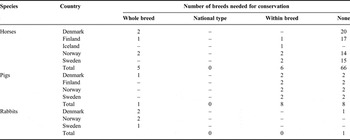
Breed situation of horses, pigs and rabbits
Table 4 shows the breeds of three species. Several native horse breeds have become endangered (Jutland and Frederiksberg in Denmark, Döle and Nordland in Norway, worktype of Finnhorse in Finland), because of the decreased demand for working horses. In some of the earlier working breeds, trotting or riding lines have been developed, helping in the maintenance of the breeds themselves. However, it is not clear, whether these types of horses suit to the forest and fieldworks, in case these become topical again. Hence, the working types deserve to be saved. Some breeds (e.g. Norwegian Döle, North-Swedish) are considered to be similar and related, and there has been exchange of material between them. The Icelandic horse is the only breed, which still has the ability for ambling pace, and can also be considered a live gene bank, because of its 1 000 years of isolation. It has spread to all Nordic countries. The Norwegian Fjord horse is found also in Denmark, Sweden and Finland. Iceland obviously is responsible for the conservation of its own breed and Norway for that of Fjord horse.
Conservation needs of Nordic horse-, pig- and rabbit breeds.

In pigs, landrace and Yorkshire occur in all the Nordic countries, and since genetic material has been exchanged between countries, the breeds could be considered Nordic ones and are not threatened as breeds. However, the rapid genetic changes taking place in them give reasons to preserve genetic material for the times, when the task of pigs will again be to convert uneatable material to food for humans. A division of labour or collaboration in this activity is well-founded. There is only one Icelandic pig material based on imports of several breeds at the beginning of 1900s and kept unselected which might deserve conservation, in order to give possibilities to develop fatty pigs eating cheap materials.
There are several meat rabbit breeds endangered in three countries.
Breed situations of poultry and bees
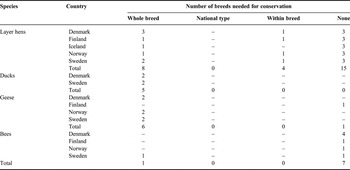
Table 5 shows the situation in laying hens, ducks, geese and bees. Each Nordic country has some native layer hens left. All of them need special attention, even though the situation has improved in two decades. The Norwegian Jaer has a sex-linked genetic factor for cross-striped feathers, making it auto sexing. In the main layer breed, White Leghorn, a need for conserving genetic variation for future use has been seen in most of the Nordic countries, because of the heavy concentration on few commercial hybrids. The possible need to abandon cage management has increased motives for this.
Conservation needs of Nordic poultry and bee breeds.

There are also native stocks of ducks and geese in several countries. The same concerns bees, in which a North-Swedish stock of brown bees has been considered worth of conservation, because of its resistance to cold.
Situation of fur animals
The Nordic countries are important producers of furs, because of their natural conditions. Conservation problems have been discussed in a special working party of the SAAS's subsection for fur-animals. The species used are fox, mink, polecat and raccoon dog. Even though these can be found from the nature any time, their conservation is well-founded from both the cultural and economic viewpoints. Maintenance of live populations of various mutant types, which are not of topical interest, is important, since the fashion can change very rapidly. In Norway, conservation of the White Polar fox was found necessary, in order to be able to produce crosses of it with Silver fox. One has discussed also a coordinated activity in the maintenance of mutants, but it has been difficult to find useful ways for dividing the labour, since the economic interest at the time of a new fashion is very great.
Follow-up of the development of conservation methods
WPAGR has been aware of that freezing of bull semen had been possible since the 1950s and that several AI societies had semen from old bulls, even of landraces. It has tried to follow up the development of both semen and embryo freezing techniques with regard to cost and efficiency in all species of farm animals. In 1981 it initiated a literature study in S on freezing embryos for conservation of AGR (Wilhelmsson and Sylvén, Reference Wilhelmsson and Sylvén1981), and has had a couple of its meetings in the Institut of Reproduction of the Danish Vet. & Agri. Univ., which was developing methods for embryo freezing. In 1983 it tried to get joint Nordic finances for a study concerning possibilities to freeze embryos from fur-bearing animals. The techniques for obtaining, in vitro culture and fertilization of oocytes from slaughtered females have already well developed and will improve possibilities to embryo conservation, without needing super ovulation of donors. The development of gene technology has opened possibilities for conserving DNA concentrated tissues and cells (e.g. semen) for later studies of the genes of breeds and individuals, and for isolation and gene transfer in the future (Brem, Reference Brem1990). DNA has the advantage, that it is a chemical, which can be safely transferred from one country to another without disease risks.
The advantages and disadvantages of live animals, frozen semen and embryos, listed by the EAAP working party (Maijala et al., Reference Maijala, Cherekaev, Devillard, Reklewski, Rognoni, Simon and Steane1984), have been taken into account in planning conservation of different species. The availability of many-sided stores of frozen semen helps in avoiding inbreeding in gene bank animals, and in getting along with rather small numbers of females. The existence of live animals is important for maintaining the interest in the breed and gives opportunities to study its various traits any time. Three different groups of motives have been considered: A = economic–biological, B = scientific and C = cultural–historical. The number of people working on the basis of C-motives has increased. These are ready to invest mental and financial resources to conservation of some breed(s). Animal geneticists are mainly interested in the A- and B-motives. The WPAGR has tried to get the different groups of people to collaborate with each other. This would make the conservation of a breed to serve that of genetic variation and help the conservers to avoid unnecessary inbreeding and economic losses. Unplanned mating and use of very limited numbers of males do not help conservation of genes.
Nordic data bank on AGR
In 1985, WPAGR started to plan an information centre (data bank) on an Inter-Nordic level, based on standardized forms for collecting information about breeds. Collection of all information registered in the countries to the data bank for handling and preserving makes the bank able to supply actual users with needed information. It would also be favourable, as several Nordic breeds cross the borders and some breeding organizations exchange breeding males and semen. All data in one bank simplify calculations of genetic connections and differences between populations. The bank was placed to the Agric. Univ. of Norway and is based on three main types of forms:
I. Origin and status: This is common for all species and breeds and gives general information of the breed.
II. Breed qualities: This gives breed characteristics and has thus to be somewhat different for different species, but the same for breeds of the same species.
III. Individual qualities: This gives similar information on individuals conserved as live animals or in the form of frozen semen, egg cells or embryos. This information is important for later utilization of stored material. The form is the same for breeds of the same species, but specific for each species.
Each piece of information is located at a given numbered place on the form, so that the numerical or coded information can be handled and understood independently from the language. Some of the rubrics are to be filled in with numbers or gene symbols, others with an X-tick. The rubric texts can thus be translated to the five different Nordic languages or to English without causing problems for data processing. Remarks and added information can, on the other hand, be in a language acceptable for further handling.
The realization of the data bank was put off in order to coordinate the forms with those of the data bank of European Association of Animal Production (EAAP), placed in Hanover, Germany. The comparisons caused some modifications in the forms. All rubrics in the EAAP forms were included in the Nordic forms with the same address numbers. In 1988, the EAAP data bank became a Global Data Bank supported by FAO. The EAAP/FAO forms concern only six species and only breeds, while the Nordic ones comprise 18 species and cover also individual animals, semen and embryo stores. There have been some technical problems in applying the database program of the EAAP/FAO bank in small computers, and hence the application has been delayed. The delay has not hindered gathering of data and is expected to be compensated for by the advantages the coordinated program will give.
Information activities
WPAGR has considered that effective spreading of information of breeds and of their conservation, to both authorities and interested people, is important for successful work. Hence, it has published reports in scientific journals and congresses, organized a seminar and participated in seminars arranged by the national working parties (Denmark and Norway in 1988, Sweden in 1991. These have also participated in agricultural shows, prepared films and TV programmes, published leaflets, popular articles and post cards, and given talks in various meetings.
WPAGR prepared a book (144 pages) about farm animals in Nordic countries (Gjelstad, Kolstad and Maijala, Reference Gjelstad, Kolstad and Maijala1993), with the following contents: Farm animals in service of mankind, development of productivity, Nordic farm animals in text and figures, motives for conservation, conservation methods, national conservation activities and Nordic collaboration on conservation. The contents reflect the work performed, and the problems discussed by WPAGR during a decade.
Progress made in conserving genetic materials
Live animals
Live animals of endangered native breeds have been placed in agricultural schools (Denmark, Norway, Sweden) and museums (Denmark, Norway), nature reserves (Sweden), prison farms (Finland), animal parks and private farms. In Norway, the agricultural museum has made contracts with agricultural schools about maintenance of cow samples of endangered breeds, plans for breeding, feeding, management, veterinary hygiene, recording, mediating animals, etc. Private interest in preserving original breeds has increased considerably in all the countries in the 1980s, and societies of interested people have been established for several breeds. In several endangered breeds of cattle it has been difficult to find purebred animals, and hence animals having 50–87.5 percent of their genes from the breed in question have also been saved (Blomqvist, Reference Blomqvist1989). Active search and registration have helped in finding new purebred cows in several breeds, which were almost extinct (e.g. 35 Westland Red Polls in Norway in 1986, but 67 cows in 1989). However, the genetic background is often rather narrow, rendering avoidance of inbreeding difficult. In some native breeds, which had some thousands of animals left at the time of committee report, the numbers have continued declining.
The Norwegian gene bank for poultry, established in 1973, got a new premise in 1983, and maintains small non-active lines of layer hens, which have traits of interest for future breeding or cultural–historical importance (e.g. Jaer hens). The intention is to place also small populations of White Norwegian goose in the bank, which is run by the Norwegian Poultry Breeders’ Assn.
Frozen semen
Old frozen semen doses have been preserved, if available, and semen has been frozen from new reasonably pure males after they have reached sexual maturity. This has been important for being able to use many males in each breed for mating and for avoiding the use of single live males to all the females of a herd. The number of bulls, from which there was semen stored, was about doubled in several Norwegian native breeds from 1984 to 1989 and in the east Finnish cattle from 1983 to 1991. In the north Finnish cattle the number has increased from 0 to 13 in the same period. The Swedish and Icelandic rules of saving 100 resp. 30 doses from each AI bull, irrespective of whether the breed is endangered or not, have meant considerable increases in the diversity of semen banks for possible changes of future needs.
In pigs, the long-term storage of one ejaculate from each boar in Denmark since the 1970s means a continuous increase in banked material. Finland has semen from several boars from the time before the Halothane testing and culling for stress susceptibility started in the 1970s. Ram semen is frozen from three counties in Norway, and Finland has semen from six Finnsheep rams frozen in the first part of the 1980s. In Norway, 50 doses of semen had been frozen from each of 50 goats in 1976–1983, i.e. a total of about 2 500 doses. Most of the Nordic countries have frozen semen from cockerels, but not yet for conservation purposes. This kind of conservation is not as important in poultry as in mammals, since the male is the homogametic sex and the share of sex hormone of the total genome is relatively large.
The popularity of AI in horses has made it possible to make plans for freezing semen from working horses for conservation purposes. The same concerns foxes.
Frozen embryos
Freezing embryos of endangered cattle breeds has started in at least two endangered breeds in both Norway and Finland, and Denmark and Sweden have the technical readiness. In Finland there are also frozen embryos from Finnsheep since 1984.