The Great East Japan Earthquake with a magnitude of 9.0 occurred on March 11, 2011. The epicenter was located 130 km off the coast, and the maximum height of the tsunami reached nearly 40 m, mainly affecting the coastal areas of East Japan. Because of the earthquake and tsunami, approximately 18400 individuals died or went missing, and approximately 400 000 buildings were completely or partially destroyed. 1
Those affected by major disasters have been reported to suffer from mental stress associated with a fear of life, loved ones’ deaths, property loss, marked destruction, impaired social safety systems, and a lost feeling of solidarity.Reference David, Mellman and Mendoza 2 - Reference Kessler, Galea and Jones 8 The authors previously reported an increased incidence in postpartum depression after the Great East Japan Earthquake in areas affected by the earthquake and tsunami.Reference Nishigori, Sugawara and Obara 9 , Reference Nishigori, Sasaki and Obara 10
Disaster-related mental stress has been shown to increase the incidence of violence,Reference Rezaeian 11 and females, children, the elderly, and those on a low income have been found to be frequent sufferers.Reference Phifer, Kaniasty and Norris 12 , Reference Feng, Tan and Benjamin 13 In such cases, domestic violence (DV) also has been reported to occur more frequently.Reference Larrance, Anastario and Lawry 14 - Reference Chan and Zhang 18 DV against pregnant females is a risk factor associated with premature delivery, low birth weight, placental abruption, uterine rupture, and fetal deathReference Shah and Shah 19 - Reference Yost, Bloom and McIntire 24 and is considered to be a serious issue in perinatal management.
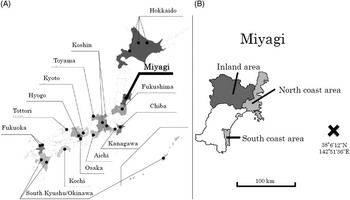
In January 2011, the Ministry of the Environment launched a large-scale cohort epidemiological research project entitled “The Japan Environment and Children’s Study” (JECS), which involved 100 000 children and their parentsReference Kawamoto, Nitta and Murata 25 in targeted municipalities located in the inland (Tome City, Kurihara City, Osaki City, Shikama-cho, Yakuya-cho, and Misato-machi), north coastal (Kesennuma City, Minamisanriku-cho, Ishinomaki City, and Onagawa-cho), and south coastal (Iwanuma City, Watari-cho, and Yamamoto-cho) areas of Miyagi Prefecture (Figure 1).
(A) Location of the Japan Environment and Children’s Study (JECS) Unit Centers. (B) Location of the JECS Area in Miyagi Prefecture. The epicenter of the Great East Japan Earthquake is schematically (x) indicated.

Because of the Great East Japan Earthquake, in Miyagi Prefecture (approximate pre-disaster population: 2 346 800) approximately 12 000 (0.5%) people died or went missing, and approximately 238 000 buildings were destroyed. 1 In the north coastal area of the prefecture (264 000), approximately 7000 (2.7%) died or went missing, and approximately 55 300 buildings were completely or partially destroyed 26 - 29 ; in the south coastal area (92 700), approximately 1100 (1.2%) died or went missing, and approximately 11 000 buildings were completely or partially destroyed. 30 - 32
In Miyagi prefecture, the JECS had been interrupted by the Great East Japan Earthquake but resumed after 3 months and was in progress at the time of the present study. Using data obtained through the JECS, this study aimed to clarify the relationship between the Great East Japan Earthquake and DV by examining the incidence of DV against pregnant females and the associated risk factors in the target areas of Miyagi Prefecture after the disaster.
METHODS
For the JECS, participants were recruited through 15 unit centers located in Hokkaido, Miyagi, Fukushima, Chiba, Kanagawa, Koshin, Toyama, Aichi, Kyoto, Osaka, Hyogo, Tottori, Kochi, Fukuoka, and South Kyushu and Okinawa. The Miyagi Unit Center recruited participants living in municipalities located in the previously mentioned inland, north coastal, and south coastal areas of Miyagi Prefecture (Figure 1).Reference Kawamoto, Nitta and Murata 25
The present study is based on the data set of jecs-ag-ai-20131008, which was released in October 2013. Registration for the JECS was initiated in January 2011 on a nationwide basis, and the primary fixed data were created, which involved 10 129 pregnant females who had given birth up to December 2011. The JECS protocol was approved by the Ministry of the Environment and the relevant ethical committee.Reference Kawamoto, Nitta and Murata 25
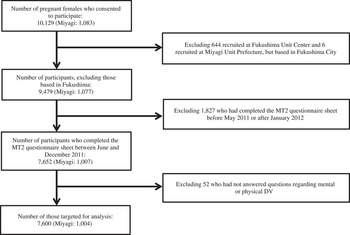
The present study analyzed 7600 out of the 10 129 pregnant females who had provided the primary fixed data, excluding (1) those who had been recruited at the Fukushima Unit Center, (2) those recruited at the Miyagi Unit Center but based in Fukushima Prefecture, (3) those who had not completed the JECS questionnaire sheet for females during the second to third trimester period (MT2) within the period between June and December 2011, (4) those who had not answered questions regarding mental DV, and (5) those who had not answered questions regarding physical DV (Figure 2).
The Study Analyzed 7600 (Miyagi Unit Center: 1004) out of the 10 129 Pregnant Females Between January 1 and December 31, 2011, and Provided Primary Fixed Data for the Japan Environment and Children’s Study (JECS).

The Great East Japan Earthquake that occurred on March 11, 2011, interrupted the JECS in Miyagi Prefecture, but the project was resumed in May in the inland and in June in the north and south coastal areas. To avoid response biases, the present study targeted pregnant females who had answered the mental and physical DV-related questions as part of the MT2 within the period June 1 to December 31, 2011, for analysis.
The MT2 consisted of the following DV-related questions, which were answered across 4 response options: <Never>, <Rarely>, <Sometimes>, and <Often>. For the judgment of mental DV, the women were asked, <Have you ever been insulted or reviled by your partner during the present pregnancy? (*Hereafter, “during pregnancy” refers to the present pregnancy, unless otherwise specified.)>. For the physical DV, the women were asked, <Have you ever been hit or beaten by your partner due to a fight during pregnancy, resulting in injury?>. To determine the DV incidence in those recruited at the Miyagi Unit Center in the study, the answers <Rarely>, <Sometimes>, and <Often> were considered to indicate the presence of mental or physical DV.
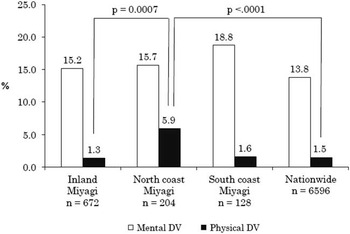
The incidence of mental and physical DV and their proportions in 4 target areas, that is, the inland, north coastal, and south coastal areas of Miyagi Prefecture and nationwide (13 unit centers, excluding those in Miyagi and Fukushima Unit Centers) were calculated, and a chi-square test was conducted for comparison (Figure 3).
Proportions of Pregnant Females Who Had Been Subject to Mental and Physical Domestic Violence (DV). Values represent the proportions of those who answered <Rarely>, <Sometimes>, and <Often> to the DV-related questions. Mental DV: <Have you ever been insulted or reviled by your partner during the present pregnancy?> Physical DV: <Have you ever been hit or beaten by your partner due to a fight, resulting in injury, during pregnancy?> A chi-square test was conducted for comparison.

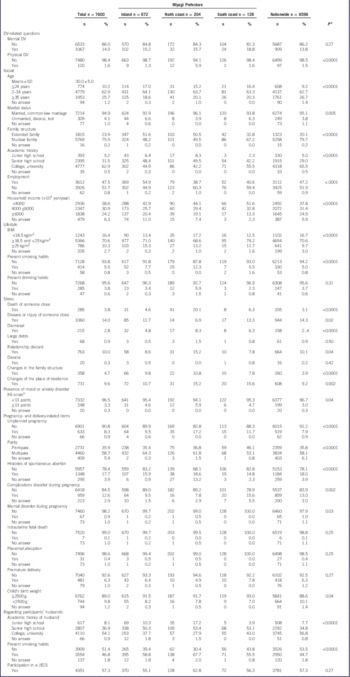
Based on the MT2 questions, the frequency and proportion of pregnant females who had been subject to DV in each area were calculated, with a focus on the following items (Table 1): social factors: age, marital status, family structure at the time of registration, academic history, employment, as well as household income and lifestyle factors: body mass index (kg/m2), smoking and drinking habits, stress experienced within the past year, stress related to the death of someone close (parent, spouse, child, or a close friend), the presence of disease (parent, spouse, or child) or injury (spouse or child), dismissal (spouse or the respondent), large debt, relationship discord, divorce, changes in the family structure (the necessity of living with grandparents, etc), and changes in the place of residence. The presence of mood or anxiety disorders was examined based on the Kessler 6 (K6) item Psychological Distress Scale score. The highest score for this scale is 24, and a score of 13 or higher is regarded as indicating the presence of mood or anxiety disorders.Reference Kessler, Andrews and Colpe 33 - Reference Kuriyama, Nakaya and Ohmori-Matsuda 35 Pregnancy- and delivery-related items examined the mothers’ emotions when the pregnancy was confirmed, unplanned pregnancies (leading to confusion or difficulty), delivery history, spontaneous abortions, complications or mental disorders during pregnancy, intrauterine fetal deaths, placental abruptions, and premature delivery, as well as the child’s birth weight. The participant husband data examined were academic background, present smoking habits, and participation in the JECS questionnaire using the FT1. To assess the homogeneity of these demographic factors among four areas, analysis of variance (ANOVA) was used for continuous data and a chi-squared test was used for categorical data in Table 1.
Characteristics of Subjects

Abbreviations: SD, standard deviation; BMI (in kg/m2; calculated from length and weight measured at enrollment), body mass index; Inland, the inland areas of Miyagi Prefecture; North coast, the north coastal areas of Miyagi Prefecture; South coast, the south coastal areas of Miyagi Prefecture; Nationwide, 13 unit centers, excluding those in Miyagi and Fukushima Prefectures.
a Comparison among four groups (Inland, North coast, South coast, and Nationwide).
b K6 (total point scores ranged from 0 to 24), the Kessler 6-item psychological distress scale. We classified individuals with scores of >13/24 as having psychological distress; JECS, The Japan Environment and Children’s Study.
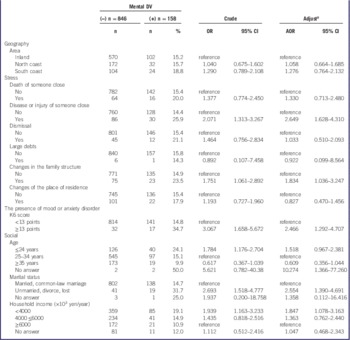
Because of the difficulty in analyzing the factors associated with DV due to the small target numbers in each area of Miyagi Prefecture, the frequency and proportion of pregnant females answering the question <Have you been subject to mental DV?> were calculated on a prefecture-wide basis by performing a univariate logistic regression analysis of the responses regarding the study items listed in Table 1 from the 3 areas (inland, north coastal, and south coastal). Subsequently, items that showed a close association were extracted at a significance level of 0.05, and a multivariate logistic regression analysis was conducted for all the items listed in Table 2. To focus on the variables that could be proxies for earthquake, all exposure (geography, stressful life events, and mood or anxiety disorder) and potential confounders (age, marital status, and household income level), the traditional risk factors for DV, were included into a working multivariate logistic model (Table 2) using SAS version 9.3 (SAS Institute Inc., Cary, NC) for the statistical analysis.
Multilevel Multivariate Regression Analysis for Mental DV in Miyagi (n=1004)

Abbreviations: OR, odds ratio; AOR, adjusted odds ratio; CI, confidence interval; K6, Kessler 6-item psychological distress scale; the Iland, inland areas of Miyagi Prefecture; North coast, the north coastal areas of Miyagi Prefecture; South coast, the south coastal areas of Miyagi Prefecture; Nationwide, 13 unit centers, excluding those in Miyagi and Fukushima Prefectures.
a Adjusted for all the items listed in Table 2.
RESULTS
The frequency and proportion of pregnant females answering the questions <Have you ever been insulted or reviled by your partner during the present pregnancy?> and <Have you ever been hit or beaten by your partner due to a fight during pregnancy, resulting in injury?>, as well as the basic characteristics from the inland, north coastal, and south coastal areas of Miyagi Prefecture and nationwide (all prefectures in Japan, excluding Miyagi and Fukushima) are shown in Table 1 and Figure 3. Those who answered the question <Have you ever been insulted or reviled by your partner during the present pregnancy?> accounted for 15.7% in the north coastal area, which was similar to those in the inland (15.2%, P=0.86) and south coastal (18.8%, P=0.47) areas and nationwide (13.8%, P=0.44). In contrast, the proportion of those who answered the question <Have you ever been hit or beaten by your partner due to a fight during pregnancy, resulting in injury?> was 5.9% in the north coastal area, which had no significant differences in the south coastal area (1.6%, P=0.06) but were higher than in the inland area (1.3%, P=0.0007) and nationwide (1.5%, P<0.0001). Comparison among the areas showed that pregnant females had been subject to physical DV most frequently in the north coastal area.
Regarding the factors associated with mental DV, 102 answered the question <Have you ever been insulted or reviled by your partner during the present pregnancy?> in the inland area, 32 in the north coastal area, and 24 in the south coastal area (Table 1). The total number of those answering the question <Have you ever been insulted or reviled by your partner during the present pregnancy?> in Miyagi Prefecture was 158 out of the total of 1004 (15.7%). On a prefecture-wide basis, a multivariate logistic regression analysis was conducted for all the items listed in Table 2. The items found to be associated with mental DV in Miyagi Prefecture (odds ratio; 95% confidence interval) were experiencing disease or injury in someone close (2.649; 1.628–4.310), changes in the family structure (1.834; 1.036–3.247), and having a K6 score ≥13, which indicated the presence of a mood or anxiety disorder (2.466; 1.292–4.707) (Table 2).
The number of pregnant females answering the question <Have you ever been hit or beaten by your partner due to a fight during pregnancy, resulting in injury?> in the three areas of Miyagi Prefecture was only 23 out of 1004 (2.3%), which prevented us from conducting the appropriate statistical analysis, such as a multivariate logistic regression.
DISCUSSION
In Japan, the Act on the Prevention of Spousal Violence and the Protection of Victims was established in 2001, which defined DV as physical, mental, sexual, financial, or social acts of violence, as well as those involving children. 36 Scales to screen for such DV are included in the Violence Against Women Screen (VAWS) and Index of Spousal Abuse (ISA).Reference Horiuchi, Yaju and Kataoka 37 The proportion of pregnant Japanese females who are VAWS positive is estimated to be approximately 24%, and those who have been subjected to DV account for approximately 5% based on the Japanese version of the ISA, indicating that at least 1 out of the 20 pregnant females suffers from DV.Reference Horiuchi, Yaju and Kataoka 37 In a study conducted in 19 countries, the incidence of DV ranged from 2.0 to 13.5%.Reference Devries, Kishor and Johnson 38 In a meta-analysis, the incidence of mental, physical, and sexual violence during pregnancy was 26.4%, 13.8%, and 8.0%, respectively.Reference James, Brody and Hamilton 39 The JECS questionnaire contains two DV-related questions; one examined mental DV: <Have you ever been insulted or reviled by your partner during the present pregnancy?>, and the other examined physical DV: <Have you ever been hit or beaten by your partner due to a fight, resulting in injury, during pregnancy?>. Nationwide, excluding the Miyagi and Fukushima Unit Centers, the incidence of mental and physical DV against pregnant females was 13.8 and 1.5%, respectively.
In other countries, mental stress associated with natural disasters has been reported to increase the incidence of DV. In the JECS, it was not possible to compare the incidence of DV before and after the March 2011 Great East Japan Earthquake due to a lack of pre-disaster data in the affected areas. A comparison of the 4 target areas found no significant differences in the incidence of mental DV for pregnant females during the 3- to 9-month study period after the disaster. In contrast, the incidence of physical DV was higher in the north coastal area (5.9%) than nationwide (1.5%, P<0.0001) or in the inland (1.3%, P=0.0007) area. The factors responsible for the higher incidence of physical DV in the north coastal area of Miyagi Prefecture remain unclear, indicating the necessity for further studies.
The following reference data shows the changes in the incidence of DV before and after the disaster based on data from the Section of Parenting Support, Department of Health and Welfare, Miyagi Prefecture. The total number of DV-related consultations dealt with at the Women’s Consultation Center, Prefectural Health and Welfare Office, and from each area of Sendai City was 895 in 2008, 999 in 2009, 1017 in 2010, 1025 in 2011, 996 in 2012, and 1031 in 2013. The Civic Consultation Center, Department of Welfare, Ishinomaki City located in the north coastal area of Miyagi Prefecture, which was directly affected by the primary tsunami, reported that the number of DV-related consultations was 29 in 2008, 44 in 2009, 49 in 2010, 46 in 2011, 50 in 2012, and 36 in 2013 (the data were directly provided by the city). In other municipalities located in this area, such as Kesennuma City, Minamisanriku-cho, and Onagawa-cho, pre-disaster data were lost because of the tsunami.
As the JECS had not been designed with a consideration of the effect of disasters, the present study did not examine the level of damage due to the Great East Japan Earthquake. On analysis of the responses to the stress-related questions, the incidence of stress associated with the death of someone close was 20.1% in the north coastal area, 6.3% in south coastal area, and 4.6% in the inland area of Miyagi Prefecture, while it was 3.1% nationwide (Table 1), suggesting such stress may be a useful index to examine the status of disaster-affected individuals.
Having a low income and a poor educational background, being young, unmarried, and unemployed, and a smoker, as well as experiencing unplanned pregnancies or having a history of spontaneous abortion, stress, or depression have been reported to be factors associated with DV against pregnant females.Reference Bailey 40 - Reference Finnbogadóttir, Dykes and Wann-Hansson 45 Because of the insufficient number of targets for the multivariate logistic regression analysis, the DV-related factors were examined on a prefecture-wide basis. In the entire Miyagi Prefecture, experiencing disease or injury in someone close, changes in the family structure, and a K6 score ≥13 were significantly associated with mental DV. The small number of targets did not allow for a statistical analysis of the factors associated with physical DV.
Limitations
In this study, the factors associated with physical DV were not statistically analyzed due to the small number of targets. The results were not compared with those of previous studies as DV indices, such as the VAWS or ISA, were not used. Comparisons before and after the Great East Japan Earthquake were not possible, as pre-disaster data were not available. The JECS questionnaire did not contain items related to disaster-related damage; therefore, information regarding the degree of disaster-related damage was not provided. This study targeted only those who had participated in the JECS, rather than covering all pregnant females living in the target areas. There were no data showing the targets as a proportion of the population. For reference, the number of pregnant females registered between January 2011 and March 2014 as a proportion of the population in each area of Miyagi Prefecture based on the number of issued maternal record books was as follows (numbers of registrations/books): inland: 70.3% (5706/8117), north coastal: 68.9% (2555/3709), and south coastal: 52.2% (959/1837) (data not published).
CONCLUSION
In a JECS questionnaire survey conducted 3 to 6 months after the Great East Japan Earthquake, there were no marked differences in the incidence of mental DV against pregnant females in the three areas of Miyagi Prefecture or nationwide, excluding Miyagi and Fukushima. In contrast, the incidence of physical DV was higher in the north coastal area compared to the inland area and nationwide. In the entire prefecture, experiencing disease or injury in someone close, changes in the family structure, and a K6 score ≥13, which indicated the presence of mood or anxiety disorders, were significantly associated with mental DV.
The results of this study revealed the current status of DV against pregnant females in disaster-affected areas. Continuous monitoring and support may be necessary to address this issue.
Acknowledgments
The Japan Environment and Children’s Study was funded by the Ministry of the Environment, the Government of Japan. This research was also supported by Research Promotion and Practical Use for Women’s Health, AMED.
Members of the Japan Environment and Children’s Study (JECS) as of 2015 (principal investigator, Toshihiro Kawamoto): Hirohisa Saito (National Center for Child Health and Development, Tokyo, Japan), Reiko Kishi (Hokkaido University, Sapporo, Japan), Nobuo Yaegashi (Tohoku University, Sendai, Japan), Koichi Hashimoto (Fukushima Medical University, Fukushima, Japan), Chisato Mori (Chiba University, Chiba, Japan), Fumiki Hirahara (Yokohama City University, Yokohama, Japan), Zentaro Yamagata (University of Yamanashi, Chuo, Japan), Hidekuni Inadera (University of Toyama, Toyama, Japan), Michihiro Kamijima (Nagoya City University, Nagoya, Japan), Ikuo Konishi (Kyoto University, Kyoto, Japan), Hiroyasu Iso (Osaka University, Suita, Japan), Masayuki Shima (Hyogo College of Medicine, Nishinomiya, Japan), Toshihide Ogawa (Tottori University, Yonago, Japan), Narufumi Suganuma (Kochi University, Nankoku, Japan), Koichi Kusuhara (University of Occupational and Environmental Health, Kitakyushu, Japan), Takahiko Katoh (Kumamoto University, Kumamoto, Japan).
Kasumi Sakurai and Hidekazu Nishigori contributed equally to this work. The findings and conclusions of this article are solely the responsibility of the authors and do not represent the official views of the above government.