Introduction
The production of bulk submicron and nanocrystalline metallic materials by severe plastic deformation (SPD) techniques, like equal-channel angular pressing (ECAP), accumulative roll bonding, multiaxial forging (MAF), and high pressure torsion (HPT), offers significant property enhancement for conventional metals and alloys [Reference Valiev, Islamgaliev and Alexandrov1, Reference Valiev2, Reference Langdon3]. Most SPD techniques, like ECAP and MAF, exploit change in strain path to achieve optimum grain refinement. In ECAP, various routes, like A, B, C and D, along with their variants are designed on the basis of rotation of sample from one pass to another to achieve different extent of grain refinement [Reference Valiev and Langdon4, Reference Zhu and Lowe5], while strain path change is pivotal to MAF and tri-axial forging [Reference Biswas and Suwas6, Reference Kumar, Gurao, Haldar and Suwas7]. However, the role of strain path change in HPT, which is by far the most potent processing technique to produce bulk nanocrystalline metallic materials, is in its infancy [Reference Pippan, Scheriau, Taylor, Hatok, Hohenwarter and Bachmaier8, Reference Hohenwarter, Bachmaier, Gludovatz, Scheriau and Pippan9] and needs to be investigated in details. Preliminary investigation on iron, nickel, aluminum, and aluminum–magnesium alloys have indicated the important role of geometrically necessary dislocations (GNDs) during cyclic HPT [Reference Wetscher and Pippan10, Reference Kawasaki and Langdon11, Reference Zhang, Starnik, Gao and Zhou12, Reference Zhang, Gao and Starnik13, Reference Wetscher and Pippan14]. It is observed that the process of grain refinement is retarded in cyclic HPT compared with that in monotonic HPT, but the former produces homogeneous microstructures from the center of the disc to the periphery compared with the latter. Other studies on cyclic HPT of Zn–Al alloy [Reference Kawasaki, Ahn and Langdon15] and cyclic torsion of Ti6Al4V [Reference Ma, Li, Mao, Yuan and Wang16] show higher hardness for cyclic HPT due to lower dissolution of silicon in the former and formation of complex dislocation structure in the latter. Thus, HPT in general and cyclic HPT in particular provide access to unique property space for existing metallic materials.
Similarly, a new property space has been made available by the advent of newly developed multicomponent multiprincipal high entropy alloys (HEAs), which are alloys of five or more elements in equal or near equal proportions characterized by high configuration entropy greater than or equal to 1.5R, where R is the universal gas constant [Reference Sharma, Yadav, Biswas and Basu17, Reference Ma, Grabowski, Körmann, Neugebauer and Raabe18, Reference Gao, Yeh, Liaw and Zhang19, Reference Miracle and Senkov20, Reference Mridha, Samal, Khan and Biswas21, Reference Mohanty, Maity, Mukhopadhyay, Sarkar, Gurao, Bhowmick and Biswas22, Reference Mohanty, Gurao and Biswas23, Reference Mishra, Samal and Biswas24, Reference Samal, Mohanty, Mishra, Biswas and Govind25]. HEA offers a large number of alloys in composition space unexplored till date and can provide excellent mechanical and functional properties. The understanding of deformation behavior in these alloys is not as well established as that in conventional metals and alloys. This is due to the incomplete understanding of operative deformation micro-mechanisms in HEAs, as well-established concepts like lattice friction stress, solid solution strengthening, and stacking fault energy developed for pure metals and dilute alloys cannot be directly extended to HEAs [Reference Mishra, Kumar and Komarasamy26, Reference Komarasamy, Kumar, Mishra and Liaw27]. Initial investigations on various single-phase and multiphase HEAs indicated formation of stacking faults and twins apart from planar slip contributing to grain refinement, leading to increase in hardness during deformation. There is a decrease in activation volume with strain in HEAs, indicating that grain boundary processes dominate at smaller grain sizes similar to conventional alloys. However, it has been shown that complete chemical homogeneity at the atomistic level can be obtained only by HPT in Cantor alloy (CoCrFeMnNi), thus elucidating the potency of HPT as a method to produce truly random solid solution HEAs [Reference Schuh, Mendez-Martin, Völker, George, Clemens, Pippan and Hohenwarter28, Reference Yuan, Tsai, Sha, Liu, Horita, Zhu and Wang29, Reference Tang, Huang, Huang, Liao, Langdon and Dai30, Reference Yu, Cheng, Zhang, Zhang, Jing, Ma, Liaw, Li and Liu31]. Recently, Shahmir et al. [Reference Shahmir, Nili-Ahmadabadi, Shaifee, Andrzejczuk and Langdon32] showed that addition of Ti to Cantor alloy provides an additional handle to obtain high strength with sufficient ductility by introducing precipitates that restrict grain growth after post-deformation annealing. Moon et al. [Reference Moon, Qi, Tabachnikova, Estrin, Choi, Joo, Lee, Podolskiy, Tikhonovsky and Kim33] showed that self-annealing in cryo-HPT processed Co20Cr26Fe20Mn20Ni14 face centered cubic (FCC) HEA with extremely low stacking fault energy of 3.5 mJ/m2 led to coarser microstructure and lower strength compared with room temperature HPT sample. Maity et al. [Reference Maity, Prashanth, Balci, Kim, Schoberl, Wang and Eckert34] carried out a thorough investigation on HPT of lamellar eutectic HEA to show that the evolution of GND density is governed by lamellar interfaces in the nanocrystalline regime. Thus, preliminary investigations on single-phase and multiphase HEAs show enough potential for achieving excellent mechanical properties by HPT; however, the effect of strain path change or cyclic loading in HPT of HEA is yet to be explored. As mentioned earlier, cyclic HPT produces more homogeneous evolution of hardness and microstructure and can provide more stable microstructures that can provide high strength and ductility; hence, it is important to study the effect of strain path change during HPT in HEAs. In the present investigation, an attempt has been made to understand the evolution of microstructure and its correlation with hardness evolution to decipher the operative micromechanisms in cyclic HPT in newly developed FCC CoCuFeMnNi HEA with copper-rich nanoclusters [Reference Tazuddin, Biswas and Gurao35, Reference Tazuddin, Gurao and Biswas36, Reference Sonkusare, Divya-Janini, Gurao, Sarkar, Sen, Pradeep and Biswas37, Reference Agarwal, Sonkusare, Jha, Gurao, Biswas and Nayan38] using X-ray diffraction, electron microscopy, microhardness measurements, and numerical simulations.
Results
Structural characterization
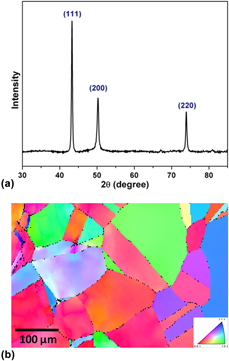
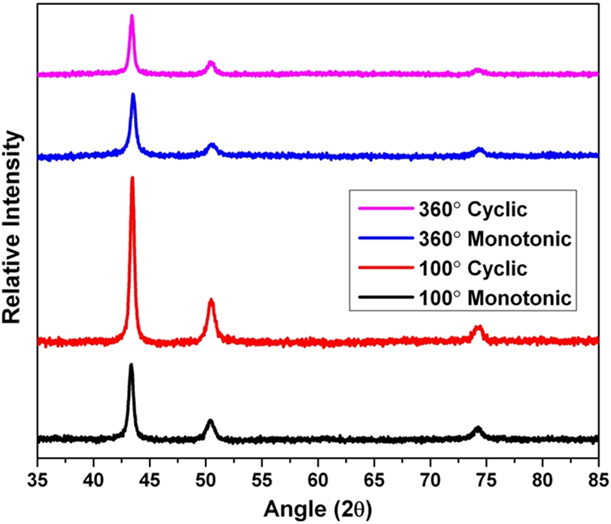
Figure 1(a) shows the X-ray diffractogram of the homogenized sample, indicating the presence of FCC single phase with a lattice parameter of 0.361 nm. The crystal orientation or inverse pole figure map of the homogenized sample shows equiaxed grains with presence of annealing twins [Fig. 1(b)]. The homogenized sample has a grain size of 47 μm and is characterized by presence of nanoclusters rich in copper, as has been reported earlier [Reference Sonkusare, Divya-Janini, Gurao, Sarkar, Sen, Pradeep and Biswas37, Reference Agarwal, Sonkusare, Jha, Gurao, Biswas and Nayan38]. Visual inspection of all the HPT discs was carried out to ascertain that there was no slipping or cracking of the samples during monotonic and cyclic HPT. Figure 2 shows the X-ray diffractogram of all the samples, indicating the stability of FCC single phase at high strain although with significant peak broadening, which indicates increase in dislocation density and micro-strain accompanied with decrease in crystallite size. An important observation is that the peak broadening for cyclic HPT samples is lower than that for the corresponding monotonic HPT sample. No attempt has been made to determine dislocation density and crystallite size from X-ray diffraction data due to the heterogeneity of deformation, leading to heterogeneous evolution of microstructure in HPT.
(a) X-ray diffraction pattern and (b) inverse pole figure map of homogenized sample of CoCuFeMnNi HEA.

X-ray diffraction patterns of monotonic and cyclic HPT deformed samples.

Evolution of hardness
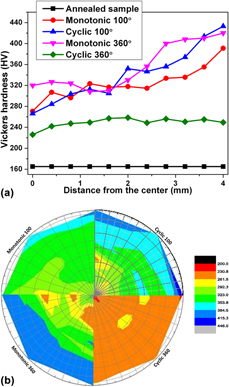
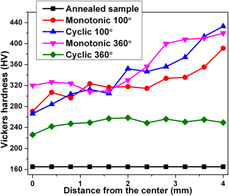
Vickers micro-hardness measurement of the HPT-processed samples in Fig. 3(a) shows an interesting trend. There is a significant increase in hardness from center of the disc to the periphery for monotonic 100° and 360° HPT sample as well as 100° cyclic HPT sample. However, the cyclic 360° sample shows almost homogeneous hardness that is lower than that of all other HPT processed samples but significantly higher than the homogenized sample. The hardness of the monotonic and cyclic HPT 100° sample is minimum at the center, while at the periphery, the cyclic sample shows higher hardness than the monotonic HPT sample. There is a significant difference between the hardness of the 360° monotonic and cyclic HPT sample at the center, which further increases from center to periphery. The hardness at the periphery of the 360° monotonic HPT sample is almost twice that of the 360° cyclic HPT sample. Surprisingly, highest hardness is observed at the periphery of the 100° cyclic HPT sample, which is slightly higher than the hardness of 100° and 360° monotonic HPT sample. A composite diagram shows the variation of hardness throughout the quarter of the disc subjected to HPT [Fig. 3(b)]. The evolution of high hardness in 100° cyclic HPT and homogeneous but lower hardness evolution in 360° cyclic sample is clear from the composite diagram.
(a) Evolution of hardness in HPT disc as a function of distance from the center. (b) 2D Contour plot for hardness of HPT samples processed by different routes.

Evolution of microstructure
Electron back scatter diffraction
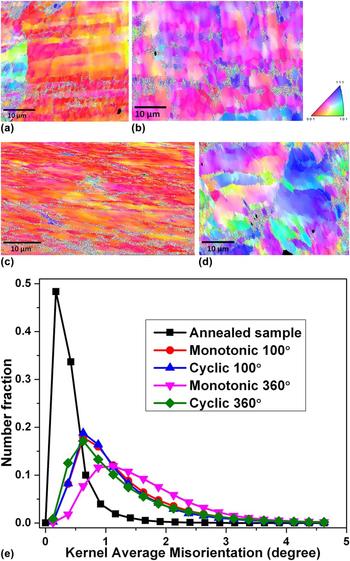
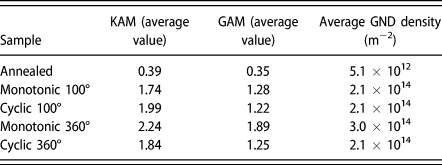
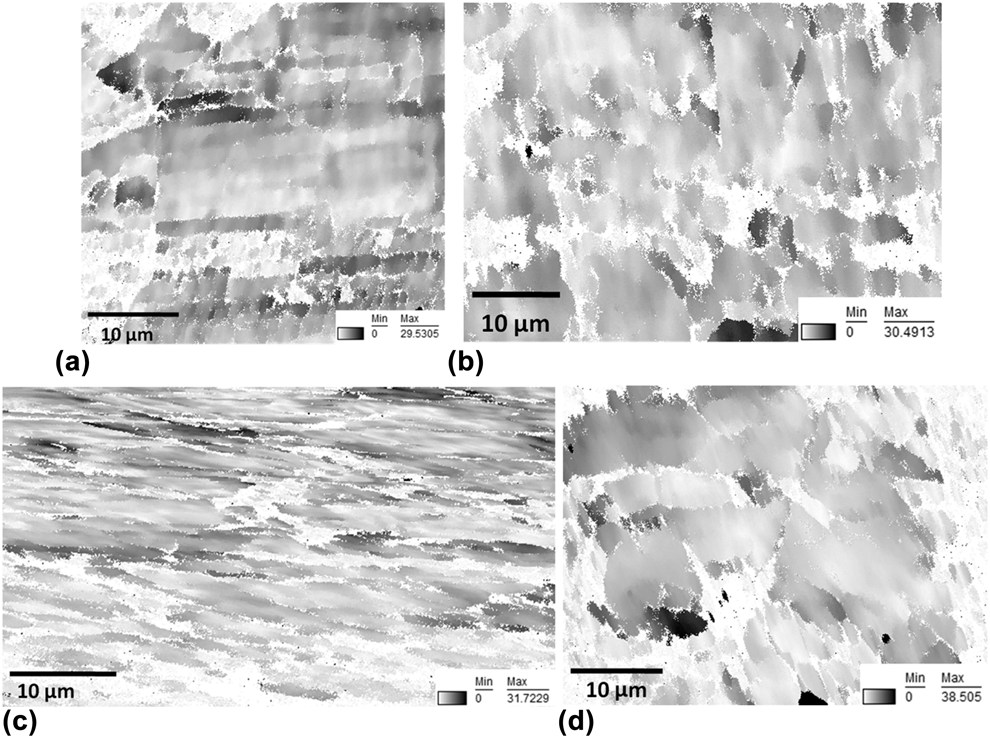
The crystal orientation or inverse pole figure maps at a location near the center of the HPT processed discs in Figs. 4(a)–4(d) indicate the presence of large color gradients within the grains, indicating presence of orientation gradients due to dislocation activity. No signs of twinning are observed in any of the four samples. Subgrain formation in prior existing grains is visible in all the four samples. It is evident that the aspect ratio of subgrains is higher for 100° monotonic sample than for 100° cyclic HPT sample. There is decrease in size and increase in aspect ratio of subgrains for 360° monotonic HPT sample. However, there is a decrease in aspect ratio of subgrains for the 360° cyclic HPT sample, indicating lower grain refinement. In order to obtain a quantitative estimate of intragranular misorientation, kernel average misorientation (KAM) distribution plots were determined and are shown in Fig. 4(e). The distribution of KAM values shows a shift of the peak to right (higher KAM value) from the homogenized sample to the HPT-processed samples, clearly indicating transition from homogeneous to heterogeneous distribution of dislocations [Reference Zhong, Yin, Sakaguchi, Nagai and Yang39]. Higher average value of KAM also indicates increase in dislocation density for the HPT-processed samples. The 360° monotonic HPT sample shows higher average KAM value and the peak is at the highest KAM value followed with the 100° monotonic sample. Both the cyclic HPT samples show lower average KAM values (Table I), and their peak in KAM distribution is almost at the same value of KAM that is to the left of the 100° monotonic HPT sample. Thus, it is very clear that cyclic HPT samples show lower dislocation density and more homogeneous distribution of dislocations compared with monotonic HPT samples. This is further corroborated from the grain average misorientation (GAM) value for all the four samples, which show a significant increase in GAM value for monotonic HPT from 100° rotation to 360° rotation and the GAM value increases slightly for cyclic HPT samples (Table I).
Inverse pole figures map of (a) monotonic 100°, (b) cyclic 100°, (c) monotonic 360°, and (d) cyclic 360° HPT samples and (e) KAM plot for all the HPT processed samples.

Intragranular misorientation in terms of KAM and GAM along with GND density for CoCuFeMnNi HEA from EBSD data.

Transmission electron microscopy
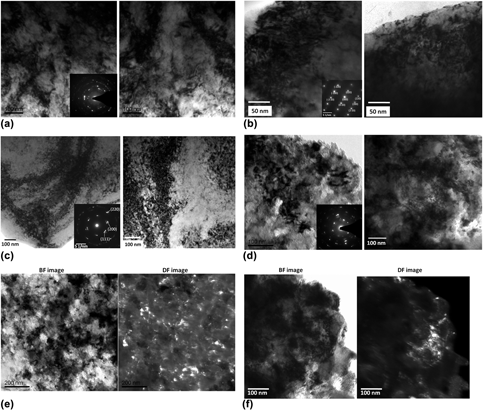
Representative bright field transmission electron microscopy (TEM) images with corresponding diffraction pattern of the HPT-processed samples in Figs. 5(a)–5(d) show significant dislocation activity for all the four samples and are characterized by formation of dislocation cell structure. A qualitative comparison of the bright-field TEM images indicates that a finer cell structure evolves for 100° cyclic HPT sample compared with the 100° monotonic sample. The 360° cyclic HPT sample shows the largest cell size, while the cell size in 360° monotonic sample is comparable to that in 100° cyclic HPT sample. In order to obtain quantitative estimate of dislocation cell size, multiple dark field images were analyzed and two representative dark-field images of 360° monotonic and cyclic HPT samples are shown in Figs. 5(e) and 5(f), respectively. The dark field images clearly indicate that the boundaries between different regions are high angle grain boundaries and indeed nanocrystalline grains are formed during the process of HPT. Grain size measurement from dark field images indicates a lower grain size for 100° cyclic HPT sample compared with 100° monotonic sample (102 ± 10 nm versus 119 ± 15 nm), while the 360° monotonic HPT sample shows the lowest grain size of 94 ± 9 nm.
Bright-field TEM images with selected area diffraction pattern of (a) monotonic 100°, (b) cyclic 100°, (c) monotonic 360°, and (d) cyclic 360° HPT samples. Bright field (BF) and dark field (DF) images of same area of (e) monotonic 360° and (f) cyclic 360° HPT sample for grain size determination.

Simulation
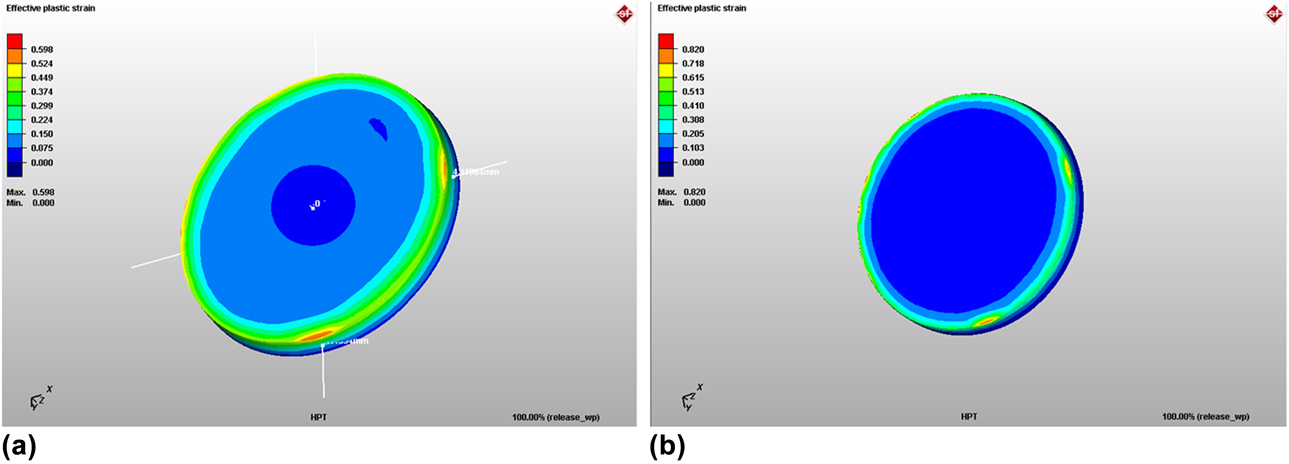
The effect of strain path change in monotonic and cyclic HPT was carried out using finite element method (FEM) using SIMUFACT (Kassel, Germany) software. The present software is routinely used for studying the evolution of stress and strain for metal working operations at different temperature and strain rate and can handle large strain deformation. In the present study, SIMUFACT was utilized to study monotonic and cyclic HPT of CoCuFeMnNi alloy by using room temperature stress–strain behavior of the alloy investigated by the authors in an earlier publication. It is expected that the stress–strain response of the alloy may change at high pressure of the order of 5 GPa that is present in HPT; due to the lack of experimental data, stress–strain behavior of CoCuFeMnNi at atmospheric pressure was used. A velocity gradient corresponding to that of pure shear was imposed on a disc specimen of 8 mm diameter and 0.8 mm thickness, and the sample was subjected to 100° and 360° twist in one direction as well as in steps of 5° forward and reverse torsion. The distribution of strain in the disc subjected to 360° twist with monotonic and cyclic loading is plotted in Fig. 6. It can be seen that the 360° monotonic sample shows higher accumulated strain than the 360° cyclic HPT sample. This can be attributed to the additive contribution of deformation processes in monotonic loading. The lower evolution of strain in cyclic HPT sample is attributed to subtractive nature of strain in odd number of cycle to even number of cycle. FEM simulations also indicate a far more uniform distribution of strain in cyclic 360° sample compared with monotonic sample. Thus, the FEM simulations show higher and more heterogeneous evolution of strain in monotonic sample compared with cyclic HPT sample. The distribution of strain shows a good match with the distribution of hardness.
Evolution of effective plastic strain in (a) monotonic 360° and (b) cyclic 360° HPT samples using FEM simulations in SIMUFACT software.

Discussion
Role of strain path change
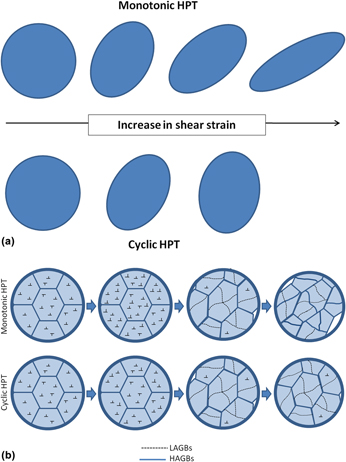
Plastic deformation is an additive process and is characterized by formation of dislocation structures to minimize overall energy of the deformed crystal [Reference Suwas, Gurao and Hashmi40]. There is a decrease in the crystallite size with increase in strain accompanied with a gradual conversion of low-angle boundaries to high-angle boundaries, leading to grain refinement in many SPD processes. A change in strain path activates additional slip systems and can aid in the grain fragmentation process like in the case of Bc route for equal channel angular extrusion [Reference Zhu and Lowe5]. For plane strain deformation by rolling, the situation is reversed with the cross-rolled sample showing lower dislocation density, overall defect content, and sluggish grain refinement due to operation of new set of slip systems in cross rolling [Reference Suwas, Gurao and Hashmi40, Reference Gurao, Sethuraman and Suwas41]. The strain path change during HPT comprises compression due to pressure followed with shear; however, since the shear strain is very large, shear microstructure dominates. However, for cyclic HPT, the orthogonal strain path change is likely to lead to formation of complex dislocation substructure [Reference Ungar, Toth, Illy and Kovacs42, Reference Correa, Aguilar and Cetlin43]. Shear deformation unlike rolling or tension, which requires five independent slip systems, needs only two independent slip systems to accommodate the imposed strain according to von Mises criterion, and hence, overall dislocation accumulation on slip planes is lower compared with uniaxial tension, leading to lower equivalent tensile flow stress and work hardening rate [Reference Ungar, Toth, Illy and Kovacs42]. At the same time, the overall dislocation density is higher for torsion at the same equivalent strain compared with tension due to the presence of strain gradients, contributing to higher GNDs. This leads to higher strain hardening in tension, compression, or plane strain compression as in rolling compared with torsion or shear as in ECAP or HPT. Due to the operation of double slip in shear, formation of dislocation cell structure is not possible, and hence, long-range stress field due to dislocations is not observed. Hence, though samples subjected to shear show higher dislocation density than samples tested in tension (for the same von Mises strain), the fraction of mobile dislocations is significantly higher for shear specimen. With increase in strain, the most active double slip system may stop operating due to latent hardening and other pair of double slip system will get operative. It is, therefore, natural that the mobile dislocations will interact with each other during strain path change and lead to enhanced annihilation. Single-phase HEAs, like CoCuFeMnNi, are known to deform by planar partial slip, which further make dislocation annihilation easy [Reference Tazuddin, Biswas and Gurao35, Reference Agarwal, Sonkusare, Jha, Gurao, Biswas and Nayan38]. This effect is further enhanced as only two independent slip systems are required for torsion so the annihilation of mobile dislocations is very dominant in the double slip system during strain path change, contributing to retarded grain fragmentation process in cyclic HPT. Canova et al. [Reference Canova, Kocks and Jonas45] determined the change in grain shape due to shear that contributes to development of grains with high aspect ratio. Development of grains with high aspect ratio and sufficient defect content is a prerequisite for continuous dynamic recrystallization processes that contribute to grain refinement in FCC materials [Reference Hallberg, Wallin and Ristinmaa46, Reference Bacca, Hayhurst and McMeeking47]. A schematic showing the delay in shape change contributing to development of lower aspect ratio for cyclic HPT compared with monotonic HPT is depicted in Fig. 7(a), while a schematic showing the evolution of finer grain size in monotonic HPT vis-à-vis cyclic HPT is depicted in Fig. 7(b). The inverse pole figure maps [Figs. 4(a)–4(d)] near the center of the disc obtained from electron back scatter diffraction (EBSD) and TEM images at the periphery in Figs. 5(a)–5(d) clearly indicate this phenomenon. It is to be mentioned here that orthogonal strain path change from compression to forward and reverse torsion in 100° cyclic HPT samples leads to higher grain refinement and formation of complex unstable dislocation substructure. The monotonic 100° HPT causes complete dissolution of initial cell structure and the new substructure gets further refined in 360° monotonic sample [Reference Correa, Aguilar and Cetlin43, Reference Wilson and Bate44]. With increase in strain from 100° to 360° in cyclic HPT, the unstable dislocation structure breaks down and grain growth occurs by grain boundary migration [Fig. 5(f)]. Such competition between hardening and softening has been observed in SPD processes, including HPT, and has been attributed to grain boundary migration, triple junction motion, or shear band formation [Reference Renk, Hohenwarter, Wurster and Pippan48, Reference Yu, Hansen, Huang and Godfrey49, Reference Kapp, Renk, Leitner, Ghosh, Yang and Pippan50].
Schematic showing (a) change in aspect ratio of grains during monotonic and cyclic HPT and (b) microstructural evolution during monotonic and cyclic HPT. LAGB: low angle grain boundaries, and HAGB: high angle grain boundaries.

Role of GNDs
Plastic deformation of materials is characterized by interaction of dislocations with each other and their interaction with other defects like grain boundaries, precipitates, and solute atoms. During large strain deformation, statistically stored dislocations (SSDs) are converted to incidental dislocation boundaries (IDBs), while GNDs are converted to geometrically necessary boundaries (GNBs) within a grain [Reference Hughes, Charzan, Liu and Hansen51]. With further deformation, IDBs and GNBs that are low-angle grain boundaries get converted to high-angle grain boundaries, leading to grain refinement. Most SPD processes rely on shear based deformation, as unlike compression or rolling, shear has inherent rigid body rotation and strain gradients associated with it unlike deformation. This is particularly important for polycrystalline materials, wherein GNDs play an even more important role in accommodating deformation. GNDs are necessary in polycrystalline materials to maintain strain compatibility between grains. GNDs are also present within a grain to maintain strain compatibility with the neighboring subgrains. The density of both SSD and GNDs is proportional to applied strain, while that of the latter is also proportional to strain gradients. In low to medium stacking fault energy materials, grain refinement occurs by the aforementioned process commonly known as continuous dynamic recrystallization or extended dynamic recovery. The reversal in strain path makes the defect structure unstable, and this can further delay grain refinement, as has been discussed in the previous section. In addition, the extent of instability is higher in HPT due to the rigid body rotation associated with shear process. In order to obtain a quantitative estimate of intragranular misorientation, grain reference orientation deviation (GROD) maps were obtained from the EBSD scans at the center of the disc. Figure 8 clearly shows lower GROD values for cyclic HPT samples than for monotonic HPT samples for the same amount of deformation. In fact, the 360° cyclic HPT sample shows the lowest GROD value. Higher GROD value is obtained near grain boundaries and triple junction as the lattice curvature is higher at these locations to maintain strain compatibility with the neighboring grains. However, cyclic HPT samples show more homogeneous distribution of GROD, indicating that the lattice curvature is more uniform throughout the grain. A quantitative estimate of the GND density is obtained by determining GND density from the lattice curvature using TSL-OIM software version 7.2 [Reference Field, Trivedi and Wright52] and is provided in Table I. It was found that there is a tremendous increase in GND density from 5.1 × 10¹² m−2 for homogenized sample to 2.1 × 10¹⁴ m−2 for 100° monotonic and cyclic HPT samples. The 360° monotonic sample shows the highest GND density (3 × 10¹⁴ m−2) and 360° cyclic sample shows dislocation density similar to that of 100° monotonic and cyclic HPT samples. This observation clearly indicates that there is annihilation of GNDs in cyclic loading compared with continuous increase in GND density for monotonic torsion.
GROD map of (a) monotonic 100°, (b) cyclic 100°, (c) monotonic 360°, and (d) cyclic 360° HPT samples obtained from EBSD.

Explaining the evolution of hardness
Strain hardening or dislocation strengthening and grain boundary hardening play a major role in determining the evolution of hardness in HPT, while additional mechanisms, like solid solution strengthening and cluster strengthening, are also important for the present alloy system. However, the effect of strain path change on the former two is substantial, while it is minimal for the latter two. The evolution of hardness at the center and near the periphery of all the four samples can be explained using contribution from dislocation and grain boundary strengthening. Higher grain size and lower dislocation density at the center and periphery of 360° cyclic HPT sample lead to the lowest hardness followed with 100° monotonic HPT sample. The finer grain size of 100° monotonic HPT sample at the periphery leads to higher hardness compared with 360° cyclic HPT sample. The 360° monotonic HPT sample shows the highest hardness near the center, and this is attributed to higher grain refinement as observed from EBSD and shows high hardness at periphery due to finer grains as observed in TEM. The 100° cyclic HPT sample provides a unique case with relatively low hardness near the center of the disc and high hardness at the periphery. The effect of strain path change on shear is minimal at the center, so it shows similar hardness comparable to 100° monotonic sample. However, at the periphery, there is substantial grain refinement with evolution of complex dislocation substructure due to strain path change that leads to highest hardness for this sample.
Summary and conclusions
A thorough microstructural investigation of monotonic and cyclic HPT samples indicates significant differences in the evolution of microstructure and hardness due to strain path change. The 100° cyclic HPT sample shows high hardness comparable to 360° monotonic HPT sample, while the 360° cyclic HPT sample shows low hardness throughout the disc specimen. Microstructural investigations indicate that change in strain path during cyclic HPT leads to annihilation of SSDs and GNDs, while there is continuous increase in dislocation density in monotonic HPT. The unstable dislocation substructure formed by orthogonal strain path change from compression to forward and reverse torsion accompanied with low grain size contributes to highest hardness of 100° cyclic HPT sample. The 100° monotonic HPT sample has relatively stable dislocation substructure that further undergoes refinement in 360° monotonic HPT sample and contributes to increase in hardness. However, the unstable dislocation substructure of cyclic HPT causes grain growth by grain boundary migration in 360° cyclic HPT sample, thus providing a uniform microstructure with coarser grain size, leading to lower hardness throughout the sample.
Experimental
HPT experiments were carried out on discs of 8 mm diameter and 0.8 mm thickness machined from vacuum arc-melted and homogenized equiatomic CoCuFeMnNi HEA billet. HPT was carried out at room temperature and pressure of 5 GPa using a computer-controlled HPT device (W. Klement GmbH, Lang, Austria) with a stationary upper anvil and rotating lower anvil for monotonic and cyclic HPT. The applied pressure ensures that there is no sliding of the disc during HPT, and the sample is subjected to pure shear, resulting in a shear strain of γ given by [Reference Pippan, Scheriau, Taylor, Hatok, Hohenwarter and Bachmaier8]:
 $$\gamma = {{\theta \times r} \over t}\quad ,$$
where, r = radius, θ = angle of twist in radian, and t = thickness of the disc.
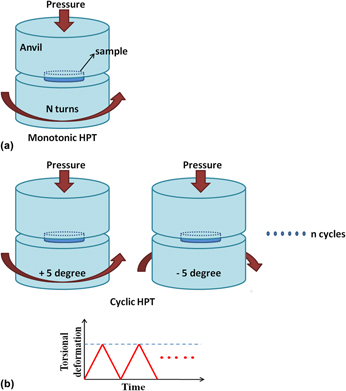
Four discs were subjected to HPT with the following conditions: (i) 100° monotonic, (ii) 100° cyclic, (iii) 360° monotonic, and (iv) 360° cyclic. A schematic of the deformation process is shown in Figs. 9(a) and 9(b). Cyclic HPT was carried out in steps of 5° rotation in clockwise direction, followed with rotation in anticlockwise direction for 5°corresponding to shear strain of ∼0.44. Thus, 100° cyclic HPT sample was produced by 10 forward and 10 reverse rotations, while 360° cyclic HPT sample composed of 36 forward and 36 reverse rotations. Thus, samples with same shear strain, but distinct strain path, were obtained at strain level of ∼8.7 and ∼31.4, corresponding to 100° and 360° rotation. HPT discs with a thickness of ∼0.55 mm postdeformation were machined into quarters using electric discharge machining, and each quarter was metallographically prepared by polishing with emery papers, followed by 1 µm alumina cloth polishing until mirror finish was obtained. X-ray diffraction was performed on HPT discs using a diffractometer PANalytical (Eindhoven, Netherlands) operating at 40 kV and 40 mA using Cu Kα radiation (λ = 0.15402 nm). A detailed characterization of microstructure and microtexture of the HPT discs was carried out using EBSD setup from Oxford Instruments (Abingdon, U.K.) mounted on a field emission gun scanning electron microscope JEOL (Akishima, Japan) JSM-7100F after colloidal silica polishing for 8 h using Vibromet from Buehler (Esslingen, Germany). EBSD data were collected from the center of the discs at an operating voltage of 20 kV with a step size of 0.1 μm using Channel-5 data collection system, and data analysis was carried out using TSL-OIM version 7.2 software from EDAX (Draper, Utah). In order to obtain microstructural information from the periphery of the HPT discs, TEM was performed using JEOL (Akishima, Japan) TEM 200 CX microscope operating at 200 kV. Discs of 3 mm diameter were machined from the periphery of the HPT discs and polished to 80 μm using emery paper, followed by dimple grinding followed by twin jet polishing using 90% methanol and 10% perchloric acid as electrolyte for TEM. Vickers microhardness measurement was carried out on one quarter of the HPT disc from the center to the periphery at 0°, 22.5°, 45°, 67.5°, and 90° using a load of 0.5 kg and dwell time of 10 s.
Schematic of (a) monotonic and (b) cyclic HPT.

Thermomechanical processing software SIMUFACT (Forming module) based on finite element modeling approach was employed to determine the evolution of stress and strain for 360° monotonic and cyclic HPT. The mechanical properties of CoCuFeMnNi alloy were used from an earlier investigation by the authors [Reference Tazuddin, Biswas and Gurao35, Reference Tazuddin, Gurao and Biswas36]. The governing equation for thermomechanical analysis can be written as follows:
 $$\left[ {{M^{\rm{e}}}} \right]\left\{ {{{\bar{\Delta }}^{\rm{e}}}} \right\} + \left[ {{K^{\rm{e}}}} \right]\left\{ {{\Delta ^{\rm{e}}}} \right\} = \left\{ {F_{\rm{M}}^{\rm{e}}} \right\} + \left\{ {F_{\rm{T}}^{\rm{e}}} \right\}\quad ,$$
where [M e] is the mass matrix, [K e] is the stiffness matrix, and  $\left\{ {F_{\rm{M}}^{\rm{e}}} \right\}$ and
 $\left\{ {F_{\rm{T}}^{\rm{e}}} \right\}$ are mechanical and thermal loadings, respectively. Since HPT was carried out at room temperature, there was insignificant contribution from thermal loads, but thermal properties of Cantors alloy were used in the simulations.
Acknowledgments
The authors would like to acknowledge the funding from DST-FIST, Government of India, for establishment of microscopy facility used in the present investigation at the Department of Materials Science and Engineering, IIT Kanpur. RS would like to acknowledge Ms. Khushubo Devi for her help in doing TEM. NK would like to acknowledge SURGE program at IIT Kanpur for hosting him at IIT Kanpur in the summer of 2018 when part of this work was carried out. The authors would like to thank SERB-DST for funding the research on deformation micro-mechanisms of HEAs.