INTRODUCTION
There are about 6500 well-known species of Echinodermata, which are distributed in six classes (Pawson, Reference Pawson2007). Price mentioned up to 99 species, which are reported from the Persian Gulf (Price, Reference Price1982), but new research shows that there are more than 100 echinoderm species in the Persian Gulf area (Clark & Rowe, Reference Clark and Rowe1971, Price, Reference Price1983; Price & Rezai Reference Price and Rezai1996, Pourvali, Reference Pourvali2013; Pourvali et al., Reference Pourvali, Nabavi, Rezai, Doraghi and Mahvari2014a, Reference Pourvali, Nabavi, Rezai, Doraghi and Mahvarib). The first report of echinoderms in the Persian Gulf dates back to 1785 (Mortensen & Heding, Reference Mortensen and Heding1940). In the past few decades, most research has been conducted in the Arabian region of the Persian Gulf (Price, Reference Price1981, Reference Price1982, Reference Price1983; Basson et al., Reference Basson, Burchard, Hardy and Price1977), however, knowledge about echinoderms on the Iranian side of the Persian Gulf is scant (Price & Rezai, Reference Price and Rezai1996).
MATERIALS AND METHODS
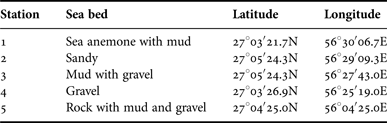
Specimens were collected in 2010–2011 from five sites in an intertidal area around Hormuz Island. The Asteroidea, Echinoidea and Ophiuroidea were collected in the intertidal zone while walking in this area. Specimens were collected by hand and preserved in 70% ethanol. The locations of the sampling sites are shown in Figure 1 and Table 1. Species identification was carried out in the laboratory using morphological keys.
Map of Hormuz Island in the Persian Gulf, showing the sampling sites.

Position and type of substrata in site sampling.
SYSTEMATICS
SEA STAR
Phylum ECHINODERMATA
Subphylum ELEUTHEROZOA
Class ASTEROIDEA
Order PAXILLOSIDA (Perrier, 1884)
Family ASTROPECTINIDAE (Gray, 1840)
Genus Astropecten (Gray, 1840)
Astropecten monacanthus Sladen, 1883
Astropecten polyacanthus polyacanthus Muller & Troschel, 1842
Astropecten polyacanthus pheragmorus Fisher, 1913
Family LUIDIIDAE (Sladen, 1889)
Genus Luidia (Forbes, 1839)
Luidia hardwicki Gray, 1840
Order VALVATIDA (Perrier, 1884)
Family ASTRINIDAE (Gray, 1840)
Genus Aquilonastra (O'Loughlin in O'Loughlin & Waters, 2004)
Aquilonastra iranica Mortensen & Heding, Reference Mortensen and Heding1940
Aquilonastra samyni O'Loughlin and Rowe, 2006
DESCRIPTION
Astropecten monacanthus Sladen (Figure 2).
Astropecten notograptus Sladen, 1888.
Astropecten squamosus Sluiter, 1889.
Astropecten monacanthus Sladen, 1833; Clark & Rowe, Reference Clark and Rowe1971, pp. 30, 46, pl. 5, Figures 1 & 2; Price, Reference Price1983, Figure 6A–C.
Astropecten monacanthus (left), Astropecten polyacanthus polyacanthus (right).
DIAGNOSIS
A species of Astropecten with medium-sized disc and fairly long, triangular arms, which are approximately quadrangular in section, general body appearance velvety; madreporite concealed by the paxillae; the paxillae distinct and daisy like; usually has one to six central spinelets, bordered by five to ten peripheral ones; supero-marginal plates forming conspicuous border to the paxillar area, and extending on to upper edge of arms such that they appear as broad, or slightly broader, than long when viewed from above; podia cinocal and without terminal suckers.
General distribution: East Africa and Madagascar; areas of the Maldives to China and southern Japan; Red Sea; Mozambique; Persian Gulf.
Astropecten polyacanthus polyacanthus Müller & Troschel, 1842 (Figure 2).
Asterias aranciaca Audouin, 1826 (synonym according to Doderlein (1917)).
Astropecten armatus Müller & Troschel, 1842 (non Astropecten armatus (Gray 1840) = Astropecten polyacanthus Muller & Troschel, 1842 according to Perrier (1875).
Astropecten burbonica Döderlein, 1917 (a variety of Astropecten polyacanthus Muller & Troschel, 1842).
Astropecten chinensis Grube, 1866 (synonym according to Sladen (1889)).
Astropecten edwardsi Verrill, 1870 (synonym).
Astropecten ensifer Grube, 1865 (synonym).
Astropecten hystrix Müller & Troschel, 1842.
Astropecten samoensis Perrier, 1869 (a variety according to Doderlein (1917)).
Astropecten polyacanthus polyacanthus Clark & Rowe, Reference Clark and Rowe1971, pp. 30, 44; Basson et al., Reference Basson, Burchard, Hardy and Price1977, p. 193; Price, Reference Price1983, Figure 8; Purwati & Lane, Reference Purwati and Lane2004, Figure 2A–C.
DIAGNOSIS
A species of Astropecten with small- to medium-sized disc and fairly long triangular arms, which are somewhat pointed and approximately quadrangular in section; general body appearance velvety; colour of live specimens pinkish-brown with dark markings on each arm; madreporite sometimes hidden by the paxillae; supero-marginal plates forming a narrow border to the paxillar area, the plates aligned mainly on the side of the arms such that they appear longer than wide when viewed from above; infero-marginal plates with numerous spinelets, a single prominent spine at the upper end and usually two or three smaller ones below it arising near the distal edge of the plate, the large ambital spines together forming a conspicuous fringe; podia conceal and without terminal disc.
General distribution: islands of the West Indian Ocean to the Red Sea, areas of the Maldives, eastwards to Hawaiian Islands, New Caledonia, Mozambique, New Zealand, Kenya, Persian Gulf.
Astropecten polyacanthus pheragmorus Fisher, 1913 (Figure 3).
Astropecten polyacanthus phragmorus (left), Luidia hardwicki (right).
Astropecten polyacanthus pheragmorus Mortensen & Heding, Reference Mortensen and Heding1940, p. 61; Clark & Rowe, Reference Clark and Rowe1971, pp. 30, 44, pl. 5, Figure 3; Basson et al., Reference Basson, Burchard, Hardy and Price1977, p. 193; Price, Reference Price1983, p. 39, Figure 7.
DIAGNOSIS
A species of Astropecten with small- to medium-sized disc and fairly long triangular arms, which are somewhat pointed and approximately quadrangular in section; general body appearance velvety; colour pattern of dorsal surface in live specimens variable, usually pink or orange-brown with black symmetrical markings, becoming pinkish-brown; madreporite often concealed by the paxillae; supero-marginal plates forming a narrow border to the paxillar area, the plates aligned mainly on the sides of the arms such that they appear longer than wide when viewed from above; surface of plates covered with numerous spinelets; a spine present near the upper edge of each supero-marginal plate and additional plates sometimes present below; infero-marginal plates with numerous spinelets, a large spine at the upper end and usually two or three smaller ones below it arising near the distal edge of the plate; adambulacral plates with three inner furrow spines, the middle one longest.
Distinctive feature: distinguished from the other subspecies, Astropecten polyacanthus polyacanthus, by the presence of spines on every supero-marginal plate, and from other local Astropecten species by the appearance of the supero-marginal plates, which are relatively narrow in dorsal view.
General distribution: East Africa and Madagascar, northern Australia and Philippine Islands, Mozambique, Persian Gulf.
Luidia hardwicki Gray, 1840 (Figure 3).
Luidia forficifer Sladen, 1889 (synonym according to A.M. Clark (1953)).
Luidia prionota Chang & Liao, 1964 (synonym according to Liao (A.M. Clark, personal communication)).
Petalaster hardwicki Gray, 1840.
Luidia hardwicki Clark & Rowe, Reference Clark and Rowe1971 pp. 30, 44, pl. 4, Figure 2; Price, Reference Price1983, p. 32, Figure 2; Purwati & Lane, Reference Purwati and Lane2004, Figure 1.
DIAGNOSIS
A small species with five to six long, flat, strap-like arms and a small disc; general body surface smooth and without marked colour pattern; madreporite concealed by the paxillae; two or three regular, longitudinal rows of approximately square lateral paxillae each side, also forming transverse rows with the superomarginal ones, each paxillae having usually five to fourteen and fifteen to twenty-two more slender peripheral ones; infero-marginal plates adorned with a single enlarged spine at the top of the plate, and several smaller spines in a series down the middle of the plate, with smaller spinelets each side; podia conical without terminal suckers.
Distinctive feature: easily distinguished from Luidia maculata by having a much smaller body size, the number of arms (five to six, seven to nine), the lack of black, mottled colouring on the dorsal side and by the two-valved pedicellariae near the mouth.
General distribution: islands of the West Indian Ocean, South-East Arabia, areas of Sri Lanka to northern Australia, China and southern Japan, Ceylon, Bay of Bengal, Persian Gulf.
Aquilonastra iranica Mortensen & Heding, Reference Mortensen and Heding1940 (Figure 4).
Aquilonastra samyni (left), Aquilonastra iranica (right).
Asterina cephea var. Iranica Mortensen & Heding, Reference Mortensen and Heding1940, Figure 3, pl. 1, Figures 1–4.
Asterina burtoni Clark & Rowe, Reference Clark and Rowe1971, pp. 68–69, pl. 9 Figure 4.
Asterina burtoni Price, Reference Price1983, Figure 14.
Aquilonastra iranica O'Loughlin and Rowe 2006, Figure 5J–K.
DIAGNOSIS
Non-fissiparous Aquilonastra species; rays five, long, broad basally, tapering, rounded distally; abactinal proximal interradial pedicellariae, pairs of tooth-like different values; abactinal gonopores; from zero to five proximal doubly populate carinal plates; lacking secondary plates; spinelets on abactinal plates in small group, up to four per group, or in transverse single or double series; spineletes short, thick, conical to subsacciform; superomarginal plates smaller than infromarginals, up to about six spinelets per superomarginal plate, up to about 12 thicker spinelets per inferomarginal plate; spines per actinal plates: oral eight, suboral five, furrow seven, subambulacral nine, actinal interradial five; interradial spine long, conical; colour in live specimens greyish, with reddish or bluish-grey spot.
General distribution: West Pakistan, Persian Gulf.
Aquilonastra samyni O'Loughlin and Rowe, 2006 (Figure 4).
Asterina cephea var. Iranica Mortensen & Heding, Reference Mortensen and Heding1940, Figure 3, pl. 1, Figures 4–6.
Asterina burtoni Clark & Rowe, Reference Clark and Rowe1971, pl. 9 Figure 4.
Asterina burtoni Price, Reference Price1983, Figure 14.
Aquilonastra samyni O'Loughlin and Rowe 2006, Figures 1, 3G, H, 6J, 10D.
DIAGNOSIS
Ray predominantly five, slight taper, rounded distally, single conspicuous madreporite, gonopore abactinal, up to 30 spinelets across abactinal plate, spinelets small, short, thick, conical to columnar, supermarginal plate smaller than infromarginal plate, spine per actinal plate up to: oral eight, sub oral six, furrow seven, subambulacral eight, actinal interradial 14, colour: red, brown, brownish red.
General distribution: Oman, Madagascar, South-East Africa, Persian Gulf.
BRITTLE STAR
Class OPHIUROIDEA
Order OPHIURIDA (Müller and Troschel, 1840)
Family OPHIOCOMIDAE (Ljungman, 1867)
Genus Ophiocoma (Gray, 1840)
Ophiocoma scolopendrina Lamarck, 1816
Family OPHIOTRICHIDAE (Ljungman, 1867)
Genus Macrophiothrix (H.L. Clark, 1938)
Macrophiothrix elongata H.L. Clark, 1938
Macrophiothrix elongata H.L. Clark, 1938 (Figure 5)
Macrophiothrix elongata (left), Ophiocoma scolopendrina (right).
Macrophiothrix elongata Clark & Rowe, Reference Clark and Rowe1971, p. 82, 114, Figure 37G; Price, Reference Price1983, p. 61, Figure 25A–C.
DIAGNOSIS
A species of ophiotrichid with soft and puffy disc, which is pentagonal in outline and covered with short multifid stumps that extend on to the ventral side of the disc and between the radial shield; radial shield triangular, two thirds the disc radius in length and usually covered with rugose granules and sometimes multifid stump; colour of live specimens purple with pale median longitudinal line bordered by two darker lines dorsally, with a well-developed pale line ventrally; oral shields broader than long and angular proximally; adoral shield barely, if at all, meeting interradially; no oral papillae, each jaw crowned with a compact cluster of apical tooth papillae; dorsal arm plates approximately hexagonal; arms extremely long with up to eight serrated spines; one small tentacle scale.
General distribution: South-East Arabia, Persian Gulf.
Ophiocoma scolopendrina Lamarck, 1816 (Figure 5).
Ophiocoma alternans von Martens, 1870 (synonym).
Ophiocoma lubrica Koehler, 1898 (synonym).
Ophiocoma molaris Lyman, 1862.
Ophiocoma variabilis Grube, 1857 (synonym).
Ophiura scolopendrina Lamarck, 1816.
Ophiocoma scolopendrina Mortensen & Heding, Reference Mortensen and Heding1940; Song et al., 1997. Figure 1; Fatemi et al., 2010, Figure 3A–D.
DIAGNOSIS
Colour in life: very varied, dorsal disc uniformly black to pale brown to black variegated pattern, dorsal arm plates brown or paler brown regions several segments wide; ventral disc is light coloured or variegated, never uniformly dark. Disc surface with fine rounded granules, extending into a V-shaped interradial area orally. Aboral arm plates broader than long, narrower on one side. Arm spines alternating three and four, stout, upper ones shorter and club-shaped. Arms irregularly banded, conspicuously extended by otherwise hidden animals to collect food particles from the water surface on flooding tides.
General distribution: Aldabra, Chagos, Comores, Eastern Africa and Madagascar, Kenya, Lifou, Madagascar, Mascarene Basin, Mauritius, Mozambique, Red Sea, Seychelles, Somalia, South Africa (country), Tanzania, West Indian Ocean, Persian Gulf.
SAND DOLLAR AND SEA URCHIN
Class ECHINOIDEA
Order CLYPEASTEROIDA (Agassiz, 1872)
Family ASTRICLYPEIDAE (Stefanini, 1912)
Genus Echinodiscus (Leske, 1778)
Echinodiscus bisperforatus Leske, 1778
Echinodiscus auritus Leske, 1778
Order CAMARODONTA (Jackson, 1912)
Family ECHINOMETRIDAE (Gray, 1855)
Genus Echinometra (Gray, 1825)
Echinometra mathaei De Blainville, 1825
Echinodiscus bisperforatus Leske 1778 (Figure 6)
Echinodiscus bisperforatus (left), Echinodiscus auritus (right).
Clark & Rowe, Reference Clark and Rowe1971, 78b, pl. 25, Figure 9; Mooi 1989, Figures 2D, 8B, 12D, 27K, 30A.
DIAGNOSIS
Test indented laterally; margin thin and sharp; apical disc central; four gonopores; internal buttressing developed as dense honeycombed meshwork; petals well developed; posterior pair shorter than the rest; interambulacral and ambulacral zones similar in width at ambitus.
Posterior ambulacra with long slit-like lunules or notches; all interambulacrum disjunct or virtually disjunct on oral surface; separated by enlarged first pair of post-basicoronal ambulacral plates; basicoronal circlet pentastellate with interambulacral plates strongly projecting; periproct oral, close to the posterior margin. Opening at outer edge of first pair of post-basicoronal interambulacral plates; food grooves bifurcating at edge of basicoronals; highly branched distally; tube-feet extending into interambulacral zones.
General distribution: Mascrene Islands, East Africa and Madagascar, Red Sea, South-East Arabia, West India and Pakistan, areas of Ceylon, Bay of Bengal, Persian Gulf.
Echinodiscus auritus Leske, 1778 (Figure 6).
Echinodiscus auritus Mortensen & Heding, Reference Mortensen and Heding1940, p. 105; Clark & Rowe, Reference Clark and Rowe1971, 78b; Price, Reference Price1983, p. 80, Figure 40.
DIAGNOSIS
A moderate- to large-sized sand dollar, with the test very thin and flat; the outline often three-lobed with the posterior side almost straight and having an open notch each side; the test having a thin sharp edge and rising only slightly towards the centre; limit of the plates often indistinct, more easily discerned in internal view of a broken test; petals oval but sometimes barely discernible in living condition, closed distally and widest near the middle; the anterior petal longer than the others; four genital pores; peristome central; periproct on the oral side set forward from the posterior edge; tridentate pedicellariae usually conspicuous but variable in appearance, and may be present on the oral and aboral sides; colour of live specimens purple or brownish; bare test off-white.
General distribution: Mascrene Islands, East Africa and Madagascar, Red Sea, South-East Arabia, West India and Pakistan, Ceylon area, Bay of Bengal, East Indies, northern Australia, Philippine Islands, Persian Gulf.
Echinometra mathaei De Blainville (Figure 7).
Echinometra mathaei.
Echinometra mathaei Mortensen & Heding, Reference Mortensen and Heding1940, p. 103; Clark & Rowe, Reference Clark and Rowe1971, p. 142, 157, Figures 62B, 69B 70B, 71A, pl. 23, Figure 5, pl. 31, Figure 19; Basson et al., Reference Basson, Burchard, Hardy and Price1977, Figure 56; Price, Reference Price1983, p. 76, Figure 37; Keshavarz et al., 2012, Figure 2A.
DIAGNOSIS
Test fairly rigid, of variable shape but usually more or less ovate; test not sculptured with pits or depressions, and elongated horizontally so that it is rarely circular when viewed from above; the upper surface somewhat domed and the ambits within the lower half; ambulacral plates usually quadrigerminate, four or five plates fused together; primary tubercles imperforate, smooth and arranged in a regular longitudinal series; secondary also smooth, of variable size arranged irregularly; apical system having variable number of tubercles on the plates, the oculars all exsert; the anus approximately central; colour of spines in live specimens variable, usually blackish-purple, often with brown or green locally, dried test pale-green or off-white.
General distribution: islands of west Indian Ocean, Mascarene Islands, East Africa and Madagascar, Kenya, South Africa, Red sea, South-East Arabia, West India and Pakistan, areas of the Maldives, Ceylon area, east Indies, northern Australia, China, Philippine Islands and South Pacific Islands, Hawaiian Islands, Persian Gulf.
ACKNOWLEDGEMENTS
The authors would like to thank the Hormuzgan Department of the Environment Organization in Bandar Abbas for their valuable assistance.