Childhood accidents present important health problems. Reference Hooper, Coggan and Adams1 Currently, although all countries are closely interested in pediatric diseases, childhood accidents do not receive enough attention; therefore, research into such accidents remains limited. 2
Accidents can happen anywhere and to anyone, and children and adults are equally affected. Reference Bánfai, Deutsch and Pék3 According to the World Health Organization (WHO), the main causes of death from injury are falls, drowning, burns, and poisoning. 4 Childhood home accidents in Turkey have been reported to account for 18%–25% of all accidents. Reference Altundağ and Öztürk5 According to local studies, home accident incidence varies between 1% and 25%. Reference Altuntaş, Kaya and Demir6
Kindergarten-age children are the most important risk group for accidents. Reference Bánfai, Deutsch and Pék3,Reference Holmes, Levy and Smith7 Children in this age group lack the developmental features needed to protect themselves from accidents. Reference Bánfai, Deutsch and Pék3,Reference De Young, Haag and Kenardy8 Also, children at this age are more exposed to accidents due to their curiosity and fearlessness. Therefore, parents and preschool teachers have many responsibilities to protect preschool children from accidents. Reference Bánfai, Deutsch and Pék3
According to studies, neglect and carelessness cause more than half of home accidents. Reference Turan, Altundağ, Yorgancı and Yıldırım9,Reference Altundağ and Öztürk10 Research on the effect of mothers’ education in home safety measures during home visits and the incidence of accidents determined that the mean incidence of accidents among children was 3.98 ± 2.69 before this training and 1.10 ± 1.68 after. Reference Altundağ and Öztürk10 Similar studies have shown that education reduces the incidence of home accidents among children. Reference Turan, Altundağ, Yorgancı and Yıldırım9–Reference Kurt and Aytekin12 The children in the risky preschool age group need adults’ help to create a safe environment and protect them from accidents. These adults are also often the children’s mothers. Reference Altundağ and Öztürk10 The literature has identified the most important way to protect children from home accidents is family education, especially for mothers. Reference Turan, Altundağ, Yorgancı and Yıldırım9,Reference Altundağ and Öztürk10 Studies have highlighted the impact of mothers’ knowledge and practices on home accidents Reference Bánfai, Deutsch and Pék3,Reference Arulogun, Ikolo and Oluwasanu13–Reference Kamel, Emam and Mohammed16 and the effectiveness of such training. Reference Altundağ and Öztürk10,Reference Carlsson, Dykes, Jansson and Bramhagen17 Providing mothers with information about children’s developmental stages and accident risks increases risk perceptions and raises awareness of accident protection; however, in Turkey, few studies have examined such awareness through educating children in school environments. Reference Altundağ and Turan18
Researchers have used various approaches to study children’s prevention of accidents. Reference Morrongiello, Bell, Park and Pogrebtsova19 Waterson and Monk (2014) emphasized that using flowcharts to provide information, especially for children, helped develop basic safety knowledge. Reference Waterson and Monk20 De Young et al. (2016), on the other hand, stated that integrating storytelling into visual material and testing children with this type of material were more appropriate interventions to develop warning materials designed for young children. Reference De Young, Haag and Kenardy8 Additionally, storytelling techniques combine drawing and language, increasing information retrieval. Reference Lauritzen and Jaeger21
Aydoğdu Torbacı (2019) determined that parents can effectively deliver intended messages to children of preschool age, thanks to an application using a motion graphic technique. Reference Aydoğdu Torbacı22 Illustrations that combine narrative storytelling and pictures can help children understand information. Reference Lepola, Lynch and Laakkonen23 Thus, storytelling that involves warnings suited to the cognitive abilities of preschool-age children is considered important. Reference Liu, Lin and Chang24 Visual perception education through educational materials has been determined to effectively increase children’s visual perception levels. Reference Akaroğlu and Dereli25
One method for delivering information to preschool children is game-based teaching methods. This approach affords children opportunities to obtain new information, use their existing knowledge, and reconstruct their knowledge through direct in-game experience. Reference Aktaş Arnas26–Reference Pehlivan28 A visually well-prepared and content-rich mobile graph-based motion application can teach preschool-age children in an entertaining way circumstances that pose an accident risk; as a result, children can learn about potential accidents by predicting the situations in which accidents may take place. Reference Aydoğdu Torbacı22
In the current study, children were encouraged to tangibly recognize and learn circumstances that may lead to accidents by imagining playing hide-and-seek in the model home environment. Thus, this study aimed to teach preschool-age children (5-year-olds) about circumstances that pose an accident risk in a model home environment through an imagined hide-and-seek game.
Methods
Design
The study used a pretest–posttest control group trial design.
Sample and Setting
This study used a pretest–posttest control group trial design. The study population included the kindergartens affiliated with the Ministry of National Education in the Aegean Region of Turkey. The study sample comprised 1 kindergarten among the schools affiliated with the region’s 2 central districts, which was selected using a simple random sampling method (selected from a random number table). Before the study, the student records were examined, and a total of 74 children of age 5 years were selected. The study’s inclusion criteria were an age of 5 years and consent for study participation from children and their parents. The study’s exclusion criteria were psychological disorders affecting learning, absence from training sessions, an inability to participate in the training program due to disease, or hospitalization and an unwillingness to participate in the study. Thirty-eight students were randomly assigned to the study group, and 36 students were randomly assigned to the control group. Two participants were excluded from the study group due to school absenteeism after an initial interview. Thus, 72 students participated in the final study (study group: n = 36; control group: n = 36). A sample of 60 children was determined to achieve 90% power with 95% confidence. Reference Faul, Erdfelder, Lang and Buchner29 Accordingly, 72 students who met the study’s inclusion criteria were recruited for the study between March and June 2019.
Study Tools and Implementation
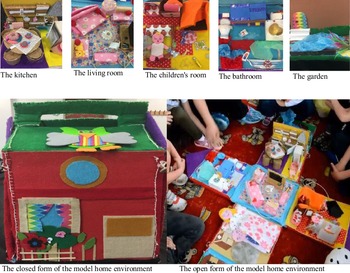
A Socio-Demographic Data Form was intended to collect information about student age and class. A Determination of Home Environment Risks Form was designed in line with the educational material (Figure 1) to identify accident risks in 5 main sections of a house. Reference Altuntaş, Kaya and Demir6,Reference Turan, Altundağ, Yorgancı and Yıldırım9,Reference Altundağ and Öztürk10,Reference Kurt and Aytekin12 These sections included a kitchen, living room, children’s room, bathroom, and garden. To determine the risk form’s content validity, opinions were solicited from 4 experts in the field of child health and diseases nursing who were professors working in this field. Then, the form was finalized according to these experts’ feedback. The item-level content validity of the evaluation form was determined to vary between 0.99 and 1.00, and the form-level validity was 0.99. The Kuder-Richardson 20 form was used as the reliability coefficient for the internal validity test, and the evaluation form’s internal consistency was determined as 0.78.
Model home environment.

The form was completed by marking a “yes” or “no” option for cases where accidents may take place in the model home environment, as determined by the researchers. Ten accident situations or accident risks were present in each section of the house, and each risk was assigned 2 points. The questionnaire was pilot-administered to 5 children with similar characteristics to the students in the study group who were not included in the study sample. Since these children understood all the questions, the study continued. Students who participated in the pilot study were not included in the final study sample. Since the questionnaire used only “yes” or “no” questions, both researchers observed the children and coded their responses.
The Model Home Environment
The study’s model house, made of felt, was planned to help children’s visualization. This model was created under the researchers’ guidance by an educator who worked as a preschool teacher, had received handicraft training, and held an undergraduate degree in child development. The walls of the house can be closed and opened manually. When opened, a room was designed on each section. When the model house was turned on, the items found in the homes of children of every socio-economic level became visible. Reference Altundağ and Turan18,Reference Aydoğdu Torbacı22,Reference Haltmatov30,Reference Yavuzer31 For example, there are sitting groups in the living room, a TV unit that is not fixed and a remote-control device with batteries visible, and an extension cable on the floor. In the kitchen, there are hot teacups and a knife on the table within children’s reach. In addition, cupboard doors are open and there is a pan with its handle facing out on the cooker. In the bathroom, there are toothpaste stains on the floor and a washing machine with its door open and plugged in. Before and after the model home’s construction, a total of 4 experts including 2 academics in the department of child health and diseases nursing who had completed education on home accidents, an instructor from the department of child development who was working as a preschool teacher, and an academic from the department of child development were consulted. These experts offered some recommendations about the model’s living room and kitchen. Accordingly, a model knife was added to the kitchen table and model extension cables were placed on the hallway floor.
The model embodied home accidents that children may encounter. The most common accidents experienced by preschool-age children are falls, poisoning, burns, and drowning. Reference Çavuşoğlu32 The situations posing an accident risk were specified for each room. To present these accident risks, necessary modifications were made after obtaining experts’ opinions, and the final model was determined. For example, small items were indicated on the model’s table, according to experts’ recommendations. The decision to include a garden and a pool in the model house was based on the possibility of children encountering related accidents in environments outside the home. Awareness has been provided for situations that may cause accidents in these environments.
For the model house, a standard house design was used. The model was designed according to drawings by children in this age group. Reference Haltmatov30,Reference Yavuzer31 The objects depicted in the house drawings by the children in the studied region of Turkey were generally used in the model. To attract children’s attention, materials of a real-life household were used in model rooms. For example, sitting groups in the living room. Thus, the studied training employed striking colors and a tangible design, which allowed participants to see the target structure easily, and was designed to be highly effective in teaching safety information to the children (see Figure 1). Reference Hooper, Coggan and Adams1,Reference Altundağ and Öztürk10,Reference Altundağ and Turan18,Reference Morrongiello, Bell, Park and Pogrebtsova19,Reference Aydoğdu Torbacı22,Reference Akaroğlu and Dereli25,Reference Kashler, Wogalter, Leuder and Rice33
Intervention
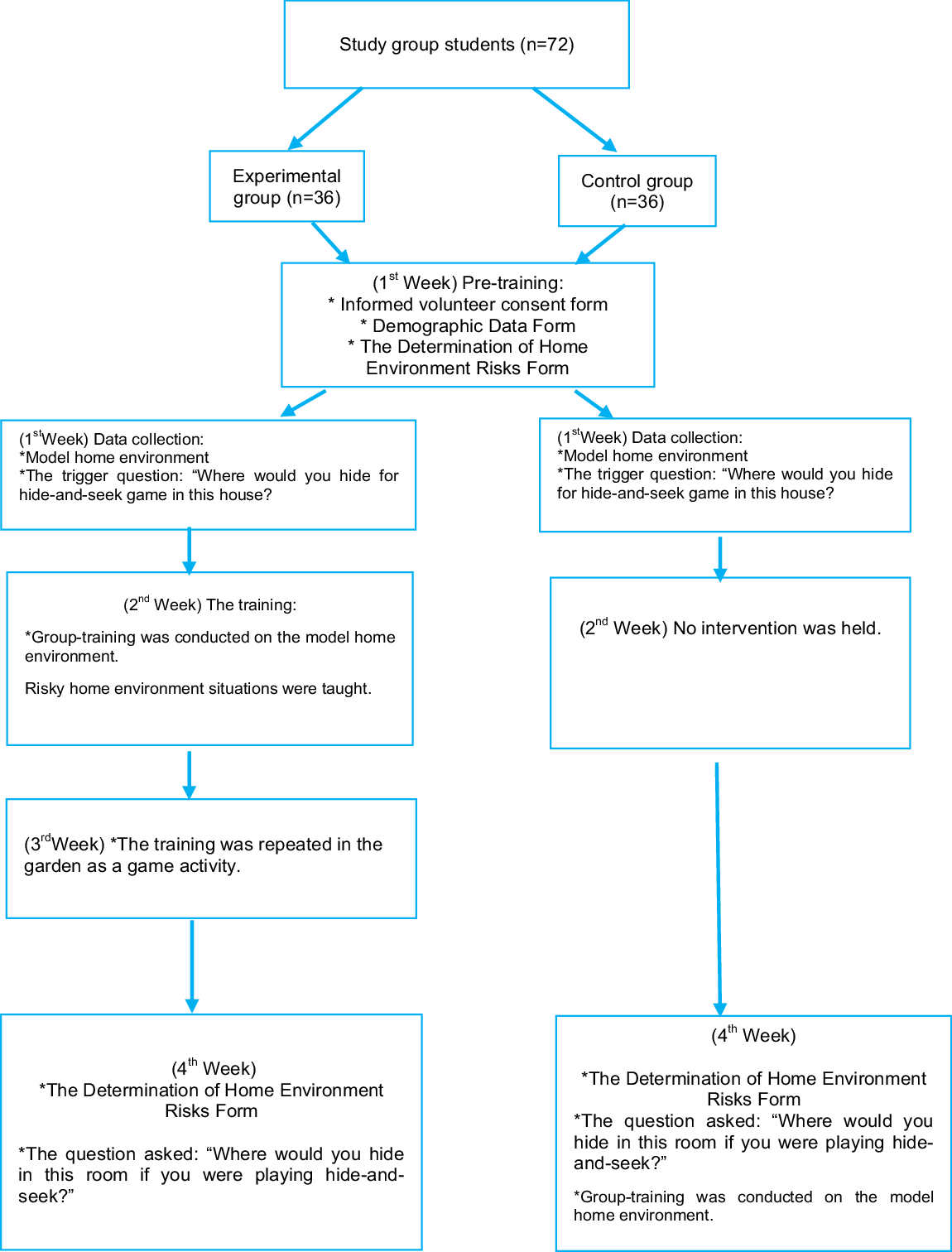
The study was conducted in 3 stages (Figure 2).
The study flowchart.

The pretest stage
After presenting general information about the study in a classroom environment, 1-on-1 interviews were conducted to prevent student interaction. The model home environment was shown to participants, and they were allowed to examine each section of the model house.
For each section of the model, students were asked, “Where would you hide in this room or in this section [the kitchen, living room, children’s room, bathroom, or garden] if you were playing hide-and-seek?” Participants were asked to show the places where they could hide when playing hide-and-seek and to identify situations that might cause them to be injured in the home environment and items that were misplaced.
The researchers coded the Determination of Home Environment Risks Form, based on participants’ responses, while they were identifying risky situations in the model home environment. 2,Reference Altuntaş, Kaya and Demir6,Reference Altundağ and Öztürk10,Reference Altundağ and Turan18,Reference Morrongiello, Bell, Park and Pogrebtsova19 The form was administered to the children in both the study and control groups at the beginning of the study. Since the model home environment highly attracted the children’s attention, they were allowed to play with any section of the model home as much as they wanted before and after the training session. The Socio-Demographic Data Form and Determination of Home Environment Risks Form were administered to participants in both study and control groups at the beginning of the study (the first week of the study).
The training stage of the study
The study group participants (n = 36) were divided into 6 small groups of 5 to 6 children (determined by classroom teachers) for interactive, effective education. The researchers were blinded to identify groups in the study, and the groups’ training lasted for 2 sessions (each session took 15–20 minutes, depending on the children’s attention spans). The education sessions were completed over 5 days. The education content involved accidents, injuries, accidental injuries that may occur in the rooms of the house, how to prevent accidents, and what measures should be taken after accidents. The children were sat in a U-shape so that they could see the model home. In the first training session, information about accidents and injuries was shown on the model home. The training sessions started with small warmup games, and then methods such as narrating, questions and answers, demonstration, and role-play were employed. During the second session, participants were asked to imagine playing hide-and-seek in the model house. At the same time, the children were asked to find the injury-risk situations in the home environment as a response to the questions: Where would you hide for the hide-and-seek game? Can you show me your hiding place? The question-and-answer technique used during the games included questions: Why did you hide there? Where can it be stored? Would you hide like this when playing in your own house? Children were applauded when they selected suitable hiding places for the hide-and-seek game. The model home environment (see Figure 1), which was appropriate for the participating children’s developmental levels, was designed consistent with the content of the training program and used during the study’s education sessions. Researchers who had conducted similar studies Reference Turan, Altundağ, Yorgancı and Yıldırım9,Reference Altundağ and Öztürk10 in this field directed this education. Researchers revealed the injury-risk situations one by one on the model home. The children’s learning about situations that may cause accidents and injuries was reinforced using the question-and-answer technique during the second week of the study.
Three weeks after the training stage, a garden activity was carried out using the model home environment with the same working groups. Participants were asked to imagine playing hide-and-seek in the model home in small groups of 3 to 5 children (determined by the class teacher), recalling what they had previously learned in the study’s training stage. In total, 9 sessions of the garden event were held, and this event continued for 2 days. No interviews were conducted with the control group, except for the administration of the questionnaire forms. During the study, the control group received a routine school education (the third week of the study).
The posttest stage
The children in the study group were asked to show the situations that posed an accident risk in the model home environment during the fourth week after the training stage, and the researchers coded their answers on a data form. After the intervention (the first month of the study), the Determination of Home Environment Risks Form was re-administered to the study and control groups. At the end of the study, the control group, according to ethical guidelines, was also trained using the model house (see Figure 2).
Data Analysis
Data were analyzed using the Statistical Package for Social Sciences (SPSS, Version 22; IBM Corp, Armonk, NY), and frequency and percentage were used to examine the sociodemographic characteristics of the participants. For evaluating the effectiveness of the training given, the paired sample t-test was used for the difference between measurements, and the student’s t-test was employed for the difference between groups. A value of P < 0.05 was accepted as statistically significant.
Results
The study recruited a total of 72 children: 18 boys and 18 girls in the study group, and 19 boys and 17 girls in the control group.
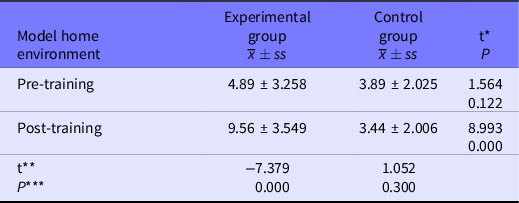
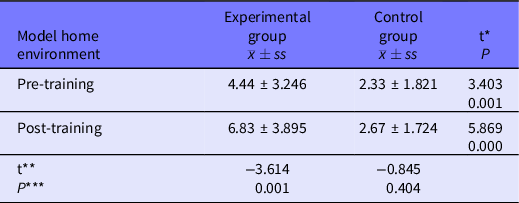
The post-training mean scores of the children in the experimental group for kitchen accident risks were found to increase (P < 0.05). No difference was found in the mean scores of the children in the control group (P > 0.05). The difference between the pre-training mean scores of the experimental and control groups was not statistically significant (P > 0.05), and the difference found between the groups after the training was statistically significant (P < 0.05) (Table 1).
Pre- and post-training mean scores of the children in the experimental and control groups for kitchen accident risks

t*, the student’s t-test; t**, the paired sample t-test; ***P < 0.05, statistically significant difference.
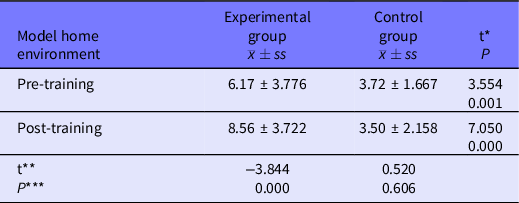
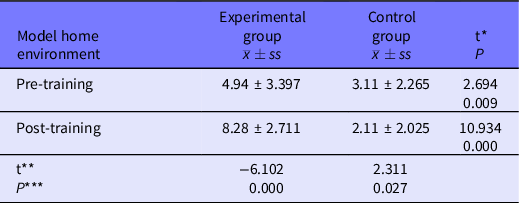
After the training intervention, the mean scores of the children in the experimental group obtained from children’s room accident risks were determined to increase (P < 0.05). There was no difference in the mean scores of the children in the control group (P > 0.05). The difference between the pre- and post-training mean scores of the study and control groups was statistically significant (P < 0.05) (Table 2).
Pre- and post-training mean scores of the children in the experimental and control groups for children’s room accident risks

t*, the student’s t-test; t**, the paired sample t-test; ***P < 0.05, statistically significant difference.
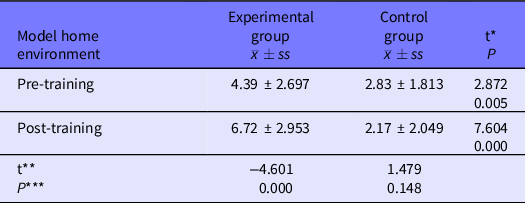
After the training intervention, the mean score of the children in the experimental group for living room/hall accident risks was determined to increase (P < 0.05). There was no change in the mean scores of the children in the control group (P > 0.05). The difference between the pre- and post-training mean scores of the study and control groups was found to be statistically significant (P < 0.05) (Table 3).
Pre- and post-training mean scores of the children in the experimental and control groups for living room/hall accident risks

t*, the student’s t-test; t**, the paired sample t-test; ***P < 0.05, statistically significant difference.
After the training intervention, the mean score of the children in the experimental group for bathroom/toilet accident risks was found to increase (P < 0.05). There was increase in the mean scores of the children in the control group (P < 0.05). The difference between the pre- and post-training mean scores of the study and control groups was found to be statistically significant (P < 0.05) (Table 4).
Pre- and post-training mean scores of the children in the experimental and control groups for bathroom/toilet accident risks

t*, the student’s t-test; t**, the paired sample t-test; ***P < 0.05, statistically significant difference.
After the training intervention, the mean score of the children in the experimental group for garden accident risks was determined to increase (P < 0.05). No change was observed in the mean scores of the children in the control group (P > 0.05). The difference between the pre- and post-training mean scores of the study and control groups was determined to be statistically significant (P < 0.05) (Table 5).
Pre- and post-training mean scores of the children in the experimental and control groups for garden accident risks

t*, the student’s t-test; t**, the paired sample t-test; ***P < 0.05, statistically significant difference.
Discussion
Accidents are a global health problem and the leading cause of mortality among children and young adults in almost all countries. 4 Crucially, children must understand that they can get injured. Accidents often look simple. As a result of injuries, children may be hospitalized, receive care, and even die. Reference Altundağ and Öztürk10,Reference Altundağ and Turan18 In developed and developing countries, accidents are the leading cause of death during childhood, and such deaths are a growing problem. Reference Altundağ and Öztürk10 Accidental deaths are 4 times more common than deaths from other problems. Reference Öztürk, Bektaş, Conk, Başbakkal, Yılmaz and Bolışık34 Protecting children from accidents depends on adults’ interventions, and the responsible adults are often children’s mothers. Reference Altundağ and Öztürk10 The extent to which mothers’ education transfers to children can only be evaluated through accidents’ occurrence. Reference Altundağ and Öztürk10,Reference Altundağ and Turan18 Studies have reported that the incidence of accidents among children has decreased after adults have been educated about the related risks. Reference Altundağ and Öztürk5,Reference Turan, Altundağ, Yorgancı and Yıldırım9
Since the majority of child accidents occur when parents are not present, interventions involving children are critical in accident prevention. Reference Damashek and Peterson35 Moreover, since children of kindergarten age act independently, preventing accidents is not always possible when these children are not constantly observed. Reference Morrongiello, Corbett and Brison36 Therefore, ensuring that kindergarten children understand accident risks and risky situations is important. Reference Aydoğdu Torbacı22
In general, program and approaches have been developed to prevent and control injuries. The new approach to prevent injuries has been defined as “changing/regulating the environment in which injuries occur” instead of “changing the behavior of individuals.” Reference Baysal and Birinci37
Considering children’s preferences, as well as their cognitive and linguistic abilities, researchers have recommended using short stories, songs, and cartoons for child safety education that show real situations instead of just written content. Reference Altundağ and Turan18,Reference Aydoğdu Torbacı22,Reference James, Nelson and Ashwill38 Similarly, many early-childhood education models have emphasized the importance of combining play and learning activities to promote children’s interaction with materials and acquisition of basic concepts and knowledge. Reference Samuelsson and Carlsson39
The education suitable for children’s development can be provided using different methods to increase children’s awareness. For this reason, different accident prevention strategies are needed for at-risk children. The use of pictures and illustrated fairy tales in studies with children ages 3–6 years was found to benefit education in accident prevention. Reference Durualp40–Reference Özer43
Studies determining accidents that may occur in all parts of the house can be found in the literature. In 1 such study, pictures and illustrations were designed according to children’s ages and used to raise awareness about home accidents. Reference Aydoğdu Torbacı22 Using and explaining visual materials suitable for preschool-age children have been found to effectively teach about home accident risks. Reference Altundağ and Turan18 In a study in which illustrations and verbal expressions were applied together to raise awareness about burns in children of the preschool period, Reference Liu, Lin and Chang24 these methods were found to be effective in the recalling capacity of this age group. This study also found motion graphics about home accidents to be effective.
In the current study, increased recognition of risky situations among the children in the study group after the model-home training intervention compared to the control group showed the importance of education in combination with an imagined hide-and-seek game (“as-if game”) in the model home environment. This model was tangible, interesting, and suitable for the preschool age level, appealing more to the sensory organs.
Teaching children about accident risks is an important facilitator in preventing accidents. Children should be informed about what could result from such behaviors by learning what they should not touch or do (for example, “Do not play with the oven,” “Do not touch the sockets,” and “Do not hang from the window”). Effective teaching strategies that will help children understand safety issues are needed. Reference Yıldırım and Kublay44
Limitations
This study faced some significant limitations. For example, participants’ familiarity with the model house environment differed. First, accident risks in the model house environment were based on statements by preschool-age children. Since the study relied on a survey, its self-reported data might have reflected bias in answering the researchers’ survey questions. Second, this research was a pilot study. The studies involving larger samples will be required to define the relationship between the model house environment and education. Finally, the study’s findings cannot be generalized to all children in Turkey because the study involved only students from 1 kindergarten.
Conclusions
Study results showed that the children in the group educated with a model home environment and hide-and-seek game designed according to the socio-economic settings and the age periods had a higher level of knowing about the situations that carry the risk of accidents in the home environment than the children in the control group. Thus, it is suggested that similar studies be conducted in larger centers, with scheduled follow-up periods and increased training sessions.
Acknowledgments
We thank all the children who participated in the study.
Funding statement
The authors received no financial support for the research, authorship, and/or publication of this article.
Conflict(s) of interest
The authors declare no potential conflicts of interest with respect to the research, authorship, and/or publication of this article.
Ethical standards
At the outset, Pamukkale University, where the study was carried out, was given institutional approval by the Ethics Committee (60116787-020/33160), and the written consents of the families were obtained. The aim and method of the research were explained to parents and children before the study; written consents were obtained from the parents, and verbal assents were obtained from the children. The parents and children were informed that if they did not want to continue, they could withdraw from the study without stating a reason.