1. Introduction
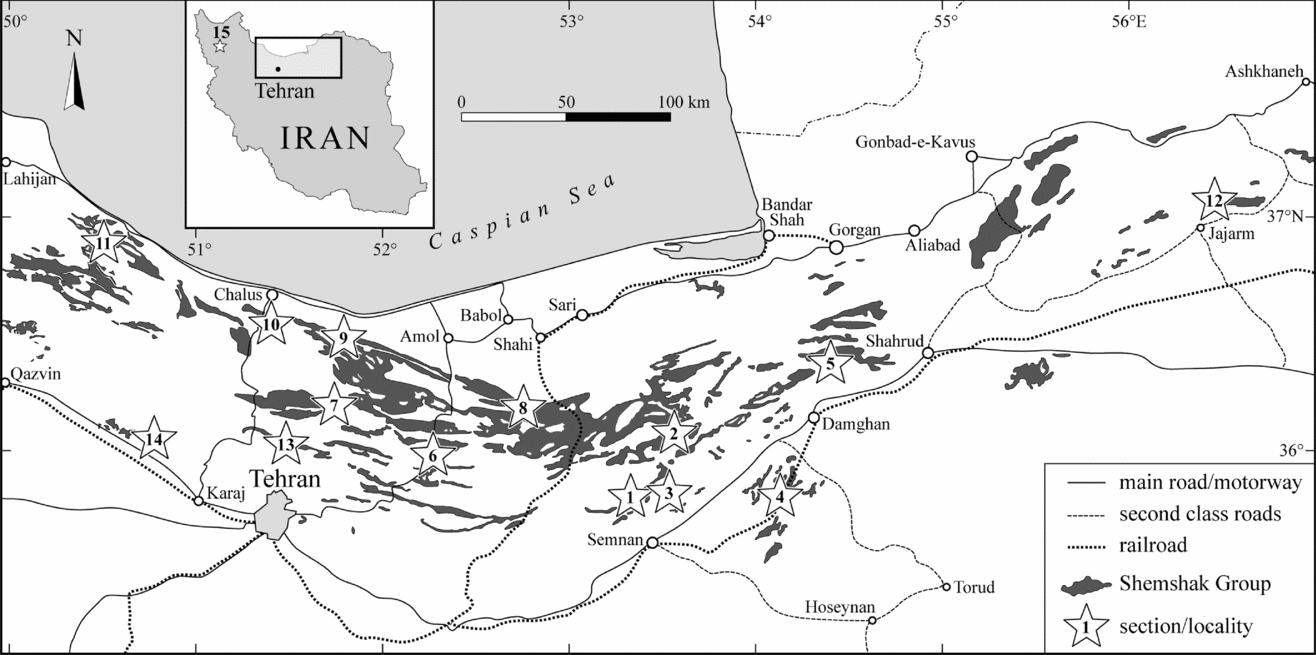
After its detachment from Gondwana in Permian time, the Iran plate, as the central part of the Cimmerian continent (Sengör, Reference Sengör, Robertson, Searle and Ries1990), moved northward and finally collided with Eurasia during Late Triassic time, thereby closing the Palaeo-Tethys (Ricou, Reference Ricou, Nairn, Ricou, Vrielynck and Dercourt1996; Dercourt, Ricou & Vrielynck, Reference Dercourt, Ricou and Vrielynck1993; Dercourt et al. Reference Dercourt, Gaetani, Vrielynck, Barrier, Biju-Duval, Brunet, Cadet, Crasquin and Sandulescu2000; Stampfli et al. Reference Stampfli, Mosar, Favre, Pillevuit and Vanney2001; Kazmin & Tikhonova, Reference Kazmin and Tikhonova2005). The resulting Eo-Cimmerian orogeny formed an E–W-trending mountain belt, the so-called Cimmerides (Sengör, Reference Sengör, Robertson, Searle and Ries1990; Sengör et al. Reference Sengör, Altiner, Cin, Ustaomer, Hsu, Audley-Charles and Hallam1998). The Alborz Range of Northern Iran itself results from the collision of Arabia with Eurasia during the Neogene, which caused uplift, folding and faulting (Stöcklin, Reference Stöcklin and Spencer1974; Alavi, Reference Alavi1996; Zanchi et al. Reference Zanchi, Berra, Mattei, Ghassemi and Sabouri2006; Guest et al. Reference Guest, Axen, Lam and Hassanzadeh2006; Guest, Guest & Axen, Reference Guest, Guest and Axen2007). The thick siliciclastic-dominated Shemshak Group (Upper Triassic to Middle Bajocian), with thicknesses up to 4000 m, is widely distributed in the Alborz (Fig. 1).
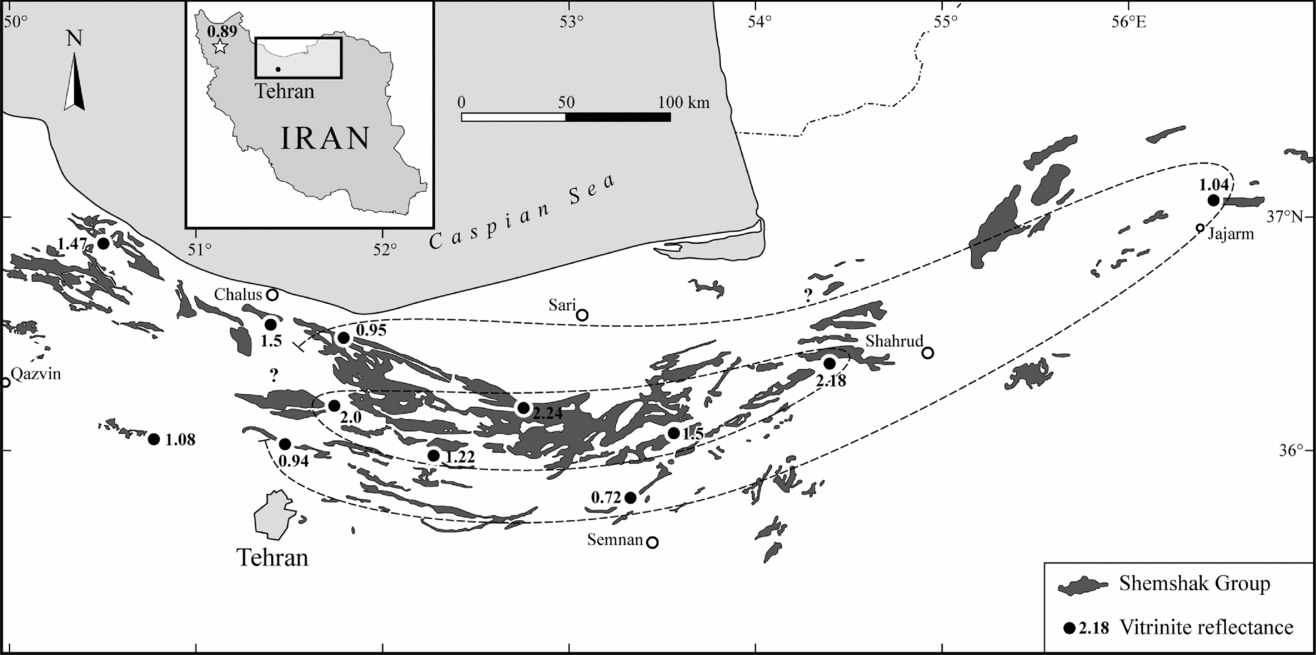
Location map showing the distribution of the Shemshak Group outcrops and the studied localities in the Alborz Range of Northern Iran. 1 – Shahmirzad area; 2 – Parvar area; 3 – Sharif-Abad section; 4 – Djam area; 5 – Tazareh section; 6 – Damavand area; 7 – Baladeh area; 8 – Paland section; 9 – Galanderud section; 10 – Ekrasar area; 11 – Javaherdeh area; 12 – Jajarm section; 13 – Shemshak type locality; 14 – Hive area; 15 – Maragheh area.

Commonly the Shemshak Group is regarded as the erosion product of the Cimmerides, deposited in a foreland basin (Assereto, Reference Assereto1966; Seyed-Emami & Alavi-Naini, Reference Seyed-Emami and Alavi-Naini1990; Alavi, Reference Alavi1996; Seyed-Emami, Reference Seyed-Emami2003). According to Wilmsen et al. (Reference Wilmsen, Fürsich, Seyed-Emami, Majidifard and Taheri2009) and Fürsich et al. (Reference Fürsich, Wilmsen, Seyed-Emami, Majidifard, Brunet, Wilmsen and Granath2009), the main part of the Shemshak Group represents an underfilled to overfilled foreland basin, whereas its upper part in the Southern Alborz was deposited during an extensional phase lasting from Toarcian to Bajocian times, resulting from the onset of the Neo-Tethyan back-arc rifting. The Mid-Bajocian (Mid-Cimmerian) unconformity, which usually marks the top of the Shemshak Group, may represent the break-up unconformity of this rifting event. In contrast, Brunet et al. (Reference Brunet, Shahidi, Barrier, Muller and Saidi2007) and Shahidi (unpub. Ph.D. thesis, Univ. Paris 6-Pierre et Marie Curie, 2008) interpret the rapid Late Triassic–Early Jurassic tectonic subsidence affecting the Central Alborz domain as the main phase of crustal thinning (= rifting) of the South Caspian Basin, and therefore the Alborz Range is regarded as its continental margin, which is now inverted. The Mid-Bajocian break-up unconformity is considered by these authors as the beginning of thermal subsidence on the margin of the Alborz and the oceanization of the South Caspian Basin.
In the present study we discuss the characteristics of organic matter (OM) of the shaly and coaly sediments from the Shemshak Group of Northern Iran using organic petrographical and organic geochemical analyses. One of our aims is to present the regional thermal maturity pattern of the Shemshak Group in the Alborz based on vitrinite reflectance data. Additionally, the thermal maturity and burial history of the Shemshak Group is modelled at four localities (pseudo-wells) using the commercial software Genex (Beicip-Franlab, 1995) to handle temperature, maturity, as well as petroleum expulsion through geological time. A subordinate goal of this study is to discuss the residual petroleum potential of the Shemshak Group and to propose guidelines for future petroleum exploration.
2. Geological setting of the Shemshak Group and its organic-rich units
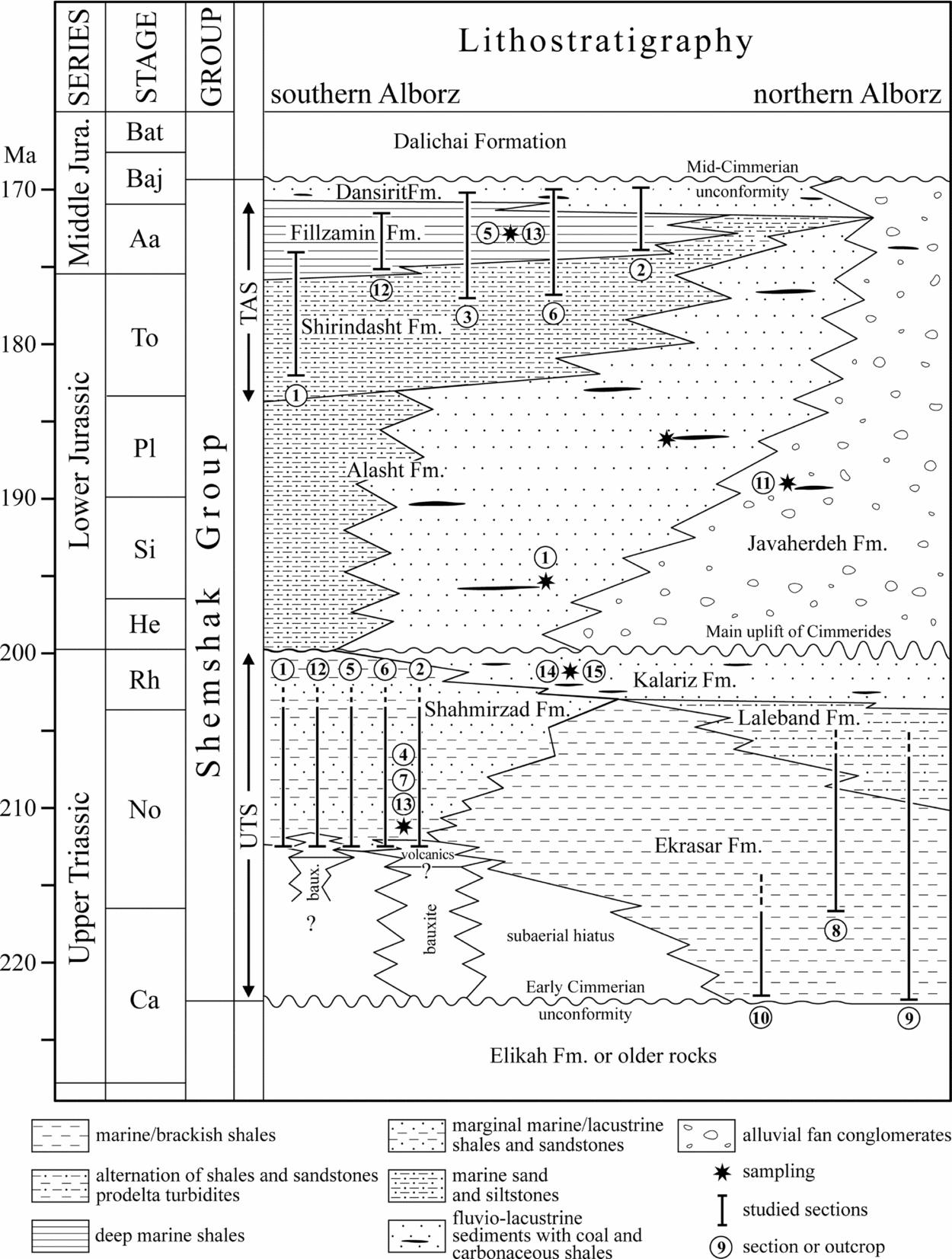
The Shemshak Group consists almost exclusively of fine- to coarse-grained siliciclastic sediments and hosts numerous coal seams and carbonaceous shales at different stratigraphic levels. Coal mines are widely distributed along the Alborz Mountain Belt, with a thickness of coal beds ranging from 0.2 to 2 m. The depositional palaeoenvironment of the Shemshak Group includes fluvial, swamp and lake systems, as well as shallow to deeper marine environments with local oxygen-deficient conditions leading to the deposition of organic carbon-rich sediments (G. M. Stampfli, unpub. Ph.D. thesis, Univ. Genève, 1978; Rad, Reference Rad1982, Reference Rad1986; Baudin & Téhérani, Reference Baudin and Téhérani1991; Fürsich et al. Reference Fürsich, Wilmsen, Seyed-Emami, Cecca and Majidifard2005; Seyed-Emami et al. Reference Seyed-Emami, Fürsich, Wilmsen, Cecca, Majidifard, Schairer and Shekarifard2006; Shekarifard et al. Reference Shekarifard, Baudin, Schnyder, Seyed-Emami, Brunet, Wilmsen and Granath2009; Fig. 2).
Lithostratigraphy of the Shemshak Group in the Alborz Range together with studied sections and sampling from the Shemshak Group in the Alborz Region (modified after Fürsich et al. Reference Fürsich, Wilmsen, Seyed-Emami, Majidifard, Brunet, Wilmsen and Granath2009). Ca – Carnian; No – Norian; Rh – Rhaetian; He – Hettangian; Si – Sinemurian; Pl – Pliensbachian; To – Toarcian; Aa – Aalenian; Baj – Bajocian; Bat – Bathonian; UTS – Upper Triassic shales; TAS – Toarcian–Aalenian shales. 1 – Shahmirzad area (lower and upper Shahmirzad sections); 2 – Parvar area (lower and upper Parvar sections); 3 – Sharif-Abad section; 4 – Djam area; 5 – Tazareh section; 6 – Damavand area; 7 – Baladeh area; 8 – Paland section; 9 – Galanderud section; 10 – Ekrasar area; 11 – Javaherdeh area; 12 – Jajarm section (lower and upper Jajarm sections); 13 – Shemshak type locality; 14 – Hive area; 15 – Maragheh area. Localities are shown in Figure 1.

Organic carbon-rich sediments of the Shemshak Group have been classified into three different units including the Upper Triassic shales (UTS), Toarcian–Aalenian shales (TAS) and coal/carbonaceous shales (CCS).
2.a. Upper Triassic shales (UTS)
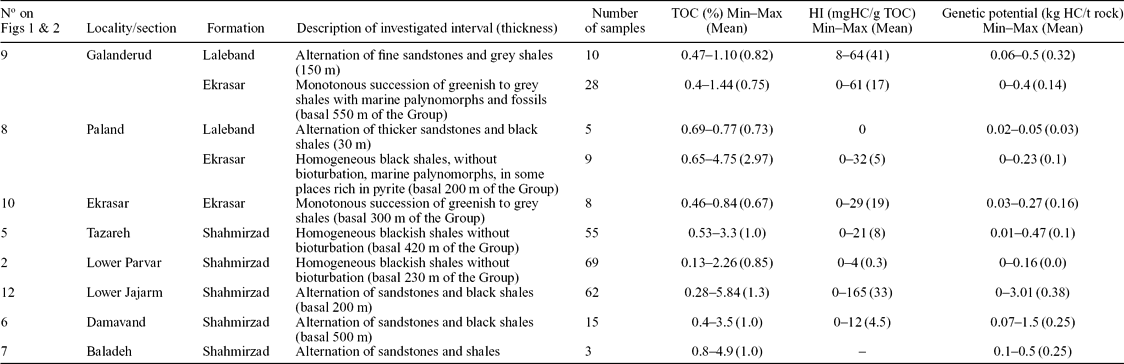
In the Northern Alborz the UTS corresponds largely to the Ekrasar Formation (Norian), up to 1000 m thick, at the base of the Shemshak Group (Bragin et al. Reference Bragin, Jahanbakhsh, Golublev and Sadovnikov1976; Y. S. Repin, unpub. report, 1987; Fürsich et al. Reference Fürsich, Wilmsen, Seyed-Emami, Majidifard, Brunet, Wilmsen and Granath2009; Seyed-Emami et al. Reference Seyed-Emami, Fürsich, Wilmsen, Majidifard and Shekarifard2009). The Ekrasar Formation consists largely of monotonous, greenish grey to black shales. At Ekrasar and Galanderud (Fig. 1), the Ekrasar Formation starts with intercalations of limestone beds with bivalves and ammonoids. Its boundary with the underlying Elikah Formation is generally sharp but conformable (Fürsich et al. Reference Fürsich, Wilmsen, Seyed-Emami, Majidifard, Brunet, Wilmsen and Granath2009), whereas at Paland the boundary is gradational (Aghanabati et al. Reference Aghanabati, Saidi, Ghasemi Nejad, Ahmadzadeh Heravi and Dabiri2002). Here the Ekrasar Formation follows apparently conformably the Middle Triassic carbonates and is composed of homogeneous black shales, sometimes rich in pyrite, especially in the basal part of the formation.
According to sedimentological and palynological evidence, the Ekrasar Formation was deposited in a marine basin (Ghasemi-Nejad, Aghanabati & Dabiri, Reference Ghasemi-Nejad, Aghanabati and Dabiri2004; Fürsich et al. Reference Fürsich, Wilmsen, Seyed-Emami, Majidifard, Brunet, Wilmsen and Granath2009) under suboxic to anoxic conditions.
In the Northern Alborz, the Ekrasar Formation is followed by the Laleband Formation (Upper Norian–Rhaetian; Fig. 2). The Laleband Formation is up to 435 m thick (Bragin et al. Reference Bragin, Jahanbakhsh, Golublev and Sadovnikov1976) and is mostly composed of an alternation of sandstones and dark shales. The transition of the Laleband Formation with the Ekrasar Formation is gradational, whereas its contact with the overlaying coal-bearing Kalariz Formation is sharp. The Laleband Formation represents turbiditic sediments of a prodelta setting (Fürsich et al. Reference Fürsich, Wilmsen, Seyed-Emami, Majidifard, Brunet, Wilmsen and Granath2009), and indicates infilling and shallowing of the deep marine basin.
In the Southern-Central Alborz, the basal part of the Shemshak Group corresponds to the Shahmirzad Formation (Norian–Rhaetian; Fig. 2). The Shahmirzad Formation unconformably overlies the karstified carbonates of the Elikah Formation and is gradually overlain by the Kalariz Formation. At Tazareh it has a thickness of about 1250 m and consists mostly of dark shales and sandstones, with some carbonate layers and a large amount of volcaniclastic rocks at the base, being deposited under fluvial, lacustrine to marginal marine settings (Fürsich et al. Reference Fürsich, Wilmsen, Seyed-Emami, Majidifard, Brunet, Wilmsen and Granath2009). At Jajarm the basal part of the Shahmirzad Formation is characterized by an alternation of black shales and sandstones.
2.b. Toarcian–Aalenian shales (TAS)
The TAS unit corresponds largely to the Shirindasht and Fillzamin formations (Fürsich et al. Reference Fürsich, Wilmsen, Seyed-Emami, Majidifard, Brunet, Wilmsen and Granath2009; Fig. 2). The Toarcian–lower Aalenian Shirindasht Formation has a thickness of 550 m and is generally characterized by alternations of bioturbated grey to olive shales and fine-grained sandstones. The basal part of the formation is dominated by sandstones and shows a fining-upward trend. The occurrence of parallel lamination and hummocky cross-stratification structures, marine fauna and trace fossils indicate a storm-dominated shelf facies. It is gradually overlain by the Fillzamin Formation (Fürsich et al. Reference Fürsich, Wilmsen, Seyed-Emami, Cecca and Majidifard2005, Reference Fürsich, Wilmsen, Seyed-Emami, Majidifard, Brunet, Wilmsen and Granath2009).
The Fillzamin Formation (Aalenian–lower Bajocian) consists of thick, monotonous, dark-grey to greenish and highly bioturbated shales with occasional fossiliferous concretions. It reaches a thickness of up to 680 m in the Tazareh section and is overlain by the Dansirit Formation. The presence of marine palynomorphs (e.g. acritarchs and dinoflagellate cysts), ammonoids and the relative decrease in grain size from the Shirindasht to Fillzamin Formation indicate a deepening of the basin (Fürsich et al. Reference Fürsich, Wilmsen, Seyed-Emami, Cecca and Majidifard2005, Reference Fürsich, Wilmsen, Seyed-Emami, Majidifard, Brunet, Wilmsen and Granath2009; Shekarifard et al. Reference Shekarifard, Baudin, Schnyder, Seyed-Emami, Brunet, Wilmsen and Granath2009). These fully marine and probably oxic sediments are characterized by low organic carbon content (Shekarifard et al. Reference Shekarifard, Baudin, Schnyder, Seyed-Emami, Brunet, Wilmsen and Granath2009). At the Shemshak type locality, the Fillzamin Formation is lithologically different from the other localities and is characterized by an alternation of dark shales and sandstones.
2.c. Coal and carbonaceous shales (CCS)
The Kalariz and Alasht formations are the main host rocks for coal deposits in the Alborz Range (Fig. 2). They are mainly composed of silty-clay sediments and fine-grained sandstones with numerous intercalations of coal and carbonaceous shales, representing fluvial, swamp and lake environments (Fürsich et al. Reference Fürsich, Wilmsen, Seyed-Emami, Majidifard, Brunet, Wilmsen and Granath2009). The partly corresponding Javaherdeh Formation is only developed in the northern part of the Alborz. It is a thick alluvial fan deposit (up to 1000 m and more) consisting largely of polymictic conglomerates and sandstones. Occasionally there are intercalations of argillaceous silt and carbonaceous shales within the Javaherdeh Formation.
The Dansirit Formation represents delta plain to marginal marine deposits. It consists mainly of sandstones with some intercalations of siltstones, carbonaceous shales and coal seams (Fürsich et al. Reference Fürsich, Wilmsen, Seyed-Emami, Majidifard, Brunet, Wilmsen and Granath2009).
3. Material and methods
In a previous study, 11 sites of the Shemshak Group were sampled and studied (Shekarifard et al. Reference Shekarifard, Baudin, Schnyder, Seyed-Emami, Brunet, Wilmsen and Granath2009). In the present study, four new sites in Eastern (Jajarm), Central (Shemshak and Hive) and Western (Maragheh) Alborz have been investigated (Fig. 1). The collected samples from Jajarm and Shemshak (site of the type section) belong to the UTS and TAS units (Fig. 2). At Hive and Maragheh, several samples from coals and carbonaceous shales (the CCS unit) have been taken from the lower part of the Shemshak Group.
Sixty-two core and 297 outcrop samples from the Shemshak Group have been investigated for evaluation of petroleum-generation potential and thermal maturity. Compared to previously published data (Shekarifard et al. Reference Shekarifard, Baudin, Schnyder, Seyed-Emami, Brunet, Wilmsen and Granath2009), 110 new samples have been collected from the new sites, including one shallow drilling core. Core samples belong to the Shahmirzad Formation in the Jajarm section.
Qualitative palynofacies studies were performed on 49 samples using both transmitted and incident UV light microscopy. Organic petrography observations have been performed on kerogen concentrates and coals from the Shemshak Group using reflected white and UV light microscopy. Measurements of vitrinite reflectance were made on 37 samples including densimetric concentrates and polished blocks of the kerogen concentrates and coal using a Leica DMR-XP apparatus. These measurements were carried out on 50 to 131 vitrinite particles for each sample using reflected light with a wavelength of 546 nm with a ×50 oil immersion objective, following the procedures described in Taylor et al. (Reference Taylor, Teichmüller, Davis, Diessel, Littke and Robert1998).
Petroleum source rock characterizations of the samples were carried out using Rock-Eval OSA and RE6 instruments (Espitalié, Deroo & Marquis, Reference Espitalié, Deroo and Marquis1985a, Reference Espitalié, Deroo and Marquisb, Reference Espitalié, Deroo and Marquis1986; Lafargue, Marquis & Pillot, Reference Lafargue, Marquis and Pillot1998; Behar, Beaumont & Penteado, Reference Behar, Beaumont and Penteado2001). Standard notations are used: S1 (free hydrocarbons) and S2 (pyrolysable hydrocarbons) in milligrams of hydrocarbons (HC) per gram of rock; Tmax is expressed in °C; total organic carbon (TOC) content in weight %; hydrogen index (HI = S2 × 100/TOC) in milligrams of HC per gram of TOC; genetic potential (S1 + S2) in milligrams of HC per gram of rock; and production index (PI = S1 / (S1 + S2)).
Total carbon content was determined using an elemental analyser LECO IR 212. As this apparatus burns rock up to 1100°C, the determination of total carbon is better compared to those calculated by the means of Rock-Eval pyrolysis, especially for carbon-rich (coal) samples. Calcium carbonate content of the selected samples was determined by gas volumetric analysis using a carbonate bomb. Only 39 samples show CaCO3 contents >1%. Total organic carbon contents of these calcareous samples are calculated by determining the difference between total carbon and carbonate carbon (Corg = Ctot − (CaCO3/8.33)), assuming that all carbonate is pure calcite. For the others (pure siliciclastic samples), the results of LECO are considered as TOC content and the hydrogen index values are calculated using these TOC results.
Elemental analysis of 33 kerogen concentrates and some coals were performed with a Flash EA 1112 Thermo CHNSO elemental analyser. The CHNS- and O-content are determined by two distinct experiments. For CHNS analysis, 1.5 to 2 mg of kerogen concentrates are pyrolysed by flash combustion at 1800°C, V2O5 being used as a fusing agent. The produced gas is then separated within a chromatographic column and finally detected in a catharometer. Bis(5-tert-butyl-benzoxazol-2-yl)thiophene (BBOT) was used as a standard. The oxygen content is measured on the same amount of kerogen by a pyrolysis at 1060°C in a He atmosphere. The CO2 then produced is detected as previously. Benzoic acid was used as a standard.
Timing of maturation and petroleum generation was reconstructed by means of the Genex4 1D computer modelling program of Beicip-Franlab, France (Beicip-Franlab, 1995). Input parameters for modelling include lithology of strata, thickness, age, hiatus and heat flow. Maturity modelling was calibrated by changing the palaeo-heat flow in order to fit the measured vitrinite reflectance values to calculated values.
4. Analytical results and interpretation
4.a. Organic matter characterization
4.a.1. Rock-Eval pyrolysis and TOC content
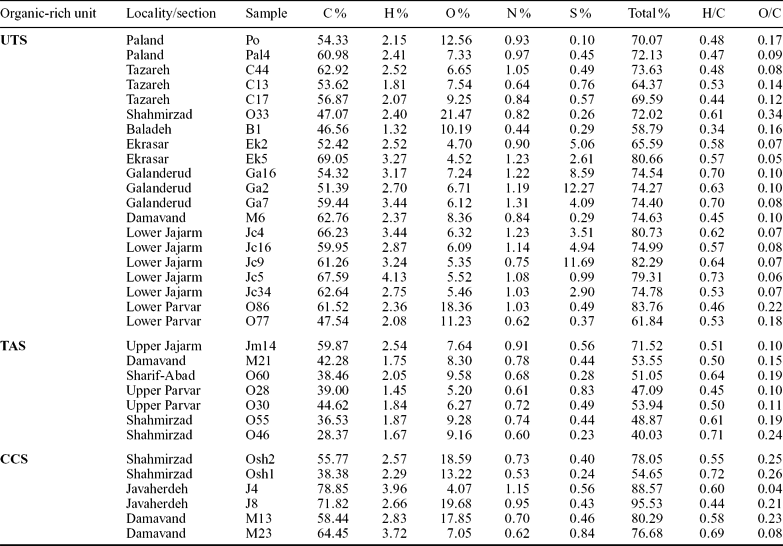
Bulk organic geochemical characteristics of the Shemshak Group in each of the studied sections are summarized in Tables 1, 2 and 3 for the UTS, TAS and CCS units, respectively. The TOC content of the shaly facies from the UTS unit ranges from 0.13 to 5.84% (Table 1). The organic-rich layers of the UTS, however, are relatively thin with thicknesses no more than 0.5 m. The TAS unit shows lower TOC values with an average of 0.6% and a maximum of 1.65% (Table 2). The dark shales of the TAS unit at the Shemshak type locality, however, show slightly higher values of organic carbon (1% on average), which is in agreement with previous data obtained on the same locality by Baudin & Téhérani (Reference Baudin and Téhérani1991). The TOC content of the shales of the TAS unit at Shahmirzad is the lowest (0.52% on average). Samples from the CCS units show a wider range in TOC, between 3.5 and 88.6% (Table 3), reflecting the occurrence of coaly facies in these shales. It should be noted that the Rock-Eval results of several samples, i.e. from Maragheh locality (UTS & TAS units), were discarded from Tables 1 and 2 because of very low TOC contents.


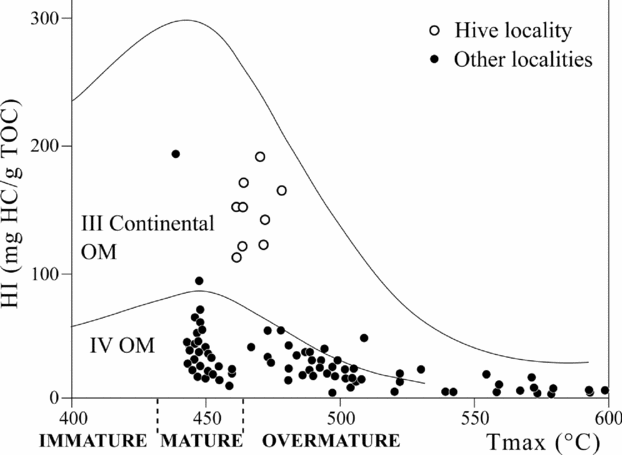
Because many samples yield no or very little hydrocarbons (<0.1 mg/g rock) during pyrolysis, interpretable Tmax values are scarce. Only one quarter of the 359 samples display reliable Tmax values. The HI–Tmax diagram indicates a mixture of Type IV (altered) and Type III (terrestrial) kerogens (Fig. 3). The maximum HI values (190 to 250 mg HC/g TOC) correspond to the coals and carbonaceous shales of the Shemshak Group at the Hive and Damavand localities (Table 3).
HI–Tmax diagram for the studied samples of the Shemshak Group in the Alborz Range showing the mature to over-mature state of organic matter. Samples from the Hive locality are coals and coaly shales that are clearly related to Type III kerogen, whereas samples from other localities plot in the area of Type IV (altered) organic matter (OM).

The HI–Tmax diagram shows that all samples of the Hive area are Type III kerogen and have reached nearly the end of the oil window (Fig. 3). The coals of the Hive area show rather high genetic potential (average 85 kg HC/tonne rock; Table 3). S1 values (up to 5 mg HC/g rock) and S2 values (up to 147 mg HC/g rock) indicate the presence of both free hydrocarbons and a remaining petroleum potential in spite of their level of thermal maturity (Littke & Leythaeuser, Reference Littke, Leythaeuser, Law and Rice1993).
4.a.2. Elemental analysis of kerogen
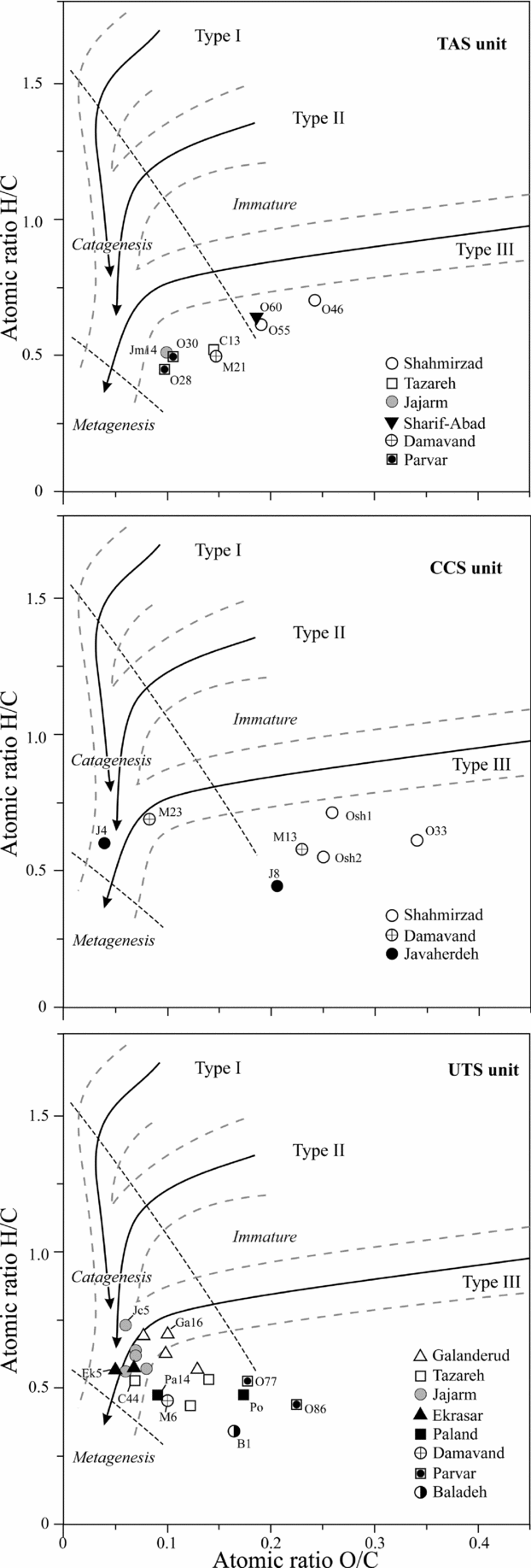
Elemental analysis data (Table 4) shows a mass balance (C + H + N + O + S elements) with a maximum value of 95.5% (on average 70%), except for some samples in which the total recovery is only 40% owing to a high amount of non-destroyed minerals. Elemental analysis of the selected kerogen concentrates indicates generally hydrogen-depleted OM in the shales of the Shemshak Group. H/C ratios of the kerogen concentrates range from 0.34 to 0.73, and 0.04 to 0.34 for O/C ratios.

The H/C and O/C atomic ratios of kerogen are plotted in a van Krevelen diagram (Fig. 4). It indicates that the samples are located in the oil and wet gas windows at catagenesis stage of Type III kerogen. This observation is globally consistent with Rock-Eval data and previous elemental analysis data on samples from the Shemshak type locality (Baudin & Téhérani, Reference Baudin and Téhérani1991).

4.a.3. Palynofacies and organic petrography
4.a.3.a. Shaly facies
Based on the present and published (Shekarifard et al. Reference Shekarifard, Baudin, Schnyder, Seyed-Emami, Brunet, Wilmsen and Granath2009) palynofacies data, the dispersed OM in the shaly units of the Shemshak Group (UTS and TAS units) is composed predominantly of amorphous OM and minor to moderate amounts of higher plant debris (ligno-cellulosic debris and some sporomorphs). In the studied samples, colour of spores varies from orange to dark brown/black showing a large range in thermal maturity, in agreement with other maturity parameters used.
At the Shemshak type locality, the Toarcian–Aalenian dark shales are characterized by the dominance of amorphous OM, a low percentage of ligno-cellulosic debris, sporomorphs and occasionally marine particles (scolecodontes). Unlike the other TAS units, here the shaly facies is enriched in pyrite framboids, consistent with a marine setting and oxygen-poor conditions.
Palynofacies observations of the Jajarm samples do not show any marine palynomorphs. It is characterized by a very high percentage of bright brown amorphous OM, some phytoclasts, brown cuticles and spores, occasionally very rich in pyrite. Some occurrences of amorphous OM with remaining cellular structure suggest an origin from waxy coatings (Tyson, Reference Tyson1995). The presence of rootlets and amorphous OM indicate, at some levels, suboxic to anoxic conditions for the basal black shales of the UTS in the Jajarm section.
Organic petrographical investigations indicate that phytoclasts dispersed in the shaly facies of the Shemshak Group are predominantly discrete particles of vitrinite with a minor contribution of inertinite macerals. Vitrinite largely occurs as isolated particles of homogeneous, partly porous vitrinite. Inertinite in the shaly parts is composed of semifusinite and inertodetrinite. The liptinite group corresponds to a few sporinite and cutinite macerals and occasionally solid bitumen.
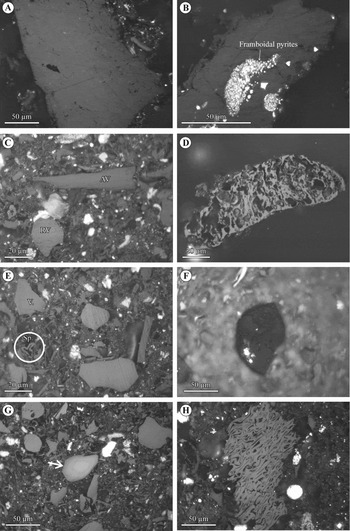
In highly mature samples, with mean random vitrinite reflectance (VRr) greater than 2%, vitrinite appears bright grey (Fig. 5c), whereas in less mature samples it is dark grey in colour (Fig. 5a, b). In addition, some occurrences of vesicular vitrinite with devolatilization vacuoles (Fig. 5d), which indicate gas expulsion from vitrinite due to high thermal maturity (Laggoun-Défarge et al. Reference Laggoun-Défarge, Lallier-Vergès, Suarez-Ruiz, Cohaut, Jimenez Bautista, Landais, Prado, Mukhopadhyay and Dow1994), are observed. Owing to the absence of magmatic activity in the vicinity of the studied section, the thermal maturity level of the studied samples is attributed solely to deep burial.
Microphotographs of dispersed organic matter in the samples from the Shemshak Group (incident white light). (a) Dark grey vitrinite; CCS units, Damavand section. (b) Vitrinite with a lot of pyrite; UTS unit, Jajarm section. (c) Autochthonous vitrinite (AV) and reworked vitrinite (RV); over-mature sample, UTS unit, Tazareh section. Vitrinite appears bright brown in the high maturity samples. (d) Coke from vitrinite showing irregular pores resulting from gas expulsion; over-mature sample, UTS unit, Tazareh section. (e) Over-mature sporinite (Sp) with the same reflectance as vitrinite (V), UTS unit, Tazareh section. (f) Solid bitumen; basal shales of the Ekrasar Formation, Galanderud section. (g) Inertinite with oxidation rims; over-mature sample, UTS unit, Tazareh section. (h) Semifusinite with cellular structure and pyrite framboids; mature sample, UTS unit, Jajarm section. For a colour version of this figure see online Appendix at http://journals.cambridge.org/geo.

The presence of angular to well-rounded vitrinite particles (Fig. 5c) suggests both autochthonous and (semi-)allochthonous origins (Littke, Baker & Rullkötter, Reference Littke, Baker, Rullkötter, Welte, Horsfield and Baker1997; Nzoussi-Mbassani, Copard & Disnar, Reference Nzoussi-Mbassani, Copard and Disnar2005), in agreement with the large standard deviations obtained for VRr values (see Section 4.b.). In general, autochthonous vitrinite is characterized by a darker colour and a larger size, up to 100 μm (Fig. 5b).
In the basal black shales unit of the Tazareh section a few grey cutinites and well-preserved sporinites do not show any fluorescence, reflecting a high thermal maturity (Fig. 5e). Some occurrences of possible granular solid pyrobitumen-like particles with orange fluorescence (Fig. 5f) in late mature samples of the Ekrasar Formation in the Galanderud section confirm hydrocarbon generation from the basal shales of the Shemshak Group. Inertinite, which is rarely observed, appears as rounded to sub-rounded particles sometimes showing oxidation rims (Fig. 5g). Semifusinite/fusinite exhibits angular to sub-angular shapes with a characteristic cellular structure (Fig. 5h). Fine-grained pyrite crystals are commonly associated with vitrinite (Fig. 5b).
4.a.3.b. Coaly facies
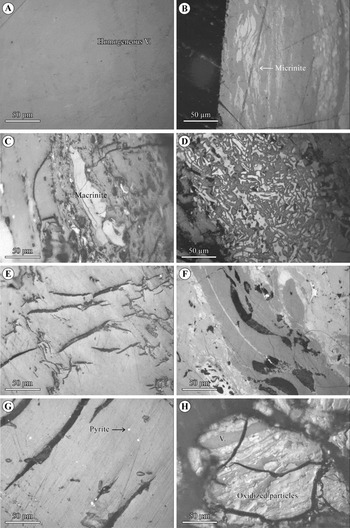
Homogeneous vitrinite (telocollinite and/or desmocollinite; Fig. 6a) is the dominant maceral in the studied coals from the Hive locality, with a low percentage of inertinite. Vitrinite appears grey to dark grey and is partly associated with pyrite grains. In the studied coals, micrinite (Fig. 6b), macrinite (Fig. 6c), semifusinite/fusinite (Fig. 6d) and inertodetrinite correspond to the main macerals of the inertinite group. Liptinite macerals, with the exception of possible solid bitumen, have not been identified. Although vitrinite does not fluoresce in our samples, darker bands of vitrinite or vitrinite-like components show weak red fluorescence, probably owing to either higher hydrogen content or different precursor material which shows suppressed reflectance (VRr = 0.9%) (Perrussel et al. Reference Perrussel, Laggoun-Défarge, Suarez-Ruiz, Jimenez, Iglesias, Rouzaud, Li and Liu1999; Iglesias et al. Reference Iglesias, Cuesta, Laggoun-Défarge and Suárez-Ruiz2001). Sometimes the silty matrix of coals shows the same fluorescence, probably implying adsorption of generated petroleum.
Microphotographs of the selected coals from the Shemshak Group in the Alborz Range (incident white light). Images (a), (b), (e), (f) and (g) belong to the Hive coals; (c) and (d) are from the Maragheh coals. (a) Homogeneous vitrinite (V). (b) Micrinite with homogeneous vitrinite. (c) Macrinite. (d) Fusinite. (e) Microfractures within pure homogenous vitrinite showing pinch and swell structure. (f) Selected concentrations of cracks and cavities in a vitrinite-dominated part of coal, filled by possible solid bitumen. (g) Parallel microfractures in vitrinite with disseminated pyrites. Cracks filled by possible solid bitumen. (h) Dominance of oxidized particles in the coals of the Shahmirzad section. For a colour version of this figure see online Appendix at http://journals.cambridge.org/geo.

Homogeneous vitrinite is commonly characterized by numerous parallel microfractures, pores and cavities partly filled by possible solid bitumen (Fig. 6e–g). The fractures show pinch and swell structures of different sizes that sometimes reach up to 200 μm in length and 30 μm in width (Fig. 6e, g). Possible solid bitumen infilling cracks and cavities of the coals shows red fluorescence, being the result of the high level of thermal maturity (Taylor et al. Reference Taylor, Teichmüller, Davis, Diessel, Littke and Robert1998). The occurrence of fluorescent exsudatinite and also the presence of micrinite is possibly evidence for oil generation from the Hive coals of the Southern Alborz (Mukhopadhyay, Reference Mukhopadhyay1991; Gentzis & Goodarzi, Reference Gentzis, Goodarzi, Mukhopadhyay and Dow1994; Stasiuk, Goodarzi & Bagheri-Sadeghi, Reference Stasiuk, Goodarzi and Bagheri-Sadeghi2006).
Although numerous studies have shown that coals are a moderate to poor source for liquid petroleum because of specific conditions and problems of migration, the generated hydrocarbons predominately migrate out as gas (Bertrand, Reference Bertrand1989; Boreham & Powell, Reference Boreham, Powell, Law and Rice1993; Littke & Leythaeuser, Reference Littke, Leythaeuser, Law and Rice1993). Concentrations of the parallel microfractures, pores and cavities are restricted to areas where the coals consist of nearly pure dark vitrinite and to isolated thick bands of dark vitrinite (Fig. 6f, g). The fractures commonly are perpendicular to vitrinite stratification where there is lamination in vitrinite. Probably these parallel microfractures and cavities are formed owing to hydraulic microfracturing of vitrinite after overpressure due to petroleum generation or outgasing.
The lack of sporinite, cutinite and other hydrogen-rich macerals (i.e. liptinite) as well as the dominance of pure vitrinite show that residual hydrogen content of the coals is probably related to the presence of vitrinite and/or vitrinite-like macerals. Most probably solid bitumen has been originated from this vitrinite and/or vitrinite-like material. Despite the high level of thermal maturity of the samples, the production index (PI) values are very low, possibly indicating petroleum migration (Hunt, Reference Hunt1995). As a result, it is evidenced that some of the Hive coals still have residual potential of oil and gas despite their level of maturity.
Some of the coals and carbonaceous shales of the Shahmirzad and Javaherdeh areas of the Alborz are characterized by the dominance of sub-rounded bright particles of inertinite, cemented by vitrinite (Fig. 6h). In contrast to the Hive coals that are mainly composed of pure vitrinite (vitrinite-rich coaly facies), they are very rich in oxidized particles of inertinite (inertinite-rich coaly facies). The very low hydrogen index values (maximum 21 mg HC/g TOC for inertinite-rich coaly facies), high atomic O/C ratios (up to 0.25; Table 4) and the abundance of inertinite particles imply the occurrence of coals with very low petroleum potential.
4.b. Maturity
Vitrinite reflectance measurements were used to assess the maturity level of OM. Most of the reflectograms show a high standard deviation (up to 0.51) and a bimodal pattern, indicating the presence of two populations of vitrinite particles. The first population with lower mean vitrinite reflectance is attributed to autochthonous particles and the second with higher mean vitrinite reflectance to reworked particles (Nzoussi-Mbassani, Copard & Disnar, Reference Nzoussi-Mbassani, Copard and Disnar2005). Vitrinite reflectance reported in the tables and figures corresponds exclusively to reflectance measurements on autochthonous vitrinite particles.
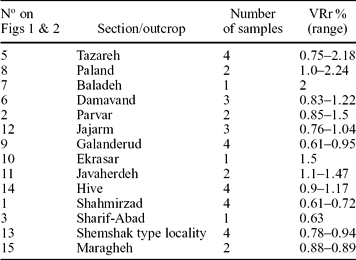
The results of mean random vitrinite reflectance measurements (VRr) for the studied localities are given in Table 5. Vitrinite reflectance values show large variation, ranging from 0.6 to 2.2% in the studied sections, indicating thermally early-mature to over-mature OM. It should be noted that the interpretable Tmax values (this study and Shekarifard et al. Reference Shekarifard, Baudin, Schnyder, Seyed-Emami, Brunet, Wilmsen and Granath2009) range from 439 to 599°C (Fig. 3), indicating also that OM has experienced widely varying levels of maturity.

Taking the basal part of the Shemshak Group as reference, the external areas of the Central-Eastern Alborz show lower VRr, ranging from 0.7 to 1.1%, whereas the axial part shows higher values of VRr (1.2–2.2%; Fig. 7) suggesting a regional thermal maturity pattern.
Regional thermal maturity pattern of the basal part (mainly UTS unit) of the Shemshak Group in the Central-Eastern Alborz Range based on the vitrinite reflectance (VRr) values. The central part of the Central-Eastern Alborz Range shows a higher thermal maturity.

5. Input data for the modelling
The modelling software used in the present study (Genex4 1D) is based on physical/chemical equations and on geological assumptions to reconstruct the burial and thermal history of a basin, the maturity of source rocks, as well as the petroleum generation (Tissot & Welte, Reference Tissot and Welte1984; Ungerer et al. Reference Ungerer, Burrus, Doligez, Chenet and Bessis1990; Beicip-Franlab, 1995). Obviously, the results depend upon the validity of the initial hypotheses. Whatever the uncertainties, basin modelling is an effective way of checking assumptions. One-dimensional modelling is used here to check what final maturity is expected for the organic-rich intervals of the Shemshak Group taking different heat flow scenarios into account.
Several parameters are needed as input data for the modelling. The choice of these parameters and the hypotheses made for modelling are briefly presented in the following Section.
5.a. Stratigraphy of the pseudo-wells
Owing to the lack of boreholes in the study area, the modelling was done using the sedimentary records from the outcrops. Four pseudo-wells were reconstructed in order to understand the controlling factors on thermal maturity of the Shemshak Group and to estimate palaeo-heat flow in the Central-Eastern Alborz Range. The Tazareh section (section 5 on Fig. 1) was selected as a key section from the over-mature zone of the Central-Eastern Alborz. The sections of Galanderud, Jajarm and Shahmirzad (sections 9, 12 and 1 on Fig. 1, respectively), chosen from the mature zone of the Central-Eastern Alborz, were also modelled. The lithostratigraphy data (thickness, age and lithology) of the Shemshak Group and overlying sediments are based mostly on the studies of Shahidi (unpub. Ph.D. thesis, Univ. Paris 6-Pierre et Marie Curie, 2008) and Fürsich et al. (Reference Fürsich, Wilmsen, Seyed-Emami, Majidifard, Brunet, Wilmsen and Granath2009).
The subsidence and thermal histories of these four pseudo-wells were reconstructed up to their burial maximum without taking into account the inversion of the basin and thrusting. Therefore, the results are only valid if maturation is strictly related to pre-deformational events. Another important assumption is that unconformities within the studied sedimentary succession were considered as non-deposition events as the eroded thickness is not constrained. Calibration of the model is usually performed by changing the palaeo-heat flow or by changing assumptions on eroded thicknesses. This latter possibility was not tested here. Absolute ages were taken from the default geological time scale given in Genex4 1D (Beicip-Franlab, 1995). In the absence of precise palaeobathymetric estimations, this parameter as well as sea-level variations through time were neglected. Percentages of ten lithologies (sandstone, siltstone, shale/claystone, marls, limestone dolomite, salt, anhydrite, coal and tuff) were attributed to the different formations. The initial porosity, matrix density, matrix thermal conductivity and matrix heat capacity were adopted from the default values given in Genex4 1D (Beicip-Franlab, 1995). The porosity–depth relationship for decompaction correction proposed in Genex4 1D was employed to model burial histories.
5.b. Source rock data and kinetic parameters
The characteristics of source rocks (quantity and quality of the organic matter) used for modelling derived from the geochemical and petrographical results described in Section 4.
The Genex4 1D chemical kinetic model includes both primary cracking (i.e. transformation of kerogen into liquid hydrocarbons) and secondary cracking (i.e. progressive degradation of oil into gas and carbon residue). The primary cracking parameters for Type III are those used by Forbes et al. (Reference Forbes, Ungerer, Kuhfuss, Riis and Eggen1991), whereas the model of primary cracking, with a dominant activation energy of 52 kcal/mol, is used for Type II. The parameters for secondary reactions are derived from Ungerer et al. (Reference Ungerer, Burrus, Doligez, Chenet and Bessis1990).
Finally, the VRr measurements on the sections corresponding to our four pseudo-wells were introduced as thermal maturity data.
5.c. Thermal parameters
The thermal history in a sedimentary basin is governed by (1) heat flow from the mantle, (2) the radiogenic heat produced in the crust, and (3) regional water flow. The increase in heat flow during rifting is related to the lithospheric thinning, which influences heat entering the basin from the asthenosphere. The main mode of heat transfer in sedimentary rocks is by vertical thermal conduction, determined by sediment lithology, porosity and nature of pore fluids. Convective heat flow, lateral dispersion of heat flow by conduction and anomalous heat intrusion, if moderate in size, have minor influences and can be neglected.
In the Genex4 1D software, two basic assumptions for heat flow histories can be implemented: (1) steady state: a constant heat flow over time, and (2) a non-steady state: a variable heat flow over time. The variable heat flow may be generated by a thermal anomaly without crustal thinning or be related to rift extension. The rift heat flow model incorporates a higher heat flow episode during the rift phase and an exponential reduction during the post-rift phase adapted from the McKenzie (Reference McKenzie1978) rifting model.
Several assumptions were made for our modelling: (1) the surface temperature was fixed at 15°C as a boundary condition, (2) the heat flow values discussed here are given at the base of the Shemshak Group, that means the Palaeozoic sedimentary rocks below are considered as part of the ‘upper crust’.
For our modelling, temperature was calculated using the transient heat flow model. The method to calculate temperature takes into account the thermal conductivities and heat capacities of the lithologies. The vitrinite maturation models used here are the EASY%Ro model of Sweeney and Burnham (Reference Sweeney and Burnham1990) and the IFP model (Durand et al. Reference Durand, Alpern, Pittion, Pradier and Burrus1986; Tissot, Pelet & Ungerer, Reference Tissot, Pelet and Ungerer1987), which uses also an Arrhenius first-order parallel-reaction approach with a distribution of activation energies.
5.d. Heat flow scenarios
Both rift heat flow and constant heat flow models can be evaluated by comparing observed and modelled maturity data. Several scenarios were tested here:
(1) A constant heat flow over time. Successive runs allow testing heat flows from 28 to 70 mW m−2 with an increase ranging from 2 to 5 mW m−2 at each run. Such heat flow values are compatible with usual foreland basin heat flows (Allen & Allen, Reference Allen and Allen2005).
(2) A variable heat flow through time, with a constant heat flow (45 mW m−2) as baseline and a sudden and strong increase (80 mW m−2) only during the deposition of the Shemshak Group (216 to 170 Ma).
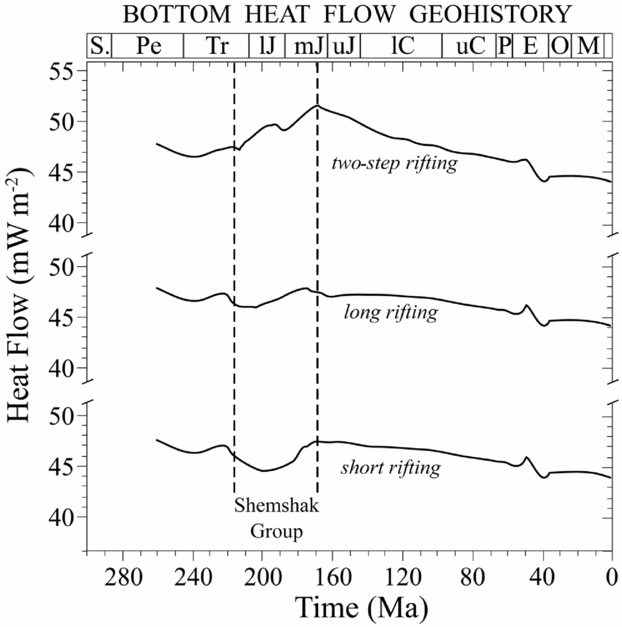
(3) A rifting hypothesis with three scenarios (Fig. 8): (i) a long rifting phase from 216 to 170 Ma, (ii) a two-step rifting with extensive phases ranging from 216 to 199 Ma and 183 to 170 Ma, in order to test the reconstruction of Brunet et al. (Reference Brunet, Shahidi, Barrier, Muller and Saidi2007) and Shahidi (unpub. Ph.D. thesis, Univ. Paris 6-Pierre et Marie Curie, 2008), and (iii) a short rifting from 183 to 170 Ma in accordance with the scenario of Fürsich et al. (Reference Fürsich, Wilmsen, Seyed-Emami, Cecca and Majidifard2005). A 1.45 β factor was used for these three scenarios.
Bottom heat flow geohistory of the Tazareh section for the three rifting scenarios (see text for details). Pe – Permian; Tr – Triassic; lJ – Lower Jurassic; mJ – Middle Jurassic; uJ – Upper Jurassic; lC – Lower Cretaceous; uC – Upper Cretaceous; P – Paleocene; E – Eocene; O – Oligocene; M – Miocene.

6. Thermal modelling results and interpretation
In basin modelling when the discrepancy between the measured thermal maturity data and modelled maturity curve is small, the modelling is considered successful and therefore the subsequent results will be reliable (Yalçin, Reference Yalçin1991; Inan et al. Reference Inan, Yalçin, Guliev, Kuliev and Feizullayev1997). In addition, the palaeo-heat flow history of the basin can be proposed by fitting observed thermal maturity and the modelled maturity curve (Sheng & Middleton, Reference Sheng and Middleton2002; Justwan et al. Reference Justwan, Meisingset, Dahl and Isaksen2006).
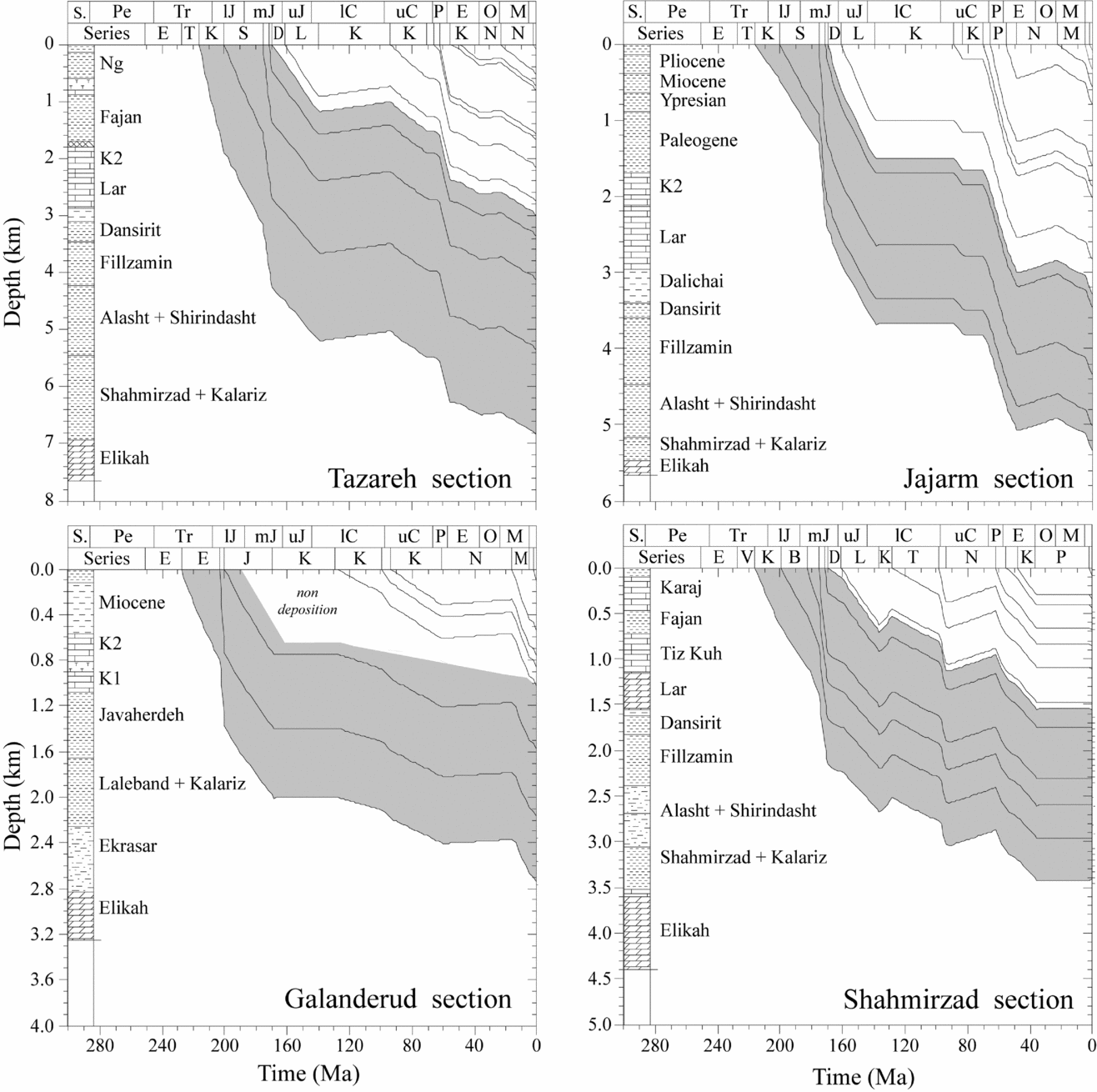
The burial geohistory of the Tazareh section indicates rapid sedimentation during the deposition of the Shemshak Group (Fig. 9). The obtained burial history is consistent with the studies of Brunet et al. (Reference Brunet, Shahidi, Barrier, Muller and Saidi2007) and Shahidi (unpub. Ph.D. thesis, Univ. Paris 6-Pierre et Marie Curie, 2008), which indicate two phases of high tectonic subsidence for the Shemshak Group in the Tazareh section during Late Triassic and Toarcian–Aalenian to early Bajocian times. Fürsich et al. (Reference Fürsich, Wilmsen, Seyed-Emami, Cecca and Majidifard2005) demonstrated the high sedimentation rate (up to 700 m Ma−1) within the Toarcian–Aalenian interval of the Shemshak Group at Tazareh. In the Shahmirzad and Jajarm sections the main subsidence phase of the Shemshak Group corresponds to the Middle Jurassic, whereas at Galanderud the main subsidence phase is during the Upper Triassic Laleband Formation (Fig. 9).
Burial geohistory curves of the Shemshak Group (grey area) and overlying sediments in the studied localities of the Central-Eastern Alborz Range. Lithostratigraphy columns are from Shahidi (unpub. Ph.D. thesis, Univ. Paris 6-Pierre et Marie Curie, 2008) and Fürsich et al. (Reference Fürsich, Wilmsen, Seyed-Emami, Majidifard, Brunet, Wilmsen and Granath2009).

According to the reconstructed burial histories, the maximum burial of the Shemshak Group in the four studied pseudo-wells has been reached during Tertiary time and therefore calibration by vitrinite reflectance provides information on maximum temperatures reached in the Tertiary. Nevertheless, it should be mentioned that a young uplift phase during Late Neogene time leads to inversion tectonics and exhumation of the Alborz, and consequently stops OM maturation. Therefore, in this case we are unable to estimate exactly the palaeo-heat flow of the Alborz basin during the sedimentation of the Shemshak Group, and all estimated heat flow values for the Alborz basin correspond to the time of maximum burial during Tertiary time.
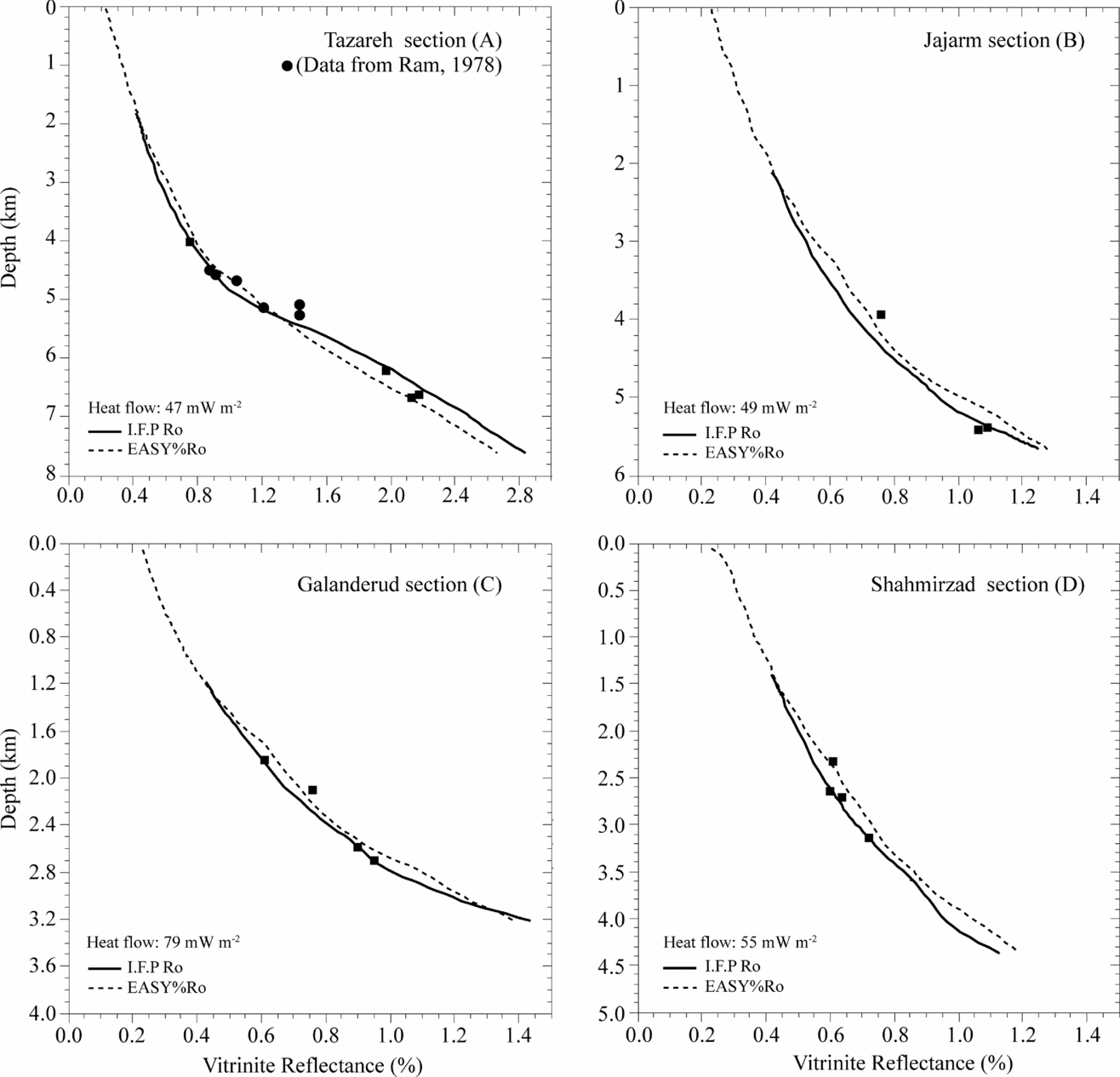
The thermal modelling of the Tazareh section using a constant heat flow of 47 mW m−2 gives the best fit for the observed thermal maturity data (plus some data from M.-H. Ram, unpub. Ph.D. thesis, Univ. Paris 6-Pierre et Marie Curie, 1978) and the modelled thermal maturity curve (Fig. 10a). However, the two-step and short rifting scenarios also show good accordance with the vitrinite reflectance data. Both indicate a maximum heat flow around 50 mW m−2 during maximum burial in the Tazareh section. According to the considerable thickness of the Shemshak Group at Tazareh (4000 m), the moderate estimated heat flow (47 to 50 mW m−2) is certainly related to the very rapid sedimentation rate, the so-called blanketing effect.
Thermal maturity modelling of the Shemshak Group during the time of maximum burial (Tertiary) in the studied localities of the Central-Eastern Alborz Range. The best fits between measured vitrinite reflectance values and modelled maturity curves are obtained using the heat flows of 47 mW m−2 for the Tazareh section (a), 49 mW m−2 for the Jajarm section (b), 55 mW m−2 for the Shahmirzad section (d) and 79 mW m−2 for the Galanderud section (c).

For the Jajarm section using a heat flow of 49 mW m−2, a good accordance is observed between measured vitrinite reflectance and the modelled maturity curve, showing also very moderate Neogene heat flow (Fig. 10b).
For the Shahmirzad section the use of a slightly greater heat flow value of 55 mW m−2 gives a good match between measured vitrinite reflectance and modelled maturity (Fig. 10d).
The Galanderud section is located in the northernmost part of the Central Alborz, close to the South Caspian Basin. According to present data, the thickness of the Shemshak Group and its overlying strata is the least among the studied sections. In this pseudo-well the best fit between the observed vitrinite reflectance and modelled maturity is obtained using a constant heat flow of 79 mW m−2, indicating a high geothermal gradient in comparison to the other studied sections (Fig. 10c).
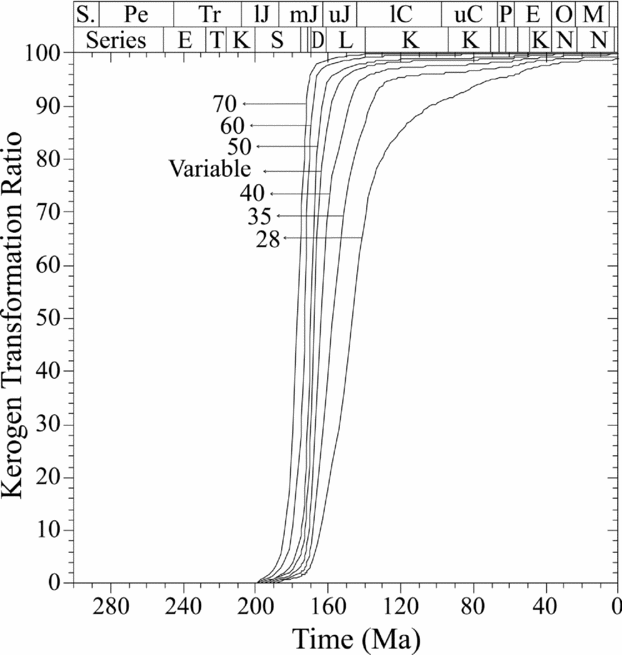
From the different obtained curves of the kerogen transformation ratio (ratio of the amount of petroleum generated by primary cracking to the maximum amount that can be generated), using different heat flows and rifting scenarios, the maximum of kerogen transformation of the basal black shales at Tazareh is reached during a rather narrow time interval from the Middle Jurassic to Early Cretaceous (Fig. 11), nearly contemporaneous with the deposition of the Dalichai and Lar formations. At the present day, this unit of the Shemshak Group is thermally over-mature and located at the beginning of the dry-gas window, in good agreement with the observed vitrinite reflectance, Rock-Eval Tmax data and palynofacies results (this study and Shekarifard et al. Reference Shekarifard, Baudin, Schnyder, Seyed-Emami, Brunet, Wilmsen and Granath2009). This suggests that the different heat flow scenarios have a limited effect on the timing of thermal maturation of this unit. Thus, the Middle Jurassic–Early Cretaceous period represents the timing of maturation for the most deeply buried part of the Shemshak Group in the Tazareh section.
Transformation ratio of kerogen and the timing of maturation for the basal black shales in the Tazareh section according different heat flow values.

In the Jajarm section the main stage of petroleum formation for the basal black shales occurs in a wide period of time from the Early Cretaceous to the Miocene. This is certainly due to the lesser thickness of the Shemshak Group and overlying beds at Jajarm. In the Galanderud section, the Ekrasar Formation has entered into the oil window during Late Jurassic time, but 75% of the transformation ratio of kerogen appears during the Miocene. The Shahmirzad section has experienced the lowest thermal maturity within the studied sections and so far only the basal part of the Group has just entered the oil window.
7. Discussion
Generally there is a concomitant increase in the VRr value from the basal part of the Shemshak Group with the increasing depth of final burial of the Shemshak Group. The basal part of the Shemshak Group (Shahmirzad Formation) in the Tazareh section has experienced the highest depth of burial (about 7000 m) and shows the highest VRr value (> 2%). Conversely the basal part of the Shemshak Group (Ekrasar Formation) in the Galanderud, Jajarm and Shahmirzad sections was less buried and shows lower values. A comparison between the Galanderud and Shahmirzad sections shows that despite a slightly greater thickness of the Shemshak Group and overlying strata, vitrinite reflectance is less at Shahmirzad than in the Galanderud section. This shows the impact of a greater heat flow, and therefore higher geothermal gradient, in the Galanderud section.
According to the observed VRr values, the basal parts of the Shemshak Group at Paland, Parvar and Baladeh are thermally over-mature and located in the dry-gas window similar to the Tazareh section. Although confident data on the lithostratigraphy and thickness of the Shemshak Group and overlying sediments at Paland and Baladeh are not available, their high thermal maturity is most probably a consequence of deep burial and a timing of maturation for these localities similar to those modelled for the Tazareh section. The Tazareh, Paland and Baladeh sections are relatively close to each other, lying on the axis of the Central-Eastern Alborz and most probably have experienced the same geological events. The Shemshak Group in the Tazareh section has the greatest thickness (4000 m thick) among all studied sections, the lowest palaeo-heat flow, and the highest thermal maturity among the modelled sections. This shows both the dominant effect of burial depth on the thermal maturity level as well as the importance of rapid sedimentation on the heat flow value. Most probably all the sections located in the over-mature zone along the axis of the Central-Eastern Alborz correspond to the deepest part of the Shemshak basin. In marginal parts of the Alborz such as Galanderud, Jajarm and Shahmirzad, the lower thermal maturity of the Shemshak sediments is largely related to the lesser thickness of the Shemshak Group and of the overlying strata.
Results of thermal modelling indicate that Neogene heat flow increases towards the northern margin of the Central-Eastern Alborz. The high palaeo-heat flow recorded in the Galanderud section may be the result of the proximity to the South Caspian depression and the effect of the thermal anomaly on the margins during its opening.
Summing up, observed variations in OM maturity values of the Shemshak Group in the Central-Eastern Alborz are mainly related to higher temperatures resulting from greater depth of burial.
During the deposition of the Dalichai and Lar formations, only the Shahmirzad Formation in the Tazareh section has entered the oil window in Middle Jurassic to Early Cretaceous times, while the Jajarm, Galanderud and Shahmirzad sections remained immature or early mature.
During Late Neogene time, which corresponds to inversion tectonics and exhumation of the Alborz, the most deeply buried parts of the Shemshak Group were highly uplifted and exposed, whereas marginal parts of the Central-Eastern Alborz were less uplifted (Alavi, Reference Alavi1996; Allen et al. Reference Allen, Vincent, Ian Alsop, Ismail-Zadeh and Flecker2003; Zanchi et al. Reference Zanchi, Berra, Mattei, Ghassemi and Sabouri2006; Guest et al. Reference Guest, Axen, Lam and Hassanzadeh2006; Guest, Guest & Axen, Reference Guest, Guest and Axen2007). The maximum amount of subsidence and uplift in the Central-Eastern Alborz occurred along the axis of the Alborz. It should be noted that uplifting not only interrupts the generation of petroleum, but also destroys possible petroleum accumulations.
The effect of possible tectonic burial and Late Cretaceous magmatism on the maturity of the Shemshak Group cannot, however, fully be ruled out; the northwestern Alborz has experienced extensive Late Cretaceous magmatism and strong tectonics, whereas towards the east the intensity of magmatism and tectonics decreases (Alavi, Reference Alavi1996). This may have a possible importance at some localities in the northwestern Alborz, probably in the Javaherdeh and Ekrasar sections, where the Shemshak Group has been buried by thrust sheets (according to geological maps of these localities). Conversely, the Late Neogene to Quaternary volcanism (e.g. Damavand Mountain) probably did not affect the thermal maturity of the Shemshak Group. This is indicated by the Shemshak and Damavand sections, which are in the vicinity of the Damavand volcano and which do not show high maturity values.
According to the modelling results, the petroleum source rocks in the basal part of the Tazareh section, along the axis of the Alborz, have generated petroleum earlier than their equivalent strata in the marginal areas as Galanderud and Jajarm. It is, however, likely that subsequent tectonic activity and uplifting during Late Neogene time has destroyed possible petroleum accumulations. Therefore, the axis of the Alborz has a low potential for petroleum exploration, except maybe for shale gas potential. On the contrary, in the marginal parts of the Alborz, especially in the areas of Galanderud and Jajarm, where the Shemshak Group was less affected by the Late Alpine tectonic activities, there is a high potential for occurrence and preservation of generated petroleum. The relatively low thermal maturity observed along the margin of the Central-Eastern Alborz, especially in the northern part, combined with the occurrence of gas/oil seepages and also the presence of oil traces in Cretaceous rocks in drilled wells in the Caspian Sea and its coastal plains, suggests that this area may contain an active petroleum system. This area is thus the best target for oil and gas exploration in the Alborz Range of North Iran.
8. Conclusions
(1) A multidisciplinary approach, including petrographical and geochemical methods and basin modelling, indicates a large variability of thermal maturity for the Shemshak Group along the Alborz Range, ranging from early-mature to over-mature. The large variation in OM thermal maturity is predominately a consequence of different burial histories.
(2) Based on the maturity map presented, thermal maturity is high along the axis of the Central-Eastern Alborz, including the Tazareh, Paland and Baladeh areas, whereas it decreases towards the external zones of the Alborz Range.
(3) Thermal maturity modelling demonstrates that the major episode of maturation and petroleum generation of the Shemshak Group was associated with deep sedimentary burial ranging from Middle Jurassic to Early Cretaceous times in the central parts of the Central and Eastern Alborz, whereas in the marginal parts maturation continued until Neogene time. Therefore, the basal source rocks in the Tazareh section generated petroleum earlier than their equivalent strata in the marginal areas.
(4) The estimated values from the palaeo-heat flow modelling of the Alborz basin during Neogene time, and the time of maximum burial, are generally moderate, ranging from 47 to 55 mW m−2 in the central and southern part of the Alborz up to 79 mW m−2 in the northern part of the Alborz. Minimum palaeo-heat flow values correspond to the Tazareh section where the Shemshak Group has a maximum thickness near to 4000 m. The moderate palaeo-heat flow observed is a response to the rapid sedimentation and high subsidence rate of the Shemshak Group.
(5) Thermal modelling results provide the first constraints on the history of maturation of the Shemshak Group. These constraints will provide a useful basis for future numerical modelling and emphasize the need for a better understanding of the burial history of the Shemshak Group to reconstruct the timing of oil generation and expulsion. Nevertheless, our preliminary data indicate that the Shemshak Group has generated petroleum during Miocene time in some parts of the Alborz. These areas are of the greatest interest for future oil prospection and should be explored carefully.
Acknowledgements
The present study is part of the Ph.D. research programme carried out between the University of Tehran (School of Mining Engineering) and the University of Paris 6, within the framework of the Middle East Basin Evolution programme (MEBE). We acknowledge financial support from the Alexander von Humboldt-Foundation (within the framework of an institutional partnership between Wurzburg and Tehran University) and the MEBE Programme. We also thank Beicip-Franlab for the use of the Genex software, Geological Survey of Iran (GSI) for logistical support and Marielle Hatton, Florence Savignac, Laurence Debeauvais and Léa Marie Bernard for their analytical help. Our thanks go also to Prof. Franz Fürsich (Erlangen University), Prof. Markus Wilmsen (SNSD, MMG, Dresden) and Dr M. R. Majidifard (GSI) for their help during the fieldtrips, and Jean-Luc Rudkiewicz (IFP Energies Nouvelles) for discussion on thermal modelling. We are indebted to the anonymous reviewers who helped us to improve this paper.