Introduction
“Nano,” “porous,” and metal are all necessary ingredients in a recipe for effective conversion of electricity to chemical energy (and vice versa). This may have driven the initial exploitation of nanoporous (NP) metals for energy applications. Ample evidence has shown that these materials are more than just an assembly of buzzwords; they are an embodiment of optimal morphologies and functional defects. Since the MRS Bulletin issue on dealloying,Reference Erlebacher and Seshadri1 we have witnessed burgeoning research on NP metals for electrochemical energy-conversion/storage devices, including fuel cells,Reference Ding, Chen and Erlebacher2 supercapacitors,Reference Lang, Hirata, Fujita and Chen3 and batteries.Reference Yu, Gu, Lang, Zhu, Fujita, Chen and Maier4 The accumulated literature warrants this article, whose intent is to keep researchers updated on the latest progress and, more importantly, to inform readers how NP metals and energy connect. The challenges that remain on the path toward commercial energy devices based on these materials are also discussed.
Nanoporous electrodes by dealloying
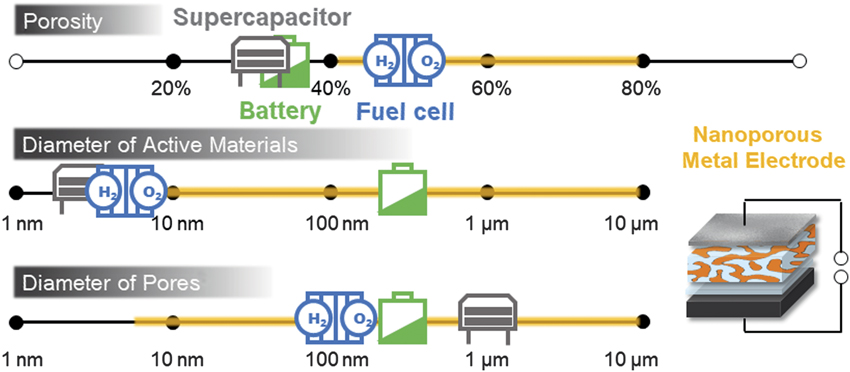
To understand the merits of NP metals, we need to look at the materials they are intended to replace. Fuel cells and batteries commonly employ electrodes composed of a continuous solid and pore phase. The continuity of these phases ensures the flow of ions and electrons to the interface. The two phases interpenetrate for maximum interface area per unit volume, which enables a large amount of reaction and thereby a high current. The solid phase, however, may not be considered continuous, at least compositionally, as such a bicontinuous porous electrode is usually constructed with the use of a polymer binder and a conductive additive (e.g., carbon), in addition to the active material. In this structure, the size of the active material determines the specific area, the catalytic activity, and the distance over which a solid-state diffusion process must operate, whereas the size of pores and the porosity affect mass transport and ion conduction in the electrolyte. Typical values of these crucial parameters, namely, the porosity, the diameter of the active material, and the diameter of pores, are schematically illustrated in Figure 1 for rationalizing the use of NP metals in fuel cells,Reference Brandon and Brett5 supercapacitors,Reference Verbrugge and Liu6,Reference Conway7 and batteries.Reference Rahn and Wang8
A comparison of the structural characteristics of nanoporous metals (highlighted in orange) with the typical values used in fuel cells,Reference Brandon and Brett5 batteries,Reference Rahn and Wang8 and supercapacitors.Reference Verbrugge and Liu6,Reference Conway7
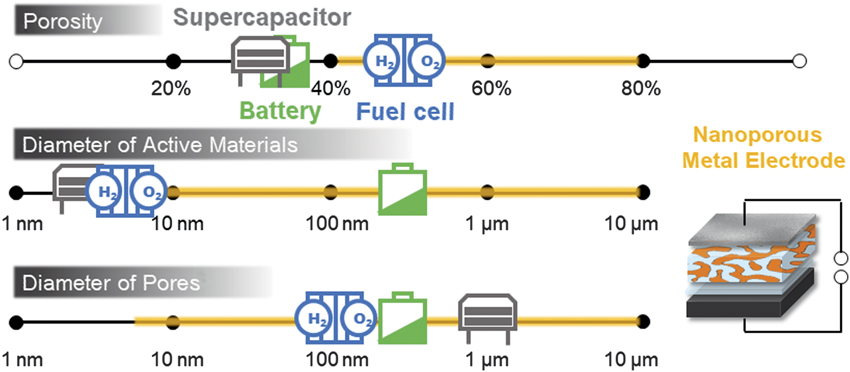
The dealloying process requires no additive for creating a uniform bicontinuous structure. The metal atoms stay connected to their neighbors during the course of dissolution, and the pores stay open, otherwise dissolution cannot proceed. (The Introductory article in this issue provides a comprehensive description of the structural evolution mechanism.) The volume fraction of the pore phase (i.e., the porosity) usually evolves to the range of 40–80%, with the lower limit corresponding to the so-called alloy parting limitReference Artymowicz, Erlebacher and Newman9 and the upper limit to the percolation threshold. Ligaments and pores in NP metals share one length scale determined by the rates of dealloying and surface diffusion. The length scale (pore or metallic ligament diameter) ranges from a few nanometers to micrometers,Reference Li and Sieradzki10,Reference Qian and Chen11 tunable via the alloy and electrolyte composition and post-annealing treatments. One can also decouple the ligament size from the pore size by creating hierarchical structures with large pores and small ligaments by stepwise dealloyingReference Qi and Weissmüller12 or structuring the parent-phase alloy. With no modifications or just simple ones, NP metals readily fit the structural needs of most energy devices.
In addition to the self-assembled bicontinuous structure, the uniqueness of NP metals also lies in the defects retained during dealloying. On the surface, a high population of atoms in low coordination sitesReference Fujita, Guan, McKenna, Lang, Hirata, Zhang, Tokunaga, Arai, Yamamoto, Tanaka, Ishikawa, Asao, Yamamoto, Erlebacher and Chen13 promote catalytic activity that can be many orders of magnitude higher than that of a planar surface. Beneath the surface, the residual less noble component renders the ligament an alloy-core–metal-shell structure.Reference Krekeler, Straßer, Graf, Wang, Hartig, Ritter and Weissmüller14 The core composition can be tuned to alter the interaction between the surface and chemical adsorbates to an optimal level—strong enough for breaking the bonds in the reactant but weak enough to evacuate the site for the next reaction in order to maximize the reaction kinetics.Reference Mistry, Varela, Kühl, Strasser and Cuenya15,Reference Wang, Markovic and Stamenkovic16 When we use NP metals as substrates for other materials, surface defects also play critical roles such as facilitating nucleation that is difficult on terrace sites and producing a conformal layer that adheres and conducts well.Reference Lang, Hirata, Fujita and Chen3,Reference Wang, Liu, Liu, Bi, Yan, Wang, Ge, Chen and Ding17 The existence of these defects also demonstrates the structural stability of NP metals, which underlies their stable performance as electrodes.
With the previously mentioned structural characteristics in mind, we focus our attention on the applications of NP metals in fuel cells, supercapacitors, and batteries.
Fuel cells
The power-driven unit in a proton exchange membrane fuel cell is called a membrane electrode assembly (MEA), which consists of a polymer electrolyte membrane sandwiched between catalyst layers on each side. Typically, each catalyst layer has a thickness of a few to tens of microns. Traditional MEA fabrication strategy involves some degree of integration of Pt-based nanoparticles, with a nanostructured carbon support.Reference Gasteiger, Kocha, Sompalli and Wagner18 With this structure, there is a tradeoff between electron, ion, and mass transport, especially when high volumetric energy density is pursued. NP metals provide an alternative solution to this dilemma by integrating highly active electrocatalysts within a bicontinuous framework, which simplifies the MEA structure and yields better reliability.
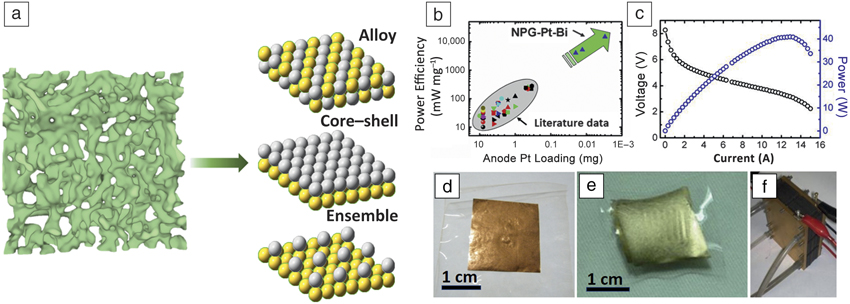
Tremendous efforts have been expended on the development of various nanostructured electrocatalysts in the past decade, especially for the cathode.Reference Stamenkovic, Mun, Arenz, Mayrhofer, Lucas, Wang, Ross and Markovic19 Koh et al.Reference Koh and Strasser20 first proposed a dealloying protocol to improve the performance of commercial Pt/C catalyst. The resulting core–shell structured PtCu/Pt nanoparticles outperformed Pt/C by factors of 4–6 for the oxygen reduction reaction (ORR). Snyder et al.Reference Snyder, Fujita, Chen and Erlebacher21 studied the PtNi dealloying process and introduced a porous metal–ionic liquid composite structure. The high oxygen solubility of the hydrophobic ionic liquid resulted in an intrinsic kinetic-current density (j k) of 18.2 mA cm−2 at 0.9 V versus a reversible hydrogen electrode (RHE), a value equal to the best single crystal Pt3Ni(111) surface. As a universal materials processing technique, it is not surprising that dealloying has stimulated great interest in searching for high-performance fuel-cell catalysts. Efforts are often focused on the following aspects: (1) the exploration of different alloy precursors, such as solid solutions,Reference Xu, Wang, Chen, Zhang and Ding22,Reference Wang, Xu, Bi and Ding23 intermetallic compounds,Reference Wang, Frenzel, Wang, Ji, Qi, Zhang and Eggeler24,Reference Lang, Han, Xiao, Gu, Yang, Wen, Zhu, Zhao, Li and Jiang25 and even metallic glasses;Reference Yu, Ding, Xu, Inoue, Sakurai and Chen26 (2) alloys of different morphology, such as thin films, ribbons, ball-milled mechanically alloyed powders,Reference Chen, Si, Gao, Frenzel, Sun, Eggeler and Zhang27 and nanoparticles;Reference Snyder, McCue, Livi and Erlebacher28 (3) casting or surface functionalization of preformed NP metal templates;Reference Xu, Wang, Wang, Wang, Zhang, Tian and Ding29,Reference Xu, Zhang, Wang, Xu, Bian, Ma and Ding30 and (4) screening their performance in various electrochemical reactions. These efforts have resulted in a wide variety of functional alloys and composites with lower precious metal contents (Figure 2a). Additionally, the enhancement of their electrocatalytic performance is often attributed to ligand and strain effects, as well as the unique architectures that favor the accessibility of target molecules and charge transfer.
(a) Dealloying allows convenient processing of functional nanoporous metal electrocatalysts in forms of alloys, core–shell structures, and designed surface ensembles. (b–f) Nanoporous gold (NPG)-based fuel-cell electrodes. (b) Direct formic acid fuel-cell performance of NPG-PtBi, compared with literature data, in terms of power efficiency to the mass of Pt used;Reference Wang, Liu, Liu, Bi, Yan, Wang, Meng, Ge, Chen and Ding31 (c) polarization curve for a 40-watt stack;Reference Wang, Liu, Liu, Bi, Yan, Wang, Meng, Ge, Chen and Ding31 (d) NPG-only MEA;Reference Yan, Meng, Xie, Liu and Ding32 (e) NPG-Pt-based MEA; (f) NPG-PtBi-based multicell stack.Reference Wang, Liu, Liu, Bi, Yan, Wang, Meng, Ge, Chen and Ding31
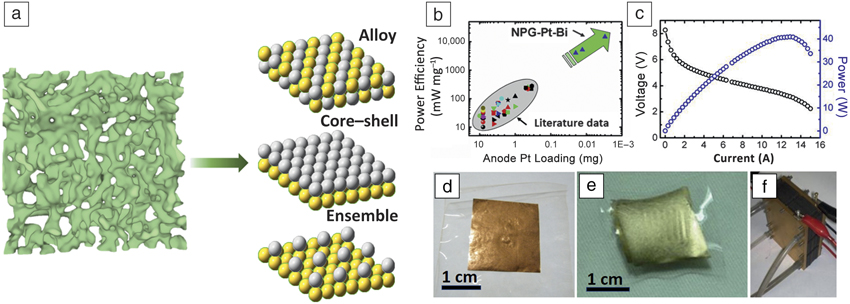
Compared to the large number of research advances in the development of NP electrocatalysts, few data exist for their performance in real fuel cells. To date, dealloyed white gold leafReference Wang, Liu, Liu, Bi, Yan, Wang, Meng, Ge, Chen and Ding31–Reference Ding, Kim and Erlebacher33 remains an indispensable platform on which various functionalized electrodes can be constructed for direct MEA tests (Figure 2b–f). These large-scale membrane electrodes typically have a gold loading of ∼0.1 mg cm–2 and Pt or Pd loadings that are even lower upon surface functionalization. This is practically acceptable for most fuel cells that have precious metal loads in the range of 0.1–4 mg cm–2, depending on their type and service conditions.Reference Gasteiger, Kocha, Sompalli and Wagner18 Wang et al. proposed three approaches for fabricating a high-performance direct formic acid fuel-cell (DFAFC) anode: (1) use of a galvanic displacement reaction to deposit Pt on dealloyed gold leaf,Reference Wang, Wang, Cai and Ding34 (2) direct electrodeposition of Pt onto the nanoporous gold (NPG) support,Reference Wang, Liu, Liu, Bi, Yan, Wang, Ge, Chen and Ding17 and (3) generating a surface Pt-Bi alloy.Reference Wang, Liu, Liu, Bi, Yan, Wang, Meng, Ge, Chen and Ding31 These anode structures readily achieve two orders of magnitude enhancement (up to 570-fold) in Pt mass activity as compared to Pt/C, due to the realization of a highly efficient direct oxidation (dehydrogenation) path.Reference Neurock, Janikb and Wieckowskic35 Li et al.Reference Li, Yin, Li, Okunishi, Shen, He, Tang, Wang, Yücelen, Li, Gong, Gu, Miao, Liu, Luo and Ding36 designed core–shell structured electrodes of NPG-Pd-Pt, which, upon potential cycling, developed a subnanometer-thick Pt-Pd-Au alloy shell. The ORR activity of this catalyst stabilized at ∼1.47 A mgPt–1 even after 100,000 potential cycles. This behavior is substantially better than the commercial Pt/C (0.095 A mgPt–1) and Pt/C30,000 (0.048 A mgPt–1) catalysts.
Yan et al.,Reference Yan, Meng, Xie, Liu and Ding32 following Erlebacher’s pioneering work on NPG-Pt for H2 fuel cells,Reference Ding, Chen and Erlebacher2 designed an NPG-only (Figure 2d) direct hydrazine hydrogen peroxide fuel cell (DHHPFC) because NPG itself was found to be active for hydrazine (N2H4) oxidation and hydrogen peroxide (H2O2) reduction. With a precious metal load of less than 0.1 mg cm–2 on each side of the fuel cell, the researchers observed a high open-circuit potential (OCP) of ∼1.2 V with a maximum power density (MPD) around 200 mW cm−2, which is 22× higher than that of Pt/C for the same noble metal loading. Wang et al.Reference Wang, Liu, Liu, Bi, Yan, Wang, Ge, Chen and Ding17 realized high-performance DFAFCs at ultralow Pt loads using the aforementioned NPG-Pt and NPG-PtBi anodes. For instance, using only 0.02 mg cm–2 Pt, an NPG-PtBi catalyst delivered an MPD of ∼80 mW cm–2, which is twice that for 2.2 mg cm–2 Pt/C, indicating an improvement of Pt efficiency of at least two orders of magnitude (Figure 2b). Most importantly, the DFAFCs withstood a rigorous 12-month life cycle and fuel impurity test, demonstrating extraordinary stability and reliability.
Guo et al.Reference Guo, Yin, Yan, Shi, Yu, Cao and Li37 recently employed an NPG-PtBi anode in a direct glucose fuel cell (DGFC). With an anode noble metal load of only 0.45 mg cm–2 (0.3 mg Au and 0.15 mg Pt), an OCP of 0.9 V was obtained with an MPD of 8 mW cm–2, indicating a maximum gravimetric power density of ∼18 mW mg–1, which is 4.5× higher than that of Pt/C, even when the weight of all precious metals in the fuel cell are taken into account.
Supercapacitors and batteries
Batteries and supercapacitors are two important electrochemical energy-storage devices. Batteries, including Li-ion batteries (LIBs), Li-air batteries, and other advanced secondary batteries, can store high energy, but usually have slow power delivery. In contrast, supercapacitors can be fully charged or discharged in seconds but have low energy density. Developing high-power Li batteries and high-energy supercapacitors are goals that represent some of the most important research directions in electrochemical energy storage. For both Li batteries and supercapacitors, the electrode materials are the most important factors controlling the energy density and rate performance. These electrode materials are required to have high electrical conductivity, large surface area, low mass density, and high electrochemical stability. Dealloyed metals with bicontinuous open nanoporosity fit the bill.
Depending on the charge-storage mechanism used, supercapacitors can be classified into two types—electric double-layer capacitors (EDLCs) and faradaic pseudocapacitors. EDLCs involve adsorption of ions. The specific energy is mainly defined by the electrochemical active surface area and density of electrodes. Freestanding NP metals can be directly used as electrodes for EDLCs.Reference Lang, Yuan, Iwasa and Chen38 An EDLC device, assembled with two NPG sheets sandwiching a sheet of cotton paper incorporating ionic liquid electrolytes can deliver a volumetric capacitance of ∼10–20 F cm–2. The energy and power densities of EDLCs based on NPG electrodes are ∼16.5–21.7 mW h cm−3 and ∼0.3–6 W cm−3, respectively. The volumetric energy density of the NPG electrodes, similar to that of some carbon-based materials, is far from satisfactory due to the limited double-layer capacitance.
NP metals can function as both current collectors and conductive reinforcements for applications in pseudocapacitors because of their high conductivity, high surface area, and self-supporting architecture. Materials of high theoretical pseudocapacitance are usually transition-metal oxides (or hydroxides) and conducting polymers, whose rate performance is limited by their poor electric conductivity.
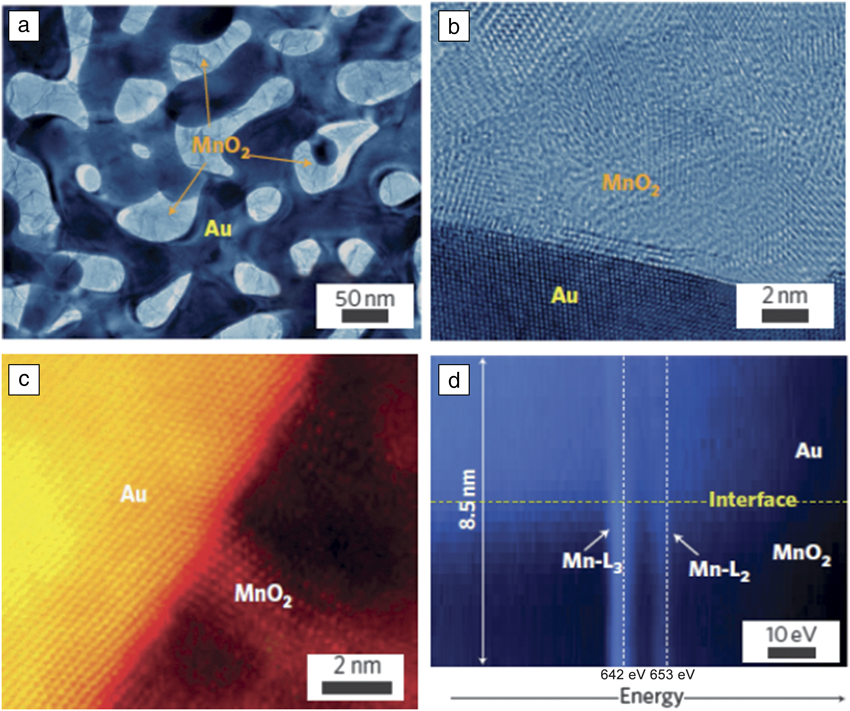
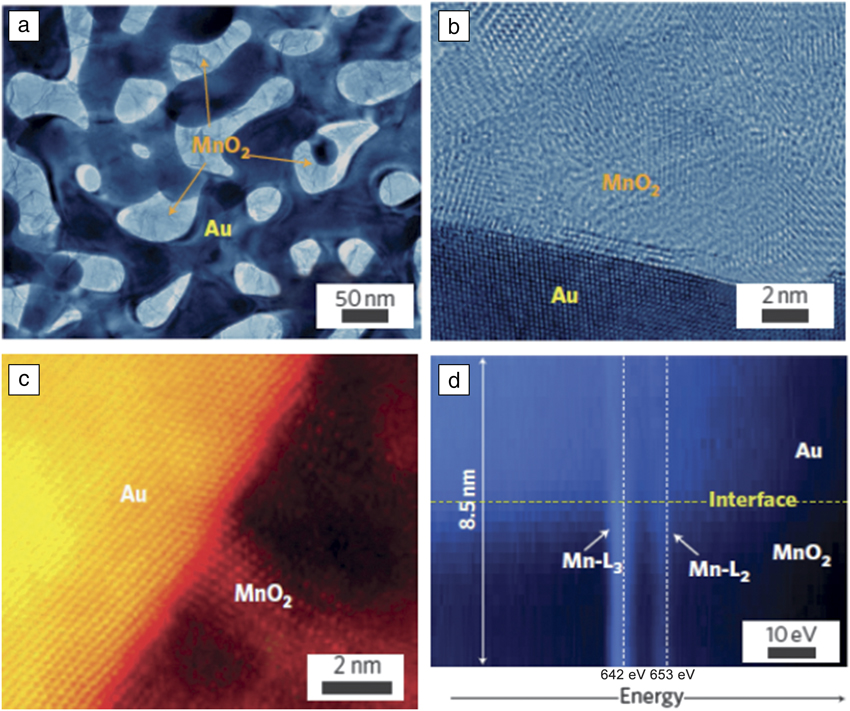
Lang et al. fabricated highly conductive and stable NPG/MnO2 hybrid electrodes (Figure 3a) by incorporating nanocrystalline MnO2 into the nanopores of NPG via a facile electroless plating process.Reference Lang, Hirata, Fujita and Chen3 The nanocrystalline MnO2 grows epitaxially on gold ligament surfaces, forming a chemically bonded metal–oxide interface (Figure 3b–c) displaying charge transfer between the gold and MnO2 nanocrystals (Figure 3d). The excellent contact between the MnO2 and gold ligaments, as well as the continuous gold network with ultrahigh electrical conductivity, assists fast electron transport in the electrodes to fully utilize the large pseudocapacitance of MnO2. The resultant NPG/MnO2 hybrid electrodes exhibit an ultrahigh specific capacitance (1145 F g–1), as well as high power density with low internal resistance. Even in organic electrolytes, the NPG/MnO2 hybrid electrodes give rise to low internal resistance, good ionic contacts, and thus enhanced redox reactions of MnO2 for high specific capacitance in a large electrochemical potential window.Reference Chen, Kang, Hou, Liu, Fujita, Hirata and Chen39 This strategy was also successfully applied in other pseudocapacitive material systems such as RuO2,Reference Chen, Hou, Kang, Hirata, Fujita and Chen40 polypyrrole,Reference Meng and Ding41,Reference Hou, Chen, Zhang, Kang, Fujita, Jiang and Chen42 and polyaniline.Reference Lang, Zhang, Fujita, Ding and Chen43 Supported by NPG, ultrahigh specific capacitances, close to their theoretical values, can be achieved from these pseudocapacitive materials.
(a) Bright-field transmission electron microscope (TEM) image of the nanoporous gold (NPG)/MnO2 hybrid. (b) High-resolution TEM image of the hybrid showing nanocrystalline MnO2 with a grain size of about 5 nm. (c) High-angle annular dark-field scanning TEM image taken from the NPG/MnO2 interface region. Nanocrystalline MnO2 epitaxially grows on the gold surface, forming a chemically bonded metal–oxide interface. (d) Electron energy-loss spectroscopy (EELS) profile image from a region across the interface. The horizontal axis shows the electron energy loss in the range of 586–705 eV. EELS spectra were obtained from 30 points with an interval of 0.28 nm and an exposure time of 1.6 s for each spectrum acquisition. The Mn L3 (642 eV) and L2 (653 eV) edges shift by about 0.5–1 eV to lower energies near the interface between the MnO2 and the gold.Reference Lang, Hirata, Fujita and Chen3
Kang et al. developed a simple approach to fabricate low-cost transition-metal-based oxyhydroxide@NP metal electrodes by electrochemical polarization of dealloyed NP Ni-Mn and Ni-Mn-Cu alloys in an alkaline solution to avoid the use of expensive gold and to simplify the fabrication routes of NP metal-based hybrid electrodes.Reference Kang, Hirata, Qiu, Chen, Ge, Fujita and Chen44,Reference Kang, Hirata, Kang, Zhang, Hou, Chen, Li, Fujita, Akagi and Chen45 The resultant Ni-Mn oxy-hydroxides grow in nanopore channels epitaxially while the NP metal structure is retained after the polarization treatment for high electrical conductivity. The polarized oxy-hydroxide is usually a single-phase multicomponent material with mixed valence, displaying a large pseudocapacitance from the contributions of both Ni and Mn cations. Combined with the advantages of low cost, an environmentally friendly nature, and high cyclic stability, these oxy-hydroxide/NP metal electrodes show great promise for applications in commercial high-capacity supercapacitors.
NP metals have also demonstrated potential for applications in LIBs with improved performance by shortening the diffusion path length, thus enhancing electron and ion transport, resulting in improved electrochemical reaction kinetics.Reference Aricò, Bruce, Scrosati, Tarascon and Van Schalkwijk46,Reference Rolison, Long, Lytle, Fischer, Rhodes, McEvoy, Bourg and Lubers47 Moreover, the hollow channels can accommodate the large volume change arising from Li intercalation/de-intercalation during charge/discharge processes, improving the cyclability by preventing the mechanical failure of the electrodes. Yu et al. developed an NPG-supported Sn (Sn@NPG) electrode as an anode for LIBs.Reference Yu, Gu, Lang, Zhu, Fujita, Chen and Maier4 The charge/discharge processes of the electrode delivered specific capacities of 624 and 756 mA hg–1, respectively, with a Coulombic efficiency of 82%. Electrochemical cycling of this electrode between 0.005 and 1.0 V versus L+/Li also showed an excellent reversible capacity of ∼599 mA hg–1 even after 140 cycles, corresponding to 95.9% of the initial charge capacity. The effect of NPG on LIB performance also enhances the electric conductivity of active materials. By utilizing MnO2@NPG as anodes, the intrinsic lithium storage capacity, excellent rate performance and high cycling stability of MnO2 can be completely realized.Reference Guo, Han, Zhang, Liu, Hirata, Chen, Fujita and Chen48 In spite of good performance of Sn@NPG and MnO2@NPG electrodes, the NPG skeleton substrate is too expensive for commercial applications in LIBs. Zhang et al. have successfully developed a 3D Sn@NP-Cu bulk electrode by coating a Sn shell on to an NP-Cu skeleton.Reference Zhang, Xing, Jiang, Du, Li, He and Liu49 However, the Sn@NP-Cu composite shows much lower cyclability than the Sn@NPG electrode, which is probably due to the poorer chemical stability of Cu compared to Au. Even so, the unique 3D NP core–shell structure enables the Sn@NP-Cu composite to have much better performance than Sn films directly coated on planar copper foils.
Outlook
In addition to the previously mentioned examples, the contributions of NP metals to the field of electrochemical energy conversion/storage also include electrocatalysis of CO2 reductionReference Lu, Rosen, Zhou, Hutchings, Kimmel, Chen and Jiao50 and the air cathode of lithium-air batteries.Reference Peng, Freunberger, Chen and Bruce51 The growing number of energy applications of NP metals continues to demonstrate their versatility as electrodes, but at the same time, when we try to advance a specific application of NP metals, we are faced with a variety of challenges.
Compared to the electrode skeleton made using a binder and carbon, two disadvantages of NP metals stand out—the increased mass and the high cost. The increased mass lowers the critically important gravimetric energy density of an energy-storage device using NP metals only as the current collector. Metals with low density are unlikely replacements due to their high reactivity and the difficulty in rendering them nanoporous. Reducing the volume fraction of metal in the structure may be one viable path; the challenge will be how to use as little metal as possible without jeopardizing the metal/active material interface and structural integrity. Presently, the high cost of NP metals seems a relative disadvantage, however significant improvements in performance may justify their future use. Nevertheless, we urge researchers to weigh cost as an important factor when designing NP metal electrodes.
The engineering of NP metals is another task that requires more attention. So far, we are unaware of any work connecting electrochemical reactions with transport phenomena in NP metal electrodes under the framework of porous electrode theoryReference Newman and Tiedemann52 widely applied to other types of porous electrodes. Water management in fuel cells and effects of electrode compression are also unexplored territories for NP metals. As many physical and chemical properties of NP metals are distinct from their carbon counterpart, we expect research along these paths to reward us with new insights that can help improve electrode performance. Eventually, we hope that, like the advanced characterization techniques that have been used to reveal the structure of NPG, advanced engineering and modeling of NP metal electrodes can parameterize the interactions between NP metals and electrolytes, which should serve as the baseline for future design of these electrodes in energy applications.

Qing Chen is an assistant professor in the Department of Mechanical and Aerospace Engineering and the Department of Chemistry at The Hong Kong University of Science and Technology. He received his PhD degree in materials science at Arizona State University. His research interests include morphology evolution in dealloying and other interface-controlled processes, and materials for energy storage and conversion. Chen can be reached by phone at +852-34692234 or by email at chenqing@ust.hk.

Yi Ding is a distinguished professor at the Institute for New Energy Materials and Low-Carbon Technologies, Tianjin University of Technology, China. He received his PhD degree from Johns Hopkins University, and joined the faculty of Shandong University, China, as a Tai-Shan Scholar in 2005. He is the director of the Tianjin Key Laboratory of Advanced Functional Porous Materials, which researches the design and processing of functional nanoporous metals for green energy technologies. He has published 110 journal articles, with more than 8000 total citations and an H-index of 47. Ding can be reached by phone at +86-22-60216546 or by email at yding@tjut.edu.cn.

Mingwei Chen is a professor at Johns Hopkins University in the Department of Materials Science and Engineering. He received his PhD degree from Shanghai Jiao Tong University, China. His research interests focus on the relationship between structure and properties of advanced materials, in particular, nonequilibrium and nanostructured materials. He is recognized internationally for his pioneering contributions to the structure and functionality of nanoporous materials, experimental structural characterization of metallic glasses, localized amorphization of boron carbide, and twinning of nanocrystalline metals. Chen can be reached by email at mwchen@jhu.edu.