Introduction
Active experimental and theoretical studies of radiative and thermodynamic properties of hot dense plasma are carried out over recent years (Hoffmann et al., Reference Hoffmann, Blazevic, Ni, Rosmej, Roth, Tahir, Tauschwitz, Udrea, Varentsov, Weyrich and Maron2005; Batani et al., Reference Batani, Dezulian, Redaelli, Benocci, Stabile, Canova, Desai, Lucchini, Krousky, Masek, Pfeifer, Skala, Dudzak, Rus, Ullschmied, Malka, Faure, Koenig, Limpouch, Nazarov, Pepler, Nagai, Norimatsu and Nishimura2007; Fortov, Reference Fortov2009; Kadatskiy and Khishchenko, Reference Kadatskiy and Khishchenko2016, Reference Kadatskiy and Khishchenko2018) to reach more deep understanding the physical processes, when matter is transformed into a high-energy density state.
As known, the high-energy density state can be achieved by high-power laser pulse interaction with the hohlraum wall in laser inertial fusion experiments, by exploding wires at X- and Z-pinches, and, finally, by impact of a heavy ion beam, which was produced by an accelerator, with a target.
A fundamental theoretical study of physical processes in these experiments requires investigations in the field of gas dynamics, photon transport processes, equation of state, and radiative opacity (Zel'dovich and Raizer, Reference Zel'dovich and Raizer1967), where the radiative opacity represents an important part of this study.
It should be noted that intensive theoretical studies in the field of many-body problem in quantum mechanics and the density functional theory (March et al., Reference March, Young and Sampanthar1967) have provided the development of a modern quantum mechanical model, which is known as the ion model of plasma (IM) (Orlov, Reference Orlov1997; Orlov and Fortov, Reference Orlov and Fortov2001), and this model ensures reliable quantum mechanical calculations of radiative opacity over a wide range of plasma temperature and density.
Previously, this model was successfully used to study the radiative opacity of hot dense plasma in the field of laser inertial fusion (Denisov et al., Reference Denisov, Orlov, Gus'kov, Rozanov, Zmitrenko and Mikhailov2005). Theoretical and experimental studies of the radiative properties of hot dense matter for optimizing soft X-ray sources were performed as well (Orlov et al., Reference Orlov, Gus'kov, Pikuz, Rozanov, Shelkovenko, Zmitrenko and Hammer2007).
IM was also used for mathematical modeling of gas dynamic and radiative processes in experiments where both laser and heavy ion beams are used (Orlov et al., Reference Orlov, Denisov, Rosmej, Schäfer, Nisius, Wilhein, Zhidkov, Kunin, Suslov, Pinegin, Vatulin and Zhao2011). IM was also reached successful results in the field of the heavy-ion inertial fusion. The theoretical explanation of so-called Au-doping effect can help understand the way to increase the efficiency of the interaction of heavy ion beams with target materials (Orlov et al., Reference Orlov, Denisov, Vergunova and Rozmej2014). Finally, a method for temperature diagnostics of Z-pinch plasma has been proposed (Orlov et al., Reference Orlov, Denisov and Vergunova2016).
Theoretical approach
As known, different theoretical models and corresponding computer codes can be used to calculate the spectral coefficients for X-ray absorption, the spectral brightness's for X-ray radiation, the Rosseland and Planck mean free paths, and other radiative characteristics of hot dense plasma. These data are required to solve the set of so called radiative hydrodynamic equations (Zel'dovich and Raizer, Reference Zel'dovich and Raizer1967) and determine temperature profiles, density profiles, and other characteristics of hot dense plasma, for instance, in the laser target at inertial confinement fusion experiments. Comparative analysis of these models has been carried out based on the density functional theory. The general set of self-consistent field equations that describe the quantum state of the whole statistical ensemble of plasma atoms and ions has been obtained (Orlov, Reference Orlov1997; Orlov and Fortov, Reference Orlov and Fortov2001). The set contains:
• the Schrödinger equations for all atoms and ions with different electron configurations,
• the Gibbs distribution,
• the electroneutrality condition.
It should be noted that Hartree–Fock equations can also be used (Denisov and Orlov, Reference Denisov and Orlov1993) instead of the Schrödinger equation, but the version, which is based on Schrödinger equations, is used in this paper.
The main feature of the set of equations is general coupling of all equations for all plasma atoms and ions including exacted states. Until recently, the solution of this set of equations seemed impossible because of an immense number of equations. Therefore additional physical approximations were used to simplify the equations although any simplification of the equations leads to a restricted range of plasma temperature and density, over which the model can be applied (Orlov and Fortov, Reference Orlov and Fortov2001). For instance, the Thomas–Fermi model (TF) can be used only for very high-plasma temperature (Feynman et al., Reference Feynman, Metropolis and Teller1949).
The Hartree–Fock–Slater model (HFS) is based on so-called “average atom” approximation, a fictitious atomic system with non-integer numbers of bound electrons in the atomic shells, where mentioned numbers are calculated using the Fermi–Dirac formula (Rozsnyai, Reference Rozsnyai1972; Nikiforov and Uvarov, Reference Nikiforov and Uvarov1973). This atomic system is considered instead of a real ensemble of plasma atoms and ions. If the temperature of the plasma decreases, this model cannot ensure accurate enough results. The limitation of this approach is connected with the application of perturbation theory, which is used to calculate the properties of a real atomic or ionic system. It should be noted that temperature border, which restricts the applicability of the HFS model, depends on the concrete plasma material. This circumstance hampers the application of this model for the compound chemical composition of plasma.
The detail configuration accounting model (DCA) is based on the Hartree–Fock equations for real atomic and ionic systems, and the Saha method is used to calculate their concentrations (Rozsnyai, Reference Rozsnyai1982). This approach leads to hard problems for high-Z chemical elements. Moreover, it cannot be used for strongly coupled plasmas because of a peculiarity of the Saha method.
Thus, one can indicate the range of plasma temperatures and densities, over which the TF, HFS, and DCA models cannot provide accurate enough results because the corresponding additional physical approximations, which have been used in the framework of these models, are invalid in the mentioned ranges (Orlov and Fortov, Reference Orlov and Fortov2001).
The solution of the general set of self-consistent field equations that describe the quantum state of the whole ensemble of plasma atoms and ions can provide an explicit solution of the radiative opacity problems. The IM has been developed to achieve this aim (Orlov, Reference Orlov1997; Orlov and Fortov, Reference Orlov and Fortov2001). Although more complicated than previous models, the set of equations was solved for “pure” substances. Then the problem was settled for compound chemical compositions (Orlov, Reference Orlov1987). As a result, reliable quantum mechanical calculations of radiative opacity characteristics became possible over a wide range of plasma densities and temperatures.
Application of the ion model of plasma to calculations of the radiative opacity characteristics of hot dense matter
As a result of solution of the general set for self-consistent field equations that describe the quantum state of the whole Gibbs statistical ensemble of plasma atoms and ions, the quantum characteristics of the Gibbs ensemble of plasma atoms and ions can be determined and these results can be used for the calculations of the radiative opacity characteristics of hot dense plasma.
The Gibbs ensemble of plasma atoms and ions contains atoms and ions with different electron configurations  $\{ N_{nl}^j \} $ (j is the number of configuration, n is the principal quantum number, and l is the orbital quantum number), and must obey Gibbs statistics:
 $$W_j = Cg_j\exp {\rm \;} \left( {-\displaystyle{{E_j-{{\rm \mu}} N_j} \over {\rm \Theta}}} \right).$$
Here N j is the total number of electrons in the subsystem j, E j is the total energy of this subsystem, C is the normalization constant, and g j is the statistical weigh, which is determined as
 $$g_j = \mathop \prod \limits_{nl} {\rm C}_{2(2l + 1)}^{N_{nl}^j}. $$
The most important characteristic of hot dense plasma is the spectral coefficient for X-ray absorption. This coefficient can be expressed as
 $$K\lpar {\hbar\! {{\rm \omega}}} \rpar = \displaystyle{1 \over {{\rm \rho}}} \tilde{K}\lpar {\hbar {{\rm \omega}}} \rpar ,$$
where ρ is the plasma density (in g/cm3) and
 $$\tilde{K}\lpar {\hbar\! {{\rm \omega}}} \rpar = \tilde{n}\mathop \sum \limits_j W_j{{\rm \sigma}} ^j\lpar {\hbar {{\rm \omega}}} \rpar .$$
Here  $\hbar\! {{\rm \omega}} $ is the photon energy (in eV),
 $\tilde{n}$ is the number of atomic nuclei per cubic centimeter, and W j is the concentration of the subsystem with electron configuration
 $\{ N_{nl}^j \} $. The total cross section for photon absorption
 ${{\rm \sigma}} ^j\lpar {\hbar \!{{\rm \omega}}} \rpar $ is determined by the formula
 $${{\rm \sigma}} ^j\lpar {\hbar\! {{\rm \omega}}} \rpar = {{\rm \sigma}} _{{\rm bb}}^j \lpar {\hbar\! {{\rm \omega}}} \rpar + {{\rm \sigma}} _{{\rm bf}}^j \lpar {\hbar\! {{\rm \omega}}} \rpar + {{\rm \sigma}} _{{\rm ff}}^j \lpar {\hbar\! {{\rm \omega}}} \rpar $$
as the sum of the cross sections for absorption in spectral lines  ${{\rm \sigma}} _{{\rm bb}}^j \lpar {\hbar {\!{\rm \omega}}} \rpar $, photo-absorption
 ${{\rm \sigma}} _{{\rm bf}}^j \lpar {\hbar {\!{\rm \omega}}} \rpar $, and for bremsstrahlung absorption
 ${{\rm \sigma}} _{{\rm ff}}^j \lpar {\hbar {{\rm \omega}}} \rpar $. The processes of scattering and stimulated emission can also be incorporated into Eq. (3).
The Rosseland mean free path l R is another important characteristic of hot dense plasma:
 $$l_{\rm R} = \displaystyle{{15} \over {4{{\rm \pi}} ^4}}\mathop \int \limits_0^\infty l_u\displaystyle{{u^4e^{-u}} \over {{(1-e^{-u})}^2}}du,$$
where
 $$u = \displaystyle{{\hbar {{\rm \omega}}} \over T},\quad l_u = \displaystyle{1 \over {\tilde{K}\lpar u \rpar }}.$$
In the case of optically thin plasma, it is important to calculate the Planck mean free path l P:
 $$\displaystyle{1 \over {l_{\rm P}}} = \displaystyle{{15} \over {4{{\rm \pi}} ^4}}\mathop \int \limits_0^\infty \displaystyle{1 \over {l_u}}\displaystyle{{u^3e^{-u}} \over {1-e^{-u}}}du.$$
Application of the ion model to study Z-pinch plasma
Active theoretical and experimental studies of X- and Z-pinch plasmas were performed last years and temperature diagnostics of Z-pinch plasma represents an important part of this study (Tilikin et al., Reference Tilikin, Shelkovenko, Pikuz and Hammer2013). As known, the explosion of wire in Z-pinch creates a tiny ball of hot dense plasma, so-called hot spot, which produces practically all plasma radiation.
Traditional methods of temperature diagnostics of hot dense radiating plasmas are based on analysis of the spectral line shape in dependence on plasma temperature and density. Usually, a relatively short interval of photon radiation energy is considered for analysis in detail the intensity and width of definite spectral lines. In this case, the energy interval is used, where the spectral lines are well distinguishable in the experiment. The experimental spectral line shape is compared with the results of theoretical calculations, which were performed beforehand at different temperatures and densities, and this approach can approximately determine the physical parameters of the plasma obtained in the experiment.
It should be noted that traditional methods of temperature diagnostics encounter definite obstacles in practice. Really, an increase of plasma density leads to the deformation of the spectral line shape because of Doppler broadening, Stark broadening, and so-called “additional” broadening of spectral lines that take place in a quantum statistical ensemble of plasma ions and atoms (Orlov and Fortov, Reference Orlov and Fortov2000).
Results of calculations
Calculations of the spectral coefficients for X-ray absorption and spectral brightness for X-ray radiation were performed for niobium plasma at the temperature of 1 keV and at different densities in an interval from 1 to 30 g/cm3 to determine the density border where the spectral lines become indistinguishable.
The spectral brightness of radiation j(E) was calculated using the following formulas in accordance with so-called “radiating ball” approximation (Barishpoltsev et al., Reference Barishpoltsev, Gus'kov, Ivanov, Kotegov and Rozanov2006):
 $$j(E) = \displaystyle{1 \over {4{{\rm \pi}}}} J_{{\rm \nu}} \lpar E \rpar \displaystyle{{R_{\rm b}} \over 3},$$
where R b is the “radiating ball” radius and
 $$J_{{\rm \nu}} \lpar E \rpar = cK\lpar E \rpar {{\rm \rho}} U_{{\rm \nu}}. $$
Here K(E) is the spectral coefficient for X-ray absorption (in cm2/g) for photon energy E = hν and frequency ν = ω/(2π), ρ is the density of the plasma (in g/cm3), C is the speed of light, and U ν is the spectral density of equilibrium radiation (in W/(cm2 eV sr)), which is given by the following formula:
 $$U_{{\rm \nu}} = \displaystyle{{8{{\rm \pi}} h{{\rm \nu}} ^3} \over {c^3}}\left[ {\exp {\rm \;} \left( {\displaystyle{{h{{\rm \nu}}} \over T}} \right)-1} \right]^{-1}.$$
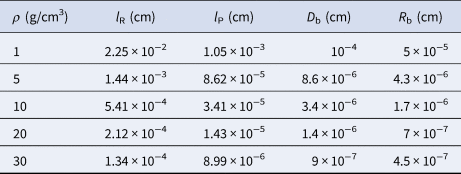
The approximation is correct only for optically thin plasma. Therefore, the value of R b was chosen provided that 2R b = Db<l P.
Table 1 presents the niobium plasma densities ρ, for which the calculations were performed, as well as the Rosseland mean free paths l R and the Planck mean free paths l P, which were calculated together with calculations of the spectral coefficients for X-ray absorption.
Calculated values of the Rosseland l R and Planck l P mean free paths for niobium plasma at different densities ρ;

Also, the chosen “radiating ball” diameter D b and corresponding radius R b are presented.
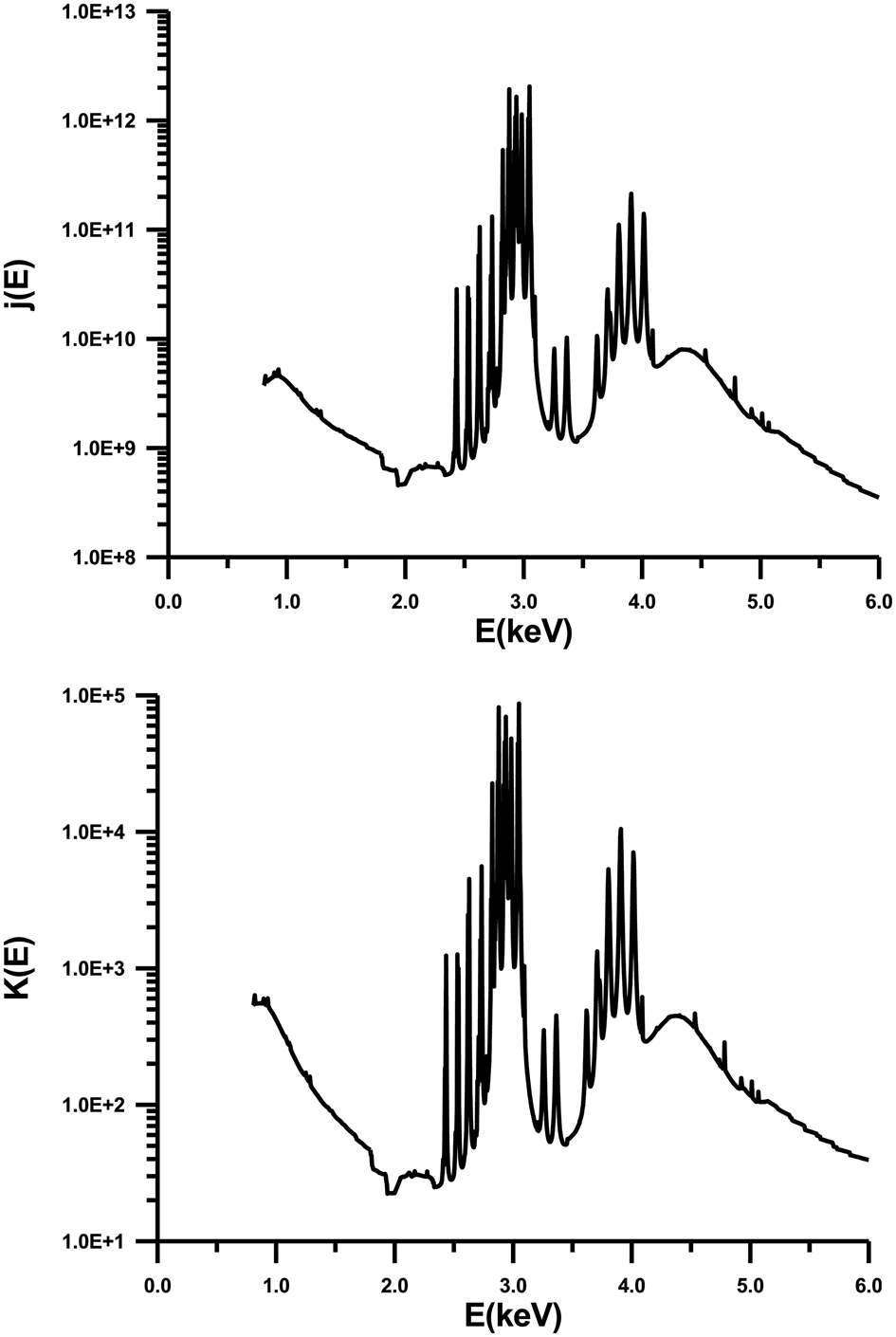
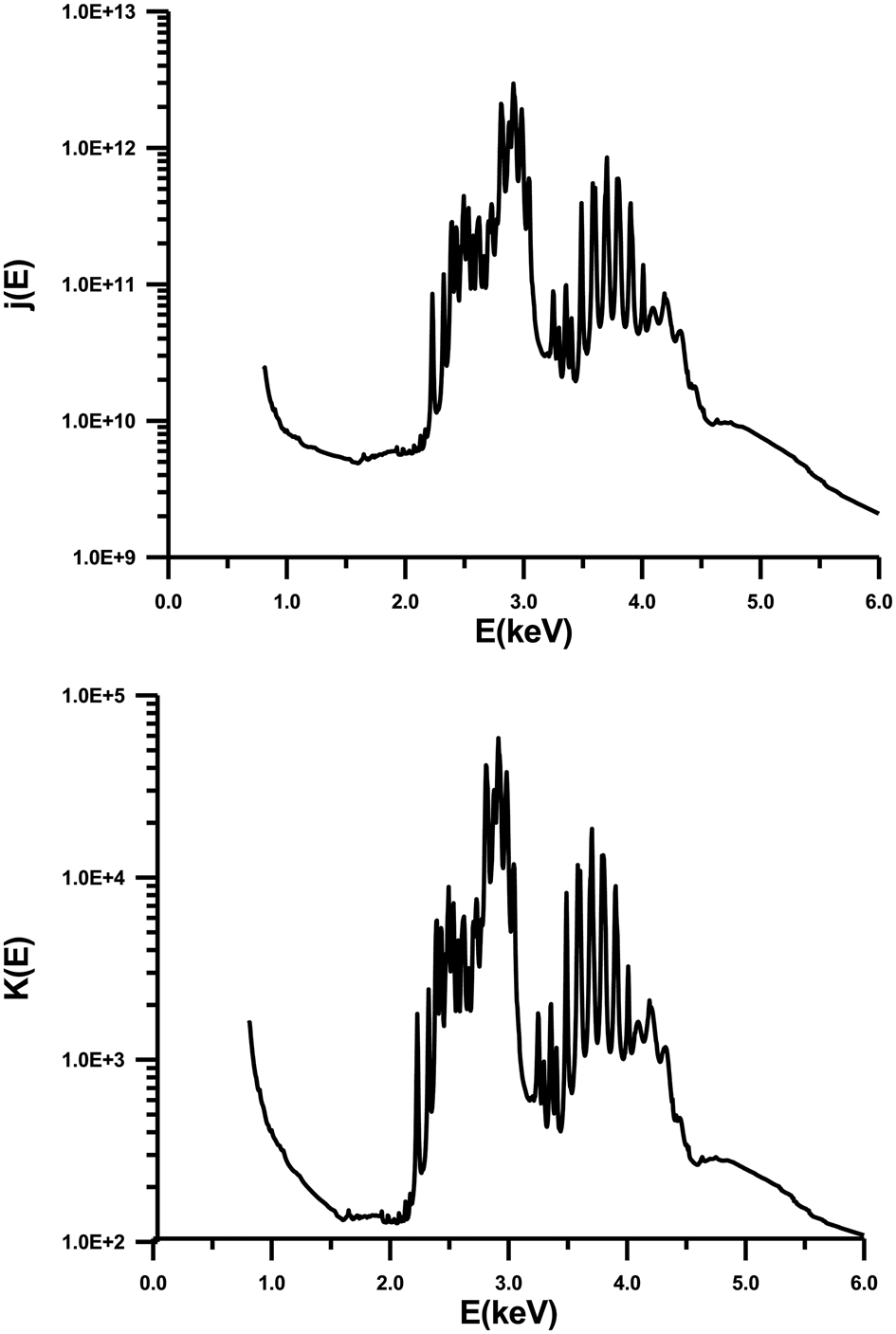
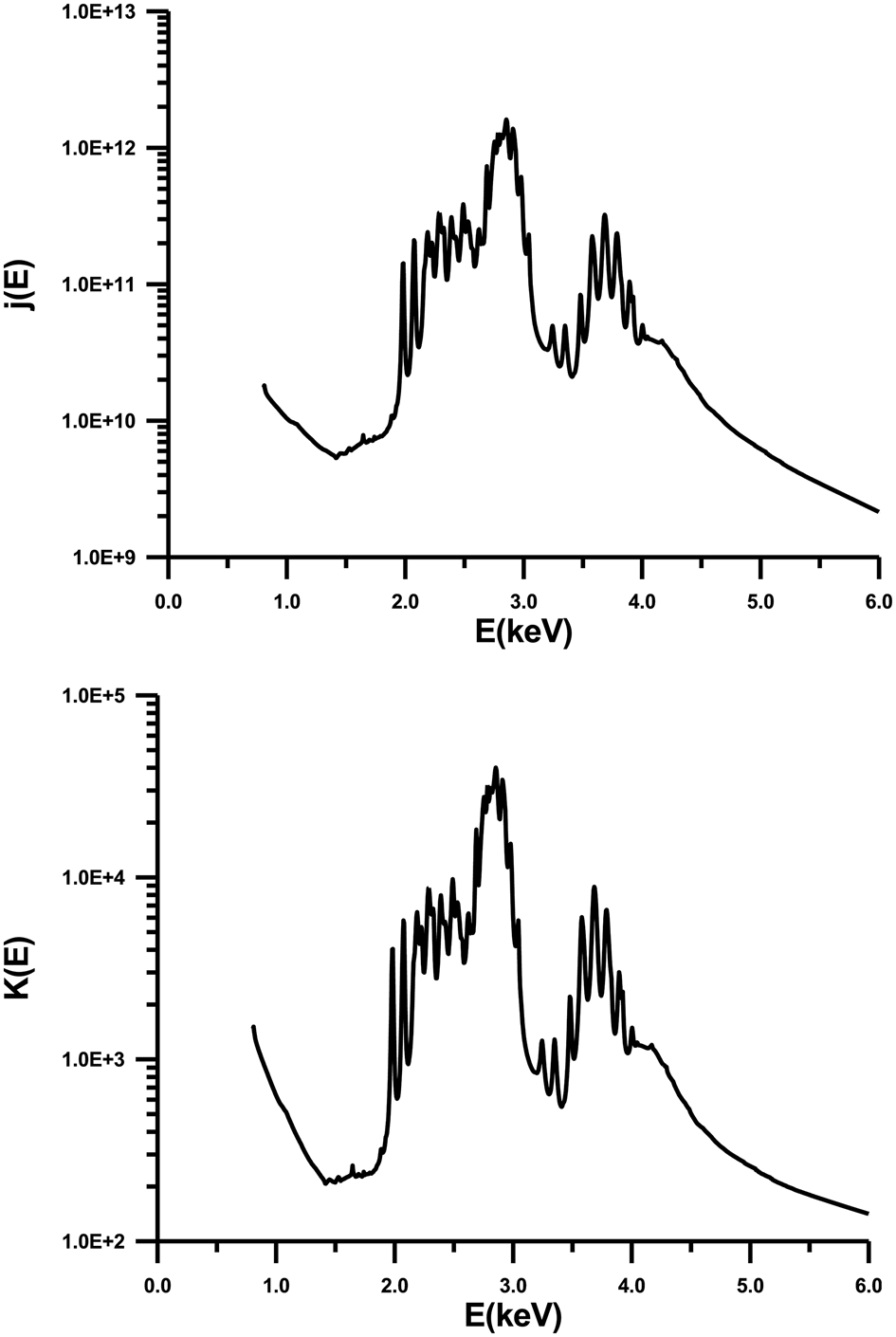
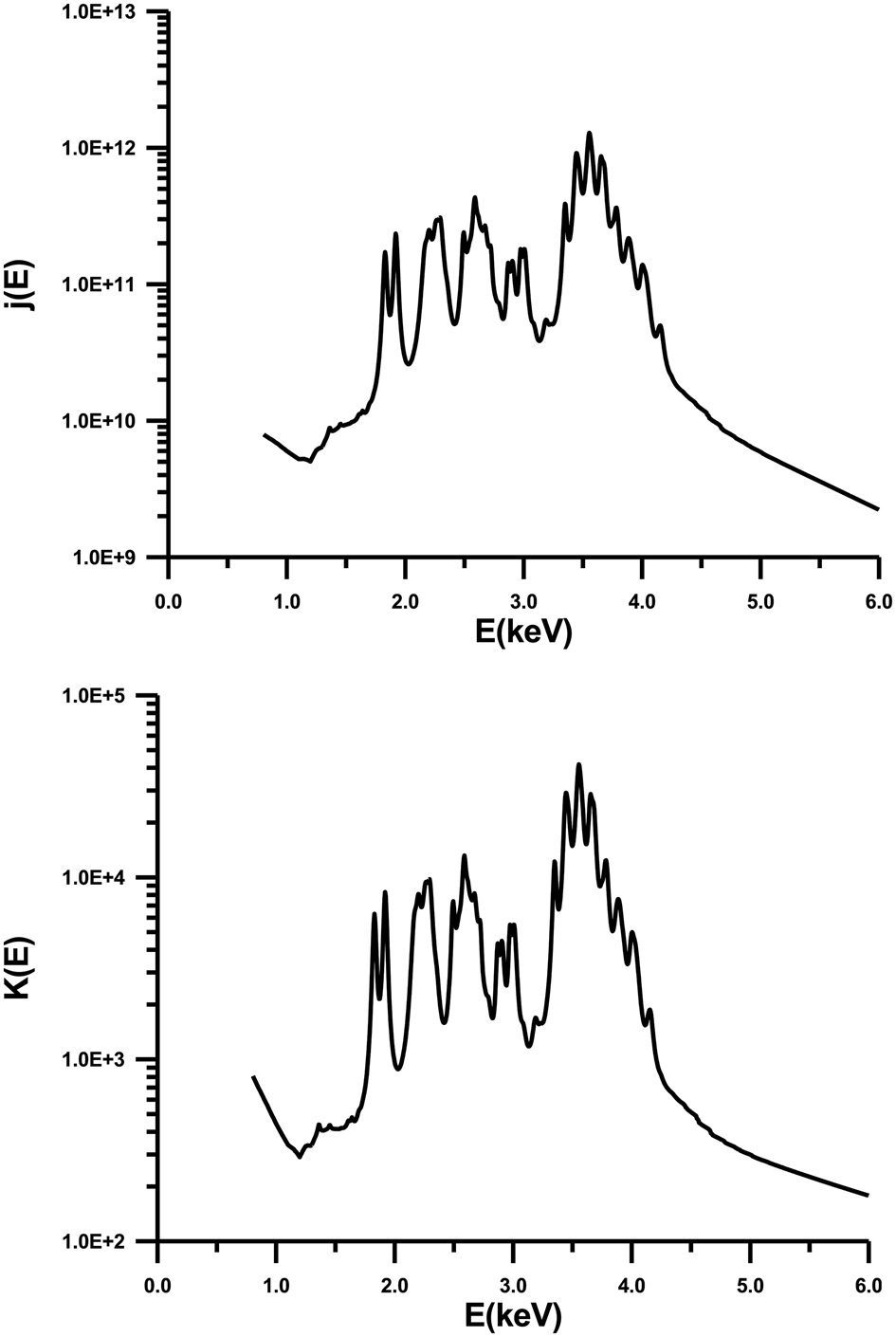
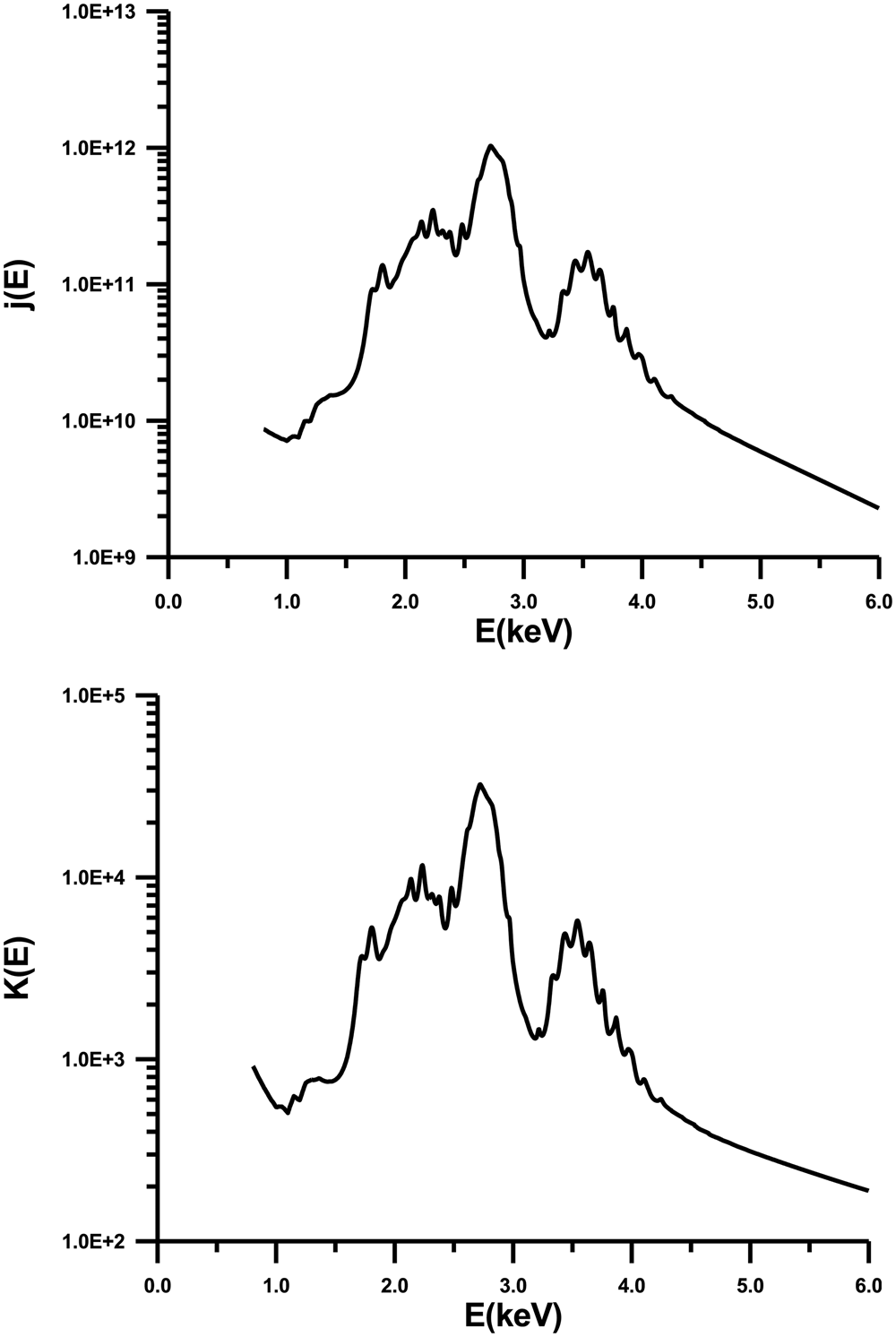
Figures 1–6 present the results of calculations, and one can see that spectral lines are good distinguishable at low densities, and distinguishability decreases with an increase in density. Finally, spectral lines become indistinguishable at very high densities. In this case, the temperature diagnostics method, which is based on analysis of spectral line shapes, becomes inapplicable.
The spectral brightness for X-ray radiation j(E) in (W/[cm2 eV sr]) and the spectral coefficients for X-ray absorption K(E) (in cm2/g) calculated for niobium plasma at the temperature of 1 keV and the density of 1 g/cm3.

The same as in Figure 1, but for the density of 5 g/cm3.

The same as in Figure 1, but for the density of 10 g/cm3.

The same as in Figure 1, but for the density of 20 g/cm3.

The same as in Figure 1, but for the density of 30 g/cm3.

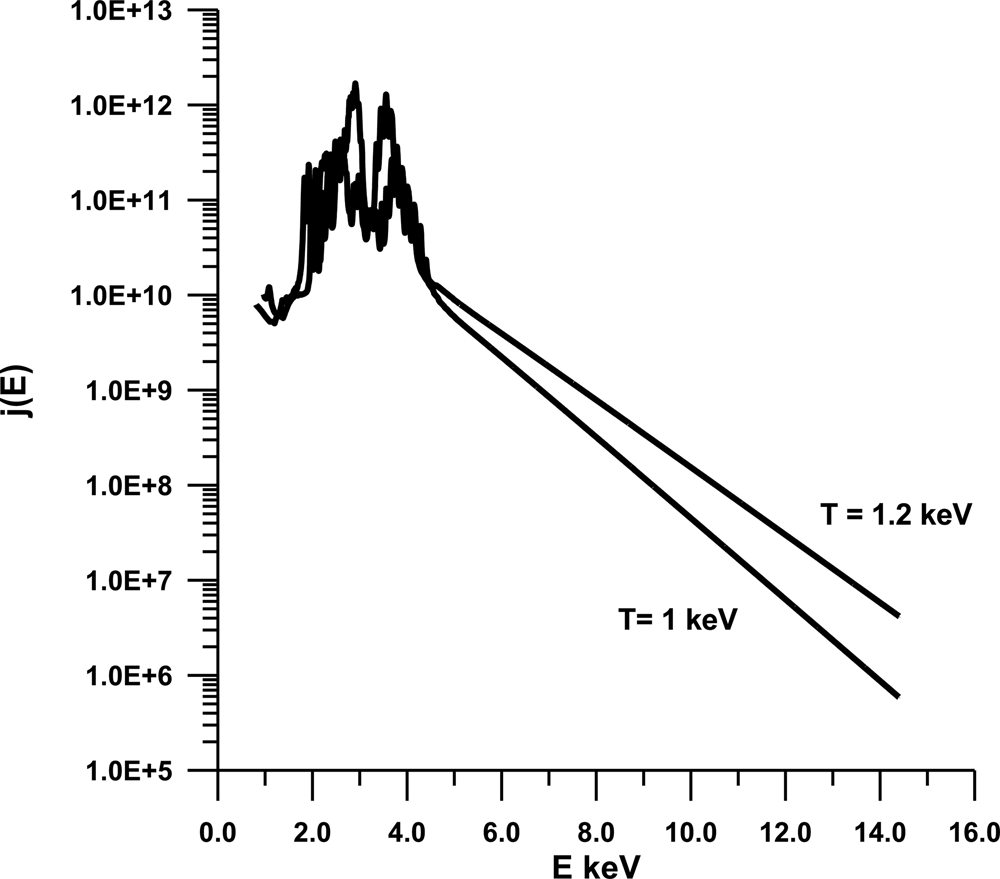
The spectral brightness's for X-ray radiation calculated for Z-pinch niobium plasma at the plasma density of 20 g/cm3 and the temperatures of 1 keV (lower line) and 1.2 keV (upper line).

Figures 1 and 2 show that spectral lines are well distinguishable at low densities. On the other hand, Z-pinch niobium plasma has high compression, and a further increase of plasma density leads to the deformation of the spectral line shape because of Doppler broadening, Stark broadening, and so-called “additional” broadening of spectral lines (Orlov and Fortov, Reference Orlov and Fortov2000). Besides, the neighboring spectral lines overlap each other, and spectral lines become indistinguishable (see Figs 3–5). As a result, traditional methods of temperature diagnostics cannot be used.
Meanwhile, temperature diagnostics represents an important part of the Z-pinch plasma study. Therefore, the modern method of temperature diagnostics can be applied. The approach is based on the quantum-mechanical calculations of spectral brightness for X-ray radiation performed in a large interval of the photon energy. In a large interval of the photon energy, a range can be found where the spectral brightness has high sensitivity to the temperature variation, and this circumstance can be used for temperature diagnostic of high-compressed plasma (Orlov et al., Reference Orlov, Denisov and Vergunova2016).
In Figure 6, the results of calculations of the spectral brightness for X-ray radiation at the plasma density of 20 g/cm3 and the temperatures of 1 keV (lower line) and 1.2 keV (upper line) are presented. One can see that temperature variation on  $20\% $ leads to a tenfold increase of spectral brightness and it is very high sensitivity.
Conclusion
One can conclude that temperature diagnostics of Z-pinch plasma, which is based on the traditional method of spectral line analysis, cannot be applied at a high-compression degree.
Under these conditions, a modern method of temperature diagnostics, which do not use spectral line characteristics as in Orlov et al. (Reference Orlov, Denisov and Vergunova2016), can be applied instead.
Acknowledgements
This work was supported by the program of fundamental research of the Presidium of the Russian Academy of Sciences No. 13 “Condensed matter and plasma at high energy densities”.