INTRODUCTION
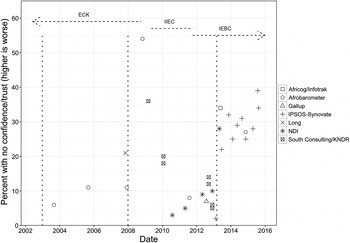
Between 2007 and 2013, Kenya's electoral management body (EMB) experienced unheralded fluctuations in popular trust among the local mwananchi, or common citizen.Footnote 1 After the 2002 elections and up until 2007, distrust of the EMB never exceeded 11% of the population. But popular distrust soared to 54% in the aftermath of the disputed 2007 elections,Footnote 2 only to again fall below 10% between 2010 and 2012. However, distrust increased to 28% after the 2013 elections and has appeared to increase further since then, according to data from surveys carried out by various pollsters, as seen in Figure 1.Footnote 3
Percentage of Kenyans who distrust the Electoral Commission (2003–2015).

Short-term fluctuations in popular trust in an EMB, in contexts such as Kenya, raise fundamental questions about the factors that determine popular trust in EMBs in developing democracies and the implications for both domestic policy-makers and international bodies engaged in improving the integrity of the democratic process and its institutions. EMBs are institutions specifically designed to ameliorate the lack of vertical accountability between governments and its citizens in regimes that lack experience in competitive multi-party politics (see Moreno et al. Reference Moreno, Crisp, Shugart, Mainwairing and Welna2003). However, large fluctuations in popular trust are a sign that, perhaps, citizens do not believe that EMBs are fulfilling their legally mandated role.
If EMBs are functioning properly, they should capably manage the electoral process and hold elites accountable to the rules of the electoral game; EMBs' capabilities should help citizens believe that their elections, one of the most crucial phases of the democratic process, reflect the popular will. Conversely, if perceptions of EMB trustworthiness are low, this may indicate that citizens view the electoral process and, thus, the elected regime as illegitimate, and, among other consequences, this could make it more difficult for the elected officials to govern (Levi et al. Reference Levi, Sacks and Tyler2009).
Even relatively high overall perceptions of EMB legitimacy may be cause for concern, if these perceptions vary significantly across groups, particularly electoral losers, within one electoral cycle or over time. Such group variation may indicate defeat of EMBs' very reason for existence in that it implies EMBs are perceived as giving preference to one group over another, rather than ensuring a legitimate process.
The existing theoretical literature considers citizens' trust in political institutions including EMBs essential to the deepening of democracy, especially in contexts where experience with multi-party politics is limited (Bratton et al. Reference Bratton, Mattes and Gyimah-Boadi2005; Norris Reference Norris2011). Cross-national studies have probed the determinants of citizen trust in an array of political institutions and found it to be a multidimensional concept, influenced by a wide range of factors, such as institutional performance (Mishler & Rose Reference Mishler and Rose2001), citizens' affiliation with the electoral winner (Moehler Reference Moehler2009), and citizens' level of political awareness (Gibson et al. Reference Gibson, Caldeira and Baird1998; Norris Reference Norris2011).
Specifically with regard to EMBs, several qualitative studies have found that public opinion about the legitimacy of election outcomes is often responsive to changes in the performance of EMBs. Changes in EMB performance that appear most important in impacting public opinion are related to transparency, autonomy, and effectiveness of the institution (Pottie Reference Pottie2001; Padmanabhan Reference Padmanabhan2002; Adebayo & Omotola Reference Adebayo and Omotola2007; Makulilo Reference Makulilo2009; Kerr Reference Kerr2013). However, little research, whether cross-national or case-study, has systematically explored the individual-correlates of citizens' trust in EMBs in any one election, and how these orientations may vary during and across electoral cycles (cf. Ugues Reference Ugues2010).Footnote 4
This gap in the literature has persisted, even though scholars and policy-makers repeatedly underscore the importance of EMBs to the integrity of the electoral process and popular support of regime principles across established and non-established democracies (Pastor Reference Pastor1999; Elklit & Reynolds Reference Elklit and Reynolds2002; Mozaffar & Schedler Reference Mozaffar and Schedler2002; Gazibo Reference Gazibo2006; Debrah Reference Debrah2011; Opitz et al. Reference Opitz, Fjelde and Höglund2013; Norris Reference Norris2014; Shah Reference Shah2015).Footnote 5 In sub-Saharan Africa, where domestic policy-makers and international donors have devoted significant resources to improving the autonomy and capacity of EMBs, scholars should rigorously examine the variables that determine citizens' perceptions of EMB's legitimacy, including whether membership in any particular group impacts these perceptions. To date, this has not occurred. To aid in filling this lacuna, we focus on the dynamics of public trust in election administration in Kenya since the reintroduction of multi-party rule in 1992. In so doing, we seek to accomplish two main aims.
First, we use systematic process-tracing to provide a framework for understanding the dominant trends in aggregate levels of trust in electoral management in Kenya between 1992 and 2013. Our analysis suggests that, in general, declines in popular trust (post-2007 and post-2013 elections) largely reflected persistent and well-documented deficiencies in the independence, transparency and administrative effectiveness of Kenya's EMBs. The lack of post-2007-election trust repeated itself among some groups post-2013 despite the successful passage in 2010 of a new constitution that ushered in important reforms. These reforms constitutionally enshrined the creation of a new EMB with provisions designed to guarantee greater institutional independence and transparency in its operations (2010 Constitution Article 81) and contributed to high rates of support of Kenya's EMB across all politically important groups between 2010 and the 2013 elections. Ultimately, despite the groundswell of optimism engendered by the post-2007 reform process, the post-2013 election collapse in confidence, particularly among opposition supporters (and Luos specifically), demonstrates how de jure changes in election administration alone often do not lead to a new pattern of long-term confidence across the political spectrum.
Second, we investigate the micro-level correlates of citizens' trust in Kenya's newly created EMB, the Independent Electoral Boundaries Commission (IEBC) during the 2013 general elections. Consistent with the existing literature on institutional support, we hypothesise that Kenyans' confidence in the IEBC is associated with their evaluations of its performance, their own status as political winners/losers, and their level of political awareness. We empirically examine these arguments using a mixed method design that combines statistical analyses of an original survey with focus group data. Our findings show that co-partisans and co-ethnics of the losing presidential candidate, as well as those who reported being critical of the institutions' performance, were more likely to report that their trust in the IEBC declined after the elections. Moreover, the effect of political awareness appears conditional on citizens' electoral position: informed losers were most likely to withdraw support from the IEBC.
We seek to make two academic and policy-related contributions. First, we advance the literature on institutional trust, particularly in the context of emerging democracies, by contributing to the important debate concerning citizens' reliance on performance evaluations and their ‘winner/loser’ status as sources of institutional trust (Anderson et al. Reference Anderson, Blais, Bowler, Donovan and Listhaug2005; Moehler Reference Moehler2009). Given that African EMBs often play a pivotal role in drawing the lines between political winners and losers and operate in contexts dominated by ‘winner-take-all’ politics, this project seeks to enhance the understanding of how citizens integrate both their political statuses and their evaluations of EMB outputs when formulating trust judgements.
Second, we contribute to the literature on the consequences of EMB reform that has chiefly sidestepped systematic analysis in the African context (Lehoucq & Molina Reference Lehoucq and Molina2002; Atkeson et al. Reference Atkeson, Alvarez, Hall and Sinclair2014). Our work distinguishes between reforms that seek to enhance EMB autonomy and those that improve EMBs' capacity to manage electoral processes, and it probes the consequences of these reforms on citizens' trust. Notably, we highlight how Kenya's new EMB garnered widespread public trust when the 2010 constitution established its de jure independence, but subsequently lost popular trust, especially among supporters of losing parties, with the failed implementation of new voting procedures.
In the following section, we discuss the conceptualisation of popular support. Next, we carefully highlight the main trends in popular trust for EMBs in Kenya since 1992. We then empirically examine the correlates of IEBC confidence following the 2013 elections and conclude by discussing the implications of our findings.
DEFINING TRUST, SUPPORT AND CONFIDENCE
We define institutional trust as the extent to which citizens believe that a specific institution will promote citizens' preferences, even when the authorities in control of the institutions are not being directly monitored (Easton Reference Easton1975).Footnote 6 We wish to highlight that we are not talking about generalised support or trust (Nannestad Reference Nannestad2008), but trust relational to institutions, organisations or individuals (Levi & Stoker Reference Levi and Stoker2000; Cook et al. Reference Cook, Hardin and Levi2005). For us, institutional trust incorporates both notions of confidence and support, and, while we acknowledge the conceptual differences, we use all three concepts – trust, confidence and support – interchangeably throughout the paper. Although the existing literature has attempted to conceptually distinguish confidence from trust, in this paper we remain agnostic to this difference, primarily because of the difficulty in translating these fine-grained conceptual distinctions in surveys conducted in contexts where respondents have little experience with participatory democracy and often have low levels of formal education.Footnote 7
THE KENYAN CASE
Since the reintroduction of multi-party rule in 1992, two non-interim bodies have governed Kenyan elections: The Electoral Commission of Kenya (ECK), which existed from 1992 until disbandment after the 2007 elections, and the Independent Election and Boundary Commission (IEBC), which has existed since 2010. Neither of these institutions has maintained widespread confidence across important societal cleavages.Footnote 8 Therefore, understanding fluctuations in EMB support amongst Kenyans requires an understanding of both the current commission and its predecessors.
The data reveal a cycle, from the early 1990s onward, of growing expectation of reform before elections and then later politicisation amongst citizens after elections. However, while support may be cyclical, there is also variation between election cycles. Specifically, we argue the 2007 elections differed from the 2013 elections: After the election in 2007, both a significant number of Mwai Kibaki's (2007 presidential winner) and almost all of Raila Odinga's (2007 presidential loser) supporters came to distrust the independence of the ECK, whereas after the 2013 elections, trust in the IEBC was split along partisan and ethnic group lines. Most winners maintained complete trust in the IEBC despite acknowledging its technical shortcomings; losers displayed comparatively lower levels of trust in the IEBC, though they split into two camps: those who now viewed the Commission as fully de-legitimised and those who retained some faith.
We examine Kenyan EMBs' development since 1992 to further understand the current cyclical nature of citizens' trust in them. In doing so, we are faced with an inferential problem, since publicly reported survey data on trust only goes back to 2003. To partially fill the lacuna, we combine analysis of observer reports and secondary literature to document what observers at the time reported about citizens' and politicians' trust in Kenya's EMBs.Footnote 9 While such data are less authoritative than survey data, since they lack representativeness and are subject to the biases of the individual scholars and observers interviewed, we believe they provide ancillary support of our argument.
1992 Elections
After incumbent president Daniel arap Moi restored multi-partyism in Kenya at the end of 1991, the Kenyan African National Union (KANU) (the political party headed by Moi) enacted legislation to strip the Provincial Administration and the Supervisor of Elections (under the auspices of the Attorney General) of their previous role in administering elections. The law revived the ECK that Moi's one-party state had kept both legally and practically powerless. The new legislation granted the ECK de jure independence and power to run elections (International Republican Institute 1993; Throup & Hornsby Reference Throup and Hornsby1998). However, Moi took few legal or rhetorical steps to distinguish the formerly powerless, non-independent commission from its new, purportedly autonomous incarnation (Andreassen et al. Reference Andreassen, Geisler and Tostensen1993; Barkan Reference Barkan1993). With the exception of one member, Moi appointed all of the election commissioners before the restoration of multi-partyism.
Because of Kenya's top-down leadership, Kenyans have tended to infer much about a governmental body from its leader, and the ECK's leadership in 1992 did not augur change. Moi kept the ECK's chair, Justice Zakaya Richard Chesoni, who had been responsible for the Commission under the single-party state, in his position. Opposition party politicians claimed Chesoni could not serve as an independent actor: he was affiliated with KANU and opposed multi-partyism (Andreassen et al. Reference Andreassen, Geisler and Tostensen1993; Commonwealth Observer Group 1993). Even more damningly, a series of newspaper articles claimed Chesoni had been mysteriously cleared of bankruptcy charges before his appointment to the new ECK, which heightened perceptions among elites that the ECK chair was beholden to the KANU and Moi (International Republican Institute 1993; Throup & Hornsby Reference Throup and Hornsby1998; Hornsby Reference Hornsby2012). Indeed, the ECK became a primary target for opposition protest in the run-up to the election (Hornsby Reference Hornsby2012). As the International Republican Institute (IRI) (1993: 10) wrote in its observation report, doubts about Chesoni ‘contributed to the distrust many Kenyans felt toward the Electoral Commission’.
The ECK demonstrated meagre capacity and poor planning skills throughout the election cycle. During the registration process, many eligible voters claimed they could not obtain identity cards required to register to vote (an issue that would return election after election). USAID and local opposition actors also reported that registration was systemically more difficult in areas supportive of the opposition parties (Throup & Hornsby Reference Throup and Hornsby1998) and that ward boundaries were gerrymandered in favour of KANU (Adar Reference Adar2000). While we do not observe the baseline level of trust before the 1992 elections, the ECK's performance during the elections does not appear to have improved confidence after the elections, and probably even decreased it, particularly among opposition members.
1997 Elections
According to an International Foundation for Electoral Systems (IFES) pre-election assessment, citizens' opinion of the ECK may have improved in the run-up to the 1997 elections given the Commission's successful administration of many by-elections between 1993 and 1996 (Klein et al Reference Klein, Scallan, Santos de Assunçao and Dauphinais1996: 14). However, citizens' perceptions of the ECK's capacity were offset by questions about its autonomy, when Moi re-appointed seven of the 11 Commissioners from the 1992 elections, including Chesoni, in the run-up to the 1997 elections.Footnote 10 Moreover, the new Commission's first action increased the number of constituencies to the benefit of KANU (Ng'ethe & Barkan, Reference Ng'ethe and Barkan1998).Footnote 11 Indeed, before the elections, IFES reported that ‘Many Kenyans, however, still point to the Commission as the most important and fundamental flaw in the electoral system’ (Klein et al Reference Klein, Scallan, Santos de Assunçao and Dauphinais1996: 14).
However, the capacity demonstrated during the by-election was not repeated during the presidential elections. The ECK's performance was nothing short of catastrophic, and the elections were plagued with problems with polling stations' opening and closing times and lack of ballot papers (Steeves Reference Steeves1999). The view of the Commission as fundamentally flawed was probably also influenced by a more active media that started to question whether the procedural failures were a result of incompetence or, rather, a KANU scheme to allow Moi to win (Ajulu Reference Ajulu1998).
2002 Elections
In the run-up to the 2002 elections, it is probable that the ECK saw a large jump in public confidence because of its increased autonomy and capacity. First, Moi did not try to amend the constitution which only allowed him two terms after the reinstatement of multi-partyism. This had the dual effect of granting the ECK more opportunity to exercise independence and signalling to Kenyans that the playing field would be more fair. Second, legislators passed a new law, mandating vote counting at the polling station-level (Ndegwa Reference Ndegwa2003), which boosted citizen confidence in the electoral process (Steeves Reference Steeves2006). Less polarisation and lack of an incumbent made the election process easier to manage, and, therefore, made it easier for Kenyans to have trust in the ECK.
While lauding these improvements, many observers noted the ECK's continued lack of independence (Carter Center 2003).Footnote 12 Additionally, technical challenges continued. For instance, the Commission announced Mwai Kibaki, the main opposition candidate from the National Alliance Rainbow Coalition (NARC), as the president, based on unofficial results, and he was inaugurated before the official final election results were released. Nevertheless, as seen in Figure 1, it is unsurprising that popular distrust was very low after the 2002 elections when Afrobarometer started collecting survey data. As the Commonwealth Observer Group (2002: 25) wrote, ‘the collation process may not have been rapid or elegant, but it commanded the confidence of those involved’. Another reason for the ‘commanding’ confidence in the ECK may have been associated with the turnover in parties with NARC besting KANU.Footnote 13
2007 Elections
By 2007, the ECK was in the limelight again, where it suffered a massive collapse in trust after elections. A competitive electoral environment pitted incumbent President Mwai Kibaki against his former ally-turned-competitor, Raila Odinga, and Kenyans looked to leadership and performance of the ECK as signals of trustworthiness.
The Commission itself did not inspire confidence, though it is likely that only keen observers were playing close attention, given the success of the 2002 elections. While the Commission still had 22 commissioners in 2007, President Kibaki had appointed them all, including 19 in the run-up to 2007. Only five of them had conducted an election before. According to monitoring reports written after the election (European Election Observation Mission 2008: 15), ‘The President's single-handed manner in which the appointments in 2007 were made undermined public confidence in the electoral authority’. Branch & Cheeseman (Reference Branch and Cheeseman2009: 25) go so far as to write, ‘the complete collapse of the ECK would not have occurred if it had not been packed by government stooges'. Figure 1 shows the significant collapse of trust across ethnic groups and winners and losers after the 2007 elections.
The story of the ECK's disbandment is well known.Footnote 14 As in the 2002 elections, the ECK announced Kibaki as the winner, again apparently without first tallying the votes. However, to Kenyan citizens, the outcome probably appeared less legitimate than it had in 2002, as Kibaki was announced the winner with only the state broadcaster present and then inaugurated one hour later, rather than in the large, public ceremony that had occurred in 2002 (Cheeseman Reference Cheeseman2008: 166). Later, ECK Chairman Samuel Kivuitu, a co-ethnic of Kibaki, admitted he had been under extreme pressure to announce the results and stated he had not actually known who had won the elections when he made the announcement. Indeed, the same trends in relationship to electoral management that occurred in the previous elections occurred again: accusations of the ECK being bought off, lacking independence and mismanaging the counting process. On this occasion, however, there was evidence that the ECK's announcement was indeed incorrect, and, furthermore, the election polarised the country along ethnic lines. Widespread post-election violence ensued, claiming the lives of an estimated 1,000 to 1,500 Kenyans and displacing upwards of 300,000.Footnote 15 According to research conducted by Dercon & Gutiérrez-Romero (Reference Dercon and Gutiérrez-Romero2012), 42% of Kenyans considered the manipulation of the ECK as the main trigger for violence in their communities.
2013 Elections
As a result of the 2007 post-election violence and the Kriegler report issued in its aftermath, a grand coalition government spearheaded the writing of a new constitution. As part of the constitutional reform process, two separate interim commissions were established while the new constitution was being drafted: one responsible for boundary delimitation, and the other – named the Interim Independent Electoral Commission (IIEC) – responsible for elections.Footnote 16 After the referendum on the new constitution in 2010, the interim bodies were united and made permanent under the Independent Elections and Boundary Commission (IEBC) (see Barkan Reference Barkan2013; European Election Observation Mission 2013).
To ensure the IEBC's independence, any individual with appropriate qualifications could now, for the first time, apply to become an IEBC commissioner, and each nominated applicant had to undergo a vetting procedure. The constitution also banned political party members and those running for elected office from applying. On the back of his success in running the constitutional referendum, the chair of the interim body, Issak Hassan, was appointed the new chair of the IEBC.
On the performance side, the IEBC introduced new technology in the form of biometric voter registration (BVR) and a new computerised results transmission system to remedy two serious problems from the 2007 elections: an inaccurate register of voters and untimely results transmission (Barkan Reference Barkan2013). Despite hiccups, the IEBC generally maintained public confidence in the run-up to the 2013 elections across both sides of the ethnically polarised political divide.Footnote 17 In fact, our data and others' showed the IEBC to be the most trusted governmental institution in the run-up to the elections, despite a series of issues and accusations, particularly pertaining to the acquisition of the new technology.Footnote 18
Support for the IEBC after the 2013 election, however, followed Kenya's previous pattern of collapsing post-electoral confidence, but this time it became polarised across groups. According to the election results, Kenyatta won, narrowly escaping a second round run-off with Odinga (see Ferree et al. Reference Ferree, Gibson and Long2014). A series of near-disastrous technological failures marred election day itself (see Barkan Reference Barkan2013). Odinga and his coalition immediately cried foul play. Immediately after the election, Odinga gave a series of speeches with the theme of ‘Democracy on Trial’, in which he stated, ‘What Kenya witnessed was the failure of virtually every instrument it had deployed for the election … the constitutional process has been thwarted by another tainted election.’Footnote 19 Therefore, according to Odinga, the method to undo this democratic shortcoming was to seek remedy in the Supreme Court.Footnote 20 The Supreme Court, however, found in favour of the IEBC and did not reverse the result, and the IEBC itself remains intact, though confidence in its functioning does not, especially among Odinga supporters.
Why was there differential trust in support for the IEBC after the 2013 election when many of the same elements were present as 2007? Several scholars have focused on the fact that peace prevailed after the elections (Cheeseman et al. Reference Cheeseman, Lynch and Willis2014; Deacon Reference Deacon2015; Harrington & Manji Reference Harrington and Manji2015; Shah Reference Shah2015). Deacon (Reference Deacon2015: 203) describes Kenyans' views of the election in religious terms as a ‘second chance’. It may be that the lack of violence, coupled with the Supreme Court decision, which worked ‘to shield the IEBC from scrutiny’ (Harrington & Manji Reference Harrington and Manji2015: 176), was sufficient for electoral winners to maintain confidence in the IEBC.Footnote 21
Overall, we have seen waves of public confidence in the electoral process. Reforms are initiated, and Kenyans appear willing to believe that the EMB is functioning well in the run-up to an election. However, with the exception of the 2002 elections, EMBs have failed to maintain confidence among a broad cross-section of the population after administering an election.
CORRELATES OF CONFIDENCE
Given Kenya's history, and guided by the existing literature on the correlates of institutional confidence, we examine four main factors that are potentially associated with citizens' confidence in the IEBC following the 2013 general elections: citizens' (1) electoral support for, or (2) ethnic affiliation with, the winning presidential candidate, (3) evaluations of EMB performance and (4) political awareness.
Winner/loser status
Citizens' electoral support for the winner/loser of the most recent election is perhaps one of the most widely explored determinants of institutional confidence (Anderson et al. Reference Anderson, Blais, Bowler, Donovan and Listhaug2005; Moehler Reference Moehler2009; Cantú & García-Ponce Reference Cantú and García-Ponce2015). Supporters of the winning candidate are more likely, relative to others, to positively evaluate regime institutions. Several studies have noted the presence of a winner/loser effect with regards to confidence in EMBs in Africa (Moehler Reference Moehler2009) and elsewhere (Ugues Reference Ugues2010).
There are two reasons why electoral outcomes may shape citizens' orientations toward EMBs. First, campaigns and elections are emotionally intensive periods, the outcomes of which usually affect citizens' psychological disposition (Anderson et al. Reference Anderson, Blais, Bowler, Donovan and Listhaug2005). The positive feelings that winners experience after an election usually foster confidence in regime institutions, while losers' frustration with outcomes might lead to more sceptical evaluations of institutions, especially those that are associated with their candidate's loss. Lack or loss of trust may be particularly acute if certain ethnic or social groups are continually losers. Second, various studies have shown that losing candidates are usually more critical of electoral authorities and EMBs, and publicly highlight deficiencies in EMB performance as justifications for their loss (Bratton Reference Bratton1998; Pastor Reference Pastor1999; Beaulieu Reference Beaulieu2014). As a result, we expect losers will be more accepting of information questioning the impartiality and efficiency of EMBs, and this may in turn structure their attitudes towards the EMB. We consider two ways in which the experience of winning and losing might influence EMB confidence. The first adheres to the traditional literature, where winner/loser status is defined by whether a citizen voted for the winning/losing candidate (Anderson et al. Reference Anderson, Blais, Bowler, Donovan and Listhaug2005).
The second examines the effect of citizens' ethnic affiliation with the winning/losing candidate. Studies have shown that in contexts of high ethnolinguistic diversity, ethnicity matters: it influences political mobilisation, distribution of resources and appointments of political elites (Posner Reference Posner2005). Furthermore, membership in and attachment to an ethnic group structures citizens' political attitudes and political behaviour (Eifert & Posner Reference Eifert and Posner2010). The same is true for Kenya, where ethnic identity has been salient during elections (Lynch Reference Lynch2006, Reference Lynch2011; Gibson & Long Reference Gibson and Long2009; Shah Reference Shah2015). Ethnicity serves as a reliable predictor of voting behaviour, especially when co-ethnic candidates are running for office and have a realistic chance of winning (Bratton & Kimenyi Reference Bratton and Kimenyi2008; Ferree et al. Reference Ferree, Gibson and Long2014). Therefore, we expect citizens who are affiliated with the ethnic group of the losing candidates (parties) to report lower levels of EMB confidence, based on a rationale similar to that for those who voted for the losing candidate. We propose the following two hypotheses:
(H1): Citizens who voted for a losing presidential candidate (Losers) are more likely to lose confidence in the IEBC.
(H2): Co-ethnics of the losing presidential candidates (Co-ethnic Losers) are more likely to lose confidence in the IEBC.
EMB Performance
Some scholars argue that institutional confidence may be indicative of citizens' rational evaluations of the performance of the institution (Miller & Listhaug Reference Miller, Listhaug and Norris1999; Mishler & Rose Reference Mishler and Rose2001). Building on these insights, we argue that citizens' confidence in EMBs may be associated with their assessments of various dimensions of the institutions' performance during different stages of the electoral cycle.
Hartlyn et al. (Reference Hartlyn, McCoy and Mustillo2008) and Elklit & Reynolds (Reference Elklit and Reynolds2002) highlight autonomy and capacity as two dimensions of EMB performance that are particularly important for citizens' attitudes towards electoral integrity. Autonomy gauges the extent to which electoral authorities can conduct their duties without manipulation by the incumbent political parties or other interest groups. Popular assessment of EMB autonomy may be based on the citizens' perception of the integrity and character of the EMB chairperson, as well as the impartiality of poll officials. Capacity captures the degree to which electoral authorities effectively manage various aspects of the electoral process. This can be evaluated based on several factors, such as whether polling stations open on time, or voters find their names on the voter register.Footnote 22 When citizens believe that EMBs fail to exercise adequate autonomy and/or capacity, this may lead them to lose confidence in the institution, as was the case in Kenya following the 2007 elections (Dercon & Gutiérrez-Romero Reference Dercon and Gutiérrez-Romero2012). Contrastingly, perceived improvements in EMB performance can enhance confidence in the institution, as seen in Nigeria's 2011 and 2015 elections (Lewis & Kew Reference Lewis and Kew2015). Consequently, we hypothesise that:
(H3): Citizens who report low levels of IEBC performance are more likely to lose confidence in the IEBC.
Political Awareness
In addition to institutional performance, other studies have emphasised the importance of citizens' political awareness. That is, whether citizens have the motivational and cognitive resources to acquire and process information about specific institutions may have crucial implications for their confidence judgements (Gibson et al. Reference Gibson, Caldeira and Baird1998). The link between political awareness and institutional confidence is complex. In the first place, it depends on certain individual traits such as citizens' (1) motivation to invest time and other resources into acquiring information about institutions, (2) cognitive capacity to understand new and to reconsider existing information on institutions and (3) social location that provides varying opportunities to learn about institutions (Cook et al. Reference Cook, Jacobs and Kim2010). Another key dimension of the awareness-trust nexus is the availability of ‘factual’ information about the institution and the identities of the sources of information (government officials, political actors and the media).
The conventional wisdom is that when citizens become more knowledgeable, they will espouse greater institutional trust (Gibson et al. Reference Gibson, Caldeira and Baird1998). However, this expectation is not always borne out, because in some contexts, informed citizens are likely to have higher expectations of institutional performance and become more distrusting when institutional performance falls below these standards (Norris Reference Norris2011). In fact, studies in Africa often find political awareness to be negatively associated with institutional trust (Bratton et al. Reference Bratton, Mattes and Gyimah-Boadi2005; Moehler Reference Moehler2009).
Building upon these insights, we argue that greater political awareness may not simply enhance or diminish institutional trust; instead, the awareness-confidence nexus could be contingent on citizens' political status as a winner or loser. Informed voters are likely to seek out information from co-partisan leaders and partisan media when making their trust judgements. As a consequence, we expect:
(H4): Politically aware losers are more likely to lose confidence in the IEBC.
Studies have shown that losing candidates/parties are usually very critical of the performance of election administrations (Beaulieu Reference Beaulieu2014). After the 2013 elections, Odinga's accusations against the IEBC were widely disseminated in print and electronic media and further formed the basis of ODM's legal challenge before the Supreme Court. Therefore, we believe informed supporters of the ODM would (1) be acutely aware of criticisms of the IEBC (relative to less informed losers), (2) consider ODM's framing of information to be credible (relative to winners) and (3) probably incorporate this framing into their evaluations of the IEBC.
DATA AND MEASUREMENT
We examine the hypothesised correlates of citizens' confidence in EMBs using data from the fifth round of the National Democratic Institute (NDI) survey that was administered across a random sample of 14,100 Kenyan respondents in July 2013, four months after the 4 March general elections.Footnote 23
Dependent Variable: Changes in IEBC Confidence
The main dependent variable, Change in IEBC Confidence (Δ IEBC Confidence), measures reported changes in citizen confidence in the IEBC following the 2013 general elections. Specifically, respondents were asked, ‘From what you may know or hear about the way the March 4, 2013 general election was managed, has your confidence in the IEBC declined, remained the same, or increased?’ Changes in IEBC Confidence is coded on a 1–3 scale with 3 representing increased confidence. Although the survey included a direct question on citizens' level of confidence in the IEBC,Footnote 24 which has been the standard approach in the literature, we decided to assess relative changes in citizen confidence in the IEBC. This is because, when compared with the straightforward confidence question, change in confidence provides a more valid approach for measuring how the events surrounding the 2013 elections may have explicitly altered (positively or negatively) citizens' levels of trust in the IEBC.Footnote 25
Independent Variables
To examine winner/loser status, we construct three binary variables, based on whether citizens reported that they (1) voted for the winner of the presidential election, Uhuru Kenyatta (Winners); (2) voted for one of the other seven presidential candidates (Losers);Footnote 26 or (3) did not vote at all (Non-voters). We expect Losers to report greater declines in IEBC confidence when compared with Winners and Non-Voters.
We gauge the significance of ethnicity through a series of dummy variables, indicating the ethnic groups in which respondents report membership. For ease of interpretation, we focused on the five largest ethnic groups in the data, who are also the most politically salient ethnic groups in Kenya: Kikuyu, Luo, Luhya, Kalenjin, Kamba, and created a sixth variable, Other Ethnic Groups, to include all other ethnic groups. Following H2, we expect co-ethnics affiliated with the main losing presidential and vice-presidential candidates, that is co-ethnics of Odinga (Luo) and Musyoka (Kamba), to be more likely to have withdrawn support for the IEBC, compared with co-ethnics of the winning presidential (Kenyatta/Kikuyu) and vice-presidential (Ruto/Kalenjin) candidate, or of other ethnic groups without dominant presidential and vice-presidential candidates.Footnote 27
We rely on two variables to assess citizens' evaluations of EMB performance. The first, IEBC Performance Index, is constructed using five questions that assess whether the IEBC and its staff are (1) independent from political control, (2) competent, (3) united, (4) of high integrity and (5) impartial in boundary delimitation. Responses to these five items were highly inter-correlated and represented a reliable scale (Cronbach's alpha = 0·90) that was re-coded to range from 0 to 1, with 1 indicating highest perceived performance. The second variable, Quality of Voter Register, probes respondents' opinions on whether the voter register used in 2013 was acceptable. The constitutional reform process emphasised developing an independent, competent and effective EMB, and many reports issued after the 2007 post-election violence saw the overhaul of the voter register as integral to rebuilding confidence among stakeholders. These two variables, then, provide adequate insight into how Kenyans assessed critical dimensions of EMB performance during the 2013 elections.
Because political awareness is a multidimensional concept that is often difficult to operationalise, guided by the existing literature, we include three indicators. The first taps into the frequency of access to different types of news media (Media Exposure). The second variable measures whether citizens report receiving any information about the voting process (Info on Voting), and the third captures citizens' reported level of education (Education).
We also include a series of controls that other studies have considered important, such as citizens' level of political participation based on whether citizens attended political party primaries (Attended Primaries), gender (Female), personal economic conditions (Index of Lived Poverty)Footnote 28 and urban/rural residency (Urban).
RESULTS
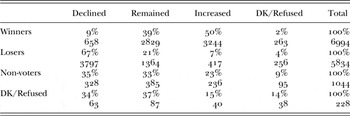
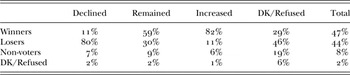
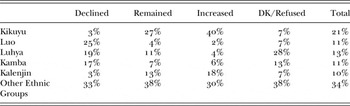
We present descriptive statistics on reported changes in IEBC confidence across two of our main correlates: winner/loser status and ethnicity. We find views towards the IEBC were relatively mixed in the aftermath of the 2013 elections: a plurality (37%) reported that confidence declined, 29% reported that confidence increased and 31% felt that confidence remained the same. Tables IA and IB highlight the correlation between winner/loser status and changes in IEBC confidence. Approximately 90% of Winners reported that confidence in the IEBC either increased (50%) or remained the same (39%), while the opposite was true for Losers, where 67% reported diminishing support of the organisation. Across Non-voters, orientations towards the IEBC were more balanced: confidence declined for 34%, remained the same for 33% and increased for 23%.
Cross-tabulation of Winner/loser and Changes in IEBC Confidence post-2013 Elections.

Source: NDI Kenya post-election survey, July 2013. The first row for each group shows the percentage within group. The second row shows weighted cell counts scaled to sample size.
Cross-tabulation of Winner/loser and Changes in IEBC Confidence post-2013 Elections.

Source: NDI Kenya post-election survey, July 2013. Rows show column percentages.
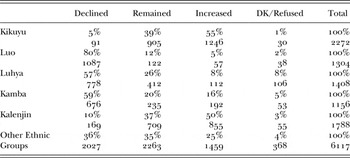
Tables IIA and IIB show that reported changes in IEBC confidence were ethnically polarised, especially for groups associated with the main presidential candidates. Specifically, only 5% of Kikuyus – co-ethnics of the elected president Uhuru Kenyatta – reported that their confidence in the IEBC declined, compared with 80% of Luos – co-ethnics of the losing presidential candidate, Raila Odinga. In sum, the cross-tabulations provide initial support for our main hypotheses concerning the effect of partisan and ethnic bias. Next, we examine our main hypotheses using multivariate regression.
Cross-tabulation of Ethnicity and Changes in IEBC Confidence post-2013 Elections.

Source: NDI Kenya post-election survey, July 2013.
The first row for each group shows the percentage within group. The second row shows weighted cell counts scaled to sample size.
Cross-tabulation of Ethnicity and Changes in IEBC Confidence post-2013 Elections.

Source: NDI Kenya post-election survey, July 2013. Rows show column percentages.
Correlates of Changes in IEBC Confidence
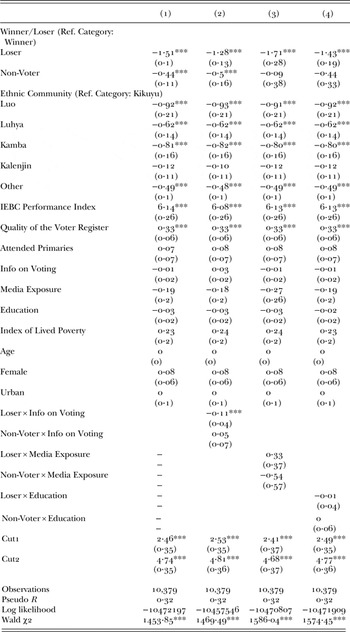
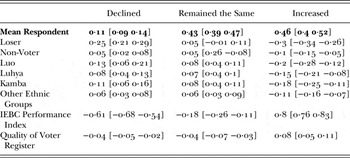
Table III presents the results of the ordered logistic regression used to examine the main correlates of changes in IEBC confidence.Footnote 29 To simplify the interpretation of logit coefficients, in Table IV we display the change in predicted values of a respondent reporting that IEBC confidence declined, remained the same or increased, given a minimum to maximum change in a specific independent variable.Footnote 30 Model 1 reports the results of the full model, while Models 2–4 report the results of interacting our measures of political awareness (info on voting, media exposure and education) with winner/loser status. In Model 1, and consistent with our expectations (H1), the coefficient for Losers and Non-voters is negative and significant, which confirms that Kenyans who did not vote for the winning presidential candidate, and those who did not vote at all, were more likely to lose confidence in the IEBC after the elections. Specifically, Losers were 25% more likely to report that confidence in the IEBC declined after the elections, while Non-voters were 5% more likely, relative to Winners.
Ordered Logistic Regression of the Correlates of Changes in IEBC Confidence.

DV: Changes in IEBC Confidence. Standard errors are clustered by sub-locations. *** p < 0·01, ** p < 0·05, * p < 0·1.
Predicted Changes in Estimated Changes in IEBC Confidence.

Predicted changes in estimated confidence for Model 1 in Table IV. 95% confidence intervals in brackets.
Our expectation that co-ethnics of losing presidential candidates would report decreased IEBC confidence was confirmed (H2). Mainly, we find that Luo co-ethnics of Raila Odinga (the main opposition candidate) were more likely than any other ethnic group to report that confidence in the IEBC declined after the elections (13% more likely to report that confidence in IEBC declined, relative to Kikuyu co-ethnics of the presidential winner). In fact, with Kikuyu as the baseline, the coefficients for all ethnic groups within our model (Luo, Luhya, Kamba and Others), with the exception of Kalenjin, are negative and statistically significant. Simply put, these ethnic group members were more likely to report decreased confidence in the IEBC, when compared with Kikuyus. The non-significance of the Kalenjin coefficient suggests that co-ethnics of the newly elected vice-president, William Ruto – a Kalenjin – were not distinguishable from Kikuyus, which makes sense given they ran together. These findings corroborate previous work by Shah (Reference Shah2015: 11) in which she finds that ethnicity also structured Kenyans' evaluations of the electoral process in 2013. Mainly, ‘Kenyans aligned to the Kikuyu – Kalenjin Jubilee Alliance were more likely to trust the electoral process, while those supporting the Luo-dominated CORD were more likely to doubt the credibility of the process.'
Our hypotheses regarding the association between evaluations of IEBC performance and changes in IEBC confidence were also confirmed (H3). First, we find that when citizens' evaluations of IEBC performance increase from the lowest level (IEBC Performance Index = 0·2) to the highest level (IEBC Performance Index = 1), those citizens are 80% more likely to say that confidence in the IEBC increased. Second, we find that the Quality of the voter register is associated with IEBC confidence, in that citizens who report that the voter register needs improvement are 4% more likely to lose confidence in the IEBC. We must admit, however, that our analysis does not allow us to rule out the possibility of endogeneity, as it is quite likely that some citizens may have relied on their level of confidence in the IEBC to assess its performance.
None of our measures of political awareness gained statistical significance in Model 1. The lack of significant findings highlights the possibility that the effect of political awareness may be conditional on respondents' status as a winner or loser. As discussed in H4, politically aware losers are more likely to lose confidence in the IEBC. We consider this possibility empirically in Models 2–4 by interacting winner/loser status (Losers and Non-voter) with Info on Voting, Media Exposure and Education, respectively. Interestingly, we find that the interaction between Losers and Info on Voting is negative and significant. This possibly suggests that being more informed about the voting process increased Losers' scepticism of the IEBC. However, neither interactions between Losers and Media Exposure nor Losers and Education are significant.
Finally, none of our controls for participation (Attended Primaries) and social structure (Lived Poverty, Female, Urban) are significant.
Focus Group Analysis
To further elucidate the previous quantitative findings, or what Posner (Reference Posner2005: 305) describes as ‘put[ing] meat on the bones of the survey results', we integrate data from 12 focus groups involving 140 participants conducted after the 2013 elections.Footnote 31 Specifically, we seek to examine how Kenyans' experience with and evaluations of the IEBC may have influenced trust in the institution. While election studies infrequently include findings from focus groups, we are guided by recent scholarship that highlight these findings' value in triangulating other data and enhancing the internal validity of causal inferences (Cyr Reference Cyr2015). Furthermore, Popkin (Reference Popkin1994) believes focus groups are invaluable for elucidating issues surrounding elections and campaigns because they engender a form of ecological validity through both the quality of information that is shared and the opinions that arise during conversation.
Among various themes, focus groups revealed that assessments of the IEBC were closely linked to the institutions' ability to implement technical solutions to remedy the problems of the 2007 election (i.e. biometric voter registration, electronic voter identification and electronic results transmission). To begin with, a majority of participants endorsed the handling of the 2013 voter registration process, especially the implementation of the biometric voter registration (BVR) technology. As one participant explained,
From registration, this new technology improved. It was very simple to register because once you have the fingerprints and everything, you could just walk away with no paper. … This gives someone surety he or she will be able to vote. (Eldoret, Male-30, Shopkeeeper)
However, the high expectations established during registration were largely unmet on election day. Participants reported experiencing or knowing of technical problems plaguing the electronic voter identification (EVD) and electronic transmission of results systems. Furthermore, most agreed the inability of these innovations to function as anticipated on election day undermined the integrity of the electoral process. Take, for instance, the following responses:
I expected since I had registered electronically when it comes to voting I will put my fingerprint and then afterwards my face will show, then I will be allowed to vote but it did not happen that way. (Kwale, Female-52, Hotelier)
I would say during the registration process the machines were okay, during the voting process it was a disaster for me. I did not even see the kit and now during the tallying process it was an abomination. (Nairobi, Male-32, Actor)
Finally, the delay in announcing the presidential election results, beyond the two-day deadline established by the IEBC, caused heightened fear, anxiety and consternation. According to one participant, ‘Because of the past experiences of the past elections, people were very tense’ (Nairobi, Female-44, Secretary).
While most participants readily acknowledged the shortcomings of the IEBC, confidence in the institution seemed to hinge on how citizens interpreted the technological failures. One subset of focus group participants interpreted the botched technological implementation and delays in announcing the results as a deliberate attempt by the IEBC and its staff to manipulate the process.
I have the feeling that the procurement process was good – everything was perfect – even the machines were perfect. And my honest opinion, the failure of the machine was not the failure of the machine. It was tampered with. (Nairobi, Female-44, Human resource manager)
Simply put, for many participants, the technological failures not only signalled the IEBC's incompetence, but its apparent lack of autonomy from Kenya's political class. Consequently, we find that many of these participants were also more likely to distrust the IEBC and call for the institution to be reconstituted before the next general elections.
A second subset of participants perceived these flaws to be part of the growing pains of a new IEBC, which had limited experience with, and time to implement, various voting technologies. The following response typifies this perspective:
I am going to believe that IEBC has the chance of growing. It was set up and then it was given a mandate to conduct an election, register voters electronically, vote manually and then transmit results electronically. It was a challenge to them, so they are growing. They will improve. (Eldoret Male-25, IT Consultant)
Unlike the previous subset of participants, however, we find that those who adopted the ‘growing pains’ perspective were less likely to lose confidence in the IEBC or support its reconstitution.
What explains participants' bifurcated interpretations of the technological failures and their confidence in the IEBC? Overall, our evidence suggests winner/loser status was associated with these two interpretations.Footnote 32 Co-ethnics of the winning presidential (Kikuyus) and vice-presidential candidates (Kalenjin), as well as participants living in counties that supported Kenyatta's coalition (Jubilee) (such as Eldoret and Nyeri), were more willing to more leniently evaluate the IEBC and not withdraw support for the institution. Contrastingly, co-ethnics of Odinga (Luos) and citizens living in opposition strongholds (such as Kwale and Makueni) were more likely to impugn IEBC's autonomy.
Whether these two perspectives reflect a script that participants had been fed from their leaders or the media, or a conclusion respondents reached individually, is not a question we can answer, but the results from the focus group dovetail well with the quantitative data, indicating that winners, particularly ethnic Kikuyus and those who likely voted for Kenyatta, were less likely to perceive bias in the IEBC's handling of the process and less likely to report that their trust in the IEBC decreased after the elections.Footnote 33
There are however a few exceptions to the winner/loser explanation that are worth noting. First, some participants, including co-ethnics of Odinga (Luos) or those living in counties that supported CORD, viewed the IEBC charitably and expressed confidence in the IEBC, despite the technological failures, because they prioritised the peaceful outcome of the elections. Second, we found that among participants in larger urban areas, especially Nairobi, it was more difficult to attribute their interpretation of technology failures to winner-loser status. Instead, we found that more educated respondents and those who voted in the elections were more likely to associate the technological failures with the ‘growing pains' narrative.
In sum, we show that the evaluations of IEBC were largely uniform across participants, who believed technological innovations failed. However, distrust in the IEBC did not fall to the levels of citizens' perceptions of the ECK following the 2007 elections, mainly because of how citizens interpreted these failures. The technological glitches signalled manipulation and malfeasance for some electoral losers, while among some winners they represented an unintentional but unfortunate setback on the road towards more democratic elections. Ultimately, winner/loser status was not the only factor that influenced citizens' confidence in the IEBC. Focus group data reveal that factors such as personal voting experience, political awareness and absence of post-election violence mattered for citizens' IEBC confidence.
CONCLUSION
We began by highlighting a worrying trend concerning Kenyans' confidence in their electoral management bodies (EMBs): Confidence peaked before each of the previous two general elections, then fell precipitously thereafter. This led us to ask two questions. First, what factors explain these trends in Kenyans' confidence in the EMB since the re-introduction of multi-party politics in 1992? Second, at the individual-level and focusing on 2013: What are the main correlates of Kenyans' confidence in their EMB?
Answering these two questions is not only important for understanding popular support of electoral governance in Kenya, but it also has implications for Africa's multi-party regimes beyond Kenya. So far, the existing literature has not systematically examined the determinants of Africans' confidence in EMBs and how confidence may change over time. This gap in the literature is worth filling, given that scholars and policy-makers have found that maintaining popular support for EMBs is vital to enhancing electoral integrity. Moreover, recent events in countries such as Nigeria and Ghana have triggered positive and negative swings in popular support for election administration, respectively.Footnote 34 Meanwhile, in other countries such as Zimbabwe, large segments of the population consistently express distrust in election management.Footnote 35
Using observer reports and secondary literature, we descriptively probed the longitudinal changes in Kenyans' confidence in EMBs and found that declines in popular trust coincided with deficiencies in the independence and administrative effectiveness of Kenya's EMBs. The stability of the cyclical trend in popular confidence, despite institutional reforms, highlights how de facto and de jure changes can often have short-term effects on citizen confidence, but they do not necessarily bring about long-term improvements in institutional legitimacy. Kenya's reform experience serves as a cautionary tale for policy-makers and donors across other multi-party regimes in Africa. While citizens are willing to reset their views based on institutional reforms, such changes may not be sustained over time, especially when institutional performance falls below the expected standard of how democracy functions during closely contested elections.
We then switched our attention to the individual-level and used survey and focus group data to examine the main sources of Kenyans' confidence in the Independent Elections and Boundaries Commission (IEBC), Kenya's main EMB since 2011. Following the literature on institutional trust in new democracies that emphasise the multidimensional nature of institutional support (Mishler & Rose Reference Mishler and Rose2001), our findings suggest that changes in Kenyans' confidence in EMBs following the 2013 elections were correlated with winner-loser status, evaluations of EMB performance and political awareness. Consistent with research on electoral governance in Mexico (Ugues Reference Ugues2010) and institutional trust in Africa (Moehler Reference Moehler2009) that highlights winner-loser gaps in institutional trust, we find that electoral losers (co-partisans or co-ethnics of the losing presidential candidates) were more likely to withdraw confidence in the IEBC following the 2013 elections. However, similar to research conducted by Bratton & Kimenyi (Reference Bratton and Kimenyi2008), we do not find that Kenyans' confidence in institutions such as the IEBC is only an ethnic or partisan census, as Kenyans who had positive evaluations of IEBC performance during different stages of the electoral process were also more likely to report that their confidence in the institution increased. While we cannot rule out the possibility that citizens' performance evaluations were also shaped by winner/loser status, these findings provide further confirmation that institutional trust in Africa reflects the short-term changes in the perceived performance of the institution (Bratton Reference Bratton2013).
Taking a cue from research on the mediating role of citizens' political awareness on institutional confidence (Gibson et al. Reference Gibson, Caldeira and Baird1998), our data also revealed a disturbing trend that informed losers tend to distrust the IEBC more than both uninformed losers and electoral winners of all awareness levels. Simply put, information actually depresses rather than enhances losers' confidence in the IEBC. While our paper also serves as a call for more work to be done about how institutional variables such as incumbency mediate this finding, the policy implications of our findings are worrisome: Citizens' willingness to access information on elections and voting may not resolve the confidence deficits that opposition groups have with regard to EMBs and other institutions that are associated with elections. Rather, there remain significant behavioural and perceptual gaps that block even the most informed voters on the losing side from considering the institution trustworthy.