INTRODUCTION
Specialism in parasites is normally described in terms of host range rather than specific resource dependency (Combes, Reference Combes2001). This definition is, however, unsatisfying when a ‘generalist’ can infect many host species that are closely related, or when a ‘specialist’ infects two phylogenetically distinct host species that represent very different resources (Bakke et al. Reference Bakke, Harris and Cable2002). Brooks and McLennan (Reference Brooks and McLennan2002) therefore identified ‘faux generalists’ and ‘faux specialists’. A ‘faux specialist’ is a parasite that is restricted to limited resources by ecological factors, but one that is able to exploit multiple hosts. ‘Faux generalists’, on the other hand, are specialists that utilize a specific resource that is phylogenetically widespread. With these caveats in mind, the concept of host specificity is still an extremely useful framework for understanding how host–parasite interactions are influenced by other organisms (Lafferty et al. Reference Lafferty, Dobson and Kuris2006; Orlofske et al. Reference Orlofske, Jadin, Preston and Johnson2012) and how, in turn, such interactions affect parasite virulence and distribution.
In this study we consider a specific relationship, where a predator acts as the paratenic host for the parasites of its prey. The use of paratenic hosts is known to promote parasite transmission and survival under certain conditions (Marcogliese, Reference Marcogliese1995), and prey may share parasites with their predators (e.g. Valtonen and Julkunen, Reference Valtonen and Julkunen1995). Here, we investigate differential effects of the predator on the parasites of its prey, using the well-studied Trinidadian guppy (Poecilia reticulata). This freshwater tropical fish has become a model species in the study of evolution. Wild guppy populations are isolated by migration barriers and each experiences a unique set of selection pressures. The most commonly researched of these is predation, which has resulted in marked morphological, behavioural and genetic variation (Magurran, Reference Magurran2005). Even within a river, guppies exposed to different predation pressures vary in their colour patterns, shoaling behaviour, courtship and generation times (reviewed by Houde, Reference Houde1997; Magurran, Reference Magurran2005). Upstream populations, which are above waterfall barriers, are characterized by low predation pressure and low genetic diversity, whereas downstream populations are exposed to greater predation pressure and have higher genetic diversity (e.g. Liley and Seghers, Reference Liley, Seghers, Baerends, Beer and Manning1975; Reznick and Endler, Reference Reznick and Endler1982; Barson et al. Reference Barson, Cable and van Oosterhout2009). Typically, female guppies select large bright showy males, but in the presence of predators, such as the cichlids Crenicichla and Aequidens spp., selection favours less conspicuous fish (e.g. Godin and McDonough, Reference Godin and McDonough2003) and females tend to mate earlier to maximize reproductive success (Reznick, Reference Reznick1982). Downstream predators also include freshwater prawns, Macrobrachium spp., and the killifish Rivulus hartii. However, this killifish is ubiquitous in the water bodies inhabited by guppies and, probably because of its ability to disperse over land (Reznick, Reference Reznick1995), is often the only fish species present in more isolated river habitats (Walsh et al. Reference Walsh, Fraser, Bassar and Reznick2011). Its predation on small, immature guppies has been well documented in the laboratory (Mattingly and Butler, Reference Mattingly and Butler1994) and in the wild (Magurran, Reference Magurran2005). When size-matched however, these fishes shoal together and both species appear to benefit from this behaviour (Fraser et al. Reference Fraser, Brousseau, Cohen and Morse-Goetz2011), so the relationship is more complicated than one of predators and prey.
An often-overlooked aspect of the interaction between the guppy and its predators is the potential effect of parasites (Magurran, Reference Magurran2005; Cable, Reference Cable, Evans, Pilastro and Schlupp2011). Guppies are subject to natural and sexual selection via parasitism. Uninfected females prefer males with fewer parasites (Kennedy et al. Reference Kennedy, Endler, Poynton and McMinn1987) and parasitized females are less discriminatory in their choice of males than healthy fish (López, Reference López1999). Parasites increase the probability of guppies being lost downstream during spate conditions (van Oosterhout et al. Reference van Oosterhout, Mohammed, Hansen, Archard, McMullan, Weese and Cable2007), and can be a significant cause of mortality under aquarium conditions (Cable and van Oosterhout, Reference Cable and van Oosterhout2007). The ectoparasitic monogeneans Gyrodactylus bullatarudis and Gyrodactylus turnbulli are the dominant guppy parasites, and they vary in abundance between different guppy populations (Cable, Reference Cable, Evans, Pilastro and Schlupp2011). Gyrodactylus bullatarudis is less well-studied than G. turnbulli, but tends to be more virulent (Cable and van Oosterhout, Reference Cable and van Oosterhout2007). Although gyrodactylids are fairly host specific, both G. bullatarudis and G. turnbulli were found experimentally to infect a wider range of hosts than predicted, with G. bullatarudis being more of a generalist than G. turnbulli (see King and Cable, Reference King and Cable2007; King et al. Reference King, van Oosterhout and Cable2009).
We investigated the interaction between guppies, their predator (R. hartii) and their dominant parasites (gyrodactylids). Specifically, we tested (i) whether R. hartii naturally acquires infections of Gyrodactylus spp. in the wild, (ii) susceptibility of isolated R. hartii to infection, (iii) frequency of gyrodactylid transmission between guppies and R. hartii, and (iv) whether gyrodactylids have the potential to survive on R. hartii when the host is out of water.
MATERIALS AND METHODS
Field data
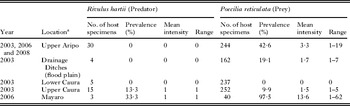
Between 2003 and 2008, we collected P. reticulata and R. hartii using a seine net from various sites in Trinidad (Table 1). These fish, carefully scooped out of the water using small buckets (to avoid dislodging ectoparasites), were anaesthetized in MS222 and either preserved individually in 90% molecular grade ethanol at the time of capture, or screened for ectoparasites on the day of capture using a stereo-microscope with fibreoptic illumination. Where three or more fish of the same species were collected (n=5 sites) we recorded gyrodactylid prevalence, mean intensity and range (sensu Bush et al. Reference Bush, Lafferty, Lotz and Shostak1997). Ieredactylus, a parasitic genus recently described from R. hartii, is distinctively larger than Gyrodactylus under a stereo-microscope (Schelkle et al. Reference Schelkle, Paladini, Shinn, King, Johnson, van Oosterhout, Mohammed and Cable2011).
Prevalence, mean intensity and range of Gyrodactylus spp. recovered from Rivulus hartii and Poecilia reticulata in Trinidad

a The Upper Aripo, flood plain drainage ditches and Lower Caura are all within the Caroni drainage. The Mayaro is within the South eastern drainage.
Source and maintenance of experimental animals
All experiments were conducted in Tobago in a makeshift indoor laboratory (24–31 °C) or in outside ponds (22–28 °C) using wild caught fish and parasites. Guppies and R. hartii were collected using seine nets in June in 3 consecutive years (2006–2008) from the Naranjo River, Trinidad (Grid Ref: UTM 20P – 692498·44 E, 118257·53 N). The site is an upland, low-predation site where R. hartii is the main guppy predator. Guppies from this population experience natural mixed species infections of G. bullatarudis and G. turnbulli. Guppies and R. hartii were maintained separately in aerated tanks with twice-weekly water changes, and fed daily with Artemia and/or Aquarian® fish flakes. All experimental fish were unlikely to have been parasite naïve.
Guppies for use in the experiments were ‘cleaned’ of natural gyrodactylid infections by removing any worms present on individually anaesthetized fish (0·02% MS222) using watchmakers’ forceps under a stereo-microscope (Schelkle et al. Reference Schelkle, Shinn, Peeler and Cable2009). Single worms from infected guppies from the same site were then transferred to the cleaned fish to culture parasites. Culture fish were housed individually in 0·6 L pots, fed daily and the water changed every other day. When a culture fish had more than 10 worms, additional uninfected fish were added to the culture and at least one parasite was removed for identification. Light microscope flat mounts of the hamuli were prepared according to Harris et al. (Reference Harris, Cable, Tinsley and Lazarus1999). Once the parasite species had been confirmed, the mono-species cultures were maintained through the weekly addition of uninfected fish and/or removal of heavily infected or previously infected hosts. These cultures provided parasites for the experimental infections. New strains of each species were established from the wild every year. Rivulus hartii used in the experimental transfers were also screened under anaesthetic approximately 1 week after capture for the presence of gyrodactylids but none was found. All R. hartii and guppies used for the experiments were of a similar size range: 17–24 and 16–21 mm standard length, respectively. Experiments 1, 2 and 4 were conducted in 2006. Experiment 3 was split between 2007 and 2008 because of difficulties in establishing the parasite monocultures. Replicates using both species were performed each year.
Experiment 1: Attachment and survival of parasites on predator
A single worm, G. bullatarudis or G. turnbulli, attached to a fragment of guppy fin tissue was positioned next to an anaesthetized R. hartii using watchmakers’ forceps (this methodology has been widely used for gyrodactylid infections of guppies (van Oosterhout et al. Reference van Oosterhout, Harris and Cable2003) and other teleosts (Bakke et al. Reference Bakke, Cable and Harris2007)). The time until attachment was recorded. Worms that had not attached within 10 min were discarded and the fish allowed to recover for at least 3 h (individually maintained in a 0·6 L pot) before a second (or maximum third) attempt was made with the same gyrodactylid species. After attachment, R. hartii were kept under light anaesthesia for 5 min. If the infection persisted, the fish was revived and the infection checked every hour thereafter until the worm was lost.
Experiment 2: Parasite transfer
Rivulus hartii and guppies were infected with one G. bullatarudis or one G. turnbulli as described above. One infected and one uninfected fish were placed together in a 10 L tank. There were four treatments: G. bullatarudis infected guppy/uninfected R. hartii (n=21); G. bullatarudis infected R. hartii/uninfected guppy (n=7); G. turnbulli infected guppy/uninfected R. hartii (n=19); G. turnbulli infected R. hartii/uninfected guppy (n=10). Trials lasted 24 h; both donor and potential recipient fish were then screened for parasites under anaesthetic.
Experiment 3: Parasite transfer in semi-natural conditions
Twenty-four replicate plastic ponds (dia. 122 cm) with a bamboo frame cover and lined with a net bag (to prevent escape of R. hartii) were filled to a depth of 12 cm with dechlorinated water. A similar experimental set-up has been used previously (van Oosterhout et al. Reference van Oosterhout, Mohammed, Hansen, Archard, McMullan, Weese and Cable2007). Six male and 6 female uninfected guppies were placed into each pond, along with an uninfected R. hartii. An additional 17 R. hartii were infected with either G. bullatarudis (n=12) or G. turnbulli (n=12) using the methods described for Experiment 1 (mean no. worms per fish±s.e.: 2·82±0·54). A single infected R. hartii was then added to each of the 24 ponds. At 6, 24 and 48 h, all fish in each pond were caught and screened for parasites before being returned to the ponds.
Experiment 4: Parasite survival on predator out of water
Individual R. hartii were infected as before with a single worm of either G. bullatarudis (n=21) or G. turnbulli (n=25). After 5 min the infection was confirmed and the fish revived and allowed to swim in fresh water for 1 min. Infected fish were placed individually into covered buckets (depth 60 cm, total volume 48 L) containing saturated leaf litter (collected from local rivers) to a depth of 14 cm. Leaf litter often covers the riparian zone of guppy rivers (personal observation) and is therefore likely to be the substrate that R. hartii most commonly migrates across when moving between guppy habitats. After 5 min fish were screened for parasite presence. In further trials individual hosts were left for up to 6 h in the leaf litter, and screened for parasites every hour.
Ethics statement
All animal work was approved by Cardiff University ethical committee and covered by UK Home Office regulations (PPL 30/2357).
Statistical analyses
Data were analysed using Minitab 12.1. Chi-squared tests and Fisher Exact tests were used to test for differences between G. bullatarudis and G. turnbulli in parasite attachment and survival. Inter-specific differences in parasite transfer under semi-natural conditions were analysed using a binomial mass function, using the rate of transfer of G. bullatarudis to calculate the probability of observing no transfers of G. turnbulli in a given number of trials. A Kruskal–Wallis was used to analyse differences in survival and attachment times. The time gyrodactylids spent attached to R. hartii, as well as the time required to transfer the worm to an uninfected R. hartii host, was analysed using a regression with life data analysis. The model used a Weibull distribution to describe the gyrodactylids’ mortality rate (or attachment rate). In this, we assumed that failure to remain attached is a function of time. In the model, gyrodactylid species was the predictor, and a Newton–Raphson algorithm was used to calculate maximum likelihood of the parameters.
RESULTS
Field data
Wild caught P. reticulata and R. hartii in the Caroni (Caura River) and South Eastern Drainages (Mayaro River) from Trinidad were naturally infected with Gyrodactylus spp. (Table 1). Both G. bullatarudis and G. turnbulli were commonly found on guppies, with prevalences ranging from 0 to 97·5%. Three individuals of Gyrodactylus spp. were recovered from R. hartii but it was not possible to identify them to species level. Guppies caught at the same sites as the infected R. hartii exhibited highly variable parasite burdens (9·9 and 97·5% prevalence at the Upper Caura and Mayaro, respectively) (Table 1).
Experiment 1: Attachment and survival of parasites on R. hartii
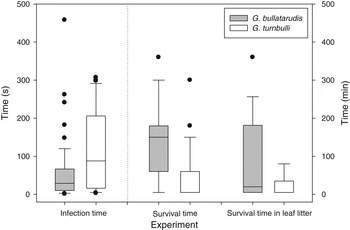
Gyrodactylus bullatarudis was more successful at infecting R. hartii during all infection attempts (χ2 ⩾ 8·21, d.f.=1, P=0·004) and took less time to infect (mean±s.e.=51·8±10·2 s) than G. turnbulli (117·8±15·2 s) during the first infection attempt (Kruskal–Wallis test, H=8·34, d.f.=1, P=0·004) (Table 2; Fig. 1). Gyrodactylus bullatarudis also survived significantly longer on R. hartii (mean±s.e.=135·8±21·5 min, max. 6 h) than G. turnbulli (mean±s.e.=61·5±13·2 min, max. 5 h) (regression with life data: Log-likelihood=−75·97, z=−2·81, P=0·005) (Fig. 1). Only a single parasite (G. bullatarudis) gave birth on a Rivulus, 1–2 h after its transfer, and by 3 h post-infection both mother and daughter parasite had been lost.
Infection time (in seconds, ‘Time (s)’), survival time and survival time in leaf litter (in min, ‘Time (min)’) of Gyrodactylus bullatarudis (grey bars) and G. turnbulli (open bars) on the paratenic host, Rivulus hartii. The dots represent outliers, the bars, the lower and upper limits and the box represents the first and third quartile value with the median. Note: in the text, means±s.e. are presented.

Number of attempts required for Gyrodactylus bullatarudis and G. turnbulli to attach to Rivulus hartii, and time taken to attach during the first attempt. In a few cases (once for G. bullatarudis and five times for G. turnbulli), parasites failed to attach and these individuals were discarded after the third attempt

Experiment 2: Parasite transfer
Transmission of gyrodactylids from an infected guppy to an uninfected R. hartii was significantly higher for G. bullatarudis (5 out of 21 trials) than G. turnbulli (0 out of 19 trials; Fisher's Exact Test, P=0·048). There was no difference in transmission of G. bullatarudis (5 out of 7 trials) and G. turnbulli (5 out of 10 trials) from R. hartii to guppies (Fisher's Exact Test, P>0·05).
Experiment 3: Parasite transfer in semi-natural conditions
Transmission of G. bullatarudis from R. hartii to guppies occurred in 3 out of 12 trials (4 guppies total) compared with no transmission for G. turnbulli (binomial probability: P=0·0317). No R. hartii was infected with G. turnbulli at the 24 h time point, whereas 4 R. hartii maintained their G. bullatarudis infection for at least 24 h, with one individual still infected after 48 h.
Experiment 4: Parasite survival on R. hartii out of water
Significantly more G. bullatarudis survived for 5 min on isolated R. hartii in leaf litter than G. turnbulli (18 out of 21 G. bullatarudis and 12 and of 25 G. turnbulli; χ2=7·619, d.f.=1, P=0·006). The mean (±s.e.) survival time of G. bullatarudis (87·8±26·0 min) was significantly longer than that of G. turnbulli (24·1±8·9 min) (regression with life data: Log-likelihood=−52·17, z=−2·54, P=0·011; Fig. 1).
DISCUSSION
Only G. bullatarudis transferred from infected guppies, P. reticulata (the prey) to uninfected killifish, R. hartii (the predator). Under experimental conditions, G. bullatarudis also infected killifish more quickly and survived for longer than G. turnbulli. When fish were held in heterospecific pairs, both parasite species showed a similar transmission rate from infected killifish to uninfected guppies. Although sample sizes were low, it was clear that both parasites showed a preference to return to their optimal host. When infected killifish were released into semi-natural ponds containing uninfected guppies, only G. bullatarudis transferred to the guppies, possibly indicating that G. turnbulli transmission is impaired after infecting the predator. Out of water, G. bullatarudis remained attached for longer than G. turnbulli (mean 88 min compared with 24 min), which suggests it is more likely to survive in the wild when killifish migrate overland (Reznick, Reference Reznick1995). How far R. hartii can migrate overland, and how long it survives out of water, have not been explicitly tested. Descriptions of population differentiation between drainages on Trinidad argue against this fish undergoing long-distance migrations (Jowers et al. Reference Jowers, Cohen and Downie2008; Walter et al. Reference Walter, Blum, Snider, Paterson, Bentzen, Lamphere and Gilliam2011), but there is evidence that they reach headwaters by bypassing waterfalls, and use pools separate from the main river channel (Gilliam and Fraser, Reference Gilliam and Fraser2001). This suggests that the survival times of Gyrodactylus spp. on R. hartii out of water observed here are sufficient for this to be a useful dispersal mechanism for the parasites.
Gyrodactylus bullatarudis can cause mass guppy mortality and may be more virulent than G. turnbulli, but it is also more prone to extinction, at least in laboratory cultures (Richards and Chubb, Reference Richards and Chubb1996; Richards and Chubb, Reference Richards and Chubb1998; Cable and van Oosterhout, Reference Cable and van Oosterhout2007; reviewed by Cable, Reference Cable, Evans, Pilastro and Schlupp2011). Nevertheless, its reduced host specificity and increased ability to survive on R. hartii in terrestrial habitats may explain why G. bullatarudis is more common than G. turnbulli in many isolated upland sites (see Cable, Reference Cable, Evans, Pilastro and Schlupp2011). This suggestion of more versatile use of host species by G. bullatarudis is analogous to Diamond's (Reference Diamond1974) ‘supertramp’ species. It could allow G. bullatarudis to be an early colonizer of new habitats and monopolize this habitat (cf. Monopolization Hypothesis; De Meester et al. Reference De Meester, Gómez, Okamura and Schwenk2002). Further work is needed to investigate interspecific competition in these gyrodactylids, particularly with reference to the establishment of new populations.
Theory suggests that the reduced reliance of G. bullatarudis on their primary host for transmission is likely to influence virulence (Galvani, Reference Galvani2003). In wild populations, the costs of parasite virulence are presumably less severe for G. bullatarudis if it can exploit killifish as a paratenic host and vector into naïve guppy populations. Rivulus hartii is more common upstream, above waterfalls than in downstream habitats (Seghers, Reference Seghers1978), and its migration is influenced by water level and its own threat of predation (Gilliam and Fraser, Reference Gilliam and Fraser2001). Given that a single individual of any Gyrodactylus species introduced into a naïve host population can be sufficient to initiate an epidemic of these viviparous, hermaphrodite pathogens (Cable and Harris, Reference Cable and Harris2002), the small behavioural difference we observe between these parasite species may have profound consequences on their evolutionary success and distribution. Understanding what drives the evolution of different transmission strategies is important as it will inform our understanding of both predator–prey and host–parasite interactions in a systems biology approach.
FINANCIAL SUPPORT
This work was supported by a Natural Environment Research Council, UK, Advanced Fellowship (J.C., grant number NER/J/S/2002/00706).