Unlike paintings, or sculptures, or films, books are created for one-on-one interactions. They are, by nature, zones of privacy. There is no way, short of censorship, for an outside observer to monitor or control the intimate encounters they offer.
—Johanna DruckerFootnote 1
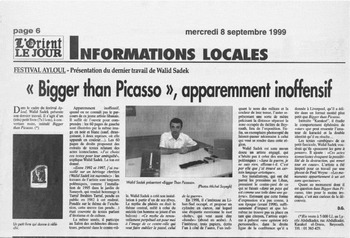
Walid Sadek's fi annani akbar min bikasu [bigger than picasso] was launched in 1999 at the Ayloul Festival in Beirut, a festival for contemporary artistic practices directed by the renowned Lebanese novelist Elias Khoury and by Pascale Feghali that took place from 1997 to 2001.Footnote 2 An article published in the Lebanese daily L'Orient Le Jour on 8 September 1999 foregrounds the “apparently inoffensive” character of the book and features a picture of Walid Sadek seated behind a table on which he had carefully arranged copies of his book selling for only LL 5000 (c. US $3.00).Footnote 3 The picture documents well the performative character of the book launch (see Figure 1). Similar to the book itself, the setting is minimalistic. Sadek, wearing a simple white shirt, his hair cut short, his hands folded, looks at his audience sternly. His ordinary, inconspicuous appearance clashes with any romantic notion of the artist as creative and rebellious spirit that the name Picasso continues to evoke. In his capacity as artist, Sadek virtually disappears in his white shirt and behind the white table, and is reduced to selling the book, neatly displayed on the table, next to an enlarged photograph of a monument in the form of an obelisk.
D.G., “«Bigger than Picasso», apparemment inoffensif,” L'Orient Le Jour, 8 September 1999, 6.

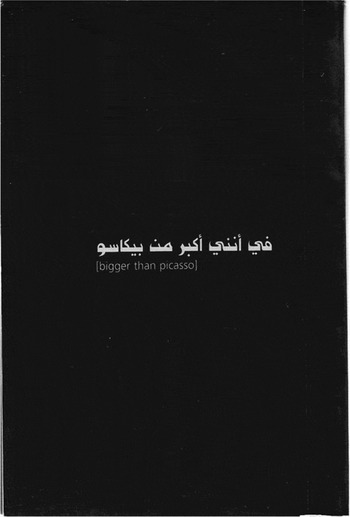
Walid Sadek, fi annani akbar min bikasu [bigger than picasso] (Beirut: Ayloul Festival, 1999), front book cover (7 × 11 cm).

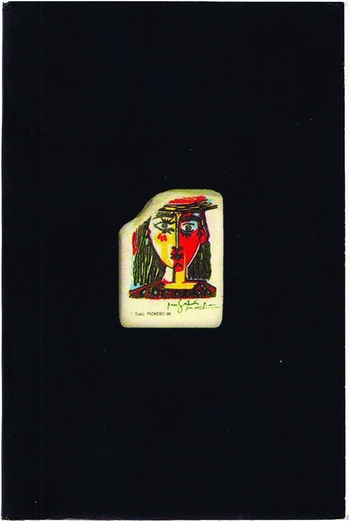
Walid Sadek, fi annani akbar min bikasu [bigger than picasso] (Beirut: Ayloul Festival, 1999), back book cover (7 × 11 cm). [A color version of this figure can be viewed online at http://journals.cambridge.org/mes]

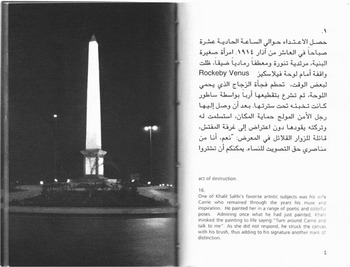
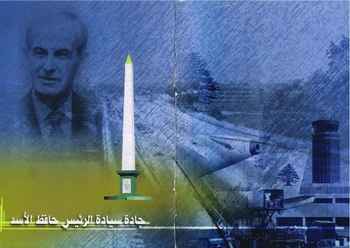
The book was introduced in the festival's brochure with the words “Monuments are born, live, and die,” but from the outside the book seems to have little to do with monuments (see Figure 2 and Figure 3). Already its very size seems to mock the idea of monumentality. Bigger than picasso measures 7 × 11 cm, a miniature paperback so tiny that it can easily be slipped into a shirt's pocket. The book cover is black; its title is printed in small, off-white letters as centered text in Arabic, with the English text “[bigger than picasso]” below it. The back cover shows a used eraser, also in off-white, upon which is printed a color reproduction of Picasso's Bust of a Woman in a Hat (1962). The image on the back and the title on the front suggest that the book is related to Picasso. However, as the book unfolds, different readings come into view that relate more closely to how the book was introduced in the festival's brochure. A typed text in Arabic and English on each recto page is juxtaposed to an image on the verso page. The sixty-two-page text consists of sixteen numbered narratives, which recount stories of art vandalism in various countries. The same image is reproduced on every verso page of the book; it is the photograph of the monument, the enlarged version of which displays on the table (see Figure 4). The image does not have a caption. Its background is engulfed in blackness. There are no indications that automatically give way to its location, identity, or (hi)story. It looks like any monument in any city. The local reader, however, can easily identify it. Unveiled to the public in 1998—one year prior to the publication of bigger than picasso—the monument was part of a major road construction project in Beirut. Dedicated to the late Syrian President Hafiz al-Asad, it stands at the center of a busy roundabout on the newly constructed Boulevard Hafiz al-Asad, a main road for Beirut's southern entrance, as the flyer distributed at the opening of the road explains (see Figure 5). It marks the beginning of Beirut's southern suburbs, known as Dahiya, and connects them to downtown Beirut in the north and the airport and the highway in the south. To the east are the Sabra and Shatila refugee camps, the site of the horrific massacres of Palestinian and Lebanese civilians in 1982 committed by Lebanese forces under the auspices of the Israeli army.Footnote 4
Walid Sadek, fi annani akbar min bikasu [bigger than picasso] (Beirut: Ayloul Festival, 1999), open page 4–5.

Flyer distributed at the monument's inauguration, 1998. [A color version of this figure can be viewed online at http://journals.cambridge.org/mes]

Enclosed between two covers that speak of Picasso, the image of the monument and the narratives of art vandalism to which it is juxtaposed remain confined in “zones of privacy.” Keeping in mind the miniature size of bigger than picasso, we may also say “zones of secrecy,” since the juxtaposition of the monument to verbal representations of art vandalism seems to suggest a new act of vandalism, this time directed against the monument. Bigger than picasso thus evades censorship but, in order to unfold meaning, it depends on the engagement of the reader. Most of the audience members at the Ayloul Festival came to see a play, a film, or an installation; they were not really interested in bigger than picasso and today many have forgotten the book. This article aims at bringing it back into discourse, doing justice to the “one-on-one interactions” and “intimate encounters” it offers, when taken home and opened. Reading bigger than picasso against changing political circumstances holds unexpected perspectives on the place of art and politics in postwar Lebanon. It also sheds light on the complex relationship between creation and destruction, on the social life of things,Footnote 5 and on the fate of all artifacts to eventually disappear.Footnote 6 The objects under examination in this article are the monument reproduced in bigger than picasso and the book itself, which is viewed here as both a subversive intervention in the life of the monument—paper unraveling stone, as in the popular children's game “scissors, paper, stone”—and an artifact in its own right. Before turning to bigger than picasso as an intervention in the life of the monument, the book needs to be situated within the context of book art and artistic practices of the postwar generation in Lebanon.
BOOK ART
As Johanna Drucker explains in The Century of Artists’ Books, it is often the fate of artists’ books to be overlooked, since they do not fall into neat categories but are hybrid, highly intermedia in character, and demand engagement on the part of the reader.Footnote 7 Having developed out of the illustrated book, the livre d'artiste, which was a phenomenon of elite culture in fin-de-siècle France,Footnote 8 the definition of book art has aroused much scrutiny, especially since the 1960s and 1970s, when new forms of artists’ books started to emerge that were closely linked to political activism.Footnote 9 As Hubert and Hubert write in The Cutting Edge of Reading: Artists’ Books:
The artist book, whether an offset multiple, a signed limited edition or one-of-a-kind volume, becomes the thing itself. Indeed, the object produced no longer functions as the conveyor of a privileged text, but as the only artifact worthy of consideration and, as such, the sole focus of attention and the treasure itself.Footnote 10
Having turned into “the treasure itself,” artists’ books have maintained an existence as an “alternative artform,” Drucker explains; “outside of gallery or museum structures,” they have “become a self-sustaining, even self-defining, realm of activity.”Footnote 11 Drucker, like Hubert and Hubert, is referring to artists’ books in Western art historical contexts. The institutional frameworks within or without which artists’ books have operated in the Arab world are different.Footnote 12 However, many artists’ books in the Arab world are interconnected with political activism. Book art has been a compelling means for Arab artists to assert their identities and to establish a link to the rich heritage of the book in Arabic-Islamic culture, while taking part in contemporary artistic practices worldwide.Footnote 13 It has often been associated with an artistic trend known as al-ḥurūfiyya (from ḥurūf: letters), the use of Arabic letters in modern art.Footnote 14Al-ḥurūfiyya has lent itself easily to notions of authenticity (aṣāla), especially starting in the second half of the 20th century, due in part to political factors such as the Arab defeat to Israel in the 1967 war, which triggered a profound identity crisis among many Arab intellectuals.Footnote 15
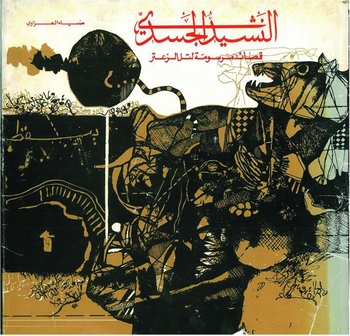
The internationally acclaimed Iraqi artist Dia Azzawi (b. 1936)—who is interested in the Arabic-Islamic heritage and beyond it the ancient Mesopotamian past, to which he refers through content (subject matter) and form (the flat surface, for instance)—can rightly be called one of the foremost practitioners of book art in the region. He has encouraged a younger generation of artists to work in book art and has built an exceptional collection of contemporary book art in Iraq.Footnote 16 His own books range from signed limited editions, reminiscent of the traditional livre d'artiste, to valuable one-of-a-kind objects and offset multiples. His multiples fit smoothly into the context of heightened political activism worldwide in the 1960s and 1970s and the new forms of book art that emerged globally during these years. They speak of direct political engagement at a time when grand narratives of resistance and revolution still met with hope of fulfillment and were closely linked to the Palestinian cause. An example is al-Nashid al-Jasadi: Qasaʾid Marsuma li-Tal al-Zaʿtar (The Body's Anthem: Illustrated Poems for Tel al-Zaatar), published in Beirut in 1980 (see Figure 6). Illustrating poems by such well-known authors as Mahmoud Darwish, Tahar ben Jelloun, and Yousef Sayegh, it pays tribute to the Palestinian civilians killed in Tel al-Zataar refugee camp in Beirut in August 1976, after a siege of several months, by Christian militias with the support of the Syrian army.Footnote 17 Directly referring to Picasso's Guernica (1937) with the horse on the book cover's right side, which directs the reader's attention from right to left, following the direction of Arabic script,Footnote 18 the book documents artistically what happened in Tel al-Zaatar—not in a newspaper style of numbering the dead, but by giving testimony of the human suffering. An outcry against war, from the Spanish to the Lebanese civil wars, it inscribes the Palestinian tragedy into world history.
Dia Azzawi, al-Nashid al-Jasadi: Qasaʾid Marsuma li-Tal al-Zaʿtar (The Body's Anthem: Illustrated Poems for Tel el-Zaatar) (Beirut: Dar al-Muthallath, 1980), book cover (30 × 30 cm). [A color version of this figure can be viewed online at http://journals.cambridge.org/mes]

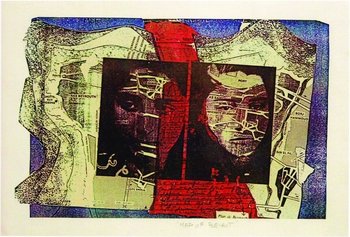
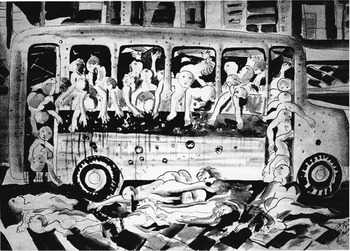
An exhibition at the Beirut Art Center entitled The Road to Peace: Painting in Times of War 1975–1991, curated by Saleh Barakat in 2009, included a number of other artists’ books produced during the Lebanese Civil War (1975–90). Some take the form of personal collage-like diaries, such as Ginane Basho's untitled artist book dated 1985, which incorporates private letters, cut-out newspaper clippings, and the map of Beirut divided by the so-called Green Line, here drenched in blood like red, a schizophrenic situation, as the superimposed photographs suggest (see Figure 7). Other books give witness to the civil war by means of vivid depictions of political events, such as Jamil Molaeb's 1978 Notes from the Civil War (see Figure 8). The open page here shows a drawing of the attack by a Christian militia on a bus carrying Palestinian civilians in Beirut on 13 April 1975, an “event” which came to mark the beginning of the civil war.Footnote 19
Ginane Basho, Map of Beirut (Beirut, 1985) (28.5 × 38.5 cm), in The Road to Peace: Painting in Times of War 1975–1991, ed. Saleh Barakat (Beirut: Alarm Editions, 2009), 15. [A color version of this figure can be viewed online at http://journals.cambridge.org/mes]

Jamil Molaeb, Notes from the Civil War (Beirut, 1978) (34 × 24 cm), in The Road to Peace: Painting in Times of War 1975–1991, ed. Saleh Barakat (Beirut: Alarm Editions, 2009), 42.

As Sadek critically writes in the epilogue to Barakat's exhibition catalogue, he does not believe in “an aesthetic of witnessing” that “indicate[s] the overwhelming as there to see but rather as over here, a here awash.”Footnote 20 His book was produced in a very different context from the books displayed in the 1978 catalogue: that of postmodern disillusionment. His interest is not in the creation of original works of art similar to those of Picasso; just like Art with a capital “A” has come to an end, so Picasso's name in bigger than picasso is spelled in lowercase. Far from claims of originality and authenticity, the minimalist layout of Sadek's book brings to the fore neoconceptual concerns that question the very place and possibility of art and visual representation in postwar Lebanon. Its miniature format comes in handy in finding ways around state violence and censorship, given that it addresses taboo issues, but it also relates to the abovementioned dichotomy of creation and destruction. The miniature is by definition opposed to the idea of originality and harbors ideas of disappearance and erasure. It is always already at a remove, as Susan Stewart points out:
Even to speak of the miniature is to begin with imitation, with the second-handedness and distance of the model. The miniature comes into the chain of signification at a remove: there is no original miniature; there is only the thing in “itself,” which has already been erased, which has disappeared from this scene of arriving-too-late.Footnote 21
POSTWAR LEBANON
Born in 1966, Sadek has played an important role in a group of artists often labeled the postwar generation in Lebanon.Footnote 22 He grew up in Beirut during the civil war, then studied in the United States before returning to Lebanon in 1992, working as an artist and pursuing an academic career in the Department of Architecture and Design at the American University of Beirut. Like many artists of his generation, Sadek has taken a distance from painting, whether figurative or abstract, and ventured into installation art, which was a new means of expression in the burgeoning art scene of 1990s Lebanon and one increasingly in demand by art festivals and biennales abroad.Footnote 23 Foreign interest in and funding of contemporary art in the Arab world, and especially work that introduces Western media art, has grown steadily, first with the turn toward multiculturalism and globalism in Western art markets, then with the emerging role of the Gulf states as powerful brokers in the arts, the opening of the private sector in Egypt, and, as some argue, a renewed focus on the Middle East worldwide since 9/11.Footnote 24 In the 1990s, the local art market in Lebanon was marked by the lack of a strong institutional infrastructure and largely dominated by small-scale art galleries dealing in paintings. The Ayloul festival, succeeded by Ashkal Alwan's homework forums, was one of the first platforms to challenge this situation. Only since the mid-2000s have new art venues—large-scale white cube exhibition spaces catering primarily to installation and video art, such as the non-for-profit Beirut Art Center and the commercial Sfeir Semler gallery—opened their doors. The bilingual character of bigger than picasso reflects on the transnational orientation and multiple audiences of artists of Sadek's generation in Lebanon, and of those in other countries in the region. As Sadek says, he wanted to make a book that would be accessible to a local public as well as to the increasing number of foreign curators visiting art festivals in the region.Footnote 25
Grounded in transnational networks and often refraining from references to local art historical contexts dating from before the civil war, the postwar generation in Lebanon has enforced the idea of a rupture with previous artistic practices and has managed to carve out a space for itself in the global and local art markets.Footnote 26 Taking a distance from the preceding generation of artists in Lebanon is programmatic as much as it is entrenched in Western artistic practices. As Gamboni notes, modern art from Marcel Duchamp to Daniel Spoerri, Lucio Fontana, Robert Rauschenberg, and Hans Haacke has been characterized by a subversive and iconoclastic character, a conscious attempt at breaking with artistic traditions.Footnote 27 What makes the postwar generation in Lebanon stand out, concludes Sarah Rogers, are its mixed-media practices that critically investigate history in ways far removed from the grand narratives of the past.Footnote 28 The idea of the archive features prominently. Examining artistic practices by Walid Raad and Akram Zaatari, Suzanne Cotter, who in 2006 curated the exhibition Out of Beirut at Modern Art Oxford, even speaks of a “documentary turn.”Footnote 29 This turn can be explained in part by local concerns, the absence of any official coming to terms with the past (travail de memoire) in Lebanon, on which more will be said later, and in part by international trends.Footnote 30
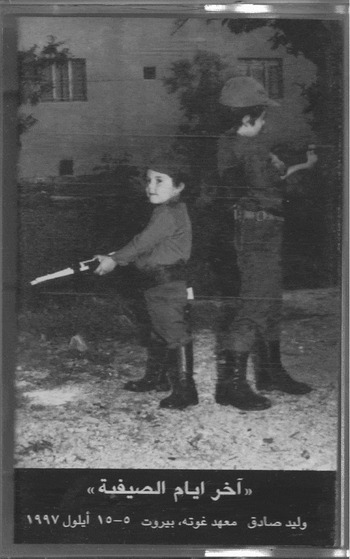
Sadek's artistic practices clearly partake of this turn. An early attempt to critically investigate the civil war in addition to his own sociopolitical and confessional background, his 1997 installation came with a booklet and a tape entitled Akhir Ayyam al-Saifiyya (Last Days of Summer) (see Figure 9). The cassette box features a photograph of Sadek and his younger brother as children dressed in militia clothes and carrying guns, Sadek a real one and his brother a toy. The tape is empty but its booklet contains the lyrics of well-known songs by the Lebanese musical diva Fairuz as modified by Christian militias during the civil war to defame their political adversaries, the Palestinians. The nostalgic tone of Fairuz's Last Days of Summer turned into a bloody reference to the 1976 siege and massacre of Tel al-Zaatar. Evoked by Sadek's tape, the lyrics resume in our ears, no matter how much we might have tried to erase them from memory. For Sadek, memory is collective and personal at once, as the photograph documents. His father, Pierre Sadek, a renowned political cartoonist who worked for a number of Lebanese dailies as well as the Lebanese Broadcasting Corporation, was an ardent supporter of Bashir Gemayel and produced a number of political posters for the Kataʾib Party and its military organization, the Lebanese Forces.Footnote 31 Compared to Azzawi's direct artistic response to the 1976 massacre of Tel al-Zaatar—his illustrated poems issued as an artist's book—Sadek's reworking of the already modified lyrics comes at a remove, about thirty years later, almost like childhood memories, so close and yet so far, suppressed by accumulated silences in postwar Lebanon.
Walid Sadek, Akhir Ayyam al-Saifiyya (Last Days of Summer) (Beirut, 1997), cassette tape cover (7 × 11 cm).

Despite generational and conceptual differences, Azzawi's and Sadek's artistic practices share some characteristics, including ideas related to publication, distribution, and the incorporation of text. Sadek has turned repeatedly to the idea of the book, or, to put it in broader terms, of publication, which he deliberately ties to installation art. Installation, says Sadek, is opening up to lighter but more precise media, associated with text, media networks, and distribution.Footnote 32 Similar to installation art, the reading process is of temporary character and breaks with artistic traditions that aim at placing a work of art in an institutional frame, such as a museum; it evades public control and collection. Sadek has published a number of artist's books, including Karaoke (1998) and Jane-Loyse Tissier (2003), which similar to bigger than picasso take the form of miniature books, and al-Kasal (Indolence, 1999), which he issued together with Lebanese artist and journalist Bilal Khbeiz as a newspaper. Another publication is Milaff: al-Zaman al-ʿAm (File: Public Time, 2005), which he worked on with Lebanese artists and journalists Bilal Khbeiz and Fadi Abdullah. It refers to the United Nations’ investigation into the assassination of Prime Minister Rafik al-Hariri on 14 February 2005 and comes in the form of a file. Writing about Sadek's text-based interventions, Kaelen Wilson-Goldie concludes that “Sadek seems to be searching for ever-newer forms of active and productive engagement in an increasingly passive world.”Footnote 33 This is again the case in his installation “The Labour of Missing,” shown in the Sharjah Biennial in 2011 and in the newly opened 500 square meter Tanit Gallery in Beirut in 2012. While partaking in “the documentary turn” that characterizes artistic practices in postwar Lebanon, Sadek here is preoccupied with absence, or the missing, not as something that has the potential to reappear but as something that comes with labor and “cohabits” what he refers to as “a protracted civil war.”Footnote 34
Few artists of the postwar generation in Lebanon have chosen to work in book art, which, as mentioned above, defies categorization and demands more engagement on the part of the reader than the art market usually provides. Raad, an internationally acclaimed installation and video artist as well as an academic who lives and works in New York, published three volumes of The Atlas Group as part of his Atlas Group project “to research and document the contemporary history of Lebanon with particular emphasis on the wars of 1975 to 1990.”Footnote 35 The publications are veritable storehouses of factious as well as fictitious material, and are close in layout to white cube exhibition spaces, but they remain bookwork, expensive if avant-garde exhibition catalogues; each volume costs about US $80. The form of the book here houses reproductions of Raad's artistic practices, which figure as “the privileged text.” Sadek's book is different. Bigger than picasso does not refer to any artistic practices by Sadek that exist outside its pages. The book itself is Sadek's artistic intervention. To put it in Hubert and Hubert's words quoted above, the book is the “sole focus of attention and the treasure itself.”Footnote 36
As book art, bigger than picasso partakes in global neoconceptual concerns but incorporates local histories in complex ways. As pointed out above, bigger than picasso comes in the guise of a publication related to Picasso. Why this ambiguity? Who is the personal pronoun speaking in its title? The Arabic part of the title is slightly different; fi annani akbar min bikasu translates literally into English as “in that I am bigger than picasso” and holds an affirmative stance. Either way, the title is sparked with irony. The English part of the title, written in all lowercase letters, breaks with Picasso's apotheosis in art history. Who or what is bigger than Picasso? The giant monument reproduced on every other page of the book? Hafiz al-Asad, who is immortalized in the obelisk, an aestheticization of politics that obliges art into its service? The book whose miniature form is in stark contrast to the gigantic nature of the monument and seems to poke fun at the very use of the comparative adjective bigger? The artist, a young, relatively unknown, and inconspicuous man from the Arab world, Lebanon, a country associated in Western media and public opinion with war, violence, and terrorism? Is he creating or destroying art? Is he committing an act of violence or calling for violent action? Is he or the book he sells offensive? Is selling art at US $3.00 offensive? Is he (claiming to be) bigger than Picasso? Is claiming to be bigger than Picasso—a role model for many artists of the sixties generations, such as Azzawi—tantamount to mocking modernist regimes of evaluations, hierarchies, and values from a postmodern and postcolonial perspective? Is he reversing center–periphery relations, which relegate art from the Arab world, or the Third World, to the margins?
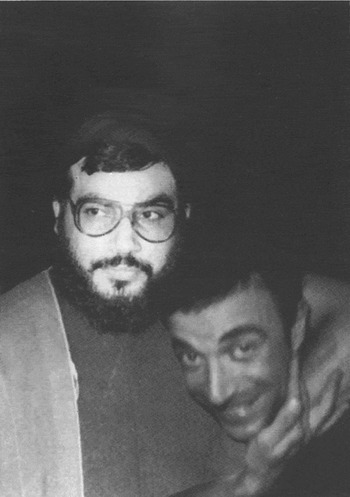
As Jessica Winegar argues, the Middle Eastern artist has turned into the counterimage of the terrorist in Western perceptions of the region, especially since 9/11.Footnote 37 Artist or terrorist, Sadek playfully deconstructs notions of art and politics, creativity and destruction, center and periphery. His artistic practices are at once engulfed in neoconceptual concerns and local politics. In the Ayloul festival in 2000, Sadek intervened with a gigantic poster entitled Better Left Untitled, featuring a large image of Hizbullah's leader Hassan Nasrallah next to a Polaroid image of himself, smaller-than-life, smiling at the onlooker from under Nasrallah's arms (see Figure 10). Nasrallah had just emerged as a hero, following the Israeli withdrawal from South Lebanon in May 2000, capturing people's fascination across the region in much the same way he is holding on to Sadek, it being unclear whether he is hugging or strangling him, as Raad points out.Footnote 38
Walid Sadek, Better Left Untitled (Beirut, 2000), poster photo-collage (210 × 300 cm).

A closer look at the juxtaposition of word and image in bigger than picasso reveals that the book is closely related to Lebanon's recent history of civil war encroaching on current affairs and, more precisely, Syrian-Lebanese relations. An artistic intervention in the life of the monument it reproduces thirty-two times on every other page, it brings to the fore subtle political criticism, at a time when such criticism was a taboo, and makes room for critically exploring the place and relation of art and politics in postwar Lebanon.
TEXT AND IMAGE
Culled, as stated in the book's front matter, from a number of sources, all rights “not reserved,”Footnote 39 the sixteen numbered narratives that run through bigger than picasso tell the stories of different acts of art vandalism. One of the sources is Dario Gamboni's The Destruction of Art, quoted above, in which Gamboni distinguishes between two terms: iconoclasm and vandalism. Whereas the first denotes the “willful destruction of art,” implying an “intention, sometimes a doctrine,” and historically has often been used in the context of Byzantium, the Reformation, and the French Revolution, the latter is of stigmatizing quality and associated with “blindness, ignorance, stupidity, baseness or lack of taste.”Footnote 40 Diverse in character, the narratives in bigger than picasso move back and forth between vandalism and iconoclasm and bring to the fore the sometimes thin line that sets them apart, based on different perceptions. The narratives include Mary Richardson's famous attack on Velasquez’ Rockeby Venus at the National Gallery in London in 1914; the dismantling of Tomsky's statue of Lenin from Leninplatz, later renamed United Nations Square, in Berlin in 1992; Tony Shafrazi's spray-painting of the words “Kill Lies All” over Picasso's Guernica in the Museum of Modern Art in New York in 1974; and the act of Lebanese artist Khalil Salibi, who is said to have struck the canvas on which he had just completed a painting of his wife Carrie with a brush, after her image failed to respond to him. Some thus relate to attacks on art carried out by individuals, as in the case of Mary Richardson, who subsequently was nicknamed in the press “Slasher Mary” or “The Ripper,” and others with court decisions to dismantle art, as in the case of the Lenin statue whose dismantlement triggered public protest. Shafrazi, the owner of a well-known art gallery in New York, considered his act innovative art. Making use of popular art, namely graffiti, he wanted to render visible in the present what had been stored as a masterpiece of art history in the museum. As this example shows, what some disapprove of as the destruction of art through blind or distasteful vandalism, others consider a creative awakening to life of dead objects.
The story about Salibi is the only reference to Lebanese art history in the sixteen narratives. Salibi (1870–1928) studied at the Syrian Protestant College, which later became the American University of Beirut (AUB), then in Edinburgh, London, and Paris, before returning to Lebanon. He was an acclaimed portrait painter, one of the first to open a studio in Beirut, and hailed as “the Father of the Lebanese Artistic Renaissance.”Footnote 41 A large donation of his paintings was recently made by his grandson to AUB, which put them on public display for the first time. A few of his nude paintings were also loaned to the Institut du monde arabe in Paris for its exhibition Le corps découvert (27 March to 15 July 2012), where they received significant international attention.Footnote 42 The story of Salibi striking the canvas brings to the fore the close relationship between art and life that is at the heart of vandalism and iconoclasm alike. It also allows Sadek to situate himself and refer back to the beginnings of modern art in Lebanon.Footnote 43 The seemingly unbroken representation of reality, as practiced by Salibi, is at once intriguing and impossible to repeat from a contemporary perspective. By referring to Salibi, Sadek not only situates himself geopolitically as an Arab and, more specifically, a Lebanese artist, but also underlines the gap that sets him and the postwar generation apart from Salibi and the beginnings of modern art in the region.
Sadek again refers to the pioneer generation of modern art in Lebanon, namely to Mustapha Farroukh (1901–57), in his 2006 installation Love Is Blind shown in Out of Beirut at Modern Art Oxford and in his 2010 first solo exhibition, Place at Last at the Beirut Art Center.Footnote 44 In both cases, captions and brief descriptions of Farroukh's paintings, mostly landscapes and portraits but also nudes, are given as traces of visual representation though the paintings themselves are absent, their places left empty. These blank spots, the absence of reference to the pioneer generation, is also a central theme in Raad's artistic practices, such as in his 2008 exhibition “A History of Modern and Contemporary Arab Art: Part I_Chapter 1: Beirut (1992–2005)” and his 2012 Scratching on Things I Could Disavow, staged at Sfeir Semler gallery in Beirut. In the 2008 exhibition, Raad directly referred to Sadek's Love Is Blind. He commissioned the Lebanese painter Rita Adiamy to reproduce an installation shot, which Sadek had provided him with, but he effaced Sadek's descriptions in addition to Farroukh's paintings, leaving his public with the captions—name, title, and date—only.Footnote 45 Here, the public is even further set apart from the beginnings of modern art in the region; even the verbal representation of visual representation—the definition A. W. Heffernan gives of ekphrasis Footnote 46—is deemed impossible. However, just as in Love Is Blind, Sadek in bigger than picasso holds on to the idea of ekphrasis. The book presents the reader with different narratives of vandalism but the works of art themselves as well as their destruction—or, better, the action/violence exercised on them—are left to the visualization of the reader, who is confronted again and again with the image of the monument.
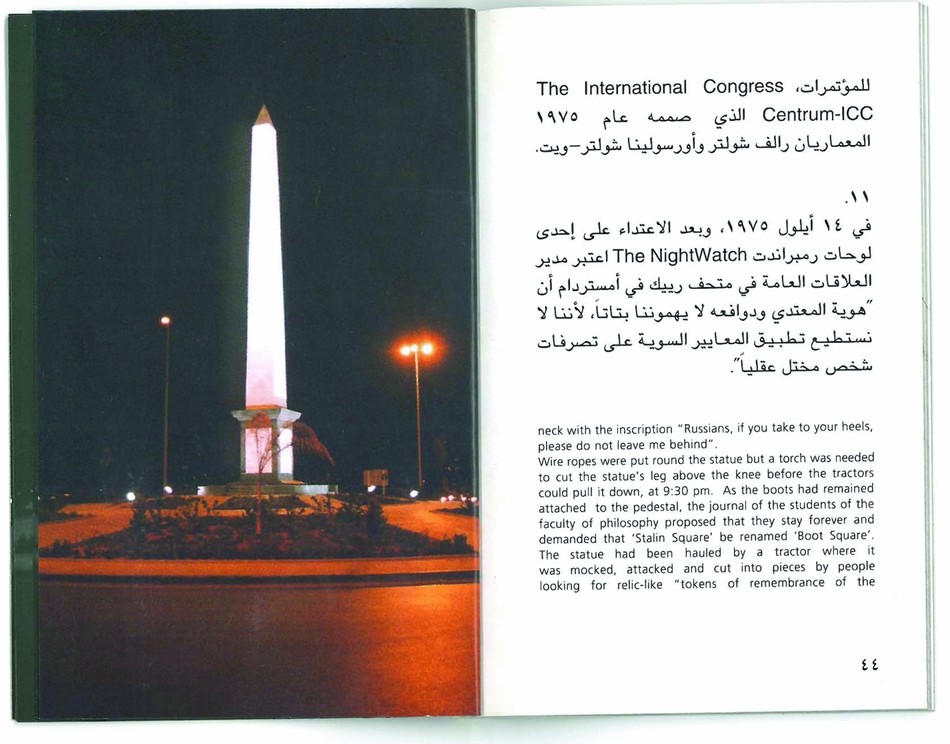
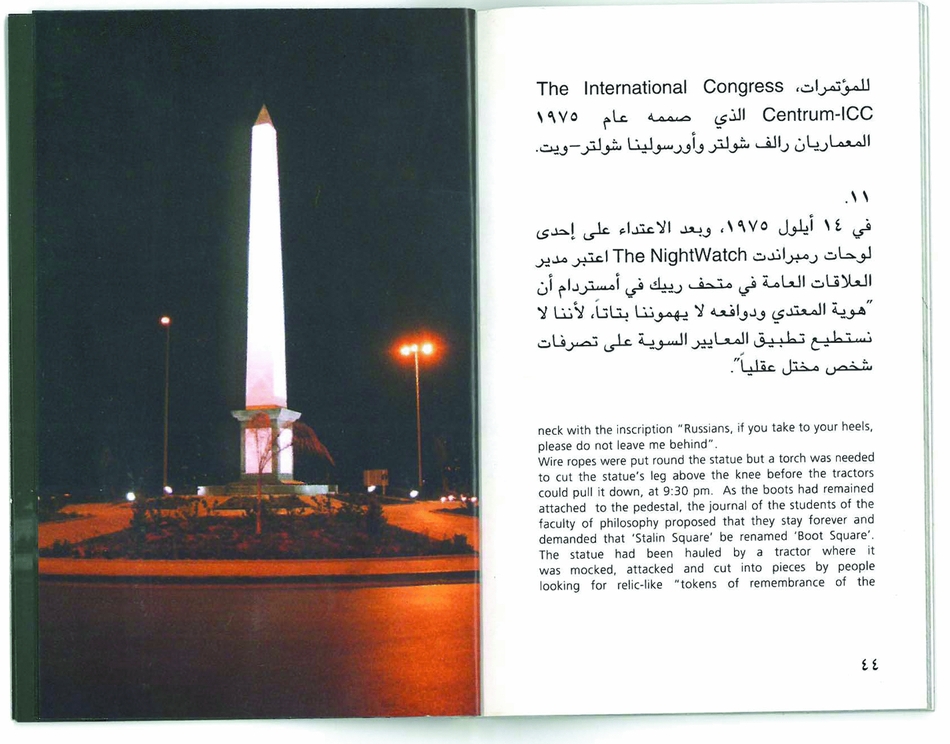
As pointed out above, this image comes without caption. The obelisk's enduring power as a political marker brings to mind colonial encounters, the Western appropriation and integration of Middle Eastern archaeology into Western historical narratives.Footnote 47 The legacy of the French Mandate hovers over Lebanon, as its politicians have alternately sought the approval of the French and Syrian governments, and as the urban landscape has been dominated by Western models. The obelisk represented in bigger than picasso is not old; it is a new monument taking the shape of the age-old obelisk. It is fashioned after Western models, such as the Luxor obelisk at the Place de la Concorde in Paris. Presented as a gift by the Khedive Muhammad ʿAli Pasha to France in 1829, thirty years after the Napoleonic invasion of Egypt, which set the stage for “re-order[ing] Egypt to appear as a world enframed,” “something object-like,” “picture-like,” “readable like a book,” as Timothy Mitchell writes,Footnote 48 it rendered Egypt visible and tangible in the heart of Paris: an Egypt that spoke of the Pharaonic past, set apart from modernity and delegated into history. As readers flip through bigger than picasso, their attention is caught by two images that stand out as they are in color rather than black and white like all the others (see Figure 11). They cause an interruption in the reading process for no obvious reason, inspired by the idea of disturbance pronounced so well by the American conceptual artist John Baldessari.Footnote 49 Prevented from falling into the familiar, the reader looks at the monument anew. The yellowish light of the surrounding lanterns illuminates the site, putting even more emphasis on the night scene and the obelisk's phallic structure. Erected at a busy intersection in Beirut, the monument is a display of power in the highly contested urban space of politically tense postwar Lebanon, rendering Syria visible and tangible in the heart of Beirut: a Syria that speaks of the enduring reign of Hafiz al-Asad. Unveiled to the public at the opening of the Boulevard Hafiz al-Asad in an inauguration led by the late Lebanese Prime Minister Rafik al-Hariri in 1998, its inscription reads: min lubnān ilā siyādat al-raʾis ḥāfiẓ al-asad taḥiyyat wafāʾ wa-ukhuwwa ilā sūriyā wa-shaʿbihā wa-jaishihā (From Lebanon to His Excellency the President Hafiz al-Asad, a salute of fidelity and fraternity to Syria, its people, and its army). The inscription affirms Lebanon's close ties with Syria, for which al-Asad coined the expression shaʿb wāḥid fī dawlatain (one people in two states). The inscription does not read “From Lebanon to Syria”; al-Asad comes first, rendering Syria without al-Asad unthinkable. Al-Asad here stands for Syria, its people, and its army, carved into the seemingly timeless nature of the obelisk for all eternity. The monument resonates with political slogans that celebrated Syria as sūriyā al-asad (Syria of Asad) and al-Asad as qāʾid li-l-abad (the leader forever), al-ab al-qāʾid (the father the leader), al-qāʾid al-munāḍil (the combatant leader), and munqidh lubnān (the savior of Lebanon), which were widespread in Syria as well as in Lebanon from the time the Syrian regime intervened militarily in Lebanon.Footnote 50
Walid Sadek, fi annani akbar min bikasu [bigger than picasso] (Beirut: Ayloul Festival, 1999), open page 44–45. [A color version of this figure can be viewed online at http://journals.cambridge.org/mes]
The Syrian army entered the Lebanese Civil War in 1976; after the Taif Accords that officially ended the war in 1989, it remained in Lebanon, partly as a counterweight to the Israeli occupation of South Lebanon (1978–2000).Footnote 51 Openly discussing the presence of the Syrian army, its security apparatus in Lebanon, as well as the flood of images glorifying Hafiz al-Asad was taboo. Bigger than picasso was published at a time when the increasingly burdening public silence about the civil war was beginning to crumble, as civil society activists and artists attempted to critically rethink the past, including through an opposition movement to the 1991 general amnesty for war crimes that made it possible for former warlords to take on government positions.Footnote 52 At the same time, dissident voices within Syria, including a number of former political prisoners,Footnote 53 calling for their country's democratization started to be more widely heard, especially through the Lebanese press. When Hafiz al-Asad passed away in June 2000, an opposition movement that called for political reform and saw the foundation of numerous political salons as well as the publication of political declarations, known as the Damascene Spring, briefly contributed to this atmosphere of relative freedom, but it was soon to be crushed by Syrian authorities.Footnote 54 The Ayloul Festival in which Sadek's book was launched was born out of this historical context.
In juxtaposing the monument to verbal representations of art vandalism, bigger than picasso critically sheds light on the political alliances that supported al-Asad's glorification and personality cult from within Lebanon. Questioning the Syrian military presence directly was impossible. The political constraints generated an aesthetic that explains the ambiguity of bigger than picasso. As pointed out above, the comparative bigger is further emphasized through contrast with the book's very format, its miniature size, which brings to the fore notions of intimacy, privacy, and secrecy in the reading process that oppose the public demonstration of power represented in the monument and allow a moment of truth. Hafiz al-Asad was known internationally for his employment of a personality cult in the consolidation of power, carefully built after Soviet models, supported by the one-party system of Baʿthist ideology, and in its omnipresent manifestations surpassing that of many other countries in recent history.Footnote 55 The personality cult around al-Asad, argues Lisa Wedeen, contributed to a politics of dissimulation in which complicity was enforced not by requiring people “to believe the ‘mystifications’ the regime puts forth” but rather by requiring them “to act as if they did, and by so acting, to live ‘within the lie.’”Footnote 56 Quoting the late Czech dissident turned president Václac Havel, Wedeen adds that in this case “everyone in his or her own way is both a victim and a supporter of the system.”Footnote 57 In 1997, the Lebanese video artist and filmmaker Akram Zaatari, a founding member of the Arab Image Foundation,Footnote 58 made a short film entitled Hubb (Love), which until today has not been shown publically in any art event in Lebanon or abroad. Shot in Syria clandestinely, it shows portrait painters of al-Asad at work in their storehouses, speaking about their love for “the leader forever,” while walking over the head, nose, or feet of his larger-than-life images to finish or dust their oeuvres. Their declarations of love appear as tragicomic reflections of their own situation, acting “as if” and living “within the lie.”
“Monuments are born, live and die,” reads the introduction to Sadek's book launch at the Ayloul festival. Their lives, as those of any object, depend not only on the material, which is chosen to last for eternity, but also on “the physical context in which they are placed and its changes, as well as the uses to which they are submitted and the way they are considered,”Footnote 59 as Gamboni writes.
Since the publication of Sadek's book in 1999, a number of changes have taken place in the life of the monument reproduced on its pages. Hafiz al-Asad is dead, though the Syrian regime as well as its military presence and security apparatus in Lebanon has lived on under his son Bashar al-Asad. The son's ascent to power was made possible by a swift change in the Syrian constitution, which reduced the required age for candidacy to president from forty to thirty-four, Bashar's age in 2000, and turned Syria into a “hereditary republic” within one month of Hafiz al-Asad's death, as Syrian dissident Riad Turk pointed out at the time.Footnote 60 Since 9/11, in the context of the U.S. government's war on terror and Syria's firm stance against the invasion of Iraq in 2003, the U.S. has declared Syria a rogue state and considered it an important player in “the axis of evil.”Footnote 61 In February 2005, Hariri, then in his second term as Lebanese prime minister, was killed in a massive car blast in downtown Beirut, an “event” that was followed by a series of additional political assassinations. The United Nations’ investigative commission into the assassination set out by accusing high-ranking Lebanese and Syrian officials of direct involvement.Footnote 62 In 2011, the Special Tribunal for Lebanon submitted to the Lebanese authorities arrest warrants for four senior Hizbullah members.Footnote 63 The demonstrations triggered by Hariri's assassination saw the withdrawal of the Syrian army from Lebanon in April 2005.Footnote 64 With the Syrian army went the forceful destruction, carried out by protestors, as well as the cautious dismantling, completed by the Syrian army, of numerous monuments dedicated to al-Asad, father and son, in Lebanon.
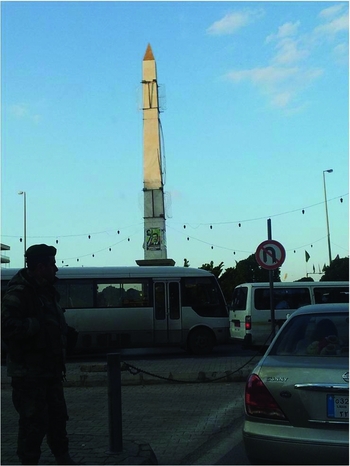
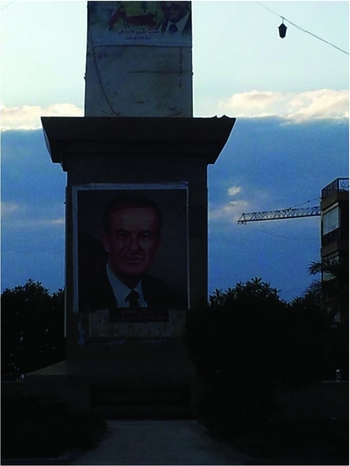
However, the monument inaugurated by Hariri and reproduced thirty-one times in bigger than picasso has remained. There are a number of reasons for this. First, it differs from the lifelike representations of the “leader forever” in that it takes on the abstract and seemingly timeless form of the obelisk; only its inscription refers directly to al-Asad. Second, it was inaugurated by Hariri, a prominent Lebanese Sunni political leader, who himself has become larger-than-life, already in his lifetime but especially since his assassination.Footnote 65 Third, it is placed in Beirut's Dahiya, a stronghold of Amal and Hizbullah, Shiʿi militias turned political parties after the civil war that are now the Syrian regime's strongest allies in Lebanon. Today, the monument has taken on a new life (see Figure 12 and Figure 13). It figures posters of Hafiz and Bashar al-Asad in addition to their Lebanese supporters: Amal's Nabih Berri and Hizbullah's Hassan Nasrallah, another political leader who has become larger-than-life, especially since the 2000 Israeli withdrawal from South Lebanon and the 2006 Lebanon war in which Beirut's southern suburbs were severely shelled by Israel. The obelisk has clearly lost its power as a national monument, but it has acquired new meaning as a communitarian monument, now fitting in smoothly with the sectarian character of most postwar monuments in Lebanon.Footnote 66 As Lucia Volk points out in Memorials and Martyrs in Modern Lebanon, monuments are meant to remain the same; however, in Lebanon they “need to be considered as ‘events’ with a life of their own. They keep changing along with the physical and cognitive landscape around them.”Footnote 67
The monument today, 26 February 2012, author's photo. [A color version of this figure can be viewed online at http://journals.cambridge.org/mes]

The monument today, 26 February 2012, author's photo. [A color version of this figure can be viewed online at http://journals.cambridge.org/mes]

The Arab Spring and the uprising in Syria have again changed the picture. Breaking down the “wall of fear,” the events have brought to the fore a political player far from the political leaders turned larger-than-life: the people.Footnote 68 Their hopeful slogan al-shaʿb yurīd . . . (the people want . . .) has traveled from the Tunisian revolution to Egypt, Bahrain, Yemen, and Syria, and continues to make itself heard despite the setbacks and forceful attempts at crushing people's demands across the region, which in Syria have turned large parts of the country into a war zone. The slogan is based on the opening lines idhā al-shaʿb yauman arāda al-ḥayāt / fa-lā budd ʿan yastajīb al-qadar (If, one day, the people wills to live / Then fate must obey) of “Iradat al-Hayat” (The Will to Life), a famous poem by the Tunisian writer Abu al-Qasim al-Shabbi (1909–34), whose poetry played a major role in the Tunisian and other Arab independence movements in the first half of the 20th century.Footnote 69
From the very outset of the Syrian revolution, a number of monuments devoted to Hafiz al-Asad across Syria have been destroyed by protestors, risking their lives, for instance in Daraa on 25 March 2011 and in Rastan on 15 April 2011.Footnote 70 But some have been removed by the regime in an effort to forestall their fall, metaphorically tantamount to the fall of the regime that erected them. This was the case with the gigantic statue of Hafiz al-Asad in Hama, which was carefully dismantled and carried off on 10 June 2011 in a truck designed to transport missiles, to guarantee that the body of al-Asad and the regime alike remained intact.Footnote 71 In light of these “events,” the monument reproduced in bigger than picasso today seems rather out of touch with reality, almost like a relic of former times, still featuring a poster of Hafiz al-Asad long after such posters had been replaced in Syria by those of his son. Read against these changed “physical and cognitive landscape[s],” a new question arises that is less about the destruction of art, the monument's death, and more about its afterlife: what happens to monuments, once they are destroyed, removed, or left to live on in changed political circumstances? Where do they disappear to? What kind of narratives, or new images, as W.J.T. Mitchell suggests,Footnote 72 does their destruction, removal, or the changed political contexts they are placed in engender?
As new artistic practices closely linked to political activism in Syria—ranging from video and performance art to graffiti, caricature, comics, and installation-like happenings such as the dyeing of Damascus's fountains in red—suggest,Footnote 73 the destruction of political markers, including monuments, takes place first and foremost in people's minds. The actual monument becomes less of an issue, may be forgotten; it loses its spell. The monument's symbolic function that seeks reaffirmation of power and obliges us to live “within the lie” is broken. The monument turns into a mere thing, an object whose value lies in documenting history,Footnote 74 crumbling political alliances, no matter how fast some political players may try to hold on to them.
CONCLUSION
More than a decade after its launch, bigger than picasso opens unlikely perspectives on the recent history of Lebanon, Syria, and Syrian–Lebanese relations. As the narratives juxtaposed with the monument in the book suggest, an object is never really destroyed by an act of vandalism; rather, it changes its meaning, lives on in a different context, or engenders new narratives, as was Tony Shafrazi's declared objective, when spray-painting “Kill Lies All” over Picasso's Guernica. Picasso's Bust of a Woman in a Hat reproduced on an eraser that figures on bigger than picasso's back cover is another example. As is the fate of so many works of art in Western consumer societies, it slowly disappears as the eraser is put to use—the eraser figuring as an instrument of erasure/destruction engendering another form of vandalism but also rendering possible the beginning of a new life, reminiscent of Robert Rauschenberg's “Erased de Kooning Drawing” of 1953, which is one of Sadek's declared favorites.Footnote 75 In this light, the book's back cover can be seen as programmatic: bigger than picasso is about erasure. At the same time, it allows ever-new readings in continuously changing political circumstances. As Stewart writes, “the closure of the book is an illusion largely created by its materiality, its cover. Once the book is considered on the plane of its significance, it threatens infinity.”Footnote 76
Bigger than picasso does not call for an act of vandalism, the destruction of the monument. Rather, it is itself of iconoclastic character, breaking with previous artistic traditions and metaphorically unraveling the monument by juxtaposing its image to text and, more precisely, to verbal representations of vandalism. The monument is not destroyed. Its image remains intact and ripe for multiplication, if deprived of what Walter Benjamin identifies as its aura, permanence, and cult value.Footnote 77 Having become part of an artistic intervention, exhibited at an art festival, the monument is left to unravel itself. Due to the political situation in postwar Lebanon, its unraveling takes place not in real time and space but within the pages of a tiny book. Bigger than picasso powerfully dismantles the politics of public monumentality—in Benjamin's words, “the situation of politics which Fascism is rendering aesthetic”Footnote 78—through the temporal and spatial unfolding of its pages, in artistic practices that are highly politicized while resorting to ephemeral and private reading processes. Art and politics, assumed to occupy different spheres since the Enlightenment, are closely intertwined; bigger than picasso slyly acknowledges this ideologically inflected conception of artistic practices. The miniature size of the book compared to the gigantic structure of the monument reveals the place of art and political dissent alike in postwar Lebanon. It reflects the situation of book art at the margins of cultural production, far from public display of power in “zones of privacy.”