The need for developmentally sensitive approaches for examining alcohol use has become abundantly clear in the past 25 years (for a review, see Chassin, Sher, Hussong, & Curran, Reference Chassin, Sher, Hussong and Currran2013). A greater emphasis on developmental approaches has resulted in examining change in alcohol use over age (e.g., adolescence to young adulthood to later adulthood), as well as change in stages of alcohol use (e.g., milestones such as onset of drinking, regular drinking, problems, and alcohol use disorder [AUD]). However, there is little research that attempts to separate change in age and in stage. For example, initiation is typically assumed to be in middle adolescence; at most, it is typically sorted into “early” initiation (before 14) and “late” initiation. Age and stage are typically confounded when examining normative drinking trajectories, and therefore there is a need to parse out drinking trajectories by both age and stage of use. The conceptualization of drinking stages as developmental milestones is particularly understudied. Most alcohol use research has focused on quantitative use (e.g., changes in frequency; see Sher, Jackson, & Steinley, Reference Sher, Jackson and Steinley2011, for a discussion on potential problems with this approach) rather than qualitative shifts in drinking behavior.
Epidemiological research indicates the ordering of these stages is typically normative, from less-severe drinking behavior (e.g., initiation or regular drinking) to more severe drinking behavior (e.g., binge drinking or AUD). Based on this information, it may be beneficial to examine such stages in a trajectory-like fashion. Developmental theories such as developmental cascade theory (Lynne-Landsman, Bradshaw, & Ialongo, Reference Lynne-Landsman, Bradshaw and Ialongo2010; Masten & Cicchetti, Reference Masten and Cicchetti2010) may be particularly useful for examining such a trajectory. Developmental cascade theory proposes that transactional processes between environments and behavior accumulate over time to reinforce specific behavioral and environmental pathways, setting the stage for more severe subsequent behavior. However, it is still unknown how milestones of drinking could play a predictive role in such a cascade.
Stages of Use as Developmental Milestones
Although most longitudinal alcohol research focuses on progression of the frequency of use, there is some research that focuses on drinking milestones. Drinking milestones are typically conceptualized as onsets of drinking behaviors that represent qualitative shifts in one's drinking trajectory. The most commonly researched milestones are drinking initiation (e.g., Sartor, Lynskey, Heath, Jacob, & True, Reference Sartor, Lynskey, Heath, Jacob and True2007) and AUD onset (e.g., Martin & Winters, Reference Martin and Winters1998; Sartor et al., Reference Sartor, Lynskey, Heath, Jacob and True2007). Other milestones investigated include the onsets of intoxication (e.g., Jackson, Reference Jackson2010; Morean et al., Reference Morean, Kong, Camenga, Cavallo, Connell and Krishnan-Sarin2014), regular drinking (e.g., drinking at least once a month for a period of at least 6 months; Grant et al., Reference Grant, Scherrer, Lynskey, Lyons, Eisen and Tsuang2006; Stallings, Hewitt, Beresford, Heath, & Eaves, Reference Stallings, Hewitt, Beresford, Heath and Eaves1999), heavier drinking (e.g., Reifman, Barnes, Dinchtcheff, Farell, & Uhteg, Reference Reifman, Barnes, Dincheft, Farrell and Utheg.1998), and individual AUD symptoms (e.g., Behrendt, Buhringer, Perkonigg, Leib, & Beesdo-Baum, Reference Behrendt, Buhringer, Perkonigg, Lieb and Beesdo-Baum2013; Buu et al., Reference Buu, Wang, Schroder, Kalaida, Puttler and Zucker2012; Chung, Martin, Winters, & Langenbucher, Reference Chung, Martin, Winters and Langenbucher2001).
Each of these milestones can potentially represent a stage of use that, when placed in a timeline, can be considered a trajectory from less to more problematic use. Although there are individual differences as to which specific milestones may come first (except for age of onset of drinking and the pathway from first AUD symptom to AUD), the trajectory from less consumption/less problematic use to more consumption is the normative pathway for most drinkers. Research indicates that drinking typically starts in adolescence, escalates in late adolescence/emerging adulthood, and desists in early adulthood (Chassin et al., Reference Chassin, Sher, Hussong and Currran2013; Maggs & Schulenberg, Reference Maggs and Schulenberg2004). Most individuals will never progress through all alcohol use stages (from onset to AUD), but will “stop” at a certain stage (and then decrease in use). However, it is nonnormative for individuals to deviate outside of this overall trajectory of milestones.
Milestones as Developmental Cascade Influences: Causal or Noncausal?
Developmentally focused alcohol research typically examines progression through these stages, linking earlier to later more problematic stages. Researchers have particularly focused on linking very early stages such as onset and much later stages such as AUD (e.g., Grant et al., Reference Grant, Scherrer, Lynskey, Lyons, Eisen and Tsuang2006; Sartor et al., Reference Sartor, Lynskey, Heath, Jacob and True2007). The overarching finding within this literature is that individuals who start to drink in young adolescence are more likely to (a) achieve later stages of problematic use and AUD and (b) attain these stages at younger ages, compared to individuals who start to drink later in life. Although there is a demonstrable association between these two milestones, there is debate as to whether early age of onset is a direct risk factor (i.e., causal mechanism) or if it is only a marker of liability. Behavioral genetics research has indicated this link to be mostly noncausal (Grant et al., Reference Grant, Scherrer, Lynskey, Lyons, Eisen and Tsuang2006; Prescott & Kendler, Reference Prescott and Kendler1999). Onset of alcohol use and AUD have different underlying etiologies. Alcohol use onset is explained primarily by environment, while AUD is influenced more by genetics (Kendler, Schmitt, Aggen, & Prescott, Reference Kendler, Schmitt, Aggen and Prescott2008). This is also reflected by the changing etiologies of overall alcohol use over adolescence and young adulthood. Shared environmental factors decrease in influence starting in middle to late adolescence. During this time, genetic influence steadily increases (e.g., Kendler, Gardner, & Dick, Reference Kendler, Gardner and Dick2011; Kendler et al., Reference Kendler, Schmitt, Aggen and Prescott2008).
However, there has been little research on the potential causality of earlier milestones on later milestones outside of the onset–AUD relationship. There are numerous milestones that fall between these two stages, such as regular or heavy use. Behavior genetic studies that have included more milestones indicate different stages of use have different etiologies (although with some shared overlap between liabilities), such as onset of alcohol use versus regular use versus dependency (Fowler et al., Reference Fowler, Lifford, Shelton, Rice, Thapar and Neale2007; Pagan et al., Reference Pagan, Ros, Viken, Pulkken, Kaprio and Dick2006). Because these milestones typically fall along a normative ordered trajectory, it is reasonable to ask if milestones closer together (in time, and in their position/order on a drinking trajectory) may have a greater causal influence on each other. This would be supported by a developmental cascade theory of alcohol use. Attainment of a new milestone may have a causal effect on changing influences, such as changes in adolescent social environments (e.g., risky peers or romantic partners), alcohol use expectancies and motivations, parent/family conflict, academic performance, and neurological/cognitive development (e.g., Brown et al., Reference Brown, McGue, Maags, Schulenberg, Hingson and Swartzwelder2008; Windle et al., Reference Windle, Spear, Fuligni, Angold, Brown and Pine2008) that in turn help support subsequent alcohol use.
Examining Milestones: Issues of Age Versus Stage and Age Versus Time
Although there are normative ages for individuals to reach specific alcohol use milestones (Faden, Reference Faden2006; Kessler et al., Reference Kessler, Berglund, Demler, Jin, Merikangas and Walters2005; Maggs & Schulenberg, Reference Maggs and Schulenberg2004), there is also obvious individual variability. Age of drinking onset has been reported in previous studies to be as early as 5 (Deutsch et al., Reference Deutsch, Slutske, Richmond-Rakerd, Chernyavskiy, Heath and Martin2013), and as late as 25 (Grant & Dawson, Reference Grant and Dawson1997). On the other end of the trajectory, there is a wide range of onsets regarding AUD; for example, individuals have reported ages of onset from as early as 15 years to as late as 56 (Kessler et al., Reference Kessler, Berglund, Demler, Jin, Merikangas and Walters2005). Stages of alcohol use may not directly map onto different age-based developmental periods, and although chronological age and stage of use are often related, they do not seem to be specifically linked.
Stages may also be qualitatively different when comparing adolescents to young adults. Specific considerations need to be taken into account as to how age may influence milestone attainment and drinking trajectories (e.g., Deas, Riggs, Langenbucher, Goldman, & Brown, Reference Deas, Riggs, Langenbucher, Goldman and Brown2000). The first, and most obvious, is the difference in the opportunity to drink for adolescents compared to adults. Adolescents have fewer opportunities to access alcohol and therefore may not be able to progress as quickly through drinking milestones as young adults. Previous research has captured this telescoping age-of-onset effect: individuals who have earlier milestone onsets (such as drinking onset) tend to take a longer time to achieve the next milestone (Jackson, Reference Jackson2010; Sartor et al., Reference Sartor, Lynskey, Heath, Jacob and True2007). This effect is potentially attributed to the higher difficulty for younger adolescents to obtain alcohol.
Alcohol use in adolescence may also have qualitatively different neurocognitive and metabolic properties compared to alcohol use in young adulthood. Adolescence is a period of rapid development and neural reorganization within the prefrontal cortex, the area of the brain responsible for executive control, self-regulation, and risk and reward evaluation. Heavier alcohol use can have a substantial impact on brain maturation during this time (Witt, Reference Witt2010), compromising healthy development of behavioral control and facilitating more problematic alcohol use. In addition, adolescence is a time of heightened vulnerability for binge drinking, increasing the likelihood of future use and earlier attainment of more problematic milestones. Animal research has documented that adolescent rats tend to experience the rewarding effects of alcohol (stimulant and hedonic effects) much more than the aversive effects (depressive effects such as motor impairment and sedation; Spear, Reference Spear2011). Thus, adolescents may not feel as if they are “drunk” as quickly as young adults, leading to higher levels of consumption and increased tolerance. Ethical issues prevent researchers from conducting drinking experiments on human adolescent subjects, and thus translation of this research to human models is uncertain. However, one previous study (Behar et al., Reference Behar, Berg, Rapoport, Nelson, Linnolia and Cohen1983) examined a sample of 8- to 15-year-old boys in which ethanol was administered in levels comparable to adult intoxication. Researchers documented no observable signs of behavioral intoxication in these boys, indicating potential similarities in lack of sensitivity to depressive effects of alcohol in humans.
Qualitative differences in adolescent and young adult alcohol use indicate it is important to examine age of milestone attainment as well as time between milestones. This will allow for examining potential unique effects of age on milestone attainment as well as adjusting for the lack of environmental equivalence for individuals who start to drink in adolescence and individuals who start to drink later. Examining both age and time allows for a more nuanced understanding of alcohol trajectories. Age-based analyses are inherently nested within the context of overall individual development. Time-based analyses separate the examination of the development of alcohol stages as separated from overall development (i.e., alcohol trajectories as longitudinal and developmental processes that can be distinct from overall development).
Tolerance as a Milestone
Tolerance, defined as either “a need for markedly increased amounts of alcohol to achieve intoxication or a desired effect” or “a markedly diminished effect with continued use of the same amount of alcohol” (American Psychiatric Association, 2013), is a prominent symptom of AUD. Previous research indicates that tolerance is one of the first alcohol use symptoms to manifest (Brenhent et al., 2013; Buu et al., Reference Buu, Wang, Schroder, Kalaida, Puttler and Zucker2012) and one of the most common individual symptoms (Harford, Grant, Yi, & Chen, Reference Harford, Grant, Yi and Chen2005). It is also a strong indicator of future AUD attainment. However, tolerance can also be seen as a normative (i.e., nonpathological) consequence of increased use of alcohol over time, making any reported tolerance a potentially ambiguous symptom of problematic use. Tolerance tends to have higher endorsement for nondependent individuals than other AUD symptoms. It is a particularly common symptom for “diagnostic orphans” (Pollock & Martin, Reference Pollock and Martin1999): individuals who report symptoms of dependence, but fall short of the required amount of symptoms needed for a diagnosis (Ray, Miranda, Chelminski, Young, & Zimmerman, Reference Ray, Miranda, Chelminski, Young and Zimmerman2008; Schuckit et al., Reference Schuckit, Danko, Smith, Bierut, Bucholz and Edenberg2008). Tolerance is also is a poor indicator of AUD attainment for adolescents (Chung et al., Reference Chung, Martin, Winters and Langenbucher2001), because a high percentage of adolescents who drink also report tolerance (Chung, Martin, Armstrong, & Labouvie, Reference Chung, Martin, Armstrong and Labouvie2002; Martin & Winters, Reference Martin and Winters1998).
Given that reporting tolerance to alcohol can be a potentially normative consequence of earlier drinking milestones, as well as a strong indicator of future AUD diagnosis, we were also interested in examining tolerance as a potentially unique milestone. We wanted to compare the attainment of tolerance to attaining the milestones of other AUD symptoms, in roles as both an outcome (i.e., how does it relate to earlier milestones) and a predictor (i.e., how does it predict potential AUD attainment)?
Current Study
The current study is a nuanced examination of alcohol use milestones. A genetically informed, discordant twin modeling approach was used in order to examine potentially causal effects of milestone attainment on alcohol use trajectories. Discordant twin models are a quasiexperimental design that allows for causal inferences (McGue, Osler, & Christensen, Reference McGue, Osler and Christensen2010). Using these models, we can determine if specific variables are unique risk factors for subsequent outcomes, rather than the link between both variables being due to a shared underlying liability. As explained in McGue et al. (Reference McGue, Osler and Christensen2010), this model is similar to the counterfactual model discussed in literature regarding statistical causality (e.g., Rubin, Reference Rubin2008).Footnote 1 Using a multilevel framework in which a twin is nested within twin pairs, we are able to decompose the specific (unique environment) effect of variables (e.g., ages of onset of earlier milestones) by comparing individual twins within a twin pair, as well as estimate familial context (genetics and shared environment) effects of these variables by comparing across different twin pairs.
Based on previous research regarding the effect of stages of alcohol use as potential developmental milestones, as well as the lack of research regarding potential causality of varied earlier milestones on later milestones, we hypothesized that milestone attainment in alcohol use trajectories may operate via a developmental cascade framework. Early milestones (e.g., onset of drinking or onset of regular drinking) may be causal catalysts that promote attainment to the next milestone. Although previous work with developmental cascade and deviance proneness theories have examined multiple environments that can promote developmental transitions of drinking behavior, particularly transitions to more harmful drinking stages (Lynne-Landsman et al., Reference Lynne-Landsman, Bradshaw and Ialongo2010; Sher, Reference Sher1991), attainment of earlier milestones per se have not been examined as potential environmental influences. Therefore, our first hypothesis was that earlier drinking milestones would have causal effects on proximal subsequent milestones but not on distal milestones that are within a developmental continuum from less to more severe drinking.
Given potential differences in examining trajectories via age of onset or time-to-event, we examined the main hypothesis both ways. Specifically, we hypothesized that, for age-of-onset models, earlier onsets of antecedent milestones would predict earlier onsets of subsequent milestones that are more proximal, but would not have potentially causal effects for milestones that are more distal in a stage-based trajectory. For the time-to-event models, we hypothesized that earlier onsets of antecedent milestones would predict a shorter time for more proximal subsequent milestones, but a longer time for more distal milestones, due to the typical “donut-hole” phenomenon evidenced in individuals who have earlier drinking onsets (e.g., Jackson, Reference Jackson2010).
We were especially interested in examining attainment of alcohol tolerance, because this milestone can act as a by-product of normative drinking behavior as well as an indicator of subsequent problematic use. Due to the relative ambiguity of tolerance as both a consequence of normative drinking and a predictor of AUD, we did not have any specific hypotheses regarding the way in which tolerance would act as a milestone compared to other AUD symptoms. However, because tolerance may have a different meaning and underlying cause in adolescence and young adulthood, we hypothesized that onset of tolerance may be a time-dependent predictor for later AUD, such that tolerance onset may be more influential if onset is later, rather than earlier.
Methods
Participants
The full sample consisted of 7,398 same-sex monozygotic (MZ) and dizygotic (DZ) twins from the Australian Twin Registry Cohort II (n = 6,265 twins, age range = 24–36; see Knopic et al., Reference Knopic, Heath, Madden, Bucholz, Slutske and Nelson2004) and Cohort III (n = 3,824 twins, age range = 27–40; see Lynskey et al., Reference Lynskey, Heath, Bucholz, Slutske, Madden and Nelson2003). Mean age of the combined sample was 30.46 years (SD = 2.62). Because the analyses required full twin-pairs for all models (all variables needed both twins to have reached milestones), the sample sizes changed based on each model. There were 2,973 overall complete pairs for the analyses. The sample was composed of 35% male MZ twins, 21% female MZ twins, 27% male DZ twins, and 17% female DZ twins.
Procedure
Both cohorts completed an individual interview based on an Australian adaptation of the Semi-Structured Assessment for the Genetics of Alcoholism (Bucholz et al., Reference Bucholz, Cadoret, Cloninger, Dinwiddie, Hesselbrock and Nurnberger1994), which assessed, along with other variables, retrospectively reported alcohol use behaviors. Cohort II was surveyed by telephone interview in 1996–2000 (participation rate = 84%). Cohort III was surveyed by computer-assisted telephone interview in 2005–2009 (participation rate = 76%).
For Cohort II, twins who had previously participated (as children in 1980–1982) in a volunteer twin panel maintained by the Australian National Health and Medical Research Council were contacted (for details, see Knopic et al., Reference Knopic, Heath, Madden, Bucholz, Slutske and Nelson2004). For Cohort III, twins were first contacted by the Australian Twin Registry to ask if they were willing to have their names and contact details forwarded to the Queensland Institute of Medical Research for potential participation in an interview-based study. Contact details of those consenting were then contacted by the Queensland Institute of Medical Research to enroll them in the study. Twins completed a questionnaire and interview. For both cohorts, the interviews were conducted by trained lay-interviewers who were blind to the status of the co-twin. Informed consent was obtained from participants, and both studies were approved by the institutional review boards at the Washington University School of Medicine and the Queensland Institute of Medical Research.
Measures
Zygosity
Zygosity was coded as a binary variable, with either 0 (monozygotic) or 1 (dizygotic) scores for twin pairs.
Gender
Gender was coded as a binary variable, with either 0 (female) or 1 (male) scores for participants.
Birth year
In order to account for both age differences and cohort effects, birth year was used as a control variable rather than age or a binary cohort variable.
Drinking onsets
Initial drinking onset was measured by the question “How old were you the first time you had a full drink of beer, wine, or spirits?” Intoxication onset was measured by the question “How old were you the first time you got drunk (that is, your speech was slurred or you were unsteady on your feet or you found it hard to keep your balance)?” Regular drinking onset was measured by the question “At what age did you start to drink regularly, that is, drinking at least once a month for 6 months or more?”
Tolerance onsets
Tolerance was measured in two different ways. Perceived tolerance was measured by the question “How old were you when you could drink ‘a lot more’ before getting drunk or feeling the effect of alcohol?” Reported tolerance was measured by asking about the initial (when first starting to drink) number of drinks needed to get drunk (or, if the participant never reported getting drunk, the initial number of drinks needed to feel an effect of alcohol), and then if there was a time in which the participant needed to drink more than the initial number reported in order to get drunk (or feel an effect). Participants were then asked the age of onset for this change.
First symptom onset
The onsets of each AUD symptom other than tolerance (withdrawal, trying to cut down/stop, drinking for longer/larger quantities than intended, failure to fulfill major role obligations, giving up activities, use in hazardous situations, spending time obtaining/using/recovering from effects, use despite knowledge of physical/psychological problem caused or exacerbated by alcohol, and use despite knowledge of social/relational problem caused or exacerbated by alcohol) were assessed. The earliest age of any reported symptom was used as the first symptom onset.
AUD onset
AUD onset was measured in the Semi-Structured Assessment for the Genetics of Alcoholism by asking about the earliest age that three symptoms of DSM-IV alcohol dependence occurred within the same year.
Initial tolerance/sensitivity
Initial tolerance was added to all models in order to account for potential confounds regarding the effect of alcohol sensitivity on subsequent tolerance development (e.g., Waller, McBride, Lumeng, & Li, Reference Waller, McBride, Lumeng and Li1983). This was assessed by asking participants how many drinks they needed in order to get drunk or to feel an effect when they first started drinking.
Analytic plan
Models were evaluated with multilevel Cox regression proportional hazard frailty models, in which a random intercept of twin pair was included, using PROC PHREG in SAS 9.4 (SAS Institute Inc., Cary, NC). A frailty model is a random effects model for survival data that estimates a Cox proportional hazard regression that accounts for a correlated data structure (Hougaard, Reference Hougaard, Klein, van Houwelingen, Ibrahim and Scheike2014). Frailty models are constructed similarly to standard proportional hazard regression models, with the inclusion of a random intercept term specifying the clustering variable. Because the age measures were not truly “continuous” measures, there was a substantial amount of tied failure rates within these data. Ties for these models were handled with the Breslow function, which assumes that ordered ties occur sequentially (Singer & Willett, Reference Singer and Willett2003, p. 523).
Two different overall methods were used for the individual outcome models: examining (a) age of onset and (b) time to event. For the age-of-onset model, the outcome variable was the age of onset of outcomes. For the time-to-event models, the outcome variable was the time between antecedent milestones and the subsequent outcome milestone (e.g., time between drinking onset and regular drinking onset). These approaches were chosen in order to examine potential unique influences of developmental age (e.g., differences in opportunity to drink at different ages) and time between milestones. Abstainers (e.g., those who never drank) were excluded from the study (n = 92, 1.26%). Those who did not report engaging in subsequent milestones were treated as censored for each outcome. Individuals who engaged in milestones out of order were also censored for each outcome, due to the nature of the hazard models. For example, when testing the regular drinking model, if drunkenness was engaged in after regular drinking, age of onset of drunkenness would not be usable as a variable predicting time to regular drinking. However, individuals who engaged in the predictor and outcome within the same year were included in the model, as well as individuals who engaged in two predictor outcomes within the same year. Simultaneous outcome–predictor occurrences were further examined by estimating additional models that removed individuals who had a “tie” in year for outcome and predictor variables.
For all models, individual twins were nested within twin pairs in order to account for interdependence (Snijders & Bosker, Reference Snijders and Bosker1999). Multilevel modeling allows for a more informed discordant twin model in that it can include both concordant and discordant twins. Frailty models included a random intercept of twin pair. For each drinking milestone predictor, two effects were estimated: a Level 1 within-twin-pair effect (i.e., the individual twin's estimate) and a Level 2 between-twin-pair effect (i.e., the twin-pair average estimate). Thus, the Level 2 between-twin-pair effect can be interpreted as the familial context (e.g., genetic influence and shared environment) effect, and the Level 1 within-twin-pair effect can be interpreted as the unique environmental effect of the milestone predictor. Interpretation of Level 1 and Level 2 parameters depends on the centering method used on the Level 1 predictor (Enders & Tofigni, Reference Enders and Tofighi2007). All Level 1 predictors were group-mean centered (i.e., individual twin estimate subtracted by the average twin pair estimate), such that Level 1 and Level 2 predictors represented direct within-twin-pair (comparison against co-twin) and between-twin-pair (comparison against other twin pairs) effects.
For all models, hazard ratios were interpreted based on age. Typical hazard ratios are interpreted such that a number lower than 1 indicates a negative relationship/lower hazard, while a number higher than 1 indicates a positive relationship/higher hazard (i.e., a hazard ratio of 0.84 indicates a 16% lower likelihood of x event, a hazard ratio of 1.16 indicates a 16% higher likelihood of x event). However, for this study that uses ages as predictors and outcomes, the hazard ratios are interpreted as either increases or decreases in age (or time) at event. Hazard ratios are interpreted as the higher or lower likelihood of attainment based on yearly increases or decreases in age of onset of milestones compared to co-twins. Because we are focusing on earlier ages of onset for predictors, we wanted to emphasize the likelihood of attainment for lower ages, which reverses the typical hazard ratio reporting of a hazard ratio below 1 indicating lower likelihood, and a hazard ratio of above 1 indicating higher likelihood. Thus, the hazard ratio of 0.84 would indicate a 16% higher likelihood of subsequent outcome milestone attainment for every year twin A had an earlier age of predictor milestone attainment compared to twin B within a twin pair.
Differences between MZ and DZ twins were tested by including interactions between all predictors and zygosity; there was only one significant difference between the within-twin effects and zygosity for the effect of within-twin drinking onset on the relationship predicting time between first symptom and AUD onset. This was included in the model. Overall, the relative lack of significant interactions with zygosity indicated that within-twin (direct) effects were generally consistent between MZ and DZ twins (e.g., there were no unaccounted for genetic influences that may be influencing the within-twin effects). Therefore, all models included MZ and DZ twins in the same model. There were some interactions between zygosity and between-twin effects; these analyses are presented in the online-only supplementary materials. In addition, we tested for interactions between milestone predictors and gender, given that some studies indicate telescoping differences, such that women tend to initiate early alcohol use milestones at a later age but quickly “catch up” in age of onset for heavier use (Randall et al., Reference Randall, Roberts, Del Boca, Carroll, Connors and Mattson1999). We found few gender differences for within-twin Level 1 interactions, although there were slightly more interactions between gender and between-twin effects. For all models, we included significant within-twin interactions only, given that the within-twin interactions were the primary focus of the study. Both zygosity and gender interactions are presented in the appendixes.
Proportional hazard assumption violations were tested in all models. A main assumption of proportional hazard models is that the hazard functions are proportional over time. Violations of this assumption indicate that these hazards differ at different times or ages (e.g., the effect of a variable on the hazard of the outcome changes as a function of age). When violations were found for a specific predictor, an enhanced Cox regression method was used to make such predictors time dependent (e.g., Schemper, Reference Schemper1992).
Results
Means and correlations for age-of-onset and time-to-event variables
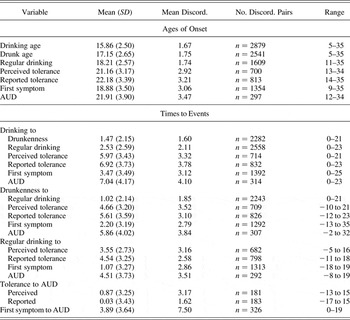
Table 1 displays means and discordance between twins for all variables. As seen in the time-between-event variables (e.g., time from drinking to AUD), there were some individuals who reported engaging in “nonnormative” patterns (as evidenced by the negative numbers in the range column) such as reporting tolerance before reporting regular drinking. Although these individuals were not included in the final analyses (because time to event models were coded such that those who reported an atypical path were censored), they are reported in Table 1 in order to document the wide range of answers.Footnote 2 Discordance was generally lower for earlier milestones compared to later milestones. Contrary to expectations, the average age of tolerance was typically later than other first symptoms.
Means and ranges for all variables and discordance between twin pairs

Note: The sample was composed of 35.12% male monozygotic twins, 20.90% female monozygotic twins, 26.84% male dizygotic twins, and 17.14% female. AUD, Alcohol use disorder.
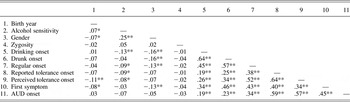
Table 2 displays the correlations between all ages of onsets. Ages of onsets were moderately to strongly correlated, as expected.
Correlations accounting for twin-pair clustering between variables

Note: AUD, Alcohol use disorder.
*p < .05. **p < .01.
Age of onset models
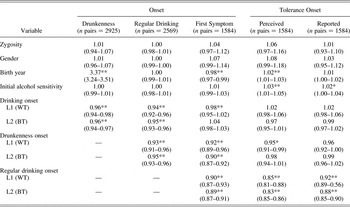
Table 3 displays the results of predicting drunkenness, regular drinking, first symptom, perceived tolerance, and reported tolerance onsets from earlier antecedent milestone onsets. Based on the normative order in which milestones are attained, drunkenness onset was predicted by only drinking onset, regular drinking was predicted by drunkenness and drinking onsets, and first symptom and perceived and reported tolerance onsets were predicted by onsets of drinking, drunkenness, and regular drinking. As seen in Table 3, initial drinking onset appeared to have potentially causal effects on drunkenness and regular drinking onsets such that younger ages increased hazards. For example, the hazard ratio of the within-twin effect of drinking onset on regular drinking (0.94), indicates that for every year that Twin 1 engaged in drinking earlier than Twin 2, the hazard of her engaging in regular drinking increased by 6%.
Hazard ratios (95% confidence intervals) for age-based discordant twin multilevel frailty models predicting age of onsets for individual drinking milestones

Note: L1, Level 1; L2, Level 2; WT, within twin; BT, between twin.
*p < .05. **p < .01.
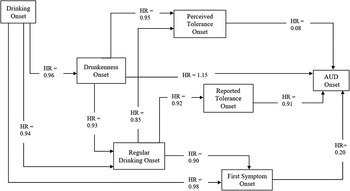
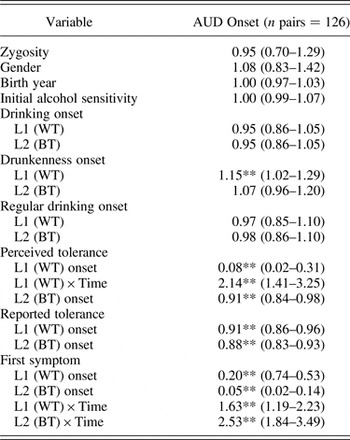
Figure 1 displays a graphical depiction of the within-twin L1 effects for all of the alcohol use milestones within the study for all models. Taking the results as a whole, it appeared that earlier milestones had potentially causal (within-twin) effects on later milestones that were more proximal within an overall drinking trajectory. Drinking onset had effects on drunkenness and regular drinking onset; drunkenness onset had effects on regular drinking, first symptom, and perceived tolerance onsets; and regular drinking onset had effects on first symptom and perceived and reported tolerance. This supports the hypothesized “cascade” view of drinking trajectories, in which earlier milestones can have stronger effects on slightly later (proximal) milestones; subsequently, these later milestones have causal effects on subsequent milestones. This is further supported by Table 4, which displays the hazard ratios for AUD in which all earlier milestones are regressed onto this outcome. AUD onset was predicted by earlier perceived and reported tolerance onset, and first symptom onset. Aside from drunkenness, no other earlier milestone (drinking or regular drinking onset) had a potential causal effect on AUD. Finally, in comparing the tolerance milestones to the first symptom milestone, there was no indication that tolerance was unique in comparison to other initial milestones. Reported tolerance was predicted by regular drinking onset (and perceived tolerance by drunkenness onset), similar to first symptom onset, and also similarly influential in predicting AUD.
Summary of within-twin significant causal effects for age-based models. HR, Hazard ratio; AUD, alcohol use disorder.

Hazard ratios (95% confidence intervals) for age-based discordant twin multilevel frailty model predicting AUD onset

Note: AUD, Alcohol use disorder; L1, Level 1; L2, Level 2; WT, within twin; BT, between twin.
**p < .01.
Finally, it is important to note that, with the exception of the AUD model, the age of onset predictors were consistent across time (i.e., they did not violate the proportional hazards assumption). For the AUD model, perceived tolerance and first symptom onsets were time dependent (the effects were not consistent over time). As expected, although the effect of perceived tolerance was such that earlier age of onset of tolerance predicted earlier AUD attainment (hazard ratio [HR] = 0.08), the interaction with time indicates that this effect was stronger for later ages (HR = 2.14).Footnote 3 A similar effect was found for the onset of first symptom.
As presented in the appendixes, tests were conducted for (a) interactions between zygosity and gender, and (b) models in which all participants with simultaneous outcome–predictor occurrences (e.g., predicting drunkenness onset for an individual who reported same-year drinking and drunkenness onsets) were removed. As demonstrated in the models examining interactions with zygosity and gender (see online-only supplementary Tables S.1 and S.2), there were few interactions with within-twin effects, and no within-twin interactions remained significant in the age-based models when all nonsignificant interactions were removed from the model. Significant zygosity interactions with between-twin effects tended to indicate that MZ between-twin effects were stronger than DZ between-twin effects, suggesting some systematic differences between MZ and DZ families. There were only three (between-twin) interactions with gender; two significant hazard ratios below 1.00 indicated that the underlying familial context explaining relations between predictor milestones and outcome milestones were stronger in females, whereas another significant hazard ratio above 1.00 indicated stronger effects for males.
As demonstrated in supplementary Tables S.3 and S.4, when participants who had same-year outcome–predictor occurrences were removed from age-based models, there were few changes in model effects. The only exception to this was the AUD model, which only retained one significant effect. However, given that all other models retained their effects and that the AUD model lost a substantial amount of power (reduced from 292 participants to 92 participants) within an already computationally complex model, it is possible that some of these effects were lost due to reduced power.
Finally, due to the large number of participants who reported AUD onset before tolerance onset (30% perceived tolerance, 19% reported tolerance; see supplementary Table S.5), we also estimated an alternate model in which AUD predicted perceived and reported tolerance. As seen in supplementary Table S.6, within-twin AUD onset had a substantial influence on both perceived and reported tolerance onset, again, such that for every year earlier one twin attained AUD compared to his or her co-twin, there was a 7% higher likelihood of attaining earlier perceived tolerance and an 8% higher likelihood of attaining earlier reported tolerance. There were no other significant milestone predictors.
Time-to-event models
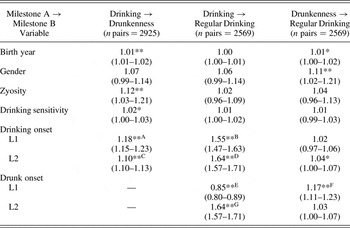
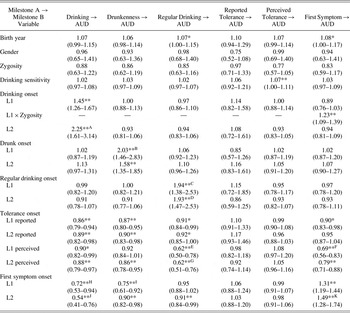
Table 5 displays the time-to-event models for predicting drunkenness (time between drinking and drunkenness) and regular drinking (time between drinking and regular drinking, and drunkenness and regular drinking). As evidenced by the telescoping-age-of-onset effect, initial earlier ages for milestones appear to cause longer times between milestones, rather than shorter times. However, there appears to be an interesting phenomenon when taking into account intermediary milestones when examining time between an early and a later milestone. Intermediary milestones are defined here as those milestones that fall in between the two milestones that are being examined (e.g., the time from Milestone 1 to Milestone 2). Thus, when predicting the time from drinking initiation to regular drinking, onset of initial drinking is the antecedent milestone (milestone 1); onset of regular drinking is the outcome milestone (milestone 2); the outcome variable would be the time between initial drinking and regular drinking; and onset of drunkenness, as falling between these two milestones, is an intermediary milestone. As seen in Table 5, when examining the time between onset of drinking and onset of regular drinking, onset of drinking, as expected, has a potential causal relation such that for every year earlier Twin 1 drinks compared to her co-twin, the hazard of a longer time period between drinking and regular drinking increases by 45% (HR = 1.55, p < .05). However, when looking at this time period, the effect of onset of drunkenness actually seems to have a potentially causal effect in which for every year Twin 1 initiates drunkenness earlier than his or her co-twin, the hazard of a shorter time period between drinking onset and regular drinking onset increases by 15% (HR = 0.85, p < .05). This is in contrast to examining the effect of drunkenness onset in the time between drunkenness and regular drinking, which supports the telescoping effect. Thus, it appears that although there may be a causal influence of age of onset on the time period between one drinking milestone and another, any milestones attained between these two milestones can increase or decrease this time interval.
Hazard ratios (95% confidence intervals) for time-to-event discordant twin multilevel frailty models estimating time from earlier outcomes to later outcomes of drunkenness and regular drinking

Note: L1, Level 1; L2, Level 2; WT, within twin; BT, between twin. The superscript capital letters indicate the hazard ratios for the interactions between variable and the log transformed time variable; all noted variables are considered time dependent in order to account for violations of proportional hazards: A0.96** (CI = 0.93–0.99). B0.83** (CI = 0.80–0.86). C0.97** (CI = 0.93–0.99). D0.81** (CI = 0.79−0.83). E1.08** (CI = 1.05–1.12). F0.95** (CI = 0.92–0.98). G1.12** (CI = 1.09–1.14).
*p < .05. **p < .01.
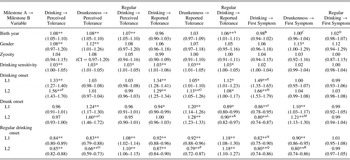
Table 6 displays the time-to-event models for first symptom, reported and perceived tolerance, drunkenness, and regular drinking onsets, respectively. Similar to the phenomena displayed in Table 5, the telescoping effect appears to occur when examining two specific outcomes. For example, age of drinking onset has a within-twin Level 1 effect on the time between drinking onset and reported tolerance onset, such that for every year Twin 1 engages in drinking earlier compared to his or her co-twin, the hazard of a longer time between drinking and reported tolerance increases by 66% (HR = 1.34). A similar phenomenon is seen when examining drunkenness onset and the time between drunkenness and reported tolerance (HR = 1.20), as well as the effect of regular drinking on the time between regular drinking and reported tolerance (HR = 1.18). However, again it appears that early age of onset of intermediary milestones actually have a shortening effect on time between two milestones. For example, drunkenness has a causal influence on the time between drinking onset and first symptom (HR = 0.86), and drinking onset and reported tolerance (HR = 0.94). In both instances, for every year earlier Twin 1 first experienced drunkenness compared to his or her co-twin, hazards of a shorter time period between drinking onset and the outcomes (first symptom and reported tolerance) increased by 14% and 6%, respectively.
Hazard ratios (95% confidence intervals) for time-to-event discordant twin multilevel frailty models estimating time from earlier outcomes to later outcomes of perceived tolerance, reported tolerance, and first symptom of AUD

Note: For all models, n pairs = 1584. AUD, Alcohol use disorder; L1, Level 1; L2, Level 2; WT, within twin; BT, between twin. The superscript capital letters indicate the hazard ratios for the interactions between variable and the log transformed time variable; all noted variables are considered time dependent in order to account for violations of proportional hazards: A1.03* (CI = 0.99–1.06). B1.05 (CI = 1.02–1.08). C1.05** (CI = 1.01–1.09). D1.05* (CI = 1.01–1.10). E0.86** (CI = 0.81–0.91). F0.86 (CI = 0.77–0.97). G0.92** (CI = 0.87–0.96). H0.82** (CI = 0.79–0.86). I1.07** (CI = 1.01–1.14). J0.79** (CI = 0.68–0.92). K0.95** (CI = 0.90–1.00). L1.11 (CI = 1.06–1.16). M0.94** (CI = 0.88–0.97). N1.07** (CI = 1.02–1.13). O1.20* (CI = 1.03–1.40). P1.06* (CI = 1.01–1.12). Q1.08 (CI = 1.03–1.13). R1.09** (CI = 1.04–1.14).
*p < .05. **p < .01.
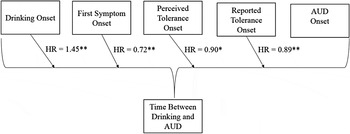
The final time-to-event AUD models had very small sample sizes (N = 389). Therefore, results for these models may not be trustworthy, particularly given the complexity of the model. However, as seen in Table 7, the same pattern seen in the previous models seemed to be replicated for the AUD model, such that when examining time between one milestone and AUD, an earlier age of onset indicated a longer time to AUD for the specific milestone in question, but an earlier age of onset for intermediary milestones lead to a shorter time to AUD. In addition, there were no “direct” causal influences of onset of perceived or reported tolerance on AUD when examining time between tolerance and AUD. Comparatively, both perceived and reported tolerance were intermediary influences on the time between first symptom and AUD. Figure 2 depicts the way in which the time between first drink and AUD is influenced by age of onset of all milestones. As seen in Figure 2, a younger age of onset of drinking is related to an increase in time between drinking onset and AUD attainment (HR = 1.45). However, younger ages of onset for attaining intermediate milestones are related to a decrease in time between drinking onset and AUD attainment.
Summary of within-twin significant causal effects for time-to-event model examining time between onset of drinking and onset of alcohol use disorder. AUD, Alcohol use disorder; HR, hazard ratio.

Hazard ratios (95% confidence intervals) for time-to-event discordant twin multilevel frailty models estimating time from earlier outcomes to later AUD

Note: For all models n pairs = 126. AUD, Alcohol use disorder; L1, Level 1; L2, Level 2; WT, within twin; BT, between twin. The superscript capital letters indicate the hazard ratios for the interactions between variable and the log transformed time variable; all noted variables are considered time dependent in order to account for violations of proportional hazards: A0.75** (CI = 0.65–0.83). B0.82** (CI = 0.69–0.96). C0.78 (CI = 0.63–0.98). D0.73 (CI = 0.61–0.87). E1.27 (CI = 1.12–1.44). F1.23** (CI = 1.09–1.39). G1.24 (CI = 1.11–1.39). H1.15** (CI = 1.02–1.29). I1.15** (CI = 1.03–1.27). J1.27** (CI = 1.10–1.47). K0.90* (CI = 0.81–1.00).
*p < .05. **p < .01.
Finally, it is important to note that, unlike the age-of-onset models, most of the effects within the time-to-event models were time dependent, in that the effects were not consistent across time. However, there were also differences within models as to whether effects were stronger at earlier or later time periods. For example, in the model predicting time from drinking onset to first symptom onset (Table 6), the age of onset for drinking (HR = 1.49) appeared to be a stronger predictor at earlier ages (HR = 0.86); however, the effect of the age of onset of drunkenness (HR = 0.86) appeared to be a stronger predictor at later ages (HR = 1.07). The large number of time-dependent effects indicates that individual temporal progression on stage-based alcohol use trajectories may be developmentally sensitive.
Time-to-event model results including zygosity and gender interactions are shown in supplementary Tables S.7–S.10. The only within-twin zygosity interaction that remained significant when all nonsignificant interactions were removed was for the time-to-event model between first symptom and AUD, for the within-twin drinking onset effect, which indicated that the effect of within-twin drinking onset on the time between first symptom and AUD was stronger in DZ compared to MZ twins (i.e., for every year one started drinking earlier than one's co-twin), there was a 42% higher likelihood of increasing the time between first symptom and AUD (supplementary Table S.10). There were also a fair amount of between-twin interactions with gender; however, results were not uniformly “stronger” for men or women. For example, as seen in supplementary Table S.7, the between-twin effect of drinking onset on the time between drinking to regular drinking onsets (HR = 1.06) indicated that the effect for earlier drinking onset was stronger for men compared to women. Conversely, the between-twin effect of drunkenness onset on the time between drinking and regular drinking onsets (i.e., the intermediary effect; HR = 0.95) indicated that an earlier onset of drunkenness was stronger for women compared to men.
Models in which participants who reported same-year predictor and outcomes were removed were also examined. As seen in supplementary Tables S.11–S.15, similar to the age-based models, results were fairly consistent for all models except for the AUD models, which could be due to the reduced sample size.
Finally, alternative models in which AUD predicted perceived and reported tolerance were also examined (see supplementary Table S.16). AUD was a significant intermediary milestone that reduced the time between antecedent milestone and outcomes in all models except for one estimating the time between regular drinking and perceived tolerance. There were no other intermediary milestone predictors, but for most models, the antecedent milestone was still a significant predictor.
Discussion
The purpose of this study was to examine a developmental cascade model of a milestone-based alcohol use trajectory to test for potentially causal effects of earlier drinking milestones on later drinking milestones. In addition, we examined the role of tolerance within this trajectory, because tolerance has been reported to be both a normative consequence of alcohol use as well as a symptom/predictor of AUD. As expected, many of the earlier milestones had potentially causal (e.g., within-twin, unique environmental) effects on later milestones, although these effects differed depending on whether this milestone-based trajectory was examined in terms of age of onset or time to event. Tolerance acted similarly to other milestones within these potentially causal pathways.
Causally inferred effects
Both age-of-onset and time-to-event models demonstrated that earlier drinking milestones were consistent with potentially causal effects on later drinking milestones when milestones were more proximal within a stage-based trajectory. The nature of these effects maps nicely onto developmental cascade theories (e.g., Masten & Ciccetti, Reference Masten and Cicchetti2010). Although previous studies have used developmental cascade theories to examine external environments on adolescent substance abuse (e.g., Haller, Handley, Chassin, & Bountress, Reference Haller, Handley, Chassin and Bountress2010; Lynne-Landsman et al., Reference Lynne-Landsman, Bradshaw and Ialongo2010), this is one of the first studies to examine the ages of earlier stages of use as environments in and of themselves. Using discordant twin analyses, we were able to remove the influence of shared genes and shared environments, allowing us to hone in on the effect of age of use specifically.
Building on previous research indicating that the relation between the age of onset of drinking and later AUD is noncausal (e.g., Prescott & Kendler, Reference Prescott and Kendler1999), this study highlights the importance of examining multiple milestones within the alcohol use trajectory. As hypothesized, for the age-of-onset models, the milestones appeared to have potentially causal influences when milestones were closer to each other within a stage-based trajectory. An earlier age of onset significantly predicted earlier age of onset for more temporally proximate subsequent milestones. It is possible that once individuals reach specific milestones, this sparks other changes in cognition, neural development, or social environment that in turn reinforce drinking behavior and increase the likelihood that the next milestone will be attained at an earlier age.
Gene–environment interactions are also possible mechanisms underlying these cascade effects. Individuals with higher genetic susceptibility to heavier alcohol use may be more influenced by milestone attainment when alcohol-specific genetic influences that influence alcohol metabolism and sensitivity come into prominence (e.g., Kendler et al., Reference Kendler, Gardner and Dick2011). An earlier trajectory may coincide with heavier drinking onsets at the time in which these genes become more influential. This would enhance a pathway that facilitates addiction, consistent with neurobiological alcohol effects pathways such as allostasis (e.g., King, Hasin, O'Connor, McNamara, & Cao, Reference King, Hasin, O'Connor, McNamara and Cao2015).
The time-to-event models were more complex. As hypothesized, when examining time from one milestone to another, an earlier age of onset for the antecedent milestone was related to a later age of onset of the subsequent milestone (i.e., a longer time between milestones). However, for milestones in between the two milestones, an earlier age of onset was related to a shorter time period in between milestones. The earlier onset/longer time period relation is consistent with a telescoping effect for ages of onset (e.g., Jackson, Reference Jackson2010), such that for individuals who attained milestones early (especially in earlier adolescence), there was a longer time until attainment of the next milestone, most likely due to the lack of opportunity for alcohol use. The shorter time period effects of the “in-between” milestones also are consistent with the age-of-onset models; regardless of availability, an earlier age of onset of one milestone is related to an earlier age of onset to the next milestone. Attaining closely related milestones most likely speeds up the stage-based trajectory overall, ensuring that, even if alcohol is harder to obtain, attaining multiple milestones at earlier ages reinforces heavier drinking behavior.
We do not suggest that reaching a milestone itself at an earlier age “causes” one to attain the next milestone at an earlier age. Rather, as proposed in the developmental cascade theory, as well as broader understanding of alcohol use mechanisms (e.g., Brown et al., Reference Brown, McGue, Maags, Schulenberg, Hingson and Swartzwelder2008), we propose a dynamic interaction between environment and behavior. Milestone attainment facilitates risky contexts in which continuing this level of alcohol consumption is reinforced and strengthened, which in turn influences subsequent milestone attainment. Engaging in one milestone at an earlier age may be a potentially causal catalyst for changes that encourage speed of transition to the next milestone. For example, alcohol use can have an important role in friendship selection in adolescence, and drinking friends are seen as attractive, high-status individuals (e.g., Osgood et al., Reference Osgood, Ragan, Wallace, Gest, Feinberg and Moody2013). Adolescents wanting to strengthen ties with drinking friends may initiate drinking behavior. This, in turn, may facilitate stronger friendships based on alcohol (i.e., increase risk-promoting environments), which will reinforce drinking behavior, increasing the hazard of attaining the next milestone at a quicker pace. In addition, increasing alcohol use, particularly at younger ages, may also impede neurocognitive developments that are normative for adolescence, and crucial for cognitive health and well-being.
It also is not reasonable to argue that simply attaining an AUD symptom could in itself facilitate disruption in neurological development or exposure to social environments that may strengthen alcohol use. Earlier research has indicated that attainment of the first symptom is predictive of later AUD status, but not in a causal fashion (e.g., Behrendt et al., Reference Behrendt, Wittchen, Hofler, Lieb, Low and Rehm2009). However, one possible explanation is that the first symptom variable is a proxy to heavier drinking beyond regular drinking. Attainment of first symptom has been related to heavier drinking behavior (Behrendt et al., Reference Behrendt, Buhringer, Perkonigg, Lieb and Beesdo-Baum2013), and it is very possible that symptom attainment may be a marker (but not a causal variable on its own) of the actual potentially causal relationship between heavy drinking behavior and subsequent AUD diagnosis.
It is important to also note that causal milestone effects do not happen in a vacuum. The developmental cascade-like nature of alcohol behavior trajectories will undoubtedly be influenced by a broad collective of influences. Alcohol use trajectories are influenced via a mix of genetic traits that predispose individuals to more impulsive or externalizing behavior, as well as poor parenting, which can exacerbate this predisposition (e.g., Iacono, Malone, & McGue, Reference Iacono, Malone and McGue2008; Sher, Reference Sher1991). Previous work with twins has indicated that the unique effect of age of onset has less influence on general drinking behavior in adulthood when genetic/familial risk for early onset of alcohol use is higher (Deutsch et al., Reference Deutsch, Slutske, Richmond-Rakerd, Chernyavskiy, Heath and Martin2013). Thus, for individuals with high deviance proneness (i.e., high externalizing predispositions), the unique effect of milestone onset may be less influential.
It is also worth noting that there appeared to be few gender differences in models. Although previous work has indicated marked gendered telescoping effects, such that women initiate alcohol use later than men, and then quickly “catch up” to men regarding heavier use (e.g., Randall et al., Reference Randall, Roberts, Del Boca, Carroll, Connors and Mattson1999), other studies have indicated that this is not evident in more recent cohorts (e.g., Keyes, Martins, Blanco, & Hasin, Reference Keyes, Martins, Blanco and Hasin2010). Given that we used same-sex twins, it is unlikely to see gender interactions with within-twin effects. Between twin effects had no overall pattern of stronger effects for either men or women, results were varied as to whether certain milestones were stronger for men or women, particularly for the time-to-event models, which is where most of the “telescoping” effects should have been documented.
Tolerance
Finally, we were also interested in the function of tolerance as a specific milestone, given its dichotomy as an AUD symptom and normative consequence of drinking, as well its developmentally sensitive nature as an AUD predictor (Chung et al., Reference Chung, Martin, Winters and Langenbucher2001; Martin & Winters, Reference Martin and Winters1998). Although tolerance has a long history as a symptom of AUD, it is also arguably one of the most difficult symptoms to study. Varying definitions of tolerance have led to an increase in variability (and thus questionable validity) in AUD diagnosis (Hasin et al., Reference Hasin, Schuckit, Martin, Grant, Bucholz and Hezler2003). In addition, other studies question the importance of tolerance as a cornerstone of the development of addiction (King et al., Reference King, Hasin, O'Connor, McNamara and Cao2015).
There were few differences in how tolerance or other first AUD symptoms were predicted by earlier milestones. There were also no differences between age of onset of tolerance and first AUD symptom in predicting AUD. Tolerance was not time dependent in this model, indicating that the effect of age of onset of tolerance was similar across age. For time-to-event models, tolerance measures acted similarly to first AUD symptom as an outcome, but not a predictor. They were predicted similarly by initial milestones (age of drinking, drunkenness, and regular drinking). When they acted as the antecedent milestone in the time-to-event models, the age of onset of neither perceived nor reported tolerance had an effect on the time between attaining these tolerance milestones and subsequent AUD. Conversely, when examining the time between first AUD symptom (not tolerance) and AUD, both perceived and reported tolerance had significant effects, such that an earlier age of onset of tolerance increased hazards of a shorter time period between first AUD symptom and AUD. Due to variability in measurement of tolerance, as well as questions about the potential role of tolerance as a main pathway to addiction, these results need to be replicated and extended. However, these results potentially indicate a dual nature of tolerance as both a normative drinking milestone and an AUD symptom. Tolerance may be a normative consequence of drinking; a trajectory marked by earlier drinking milestones can lead to earlier tolerance, although this in itself may not necessarily be problematic. However, when earlier drinking milestones are also paired with earlier onsets of other AUD symptoms, tolerance may also facilitate a quicker transition to AUD.
Strengths and limitations
This study is one of the first to take a fine-grained view of alcohol use based on the trajectory of milestones. In addition, this trajectory was examined as a function of both age and time, accounting for potential differences within adolescent and adult alcohol use. Genetically informed twin data also provided stronger tests of association by removing the confounding effects of shared genes and environment. The quasi-experimental nature of the discordant-twin analysis allowed for a clearer identification of the underlying mechanisms that guide associations between milestones.
The most obvious limitation of this study is the use of retrospective reports. It is possible that individuals were not able to accurately recall the exact age of onset for these behaviors. In addition, the measures used for age of onset were year based. More nuanced information could have been used, especially regarding events that potentially happened within the same year to determine if these events were concurrent or sequential. This lack of detail extends to a lack of information about contexts in which these behaviors took place. Limited contextual information about drinking initiation does not allow us to test assumptions of the equivalent exposures within and between pairs. For example, although early alcohol use is associated with later alcohol problems, contexts in which youth first start drinking outside the family seem to add to this risk (Warner & White, Reference Warner and White2003). Another limitation is the smaller sample sizes in the models of later stages in the alcohol use trajectory, such as the AUD model. Because multilevel nested models need both twin-pair and individual information, twin pairs who only had one individual reporting some behaviors were not included in the final model. Therefore, although the initial sample was quite large, later models that examined later drinking milestones decreased by size, and due to both a decrease in size and the complexity of the model, it is possible that these factors influenced the final results. Care should be taken in interpreting the final model results; the results, particularly from the AUD model, should be replicated in other samples.
The results based on this sample of predominantly white Australian young adults may not generalize to other countries, age groups, racial/ethnic groups, or historical periods. Other unmeasured unique environmental effects could explain the relations between earlier and later milestones as well. Strong causal inferences cannot be drawn solely from these analyses, because there may be potential within-twin-pair confounders or mediating variables that have not been taken into account. Finally, these results cannot explain the underlying mechanisms that may be driving a developmental-cascade type relationship between milestones. Additional research is needed to better identify the specific mechanisms that explain these relationships.
Future research and implications
In addressing these limitations, future research would benefit from prospective data collected at regular intervals. This would allow for more accurate reports of specific onsets. Other drinking milestones, such as first episode of binge drinking, first long-term period of heavy drinking, and other individual AUD symptoms, as well as milestones that examine desistence and recidivism of drinking behavior should also be examined. Whether or not age or time of previous milestone attainment has any influence on decreases in alcohol use (or specific milestones marking decreases), as compared to increases, is relatively understudied. This would also be beneficial for examining within a maturing-out framework (e.g., Lee & Chassin, Reference Lee and Chassin2013). The stability of milestone and stage attainment over shorter periods of time should also be examined. Although we use “onset” as a marker of attaining a specific milestone, engagement may oscillate, especially over shorter time periods.
Finally, examining trajectories within a broader context of biopsychosocial systems that relate to alcohol use will help us understand potential mediators and moderators of behavioral cascades in alcohol use. Examining milestones/alcohol use stages within the context of developmental stages will help us better understand the relevancy of milestones. This may be particularly important for milestones that are close together in proximity. If two milestones occur in a short period of time, it is possible that developmental-specific unique environment onsets may be underlying mechanisms influencing milestone attainments. Unique environmental influences that relate to both predictor (earlier milestone) and outcome (subsequent milestone) may be confounding effects on a causally inferred pathway. However, whether close milestones may share these influences or if there is a reciprocal relationship that allows for a developmental-cascade trajectory remains to be seen.
Such nuances will be particularly important in developing more effective prevention and intervention methods to tailor needs based on both the age of the participant and the stage of alcohol use. Examining the speed at which an individual has gone through previous milestones, as well as the contexts in which these milestones occurred, will help pinpoint the potential urgency of treatment needed, as well as what may be the best type of treatment for specific individuals.
Conclusion
This study is one of the first to examine multiple alcohol use milestones within an individual trajectory. In sum, we documented that within a stage-based trajectory, earlier milestones have potentially causal effects on subsequent milestones that are close in trajectory proximity, such that an earlier age of onset of one milestone increases the likelihood of an earlier age of onset for the next milestone. However, there are differences in the effect of age of onset of milestones when examining age or time-to-event outcomes, indicating that the two may not be inextricably linked. Ultimately, this paper emphasizes that alcohol use itself is a developmental behavior that undergoes multiple qualitative changes that are separate from overall developmental change, as well as the importance of earlier milestones when examining later problematic drinking.
Supplementary Material
To view the supplementary material for this article, please visit http://dx.doi.org/S0954579416000523.