Introduction
Hysterothylacium species are marine ascaridoids that complete their life cycle in various fish species. Usually fish low on the food chain act as intermediate/paratenic hosts for Hysterothylacium species, whereas large predatory fish are their definitive hosts (Deardorff & Overstreet, Reference Deardorff and Overstreet1981). Members of the Hysterothylacium species are considered to be of zoonotic significance following a case of human infection with a female Hysterothylacium aduncum in Japan (Yagi et al., Reference Yagi, Nagasawa, Ishikura, Nakagawa, Sato, Kikuchi and Ishikura1996).
According to Froese & Pauly (Reference Froese and Pauly2016) over 200 species of fish are found in Iraqi marine waters, many of which are edible; however, our knowledge of their parasites is poor. Although there have been some reports on the presence of Hysterothylacium in Iraqi marine fish, most of these are based on morphology only, providing limited morphological description that makes specific identification difficult (Ali et al., Reference Ali, Mhaisen and Khamees2014). Therefore the aim of the present study was to provide a detailed morphology combined with sequence data of the first and second transcribed spacers of the ribosomal DNA (ITS-1 and ITS-2, respectively) for selected Hysterothylacium species found in the region.
Materials and methods
Collection and examination of nematodes
Nematode parasites were collected from five species of fish – the areolate grouper, Epinephelus areolatus (Forsskål, 1775), tigertooth croaker, Otolithes ruber (Bloch & Schneider, 1801), largetooth flounder, Pseudorhombus arsius (Hamilton, 1822), brushtooth lizardfish, Saurida undosquamis (Richardson, 1848) and oriental sole, Brachirus orientalis (Bloch & Schneider, 1801) – from Khor Abdulla, located in the south of Iraq. All fish were examined visually; nematode parasites were collected and preserved in 70% ethanol, and transferred to the Parasitology Laboratory, Charles Sturt University, Australia, where they were prepared for morphological and molecular examination. A small piece of the mid-body of each nematode was excised for molecular study, and the rest of the nematode was cleared in lactophenol for morphological examination, as described previously (Shamsi et al., Reference Shamsi, Gasser, Beveridge and Shabani2008, Reference Shamsi, Norman, Gasser and Beveridge2009a, Reference Shamsi, Norman, Gasser and Beveridgeb, Reference Shamsi, Gasser and Beveridge2011). Nematodes were identified using the morphology of the labia, the position of the excretory pore, the oesophageal ventriculus, ventricular appendix and the tail (Shamsi et al., Reference Shamsi, Gasser and Beveridge2013, Reference Shamsi, Poupa and Justine2015, Reference Shamsi, Ghadam, Suthar, Ebrahimzadeh Mousavi, Soltani and Mirzargar2016; Shamsi, Reference Shamsi2016). All measurements are given in millimetres as the mean followed by the range in parentheses. The specimens have been deposited in the South Australian Museum, Adelaide (SAM).
Molecular analysis
Genomic DNA was isolated from individual larvae by sodium dodecyl sulphate/proteinase K treatment, column-purified (Wizard™ DNA Clean-Up, Promega, Madison, Wisconsin, USA) and eluted into 40 μl of water (Shamsi et al., Reference Shamsi, Gasser, Beveridge and Shabani2008). Host DNA was isolated from the musculature of fish using the same method. The polymerase chain reaction (PCR) was used to amplify the ITS-1 and ITS-2 regions using primers and cycling conditions described previously (Shamsi et al., Reference Shamsi, Gasser, Beveridge and Shabani2008, Reference Shamsi, Norman, Gasser and Beveridge2009a, Reference Shamsi, Norman, Gasser and Beveridgeb, Reference Shamsi, Gasser and Beveridge2011). Samples with fish DNA or without genomic DNA were included in the PCRs as negative controls; no amplicons were produced in the PCR from these samples. An aliquot (4 μl) of each amplicon was examined on a 1.5% w/v agarose gel, stained with ethidium bromide and photographed using a gel documentation system.
Amplicons were purified over mini-columns (Wizard™ PCR Prep, Promega), eluted in 30 μl of water and then were sent to Australian Genomic Research Facilities to be subjected to Sanger sequencing, in both directions, using the same primers as for PCR. Sequences were aligned using the computer program ClustalX (Thompson et al., Reference Thompson, Gibson, Plewniac, Jeanmougin and Higgins1997) and then adjusted manually. Polymorphic sites were designated using International Union of Pure and Applied Chemistry (IUPAC) guidelines.
Results
Three distinct Hysterothylacium taxa were found in the examined fish in the present study. Their morphological description and molecular characterization based on the ITS sequence data are provided below and details of the specimens examined in the present study are shown in table 1.
Details of the museum and GenBank accession numbers of the Hysterothylacium spp. examined in the present study.

Hysterothylacium larval type XVI
Material examined
Ten specimens: specimen number 15-1 from the stomach of E. areolatus, museum accession number AHC47861; specimen numbers 2-3, 2-4, 2-10, 2-13, 2-14, 2-15 and 2-16 from the alimentary tract of P. arsius, museum accession number AHC47862; and specimen numbers 6-3 and 6-18 collected from the intestine of S. undosquamis, museum accession number AHC47863.
Description
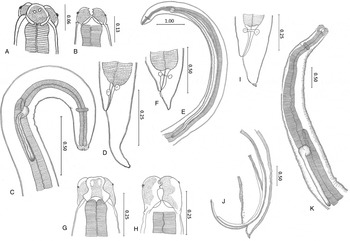
Fourth-stage larvae (fig. 1A–D). Body length 7.62 (3.55–10.73; n = 10), width 0.21 (0.13–0.35; n = 10). Three labia, one dorsal, two subventrals; dorsal labium 0.05 (0.04–0.07; n = 7) long, 0.05 (0.03–0.07; n = 7) wide, subventral labia 0.05 (0.03–0.08; n = 8) long, 0.04 (0.03–0.06; n = 8) wide, interlabia 0.02 (0.01–0.02; n = 8) long. Nerve ring 0.28 (0.24–0.35; n = 5) from anterior end. Excretory pore below the nerve ring, 0.32 (0.28–0.40; n = 4) from anterior end. Muscular oesophagus 0.77 (0.58–0.96; n = 7) long, 0.09 (0.09–0.10; n = 7) of body length. Ventriculus relatively round, 0.08 (0.07–0.09; n = 2) long. Ventricular appendix 0.39 (0.34–0.46; n = 3) long, 0.47 (0.43–0.50; n = 3) of oesophageal length. Intestinal caecum 0.18 (0.16–0.22; n = 3) long, 0.22 (0.17–0.26; n = 3) of oesophageal length and 0.48 (0.35–0.59; n = 3) of ventricular appendix length. Tail 0.21 (0.16–0.30; n = 8) long, 0.09 (0.05–0.14; n = 8) wide, 0.03 (0.02–0.04; n = 8) of body length, with relatively few sharp spines at tip.
Larvae of third and fourth stages (L3, L4) and adults of Hysterothylacium spp. (A) Dorsal labium, (B) subventral labia, (C) anterior and (D) posterior ends of the Hysterothylacium type XVI fourth-stage larva. (E) Anterior and (F) posterior ends of the Hysterothylacium type XV third-stage larva. (G) Dorsal labium, (H) subventral labia, (I) posterior end of a female, (J) posterior end of male and (K) anterior end of Hysterothylacium reliquens adults. Scale bars are given in millimetres.

Molecular characterization
ITS-1 and ITS-2 were 436 and 276 bp long, respectively (GenBank accession numbers: LT717074–7). They were, respectively, 99.5% and 100% identical to Hysterothylacium persicum (GenBank accession numbers LT576366, LT576367, LT576368 (ITS-1) and LT576369, LT576370, LT576371 (ITS-2)).
Hysterothylacium larval type XV of Shamsi, Ghadam, Suthar, Ebrahimzadeh Mousavi, Soltani, & Mirzargar, Reference Shamsi, Ghadam, Suthar, Ebrahimzadeh Mousavi, Soltani and Mirzargar2016
Material examined
Twenty-two specimens: specimen numbers 20-16 and 20-19 collected from the intestine of O. ruber, museum accession number AHC47864; specimen numbers 2-5, 2-6, 2-21, 2-23 and 2-24 collected from the intestine of P. arsius, museum accession number AHC47865; specimen numbers 6-4, 6-6, 6-10, 6-11 and 6-16 collected from the intestine of S. undosquamis, museum accession number AHC47866; and specimen numbers 1-1, 1-9, 1-19, 1-21, 1-23, 1-25, 1-26, 1-29, 1-36 and 1-38 collected from the liver of B. orientalis, museum accession number AHC47867.
Description
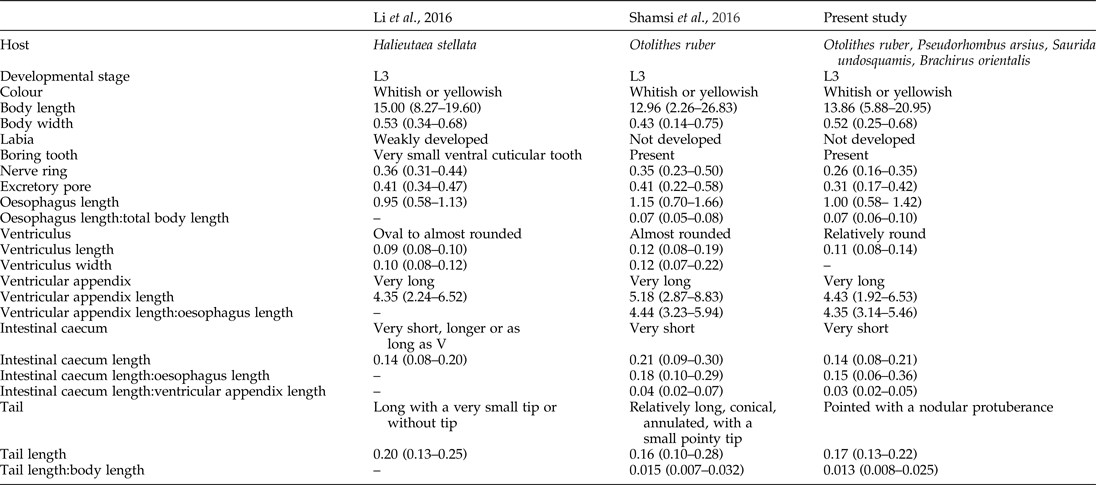
Third-stage larvae (fig. 1E and F), labia not developed. Body length 13.86 (5.88–20.95; n = 22), width 0.52 (0.25–0.68; n = 22). Tooth present. Nerve ring 0.26 (0.16–0.35; n = 17) from anterior end. Excretory pore below the nerve ring, 0.31 (0.17–0.42; n = 16) from anterior end. Oesophagus 1.00 (0.58–1.42; n = 22) long, 0.07 (0.06–0.10; n = 22) of body length. Ventriculus relatively round, 0.11 (0.08–0.14; n = 19) long. Ventricular appendix 4.43 (1.92–6.53; n = 20) long, 4.35 (3.14–5.46; n = 20) times oesophageal length. Intestinal caecum short, 0.14 (0.08–0.21; n = 14) long, 0.15 (0.06–0.36; n = 14) of oesophageal length and 0.03 (0.02–0.05; n = 13) of ventricular appendix length. Tail pointed with a nodular protuberance, 0.17 (0.13–0.22; n = 21) long, 0.31 (0.21–0.43; n = 21) wide, 0.013 (0.008–0.025; n = 21) of body length.
Molecular characterization
ITS-1 and ITS-2 were 440 and 297 bp long, respectively (GenBank accession numbers: LT717078–9). They were, respectively, 100% and 99.7% identical to previously reported Hysterothylacium larval type XV (GenBank accession numbers LT576348–56 (ITS-1) and LT576363–5 (ITS-2)).
Hysterothylacium reliquens (Norris & Overstreet, Reference Norris and Overstreet1975)
Material examined
Twenty-eight specimens: specimen numbers 20-6, 20-15 and 20-24 (males) and 20-2, 20-3, 20-4, 20-7, 20-11, 20-12, 20-13, 20-17, 20-18 and 20-23 (females) collected from the intestine of O. ruber, museum accession number AHC47868; specimen numbers 1-27, 1-33, 1-34, 1-35 and 1-37 (males) and 1-3, 1-8, 1-15, 1-16, 1-17, 1-18, 1-20, 1-22, 1-30 and 1-31 (females) collected from the liver of B. orientalis, museum accession number AHC47869.
Description
Males
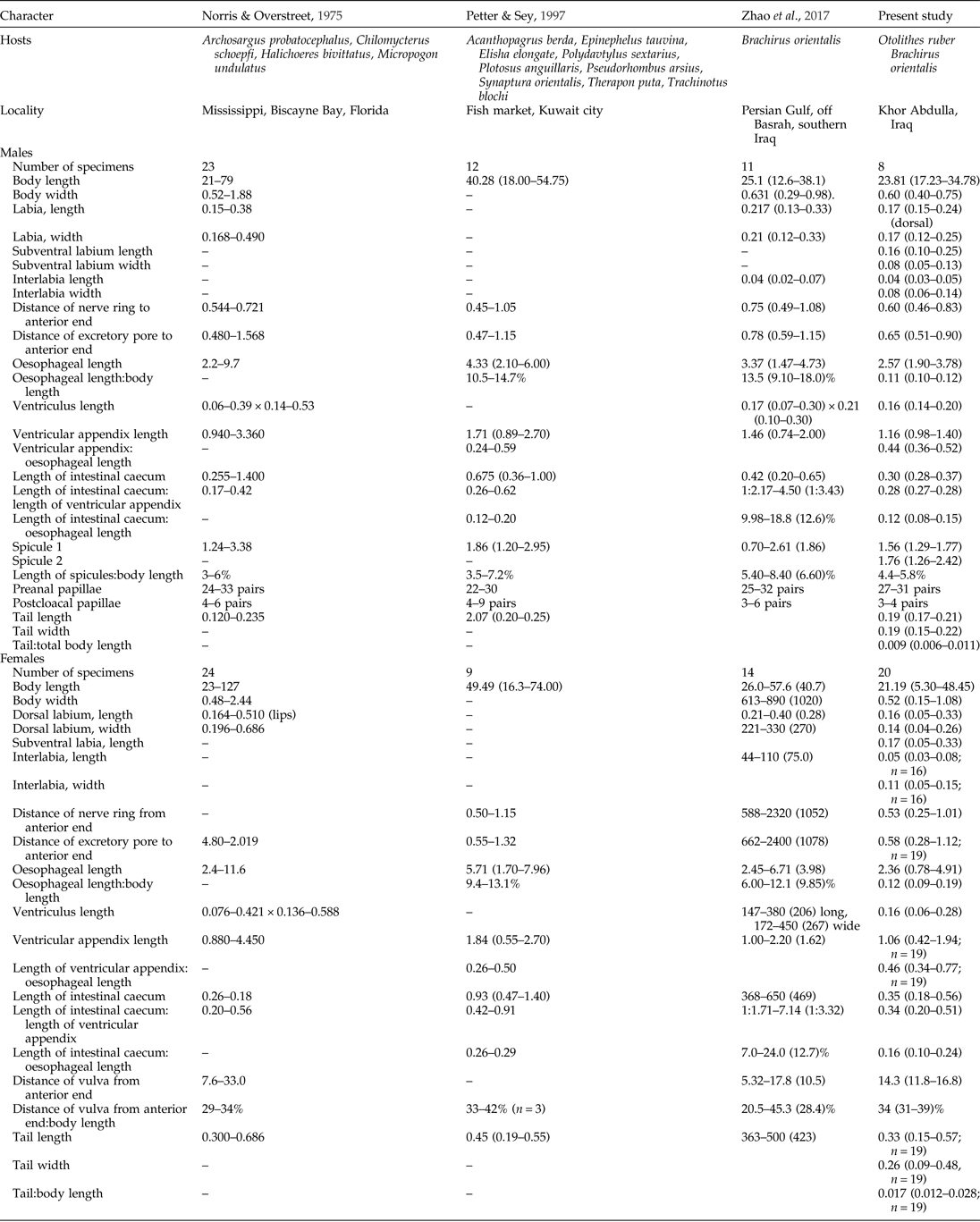
Cuticle annulated; alae present. Body length 23.81 (17.23–34.78; n = 8), width 0.60 (0.40–0.75; n = 8). Three labia, one dorsal, two subventrals; dorsal labium 0.17 (0.15–0.24; n = 7) long, 0.17 (0.12–0.25; n = 7) wide, subventral labium 0.16 (0.10–0.25; n = 8) long, 0.08 (0.05–0.13; n = 8) wide, interlabia 0.04 (0.03–0.05; n = 8) long, 0.08(0.06–0.14; n = 8) wide at base. Nerve ring 0.60 (0.46–0.83; n = 8) from anterior end. Excretory pore below the nerve ring, 0.65 (0.51–0.90; n = 7) from anterior end. Muscular oesophagus 2.57 (1.90–3.78; n = 8) long, 0.11 (0.10–0.12; n = 8) of body length. Ventriculus relatively round, 0.16 (0.14–0.20; n = 8) long. Ventricular appendix 1.16 (0.98–1.40; n = 5) long, 0.44 (0.36–0.52; n = 5) of oesophageal length. Intestinal caecum 0.30 (0.28–0.37; n = 5) long, 0.12 (0.08–0.15; n = 5) of oesophageal length and 0.28 (0.27–0.28; n = 3) of ventricular appendix length. Spicules blunt; spicule 1 1.56 (1.29–1.77; n = 3) long and spicule 2 1.76 (1.26–2.42; n = 8) long. Precloacal papillae 27–31 pairs, postcloacal papillae 3–4 pairs. Tail 0.19 (0.17–0.21; n = 8) long, 0.19 (0.15–0.22; n = 8) wide, 0.009 (0.006–0.011; n = 8) of body length.
Females
Cuticle annulated; alae present. Body length greatly variable 21.19 (5.30–48.45; n = 20), width 0.52 (0.15–1.08; n = 20). Three labia, one dorsal, two subventrals; dorsal labium 0.16 (0.05–0.33; n = 20) long, 0.14 (0.04–0.26; n = 20) wide, subventral labia 0.17 (0.05–0.33; n = 20) long, 0.09 (0.03–0.23; n = 20) wide, interlabia 0.05 (0.03–0.08; n = 16) long, 0.11(0.05–0.15; n = 16) wide at base. Nerve ring 0.53 (0.25–1.01; n = 20) from anterior end. Excretory pore below the nerve ring, 0.58 (0.28–1.12; n = 19) from anterior end. Muscular oesophagus 2.36 (0.78–4.91; n = 20) long, 0.12 (0.09–0.19; n = 20) of body length. Ventriculus relatively round, 0.16 (0.06–0.28; n = 20) long. Ventricular appendix 1.06 (0.42–1.94; n = 19) long, 0.46 (0.34–0.77; n = 19) of oesophageal length. Intestinal caecum 0.35 (0.18–0.56; n = 20) long, 0.16 (0.10–0.24; n = 20) of oesophageal length and 0.34 (0.20–0.51; n = 19) of ventricular appendix length. Tail conical, tip covered with numerous minute spinous structures, 0.33 (0.15–0.57; n = 19) long, 0.26 (0.09–0.48, n = 19) wide, 0.017 (0.012–0.028; n = 19) of body length.
Molecular characterization
ITS-1 and ITS-2 were 432 and 341 bp long, respectively (GenBank accession numbers: LT717080–5). They were 100% identical to ITS-1 and ITS-2 of H. reliquens available in GenBank (KX786289–93).
Discussion
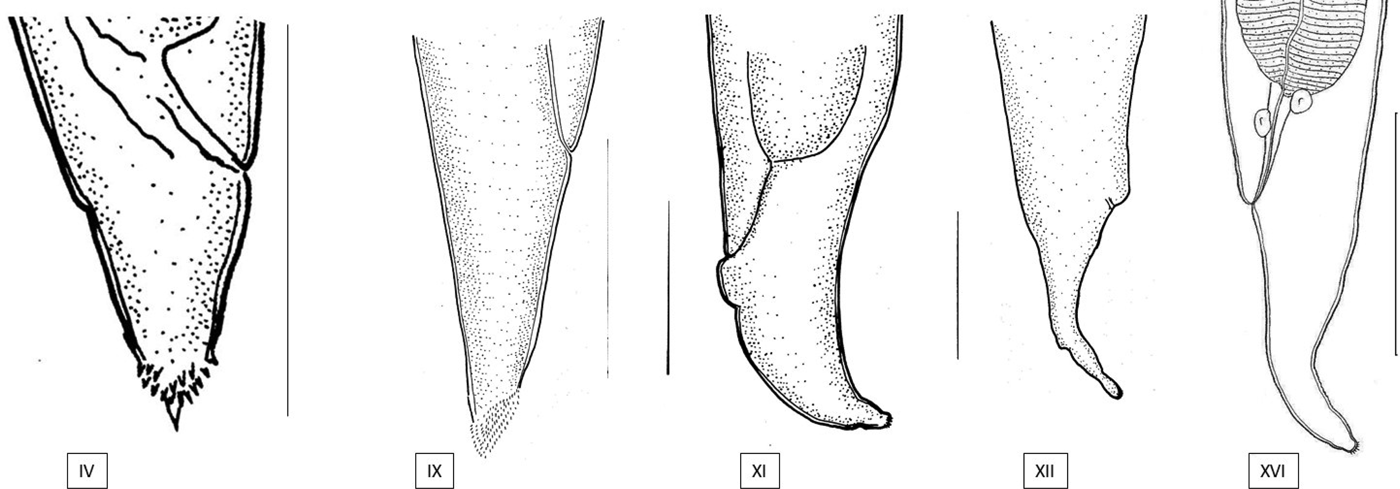
This is the first study describing Hysterothylacium larval type XVI. This morphotype is in the fourth developmental stage, of which there are only four previous reports, including types IV, IX, XI and XII (Shamsi et al., Reference Shamsi, Gasser and Beveridge2013, Reference Shamsi, Poupa and Justine2015). Hysterothylacium type XVI in the present study can be easily distinguished from types IV, IX, XI and XII by the morphology of the tail (fig. 2). Hysterothylacium larval types IV and IX are distinct by having a cluster of spines, and types XI and XII can be differentiated morphologically based on the width of the tail region, being very narrow in type XII and being fleshier in type XI. In addition to the morphological differences, ITS sequence data support the distinction of Hysterothylacium larval type XVI from types IV, IX, XI and XII. Interestingly, alignment of the ITS-1 and ITS-2 sequence data of Hysterothylacium larval type XVI in the present study with those deposited in GenBank shows that they are almost identical (99.5–100% similarity) with adult H. persicum (GenBank accession numbers LT576366, LT576367, LT576368 (ITS-1) and LT576369, LT576370, LT5 76371 (ITS-2)) and Hysterothylacium larval type XIV (GenBank accession numbers LN651105–LN651107), which is a third-stage larva. Therefore, the present study contributed to elucidating the partial life cycle of H. persicum among various hosts and its distribution, which seems to be wide, at least from New Caledonia in the South Pacific to the most western corner of the Persian Gulf, off Iraqi coasts in the northern hemisphere.
Comparison of the tail morphology between Hysterothylacium larval types in the fourth stage of development. Roman numbers refer to the larval type. Scale bars: 0.2 mm.

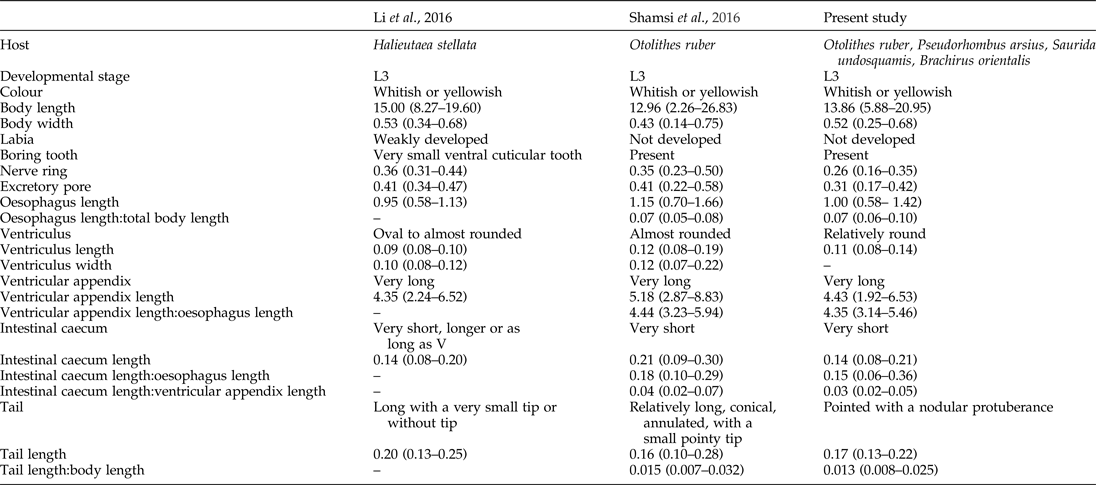
Another Hysterothylacium larval type in the present study was Hysterothylacium type XV, which had been described previously for the first time from the East and South China Sea (Li et al., Reference Li, Zhao, Guo and Zhang2016) and later from the area joining the Persian Gulf and the Gulf of Oman (Shamsi et al., Reference Shamsi, Ghadam, Suthar, Ebrahimzadeh Mousavi, Soltani and Mirzargar2016). In the present study, we report three new hosts, P. arsius, S. undosquamis and B. orientalis, for this larval type. Comparison of morphological characters between specimens examined in the present study and those in previous studies (table 2) showed that they belong to the same larval type. This is also supported by ITS-1 and ITS-2 sequence data, which were, respectively, 100% and 99.7% identical to previously reported Hysterothylacium larval type XV (Shamsi et al., Reference Shamsi, Ghadam, Suthar, Ebrahimzadeh Mousavi, Soltani and Mirzargar2016), GenBank accession numbers LT576354 (ITS-1) and LT576363 (ITS-2).
Comparison of the morphology of the Hysterothylacium type XV third-stage larva (L3) in the present study with previous studies. All measurements are given in millimetres.
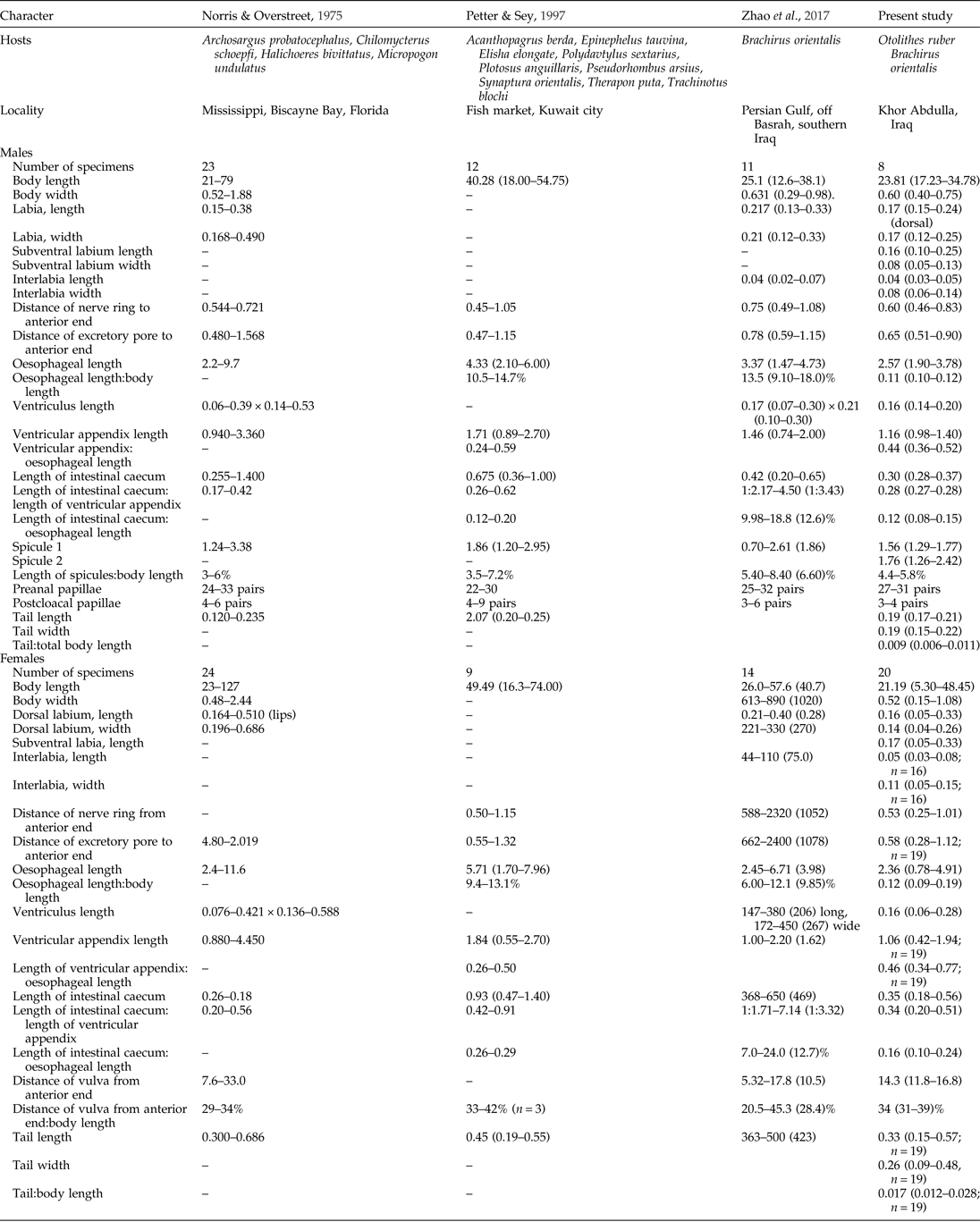
Hysterothylacium reliquens was first described by Norris & Overstreet (Reference Norris and Overstreet1975) from Archosargus probatocephalus (type host) and other fishes of the northern Gulf of Mexico and southern Florida. The species was later reported sporadically from other parts of the world, including from the Persian Gulf off Kuwait and Iraq (Petter & Sey, Reference Petter and Sey1997; Zhao et al., Reference Zhao, Zhao, Ali, Chen and Li2017). Comparison of morphological characteristics of taxonomic significance among H. reliquens specimens in the present study and those in the previous studies (table 3) does not show a significant difference and, as suggested previously (Zhao et al., Reference Zhao, Zhao, Ali, Chen and Li2017), it seems that this species has a wide geographical distribution across continents. In the present study we report O. ruber as a new host for H. reliquens.
Comparison of the morphometric characters of H. reliquens in the present study with the original report and previous reports from the same regions (measurements are given in millimetres).
In conclusion, the present study showed the presence of at least three members of the genus Hysterothylacium in Iraqi fish. The detailed morphological characterization, along with characterization of the ITS-1 and ITS-2 regions of these taxa, can be useful for any future taxonomical and systematics studies of these parasites in the region and beyond.
Financial support
The School of Animal and Veterinary Sciences, Charles Sturt University and Graham Centre for Agricultural Innovations provided financial support toward taxonomic studies in this work.
Conflict of interest
None.