





Introduction
Psychiatric training organizations are highlighting the importance of psychiatric formulation (American Board of Psychiatry & Neurology, 2011; Royal Australian and New Zealand College of Psychiatrists, 2016, 2022; Royal College of Psychiatrists, 2023). However, questions remain as to how it should be taught. For example, difficulties in achieving reproducible standards for assessment led to the removal of formulation from the Royal College of Psychiatrists’ membership (MRCPsych) examinations (Benning & Broadhurst, Reference Benning and Broadhurst2007; Reveley, Reference Reveley1983; Tyrer, Reference Tyrer2007; Tyrer & Oyebode, Reference Tyrer and Oyebode2004). If formulation cannot be standardized, why persist in teaching and assessing it?
Yet the counter-argument remains. Both institutions and individual practitioners continue to identify formulation as a critical element of psychiatric practice with, for example, the UK’s Royal College of Psychiatrists explicitly listing it as a high-level outcome (HLO 2.2) in both core and all specialty trainings (Royal College of Psychiatrists, 2022a, 2022b). The paradox, then, is clear: although assessment frameworks have struggled to capture formulation reliably, psychiatry continues to regard it as central to its identity and practice.
The pedagogic challenge of psychiatric formulation is inseparable from the complexity of the concept itself (Owen, Reference Owen2023). Its intellectual lineage dates to the 1920s, when Adolf Meyer introduced the notion of ‘psychobiological reactions’ and advocated for the use of individual life charts. Subsequently Engel’s seminal contribution – the biopsychosocial (BPS) model – remains foundational to contemporary discussions. Within British psychiatry, the ‘4P’ model (predisposing, precipitating, perpetuating, and protective factors) emerged as a pragmatic extension of BPS. American psychiatry was more influenced by psychoanalytic paradigms, favorable to formulation, until the introduction of the DSM-III multiaxial system sought to enhance reliability. This system was later abandoned in DSM-5, reflecting a shift away from structured formulation in favor of symptom-based classification alone. At Johns Hopkins in the United States, McHugh and Slavney (Reference McHugh and Slavney1998) reoriented psychiatric assessment toward Karl Jaspers’ methodological pluralism. Their model proposed 4 ‘perspectives’: Diseases, Dimensions, Behaviors and Life Stories and prioritized ‘intelligibility’ over reliability (DSM-III) or causal inference (4P) (McHugh, Reference McHugh2012).
Despite its rich and varied history, formulation in contemporary psychiatric practice risks marginalization or mere lip service. It is often reduced to psychological interpretation, with limited integration of biological and social domains – undermining its holistic intent. Yet any clinical skill deemed essential must be supported by structured training, particularly when conceptually demanding.
In response to a renewed interest in formulation, we undertook a review of the literature with two objectives:
-
1. To systematically examine academic publications on the teaching of psychiatric formulation.
-
2. To reflect on these findings and propose recommendations for enhancing formulation pedagogy within psychiatric education.
Methods
This study on education formed part of a wider effort to identify published literature on psychiatric formulation. To get an overview of the landscape of publications on psychiatric formulation, we searched two bibliographic databases, PsychINFO (1806–present) and MEDLINE (OVID interface, 1948 onwards), for relevant peer-reviewed literature from their inception until June 15, 2023. A search strategy was developed by the first author (GF) with a university librarian. After the MEDLINE strategy was finalized, it was adapted to the syntax and subject headings of PsychINFO (see Supplementary Table S1).
After deduplication, two reviewers (GF and GK) independently screened all titles and abstracts. We started by doing a pilot testing for screening titles and abstracts (T&A) to set an agreement about provisional inclusion and exclusion criteria using EPPI-Reviewer. The κ coefficient was 0.39 reflecting the complex and varied nature of the literature we found but indicating fair interrater agreement. It was clear that one category of publication was medical education. This area of inquiry addresses the varied educational strategies developed to support teaching on formulation. We were able to ‘tag’ these publications, and our interrater agreement was higher (κ = 0.50).
Table 1 gives our final inclusion and exclusion criteria.
Inclusion and exclusion criteria

Table 1. Long description
The table is divided into two main sections.
Inclusion criteria:
- Peer-reviewed publications in English available in full text format discussing the concept of clinical formulation within psychiatry.
- Papers discussing formulation in the field of medical education.
- Papers addressing recognised psychiatric disorders including psychosomatic and stress-related disorders.
Exclusion criteria:
- Abstract-only evidence, conference proceedings and other grey literature.
- Books, paper reviews or comments.
- Papers where the discussion is around the topic of cultural formulation or risk formulation.
- Articles on formulation for or by professionals working in a field other than psychiatry i.e. occupational therapy.
- Articles which discuss the term formulation within a restricted psychotherapy framework/school/standpoint.
- Papers presenting a single case report and the specifics of its formulation.
Given the importance of this category of publications, a systematic review of the literature on psychiatric formulation in medical education became the object of our study. Our primary aim was to explore and thematize how formulation in psychiatry has been approached in medical education.
Full-text papers of any T&A agreed for inclusion by both reviewers were retrieved where possible. Subsequently, each study was assessed by the first author for eligibility. Papers which raised doubt about inclusion were discussed as a group and a consensus decision agreed. To increase the chance of literature saturation, we scanned the reference lists of included studies.
We then performed thematic analysis (Braun & Clarke, Reference Braun and Clarke2006). GF read and immersed in all the papers and developed an initial set of themes. Individual papers raising interpretative challenges were shared with GO for discussion. Through an iterative cycle involving several returns to the primary texts, we developed a thematization of the literature.
Results
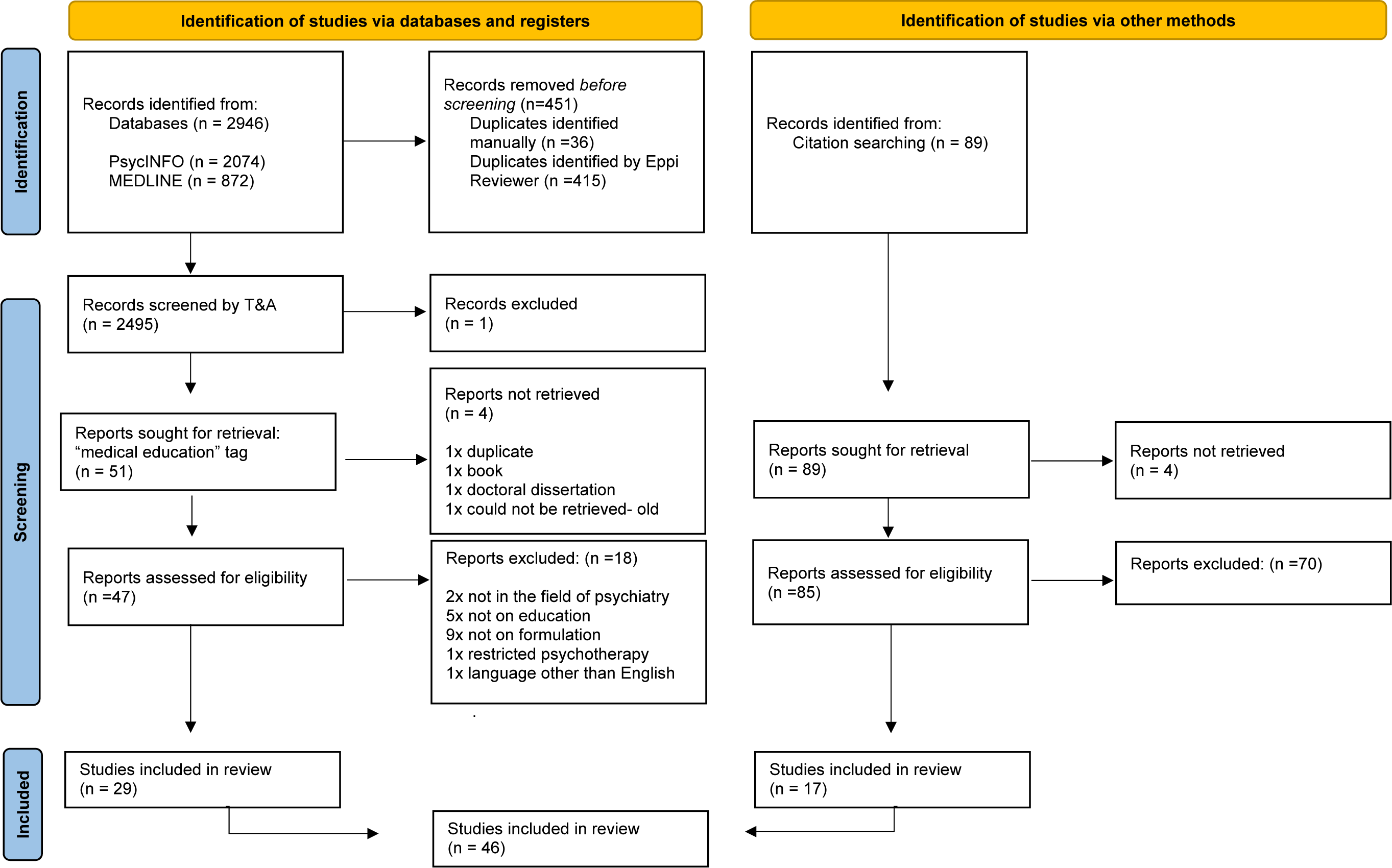
The search identified a total of 2,946 citations of which 451 were removed as duplicates. Out of these, 2,495 records were screened by T&A, and 51 were tagged as relevant under the ‘medical education’ filter (see Figure 1 for the Preferred Reporting Items for Systematic Reviews and Meta-Analyses [PRISMA] flow diagram) (Page et al., Reference Page, Moher, Bossuyt, Boutron, Hoffmann, Mulrow, Shamseer, Tetzlaff, Akl, Brennan, Chou, Glanville, Grimshaw, Hróbjartsson, Lalu, Li, Loder, Mayo-Wilson, McDonald and McKenzie2021).
PRISMA flow diagram showing the study selection process.

Figure 1. Long description
The flowchart is divided into three vertical phases: Identification, Screening, and Included.
Column 1: Identification of studies via databases and registers.
- Records identified from Databases (n = 2946), including Psyc I N F O (n = 2074) and M E D L I N E (n = 872).
- Records removed before screening (n = 451): 36 duplicates identified manually and 415 duplicates identified by Eppi Reviewer.
- Records screened by T & A (n = 2495), with 1 record excluded.
- Reports sought for retrieval with medical education tag (n = 51). 4 reports were not retrieved due to being a duplicate, a book, a doctoral dissertation, or too old.
- Reports assessed for eligibility (n = 47). 18 reports were excluded: 2 not in psychiatry, 5 not on education, 9 not on formulation, 1 restricted psychotherapy, and 1 non-English.
- Studies included in review (n = 29).
Column 2: Identification of studies via other methods.
- Records identified from Citation searching (n = 89).
- Reports sought for retrieval (n = 89), with 4 reports not retrieved.
- Reports assessed for eligibility (n = 85), with 70 reports excluded.
- Studies included in review (n = 17).
Bottom Center: The two columns converge to a final box stating Studies included in review (n = 46).
After full-text assessment, 29 out of 51 papers were included in the final analysis. In addition to these, 17 papers were found from citation searches giving a total of 46 papers.
The literature reviewed was predominantly opinion-based or descriptive and located geographically (mainly toward the United States and Australia with limited representation from other Anglophone countries – Canada, New Zealand, and the United Kingdom) and a single source from India.
Two main categories emerged: ‘Formulation tools’ and ‘Educational strategies’ with a few papers classifiable as ‘Evaluation of Outcomes’.
Formulation tools
Most papers in this category aimed at presenting frameworks for psychiatric formulation with variable attention to teaching (see Supplementary Table S2). The most striking overall feature across this literature was a lack of cohesiveness. Instead of progressively building upon preceding findings, there was a pattern of accumulation of multiple separate frameworks. This was likely driven by conflicting views and unknowns summarized under the following themes.
Lack of consensus on definition
What do we aim to teach? Most papers acknowledged the absence of a shared agreement on the definition of formulation (Faulkner et al., Reference Faulkner, Kinzie, Angell, U’Ren and Shore1985; Kuruvilla & Kuruvilla, Reference Kuruvilla and Kuruvilla2010; Winters, Hanson, & Stoyanova, Reference Winters, Hanson and Stoyanova2007). While some features of the definitions were reasonably invariant, others, such as the emphasis on diagnosis, management, or prognosis, were not (Cleghorn, Reference Cleghorn1985), (see Supplementary Table S3, Supplementary Materials for a list of definitions). Most agreed on the integrative nature of formulation (Faulkner et al., Reference Faulkner, Kinzie, Angell, U’Ren and Shore1985; Kline & Cameron, Reference Kline and Cameron1978) and referred to it either as hypothesis/explanation (Bergner, Reference Bergner1998; Cleghorn, Reference Cleghorn1985; Goldman, Reference Goldman2012; Parker et al., Reference Parker, Nhieu, Warren, Dark, Cutbush and Suetani2023), understanding (Perry, Cooper, & Michels, Reference Perry, Cooper and Michels1987; Selzer & Ellen, Reference Selzer and Ellen2014), or a mix of the two (Weerasekera, Reference Weerasekera1993 [‘… hypothesis of how an individual’s presenting problem can be understood]’). It was linked to individualized, evidence-based, or collaborative treatment planning (Abbas, Walton, Johnston, & Chikoore, Reference Abbas, Walton, Johnston and Chikoore2012; Baird et al., Reference Baird, Hyslop, Macfie, Stocks and Van der Kleij2017; Kendjelic & Eells, Reference Kendjelic and Eells2007; McClain, O’Sullivan, & Clardy, Reference McClain, O’Sullivan and Clardy2004; Winters et al., Reference Winters, Hanson and Stoyanova2007). Formulation was described as a communication tool (Ben-Aron & Mccormick, Reference Ben-Aron and Mccormick1980; Reilly & Newton, Reference Reilly and Newton2011, a clinical hypothesis (Kendjelic & Eells, Reference Kendjelic and Eells2007; Weerasekera, Reference Weerasekera1993), or a roadmap for intervention (Goldman, Reference Goldman2012; Winters et al., Reference Winters, Hanson and Stoyanova2007).
Recipients of formulation
Linked to formulation definition is its audience. Across the literature, the intended recipient of a formulation was often not explicitly specified and this might depend on whether formulation is primarily conceived as a clinical reasoning or a communication tool. Most accounts positioned clinicians and multidisciplinary teams as the primary audience. However, several authors also emphasized formulations as collaborative tools that should be shared with patients and families (e.g. Bergner, Reference Bergner1998; Goldman, Reference Goldman2012; Winters et al., Reference Winters, Hanson and Stoyanova2007; Parker, Reference Parker, Nhieu, Warren, Dark, Cutbush and Suetani2023 and Cleghorn, Reference Cleghorn1985), with Goldman going one step further by identifying ‘agreement on the formulation’ as a key step embedded in the process. Others highlighted their educational role in supervision and training (e.g. Ben-Aron & Mccormick, Reference Ben-Aron and Mccormick1980; McDougall & Reade, Reference McDougall and Reade1993 and Cleghorn, Reference Cleghorn1985) in which formulations were communicated to examiners, supervisors, teachers, and trainees.
Contested relationship of diagnosis and formulation
Views on the reciprocal role of diagnosis and formulation were inconsistent, and there was ambivalence about whether they were complementary or mutually exclusive. Diagnosis was included in the broader structure of formulation itself, as one of its components, either when the DSM-III multiaxial model (Cleghorn, Reference Cleghorn1985) or the BPS model (Kuruvilla & Kuruvilla, Reference Kuruvilla and Kuruvilla2010; McDougall & Reade, Reference McDougall and Reade1993; Winters et al., Reference Winters, Hanson and Stoyanova2007) was used. Other times, diagnosis was excluded although its value was still recognized, for example, in the psychodynamic formulation from Perry et al. (Reference Perry, Cooper and Michels1987) and the longitudinal formulation approach by Reilly and Newton (Reference Reilly and Newton2011). Some authors (Bolton, Reference Bolton2015; Fleming & Patterson, Reference Fleming and Patterson1993; Parker et al., Reference Parker, Nhieu, Warren, Dark, Cutbush and Suetani2023) described them as distinct, but complementary competences (classifying vs explanation/understanding), while focused on what formulation added beyond diagnosis, especially where DSM fails (Cleghorn, Reference Cleghorn1985; Goldman, Reference Goldman2012) or stated formulation should precede and justify the final diagnosis (De Beer, Reference De Beer2017). At times, the two terms were linked together. Nurcombe et al. referred to a ‘diagnostic formulation’, whereby formulation makes explicit the reasoning that supports a diagnosis and reveals areas where the available evidence may also support alternative interpretations (Nurcombe & Fitzhenry-Coor, Reference Nurcombe and Fitzhenry-Coor1987). Fernando et al. described formulation as a structured process that organizes clinical observations, diagnostic hypotheses, explanatory factors, and management considerations, thereby making clinical reasoning explicit (Fernando, Cohen, & Henskens, Reference Fernando, Cohen and Henskens2012).
Cleghorn, Fernando, Goldman, and Nurcombe (Cleghorn, Cleghorn, Reference Cleghorn1985; Fernando et al., Reference Fernando, Cohen and Henskens2012; Goldman, Reference Goldman2012; Nurcombe & Fitzhenry-Coor, Reference Nurcombe and Fitzhenry-Coor1987) all characterized formulation as an iterative process involving the generation, testing, and revision of hypotheses. In this respect, formulation may serve as a safeguard against the tendency described by Kendell (Reference Kendell1975, pp. 51–52) to excessively anchor to an early diagnosis.
Historical theoretical shifts and dominance of the BPS model
The literature reflected a historical paradigm transition from psychodynamic theory. Some authors related to a purely psychodynamic approach to formulation (biological factors are considered, but not central) (Molina, Reference Molina1982; Perry et al., Reference Perry, Cooper and Michels1987), while others presented what Weeresakera defines as ‘comprehensive models that include non-dynamic perspectives’ (Cleghorn, Reference Cleghorn1985; Kline & Cameron, Reference Kline and Cameron1978; Ross, Leichner, Matas, & Anderson, Reference Ross, Leichner, Matas and Anderson1990). Subsequent papers tended to endorse the BPS model – or variations of it (see Weerasekera, Reference Weerasekera1993) – yet often with influences from psychodynamic theories. Few authors discussed DSM-III’s multiaxial system as a schema to formulate, integrating knowledge from different levels (Axes 1–5), in the absence of a unifying one (Cleghorn, Reference Cleghorn1985; Faulkner et al., Reference Faulkner, Kinzie, Angell, U’Ren and Shore1985). No authors referenced the concept of Verstehen or the diagnostic hierarchy developed in European psychiatry in which diagnoses have three fundamental kinds (organic conditions, the ‘major psychoses’, and ‘reactions’ of the personality) (Owen, Reference Owen2025).
The BPS model was the default for formulation often assumed without much discussion about its conceptual grounds (Bolton, Reference Bolton2014) and BPS and 3/4Ps dominated the literature. The more recent literature increasingly promoted a neuroscientific perspective.
Integration – Its concept and challenges
From the 1980s (e.g. Leigh, Feinstein, & Reiser, Reference Leigh, Feinstein and Reiser1980), the BPS model has been used to introduce students to psychosocial aspects of medical practice. In subsequent years, studies seemed more interested in the integration of different models/perspectives within the eclecticism of the BPS model, which includes multiple submodels within each of its domains to the point that McDougall and Reade stated ‘When many models, such as the biopsychosocial model, are used, integration is more complicated’ (McDougall & Reade, Reference McDougall and Reade1993). Integration was a term also used to refer to the cognitive/inferential tasks involved in the process of formulating. For example, McDougall and Reade (McDougall & Reade, Reference McDougall and Reade1993 describe different types of integration as ‘[…] any particular subjective sense which the psychiatrist makes of a vast amount of varied input’). After this vague description, they call for more research in the field, raising a problem for education rather than giving an education solution. More recently (Fernando et al., Reference Fernando, Cohen and Henskens2013), integration has been considered in terms of pattern-based formulation.
Some studies have sought to construct an overarching framework, theoretical and integrative across the BPS levels, informed by neuroscience particularly in the context of trauma, stress, and adverse life experiences (see below). This aligns with Benjamin et al.’s (Reference Benjamin2013) ‘convergence of neuroscience, social science, and individual narrative meaning’, reflecting the observation that ‘the boundaries of the biopsychosocial model are becoming less rigid and a need for integrative case formulation is emerging’. The expansion of neuroscience toward social neuroscience might provide a linking theory among different levels.
Emergence of neuroscience in formulation
Some, mainly US studies, endorsed a neuroscience-based perspective on formulation with a specific focus on neural circuit-based knowledge (Ross et al., Reference Ross, Arbuckle, Travis, Dwyer, van Schalkwyk and Ressler2017; Torous et al., Reference Torous, Stern, Padmanabhan, Keshavan and Perez2015). The BPS model is acknowledged in passing as the default mode for psychiatric formulation, but only the biological domain is further explored. Others, such as Brenner (Reference Brenner2016) referred to an enrichment of the BPS model through integration of neuroscience, social sciences findings, and subjective experiences. Newman (Reference Newman2017) endorsed psychodynamic formulation, which incorporated the neurobiological underpinnings of self-functioning and relational trauma. Instead of having two different phenomena, one psychological and the other biological, the same phenomenon is explained from two perspectives at two different levels – psychological and biological (e.g. parental reflective functioning and neurodevelopmental affective regulation).
Diversity of interpretations of BPS model
Authors interpreted the BPS model in different ways. Some endorsed a theoretically neutral stance (assembly of simple data-based information/empirical risk factors (Goldman, Reference Goldman2012; Reilly & Newton, Reference Reilly and Newton2011; Ross, Reference Ross2000), while others favored a theoretically eclectic multimodel approach, assembling different theories, often including psychodynamic interpretations (McDougall & Reade, Reference McDougall and Reade1993; Weerasekera, Reference Weerasekera1993. A few other authors included a mix of data-based information and prompts hinting at specific theories, for example, defense mechanisms, stage of life (Selzer & Ellen, Reference Selzer and Ellen2014). This highlights the problem of eclecticism: what and how to choose/prioritize? Goldman and colleagues tried to answer this question with their ‘Most, Areas, Pragmatic, Step’ (MAPS) process, claiming its superiority over the BPS model while mostly reproducing it with the addition of helpful timelines of onset and patterns of symptoms (Goldman, Reference Goldman2012).
Tools for formulation can be sorted between frameworks for extraction of data/summary (Ben-Aron & McCormick, Reference Ben-Aron and Mccormick1980; Leigh et al., Reference Leigh, Feinstein and Reiser1980) and frameworks that try to infer a mechanism that accounts for the patient’s symptoms and problems (Kendjelic & Eells, Reference Kendjelic and Eells2007), with the former easier to develop than the latter. Yet, as Parker and colleagues stressed (Parker et al., Reference Parker, Nhieu, Warren, Dark, Cutbush and Suetani2023), it is important not to view the BPS matrix or any other tool as the formulation itself.
Causation versus understanding
Across models the distinction between meaning making/‘understanding’ and causation/‘explaining’ was quite poorly addressed, contributing to theoretical vagueness and educational challenges. Many sources conflated explanation with understanding. Some authors refer to explanatory models/etiological models only (Fernando et al., Reference Fernando, Cohen and Henskens2012), while the two terms explanation and understanding are at times used interchangeably especially in the ‘psychological domain’ even in papers where the main focus is on etiology (biological or social) (Goldman, Reference Goldman2012). Selzer and Ellen (Reference Selzer and Ellen2014) state that ‘understanding necessarily includes etiology, so much of the formulation is about identifying postulated reasons/factors/causes/mediators for a patient’s presentation’. Perry et al. (Reference Perry, Cooper and Michels1987) in their psychodynamic approach to formulation identify the risk of conflating the two concepts, yet they introduce a distinction between psychodynamic meaning and psychodynamic causes, which further blurred the debate.
Cognitive processes and teaching of formulation
The concept of formulation has also been explored as a reasoning process potentially amenable to teaching (De Beer, Reference De Beer2017; Nurcombe & Fitzhenry-Coor, Reference Nurcombe and Fitzhenry-Coor1987). In Nurcombe’s paper, the identification of important cognitive steps such as ‘identification of salient cues’, ‘drawing inferences’, and ‘recognising patterns’ was identified as important, but it was not followed with educational strategies (or ‘how-to’ knowledge). Inference was often mentioned and its varying degrees (from 1: descriptive to 5: highly inferential) were used as a quality measure for formulation (Kendjelic & Eells, Reference Kendjelic and Eells2007). This might be of value, provided the risks of being ‘overly inferential’ with subsequent lack of reliability, or descriptive soundness, are considered. An interesting contribution was by Fernando et al. (Reference Fernando, Cohen and Henskens2012) on pattern-based formulation, presenting a list of structured templates based on model-based etiological knowledge.
Tool variety and limitations
All the studies stressed the need for better formulation training and gave some recommendations for tools (often diagrams). However, this literature, taken together, revealed a plethora of formulation tools with little actionable ‘how-to’ knowledge. Although different visual tools might fuel discussion and highlight knowledge gaps, an overemphasis on the specifics of a diagram/schema risks overlooking more substantial issues in formulation theory, pedagogy, and practice. How to populate the empty boxes/headings with organized personalized knowledge to construct a coherent formulation? Why these boxes/headings rather than those? These questions remain open.
Educational strategies
Moving on to the literature on Educational strategies (Supplementary Table S4), a notable feature was the lack of continuity with the literature on formulation tools: in other words, only a limited number of studies have progressed from Supplementary Tables S2 to S4, which introduces another element of disjointedness. Within this literature we identified the following themes:
Formulation as core clinical competency
Common across the studies was the recognition of formulation as a critical core competency and its underdevelopment as a skill in psychiatric training (Abbas et al., Reference Abbas, Walton, Johnston and Chikoore2012; McClain et al., Reference McClain, O’Sullivan and Clardy2004; Misch, Reference Misch2000). There is a shared recognition of the need for standardized methods for teaching and evaluating formulation as well as an acknowledgment of the implementation challenges.
Widespread endorsement of the BPS model
As before, there was a widespread endorsement of the BPS model (Guerrero, Hishinuma, Serrano, & Ahmed, Reference Guerrero, Hishinuma, Serrano and Ahmed2003; Hickey, Penney, & John, Reference Hickey, Penney and John2017; McClain et al., Reference McClain, O’Sullivan and Clardy2004; Ross et al., Reference Ross, Leichner, Matas and Anderson1990) with a few exceptions.
Limited practical, detailed delivery strategies
Studies reported the development of varied formulation tools (in line with, though typically different from, the ones in the previous section) and teaching modalities (lectures, seminars, discussion groups, case conferences, grand rounds, and workshops) while often omitting to outline the details of the delivery. This poses problems of reproducibility and lack of evidence-based data. Despite these limitations, throughout the literature an array of relevant suggestions and insights were found. As an example, Bolton (Reference Bolton2015) highlighted knowledge organization in a curriculum with clear pedagogical objectives and emphasized the structuring of knowledge as a core pedagogical method. He used a 4Ps schema – which appeared as a restructured longitudinal BPS model – to guide content delivery and promote the use of multiple explanatory levels in a nonreductive manner .
Unresolved ‘how-to’ question
Overall, there was a notable mismatch between the aspiration of the studies, as expressed in their aims, and their actual implementation and delivered results. The ‘how-to teach formulation?’ question remains largely open.
Evaluation of outcomes
A few studies tried to evaluate outcomes formally, and we grouped them in Supplementary Table S5. Papers included in this table are the few that attempted the development of structured evaluation tools and formal testing. Despite this strength of systematic purpose, they presented with significant limitations: content validity was rarely established, tools often only gave subjective ratings, and the link between formulation quality and prediction of clinical outcome remained uncertain. Overall, there appeared to be no strong correlation between the development of structured approaches to formulation in the literature, and their validity and reliability as effective teaching tools and the lack of a coordinated research program was evident.
Conclusions
This review identified a quite small and highly heterogeneous literature on teaching psychiatric formulation. We found two dominant strands in the literature – formulation tools and educational strategies – which were often treated in isolation. We found that the literature is dominated by the BPS model and has largely originated in the United States and Australia. It reveals a striking paradox: despite widespread agreement on the centrality of formulation as a core clinical competency in psychiatry, how to teach it remains fragmented, methodologically weak, and conceptually inconsistent.
Interpretation in context
Given this, we propose three possible interpretations of the data.
A – Formulation is too muddled for psychiatric education. This interpretation emphasizes the weaknesses in the literature and is an interpretation with precedents (Ghaemi, Reference Ghaemi2009; Johnstone, Reference Johnstone2010, p. 237). Indeed, as already mentioned, the Royal College of Psychiatrists chose to remove formulation from the long case assessment in its membership examination and the American Psychiatric Association chose to remove the multiaxial system of formulation from the DSM-5.
B – Formulation is an underdeveloped educational research area whose evidence base now requires a coordinated ‘formulation project’ (i.e. with working groups defining standardized research methods and field studies). This interpretation emphasizes the widespread agreement on the on centrality of formulation in psychiatric practice combined with the limited resources that have been given to the development and evaluation of a complex intervention.
C – Formulation is too dominated by the BPS model. This interpretation emphasizes the widespread agreement on the centrality of formulation but highlights that the BPS model has failed to achieve conceptual coherence or practical educational strategies. It emphasizes other relevant concepts and strategies.
Reflections and recommendations
‘Missing data’
Our search of major medical databases revealed a clear data-capture bias. Papers discussing important frameworks such as ‘The perspectives of psychiatry’ (McHugh & Slavney, Reference McHugh and Slavney1998) and concepts such as the ‘Diagnostic hierarchy’ and ‘Verstehen’ (Jaspers, Reference Jaspers1963) were missing, yet they clearly relate to the underlying concept of formulation as a holistic, integrative assessment in practical psychiatry. As such, our review should be read as a synthesis of teaching psychiatric formulation as the term ‘formulation’ is currently used in the Anglophone literature. We recommend that these other frameworks and concepts, which have a distinctive academic lineage in European psychopathology, should be included in future research into teaching formulation.
Some other perspectives on formulation and meaning making were not captured by our search strategy because they belong more to a ‘gray literature’. These include recent UK-based frameworks such as the Power Threat Meaning Framework (Johnstone & Boyle, Reference Johnstone and Boyle2020). While such perspectives with their strong emphasis on replacing diagnostic constructs with narrative formulations blended with social justice may significantly shape clinical attitudes and training environments, they are not consistently represented within the academic literature reviewed here. This may reflect their location within traditions of activism.
It would also be interesting understanding how the process of formulating is carried out in non-Western cultures missing from data here.
Definition of formulation and its relation to diagnosis
The literature is saturated with papers stressing a lack of consensus on a shared definition, clear content, structure, and aims of psychiatric formulation and its relation to diagnosis (Faulkner et al., Reference Faulkner, Kinzie, Angell, U’Ren and Shore1985; Fleming & Patterson, Reference Fleming and Patterson1993; Hollyman & Hemsi, Reference Hollyman and Hemsi1983a, Reference Hollyman and Hemsi1983b; ‘The Scribe’s Column’, 1979; Varghese & Mellsop, Reference Varghese and Mellsop1983), the primary agreement being on the fact we require clarity about it (Bagster, Myles, & Large, Reference Bagster, Myles and Large2021; Mohtashemi, Stevens, Jackson, & Weatherhead, Reference Mohtashemi, Stevens, Jackson and Weatherhead2016; Summers & Mizen, Reference Summers and Mizen2016).
Diagnosis and formulation are used as terms that seem to divide between the quantitative which aims to establish predictive validity versus the qualitative which seeks meaning (Winters et al., Reference Winters, Hanson and Stoyanova2007). While diagnosis is supposedly atheoretical, formulation tries to develop a theory about what happened to the individual in front of us and therefore might support the individualization of treatment planning (Restifo & Tan, Reference Restifo and Tan2020). In our view, these distinctions are not very fundamental. We recommend more clarity about how diagnosis is part of formulation, how diagnosis typically requires qualitative competencies, and how formulation can improve predictive validity.
Ontological awareness
The evolving structure of diagnostic/nosological systems reflects ontological aspects of psychiatry (i.e. organic versus nonorganic divide, mental illness as categories versus dimensions, variations of human nature versus disease) (Patil & Giordano, Reference Patil and Giordano2010). The ‘hierarchical relationships’ between diagnostic levels (Ghaemi, Reference Ghaemi2018; Maj, Reference Maj2005; Owen, Reference Owen2023) remains largely absent from the discussion, flattened (as in the removal of DSM-III’s multiaxial system from DSM-5) or unaddressed. Formulation might also serve as a reminder of the mind–body dualism operating (sometimes uncritically) in psychiatry (Miresco & Kirmayer, Reference Miresco and Kirmayer2006). Rather than suppressing these ontological considerations regarding ‘levels’ of diagnosis, categories versus dimensions or mind–body dualism, we recommend discussion and study of them.
Neuroscientific knowledge
Neurobiological knowledge is a requirement in current practice; however, the ‘technological paradigm’ should not be pursued at the expense of ‘non-technological’ elements of the treatment (Bracken et al., Reference Bracken, Thomas, Timimi, Asen, Behr, Beuster, Bhunnoo, Browne, Chhina, Double, Downer, Evans, Fernando, Garland, Hopkins, Huws, Johnson, Martindale, Middleton and Yeomans2012). A purely neural circuit-based paradigm of psychiatric illness (Solomon et al., Reference Solomon, Hessl, Chiu, Olsen and Hendren2009) would once again distance us from holism and the integrative aims of formulation. However, the consideration of consciousness as an ‘emergent feature’ of the brain with its unique properties (McHugh, Reference McHugh2012) and social neuroscience (i.e. epigenetics and neurobiology of experiential stress) might, from a neuroscience perspective, refresh the debate about the BPS model itself.
Causation versus meaning in case analysis
Formulation is a deliberate attempt to embrace complexity and think holistically, therefore consciously thinking at two different levels: the causal (to explain) and the meaning making (to understand). Our causal knowledge, especially at the individual level (n = 1), is often uncertain. Similarly, meaning making implies subjectivity and intersubjectivity, which are processes inherently open. This means that formulation is an exercise of uncertainty endurance and meaningful disagreement.
A more explicit discussion of evidence-based causation – particularly a pluralistic view where biological variables are not presumed primary targets for intervention – might also be beneficial. This seems to be central to the BPS and 4Ps models, insofar as they are based on causation.
By reconnecting to the concept of Verstehen, with its focus on the person as a living being in time, we could enrich experiential teaching, building it into the process of clinical formulation, that involves empathic experiencing of the individuals and their lived experience or ‘phenomenology’ therefore associating the cognitive with the experiential/relational. We recommend that training foster the capacity to alternate between a perspective searching for a causal structure/explanatory mechanism (e.g. 4Ps) and an empathic Verstehen-oriented mind aiming at grasping human experience. This dual stance is captured by the concept of ‘bimodal relatedness’ in Docherty, Marder, Van Kammen, and Siris (Reference Docherty, Marder, Van Kammen and Siris1977).
Continuity in educational strategies and detail on delivery
It seems reasonable to expect more attention to the validation of educational materials and tools and for educational strategies to describe with more detail what to practically do in a classroom/clinic. We recommend more clarity on (a) teaching formulation for clinical reasoning and (b) teaching formulation for communication – including the coproduction of formulation with patients and carers. Each have important, but distinctive, roles. We also recommend that research move beyond single-institution overviews to include multisite evaluations of training interventions with clinically relevant outcomes.
Realities of service provision and delivery
The problem of fragmentation of care and service delivery and the increasing administrative complexity within modern mental health systems might be factors contributing to the deficiency in concise and accurate formulations (Hughes, Reference Hughes2016). However, formulation might help highlight the impact of contemporary service fragmentation and administrative complexity so as to identify priorities for quality of care and simplification of administration.
The rise of artificial intelligence
Artificial intelligence (AI) is not addressed in the formulation literature reviewed here, yet it is likely to become increasingly relevant as AI learns to formulate. Here a relevant question is whether formulation is a fundamentally human task rather than a machine task – not because humans are not prone to error, but precisely because we can be aware of the fundamental uncertainty about human nature and inhabit a space for reflections and open questions. As AI machinery evolves, formulation may become an increasingly beneficial reference point for holding questions about human nature in mind and how we want to define our profession.
Limitations
This review has limitations. The literature was heterogeneous and hard to define; however, we developed inclusion and exclusion criteria and interrater reliability was satisfactory. Books and non-English language publications were excluded, and this led to omitting relevant perspectives. Literature focused solely on cultural formulation, risk assessment, or specific psychological models (e.g. cognitive behavioral therapy, psychodynamic) was excluded to maintain a focus on psychiatric formulation and ensure feasibility, though this reduced the overall comprehensiveness of the review. Finally, the predominantly Western and Anglophone origins of the included studies may limit the generalizability of findings to other cultural or healthcare contexts.
Final concluding statement
This literature review documents conceptual and empirical gaps in teaching formulation in psychiatry, but not the futility of formulation itself. In our view, the question is therefore one of how, not whether (i.e. interpretations B and C above). Formulation is inherently complex, uncertain, and pluralistic reflecting the broader challenge of holism in psychiatry. Advances require a shift toward evidence-based strategies in conceptualization, pedagogy, and evaluation whilst recognizing that reducing the teaching of formulation to ‘The Diagram’ overlooks its conceptual depth and complexity.
Supplementary material
The supplementary material for this article can be found at http://doi.org/10.1017/S0033291726105601.
Author contributions
GF and GO conceptualized the study. GF ran the searches and acquired the data. GF and GK screened abstracts and titles. GF analyzed the data, and all of the authors discussed the findings. GF wrote the draft. GO and GK commented on the draft. All of the authors agreed to the final manuscript.
Funding statement
This work was supported by the National Institute for Health and Care Research (NIHR) Academic Clinical Fellowship (ACF).
Competing interests
The authors declare that they have no conflicts of interest in relation to this manuscript.



 Open access

