Introduction
Trichostrongyliasis is a zoonotic disease caused by the intestinal nematodes, Trichostrongylus spp. (Ghadirian & Arfaa, Reference Ghadirian and Arfaa1975). These parasites are ubiquitous among herbivores, including cattle, sheep, goats and deer, worldwide (Roberts & Janovy, Reference Roberts and Janovy2012). Human trichostrongyliasis has a cosmopolitan distribution. Its highest prevalence rates are found in the Middle East, Africa and South-East Asia (Ghadirian & Arfaa, Reference Ghadirian and Arfaa1975; Phosuk et al., Reference Phosuk, Intapan, Sanpool, Janwan, Thanchomnang, Sawanyawisuth, Morakote and Maleewong2013). It is estimated that 5.5 million people are infected globally (Garcia, Reference Garcia2007). Epidemiological studies in Iran have shown that various species of Trichostrongylus are prevalent in domestic animals and humans. In past decades, the most common Trichostrongylus species infecting humans were T. colubriformis and T. orientalis (Ghadirian & Arfaa, Reference Ghadirian and Arfaa1975). However, recent studies have revealed that T. colubriformis is the predominant agent infecting patients of northern Iran (Ashrafi et al., Reference Ashrafi, Tahbaz, Sharifdini and Mas-Coma2015; Gholami et al., Reference Gholami, Babamahmoodi, Abedian, Sharif, Shahbazi, Pagheh and Fakhar2015; Sharifdini et al., Reference Sharifdini, Derakhshani, Alizadeh, Ghanbarzadeh, Mirjalali, Mobedi and Saraei2017a, Reference Sharifdini, Heidari, Hesari, Vatandoost and Kiac). Human infections occur mostly by consumption of raw vegetables contaminated with infective filariform larvae (Watthanakulpanich et al., Reference Watthanakulpanich, Pongvongsa and Sanguankiat2013).
Trichostrongyliasis is usually asymptomatic unless several hundred worms are present in the intestine (Chim et al., Reference Chim, Luk and Yuen1997). At this stage, the high worm burden causes damage to the small intestine mucosa. Patients may present with abdominal pain, diarrhoea, anorexia, nausea, weakness, dizziness and generalized fatigue or malaise (Chim et al., Reference Chim, Luk and Yuen1997; Wall et al., Reference Wall, Bhatnagar, Watson and Doherty2011). Analysis of blood samples from trichostrongyliasis patients showed mild leukocytosis and eosinophilia (Watthanakulpanich et al., Reference Watthanakulpanich, Pongvongsa and Sanguankiat2013). Severe infections may lead to the development of mild anaemia and cholecystitis, indicating that the worm has gained entry to the bile duct. The production of metabolic waste by Trichostrongylus worms may cause systemic poisoning during heavy infections. Also, complications such as thyroid hormone deficiency, haemorrhage and emaciation may occur (Roberts & Janovy, Reference Roberts and Janovy2012).
Little information is available regarding the clinical aspects of human trichostrongyliasis. Therefore, the purpose of this study was to analyse the demographic and clinical characteristics of a large number of trichostrongyliasis patients in an endemic area of northern Iran.
Materials and methods
Study area
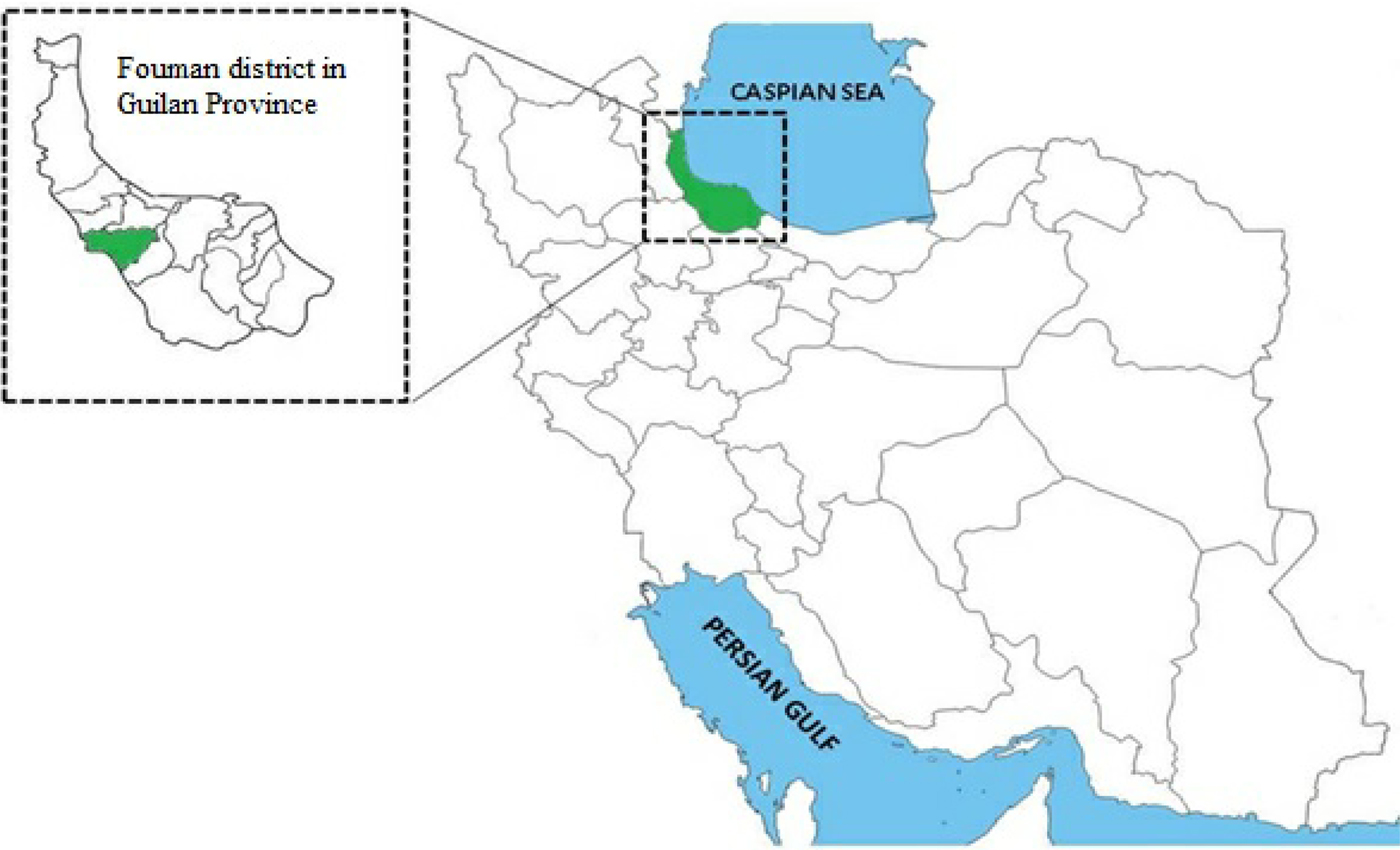
Fouman district is located in the south-western region of Guilan Province in northern Iran, stretched across the south of the Caspian Sea. It is situated between 37°13′N latitude and 49°8′E longitude (fig. 1). This region has a humid subtropical climate with annual mean rainfall of 1275 mm. It is geographically divided into two parts: a plain with moderate climate and a mountainous forest region. Most rural inhabitants are rice and tobacco farmers on the plain and animal farmers in the mountainous zone (Kazemi Rad & Mohammadi, Reference Kazemi Rad and Mohammadi2015).
Map of Iran, showing the geographical location of Guilan Province and the district of Fouman, our study area.

Patients
The patients were rural residents of the study area, who were positive for Trichostrongylus species. These individuals were found in a cross-sectional study on intestinal parasites, carried out during 2015–2016. Demographic data, including sex, age and the clinical manifestations of patients, were recorded.
Parasitological examinations
Identification of Trichostrongylus infection was based on formalin–ethyl acetate concentration technique and nutrient-agar plate culture. In brief, about 3 g of faecal sample was added to a nutrient-agar culture plate and incubated at room temperature for 3–4 days (Kia et al., Reference Kia, Mahmoudi, Zahabiun and Meamar2007; Sharifdini et al., Reference Sharifdini, Mirhendi, Ashrafi, Hosseini, Mohebali, Khodadadi and Kia2015). Later, the culture plates were evaluated under a stereomicroscope to identify any larvae and their tracks. Trichostrongylus larvae were differentiated from other intestinal nematodes, such as Strongyloides stercoralis and hookworms, as described by Kia et al. (Reference Kia, Mahmoudi, Zahabiun and Meamar2007) and Sharifdini et al. (Reference Sharifdini, Mirhendi, Ashrafi, Hosseini, Mohebali, Khodadadi and Kia2015).
Haematological investigation
Five-millilitre samples of venous blood were collected from each patient for haematological analysis using an automated blood cell analyser (Sysmex KX-21N, Kobe, Japan). Haematocrit (HCT), red blood cell count (RBC), white blood cell count (WBC) and differential WBC were determined.
Data analysis
Statistical analyses were performed using SPSS software version 18 (SPSS Inc., Chicago, Illinois, USA), and statistical tests including chi-squared (χ2) and Fisher's exact tests were used to compare the clinical symptoms observed in the study with age and gender of patients. The Pearson correlation coefficient was computed between age and eosinophil counts. A probability (P) value of <0.05 was considered to be statistically significant.
Results
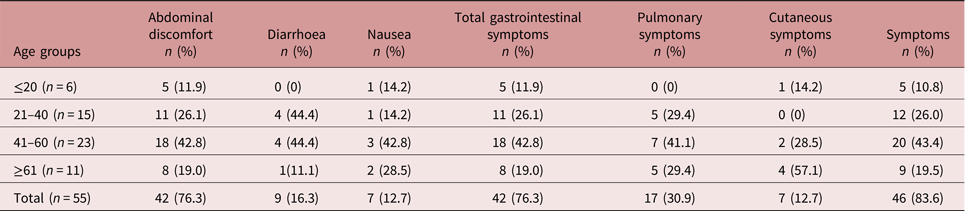
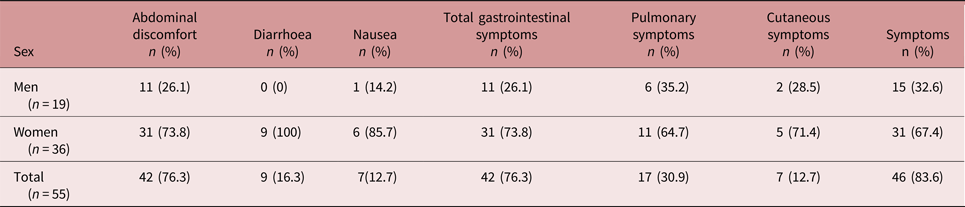
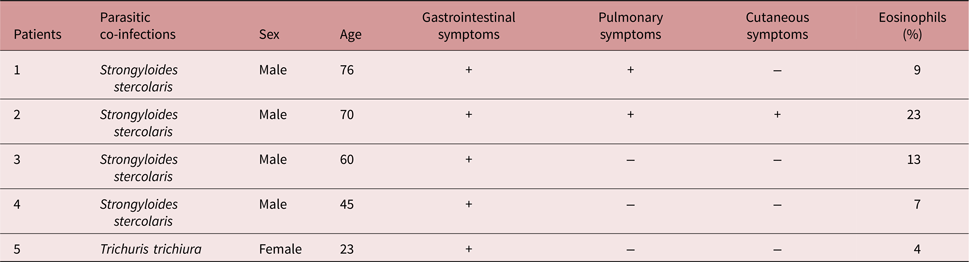
Overall, of the 60 individuals who participated in this study, 23 (38.3%) were male and 37 (61.7%) were female. The patients’ age ranged between 9 and 76 years, with a mean age of 44.4 (± SD) years. Among the participants, 55 patients were infected with only Trichostrongylus. Five patients had mixed infections: as well as Trichostrongylus, four (6.6%) had S. stercoralis infection and one (1.6%) was infected with Trichuris trichiura. Patients infected with Trichostrongylus alone were further analysed based on sex, age groups and clinical manifestations, as shown in tables 1 and 2.
Distribution of patients with trichostrongyliasis according to age groups and clinical manifestations.

Distribution of patients with trichostrongyliasis according to sex and clinical manifestations.

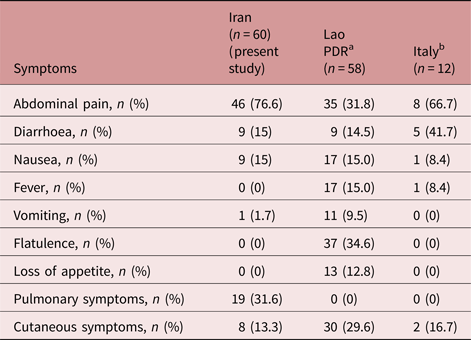
Among the patients analysed, nine (16.4%) were asymptomatic and 46 (83.6%) manifested clinical symptoms. No statistically significant differences were found between the clinical manifestations and sex and age groups (P > 0.05). Forty-two patients (76.3%) complained of gastrointestinal manifestations, including abdominal discomfort (76.3%), diarrhoea (16.3%) and nausea (12.7%). Pulmonary symptoms were recorded in 17 patients (30.9%), and seven patients (12.7%) reported cutaneous symptoms, including itching and rash.
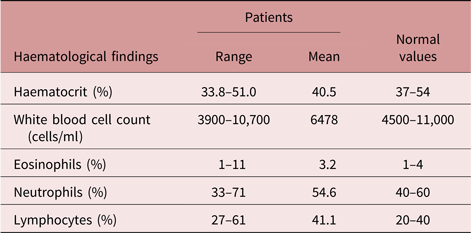
Among the 55 patients analysed, ten (18.1%) had eosinophilia, ranging between 5 and 11% with a mean of 6.1%. There was no statistically significant relationship between the eosinophilia observed in patients and their age groups, sex and clinical symptoms (P > 0.05). In the current study, five (9.1%) patients presented with hypochromic microcytic anaemia. Four of these patients were women and one was a man; their ages ranged from 21 to 66 years, with a mean age of 44 years. Table 3 shows the haematological parameters tested in the patient samples.
Haematological findings observed in 55 patients with trichostrongyliasis.

The distribution of mixed infections with S. stercoralis and T. trichiura based on sex, age groups and clinical manifestations is shown in table 4. A comparison of trichostrongyliasis symptoms found in this study with those reported in other studies is shown in table 5.
Parasitic co-infections among trichostrongyliasis patients and their characterizations according to sex, age and clinical manifestations.

Comparison of trichostrongyliasis symptoms in the patients of the present study with those of similar studies.

a Watthanakulpanich et al. (Reference Watthanakulpanich, Pongvongsa and Sanguankiat2013);
b Buonfrate et al. (Reference Buonfrate, Angheben, Gobbi, Mistretta, Degani and Bisoffi2017).
Discussion
In past decades, studies on the epidemiology of human trichostrongyliasis have revealed a high prevalence of infection by various species in Iran (Ghadirian et al., Reference Ghadirian, Arfaa and Sadighian1974; Ghadirian & Arfaa, Reference Ghadirian and Arfaa1975; Ghadirian, Reference Ghadirian1977). However, information regarding clinical symptoms of human trichostrongyliasis was limited, as the majority of patients were co-infected with other intestinal helminths. This being the case, clinical manifestations could not be attributed to trichostrongyliasis alone (Ghadirian & Arfaa, Reference Ghadirian and Arfaa1975). Recently, the prevalence of most soil-transmitted helminths (STHs), especially Ascaris lumbricoides, T. trichiura and hookworms, has declined sharply in Iran (Rokni, Reference Rokni2008; Sharifdini et al., Reference Sharifdini, Ghanbarzadeh, Kouhestani-Maklavani, Mirjalali and Saraei2017b). In addition, Trichostrongylus spp. (Ahmadi et al., Reference Ahmadi, Kia, Rezaeian, Hosseini, Kamranrashani and Tarighi2015; Ashrafi et al., Reference Ashrafi, Tahbaz, Sharifdini and Mas-Coma2015; Gholami et al., Reference Gholami, Babamahmoodi, Abedian, Sharif, Shahbazi, Pagheh and Fakhar2015) and S. stercoralis (Kia et al., Reference Kia, Mahmoudi, Zahabiun and Meamar2007; Ahmadi et al., Reference Ahmadi, Kia, Rezaeian, Hosseini, Kamranrashani and Tarighi2015; Sharifdini et al., Reference Sharifdini, Mirhendi, Ashrafi, Hosseini, Mohebali, Khodadadi and Kia2015) are still reported at lower prevalence, compared to those described in previous decades, in some regions of the country, due to the zoonotic nature of the former and the auto-infection ability of the latter parasite, respectively. Thus, the current situation presented a valuable opportunity to analyse the clinical aspects of human trichostrongyliasis.
The results of the present study showed that the female population (61.7%) is more susceptible than the male population (38.3%), which is compatible with the results obtained in a report from Lao PDR (Watthanakulpanich et al., Reference Watthanakulpanich, Pongvongsa and Sanguankiat2013). In our study, the most common age group for infected patients was 41–60 years (41.6%), followed by the age groups 21–40 and ≥61 years, respectively. These findings are similar to those of other studies (Watthanakulpanich et al., Reference Watthanakulpanich, Pongvongsa and Sanguankiat2013; Phosuk et al., Reference Phosuk, Intapan, Prasongdee, Changtrakul, Sanpool, Janwan and Maleewong2015). The higher rate of infection in females and the most susceptible age-group distribution can both be attributed to working in vegetable farms, labouring in rice and tea fields, and close contact with herbivorous animals. The least susceptible age group was ≤20 years. The majority of individuals in this group were school-age children, mostly busy with their education and less likely to work in the fields or with animals.
Adult worms of Trichostrongylus insert their heads into the intestinal mucosa; therefore, an inflammatory response occurs when there is a large number of worms (Watthanakulpanich et al., Reference Watthanakulpanich, Pongvongsa and Sanguankiat2013). Clinical symptoms are related to the intensity of worm burden in intestine, and the absence of signs is associated with light and moderate infections. However, in heavier infections (a few hundred worms) there may be slight anaemia, weight loss, headache, mild blood eosinophilia, anorexia, pulmonary allergy, abdominal discomfort and diarrhoea (Wallace et al., Reference Wallace, Henkin and Mathies1956; Boreham et al., Reference Boreham, McCowan, Ryan, Allworth and Robson1995; Ralph et al., Reference Ralph, O'Sullivan, Sangster and Walker2006; Thibert et al., Reference Thibert, Guiguen and Gangneux2006; Lattes et al., Reference Lattes, Ferte, Delaunay, Depaquit, Vassallo, Vittier, Kokcha, Coulibaly and Marty2011).
In the present study, 83.6% of patients showed clinical complaints. A high percentage of patients (76.3%) experienced gastrointestinal manifestations, including abdominal pain, diarrhoea, nausea and vomiting. This result indicates that gastrointestinal complaints are the most common clinical manifestation in patients suffering from Trichostrongylus infection. These findings correspond with previous reports on trichostrongyliasis cases that showed clinical symptoms (Boreham et al., Reference Boreham, McCowan, Ryan, Allworth and Robson1995; Ralph et al., Reference Ralph, O'Sullivan, Sangster and Walker2006; Thibert et al., Reference Thibert, Guiguen and Gangneux2006; Lattes et al., Reference Lattes, Ferte, Delaunay, Depaquit, Vassallo, Vittier, Kokcha, Coulibaly and Marty2011; Watthanakulpanich et al., Reference Watthanakulpanich, Pongvongsa and Sanguankiat2013; Buonfrate et al., Reference Buonfrate, Angheben, Gobbi, Mistretta, Degani and Bisoffi2017). Ashrafi et al. (Reference Ashrafi, Tahbaz, Sharifdini and Mas-Coma2015) reported a familial Trichostrongylus infection in the north of Iran, initially misdiagnosed as acute fascioliasis. This group of patients presented with gastrointestinal manifestations, including abdominal and epigastric pain, severe and voluminous diarrhoea, nausea, flatulence and dyspepsia (Ashrafi et al., Reference Ashrafi, Tahbaz, Sharifdini and Mas-Coma2015). In our study, some patients (30.9%) had pulmonary allergy similar to those in a recent report from Iran (Ashrafi et al., Reference Ashrafi, Tahbaz, Sharifdini and Mas-Coma2015). This complaint was not documented in other studies (Ralph et al., Reference Ralph, O'Sullivan, Sangster and Walker2006; Watthanakulpanich et al., Reference Watthanakulpanich, Pongvongsa and Sanguankiat2013; Phosuk et al., Reference Phosuk, Intapan, Prasongdee, Changtrakul, Sanpool, Janwan and Maleewong2015; Buonfrate et al., Reference Buonfrate, Angheben, Gobbi, Mistretta, Degani and Bisoffi2017). Moreover, 12.7% of patients in the present study complained of cutaneous symptoms including itching and rash, which were similar to those described in other studies conducted in Iran (Ashrafi et al., Reference Ashrafi, Tahbaz, Sharifdini and Mas-Coma2015), Italy (Buonfrate et al., Reference Buonfrate, Angheben, Gobbi, Mistretta, Degani and Bisoffi2017) and Lao PDR (Watthanakulpanich et al., Reference Watthanakulpanich, Pongvongsa and Sanguankiat2013). Our results demonstrate that pulmonary symptoms are the second most common complication in trichostrongyliasis patients. One of our previous studies showed that, in patients suffering from strongyloidiasis, gastrointestinal manifestations were the first complication, but the second most common clinical indication was cutaneous symptoms (Sharifdini et al., Reference Sharifdini, Kia, Ashrafi, Hosseini, Mirhendi, Mohebali and Kamranrashani2014). It is clear that, in contrast to S. stercoralis, Trichostrongylus spp. never undergo a lung migration, therefore pulmonary symptoms may be a side-effect of a strong host immune response against the parasite.
In this study, none of the patients suffered from fever. This conflicted with other reports from Iran (Ashrafi et al., Reference Ashrafi, Tahbaz, Sharifdini and Mas-Coma2015), Lao PDR (Watthanakulpanich et al., Reference Watthanakulpanich, Pongvongsa and Sanguankiat2013) and Italy (Buonfrate et al., Reference Buonfrate, Angheben, Gobbi, Mistretta, Degani and Bisoffi2017), where the appearance of fever during Trichostrongylus infections was described. Our study found no evidence of a significant increase in white blood cell count, neutrophil or lymphocyte numbers, from blood samples of infected individuals. However, mild eosinophilia was observed in 18.1% of patients, with a mean count of 6.1%. Peripheral eosinophilia has previously been documented in trichostrongyliasis patients (Boreham et al., Reference Boreham, McCowan, Ryan, Allworth and Robson1995; Watthanakulpanich et al., Reference Watthanakulpanich, Pongvongsa and Sanguankiat2013; Ashrafi et al., Reference Ashrafi, Tahbaz, Sharifdini and Mas-Coma2015; Buonfrate et al., Reference Buonfrate, Angheben, Gobbi, Mistretta, Degani and Bisoffi2017). According to the present results, there is no statistically significant relationship between eosinophilia and sex and age groups, or clinical manifestations. Watthanakulpanich et al. (Reference Watthanakulpanich, Pongvongsa and Sanguankiat2013) showed that the mean eosinophilia among patients with light and moderate infections of trichostrongyliasis were 4.2% and 5.2%, respectively. Sharifdini et al. (Reference Sharifdini, Kia, Ashrafi, Hosseini, Mirhendi, Mohebali and Kamranrashani2014) reported that 98.1% of patients with S. stercoralis infection showed eosinophilia with a mean value of 22.7%. They also found an inverse correlation between eosinophilia and age. Also, the mean relative eosinophilia in strongyloidiasis was statistically higher in asymptomatic than in symptomatic patients (Sharifdini et al., Reference Sharifdini, Kia, Ashrafi, Hosseini, Mirhendi, Mohebali and Kamranrashani2014). These studies illustrate that the frequency and level of blood eosinophilia in trichostrongyliasis patients is less than those in individuals with S. stercoralis infection (Watthanakulpanich et al., Reference Watthanakulpanich, Pongvongsa and Sanguankiat2013; Sharifdini et al., Reference Sharifdini, Kia, Ashrafi, Hosseini, Mirhendi, Mohebali and Kamranrashani2014; Phosuk et al., Reference Phosuk, Intapan, Prasongdee, Changtrakul, Sanpool, Janwan and Maleewong2015). It is important that eosinophilia usually heralds the detection of helminthic infections and it may sometimes be the only indication of infection (Wolfe, Reference Wolfe1978). However, eosinophilia alone cannot be used to infer trichostrongyliasis because it is a common clinical indication in acute and high-rate infections. It is also an indicator that declines in chronic infections. Interestingly, eosinophilia was not found in most strongyloidiasis patients with hyperinfection syndrome (Gotuzzo et al., Reference Gotuzzo, Terashima, Alvarez, Tello, Infante, Watts and Freedman1999).
In the present study, five individuals presented with hypochromic microcytic anaemia, likely due to the accumulation of worms, but this has not been reported in other studies (Boreham et al., Reference Boreham, McCowan, Ryan, Allworth and Robson1995; Watthanakulpanich et al., Reference Watthanakulpanich, Pongvongsa and Sanguankiat2013; Ashrafi et al., Reference Ashrafi, Tahbaz, Sharifdini and Mas-Coma2015; Buonfrate et al., Reference Buonfrate, Angheben, Gobbi, Mistretta, Degani and Bisoffi2017).
In conclusion, this study provided novel information on clinical aspects and haematological findings of trichostrongyliasis patients, which may be used as important criteria during clinical diagnosis of trichostrongyliasis. Our results indicate that patients in endemic areas are likely to experience gastrointestinal symptoms (abdominal discomfort, diarrhoea, nausea and vomiting), pulmonary allergy or cutaneous symptoms related to trichostrongyliasis. These could prove to be very useful diagnostic data for physicians.
Acknowledgements
The authors would like to thank all the people who contributed to this research.
Financial support
Financial support for this study was provided by Qazvin University of Medical Sciences, Qazvin (Iran) through a research grant (Project number 662).
Conflict of interest
None.
Ethical standards
The study protocol was approved by the Ethics Committee of Qazvin University of Medical Sciences, Iran (Ref. No. IR.QUMS.REC.1394.816). Written informed consent was provided by all patients.