Introduction
Obsessive–compulsive disorder (OCD) is a disabling psychiatric disorder that, if left untreated, has a chronic course. At present, clinical management of OCD consists of pharmacotherapy and cognitive–behavioural therapy (CBT) (March et al. Reference March, Frances, Kahn and Carpenter1997; Foa et al. Reference Foa, Liebowitz, Kozak, Davies, Campeas, Franklin, Huppert, Kjernisted, Rowan, Schmidt, Simpson and Tu2005; Abramowitz, Reference Abramowitz2006; Denys, Reference Denys2006; O'Connor et al. Reference O'Connor, Aardema, Robillard, Guay, Pélissier, Todorov, Borgeat, Leblanc, Grenier and Doucet2006). Although often effective, both treatments have their limitations. Patients usually have only a partial response to medication (Eddy et al. Reference Eddy, Dutra, Bradley and Westen2004) and CBT (Simpson et al. Reference Simpson, Huppert, Petkova, Foa and Liebowitz2006, Reference Simpson, Foa, Liebowitz, Ledley, Huppert, Cahill, Vermes, Schmidt and Hembree2008). In addition, medication can have significant side effects and the exposure and response prevention in CBT often provokes intense anxiety, resulting in a 25% drop-out of patients (Franklin et al. Reference Franklin, Abramowitz, Foa, Kozak and Levitt2000). Eventually, 10% of patients with OCD do not respond adequately to current treatments and remain severely affected (Denys, Reference Denys2006).
In the last decade, a new treatment for treatment-refractory OCD patients has emerged: deep brain stimulation (DBS). DBS is an adjustable, reversible, non-destructive neurosurgical intervention using implanted electrodes to deliver electrical pulses to areas in the brain. DBS at different brain targets has demonstrated to be an effective treatment for treatment-refractory OCD patients (Nuttin et al. Reference Nuttin, Gabriëls, Cosyns, Meyerson, Andréewitch, Sunaert, Maes, Dupont, Gybels, Gielen and Demeulemeester2003; Abelson et al. Reference Abelson, Curtis, Sagher, Albucher, Harrigan, Taylor, Martis and Giordani2005; Mallet et al. Reference Mallet, Polosan, Jaafari, Baup, Welter, Fontaine, du Montcel, Yelnik, Chéreau, Arbus, Raoul, Aouizerate, Damier, Chabardès, Czernecki, Ardouin, Krebs, Bardinet, Chaynes, Burbaud, Cornu, Derost, Bougerol, Bataille, Mattei, Dormont, Devaux, Vérin, Houeto, Pollak, Benabid, Agid, Krack, Millet and Pelissolo2008; Denys et al. Reference Denys, Mantione, Figee, van den Munckhof, Koerselman, Westenberg, Bosch and Schuurman2010; Goodman et al. Reference Goodman, Foote, Greenberg, Ricciuti, Bauer, Ward, Shapira, Wu, Hill, Rasmussen and Okun2010; Huff et al. Reference Huff, Lenartz, Schormann, Lee, Kuhn, Koulousakis, Mai, Daumann, Maarouf, Klosterkötter and Sturm2010), with a mean responder rate of approximately 60% (Figee et al. Reference Figee, Mantione, van den Munckhof, Schuurman and Denys2010).
DBS certainly is a promising technique, but patients often show only a partial response. Therefore, the treatment still needs to be improved by optimizing the brain target, the adjustment of electrode settings, the selection of patients and the post-operative management. We have previously reported on the clinical outcome of accumbens DBS in 16 treatment-refractory OCD patients (Denys et al. Reference Denys, Mantione, Figee, van den Munckhof, Koerselman, Westenberg, Bosch and Schuurman2010). In the present study we hypothesized that the addition of CBT augments the effectiveness of the post-operative management in DBS. Since CBT has proven to be effective as an augmentation strategy to increase the general partial response of pharmacotherapy in OCD (Foa et al. Reference Foa, Liebowitz, Kozak, Davies, Campeas, Franklin, Huppert, Kjernisted, Rowan, Schmidt, Simpson and Tu2005), we assume that it could possibly be used in a similar approach to extend the partial response of DBS. The aim of the present study was to evaluate the addition of CBT to DBS and to discuss the methodology of the CBT programme.
Method
Patients
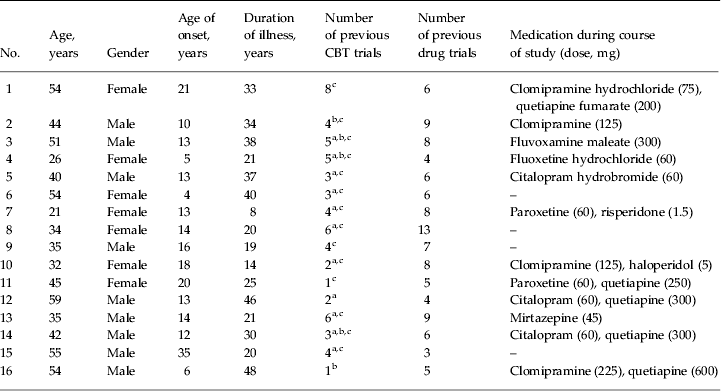
Patients were recruited through the out-patient clinic for anxiety disorders of the Academic Medical Center in Amsterdam. The study population consisted of 16 treatment-refractory OCD patients who participated in a trial in which the effectiveness of DBS for treatment-refractory OCD was assessed in a double-blind cross-over design (Denys et al. Reference Denys, Mantione, Figee, van den Munckhof, Koerselman, Westenberg, Bosch and Schuurman2010). Pre-treatment demographic and clinical characteristics are presented in Table 1. A full description of inclusion and exclusion criteria may be found in the paper by Denys et al. (Reference Denys, Mantione, Figee, van den Munckhof, Koerselman, Westenberg, Bosch and Schuurman2010). Informed consent of the participants was obtained after the nature of the procedures had been fully explained.
Demographic and clinical characteristics of each patient in the DBS group (n = 16) at baseline

DBS, Deep brain stimulation; CBT, cognitive–behavioural therapy.
a Out-patient treatment.
b Day treatment.
c Clinical admission.
Procedure
The study consisted of three sequential treatment phases: an open phase of 8 months, a double-blind cross-over period of 4 weeks and a maintenance phase of 1 year. After surgery, patients entered an open phase of 8 months during which they were evaluated every 2 weeks to assess severity of symptoms and to determine optimal stimulation parameters. In the open phase, a standardized 24-week cognitive–behavioural treatment programme was added (Fig. 1). CBT was started when three conditions were fulfilled. First, a clinically significant decrease in OCD symptoms had to be obtained. This was determined as a decrease of at least 6 points on the Yale–Brown Obsessive Compulsive Scale (YBOCS; Goodman et al. Reference Goodman, Price, Rasmussen, Mazure, Delgado, Heninger and Charney1989a , Reference Goodman, Price, Rasmussen, Mazure, Fleischmann, Hill, Heninger and Charney b ). Second, there had to be no further decrease in symptoms, i.e. a stable score on the YBOCS for three successive visits (6 weeks). And third, it had to be observed that patients avoided resisting their compulsions and avoided anxiety-provoking exposure situations. Treatment with CBT consisted of weekly individual sessions of 60 min. During CBT, we aimed to keep stimulation parameters constant and limited the adjustments of stimulation parameters to small increases in voltage with a maximum of 5.0 V. After finishing the open phase, patients entered a double-blind cross-over period of 4 weeks. Patients were allocated to two periods of 2 weeks with stimulation blindly turned on (active stimulation) in one period and stimulation blindly turned off (sham stimulation) in the other period. Patients were evaluated after each condition. CBT was continued during the cross-over period. This period was followed by a maintenance phase of 1 year in which CBT was reduced on the basis of individual needs and the number of CBT sessions varied between patients. When ending the maintenance phase, patients were assessed again for severity of symptoms. During the whole study, besides CBT, no other psychological treatments were allowed. Patients were allowed to use medication (see Table 1 for a specification of medication). When serotonin re-uptake inhibitors (SSRIs) were used, they were tapered off pre-operatively to minimize the risk of haemorrhage during surgery. Immediately after surgery they were built up to levels similar to those before surgery.
Course of obsessive–compulsive disorder symptoms, anxiety symptoms and depression symptoms during deep brain stimulation (DBS), additional cognitive–behavioural therapy (CBT) double-blind cross-over phase and follow-up phase of the study. HAMD, Hamilton Rating Scale for Depression; YBOCS, Yale–Brown Obsessive Compulsive Scale; HAMA, Hamilton Anxiety Scale.

CBT was conducted by a cognitive–behavioural therapist and a behavioural nurse therapist specialized in treating patients with OCD. The treatment manual was adapted from Verbraak et al. (Reference Verbraak, Hoogduin, Methorst, Arts, Hansen, Keijsers, Keijsers, van Minnen and Hoogduin2004). Treatment started with exposure and response prevention (ERP) in order to confront patients gradually with their feared stimuli and feared social contexts (e.g. ‘touch the doorknob without hand washing’). Cognitive therapy and behavioural experiments were added subsequently and were used to challenge dysfunctional beliefs (e.g. ‘if I touch the doorknob, I will become sick’). The treatment manual was adjusted on several points to suit this group of severely ill, therapy-refractory patients. First, since patients were reluctant to start again with CBT because of earlier negative CBT experiences, the treatment started with an extensive evaluation of their motivation to reduce their symptoms. Common questions to discuss patients' motivation were: ‘what do you expect from therapy?’ and ‘what are you going to do with your life when OCD symptoms have diminished?’. Second, during the optimization of stimulation parameters in the open phase, it appeared that patients tended to filter out positive experiences and that acknowledgement of the initial positive effect of DBS was essential in further improvement of symptoms: a change in focus had to be realized to enhance motivation for treatment. Therefore, before the actual start of ERP, patients were asked to keep a diary of positive experiences to shift their focus from symptoms that did not (yet) improve to symptoms that did improve after DBS. Third, compulsions had become extremely elaborate and time-consuming in the course of their disease and patients had developed an extensive pattern of avoidance to prevent themselves from the need to perform their rituals. For this reason, the start of exposure therapy aimed at the reduction of compulsions while patients were still allowed to avoid anxiety-provoking situations. Rituals were decreased step by step while patients were encouraged to remain in each exposure situation until the distress decreased noticeably. Fourth, it was observed that part of the compulsions had become habits rather than rational avoidance responses triggered by obsessions: e.g. patients repeatedly washed their hands because they did so for the past 20 years, not because of a clear irrational belief about contamination. Therefore, the start of cognitive therapy aimed explicitly at revealing the original obsessions (e.g. ‘if I touch the doorknob, I will become sick’), whereby the absurdness of the behaviour could be brought up easier for discussion.
Outcome measures
Obsessive–compulsive symptoms were assessed with the YBOCS. A patient was rated as a responder in the case of a ⩾35% decrease on the YBOCS. Depression was rated with the 17-item Hamilton Rating scale for Depression (HAMD; Hamilton, Reference Hamilton1960) and anxiety was evaluated with the Hamilton Anxiety Scale (HAMA; Hamilton, Reference Hamilton1959). A trained and blinded investigator completed the scales at baseline and at each visit.
Statistical analysis
The primary outcome measures, the YBOCS score, HAMA score and HAMD score, were analysed using a repeated-measurements analysis. The difference between stimulation effects and effect of treatment with CBT was calculated with post-hoc paired t tests. The data are presented as mean values and standard deviations at the 5% level of significance. All statistical analyses were conducted with the SPSS statistical package version 18.0 (IBM, USA).
Results
Table 2 shows mean baseline scores before implantation, mean scores following DBS optimization, mean scores following CBT treatment, mean scores in the cross-over phase, and mean scores at the end of the maintenance phase on, respectively, the YBOCS, the HAMA and the HAMD. All symptom scores decreased during the course of DBS treatment. The YBOCS diminished by 52%, from 33.8 (s.d. = 3.6), corresponding with very severe OCD, to 16.2 (s.d. = 8.6), indicating mild OCD at the end of the maintenance phase, i.e. 1 year after the cross-over phase (repeated-measures analysis: F 24,360 = 9.74, p < 0.001). The HAMA decreased by 57% from 20.9 (s.d. = 5.9), corresponding with moderate anxiety, to 8.9 (s.d. = 5.4), indicating mild anxiety at the end of the maintenance phase (repeated-measures analysis: F 24,360 = 9.65, p < 0.001). The HAMD decreased by 46% from 19.5 (s.d. = 6.7), corresponding with moderate depression, to 10.6 (s.d. = 6.0), indicating mild depression at the end of the maintenance phase (repeated-measures analysis: F 24,360 = 7.07, p < 0.001).
Outcome measures in the open-phase, double-blind cross-over phase and maintenance phase

Data are given as mean (standard deviation).
CBT, Cognitive–behavioural therapy; YBOCS, Yale–Brown Obsessive Compulsive Scale; HAMA, Hamilton Anxiety Scale; HAMD, Hamilton Rating Scale for Depression.
The time needed to optimize stimulation parameters and obtain a significant decrease in YBOCS score varied between patients, but was on average 8 weeks. Optimization of DBS stimulation parameters without CBT treatment resulted in a 25% decrease [8.3 (s.d. = 7.8) points, p < 0.001] of mean YBOCS scores compared with baseline. The mean HAMA score decreased 41% [8.6 (s.d. = 9.0) points, p = 0.002] and the mean HAMD score decreased 32% [6.3 (s.d. = 8.0) points, p = 0.006]. Out of 16 patients, six were considered responders with a mean decrease of 49.6% (s.d. = 8.7) % on the YBOCS. With the addition of 24 weeks of CBT to ongoing DBS treatment, there was a supplementary 22% mean decrease of total YBOCS score [7.3 (s.d. = 11.3) points, p = 0.021] although no significant additional decrease of HAMA score [decrease of 2.3 (s.d. = 8.7 points), p = 0.317] and HAMD score [decrease of 2.8 (s.d. = 7.7) points, p = 0.158] was observed. With the addition of CBT, the number of responders increased from six to nine out of 16 patients, with a mean decrease in the total YBOCS score of 72% (s.d. = 17.3) %. Two patients refused to participate in the double-blind cross-over phase and were excluded from further assessments. In the cross-over phase, the mean-YBOCS score, HAMA score and HAMD score increased significantly. Due to the relapse in symptoms, most patients were unable to apply CBT techniques during off-stimulation.
Discussion
In this explorative study of combined DBS and CBT treatment, we evaluated the effectiveness of CBT as an augmentation strategy to DBS. Three interesting observations were made. First, we have an indication that CBT as an addition to DBS results in a significant additional reduction of obsessions and compulsions, suggesting that CBT may be required to accomplish further improvement of obsessive–compulsive symptoms following the initial effect of optimization of stimulation. Second, CBT as an addition to DBS did not seem to affect anxiety and depressive symptoms but seems to be uniquely associated with a reduction in OCD symptoms. Third, discontinuation of stimulation in the double-blind cross-over phase resulted in a complete and rapid disappearance of the overall effect, i.e. the initial effect of DBS on obsessive–compulsive, anxiety and depressive symptoms as well as the gained successes of additional CBT.
No previous study has reported the effects of CBT augmentation to DBS. However, our observation that DBS targeted at the accumbens has a profound effect on anxiety and depressive symptoms and a moderate effect on OCD symptoms can be compared with other studies. In line with our findings, immediate anhedonic, antidepressive, and anxiolytic effects were observed after accumbens stimulation in major depressive disorder (MDD) (Bewernick et al. Reference Bewernick, Hurlemann, Matusch, Kayser, Grubert, Hadrysiewicz, Axmacher, Lemke, Cooper-Mahkorn, Cohen, Brockmann, Lenartz, Sturm and Schlaepfer2010). Interestingly, DBS of the subthalamic nucleus in OCD specifically decreased compulsions without significant effects on anxiety and depressive symptoms (Mallet et al. Reference Mallet, Polosan, Jaafari, Baup, Welter, Fontaine, du Montcel, Yelnik, Chéreau, Arbus, Raoul, Aouizerate, Damier, Chabardès, Czernecki, Ardouin, Krebs, Bardinet, Chaynes, Burbaud, Cornu, Derost, Bougerol, Bataille, Mattei, Dormont, Devaux, Vérin, Houeto, Pollak, Benabid, Agid, Krack, Millet and Pelissolo2008). Thereby it is possible that the selective efficacy of CBT, as an addition to DBS treatment in our study, depends on our target of stimulation.
The mechanism of action of behaviour therapy for OCD may clarify the positive effects of additional CBT in this study. It is assumed that two associations maintain the symptoms in OCD: first, the association between specific stimuli and the provocation of anxiety; and second, the association between the ritualistic behaviours and the reduction in anxiety (Kozak & Foa, Reference Kozak and Foa1997). Behaviour therapy, e.g. ERP, aims to break these associations, preventing the transient and negative reinforcement that occurs when patients reduce their anxiety through compulsions. It has been widely assumed that, as a result, exposure-based treatment disrupts the obsessive–compulsive cycle and leads to habituation and therefore decrease of anxiety (Pence et al. Reference Pence, Sulkowski, Jordan and Storch2010). However, presently it has been suggested that habituation of anxiety does not predict therapeutic outcome and it has been postulated that inhibitory learning, the forming of new corrective associations, underlies the mechanism of action of ERP (Craske et al. Reference Craske, Kircanskin, Zelikowsky, Mystkowski, Chowdhury and Baker2008).
It is likely that the first association between stimuli and anxiety is rapidly weakened by DBS alone, because of its initial effect on anxiety symptoms. However, it is unlikely that DBS solely is able to completely inhibit the second association between ritualistic behaviours and reduction of anxiety, because part of the OCD symptoms remained after effective DBS. Recent research indicates that compulsivity in OCD may arise from excessive stimulus–response habit formation (Gillan et al. Reference Gillan, Morein-Zamir, Urcelay, Sule, Voon, Apergis-Schoute, Fineberg, Sahakian and Robbins2014). Our results suggest that there are goal-directed compulsions fuelled by anxiety that are affected by DBS as well as long-existent repetitive compulsive behaviour, which has a more habitual nature, that is more difficult to treat with DBS. It is our clinical observation that during DBS further improvement of OCD symptoms stabilized because patients were unable to intentionally stop their remaining habitual behaviour. It was reported that ERP prior to DBS led to extreme and intolerable anxiety symptoms that eventually resulted in compulsions and hindered successful response prevention. This is supported by the high number of unsuccessful CBT trials before DBS in our sample (Table 1). With CBT post-DBS, patients were encouraged to stop their remaining habitual compulsions and were able to experience that the level of anxiety after ERP does not become intolerable as in previous CBTs. CBT post-DBS appears thus to be necessary to stop habitual behaviour and to enable patients to experience that they can manage anxiety.
The above-described mechanism of action of CBT in accumbens DBS is strengthened by a recent animal study (Rodriguez-Romaguera et al. Reference Rodriguez-Romaguera, Do Monte and Quirk2012) which showed that DBS of the dorsomedial ventral striatum applied during extinction training decreases fear responses and facilitates the extinction of conditioned fear in rats. It has therefore been suggested that DBS could augment the effectiveness of CBTs in OCD. In line with Rodriguez-Romaguerra et al. (Reference Rodriguez-Romaguera, Do Monte and Quirk2012), our results suggest that DBS enables CBT and, therefore, CBT could augment the effectiveness of DBS.
We have recently demonstrated that accumbens DBS in OCD restores ventral striatal reward responses and connectivity with the prefrontal cortex (Figee et al. Reference Figee, Luigjes, Smolders, Valencia-Alfonso, van Wingen, de Kwaasteniet, Mantione, Ooms, de Koning, Vulink, Levar, Droge, van den Munckhof, Schuurman, Nederveen, van den Brink, Mazaheri, Vink and Denys2013). In MDD, accumbens stimulation reduced anxiety and depression by modulation of amygdala and prefrontal metabolism (Bewernick et al. Reference Bewernick, Hurlemann, Matusch, Kayser, Grubert, Hadrysiewicz, Axmacher, Lemke, Cooper-Mahkorn, Cohen, Brockmann, Lenartz, Sturm and Schlaepfer2010). Together, these findings indicate that DBS restores motivational and affective control in a broader limbic–striatal–cortical network. CBT, on the other hand, primarily affects hyperactivity in the orbitofrontal cortex (Nakao et al. Reference Nakao, Nakagawa, Yoshiura, Nakatani, Nabeyama, Yoshizato, Kudoh, Tada, Yoshioka, Kawamoto, Togao and Kanba2005), an area that is thought to mediate the affective appraisal of stimuli and therefore plays an important role in the mediation of extinction (Brody et al. Reference Brody, Saxena, Schwartz, Stoessel, Maidment, Phelps and Baxter1998). In addition, recent evidence suggests that CBT influences brain activity in the caudate nucleus and the pallidum, core regions that have been shown to be directly involved both in the acquisition of repetitive behaviour and thus in the pathophysiology of OCD (Freyer et al. Reference Freyer, Klöppel, Tüscher, Kordon, Zurowski, Kuelz, Speck, Glauche and Voderholzer2011). Thus, accumbens DBS and CBT may collaborate in a complementary process in which DBS restores affective and motivational control over unwanted behaviours, paving the way for further extinction of habitual behaviours by CBT.
A complementary relationship of DBS and CBT is confirmed by our third observation that OCD as well as anxiety and depressive symptoms completely relapsed in the double-blind cross-over phase. In spite of newly learned associations during CBT, patients were not able to preserve their gained improvement. Although patients have a risk to relapse after treatment discontinuation following combined therapy of medication and CBT for OCD, additional CBT results in a lower relapse rate and a longer time to relapse compared with medication therapy alone (Simpson et al. Reference Simpson, Liebowitz, Foa, Kozak, Schmidt, Rowan, Petkova, Kjernisted, Huppert, Franklin, Davies and Campeas2004). The fast and complete relapse in the double-blind cross-over phase of DBS treatment, despite the addition of CBT, is in sharp contrast with these findings. In our study, after discontinuation of stimulation, anxiety and depressive symptoms returned acutely and, moreover, worsened compared with baseline. This worsening might be an overestimation of symptoms, because patients compare their condition with their symptoms post-DBS instead of pre-DBS, or it might be the result of a rebound effect. The fact that discontinuation of stimulation overrules the gained effect of CBT in the open phase suggests that efficacy of CBT depends on stimulation. On the other hand, with stimulation on again, OCD symptoms improved to a level comparable with post-CBT instead of post-optimization, which suggests that CBT techniques were saved during off-stimulation and which emphasizes the complementariness of both treatments.
Limitations
A limitation of this study is the exploratory nature of the CBT treatment. All 16 patients received complementary CBT and therefore a comparison between DBS as a stand-alone treatment and DBS and CBT as a combination treatment is not possible. However, the mean YBOCS total score decrease of 72% in 56% of the responding patients in our study is the largest follow-up YBOCS decrease published to date in DBS studies (De Koning et al. Reference De Koning, Figee, van den Munckhof, Schuurman and Denys2011). In addition, our response rate of 56% is significantly higher than the response rate of 10% reported in a comparable study of accumbens DBS (Huff et al. Reference Huff, Lenartz, Schormann, Lee, Kuhn, Koulousakis, Mai, Daumann, Maarouf, Klosterkötter and Sturm2010). These results suggest that the combination of DBS and CBT could be most effective in reducing symptoms in treatment-refractory OCD patients. However, we strongly recommend exploring the additional effect of CBT by means of a randomized controlled clinical trial (RCT). A second limitation of this study is the small sample size, although our patient group is relatively large compared with previous DBS studies (Nuttin et al. Reference Nuttin, Gabriëls, Cosyns, Meyerson, Andréewitch, Sunaert, Maes, Dupont, Gybels, Gielen and Demeulemeester2003; Abelson et al. Reference Abelson, Curtis, Sagher, Albucher, Harrigan, Taylor, Martis and Giordani2005; Goodman et al. Reference Goodman, Foote, Greenberg, Ricciuti, Bauer, Ward, Shapira, Wu, Hill, Rasmussen and Okun2010).
Conclusion
The results of this explorative study suggest that DBS targeted at the accumbens may not be optimal as a stand-alone treatment but that the clinical improvement with DBS could be enhanced by the addition of CBT. Since our study is the first to investigate the addition of CBT to DBS, we did not employ a RCT design. Therefore, no firm conclusions can be drawn. However, the positive results of our exploratory study indicate that a subsequent RCT investigating the addition of CBT to DBS is warranted. It seems that accumbens DBS results in fast profound affective changes enabling patients to engage in CBT augmentation for further extinction of compulsive acts that have a habitual nature, allowing patients to regain control of their own behaviour.
Acknowledgements
This study was part of the study on the clinical effects of DBS of the nucleus accumbens for therapy-refractory OCD, supported by an unrestricted investigator-initiated research grant by Medtronic Inc. who provided the devices, and by the Netherlands Organization for Scientific Research (NWO): ZON-MW VENI programme (no. 916.66.095 to D.D.).
Declaration of Interest
None.