Much has been written in the popular press and academic journals about the Affordable Care Act (ACA). It has been characterized by its supporters as the biggest expansion of coverage since the Great Society, and by its detractors as government overreach and socialism. Even after the president’s signature, two major Supreme Court verdicts upholding essential features, and the president’s reelection, political opposition to the ACA, almost exclusively confined to Republicans, has shown few signs of abating. Unfortunately, the often shallow public debate about the ACA largely ignores the historical context of the American grant-in-aid system, its evolutionary nature, and its crucial role in expanding access to health care. We seek to remedy this lack of context by providing an overview of the development of the U.S. grant system, focused on health-care-related programs, from the earliest days of the Republic to the ACA. We argue that much of relevance to understanding the current controversy and predicting how it will play out over time can be learned from this history. It follows a large number of works assessing the development of the American welfare state.Footnote 1 However, it significantly differs from previous works by focusing exclusively on programs of shared governance; that is, programs jointly implemented and administered by federal and state governments. Additionally, it differs in its emphasis by exclusively focusing on health-care-related programs.
Based on our analysis, we challenge the ubiquitous claims that the ACA is a cataclysmic departure from everything that came before it. Instead, we argue that within the American grant system, particularly as it has been used to expand access to health care, the ACA should be seen as a very substantial, but nonetheless natural, continuation of a long series of incremental, trial-and-error adjustments to new circumstances. Lacking the constitutional power to force states into action, the federal government necessarily seeks to entice states into cooperation through financial incentives.Footnote 2 Not surprisingly, when given latitude, states have often implemented programs only slowly and gradually—and sometimes not all.Footnote 3 However, over time, the federal government and the states usually become partners who share in the development, design, administration, and improvement of these programs. Within this system, earlier programs serve as foundations for future expansions. In the process of this transformation, grant programs have expanded in number, size, subject matter, and the extent of administrative involvement by the federal government. These developments have been neither consciously rational nor synoptic. Instead, they should be seen as the result of successive adaptations to altered circumstances.
We proceed as follows. First, we present a brief overview of the development of the American grant system from the early days of the Republic to the first true health-related grant of significance, the Sheppard-Towner Act of 1921. We show how over time a system of monetary and land grants incrementally increased in size and purpose. However, the early system was largely free from federal interference and focused on providing states with funding for generally uncontroversial programs. Over time, changing economic, social, and demographic circumstances necessitated expansion of the system in terms of subject matter and type of grants. Second, we trace the development of major health-care-related grants. We begin with the developments leading up to the Sheppard-Towner Act. Next, we consider efforts during the Depression and World War II, followed by programs in the postwar period up to the Great Society. Finally, we turn to more recent programs, including Disproportionate Share Hospital Funding (DSH), the Health Insurance Portability and Accountability Act of 1996 (HIPAA), the State Children's Health Insurance Program (S-CHIP), and the Trade Act of 2002. We do so by providing brief accounts of the key features of each program. While much has been written about several of these programs independently, we argue that much more can be gained by taking a more holistic and historical view. We conclude by summarizing the contributions of past programs to the ACA and by offering an outlook for its future.
Early Development of the U.S. Grant-in-Aid System
In federal systems like the United States, the ambitions of national governments are constitutionally impeded by the sovereign powers of their constituent parts. Limited in what they can achieve by direct action, national governments throughout the world have long circumvented these restrictions by separating the financing and production function; that is, by financially inducing states to implement programs desired by national policymakers. In the United States, grant-making—financial transfers from the national government to the states—occurred as far back as the Continental Congress.Footnote 4 Initially, the main mechanism utilized by the federal government was the disbursement of public lands to support states in the development of their infrastructures and public education systems. As such, starting with the admission of Ohio to the union in 1802, all newly admitted states received a land grant from the federal government.Footnote 5 Land grants were also used to stimulate internal improvements such as flood control and canal and road building.Footnote 6 The first cash grant was established in 1808 for the maintenance of the National Guard.Footnote 7 These early grants were rather limited in scope and came with few if any restrictions.
Absent strict conditions and close supervision, states often utilized grant funding for unintended purposes.Footnote 8 As a result, more restrictive grant-making was eventually established under the Morrill Act of 1862, which provided for agricultural and mechanical-arts education.Footnote 9 The act also included some minor requirements for states, such as the submission of annual reports to the federal government. By disallowing the utilization of federal funds for buildings, the act also indirectly required states to “match” funds. After the Civil War, federal grant-making continued to focus on agriculture,Footnote 10 but it also included provisions for the care of veterans. The Hatch Act of 1887 and the Morrill Act of 1890 further extended federal supervision of states’ use of grants.Footnote 11 Perhaps most significantly, states would henceforth risk the withdrawal of funding if they failed to fulfill grant requirements.Footnote 12
The early decades of the twentieth century saw a major increase in the number of grants and the sizes of appropriations.Footnote 13 For example, the fiscal consequences of grant-making grew with the introduction of the concept of open-ended appropriations by the State Marine School Act. Similarly, the Weeks Act of 1911 allowed for greater administrative discretion in the allocation of funds as well as an expansion of matching requirements.Footnote 14 The latter, promoting forest fire prevention, also serves as the first fully cooperative grant program between the federal and state governments, as it included significant consultation and joint administrative arrangements, as well as provisions for federal inspections.Footnote 15 National oversight was further increased under the Smith-Lever Act of 1914, which for the first time required states to submit plans for federal approval.Footnote 16 It also specifically required states to match federal funding dollar for dollar.Footnote 17 In addition, the Federal Aid Road Act of 1916 drastically increased the financial commitment of the federal government to the grant system.Footnote 18 Adjustments to the act by the Federal Highway Act of 1921 further expanded federal funding and spurred the development of a national highway system. The federal government became more assertive with the Hayden-Cartwright Act of 1934,Footnote 19 which required states to spend gasoline taxes on road construction or face the withdrawal of federal funds. Finally, the commitment of the national government to education was strengthened by the Smith-Hughes Act of 1917, which supported vocational education.Footnote 20 In combination, the Smith-Lever Act, the Weeks Act, the Smith-Hughes Act, and the Federal Aid Road Act ushered in the era of modern grant-making and provided the template for subsequent grant programs.
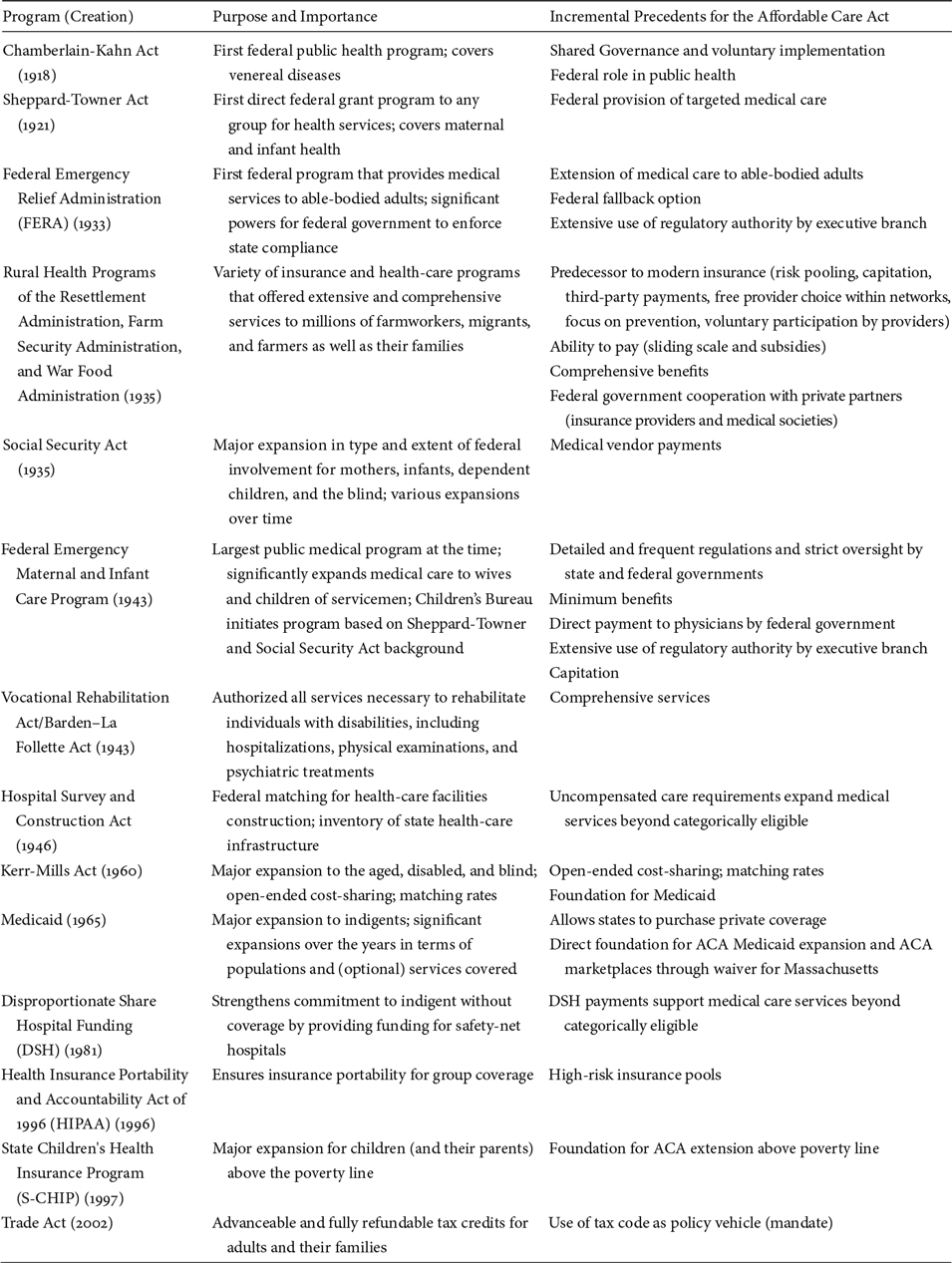
We next turn to federal grant programs aimed at expanding health services. Table 1 previews each program in terms of its major provisions.
Shared Governance Health-Care Programs and Connection to Affordable Care Act

Source: Authors’ distillation from multiple references cited in text.
Early Health-Care Efforts and the Sheppard-Towner Act of 1921
Despite its long history of grant-making, the federal government played only a very limited role in the provision of health care until the 1930s. This limited involvement largely hails from Chief Justice Marshall’s opinion in Gibbons v. Ogden, which, with the exception of brief periods of panic during yellow fever and cholera outbreaks, generally limited the involvement of the national government in health matters.Footnote 21 However, over time, the federal government has nonetheless provided direct services to a number of groups of individuals, including Native Americans, inmates, military personnel, and veterans, as well as contributing to the improvement of public health.Footnote 22 The U.S. Public Health Service and its predecessors have played a prominent role in many of these efforts.Footnote 23 The federal government’s first involvement in the provision of medical care was the Marine Hospital Service Act in 1798, which funded medical care for merchant seamen.Footnote 24 Around the same time, it was also briefly responsible for vaccinations against smallpox.Footnote 25 Interestingly, the federal government, through the Bureau of Refugees, Freedmen, and Abandoned Lands, provided medical and hospital care for freed slaves for several years during and immediately after the Civil War.Footnote 26 However, it took passage of the Chamberlain-Kahn Act of 1918, which provided grants for venereal disease programs, for the first shared-governance health-care program to be established.Footnote 27
The first major federal grant program for health purposes was authorized under the Sheppard-Towner Maternity and Infancy Protection Act of 1921.Footnote 28 Sheppard-Towner provided between $1.2 and $1.4 million ($16 and $19 million in current dollars) annually to improve health-care services for mothers and infants, making it “the first direct federal grant-in-aid program to any group for health services.”Footnote 29 The program was enacted after a long struggle in Congress full of denunciations of socialism, free love, birth control, federal encroachment, paternalism, and state interference with the practice of medicine.Footnote 30 Any interference with private medicine was to be avoided, which severely limited the program in providing medical services or financial support for individuals.Footnote 31 Ironically, although the act passed Congress with the largest majority recorded for any federal aid statute up to that time, it was also the first one to be contested in court in Frothingham v. Mellon and in Massachusetts v. Mellon.Footnote 32
The program continued until 1929, when Congress, under pressure from the American Medical Association, the Catholic Church, and the Daughters of the American Revolution, allowed it to expire.Footnote 33 During the seven years in which the program was in effect, states varied widely in the implementation of their programs in terms of activities performed, cooperation with the federal Children’s Bureau, staffing, and benefits.Footnote 34 Without federal support, twenty-three of the forty-five states that had established programs under Sheppard-Towner ultimately reduced funding to $10,000 or less annually.Footnote 35 Partly because of the success of the educational measures of Sheppard-Towner, physician training and practices focused increasingly on prevention and consultation, bringing Sheppard-Towner into increasing conflict with the practice of private medicine.Footnote 36 The controversial debate over the creation of grants to support education further stiffened resistance against grants in general.Footnote 37 Finally, Presidents Coolidge and Hoover favored fiscal conservatism and opposed the program on budgetary grounds.Footnote 38 Various attempts to renew the program failed.Footnote 39 Each bill sparked heated debates about socialism and federal encroachment on state affairs,Footnote 40 despite the fact that states received more than $135 million in grant funding in 1930Footnote 41 and $180 million in 1931 for various other purposes.Footnote 42 However, with state and local budgets soon strained by the effects of the Great Depression, most of the concerns about federal grant-making quickly evaporated.
The Great Depression, World War II, and the Great Society
Federal Emergency Relief Administration
Not surprisingly, under the grip of the Depression, state and local governments were no longer able to provide for the needy; federal intervention soon followed. One of the earliest examples is the Federal Emergency Relief Administration (FERA).Footnote 43 Established in 1933, FERA gave the federal government a much more active role in health care for working-age adults.Footnote 44 It followed on the heels of a limited program under the auspices of the Reconstruction Finance Corporation (RFC), which quickly exhausted its funds and did not prove very effective in distributing aid to the states.Footnote 45 Services covered under FERA were quite extensive for the time, including physician care, emergency dental services, bedside nursing, prescription drugs, and emergency appliances.Footnote 46 However, hospital costs were not covered,Footnote 47 and state programs differed greatly.Footnote 48 Nonetheless, FERA proved to be pivotal in the enlargement of the welfare state because it offered, for the first time, federal support for medical services to healthy adults, but who were unemployed. By doing so, it “exercised tremendous influence on the subsequent development of the medical care programs of public welfare departments.”Footnote 49 Moreover, “it set a precedent for increased participation of state and federal governments in financing medical care for the needy.”Footnote 50
In addition to the provision of medical services, the implementation of FERA serves as a particularly useful lens for viewing the implementation of the ACA because it markedly differed from other grant programs of the time by providing extensive powers to the federal government.Footnote 51 Specifically, through “federal assumption,” the federal government took over the administration of the program in several states that failed to meet grant requirements.Footnote 52 However, federal administrators found themselves confronted with the intricacies of petty local issues as well as reduced state cooperation and financial contributions.Footnote 53 In addition, various states entered into “partnerships” with the federal government to administer their programs.Footnote 54 Before FERA, federal options in the case of noncompliance had largely been limited to the withdrawal of federal funds, which runs contrary to the interests of those federal policymakers who seek the substantive outcomes that the grants were intended to produce.Footnote 55
Rural Health-Care Programs
While many Americans suffered from the effects of the Depression, it was America’s rural population that was particularly hard hit.Footnote 56 Not surprisingly, agricultural recovery was one of the centerpieces of the New Deal.Footnote 57 To address the challenges of agricultural production, the federal government developed a variety of insurance and health-care programs that offered extensive and comprehensive services to millions of farmworkers, migrants, farmers, and their families under the auspices of the Resettlement Administration (RA) and later the Farm Security Administration (FSA) and the War Food Administration (WFA).Footnote 58 One of the major programs provided subsidies to farmers participating in the FSA loan program to establish various prepayment programs for medical services.Footnote 59 Services were generally comprehensive and included ordinary medical care, emergency surgery and hospitalization, maternal and infant care, prescription drugs, and dental care.Footnote 60 Some of the plans utilized capitation-like arrangements,Footnote 61 while others directly hired physicians.Footnote 62 Overall, the FSA established more than twelve hundred medical plans nationwide.Footnote 63 It even set up statewide prepayment programs in North and South Dakota,Footnote 64 a variety of experimental programs, including countywide prepaid schemes open to all residents, and comprehensive rural health service programs.Footnote 65 Finally, Medical cooperatives in the Greenbelt Communities were also supported by the FSA.Footnote 66
In addition, the FSA and its successors provided extensive services directly to migrant farmworkers through medical assistance on agricultural trains, mobile and roving clinics, migratory labor camps that included health centers staffed with qualified providers, full-service hospitals, and Agricultural Workers Health Associations (AWHA).Footnote 67 These services included physician, surgeon, dental, and hospital care, prescription drugs, immunizations, contraception, and maternal and infant care, as well as health, nutrition, and sexual education.Footnote 68 Perhaps most important, both direct and indirect services received extensive funding from the federal government, operated in almost all states, and covered both foreign and domestic agricultural workers.Footnote 69 Opposition by the American Medical Association and the Farm Bureau as well as improved economic conditions ultimately led to the demise of these programs shortly after World War II.Footnote 70
The Social Security Act
While these New Deal programs were only short-lived, the centerpiece, the Social Security Act of 1935, proved much more durable.Footnote 71 Although commonly associated with old age insurance, the Social Security Act and its amendments further expanded the federal government’s role in providing health care to the needy.Footnote 72 Moreover, it reversed the trend of significant public health-care funding reductions by state and local governments.Footnote 73 In particular, the Social Security Act’s Title V reinvigorated state child and maternal health programs, which had severely contracted after the demise of Sheppard-Towner.Footnote 74 More important from a historical perspective, the Social Security Act expanded services for the elderly and the blind. The original Social Security Act indirectly provided for medical support by making available cash grants that were supposed to cover the cost of health care. In addition, a few states decided to make payments to medical providers solely with state funds, while others relied on the charity of local governments.Footnote 75 Subsequent amendments to the Social Security Act generally increased funding, at times dramatically. Specifically, the 1950 amendments greatly enlarged the capability of states to provide medical and nursing-home care by allowing for federal matching of direct payments to medical providers.Footnote 76 Similarly, the 1956 and 1957 amendments changed the medical payment matching mechanism and made it significantly more generous.Footnote 77 Finally, the 1958 amendments allowed a variable matching rate ranging from 50 to 65 percent depending the income of a state’s residents.Footnote 78
Vocational Rehabilitation Programs
During this period, Congress also initiated the provision of medical services to those individuals who were suffering from disabilities. Federal involvement in vocational rehabilitation programs had been established with the Soldier’s Rehabilitation Act in 1918 and expanded to civilians in 1920 with the Civilian Vocational Rehabilitation Act.Footnote 79 Federal involvement in the program expanded over time and significantly broadened it.Footnote 80 In addition to rehabilitation funding through the Federal Emergency Relief Agency and the Social Security Act, the federal government also initiated experimental programs that included physical restoration.Footnote 81 Eventually, medical services were fully included in the amendments under the Barden–La Follette Act of 1943,Footnote 82 which specifically authorized services necessary to allow individuals with disabilities to participate in the workforce as fully as possible, including hospitalizations, physical examinations, and psychiatric treatments.Footnote 83 Vocational rehabilitation benefits were further broadened over the years, for example, by the Vocational Rehabilitation Amendments of 1954 and 1968 and through the establishment of Medicare and Medicaid.Footnote 84
Federal Emergency Maternal and Infant Care Program
During World War II, and with the precedents of the New Deal programs, the federal government became concerned about troop morale, particularly for married service members.Footnote 85 As a result, Congress authorized the Federal Emergency Maternal and Infant Care Program (EMIC), which appropriated funding for states to provide extensive medical and hospital care for about 80 percent of the families of American service members.Footnote 86 In close cooperation, the federal government and the states strictly regulated both benefits and provider payments.Footnote 87 The program ran from 1943 through 1949. At the time, it was the nation’s largest public medical program and covered one in seven births nationwide.Footnote 88 The Federal Emergency Maternal and Infant Care Program is also the predecessor of the Department of Defense dependents’ Medicare and CHAMPUS/TRICARE programs, which to this day provide comprehensive health care to service members and their families.Footnote 89
Hospital Survey and Construction Act of 1946
After World War II, the federal government further expanded its involvement in the health-care sector, particularly with respect to financing. One of the most substantial investments was the so-called Hill-Burton Program created by the Hospital Survey and Construction Act of 1946. The program provided more than $5 billion in construction funding matched by $10 billion in local funding.Footnote 90 The massive infusion of capital led to a torrent of construction and expansion of public and nonprofit hospitals, thus indirectly improving access to care for millions of Americans.Footnote 91 Hill-Burton followed in the footsteps of a variety of Great Depression hospital construction programs under the Federal Emergency Relief Administration, the Works Progress Administration, and the Civil Works Administration.Footnote 92
The Kerr-Mills Act of 1960
Despite the various medical vendor payment programs provided by the Social Security Act, and despite the major investment in hospital construction, a significant number of Americans across the country continued to lack access to health-care services. As seniors were disproportionately affected, Congress passed the Kerr-Mills Act of 1960, which established the medical assistance for the aged (MAA) program and expanded funding for the existing old age assistance (OAA) program under the Social Security Act.Footnote 93 Specifically, Kerr-Mills sought to financially induce states to expand medical services for the aged with more generous matching formulas.Footnote 94 In 1962, Kerr-Mills coverage was expanded to disabled individuals older than twenty-one years and for the blind older than sixty-five years.Footnote 95 Kerr-Mills allowed coverage for a wide variety of services, including inpatient hospital, skilled nursing home, physician, physical therapy, dental, laboratory, x-ray, diagnostic, screening, and preventive services, as well as prescription drugs, eyeglasses, dentures, and prosthetic devices. The program was a significant extension of federal responsibility because it provided for virtually open-ended cost-sharing with states, only dependent on the willingness of states to provide matching funds.Footnote 96 Yet while by 1965, the year Medicaid was enacted, forty states had created programs, these programs showed significant variation in terms of benefits and eligibility requirements, with only a very small minority of states, particularly wealthy ones, offering what could be termed comprehensive benefits packages.Footnote 97 Moreover, despite improvements over past programs, Kerr-Mills enrolled less than 1 percent of those eligible.Footnote 98
Medicaid
Dissatisfied with the progress of Kerr-Mills, Congress dramatically expanded coverage with the creation of Medicaid and Medicare as part of the Social Security Act amendments in 1965. However, initially the coverage expansion was decidedly limited because Medicaid was envisioned solely as a program for welfare recipients.Footnote 99 Implementation was markedly staggered despite federal encouragement to states to join by ending Kerr-Mills payments in 1969, and by offering enhanced matching for other categorical assistance programs.Footnote 100 Hence while twenty-five states had established programs by the end of 1966, it took until 1982 for the last state (Arizona) to join.Footnote 101 Overall, poor states were particularly slow in implementing and in offering coverage to the indigent.Footnote 102 This is particularly striking as less affluent states were offered a more generous federal match, which reached up to 74 percent.Footnote 103 Over time, benefits and eligibility have been expanded liberally by both the federal government and many of the states.Footnote 104 Many states have particularly expanded their “optional services,” services that states are not required to offer but receive federal matching when offered, which make up 61 percent of Medicaid spending.Footnote 105 However, several attempts by state Medicaid programs seeking to expand coverage to medically indigent adults, that is, individuals living in poverty who did not qualify for welfare, proved short-lived.Footnote 106 Hence, although eligibility was expanded over the years, Medicaid continued to be unavailable to a significant percentage of the medically indigent population.
Recent Developments
Disproportionate Share Hospital Funding
Concerned about preservation of the safety net, Congress acknowledged the shortcomings of the Medicaid program and established the Disproportionate Share Hospital funding program in 1981 through the Boren Amendment to the Social Security Act.Footnote 107 The program was intended to provide additional compensation to hospitals serving a large number of Medicaid and uninsured patients. Over time, Disproportionate Share Hospital payments evolved into the largest dedicated funding source for uncompensated care in the United States.Footnote 108 Initially, however, states largely ignored the option of establishing disproportionate share hospital payment systems with only rudimentary programs being put in place in seventeen states by 1985, despite the fact that the program contained no upper limit on total expenditures.Footnote 109 Through a series of amendments, Congress sought to increase participation in the program during the late 1980s.Footnote 110 With this renewed encouragement, most states quickly realized the advantageous fiscal potential for Disproportionate Share Hospital payments, and began to expand their programs rapidly and creatively by using provider donations and taxes as well as intergovernmental transfers to maximize federal matching funds.Footnote 111 Congress, concerned about the resulting massive growth in the program, passed a variety of measures over the years seeking to rein in spending.Footnote 112 Some of the cutbacks were later softened, for example, in the Medicare Prescription Drug, Improvement, and Modernization Act of 2003 and the American Recovery and Reinvestment Act of 2009, as Congress repeatedly caved to pressure from hospitals and states.Footnote 113 Today, after various congressional restrictions, Disproportionate Share Hospital payments have been reduced to about 4 percent of total Medicaid spending from a high of 15 percent in 1992.Footnote 114
The Health Insurance Portability and Accountability Act of 1996
Aiming to fill in the gaps of the current system left by various public and private programs, President Clinton’s health plan sought to revamp substantially the health insurance field.Footnote 115 Many explanations have been offered for the political failure of the plan.Footnote 116 However, Congress was at least able to agree on a small number of adjustments to improve access to insurance coverage.Footnote 117 The Health Insurance Portability and Accountability Act (HIPAA) is perhaps best known for its provisions related to the privacy of medical records. However, it also significantly altered the balance of insurance regulation between the states and the federal government. Specifically, it provided additional protection for individuals and small groups already insured with respect to preexisting conditions, renewability, and the continuation of coverage. States, the National Conference of State Legislatures (NCSL), and the National Association of Insurance Commissioners (NAIC) were intensively involved in the legislative negotiations. Hence, it is not surprising that the Health Insurance Portability and Accountability Act relies extensively on the states for implementation of the insurance portability requirements for eligible individuals transitioning from group to individual coverage.Footnote 118 The act provides states with a wide variety of options for compliance. States can implement certain model acts developed by the National Association of Insurance Commissioners, create qualified high-risk pools, or develop other innovative mechanisms to ensure coverage.Footnote 119 However, the act also authorized federal enforcement in case states failed to comply.Footnote 120 Implementation varied significantly across the states. Over the course of the program, a number of states failed to comply, leading the Health Care Financing Administration to enforce provisions of the act directly.Footnote 121 While these provisions are primarily regulatory, the federal government has invested hundreds of millions of dollars in the states’ preferred compliance options, high-risk insurance pools.Footnote 122
The State Children’s Health Insurance Program
Another important expansion of coverage under the Clinton administration was the State Children’s Health Insurance Program (S-CHIP). The program was created as part of the bipartisan Balanced Budget Act of 1997 and was intended to increase coverage for children and their families with income just above the Medicaid limit for eligibility. However, it is not an individual entitlement and provides states with significant leeway in implementation. Funds are distributed to states as block grants based on a set formula. Unspent funds are reallocated to other states after three years. Funding comes from a combination of general fund dollars and tobacco taxes. S-CHIP provides significantly higher federal matching rates through the Enhanced Federal Medical Assistance Percentage.Footnote 123 It came up for renewal in 2007, and Congress twice passed a reauthorization that significantly expanded funding and eligibility for the program, including for adults and legal immigrants. After vetoing the extension twice, President Bush and Congress agreed to extend the program temporarily until 2009. Under President Obama, Congress moved quickly and extended the program with various changes through 2013, including a limitation on adult coverage and additional optional coverage for pregnant women and legal immigrants. Most recently, the ACA extended S-CHIP by requiring states to continue their existing programs through 2019.Footnote 124 Like all shared governance programs, the implementation of S-CHIP varies in significant ways across states and time.Footnote 125
The Trade Act of 2002
Despite its conservative credentials, the Bush administration did nothing to reduce the federal government’s involvement in the provision of health care. Indeed, by expanding prescription drug coverage for the elderly through the Medicare Prescription Drug, Improvement and Modernization Act of 2003 (Medicare Part D), it significantly enlarged the federal government’s financial commitment to Medicare. However, its only expansion of the breadth of coverage was a minor one through the Trade Act of 2002. The health-related provisions of the act held the potential to affect the health of millions of U.S. citizens directly through the establishment of the Health Coverage Tax Credit (HCTC). The program provides tax credits to qualified individuals that amount to 65 percent of premium costs.Footnote 126 These tax credits are particularly innovative because the credits are “advanceable” and fully refundable,Footnote 127 two features that have long been lauded by Republicans as desirable components of health reform.Footnote 128 The legislation provided for ten different types of plans eligible for the tax credit. Three of these are referred to as “automatic” because no state action is required. The three types are spousal, continuation coverage (COBRA), or individual coverage plans.Footnote 129 However, the other seven types of coverage require state action.Footnote 130 States are given significant leeway in developing these options to allow for innovative approaches. These options include state continuation of coverage plans, high-risk pools, or other forms of arrangements between states and insurers. However, by the time the program expired in late 2013, not all states had programs in place and generally fewer than twenty thousand individuals were able to take advantage of the HCTC.Footnote 131
Conclusion: Understanding the Affordable Care Act in Historical Perspective
More than two hundred years of federal grant making and shared governance show a clear evolutionary pattern in terms of number, size, subject matter, and the extent of administrative involvement by the federal government. This pattern also holds for almost one hundred years of health-care-related programs implemented jointly by the federal government and the states. Concerns over states’ rights have always been raised in debates about these programs. Lacking constitutional authority to force states into action, the federal government necessarily seeks to entice states into cooperation through financial incentives. Not all states implemented programs immediately—or even at all—and if they did so, the programs tended to differ markedly. However, over time, the federal government and the states become partners sharing in the development, design, administration, and improvement of these programs. Specifically with respect to health care, states have retained a significant degree of primacy.Footnote 132
Not surprisingly, the ACA fits naturally into this pattern as its three major programmatic components—the Pre-Existing Condition Insurance Plan, health insurance marketplaces, and the expansion of Medicaid—involve shared governance.Footnote 133 For each of these components, states were given significant leeway in terms of implementation, including the option to rely on the federal government to take over responsibility.Footnote 134 Equally unsurprising, states have taken advantage of this leeway and have bargained extensively, and the result has been wide discrepancies in terms of approaches taken across the country with a group of states blazing ahead while others have taken a cautious or even hostile approach.Footnote 135
Opponents of the ACA correctly criticize its great complexity; proponents bear a heavy burden in making their case for its key components in the face of this complexity. Conceptually, one can easily imagine a simpler approach along the lines of the single-payer systems in many of the other wealthy industrialized countries. Practically, however, limited national authority, stark ideological divisions over the appropriate role of the national government in the provision of health care, and the creation of vested interests for the continued dominant role of private insurers and the persistence of various public programs make other than an evolutionary approach politically unlikely.
The history of federal-state shared governance of health care through grant programs helps one understand the particular pattern of complexity in the ACA. Returning to Table 1, we see that the grant programs adopted by the federal government over the last century incrementally created precedents for the various components of the ACA. From this perspective, the ACA is exceptional more in magnitude than in kind: it continues to rely largely on federal financing and the setting of regulatory floors while shifting much of the implementation and administrative burden to the states. Ultimately, developments surrounding the ACA are thus well within our experience with past programs, and the full extent of participation in the ACA and its impacts will only become clear over a period that may stretch out over the next decade. We expect similar results for any future programs, such as those aimed at reaching the tens of millions who will remain uninsured under the ACA, that involve shared governance between the federal and state governments.