Introduction
Adolescent sexual and reproductive health had emerged as an important issue in many countries over the last decade due to rising trends in sexually transmitted infections (STIs) and HIV among young people, teenage pregnancy and unsafe abortions. In 2017 about 16% of the world’s population aged 15–24 years (1.1 billion) lived in low- and middle-income countries (United Nations, 2017). In 2016, the number of new HIV infections in young people in this age group was 610,000, of which 26,000 were in those aged between 15 and 19 years, with the number being higher among girls (UNICEF, 2018). In 2016, about 3.9 million unsafe abortions were reported to have occurred among women aged 15–19 years (Darroch et al., Reference Darroch, Woog, Bankole and Ashford2016). In addition, maternal mortality has been shown to be a leading cause of death in young women in Africa and South East Asia (Patton et al., Reference Patton, Coffey, Cappa, Currie, Riley and Gore2012).
Adolescence is a time of self-discovery when young girls and boys experience biological, psychological and social changes. Curiosity and experimentation are normal among adolescents and certain behaviours place them at risk, with potentially undesired consequences, mainly due to their limited knowledge about sexual and reproductive health issues (Kebede et al., Reference Kebede, Molla and Gerensea2017). Young people tend to underestimate their susceptibility to infections and are unable to conceptualize the long-term effects of their behaviours (Kershaw et al., Reference Kershaw, Ethier, Niccolai, Lewis and Ickovics2003). However, it is important to note that in certain countries, sexual and reproductive health matters are still considered too sensitive to be discussed openly, especially with young people (Ayehu et al., Reference Ayehu, Kassaw and Hailu2016; Roudsari et al., Reference Roudsari, Javadnoori, Hasanpour, Hazavehei and Taghipour2013), and this is the case in Malaysia (Khalaf et al., Reference Khalaf, Low, Merghati-Khoei and Ghorbani2014).
Malaysia, located in South East Asia, is geographically divided into Peninsular Malaysia and East Malaysia by the South China Sea and is home to 32 million people (Department of Statistics Malaysia, 2017). East Malaysia is comprised of two states, namely Sabah and Sarawak (out of the fourteen states in the whole of Malaysia). Sabah and Sarawak have a combined population of 6,634,400, with young people aged 10–19 years accounting for 18.9% of the total population, with slightly more males than females (51.0%) (Department of Statistics Malaysia, 2018). Based on the 2010 Population and Housing Census, the indigenous group forms the largest ethnic group in East Malaysia, with the Kadazan-Dusun being the biggest ethnic group in Sabah and the Iban in Sarawak (Department of Statistics Malaysia, 2011). The ethnic composition is different from that in Peninsular Malaysia where the Malay form the largest ethnic group (67.4%), followed by Chinese (24.6%), Indians (7.3%) and ‘others’ (0.7%).
In 2012, the Ministry of Health Malaysia, with the co-operation of the Ministry of Education Malaysia and the World Health Organization (WHO), conducted the Global School-based Student Health Survey (GSHS) Malaysia involving 25,507 students aged 13–17 years (overall response rate of 89%). This survey found the prevalence of school students engaging in various risky behaviours (alcohol consumption and smoking before the age of 14, marijuana use, engagement in sexual intercourse, playing truant and involvement in physical fights) was higher in Sabah and Sarawak compared with among students in Kuala Lumpur, the capital city of Malaysia. The prevalence of engagement in sex among these students was 9.6% and 8.7% in Sabah and Sarawak, respectively, while Kuala Lumpur reported a prevalence of 8.8% (Ministry of Health Malaysia & Institute of Public Health, 2012).
A similar rising trend in HIV infections has been observed in Malaysia. The rate of HIV infection due to sexual transmission increased from 18.8% in 2000 to 55.5% in 2011, with about 26% of new infections in 2011 occurring amongst young people aged 13–29 years (Ministry of Health Malaysia & Institute of Public Health, 2012). The incidence of abandoned babies also seems to be on the rise in the country, with 561 cases being reported between 2005 and 2014 (Malaysian Royal Police, 2014; Mansoor, Reference Mansoor2014). This alarming figure suggests an increase in premarital sex resulting in unwanted pregnancy among unmarried girls in Malaysia. To date, many studies pertaining to adolescents’ sexual and reproductive health have focused on Peninsular Malaysia, and there has been a dearth of studies in Sabah and Sarawak. Thus this study examined sexual and reproductive health knowledge among adolescent school children in these areas of East Malaysia.
Methods
Data were obtained from a survey of adolescents aged 13–18 years conducted in March–July 2015 in selected schools in East Malaysia. An anonymous, self-administered questionnaire in the Malay language was used. The questionnaire was later translated into English for purposes of reporting. Eighteen schools were selected from each state using systematic sampling based on the size of enrolment as well as stratification by urban–rural location. In each selected school, one class was randomly selected for each level of schooling from secondary Level 1 to secondary Level 6. All students from each selected class were included as possible respondents in the study. Written informed consent was obtained from both the students and their parents prior to the survey.
The questionnaire asked for information on personal, family and school characteristics, and twelve knowledge items related to sexual and reproductive health knowledge, i.e. sexual intercourse, contraception, pregnancy, HIV and STIs, abortion and Malaysian sexual and reproductive health laws. The items were either true or false and respondents were asked to answer ‘True’, ‘False’ or ‘Don’t know’. Cronbach’s alpha for the twelve items was 0.761.
Sexual and reproductive health knowledge was measured by the proportion of respondents with correct answers for each item. Chi-squared tests were performed to examine differences in the proportion of correct answers across three subgroups, namely by sex, age and place of residence, based on the location of the school. The data were further analysed to generate a sexual and reproductive health knowledge index for each respondent by taking the number of correct response and dividing it by the total number of items (i.e. 12). The average knowledge index was subsequently computed for the three subgroups and independent t-tests were performed to examine their respective mean differences.
Results
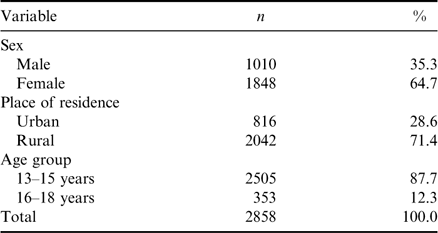
There were 2858 respondents with complete information on the sexual and reproductive health knowledge item responses as well as information on sex, age and place of residence. The response rate was 90%. Non-response was due to the lack of parental consent for the student to participate in the study. The distribution of sample respondents by sex, age and school location is shown in Table 1. The majority were female, aged 13–15 years and from rural schools, and this reflects the characteristics of the targeted sample.
Distribution of respondents by sex, age and place of residence, East Malaysia, 2015

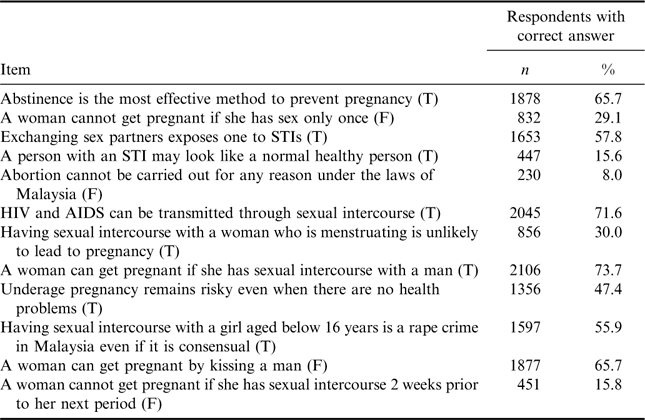
Table 2 shows the percentage of respondents answering correctly to the twelve knowledge items. The proportions of respondents who had correct responses to the knowledge items ranged from 8% (for knowledge about abortion under Malaysian law) to 73.7% (for knowledge that a woman can get pregnant if she has sexual intercourse with a man). The majority of the respondents answered the item on HIV transmission correctly (71.6%), and 65.7% knew that abstinence was the most effective method of preventing pregnancy.
Percentage of respondents answering correctly to sexual and reproductive health knowledge items

T=True; F=False.
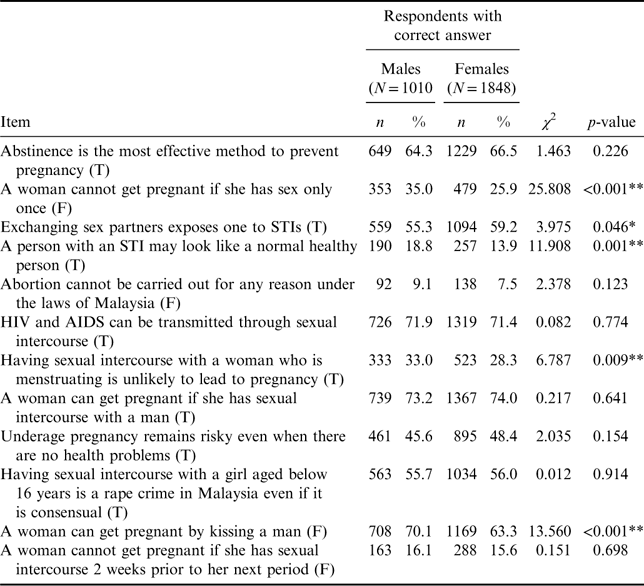
Five items showed significant differences in the percentage of correct answers by sex (Table 3). More males than females answered correctly on the following items: a woman can get pregnant if she has sex only once (males 35%, females 25.9%); people with STIs may look healthy and normal (males 18.8%, females 13.9%); having sexual intercourse with a woman who is menstruating is unlikely to lead to pregnancy (males 33.0%, females 28.3%); and a woman will not get pregnant by kissing a man (males 70.1%, females 63.3%). The only item for which female respondents had a significantly higher proportion of correct answers than male respondents was that exchanging sex partners exposes one to STIs (females 59.2%, males 55.3%).
Percentage of respondents answering correctly to sexual and reproductive health knowledge items by sex

T=True; F=False.
*p<0.05; **p<0.001.
As shown in Table 4
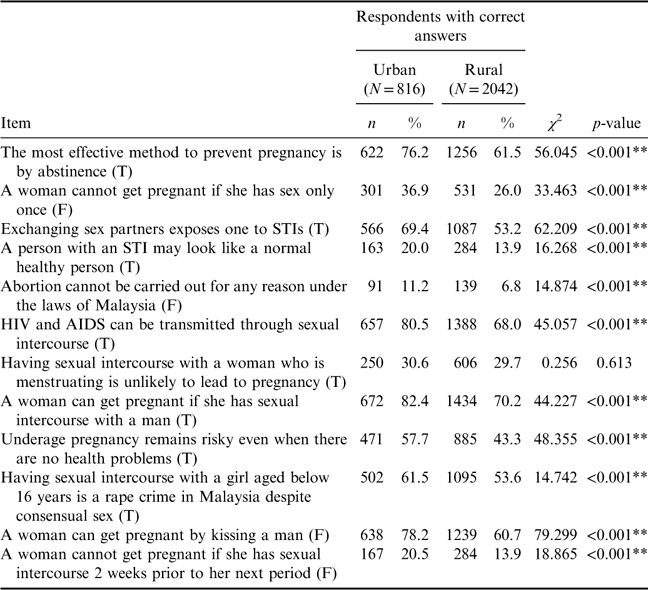
Percentage of respondents answering correctly to sexual and reproductive health knowledge items by place of residence

**p<0.001.
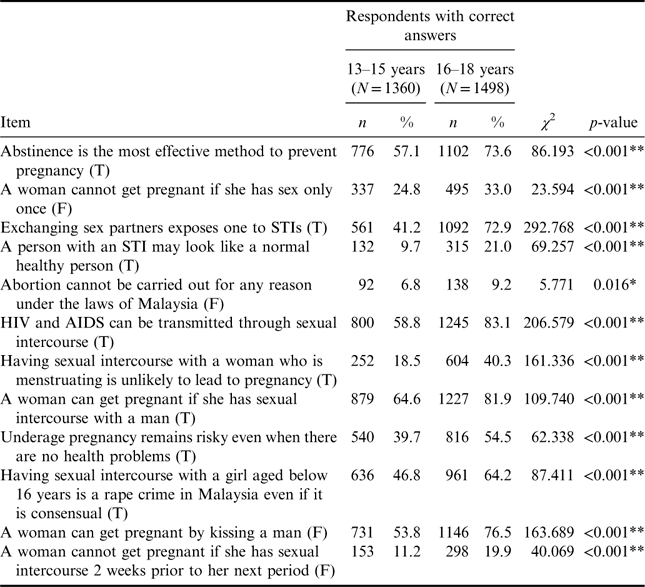
, respondents aged 16–18 years had significantly higher proportions of correct responses compared with those aged 13–15 years on all twelve knowledge items. More than 80% of those aged 16–18 years answered correctly on items related to HIV and AIDS transmission and that a woman can get pregnant if she has sexual intercourse with a man. A low proportion of correct answers was observed in both age groups for items related to Malaysian abortion law, that a woman can get pregnant if she has sexual intercourse 2 weeks prior to her next period and that people with STIs may look healthy.
Percentage of respondents answering correctly to sexual and reproductive health knowledge items by age

*p<0.05; **p<0.001.
Respondents from urban schools had a significantly higher proportion of correct answers than their rural counterparts on all twelve knowledge items, with the exception of the item that having sexual intercourse with a woman who is menstruating is unlikely to lead to pregnancy (Table 5).
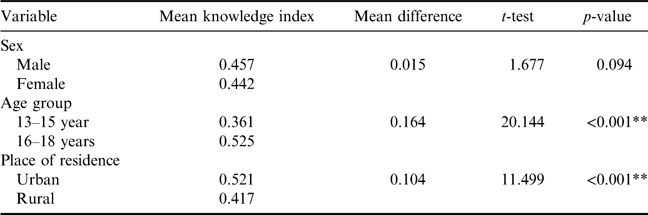
The data were further analysed by computing a knowledge index for each respondent using the ratio of the number of correct responses to the total number of knowledge items (twelve items). The overall mean knowledge index was 0.447. Table 6 shows and the mean knowledge index by sex, age and place of residence (Table 6). No significant difference was observed between males and females, while the mean knowledge indexes for respondents aged 16–18 years and for those from urban schools were significantly higher than those of respondents aged 13–15 years and those from rural schools, respectively.
Mean sexual and reproductive health index by sex, age and place of residence

**p<0.001.
Discussion
This study assessed East Malaysian adolescents’ knowledge of reproductive and sexual health based on twelve items. The overall mean knowledge score of the respondents was 6.8 – slightly above the half-way mark, with variations across sex, age and place of residence. The majority of the respondents knew that HIV and AIDS can be transmitted through sexual intercourse, that a woman can get pregnant if she has sexual intercourse with a man, that abstinence is the most effective method of preventing pregnancy and that a woman cannot get pregnant by kissing a man. However, the respondents had very little knowledge on Malaysian abortion law, that a woman can get pregnant if she has sexual intercourse 2 weeks prior to her next period and that people with STIs may look like normal healthy people.
Male respondents, those who were older and those from urban schools generally had higher knowledge than female respondents, younger respondents and those from the rural schools, respectively. These findings were consistent with those of earlier studies (WHO, 2005). Older, male respondents may have better knowledge because of their more permissive attitudes towards sex (Zuo et al., Reference Zuo, Lou, Gao, Cheng, Niu and Zabind2012), which may lead them to find out more about sexual and reproductive health. Respondents from urban schools could have had higher knowledge due to better internet access than rural areas. In Malaysia, there is a difference in internet adoption between urban and rural areas, with 76.3% of urban residents having internet access compared with only 56.9% of rural residents (Malaysian Communications and Multimedia Commission, 2017). Sabah and Sarawak are among the least-urbanized states in Malaysia with 53.3% and 53.2% of the total urban population, respectively (Department of Statistics Malaysia, 2011).
The mean knowledge index of around 0.45 suggests that there are areas of concern, and that greater attention should be focused on younger adolescents and those in rural areas. A study conducted among 5088 Malaysian young people by the National Population and Family Development Board (NPFDB) under the Ministry of Women, Family and Community Development revealed that some adolescents had their sexual debut before the age of 15 (Hassan et al., 2016). Given this, early sexual education is warranted. The NPFDB aims to empower young people with knowledge and skills on sexual and reproductive health matters, with schemes such as the Teen Cafés. Despite such governmental and non-governmental initiatives, much more effort is needed to increase sexual and reproductive health awareness in local contexts. In recognition of this, in 2011 the Malaysian government introduced a Social and Reproductive Health Education module into the Malaysian school curriculum covering reproductive systems, conflict management, puberty, the risks of pre-marital sex, STIs and sexual identity. Better knowledge of issues surrounding sexual and reproductive health will equip adolescents to guide them in making informed decisions about their future sexual behaviours.
The study has its limitations. Due to its cross-sectional design no causal effects could be confirmed. Secondly, there were slightly more female respondents than males, and this did not correspond to the general population of young people aged 10–19 years in East Malaysia, where more males were reported in 2015 when this study was conducted (Department of Statistics Malaysia, 2018). Nevertheless, the discrepancy was not large. The study does, however, add to the scant literature in East Malaysia, and provides a recent update on sexual and reproductive health knowledge among young people in the region, drawing from a large sample of young people from urban and rural areas. The study’s sampling procedure enables generalization of the findings to the whole of East Malaysia, allowing it to inform the development of sexual and reproductive health policies and programmes targeting this population.
Acknowledgments
The authors would like to thank the National Population and Family Development Board, Ministry of Women, Family and Community Development, Malaysia for funding this research and the Population Studies Unit, University of Malaya, for its support.
Ethical Approval. Ethical approval for this study was obtained from the University of Malaya Medical Centre Medical Ethics Committee, 15th May 2013, and the Ministry of Education Malaysia, 20th August 2014.
Conflicts of Interest. The authors have no conflict of interest to declare.
Funding. This project was commissioned to the University of Malaya Consultancy Unit by the National Population and Family Development Board, Ministry of Women, Family and Community Development, Malaysia (UPUM/SSC.147).