Introduction
The production of yellow-orange-red anthraquinone pigments in the superficial tissues is a major characteristic of most species in the family Teloschistaceae and in many taxa these are the only lichen compounds present (Santesson Reference Santesson1970). Our knowledge of these anthraquinones is increasing (Elix et al. Reference Elix, Wardlaw and Søchting2000; Søchting et al. Reference Søchting, Sogaard, Elix, Arup, Elvebakk and Sancho2014). Depending on the combination of the biosynthetically related anthraquinones and their proportions, several chemosyndromes have been distinguished (Søchting Reference Søchting1997, Reference Søchting2001). Chemosyndrome is a fairly constant and specific character, and most species have only one syndrome.
Secondary metabolites other than anthraquinones are quite rare in Teloschistaceae. Some species, in addition to anthraquinones, produce depsides (atranorin, gyrophoric acid and lecanoric acid; see Joshi et al. Reference Joshi, Wang, Yamamoto, Koh and Hur2010; Arup et al. Reference Arup, Søchting and Frödén2013; Vondrák et al. Reference Vondrák, Frolov, Košnar, Arup, Veselská, Halıcı, Malíček and Søchting2020; Zhang et al. Reference Zhang, Wang, Li, Søchting, Yin, Wang and Wang2019), depsidones (caloploicin, vicanicin and isofulgidin; see Søchting & Frödén Reference Søchting and Frödén2002; Søchting & Figueras Reference Søchting and Figueras2007; Bungartz et al. Reference Bungartz, Søchting and Arup2020), xanthones (lichexanthone; see Bungartz et al. Reference Bungartz, Søchting and Arup2020), and usnic acid (Arup et al. Reference Arup, Søchting and Frödén2013). Together with anthraquinones, many species also contain dark pigments of an unknown chemical structure, as for example, Cinereorufa-green and Sedifolia-grey, which are insoluble in acetone and therefore unextractable by common methods (Wetmore Reference Wetmore1996; Meyer & Printzen Reference Meyer and Printzen2000; Vondrák et al. Reference Vondrák, Šoun, Vondráková, Fryday, Khodosovtsev and Davydov2012, Reference Vondrák, Frolov, Košnar, Arup, Veselská, Halıcı, Malíček and Søchting2020; Frolov et al. Reference Frolov, Vondrák, Košnar and Arup2021). In a small number of lineages of Teloschistaceae, anthraquinones are occasionally or entirely absent and replaced by other compounds (Vondrák et al. Reference Vondrák, Šoun, Vondráková, Fryday, Khodosovtsev and Davydov2012), such as depsides and depsidones in Olegblumia demissa (Flot. ex Körb.) S. Y. Kondr. et al. and Sucioplaca diplacia (Ach.) Bungartz et al. (Søchting & Figueras Reference Søchting and Figueras2007; Bungartz et al. Reference Bungartz, Søchting and Arup2020) or Sedifolia-grey in Pyrenodesmia (Frolov et al. Reference Frolov, Vondrák, Košnar and Arup2021).
During three field trips in Yakutia (East Siberia, Russia), we collected a peculiar sterile epigaeic lichen crust lacking anthraquinones. Although collected only from the two nearby localities, it was common there. Subsequent analyses demonstrated that it belonged to the family Teloschistaceae and contained a remarkable chemistry (naphthopyrans) that is uncommon in lichens and previously unknown in Teloschistaceae, as well as an unidentified brown pigment resembling melanin. The lichen was not identified as any known taxon and due to its remarkable chemistry and morphology, and considering the current status of the taxonomy of Teloschistaceae, it is described here as a new species in a new genus.
Material and Methods
Sampling and phenotype evaluation
Several thalli were collected from the two localities in the Republic of Sakha (Yakutia) in Russia by L. Konoreva in 2016 and by I. Prokopiev and I. Frolov in 2021 and 2023. The specimens are deposited in LE, C, PRA and the personal herbarium of I. Frolov. Specimens from 2016 and 2021 were subjected to morphological, biochemical and phylogenetic analyses.
Measurements of morphological characters follow Vondrák et al. (Reference Vondrák, Frolov, Arup and Khodosovtsev2013) and microscopic observations are based on hand-cut sections mounted in water without chemical treatment. Measurements are accurate to 0.5 μm for cells and 5–10 μm for larger structures. Measurements of particular characters are given as x̄ 1–x̄ 2–x̄ 3 (n), where x̄ 1 is the minimum value, x̄ 2 is the arithmetic mean of all measurements, x̄ 3 is the maximum value, and n is the total number of measurements. Morphological terminology follows Vondrák et al. (Reference Vondrák, Frolov, Arup and Khodosovtsev2013) and the LIAS glossary (available at https://glossary.lias.net/wiki/).
The following were used for spot tests: 10% aqueous KOH solution (K), aqueous solution of calcium hypochlorite (C) and 5% alcoholic p-phenylenediamine solution (P).
Identification of secondary metabolites (TLC, UV/Vis spectrometric and HPLC-UV-ESI-QTOF/MS analyses)
For thin-layer chromatography (TLC) and high-performance liquid chromatography with UV detection coupled with electrospray-ionization quadrupole time-of-flight mass spectrometry (HPLC-UV-ESI-QTOF/MS), air-dried samples (4 mg) of the lichen were ground to a powder. Secondary substances were extracted from each sample with 0.3 ml of acetone. Extraction was carried out with constant stirring for 12 h at 20–25 °C. The obtained extracts were centrifuged for 10 min at 6000 g and kept at 4 °C until analysis.
TLC was performed on silica gel 60 plates (Merck, Darmstadt, Germany) using solvent system C (toluene:acetic acid = 170:30 v/v) according to Huneck & Yoshimura (Reference Huneck and Yoshimura1996). Authentic atranorin and norstictic acid were used as controls. After chromatographic development, the plates were examined under UV light (254 and 366 nm), then sprayed with a 10% sulphuric acid solution and heated at 100 °C for 15 min. Finally, the plates were cooled to room temperature and studied in daylight.
For UV/Vis spectrometric analysis, spots from the TLC plate (before a 10% sulphuric acid treatment) were scraped off with a scalpel. The resulting silica, containing the investigated substances, was extracted with 0.5 ml of acetonitrile. UV/Vis absorption spectra were recorded on a Beckman DU 800 spectrometer in the range 200–800 nm.
HPLC-UV-ESI-QTOF/MS analyses were performed with an Agilent 1290 Series chromatograph with UV detection. For chromatographic separation, a Thermo Hypersil-Keystone C18 column (150 × 2.1 mm × 5 μm) was used. The mobile phase consisted of (A) water:acetonitrile:formic acid (95:5:0.1 v/v), and (B) acetonitrile:water:formic acid (90:10:0.1 v/v). Analyses were performed at 30 °C and a flow rate of 0.3 ml min−1 in the gradient elution mode, and the percentage of B was programmed as follows: 5% (2 min) – 50% (5 min) – 70% (15 min) – 100% (25 min) – 100% (35 min). The volume of the injected sample was 5 μl. Spectra of eluting substances were recorded in UV at 250 nm. After separation, the samples were also analyzed with a quadrupole time-of-flight mass spectrometer (6538 Series, Agilent, USA). Ionization was achieved by electrospray in the negative mode. Voltage on the capillary was 2.5 kV, capillary temperature 350 °C, atomizing gas pressure 45 psi, desiccant gas (nitrogen) temperature 225 °C, and drying gas flow rate 5 l min−1. Mass spectra were recorded in the range 100–1000 m/z. For confirmation purposes, a targeted MS/MS analysis was performed. The precursor ions were filtered by the quadrupole. The collision energy of 30 eV was defined for MS/MS experiments. The resulting chromatograms were processed with MassHunter WorkStation v. B.07.00 software (Agilent, USA). In order to identify lichen substances, the obtained MS/MS spectra were compared with spectra from the MassBank of North America (MoNA).
DNA extraction, amplification and sequencing
DNA was extracted with a CTAB-based protocol (Aras & Cansaran Reference Aras and Cansaran2006). Amplifications were made of the internal transcribed spacer regions (nrITS), the large subunit (nrLSU) of the nuclear ribosomal RNA genes, and the small subunit of the mitochondrial ribosomal RNA gene (mtSSU). Primers for PCR amplification were ITS1F (Gardes & Bruns Reference Gardes and Bruns1993) and ITS4 (White et al. Reference White, Bruns, Lee, Taylor, Innis, Gelfand, Sninsky and White1990) for ITS, AL1R (Döring et al. Reference Döring, Clerc, Grube and Wedin2000) and LR5 (Vilgalys & Hester Reference Vilgalys and Hester1990) for nrLSU, and mrSSU1 (Zoller et al. Reference Zoller, Scheidegger and Sperisen1999) and mrSSU7 (Zhou & Stanosz Reference Zhou and Stanosz2001) for mtSSU. The PCR settings followed Ekman (Reference Ekman2001). Sequences obtained were uploaded onto the NCBI database (GenBank) and Accession numbers are provided in the species protologue.
Alignments and phylogenetic analyses
Newly obtained sequences were edited in FinchTV v. 1.4.0 (Geospiza Inc., Seattle, USA; http://www.geospiza.com) and BioEdit v. 7.2.5 (Hall Reference Hall1999). Together with sequences downloaded from GenBank, datasets were aligned online using MAFFT v. 7 (Katoh & Standley Reference Katoh and Standley2013; available at http://mafft.cbrc.jp/alignment/server/), with the L-INS-i method (Katoh et al. Reference Katoh, Kuma, Toh and Miyata2005) selected automatically by the program. To exclude ambiguously aligned positions, alignments were subsequently analyzed by the gappyout algorithm as implemented in the TrimAl software package (Capella-Gutierrez et al. Reference Capella-Gutierrez, Silla-Martinez and Gabaldon2009). Phylogenetic reconstructions of the concatenated dataset, as well as of the three single loci, were carried out using Bayesian inference in MrBayes v. 3.2.6 (Ronquist & Huelsenbeck Reference Ronquist and Huelsenbeck2003) and the analyses were run on the CIPRES Web Portal (http://www.phylo.org/portal2/). In the concatenated dataset, three partitions corresponding to three DNA loci were analyzed separately. Models of nucleotide substitutions for each partition (or single locus) were selected using the corrected Akaike information criterion implemented in jModelTest v. 0.1.1 (Posada Reference Posada2008). The SYM + I + G model was selected for nrITS, the GTR + I + G for nrLSU, and the HKY + I + G for mtSSU. MrBayes analyses were performed using two independent runs with four MCMC chains (three cold and one heated) in each run. Trees were sampled every 500th generation. The analyses were stopped when the average standard deviation of split frequencies between the simultaneous runs dropped below 0.01 (140 000 generations for the concatenated dataset, 1 165 000 for nrITS, 1 690 000 for nrLSU, and 1 065 000 for mtSSU). The first 25% of trees was discarded as burn-in, and the remaining trees were used for construction of a 50% majority-rule consensus tree. Accession numbers of sequences downloaded from GenBank and used in the analyses are provided in Supplementary Material Table S1 (available online).
Results and Discussion
Phylogeny and taxonomic position of the new species
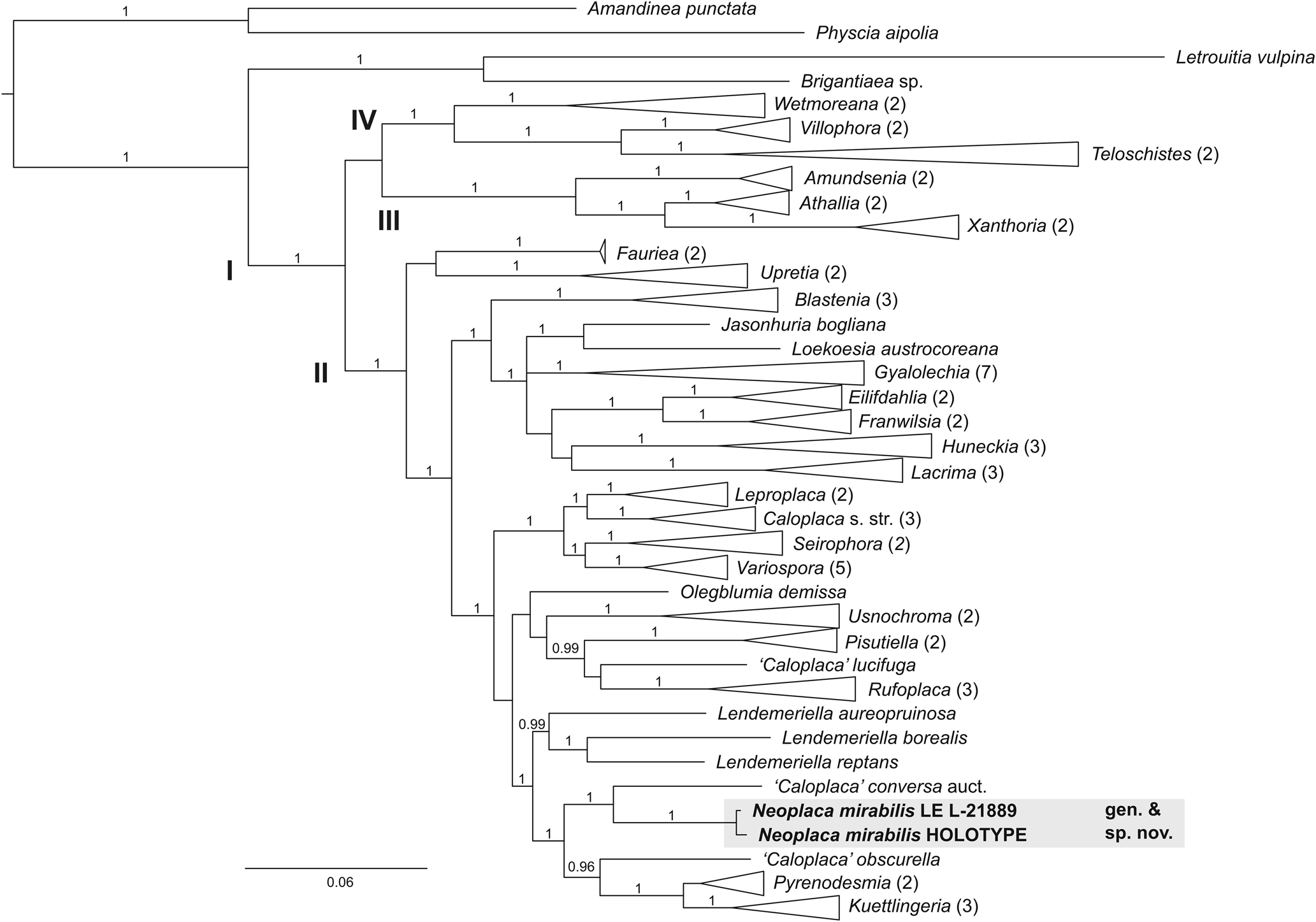
Performing an online NCBI BLAST search with sequences of all three loci of the new species demonstrated that it belongs in the subfamily Caloplacoideae of the family Teloschistaceae, but without a distinct generic affiliation, with c. 87% identity of nrITS to species of Caloplaca s. str., Lendemeriella and Pyrenodesmia. For a more accurate determination of the taxonomic position of the new species, it was included in the combined analysis of the nrITS, nrLSU and mtSSU dataset, together with the main genera of the subfamily Caloplacoideae and a few genera of the subfamilies Teloschistoideae and Xanthorioideae. The combined alignment included 75 terminal species and a total of 2273 positions before trimming and 2051 positions thereafter. The phylogeny was rooted with taxa of the families Brigantiaeaceae and Physciaceae following Arup et al. (Reference Arup, Søchting and Frödén2013). The three single loci were also analyzed separately.
According to our phylogenetic analysis of the combined alignment, the two specimens of the new species are nested within a highly supported clade encompassing the genera Kuettlingeria, Lendemeriella and Pyrenodesmia, and the species ‘Caloplaca’ conversa auct. and ‘C.’ obscurella (Fig. 1). The new species, however, does not belong to any of these genera forming a sister lineage to the specimen labelled as ‘C. conversa’ in GenBank, but here it is given as ‘C. conversa auct.’ since ‘C.’ conversa sensu Krempelhuber (Reference Krempelhuber1861) is not related to this specimen and currently belongs in the genus Pisutiella. Analyses of the single loci generated the same position for the new species (not supported in nrITS and mtSSU; Supplementary Material Figs S1–S3, available online).
Phylogeny of the subfamily Caloplacoideae (Teloschistaceae) based on the combined Bayesian analysis of nrITS, nrLSU and mtSSU data. Genera are collapsed into single terminals. Numbers at branches represent posterior probability (PP) values ≥ 0.95. Numbers in parentheses correspond to the number of species of a genus used in the analysis. I = Teloschistaceae; II = Caloplacoideae; III = Xanthorioideae; IV = Teloschistoideae.

As a result, the new species could not be assigned to any currently established genus of Teloschistaceae. Due to the outstanding features of the new species, as well as the distinct position in the Teloschistaceae phylogeny, a new genus to encompass it is proposed.
Secondary metabolites: HPLC-UV-ESI-QTOF/MS analysis and naphthopyrans
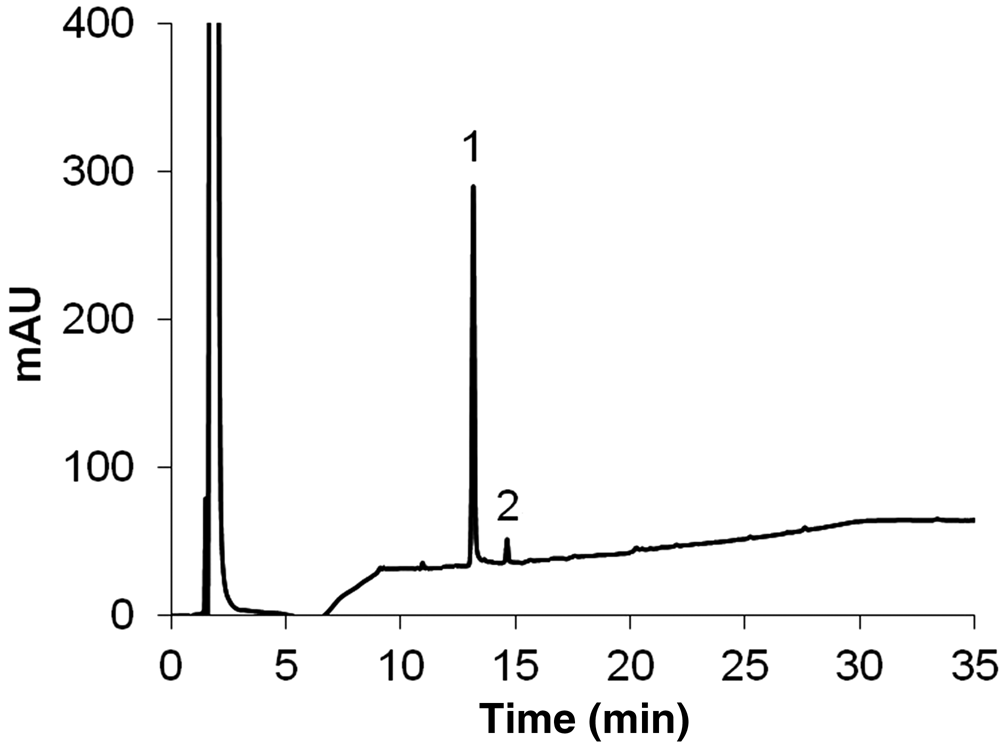
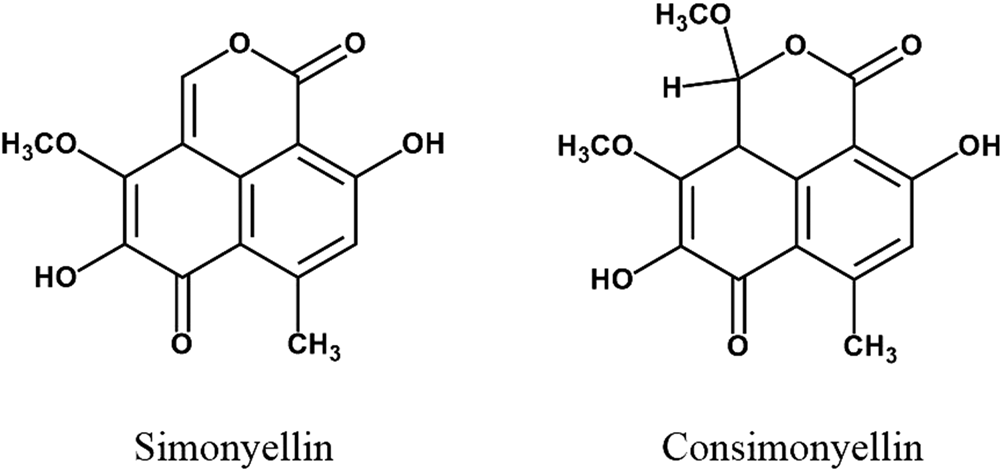
HPLC-UV analysis of the samples of thalli of the new species revealed two compounds with Rt = 13.2 min–major and Rt = 13.9 min–trace (Fig. 2). The obtained mass spectra of the substances revealed molecular ions [M-H]- with m/z 273.0403 (for Rt = 13.2) and 305.0659 (for Rt = 13.9) corresponding to the molecular formulas C14H10O6 and C15H14O7 respectively. Analysis of the MS/MS fragments showed that the compound C14H10O6 was simonyellin while C15H14O7 was a methoxylated derivative of simonyellin, namely consimonyellin (Fig. 3). Both chemicals belong in the class of organic compounds known as naphthopyrans. The obtained ESI-MS/MS spectra of simonyellin and consimonyellin are provided in Supplementary Material Fig. S4 (available online).
HPLC-UV chromatograms (250 nm) of acetone extracts of Neoplaca mirabilis. 1 = simonyellin; 2 = consimonyellin.

Structural formulas of the Neoplaca mirabilis secondary metabolites.

To explore the cause of the yellow colour of blastidia in the new species, these vegetative propagules were analyzed separately. After the twice-repeated extraction of separated blastidia in 0.1 ml of acetone, their colour changed from yellow to grey-green. In the yellow-dyed extract, naphthopyrans in the same ratio as in the whole thallus were detected by HPLC-UV. Since consimonyellin is a colourless substance (Huneck Reference Huneck2001), and simonyellin is a yellow pigment (Elix Reference Elix2014), it can be concluded that the yellow colour of blastidia is caused by the latter compound.
This is the first time naphthopyrans have been detected in the family Teloschistaceae and the second in the order Teloschistales; here, simonyellin was previously known in the family Brigantiaeaceae, and more particularly in the species Brigantiaea leucoxantha and B. tricolor (Elix Reference Elix2008). Naphthopyran derivatives are not widespread lichen substances. Besides Brigantiaeaceae, simonyellin was known only in the family Roccellaceae, in the genera Cresponea and Simonyella, and in the genus Bactrospora that has an uncertain position in the Arthoniales (Elix et al. Reference Elix, Feige, Lumbsch, Mies and Wardlaw1995, Reference Elix, Øvstedal and Gremmen2011; Kalb Reference Kalb2004; Berger & Aptroot Reference Berger and Aptroot2008; Kantvilas Reference Kantvilas2020), whereas consimonyellin has only been detected in the genus Cresponea (Elix et al. Reference Elix, Øvstedal and Gremmen2011; Kantvilas Reference Kantvilas2020). However, phenalenone, the precursor of naphthopyrans, is a well-known metabolite of non-lichenized fungi (Cooke & Edwards Reference Cooke, Edwards, Herz, Grisebach and Kirby1981). Takenaka et al. (Reference Takenaka, Hamada and Tanahashi2010) demonstrated that the isolated mycobiont of Lecanora leprosa was able to biosynthesize the naphthopyran-lecanopyrone, which was not found in the lichenized state of the mycobiont. It can be assumed that the ability of lichens to biosynthesize naphthopyrans represents the expression of the biosynthetic gene clusters of free-living fungi normally suppressed in the lichenized condition in lichens.
Secondary metabolites: TLC and UV/Vis spectrometric analyses and an unknown brown pigment
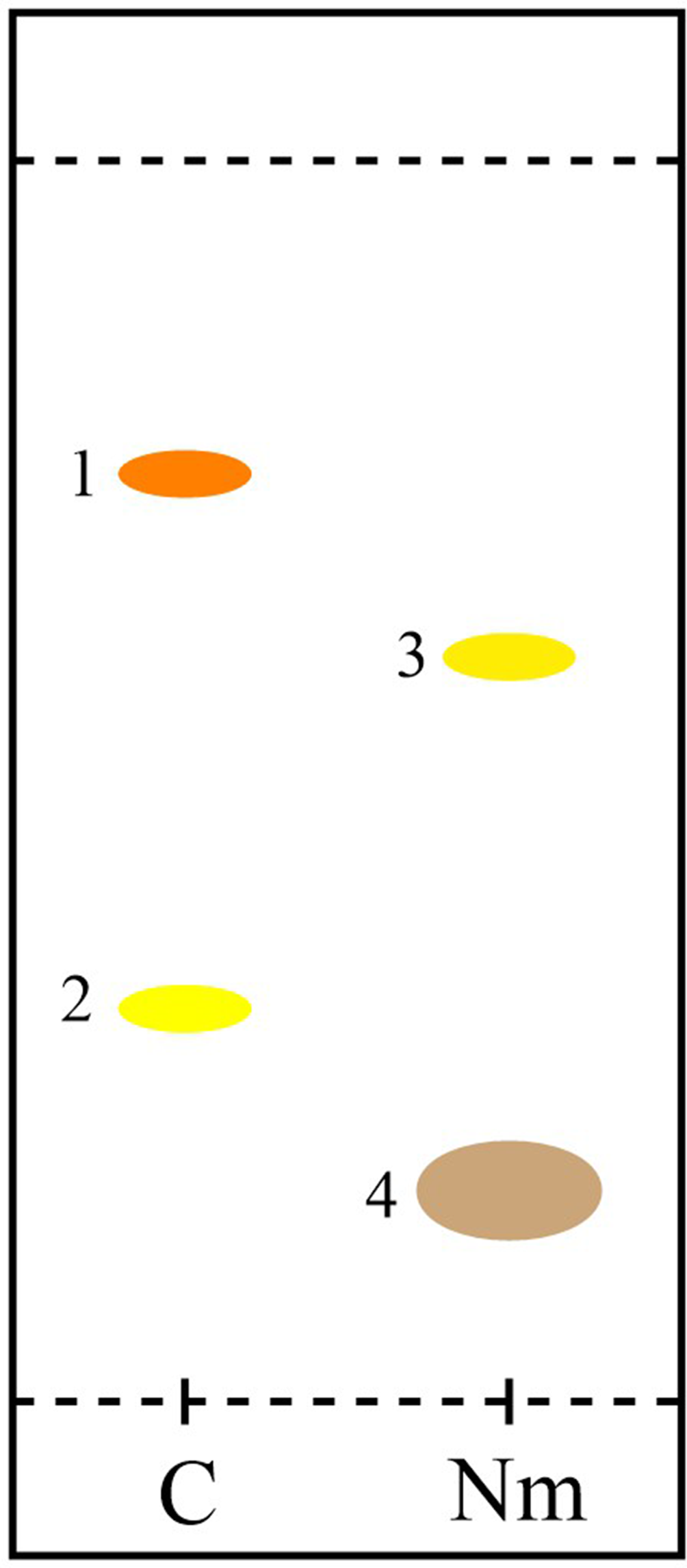
TLC analysis (solvent system C; Fig. 4) revealed a yellow-coloured compound with R f = 0.6 corresponding to simonyellin and a brown pigment with R f = 0.2, which was not detected by HPLC-UV. UV/Vis spectrum of acetonitrile solution of simonyellin shows absorption maxima at wavelengths 241, 264, 274, 307, 326 and 365 nm. The obtained UV/Vis spectrum of simonyellin is provided in Supplementary Material Fig. S5 (available online).
TLC analysis in solvent C (toluene:acetic acid = 170:30 v/v). Controls = C; Nm = Neoplaca mirabilis. 1 = atranorin; 2 = norstictic acid; 3 = simonyellin; 4 = brown pigment. In daylight after spraying with 10% sulphuric acid and drying at 100 °C for 10 min. In colour online.

The brown pigment was readily soluble in 10% KOH and sparingly in water, methanol, ethanol and acetone. This pigment discoloured in reaction with oxidizing agents (0.5 М KMnO4, 30% H2O2) and produced a brown precipitate with 1% FeCl3. These characteristics resemble those displayed by the pigment melanin (Khabibrakhmanova et al. Reference Khabibrakhmanova, Rassabina, Khayrullina and Minibayeva2022); however, the solubility of our pigment in the organic solvents is not typical for melanin. Due to the scarcity of the available material, it was not possible to isolate enough brown pigment to obtain the infrared spectra that could confirm its assignment to melanin.
Taxonomy
Neoplaca I. V. Frolov, Prokopiev & Konoreva gen. nov.
MycoBank No.: MB 849087
Thallus consists of squamules lacking anthraquinones and containing naphthopyrans.
Type species: Neoplaca mirabilis I. V. Frolov, Prokopiev & Konoreva.
Thallus whitish, greyish to yellowish, squamulose with citrine to orange-yellow blastidia on margin.
Apothecia and pycnidia unknown.
Chemistry
Thallus contains simonyellin as a major compound, traces of consimonyellin, and an unknown brown pigment. Pigments are apparently located inside the cells of the cortex.
Etymology
The genus name is a combination of the syllables ‘-placa’, hinting at Caloplaca s. lat., and ‘neo-’, indicating the innovative chemical and morphological characters of the new species of the genus.
Distribution
Currently the genus is known only from the two nearby localities in Yakutia, East Siberia.
Notes
Neoplaca mirabilis is the only species included in the genus, and despite its remarkable morphological and chemical features uncharacteristic of the Teloschistaceae, the new genus has just a common position among the other genera of the subfamily Caloplacoideae (Fig. 1). Due to the absence of anthraquinones, apothecia and pycnidia (see protologue), the taxonomic position of the new species within Teloschistaceae is based solely on molecular data.
Neoplaca mirabilis I. V. Frolov, Prokopiev & Konoreva sp. nov.
MycoBank No.: MB 848237
Thallus epigaeic, consisting of scattered whitish to greyish, or rarely with pale yellow tinge, squamules 1–4.5 mm diam., 0.3–1 mm thick. Blastidia common, produced from the margin of squamules, citrine to orange-yellow, highly contrasting with the colour of the upper surface. Apothecia and pycnidia are unknown. Contains simonyellin, consimonyellin and an unknown brown pigment. Anthraquinones are absent.
Type: Russia, Republic of Sakha (Yakutia), Tomponsky District, 145 km NE of Khandyga, right bank of the Vostochnaya Khandyga River, along the stream crossing the Kolyma Highway at the 585th km, 580 m alt., 63°07ʹ17.2ʺN, 138°14ʹ33.8ʺE, soil on exposed south-facing siliceous outcrops on the left bank of the stream, 12 August 2021, I. Frolov 3706 & I. Prokopiev (LE L-21846—holotype; C, PRA—isotypes). GenBank Accession numbers of the holotype sequences: OQ721918 (nrITS), OQ721950 (nrLSU), OQ724518 (mtSSU).
A–D, Neoplaca mirabilis (holotype). A, squamule with folded surface and blastidia. B, effigurate thallus formed by merged squamules. C, mature squamule surrounded by numerous primordia. D, cross-section of the cortex with the cell protoplasts coloured by a brown pigment. Scales: A–C = 2 mm; D = 10 μm. In colour online.

Thallus epigaeic, consisting of scattered whitish to greyish, or with pale yellow tinge, squamules, starting as tiny granules c. 0.1 mm diam., developing into small convex areoles/squamules 0.5–1 mm diam. and then into mature squamules 1–4.5 mm diam., sometimes with obscurely lobed margin, usually with blastidia and surface with wide, convoluted folds, in some places resembling the appearance of the brain in mammals; sometimes the squamules overlap each other like roof tiles or merge to form effigurate thalli c. 1 cm diam. (Fig. 5B); mature squamules are often surrounded by numerous tiny primordia, apparently germinating from blastidia (Fig. 5C), probably indicating the considerable ability of the species to reproduce vegetatively. Squamules in areas attached to substratum 0.7–1 mm thick, and those in detached parts thinner, up to 0.3–0.4 mm. Cortex paraplectenchymatous, 33–40 μm thick, consisting of two clearly distinguishable layers (Fig. 5D), a lower layer, c. 20 μm thick, consisting of colourless cells, and an upper layer, 13–20 μm thick, composed of cells with brown protoplasts and transparent cell walls (Fig. 5D). Cortex covered with uneven layer of white pruina, 12.5–45 μm thick, consisting of colourless crystals insoluble in KOH of various shapes and sizes up to 20 μm; cells of cortex isodiametric, 5–5.9–7 μm diam. (n = 10); on the lower side of squamules, cortex is absent. Algal layer 55–83 μm thick; algal cells globose, 9–12.2–15 μm diam. (n = 10). Medulla 0.2–0.8 mm thick, white, lax, composed of loosely interwoven, irregularly arranged hyphae up to 5 μm thick, with walls up to 2 μm thick and narrow lumina 1–2 μm. Blastidia common, produced from margin of squamules, citrine to orange-yellow, highly contrasting with the colour of the upper surface, rarely whitish, 58–89–125 μm diam. (n = 10), covered with a thin layer of brown pigment and tiny hook-shaped colourless hairs; hyphal sheath of blastidia 35–38 μm thick, consisting of isodiametric cells 5–7 μm diam.
Apothecia and pycnidia not observed.
Chemistry
Simonyellin (detected by both TLC and HPLC, major), consimonyellin (HPLC, trace), and an unknown brown pigment (TLC). Anthraquinones not detected. Squamules and blastidia K+ orange-brown, C−, P+ yellow (fleeting reaction). The reaction of the thallus with K does not correspond to simonyellin, which should be K− (Elix Reference Elix2014), but to the brown pigment. Its spot on the TLC plate demonstrates the same reaction with K.
Pigments of the new species are apparently located inside the cells of the cortex (Fig. 5D), whereas anthraquinones and, for example, Sedifolia-grey are located on the cell surface. After adding K to the cortex cross-section, the brown grains in the protoplasts dissolve, and the cell walls and protoplasts become uniformly coloured yellow or orange.
Etymology
The epithet reflects the highly unusual chemistry and habit of the new species for the Teloschistaceae.
Similar taxa
Neoplaca mirabilis is an unusual species owing to its large, whitish pruinose squamules with contrasting citrine to orange-yellow blastidia. Combined with its outstanding chemistry, the new species cannot really be confused with any other known taxon. Nevertheless, it may resemble the sterile epigaeic thalli of squamulose Xanthocarpia tominii (Savicz) Frödén et al. which, however, has bright, orange to ochre-yellowish, much smaller squamules up to 1.5 mm diam., soredia not contrasting with the thallus, and a purple reaction in K (contains anthraquinones). When squamules of the new species merge to form effigurate thalli, N. mirabilis may resemble Calogaya decipiens (Arnold) Arup et al. or Gyalolechia lenae (Søchting & G. Figueras) Søchting et al. that occasionally occur on soil on rocks. These species are easily distinguishable by the purple reaction in K of their thalli, soralia and apothecia (anthraquinones), as well as the pale yellow to orange colour of their thalli and soralia. Note also that sorediate Flavoplaca flavocitrina (Nyl.) Arup et al. and blastidiate Gyalolechia epiphyta (Lynge) Vondrák, which can be epigaeic, have areolate yellow to orange thalli containing anthraquinones (K+ purple). Furthermore, epigaeic species of the former genus Fulgensia A. Massal. & De Not. (currently included in Gyalolechia A. Massal.) can resemble the new species, especially when sterile, but they do not have blastidia and have a purple reaction in K. Other crustose Teloschistaceae occurring on soil (e.g. Blastenia ammiospila (Wahlenb. ex Ach.) Arup et al., Bryoplaca spp., Calogaya schistidii (Anzi) Arup et al. and ‘Caloplaca’ raesaenenii Bredkina) are richly fertile, have areolate or poorly developed thalli lacking vegetative propagules, and contain anthraquinones, at least in their apothecia. Other epigaeic crustose taxa known from Siberia (e.g. species of Endocarpon, Psora and Toninia) lack vegetative propagules and naphthopyrans.
Ecology and distribution
Currently the new species is known from the two nearby localities in Yakutia (right bank of the Vostochnaya Khandyga River), where it is quite common and grows on base-rich soil on exposed south-facing siliceous outcrops along small brooks at an altitude of 550–850 m a.s.l. together with species of Collema, Endocarpon, Leptogium and Toninia. The valley slopes of these brooks are covered with Larix gmelinii forest and the bottom of the valleys are treeless, which is probably due to the destructive impact of floods (Fig. 6A & B).
A & B, type locality of the newly described Neoplaca mirabilis. A, general view. B, soil on rocks with whitish thalli of the new species. In colour online.

Additional material studied
Russia: Yakutia: same as the type, 2016, L. Konoreva J-304 (LE L-21889, hb. Frolov; GenBank Accession numbers: OQ721919 (nrITS), OQ721949 (nrLSU), Q724517 (mtSSU)); ibid., along the brook crossing the Kolyma Highway at the c. 620th km, 63°08ʹ42.8ʺN, 138°43ʹ11.0ʺE, 850 m alt., 2023, I. Frolov 3847 & I. Prokopiev (hb. Frolov).
Acknowledgements
Prof. Mark Seaward kindly revised the manuscript. Ivan V. Frolov and Ilya A. Prokopiev were supported by the Russian Science Foundation (RSF grant no. 23-24-00207: https://rscf.ru/en/project/23-24-00207/).
Author ORCIDs
Ivan V. Frolov, 0000-0003-4454-3229; Ilya A. Prokopiev, 0000-0001-8755-7140; Liudmila A. Konoreva, 0000-0002-4487-5154.
Competing Interests
The authors declare none.
Supplementary Material
The Supplementary Material for this article can be found at https://doi.org/10.1017/S0024282923000567.