Introduction
The Ordovician deposits of the Buçaco Syncline have long been the subject of study. Fossil assemblages of Upper Ordovician units from this Hercynian structure were described by Ribeiro (Reference Ribeiro1853), Delgado (Reference Delgado1908), Thadeu (Reference Thadeu1947), Mitchell (Reference Mitchell1974), Elaouad-Debbaj (Reference Elaouad-Debbaj1978), Paris (Reference Paris1979), Young (Reference Young1985), Sarmiento et al. (Reference Sarmiento, del Moral and Piçarra2001), Lopes et al. (Reference Lopes, Vaz, Sequeira, Piçarra, Fernandes, Pereira, Gutiérrez-Marco, Rábano and García Bellido2011), Colmenar et al. (Reference Colmenar, Harper and Villas2014, Reference Colmenar, Pereira, Sá and da Silva2015, Reference Colmenar, Pereira, Sá, da Silva and Manzanares2016a, Reference Colmenar, Pereira, Young, Romano, da Silva, Sá, Gurdebeke, J. De Weirdt, T.R.A. Vandenbroucke and B.D. Cramerb, Reference Colmenar, Pereira, Pires, da Silva, Sá and Young2017a, Reference Colmenar, Pereira, Sá, da Silva and Youngb), Colmenar (Reference Colmenar2015, Reference Colmenar2016), Jacinto et al. (Reference Jacinto, Gutiérrez-Marco, Zamora, Zamora and Rábano2015), Pereira et al. (Reference Pereira, Colmenar, Sá, da Silva and Young2016), and Pereira (Reference Pereira2017). These authors described assemblages largely from the east limb of the syncline, especially those from the predominantly volcaniclastic Porto de Santa Anna Formation (Mitchell, Reference Mitchell1974) or from the carbonate Ferradosa Formation (Young, Reference Young1988). In his detailed survey, Delgado (Reference Delgado1908) indicated the presence of clastic sediments overlying the thinned Porto de Santa Anna Formation and related deposits on the west limb of the northern part of the Buçaco Syncline. Later, Paris (Reference Paris1981) noted the presence of a unit similar to the Upper Ordovician “Pelites à fragments” of Normandy (France) near Covelo (Penacova), in the same sector of the Buçaco Syncline referred to by Delgado (Reference Delgado1908).
In the 1980s, the revision of the Upper Ordovician stratigraphy of Central Portugal by one of us (Young, Reference Young1985, Reference Young1988) revealed the presence of a regressive sequence reflecting the glacio-eustatic lowering of sea level during the onset of Hirnantian glaciation (the Ribeira Cimeira and Ribeira do Braçal formations), as well as the overlying glaciomarine deposits themselves (the Casal Carvalhal Formation). An Hirnantian age was proposed for this sequence based on stratigraphic correlation (Young, Reference Young1988; Brenchley et al., Reference Brenchley, Romano, Young and Storch1991). Recently, this age assignment was further narrowed to the mid-upper Hirnantian based on palynomorphs from the Ribeira do Braçal Formation (Lopes et al., Reference Lopes, Vaz, Sequeira, Piçarra, Fernandes, Pereira, Gutiérrez-Marco, Rábano and García Bellido2011). The macrofossiliferous content of these beds remained undescribed since its discovery by Young (Reference Young1985).
In this paper, the Portuguese Ribeira do Braçal Hirnantian assemblage will be described, illustrated, and discussed for the first time. Among all the groups represented in the assemblage, only the brachiopods and the trilobites are studied in detail. In addition, its relation to the effects of the Hirnantian glaciation and the implications for the knowledge of the communities that preceded and proceeded the second biggest known Phanerozoic extinction (e.g., Sheehan, Reference Sheehan2001) will be debated.
Geographical and geological setting
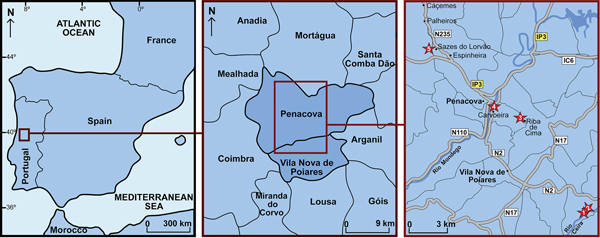
The studied material was collected from five Ribeira do Braçal Formation localities located in Penacova and Vila Nova de Poiares municipalities, both in the northern part of the Coimbra district (Fig. 1). The Hirnantian fossil assemblages occur in the basal 75 cm of the Ribeira do Braçal Formation, above the unconformity with the underlying Porto de Santa Anna Formation (regional upper Berounian-Kralodvorian, global Katian).
Geographic location of the first Portuguese Hirnantia Fauna fossil localities. Stars with numbers refer to Localities 1 to 5.

The Ordovician rocks of the Buçaco Syncline crop out in the Penacova-Vila Nova de Poiares region, which lies in the western portion of the Central Iberian Zone (CIZ). This syncline comprises two lithostratigraphic sequences separated by an angular unconformity: the Beiras Group, a monotonous, kilometer thick series of intercalated shales and greywackes of Neoproterozoic age; and the post-Cambrian Paleozoic metasedimentary sequence, ranging from Lower Ordovician to the Silurian (Oliveira et al., Reference Oliveira, Pereira, Piçarra, Young, Romano, Gutiérrez-Marco, Saavedra and Rábano1992; Pereira et al., Reference Pereira, Linnemann, Hofmann, Chichorro, Solá, Medina and Silva2012).
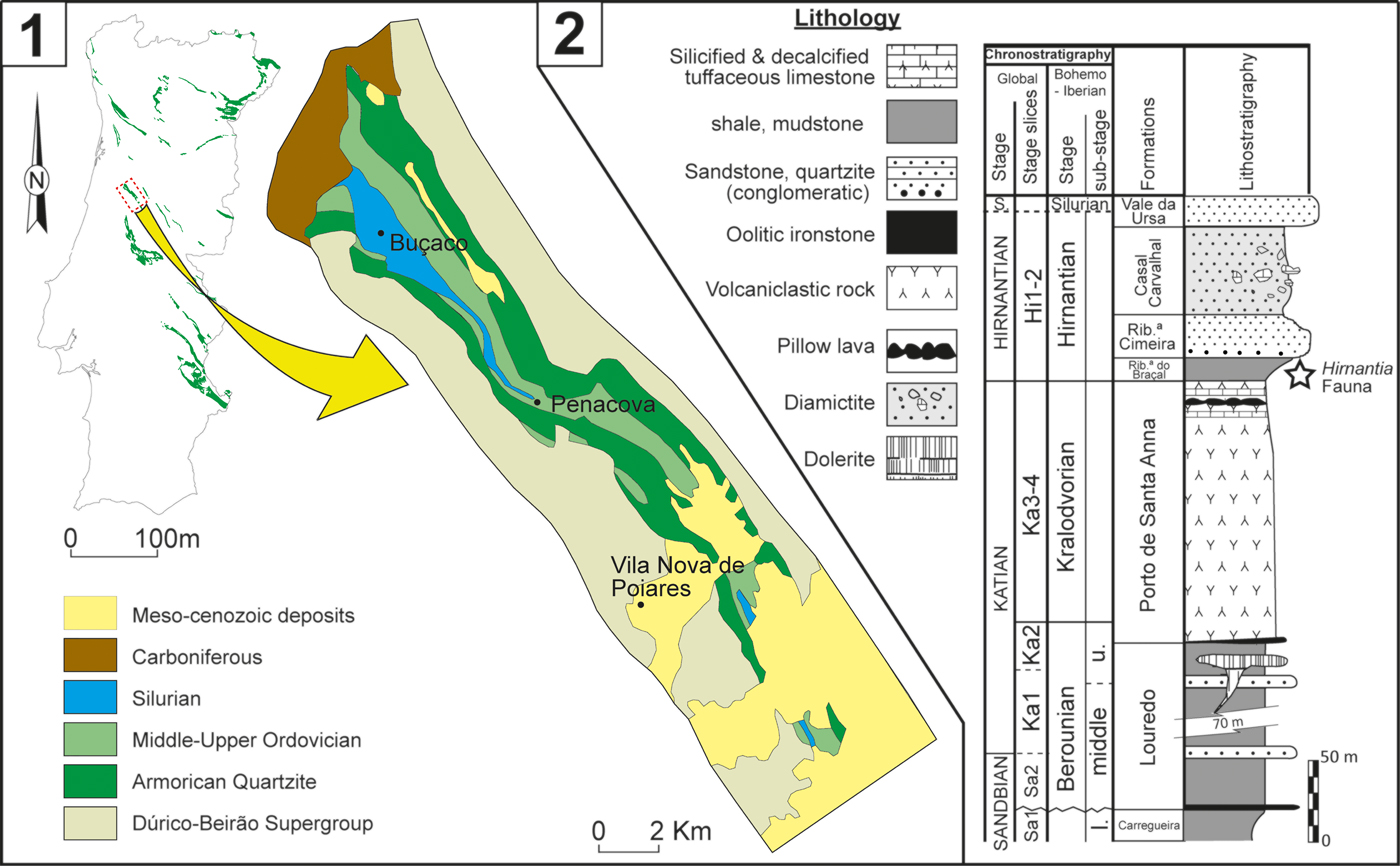
The Upper Ordovician sequence of the Buçaco Syncline (Fig. 2) encompasses deposits of three major phases of sedimentation (Young, Reference Young, Young and Taylor1989). The first of these phases is represented by the sediments referred to the Louredo Formation, a sequence of storm-dominated shallow marine clastic sediments of mid to upper Berounian (global upper Sandbian-lower Katian) age. The Louredo Formation is overlain by strata of the second phase: a complex of volcaniclastic and carbonate beds in the Venda Nova Group (Young, Reference Young1988). The predominantly volcanic section of this group falls within the Porto de Santa Anna Formation. This volcanic and volcaniclastic sequence thins from northeast to southwest, its facies becoming more distal. A volcanic source close to the northern limit of the exposed Upper Ordovician strata in the Buçaco Syncline was postulated by Young (Reference Young1985). A series of dolerite sills intruded into the underlying Louredo Formation, and in some cases, into the Porto de Santa Anna Formation itself may be linked to this extrusive activity. The Venda Nova Group also embraces considerable carbonate deposits, now mainly represented by dolomite, but also including some bioclastic and silicified limestones. The relationship of the carbonates to the contemporary volcanics is somewhat obscured by deformation. However, the carbonate deposits seem to occur in a linear, although probably not continuous, belt along the southwestern margin of the area of thick volcanic strata. These carbonates separate two distinct areas of volcaniclastic occurrences: one lying to the northeast, marked by relatively thick beds, and another located to the southwest, characterized by very thin or even absent volcaniclastic beds.
Geological setting of the Buçaco area. (1) Portugal map showing the Ordovician outcrops (left) in green color (see online version for color) and detailed geological map of the Buçaco Syncline (right); (2) synthetic stratigraphic column of the Ordovician sequence of the Buçaco Syncline showing the stratigraphic position of the Hirnantia Fauna assemblages (modified after Colmenar et al., Reference Colmenar, Pereira, Sá, da Silva and Young2017b).

The deposits of the third phase, those connected with the Hirnantian glaciation, overlie the older deposits in the area. However, the paleorelief produced during the previous phase had a strong influence on their nature and distribution. The first of these third-phase deposits corresponds to a regressive sequence of mudstones and fine-grained sandstones in which the macrofossiliferous assemblage herein described occurs. These constitute the Ribeira do Braçal Formation (Young, Reference Young1988). In the Buçaco Syncline, this unit crops out in the area southwest of the earlier mentioned Venda Nova Group carbonate deposits. Its base may appear slightly tuffaceous or calcareous in places, therefore some gradation from the earlier deposits seems possible. The base of the Ribeira do Braçal Formation includes very fine-grained sediments, with the mudstones becoming more micaceous upwards. Siltstone and sandstone beds, probably storm-generated, become intercalated in the upper section of the formation.
The succeeding unit is the Ribeira Cimeira Formation, predominantly composed of dark sandstones, locally conglomeratic. This formation is interpreted as representing the deposits formed close to the peak of the glacio-eustatic Hirnantian regression. In the area southwest of the earlier carbonate belt, the Ribeira Cimeira Formation (Young, Reference Young1988) overlies the Ribeira do Braçal Formation, but in the northern parts of the west limb of the syncline it rests directly on the volcaniclastic beds of the Porto de Santa Anna Formation. On the other hand, in the Rio Ceira Inlier (Localities 1 and 2, Fig. 3.1), the Ribeira Cimeira Formation lies over a major basal erosion surface, probably associated with channeling at its base. The deposition environment of this formation is not fully understood. However, it seems likely to have been marine. The influx of conglomeratic debris derived from the deposits of the Venda Nova Group is attributed to their emergence during the regression. These conglomeratic sandstones are overlain by a transgressive sequence, the Casal Carvalhal Formation (Young, Reference Young1988), which is rather poorly represented in the Buçaco Syncline. The lower part of this formation, however, crops out at several locations in the area, and consists of massive sandy mudstones with isolated pebbles. These deposits are believed to be of glaciomarine origin, with the isolated pebbles interpreted as dropstones. These sediments are closely comparable with those of similar age in other parts of Iberia and Armorica (e.g., the “Pélites à fragments” of Normandy), for which a glaciomarine origin has been proposed (Brenchley et al., Reference Brenchley, Romano, Young and Storch1991 and references).
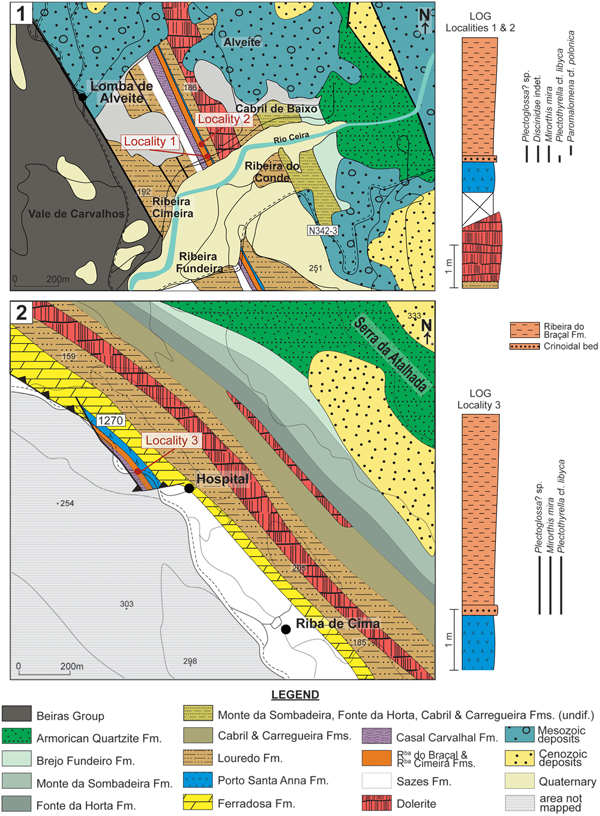
Geological setting and stratigraphic logs of Localities 1 to 3. (1) Geological map of the Rio Ceira Inlier, Vila Nova de Poiares municipality, showing the situation of Localities 1 and 2, and schematic log of the section showing the position of the fossiliferous beds and the vertical range of brachiopod species; (2) geological map of the Riba de Cima area, Penacova municipality, showing the situation of Locality 3 and schematic log of the section showing the position of the fossiliferous beds and the vertical range of brachiopod species.

Materials and methods
The material for this study was collected during several field campaigns by one of us (TPY) during the late 1980s and during recent campaigns in the spring and fall of 2016 and 2017 by all the authors. The five localities sampled are described below (see Figure 1 for geographic location) and have yielded a total of 141 brachiopods and 22 identifiable trilobite remains, as well as numerous echinoderms, disarticulated machaeridians, several ostracode valves, and bryozoans.
Locality 1
Ribeira do Braçal stratotype (Fig. 3.1, log Locality 1 and 2; 40°10'27.8″N, 8°11'00.7″W). This locality corresponds with the stratotype of the Ribeira do Braçal Formation (Young, Reference Young1988). It lies on the eastern limb of the Buçaco Syncline in the Rio Ceira Inlier. A section exposing this Upper Ordovician sequence crops out along the dirt track cut running from Serpins, through Ribeira Fundeira, towards Cabril de Baixo on the north side of the valley of the Rio Ceira. In this section, the Porto de Santa Anna Formation (regional upper Berounian–Kralodvorian, global Katian) is <2 m thick. At its top, beds with brachiopods, probably of upper Kralodvorian (global late Katian) age, occur (Colmenar et al., Reference Colmenar, Pereira, Pires, da Silva, Sá and Young2017a). In this locality, the Ribeira do Braçal Formation is ~14 m thick. A thin crinoidal bed, rich in Pentagonocyclicus columnals, marks the very base of the formation. This bed in this locality also yielded other echinoderms such as echinosphaeritids, linguliformean and rhynchonelliformean brachiopods, as well as ramose and massive bryozoans. The next layer is composed of green, somewhat nodular, mudstones, ~5 cm thick. These are overlain by variegated light and dark gray mudstones (8 m), which may have been slightly calcareous when fresh. The dark gray mudstones are in turn overlain by gray silty mudstones (7 m). The macrofossil content decreases rapidly up from the base of the formation, and disappears entirely within the gray silty mudstones, ~20 cm above the base. At Locality 1, the higher sections of the formation are largely composed of gray micaceous mudstones, with thin, sharp-based, laterally persistent intercalations of siltstones and sandstones. These intercalations become predominantly sandy in the uppermost part of the formation. Some coarse beds in the uppermost part of the formation show features interpreted as tempestitic (HCS stratification), while those in the lower part tend to be massive or parallel-laminated and are of indeterminate origin.
The base of the overlying Ribeira Cimeira Formation, marked by cross-bedded sandy conglomerates, sits over an unconformity. At Locality 1, in the above-mentioned dirt track, the erosion contact is strongly channeled, with channels up to 1 m deep. In the valley north of this location, the contact surface may show a relief of as much as 10 m. The basal conglomerates are composed largely of volcanic or volcaniclastic rock fragments derived from the Porto de Santa Anna Formation. It also includes clasts of the basal ironstone of the Porto de Santa Anna Formation, suggesting that locally the post-Porto de Santa Anna erosion may have completely obliterated the upper Berounian–Kralodvorian deposits. Most of the Ribeira Cimeira Formation sequence comprises dark quartzites. The quartzites gradually transition into pebbly sandy mudstones interpreted as glacio-marine deposits assigned to the overlying Casal Carvalhal Formation.
Locality 2
Forest path 50 m north of the stratotype at Locality 1 (Figure 3.1, log Locality 1 and 2; 40°10'30.7″N, 8°11'00.9″W). This fossiliferous locality lies in a forest path in the valley located roughly 50 m north of Locality 1. At this location, only the lowest part of the Ribeira do Braçal Formation is exposed, overlying a thin (~1 m thick) sequence of the Porto de Santa Anna Formation yielding upper Kralodvorian (upper Katian) fossils. As in the previous locality, macrofossils have been found within the basal 20 cm of the unit. In this section, the base of the Ribeira do Braçal shows no traces of the crinoidal bed so prominent at Locality 1. At this locality, the base of the formation is marked by fossiliferous green and gray mudstones. The only fossils found in the mudstones are those of brachiopods and few crinoid columnal plates.
Locality 3
Riba de Cima (Fig. 3.2, log Locality 3; 40°15'41.4″N, 8°14'54.1″W). This locality lies on the eastern limb of the Buçaco Syncline, just south of the Rio Mondego, in the southern sector of the main outcrop of this structure. The locality lies close to the faulted axial region of a major fold, therefore the fossil material from this site is more deformed than that from Localities 1 and 2. The material was collected from a section exposed along a narrow track running from the main road to Ferradosa, down into the valley of the Ribeira de Ribas. The succession seen in the section includes, from East to West, volcanics of the Porto de Santa Anna Formation, the Ribeira do Braçal Formation, the Ribeira Cimeira Formation, and the Casal Carvalhal Formation. The Casal Carvalhal Formation is faulted against Silurian black mudstones a few meters thick, which separate the opposing limbs of the syncline. The highest beds seen on the west limb in this area are part of the Louredo Formation of middle–upper Berounian (upper Sandbian–lower Katian) age.
The lower part of the Ribeira do Braçal Formation yields fossil content, mainly brachiopods and crinoids, over a thickness of at least a meter. Interbedded within the fossiliferous horizons are several thin coquinoid beds, predominantly the brachiopod Plectothyrella cf. P. libyca. The fossiliferous beds are mainly represented by fine gray mudstone. Little is known about the higher parts of the formation at this locality.
Locality 4
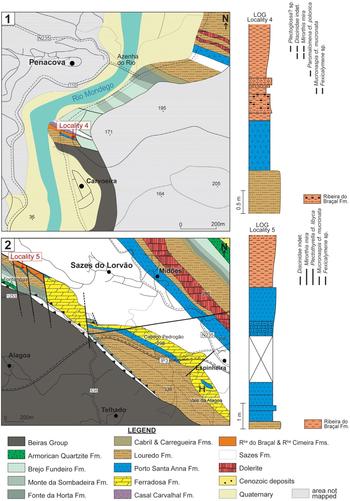
Carvoeira (Fig. 4.1, log Locality 4; 40°15'57″N 8°16'40″W). Southwest of the Riba de Baixo locality the geological structure becomes highly complex. In this area, rather than by a single simple fold, the Buçaco Syncline is represented by at least two synclinal closures, with a complex series of northeast-younging fault-blocks. In one of the blocks, a deformed and faulted sequence from the middle part of the Louredo Formation (Upper Ordovician) through the Sazes Formation (Silurian) is exposed on the road cut immediately south of Carvoeira cemetery. A continuous sequence from the Porto de Santa Anna Formation, through the Ribeira do Braçal Formation and into the Ribeira Cimeira Formation is exposed here. Approximately 1 m of highly-weathered tuffs are exposed northeast of a fault. These tuffs are overlain by pink siliceous mudstones at the base (15 cm), passing up into green mudstones with pyrite nodules (30 cm), then very fine-grained gray mudstones (25 cm), and finally into micaceous mudstones, green near the base, but rapidly becoming gray.
Geological setting and stratigraphic logs of Localities 4 and 5. (1) Geological map of the Carvoeira area, Penacova municipality, showing the situation of Locality 4, and schematic log of the section showing the position of the fossiliferous beds and the vertical range of brachiopod and trilobite species; (2) geological map of the Fontainhas area, Penacova municipality (after Soares et al., Reference Soares, Marques and Sequeira2007), showing the situation of Locality 5 and schematic log of the section showing the position of the fossiliferous beds and the vertical range of brachiopod and trilobite species.

Fossils occur throughout the basal 70 cm of the formation. The assemblage is the most diverse of the studied ones, yielding trilobites, machaeridians belonging to the genus Plumulites, as well as brachiopods and very few and sparse crinoid columnals. The Ribeira do Braçal Formation becomes increasingly deformed upwards. Approximately 10 m of mudstones are exposed, but deformation has probably thinned the original thickness. The sedimentary characteristics of the formation above the fossiliferous horizons are very close to those seen at Locality 1.
Locality 5
Pé de Viso/Fontainhas (Fig. 4.2, log Locality 5; 40°18'55″N 8°20'58″W). On the northern area of the western limb of the Buçaco Syncline, to the southwest of Sazes de Lorvão, the Ordovician sequence is also strongly disrupted by faulting, including many low-angle faults. Various facies of the Venda Nova Group and younger Ordovician facies are present in this area. One fault-block includes a thin sequence of tuffs and decalcified limestones, ~5 m thick, belonging to the Porto de Santa Anna Formation. The contact of these beds with the Louredo Formation is faulted in this sector. However, fossil assemblages normally found close to the base of the Porto de Santa Anna Formation have been recovered, so it appears likely that that the thinness is an original depositional feature. These beds are overlain by a relatively thick sequence of the Ribeira do Braçal Formation, 25–30 m thick. This unit is overlain by deformed quartzites, probably referable to the Ribeira Cimeira Formation, that lie in faulted contact with the Sazes Formation of Silurian age. The Casal Carvalhal Formation has not been recognized in this area. The fossils, consisting brachiopods, trilobites, and ostracodes determined as Herrigia? sp., were recovered from the basal 75 cm of the Ribeira do Braçal Formation, the first 40 cm of which is composed of the green mudstones, while higher beds are gray. The fossil content disappears as the mudstones become micaceous. Development of the higher parts of the formation is similar to that seen at Localities 1 and 3, but the muddy part of the formation is thicker, and sandstones do not appear until 20–25 m above the base.
Repositories and institutional abbreviations
All figured specimens are deposited, with MG-prefix, in the Geological Museum of Lisbon. The non-figured specimens are temporarily housed in the Faculty of Sciences of Lisbon University.
Systematic paleontology
The use of open nomenclature follows Bengtson (Reference Bengtson1988) and the synonymy lists, Matthews (Reference Matthews1973).
Phylum Brachiopoda Dumeril, Reference Dumeril1806
Subphylum Linguliformea Williams et al., Reference Williams, Carlson, Brunton, Holmer and Popov1996
Class Lingulata Gorjansky and Popov, Reference Gorjansky and Popov1985
Order Lingulida Waagen, Reference Waagen1885
Superfamily Linguloidea Menke, Reference Menke1828
Family Obolidae King, Reference King1846
Subfamily Glossellinae Cooper, Reference Cooper1956
Genus Plectoglossa Cooper, Reference Cooper1956
Type species
Plectoglossa oklahomensis Cooper, Reference Cooper1956.
Plectoglossa? sp.
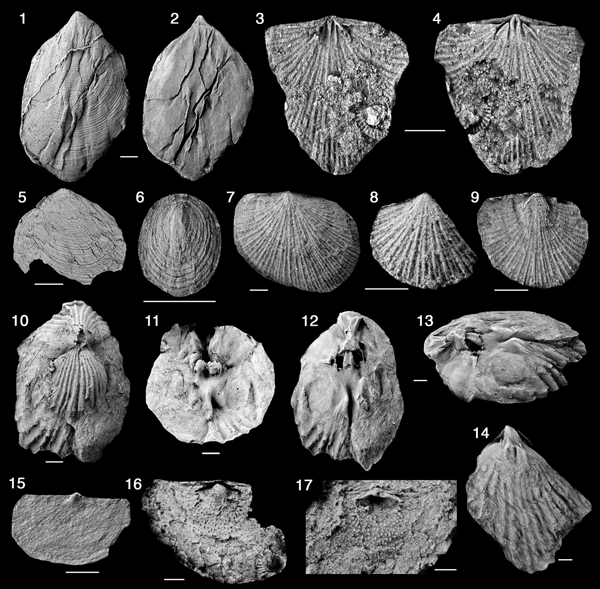
Figure 5.1–5.2, 5.5
Occurrence
Lower part of Ribeira do Braçal Formation at Localities 1–4.
Materials
Only six specimens available: two complete external molds of a ventral (Fig. 5.1, 5.2; MG30722) and dorsal (Fig. 5.5; MG30723) valves from Locality 1; one small fragment from Locality 2; one incomplete external mold from Locality 3 and one incomplete external mold and one poorly preserved internal mold of a ventral valve, both from Locality 4.
Brachiopods from the Ribeira do Braçal Formation. Plectoglossa? sp. (1, 2, 5) from Locality 1; (1, 2) latex cast of exterior (1) and internal mold (2) of a ventral valve (MG30722); (5) latex cast of exterior of a dorsal valve (MG30723). Mirorthis mira Zeng in Wang and others, Reference Wang, Zeng, Zhou, Xiang, Lai, Ni, Xu, Sun and Li1983 (3, 4, 7–9) from Locality 2; (3, 4) latex cast of interior (3) and internal mold (4) of a dorsal valve (MG30724); (7) latex cast of exterior of a dorsal valve (MG30725); (8) latex cast of exterior of a ventral valve (MG30726); (9) internal mold of a ventral valve (MG30727). (6) Discinidae gen. et sp. indet., latex cast of exterior of a dorsal valve (MG30728) from Locality 4. Plectothyrella cf. P. libyca Havlíček in Havlíček and Massa, Reference Havlíček and Massa1973 (10–14), from Locality 5; (10–13) latex cast of exterior (10) and interior (11), internal mold in dorsal (12) and lateroblique (13) views of a shell with the conjoined valves (MG30729); (14) internal mold of a ventral valve (MG30730). Paromalomena cf. P. polonica (Temple, Reference Temple1965) (15–17); (15) internal mold of a ventral valve (MG30731) from Locality 2; (16) internal mold of a ventral valve (MG30732) from Locality 1; (17) latex cast of the precedent specimen showing the papillae arrangement. All scale bars = 2 mm.

Remarks
The elongate oval shell with regular, elevated concentric growth lines approximate our material to Plectoglossa Cooper (Reference Cooper1956). Nevertheless the impossibility to observe the ventral pseudointerarea, diagnostic character of this taxon, we prefer to assign this material to this taxon with some doubts. The internal characters of this genus remain unknown. More complete and better-preserved material from these localities will allow the description of this character and warrant the generic classification.
Superfamily Discinoidea Gray, Reference Gray1840
Family Discinidae Gray, Reference Gray1840
Discinidae gen. et sp. Indet
Figure 5.6
Occurrence
Lower part of Ribeira do Braçal Formation at Localities 4 and 5.
Materials
29 specimens in form of internal and external molds, 24 of them from Locality 4 and five from Locality 5. The figured specimen (Fig. 5.6; MG30728) is from Locality 4.
Remarks
The subconical holoperipheral growth of the valves allows including our material within the Discinidae. Despite the large number of specimens, their preservation precludes specific and generic assignment.
Subphylum Rhynchonelliformea Williams et al., Reference Williams, Carlson, Brunton, Holmer and Popov1996
Class Strophomenata Williams et al., Reference Williams, Carlson, Brunton, Holmer and Popov1996
Order Strophomenida Öpik, Reference Öpik1934
Superfamily Strophomenoidea King, Reference King1846
Family Glyptomenidae Williams, Reference Williams and Moore1965
Subfamily Glyptomeninae Williams, Reference Williams and Moore1965
Genus Paromalomena Rong, Reference Rong and Sinica1984
Type species
Paromalomena polonica (Temple, Reference Temple1965)
Paromalomena cf. P. polonica (Temple, Reference Temple1965)
Figure 5.15–5.17
Occurrence
Material referred to this species is known from the lower part of the Ribeira do Braçal Formation of the Buçaco Syncline.
Other occurrences of Paromalomena polonica.—Zalesie Fm, Holy Cross Mountains, Poland (Baltica); Kuldiga Fm, Estonia and Latvia (Baltica); Zhalairskaya Fm, Chu-Ili Terrane (Kazakhstan); Pangshsa-Pye Fm, Burma (Sibumasu); Wang Tong Fm, S. Thailand (Sibumasu); Kuanyinchiao Fm (South China); Xainza Fm, S. Tibet, (Western China); Ashgill Fm, Lake District, England (Avalonia); Keisley Limestone, Westmorland, England (Avalonia); Graig-wen Sandstone, C. Wales (Avalonia); Don Braulio Fm, Argentina (Precordillera); Kosov Fm, Czech Republic (Bohemia).
Description
Ventri-biconvex shell, semicircular in outline, about 60% as long as wide, maximum width located at hinge line, both valves convex near umbo, while the dorsal valve particularly becomes planar anteriorly; ornament poorly known but costellate, with ribs derived by branching, ornament stronger on ventral valve, which also bears faint rugae. The prominent protegular node of the dorsal valve is devoid of ornament.
Ventral interior poorly preserved but with divergent and short dental plates.
Dorsal interior with divergent socket ridges that become parallel to hinge line distally; the pit anterior to the cardinal process lobes is very deep, these lobes are separated by a deep groove. The interior of the valve is covered with fine papillae, except for a field in front of the pit, the edges of this field are marked by a zone of much larger papillae.
Materials
There are several tens of specimens from the Ribeira do Braçal Formation in Localities 1 and 2; as with other material from this horizon, much of it is poorly preserved, and many of the molds suffer from being composite. Further material is known from a similar horizon further north near Locality 3, in coquinoid beds, but this material is very fragmentary, although individual fragments may preserve details (such as the papillate interior, Fig. 5.16, 5.17; MG30732) well.
Remarks
This material is close to P. polonica as described by Temple (Reference Temple1965); however, the illustrations given by Temple (Reference Temple1965, e.g., pl. 15, fig. 2) do not show the same distribution pattern of papillae as the one displayed by the Portuguese material. In the latter, the papillae seem to decrease in size away from the dorsal umbo, and do not show a smooth zone in front of the pit, with a ring of coarser papillae around it.
Class Rhynchonellata Williams et al., Reference Williams, Carlson, Brunton, Holmer and Popov1996
Order Orthida Schuchert and Cooper, Reference Schuchert and Cooper1932
Suborder Dalmanellidina Moore, Reference Moore, Moore, Lalicker and Fischer1952
Superfamily Dalmanelloidea Schuchert, Reference Schuchert, von Zittel and Eastman1913
Family Dalmanellidae Schuchert, Reference Schuchert, von Zittel and Eastman1913
Subfamily Dalmanellinae Schuchert, Reference Schuchert, von Zittel and Eastman1913
Genus Mirorthis Zeng in Wang et al., Reference Wang, Zeng, Zhou, Xiang, Lai, Ni, Xu, Sun and Li1983
Type species
Mirorthis mira Zeng in Wang et al., Reference Wang, Zeng, Zhou, Xiang, Lai, Ni, Xu, Sun and Li1983 from the Hirnantian of South China.
Mirorthis mira Zeng in Wang et al., Reference Wang, Zeng, Zhou, Xiang, Lai, Ni, Xu, Sun and Li1983
Figure 5.3, 5.4, 5.7–5.9
- ? Reference Reed1915
Dalmanella mansuyi; Reed, pl. 10, figs. 14, 15.
- cf. Reference Havlíček1950
Dalmanella boučeki; Havlíček, p. 29, pl. 4, figs. 7, 8, text-fig. 6.
- Reference Temple1965
Bancroftina? cf. bouceki; Temple, p. 392, pl. 7, figs. 1–4, 6, 7.
- Reference Havlíček1971
Horderleyella cf. bouceki; Havlíček, p. 51, pl. 19, figs. 8, 9.
- Reference Wang, Zeng, Zhou, Xiang, Lai, Ni, Xu, Sun and Li1983
Mirorthis mira; Zeng in Wang et al., p. 116.
- Reference Young1985
Horderleyella sp. B; Young, p. 299, pl. 18, figs. 26–31, pl.19, figs. 1–3.
- Reference Leone, Hammann, Serpagli and Villas1991
Mirorthis cf. mira; Leone et al., pl. 6, figs. 1–3.
- Reference Cocks and Fortey1997
Mirorthis mira; Cocks and Fortey, p. 124, pl. 2, fig. 8.
- ? Reference Harper and Williams2002
Mirorthis aff. mira; Harper and Williams, figs. 5F, 5G.
Occurrence
This species is known from the lower part of the Ribeira do Braçal Formation of the Buçaco Syncline. Other occurrences: Zalesie Formation, Holy Cross Mountains, Poland (Baltica); Hirnant Beds, Aber Hirnant, North Wales (Avalonia); Ashgill Fm, Lake District, England (Avalonia); Kuanyinchiao Formation (several districts, South China); Wang Tong Formation, South Thailand (Sibumasu); Panghsa pyé Beds, North Shan State, Burma (Sibumasu); Serra Corroga Member of the Rio San Marco Formation, Sardinia (Italy); and Lower Second Bani Formation, Central Anti Atlas (Morocco).
Description
Shell ventri-biconvex of small size, with both valves of fairly low convexity, cardinal angles rounded, widest point ~40% of valve length anterior of hinge line, valves ~90% as long as wide. Dorsal shallow sulcus not very well marked due to deformation, but slightly marked in a few specimens (Fig. 5.7). Ventral interarea planar, apsacline to slightly orthocline, ~7% as long as valve length, delthyrium open. Dorsal interarea planar, anacline, ~8% as long as valve length, with open notothyrium partially filled by cardinal process. Radial ornament costellate with 6–8 ribs per 2 mm at 5 mm anteromedianly from umbo, ribs are also strongly impressed in both interiors.
Ventral interior with widely divergent dental plates extending forward from umbo ~19–27% of valve length and dental plates divergence ~70°; muscle field suboval, poorly impressed anteriorly, with diductor scars not enclosing anteriorly adductors.
Dorsal interior with widely divergent brachiophores, associated with subparallel ancillary struts and deep crural pits, fulcral plates present; cardinal process bilobed, narrow anteriorly, not extending beyond the anterior ending of the ancillary struts; adductor scars not observed.
Materials
Several dozen internal and external molds. This species is present in all the sampled Localities. All figured specimens from Locality 2 (numbers MG30724-30727). The probably originally slightly calcareous mudstone containing these specimens is rather soft, and most of the material is poorly preserved in the form of composite molds. Some rare specimens are well preserved in a harder, concretionary lithology.
Remarks
We included here all the material classified as Horderleyella cf. bouceki (formerly Bancroftina? cf. bouceki described by Temple [Reference Temple1965]) by Young (Reference Young1985) because of the suggested synonymy of this species with Mirorthis mira by Harper (in Williams et al., Reference Williams, Brunton, Carlson, Alvarez, Ansell and Baker2000) and Harper and Williams (Reference Harper and Williams2002, p. 77). All the characters match with those described by Temple (Reference Temple1965) for specimens from Poland, England, and Wales. However, many of the studied specimens do not preserve the shallow dorsal median sulcus typically present in the Chinese material, but this character also cannot be observed in some Polish material (see Temple, Reference Temple1965, pl. 7, figs. 2, 4). The absence of this character in most of the Portuguese material is likely due to the extreme compaction suffered by the specimens.
Order Rhynchonellida Kuhn, Reference Kuhn1949
Superfamily Rhynchotrematoidea Schuchert, Reference Schuchert, von Zittel and Eastman1913
Family Trigonirhynchiidae Schmidt, Reference Schmidt1965
Subfamily Rostricellulinae Rozman, Reference Rozman1969
Genus Plectothyrella Temple, Reference Temple1965
Type species
Plectothyrella crassicostis (Dalman, Reference Dalman1828).
Plectothyrella libyca Havlíček in Havlíček and Massa, Reference Havlíček and Massa1973
Figure 5.10–5.14
Occurrence
This species is known from the lower part of the Ribeira do Braçal Formation of the Buçaco Syncline. Referred species occurrences: Memouniat Formation at Jbel Fezzan (Libya); upper part of the Lower Second Bani Formation at Foum el Fehamya (Morocco).
Description
Shell strongly biconvex of medium size (largest specimen ~17 mm long), subcircular in outline, with maximum width at about mid length of shell, beak suberect, anterior commissure uniplicate, ventral sulcus and dorsal fold arising beyond 4 mm growth stage. Ventral and dorsal valves slightly longer than wide; delthyrium and notothyrium open.
Radial ornament costate, with ribs strong, straight, high, with rounded tops, rarely branching, arising from the beak and as wide as intercostal spaces; 17 ribs in the ventral valve, of which three ribs in the ventral sulcus and seven in each flank; 18 ribs in the dorsal valve, of which four in the dorsal fold and seven in each flank.
Ventral interior with short but strong teeth, with very reduced dental plates, bounding pedicle chamber highly excavated in the umbonal region of the shell; muscle field short, subtriangular, obscured anteriorly, and bisected by a short median ridge.
Dorsal interior with stout crural bases divergent anteriorly, converging basally, and resting directly on valve floor, bounding narrow notothyrial chamber; dental sockets rounded, low and cardinal process lacking; median ridge thin and high, arising from notothyrial chamber and bisecting dorsal muscle scars. Dorsal muscle field strongly impressed posteriorly, but obscured anteriorly, bounded posterolaterally by strong and short muscle-bounding ridges. Ornament strongly impressed on interior of both valves, except on postero-median regions.
Materials
Several dozen internal and external molds from the basal horizon of the Ribeira do Braçal Formation in Localities 1, 3, and 5, being the most abundant in the latter. Approximately half of the specimens are preserved as conjoined valves (Fig. 5.10–5.13; MG30729). Depth measurements have not been taken due to the flattening and degree of deformation of the specimens.
Remarks
All the internal and external characters warrant the inclusion of this material within the genus Plectothyrella Temple, Reference Temple1965. Villas et al. (Reference Villas, Lorenzo and Gutiérrez-Marco1999) considered the ribbing pattern as the best way for discriminating between Plectothyrella species. The ribbing pattern matches exactly with the one of Plectothyrella libyca Havlíček in Havlíček and Massa, Reference Havlíček and Massa1973 from Hirnantian of Libya and Morocco, with three ribs in the ventral sulcus, four ribs in the dorsal fold, and seven in each flank. This species is the only known with fewer than eight ribs in the flanks. The remaining external and internal characters are also in agreement with those of the Libyan-Moroccan species.
Phylum Arthropoda Siebold and Stannius, Reference Siebold and Stannius1845
Class Trilobita Walch, Reference Walch1771
Order Phacopida Salter, Reference Salter1864
Suborder Phacopina Richter, Richter, and Struve, Reference Richter, Richter, Struve and Moore1959
Superfamily Dalmanitoidea Vodges, Reference Vodges1890
Family Dalmanitidae Vodges, Reference Vodges1890
Subfamily Mucronaspidinae Holloway, Reference Holloway1981
Remarks
The subfamily Mucronaspidinae was established by Holloway (Reference Holloway1981) who distinguished it from Dalmanitininae because of the different configuration of the thoracic pleural tips. Some authors (e.g., Lespérance, Reference Lespérance, Cocks and Rickards1988; Rábano, Reference Rábano1990; Henry et al., Reference Henry, Vizcaïno and Destombes1992) rejected this division. Nevertheless, Hammann and Leone (Reference Hammann and Leone2007) defended the validity of Mucronaspidinae, which is followed here.
Genus Mucronaspis Destombes, Reference Destombes1963
Type species
Dalmanitina (Mucronaspis) termieri Destombes, Reference Destombes1963 from the Upper Ktaoua Formation, upper Katian (Kralodvorian of the Ibero-Bohemian regional scale) of Morocco.
Mucronaspis cf. M. mucronata (Brongniart, Reference Brongniart, Brongniart and Desmarest1822)
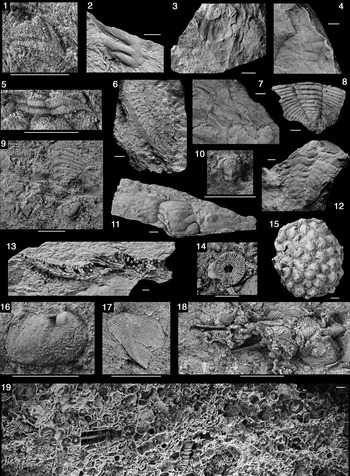
Figure 6.1–6.10
Occurrence
Ribeira do Braçal Formation (level located 70 cm above the base) in Penacova (Localities 4 and 5), Hirnantian, Portugal.
Trilobites, echinoderms, bryozoans, ostracodes, and machaeridians from the Ribeira do Braçal Formation; Mucronaspis cf. M. mucronata (Brongniart, Reference Brongniart, Brongniart and Desmarest1822) (1–10), (1) internal mold of a fragmented librigena showing the genal spine (MG30737) from Locality 4 in dorsal view; (2) internal mold of a fragmented glabella (MG30601) from Locality 5 in dorsal view; (3) external mold of a fragmented cranidium (MG30546) from Locality 4 in dorsal view; (4) latex cast of external mold of a fragmented cranidium (MG30546-2) from Locality 4 in dorsal view; (5) internal mold of a thoracic segment (MG30550-1) from Locality 4 in dorsal view; (6) external mold of a pygidium preserving the pygidial spine (MG30556) from Locality 5 in dorsal view; (7) external mold of a pygidium preserving the pygidial spine (MG30539) from Locality 5 in dorsal view; (8) internal mold of a pygidium (MG30549) from Locality 4 in dorsal view; (9) internal mold of a fragment of a pygidial pleura and internal mold of a meraspid? trunk (thoraco-pygidium) (MG30545) from Locality 4; (10) internal mold of a meraspid? hypostome (MG30738) from Locality 5 in ventral view; Flexicalymene? sp. (11, 12), (11) internal mold of a cranidium (MG30547) from Locality 4 in dorsal view; (12) internal mold of a pygidium (MG30557) from Locality 5 in dorsal view; ramose bryozoan (13) from Locality 1 (MG30739); Pentagonocyclicus (col.) sp. (14) latex cast of a columnal plate (MG30735) from Locality 1; Echinosphaeritidae indet. (15) latex cast of a theca in lateral view (MG30736) from Locality 1; Herrigia? sp. (16) internal mold (MG30733) from Locality 5; Plumulites sp. (17, 18) from Locality 4, (17) latex cast of a sclerite (MG30734), (18) latex cast of several sclerites partially articulated (MG30740); (19) general view of the crinoidal basal horizon of the Ribeira do Braçal Formation at Locality 1 (MG30741). All scale bars = 2 mm.

Description
Cephalic axial furrows running straight from S1 to S3; S2 straight and transversal, meeting the axial furrow. Anterior lobe broad (tr.), causing a strong divergence in the axial furrows anterior to S3. Posterior edge of the palpebral lobe opposite L2. The posterior border furrow extends to the fixigenal lateral border furrow. The genal spine is aligned with the lateral border, so it forms an obtuse angle of ~140° with the cephalic posterior border. The librigena has a fine granular sculpture. The thoracic pleural tips are spinous (Fig. 6.5). The most complete pygidium (MG30549, Fig. 6.8) allowed counting 10 axial rings, seven pleural furrows, and seven interpleural furrows, defining eight ribs. The pleural and interpleural furrows are equally deep, and in the larger specimens their abaxial endings almost reach the pygidial margin. In the medium-size specimens, the pleural furrow is strongly incised abaxially and it is slightly larger (tr.) than the interpleural furrow and curving posteriorly. The interpleural furrows are curved forwards, dividing the pleural ribs in an anterior and a posterior band of similar length (exsag.) in its abaxial half (tr.). The base of the pygidial spine is broad (tr.) and its length (sag.) is at least half the pygidial length.
Materials
The available material is fairly fragmentary, consisting of accumulations of sclerites in the fossiliferous beds. One cranidium (external mold: MG30546-1); one librigena (internal mold: MG30552a/external mold: MG30552b); eleven pygidia (internal molds: MG30539-1; 30539-2; 30540a; 30541; 30549-1; 30553; 30554; 30556a/external molds: MG30540b; 30542; 30544; 30548; 30549-2; 30556b); one meraspid pygidium (MG30550-2); one meraspid? hypostome (MG30738), and several sclerites (MG30543; 30545; 30546-2; 30550-1; 30555) from the Ribeira do Braçal Formation at Locality 4, along with one cranidium (MG30601); one cephalon (MG30604), three pygidia (MG30599; 30603; 30608), and several sclerites (MG30600; 30602; 30605-7) from the Ribeira do Braçal Formation at Locality 5.
Remarks
The pygidial configuration, the relative width of the axis, the configuration of the pleural and interpleural furrows, and the pygidial spine allowed the generic assignment to Mucronaspis. This assignment is also supported by the cephalic features, namely the continuity of the posterior border furrow into the librigenal lateral border furrow and the presence and configuration of the genal spines; and by the spinous thoracic pleural tips. The very small size of a poorly preserved hypostome (Fig. 6.10) suggests it represents a meraspis. The general morphology is similar to documented hypostomes of Mucronaspis holaspis (e.g., Zhou et al., Reference Zhou, Zhou and Yuan2012, fig. 4J–4N), differing in the middle furrow, which is deeply incised, in particular medially. Although the material is fragmentary, the presence of a long pygidial spine, the number of axial rings, and the number and configuration of the pleural and interpleural furrows agree with the species Mucronaspis mucronata and M. grandis (Barrande, Reference Barrande1852). The strong expansion of the glabellar anterior lobe allows differentiation from M. grandis and justifies the identification of the Portuguese specimens in open nomenclature as Mucronaspis cf. M. mucronata. The species Mucronaspis mucronata was defined in the Jonstorp Formation (upper Katian) in Sweden. In the high-latitude peri-Gondwana, several records of this species, usually identified in open nomenclature, have been documented in recent years, all from Hirnantian units: Mucronaspis cf. M. mucronata from the Marmairane Formation (Hirnantian) of Mouthoumet in France (Álvaro et al., Reference Álvaro, Colmenar, Monceret, Pouclet and Vizcaïno2015), Mucronaspis mucronata from Teruel (Vizcaïno et al., Reference Vizcaïno, Álvaro and Monceret2004) and from the Cantabrian Zone (Bernárdez et al., Reference Bernárdez, Colmenar, Gutiérrez-Marco, Rábano, Zamora, Pankhurst, Castiñeiras and Sánchez Martínez2015) in Spain and Mucronaspis mucronata mucronata from the Girisi Member of the Marco Formation in Sardinia (Hammann and Leone, Reference Hammann and Leone2007; although in our opinion, the Sardic material does not allow a specific assignment and it is better classified as Mucronaspis sp. indet.). Mucronaspis cf. M. mucronata is the first record of this genus in Portugal.
Suborder Calymenina Swinnerton, Reference Swinnerton1915
Superfamily Calymenoidea Burmeister, Reference Burmeister1843
Family Calymenidae Burmeister, Reference Burmeister1843
?Subfamily Calymeninae Milne Edwards, Reference Milne Edwards1840
Remarks
Siveter (Reference Siveter1977) established the subfamily Flexicalymeninae for Calymenidae, to include the members of this family that lack fixigenal buttresses in front of the glabellar lobes. Although it was used by several authors (e.g., Hammann, Reference Hammann1985; Henry, Reference Henry1996), Adrain (Reference Adrain, Harper and Servais2013) considered that Flexicalymeninae creates paraphyly with Calymeninae. Herein we follow this opinion, assigning Flexicalymene and the remaining members of Flexicalymeninae (sensu Siveter, Reference Siveter1977) to Calymeninae.
Genus Flexicalymene Shirley, Reference Shirley1936
Type species
Calemene blumenbachi var. caratacti Salter, Reference Salter1864 from the Sandbian (Caradoc of the British regional scheme) of Shropshire, England.
Flexicalymene sp.
Figure 6.11, 6.12
Occurrence
Ribeira do Braçal Formation (level located 70 cm above the base) in Penacova (Localities 4 and 5), Hirnantian, Portugal.
Materials
The studied material consists of one single cranidium and one pygidium, both incomplete and deformed, from two different outcrops. One pygidium (external mold: MG30557) from Locality 4; one cranidium (internal mold: MG30547) from Locality 5.
Remarks
Although the cranidium is strongly compacted, having a general appearance of a homalonotid trilobite, it is possible to observe in the anterior limit of the left fixigena the typical anterior border of Calymenidae, strongly convex (exsag.), straight and broad (exsag.) in its fixigenal portion. In addition, the inflated and rounded to subtriangular L1, the smaller L2, the deep, short (tr.) and slightly oblique S3, and an even shorter (tr.) and transversal S4, supports the assignment to Calymenidae. The configuration of the glabellar furrows, the fixigena, the anterior border, and the position of the eye allowed assignment to Flexicalymene. The palpebral lobes are located closer to the glabella and significantly more anterior than most of the species of this genus, which resembles F. ouzregui Destombes, Reference Destombes1966 from the upper Katian of Morocco. The studied pygidium supports the assignment to Flexicalymene. The pygidial axis bears six axial rings and a semicircular terminal piece and the pleural fields bear five pleural furrows, intercalated by interpleural furrows. These characters coincide with the diagnosis of F. ouzregui, but until the collection of additional material, it is preferable to classify the Portuguese records as Flexicalymene sp.
Paleobiogeographic and paleoecological significance of the Portuguese Hirnantian association
The Hirnantia Fauna are opportunistic brachiopod-dominated paleocommunities that originated and spread in shallow marine environments after the first episode of the end-Ordovician mass extinction (Temple, Reference Temple1965). Some of the taxa of the Portuguese assemblage, or the referred species in the cases of open nomenclature, such as the brachiopods Mirorthis mira, Paromalomena cf. P. polonica, and Plectothyrella libyca, and the trilobites Mucronaspis cf. M. mucronata and Flexicalymene, are typically present in Hirnantian assemblages globally (Temple, Reference Temple1965; Owen et al., Reference Owen, Harper, Jia-Yu, Barnes and Williams1991).
The brachiopod Mirorthis mira is well known from high-diversity assemblages of the Hirnantia Fauna (Rong and Li, Reference Rong and Li1999), such as the ones from Bohemia (Marek and Havlíček, Reference Marek and Havlíček1967), Sweden (Bergstrom, Reference Bergstrom1968), South China (Rong, Reference Rong and Sinica1984), and England (Temple, Reference Temple1968), but is also present in a few low-diversity assemblages such as the ones from Sardinia (Leone et al., Reference Leone, Hammann, Serpagli and Villas1991) and in the Portuguese association studied here, in which it is dominant. This species is interpreted as being adapted to live in a relatively narrow range of substrates. Its fossils have been found in mudstones of outer BA 3 or inner BA 4 in South China (Rong, Reference Rong and Sinica1984), Burma (Reed, Reference Reed1905; Rong and Li, Reference Rong and Li1999), and England (Temple, Reference Temple1968), as well as in sandy mudstones in Thailand (Cocks and Fortey, Reference Cocks and Fortey1997). Paromalomena polonica (Temple, Reference Temple1965) preferred clay and silty muddy bottoms, and may have lived on a relatively narrower range of substrate types than Hirnantia sagittifera (M'Coy, Reference M'Coy1851) and Eostropheodonta hirnantensis (M'Coy, Reference M'Coy1851) (mainly BA2-3), but in a relatively wider depth range (BA3-5) than the latter two species (Rong and Li, Reference Rong and Li1999).
Plectothyrella species have been used as markers of climate belts during the Hirnantian (Havlíček, Reference Havlíček1990). Plectothyrella libyca together with Plectothyrella haughtoni Cocks and Brunton (in Cocks et al., Reference Cocks, Brunton, Rowell and Rust1969) and Plectothyrella crassicostis chauveli Havlíček, Reference Havlíček1971 are considered distinctive of a cold climatic belt (Havlíček, Reference Havlíček1990; Villas et al., Reference Villas, Lorenzo and Gutiérrez-Marco1999). According to Villas et al. (Reference Villas, Lorenzo and Gutiérrez-Marco1999), this belt would be equivalent to the Bani province of Rong and Harper (Reference Rong and Harper1988), characterized by an atypical extremely low-diversity Hirnantia Fauna. If the specific assignment of the specimens in the Portuguese association to Plectothyrella libyca is confirmed, it would strengthen the case for a high latitudinal setting of the territory of Iberia as part of Gondwana or close to it during the Late Ordovician. The high-latitude setting of the Portuguese Central Iberian Zone (~60–50° S, see Harper et al., Reference Harper, Rasmussen, Liljeroth, Blodgett, Candela, Jin, Percival, Rong, Villas and Zhan2013) during the late Katian has already been demonstrated by Colmenar et al. (Reference Colmenar, Pereira, Sá, da Silva and Young2017b) through the record of a Foliomena brachiopod fauna. The herein reported Portuguese Hirnantia brachiopod fauna would support this paleobiogeographic setting of the Portuguese Central Iberian Zone into the uppermost Ordovician.
The Late Ordovician trilobite biogeography was marked by strong cosmopolitanism related to the global cooling that preceded the onset of the end-Ordovician glaciation. The previously existing trilobite biochoremas, which were becoming more and more diffused over the second half of the Ordovician, disappeared altogether in the latest part of the period (Whittington and Hughes, Reference Whittington and Hughes1972). The trilobite assemblages related to the end-Ordovician glacial event have been usually typified as Mucronaspis Fauna (Lespérance, Reference Lespérance1974), after the worldwide occurrence of this genus in Hirnantian deposits. These assemblages concur with the Hirnantia Fauna. The Mucronaspis Fauna is represented by low-diversity assemblages, usually dominated by this genus, but with the genera Brongniartella, Platycoryphe, Flexicalymene, and Bojokoralaspis also occurring frequently (Lespérance, Reference Lespérance, Cocks and Rickards1988). Mucronaspis fauna occur in different paleoenvironments from near shore, relatively shallow-water settings to deep-water environments (Rong et al., Reference Rong, Huang, Zhan and Harper2008).
The studied trilobite assemblage from the Hirnantian Ribeira do Braçal Formation is typical of Mucronaspis Fauna, being largely dominated by specimens of the genus Mucronaspis with the subordinate occurrence of Flexicalymene. In high-latitude peri-Gondwana, Mucronaspis has been documented from several Hirnantian units in Spain (Robardet and Gutiérrez-Marco, Reference Robardet and Gutiérrez-Marco2004; Vizcaïno et al., Reference Vizcaïno, Álvaro and Monceret2004; Bernárdez et al., Reference Bernárdez, Colmenar, Gutiérrez-Marco, Rábano, Zamora, Pankhurst, Castiñeiras and Sánchez Martínez2015), France (Henry, Reference Henry1980; Álvaro et al., Reference Álvaro, Colmenar, Monceret, Pouclet and Vizcaïno2015), Sardinia (Hammann and Leone, Reference Hammann and Leone2007), and the Czech Republic (Mergl, Reference Mergl, Gutiérrez-Marco, Rábano and García-Bellido2011). Although usually identified in open nomenclature, the records of the genus from Spain and Sardinia were assigned to the same species identified in the Portuguese assemblage, Mucronaspis mucronata (for further information, please refer to the preceeding Systematic Paleontology section).
The Hirnantian glacial conditions certainly favored trilobites adapted to cold water conditions, namely the genus characteristic of the High-Latitude Trilobite Province, sensu Pereira (Reference Pereira2017) (= Selenopeltis Province, sensu Whittington and Hughes, Reference Whittington and Hughes1972 and the Dalmanitoidean Realm, sensu Adrain et al., Reference Adrain, Edgecombe, Fortey, Hammer, Laurie, McCormick, Owen, Waisfeld, Webby, Westrop, Zhou, Webby, Droser and Paris2004). As Adrain et al. (Reference Adrain, Edgecombe, Fortey, Hammer, Laurie, McCormick, Owen, Waisfeld, Webby, Westrop, Zhou, Webby, Droser and Paris2004, p. 236) mentioned, “…many groups that had shown strong high latitude endemicity achieved wider, low-latitude distributions. For example, dalmanitids, chasmopine, pterygometopids, reedocalymenine calymenids, homalonotids, and cyclopygids, among others, became widespread just prior to the extinction.” In fact, the genus Mucronaspis, which became the most typical taxon of the Hirnantian trilobite assemblages worldwide, originated in the high-latitude peri-Gondwana region, where it has its oldest record from the uppermost Sandbian of Morocco (Mucronaspis zagoraensis Destombes, Reference Destombes1972 from the lower Ktaoua Formation). Mucronaspis was also documented in the Sandbian of Wales (as Dalmanitina by Reed, Reference Reed1904, later assigned to Mucronaspis by Destombes, Reference Destombes1972 and Owens and Servais, Reference Owens and Servais2007). Nevertheless, the broad record of this genus in the Upper Ordovician of Morocco, with Mucronaspis termieri (Destombes, Reference Destombes1963) and Mucronaspis greti (Destombes, Reference Destombes1963) from the upper Katian–upper Ktaoua Formation (plus M. zagoraensis, which is also present in the lower Katian Tiouririne Formation), and the probable evolutionary relationship of Mucronaspis with the endemic genus Eodalmanitina Henry, Reference Henry1965 (Hammann and Leone, Reference Hammann and Leone2007), supports a high-latitude peri-Gondwanan origin. Assemblages of Mucronaspis were described from deeper water settings than those of the coeval Hirnantia faunas in North Wales (Brenchley and Cullen, Reference Brenchley and Cullen1984) and at Percé, Canada (Lespérance et al., Reference Lespérance, Malo, Sheehan and Skidmore1987). At Percé, the so-called Mucronaspis Community was interpreted as occupying a BA6 position (Lespérance et al., Reference Lespérance, Malo, Sheehan and Skidmore1987, p. 123). In the Barrandian Area it was interpreted by Štorch (Reference Štorch1990) as a deeper water (benthic assemblage 4–5) equivalent of the Hirnantia Fauna (Brenchley and Štorch, Reference Brenchley and Štorch1989; Štorch and Mergl, Reference Štorch and Mergl1989). However, the Mucronaspis Community has also been recorded in shallow water sediments of the Chinese Nancheng Shale of southern Shaanxi (Rong and Harper, Reference Rong and Harper1988) and of the Norwegian Oslo region (Brenchley and Cullen, Reference Brenchley and Cullen1984). Thus, as with the biogeographic distribution, the limited number of widespread Hirnantian trilobite genera were also bathymetrically more eurytopic than the typical brachiopod Hirnantia faunas.
Acknowledgments
We thank the editors, E. Currano and R. Zhan, as well as the reviewer J. Rong, whose comments helped to improve the quality of this manuscript. We are indebted to Mike Romano (University of Sheffield) for sharing many data that were (twice) lost in time, this work belongs to him too. We also want to thank M. Ramalho (Museu Geológico de Lisboa) for granting access to fossil collections under his care; A. Jacinto (Galp), G. Silvério (Universidade de Lisboa), and J.J. Álvaro (Instituto de Geociencias, CSIC-UCM) for helping with fieldwork in Vila Nova de Poiares; S. Zamora (Instituto Geológico y Minero de España, IGME) for helping with the identification of the echinoderms. JC was supported by the IBEROR projects CGL2012-39471/BTE and CGL2013-48877-P from the Spanish MINECO. SP was supported by a FCT PhD grant (SFRH/BD/73722/2010). This is a contribution to the IGCP-653 Project.