


Breake down some of your courtys, for ye haue to[o] many, being so fylthyly mynystred. The court of the marshyalsee, I can neyther thynck, speake nor write[,] the slendernesse and vnreasonable chargys of that court. If the kyng knewe what boytrye [childishness] were there vsed, I think he wold neuer suffer them more to kepe court, or els he wold loke other wyse vpon it. It is meruel, but only that god is mercyful, that fyre descend not down from heauen, & destroye that court, and the augmentacyon!Footnote 1
So wrote the polemicist Henry Brinkelow in 1542. To him, the court of the marshalsea of the king’s household was so extortionate and ineffectual that the only remedy was for it to be blasted with all-consuming fire. There is a rather less theatrical description of this court in the anonymous treatise Diuersite de courtes, written probably in the reign of Henry VII and first printed in 1525,Footnote 2 where the marshalsea is called an “ancient court” with two purposes: “the good governance and order of the king’s household” and “the protection of the king and his servants.”Footnote 3 The court of the marshalsea was indeed a very old court, having “emerged,” as historians say, c. 1290, about half a century after the foundation of the Court of King’s Bench.Footnote 4 The marshalsea had jurisdiction over offences occurring and causes of legal action accruing within the verge of the court, that is, the area immediately surrounding the king’s household, defined using a moveable circular perimeter of twelve miles’ radius centered on the house or palace where the king was currently residing. The operations of this unusual ambulatory court have received scant scholarly attention.Footnote 5 Although it was a court of record,Footnote 6 no court rolls or books survive from 1357 on, so we know little about how the marshalsea worked in practice in the fifteenth through seventeenth centuries.Footnote 7 By contrast, the workings of the court as it stood in the early nineteenth century, in the twilight years prior to its abolition, are known in minute detail.Footnote 8 A seminal article by W. R. Jones focussed solely on the court’s operations in the fourteenth century, a period for which there is a comparative abundance of primary material.Footnote 9 A subsequent article by Douglas G. Greene offered a discussion of the court in the late sixteenth and early seventeenth centuries, but he drew on no records of proceedings and focussed almost exclusively on the declarations of Sir Edward Coke and other authorities, which were not always neutral statements of the law as it was practised, for jurists like Coke often sought to reshape the law under pretence of describing it.Footnote 10
The purpose of this article is to offer, for the first time, a discussion and analysis of the jurisdiction, workings, and personnel of the court of the marshalsea during the reign of King Henry VIII (1509–1547), and to investigate a series of reforms to the judiciary and jurisdiction of the court that occurred during this period. The first section discusses the court’s jurisdiction and procedure in criminal cases. It explains the significance of a 1542 act of parliament that expanded and clarified the court’s jurisdiction over serious crimes committed within the palace precinct. The second section analyses the court’s civil jurisdiction, which was to become a matter of serious controversy in the early seventeenth century.Footnote 11 The third section discusses the judiciary and staff of the court before, during, and after the Henrician reforms, and it charts the rise of the under-steward of the marshalsea (referred to consistently as steward of the marshalsea from 1539) as chief controlling officer of the court. One of the unexpected findings is that Sir Thomas More served as under-steward in the 1520s. Most importantly, I argue that by 1542, the court’s jurisdiction had become trifurcated into a plea side, an ordinary criminal side, and a “palace” criminal side. Each side had a different composition of judges, but the officer common to all was the steward of the marshalsea. By the late 1530s, both the plea side and the ordinary criminal side of the marshalsea had become settled at the marshalsea prison in Southwark.
Aside from being interesting in its own right, a study of the court of the marshalsea reveals certain attitudes toward the dispensation of justice in the sixteenth century. The popular movements that led to the abolition of the court of Star Chamber, the court of High Commission and the council of the North in 1641; the effective abolition of the court of requests and the council of the marches of Wales in 1642; and the abolition of the court of the marshalsea and palace court in 1651 were not attacks on the royal prerogative per se so much as attacks on procedural irregularity and unpredictability.Footnote 12 The collective urge to regularity that became so pronounced in the seventeenth century had already manifested itself in the early sixteenth. The reign of Henry VIII, sometimes seen as the archetypal arbitrary ruler, paradoxically saw a movement toward the regularization and professionalization of legal institutions. For example, the itinerant Court of Requests went through multiple stages of reform and rationalization during Henry VIII’s reign and was settled at Westminster in the 1520s.Footnote 13 The legal jurisdiction of the Star Chamber gradually became distinct from the political and executive function of the king’s council between the 1520s and 1540s.Footnote 14 The Court of Wards, a revenue court with origins in the reign of Henry VII, was placed on a clear statutory footing in 1540.Footnote 15 In the London Sheriffs’ Court, legally trained undersheriffs came to serve as judges and displaced the lay sheriffs, though the latter were still named as judges in the court’s proceedings as a curial formality.Footnote 16 At about the same time, England’s county courts came to try lawsuits by means of jury trial rather than compurgation, bringing them into line with the best practice of other courts.Footnote 17 After 1515, the king ceased the arbitrary practice of modifying statute law by prerogative proviso after the assent stage in parliament.Footnote 18 These reforms happened under the oversight of men with a common training at the Inns of Court who filled administrative and judicial offices throughout the country. The regularization of legal institutions during Henry VIII’s reign could be described as a “reformation from within” that promised to be far less destructive than the “reformation from without” that was forced on various legal institutions under the Stuarts. The urge to regularity also found expression in the gradual emergence of English administrative law from around 1550, defined as a “body of legal rules concerned directly with the legal constraints that should be placed on the administration.”Footnote 19
As will become clear in this article, the court of the marshalsea was no exception to the trend towards regularity. For example, the marshalsea formally gained its own legally trained steward in 1539 to act in place of the lay lord steward. At about the same time, the marshalsea’s criminal calendar came to be dispatched by panels of commissioners, one of whom was the steward, in imitation of the effective model of the sessions of the peace. However, there were also countertrends away from regularization: most importantly, a strengthening of the court’s semi-arbitrary “palace” jurisdiction and a tendency for the court to stretch its jurisdictional bounds in civil suits.Footnote 20 The court’s failure to utterly regularize itself was one reason why it became vulnerable to attack in the seventeenth century. By shedding new light on a little-studied early modern court, this article hopes to contribute to the historiography surrounding the reshaping of legal institutions in the early sixteenth century. It does so by offering a rare glimpse into the workings of a court that operated from one of England’s highest seats of power: the royal household.
Jurisdiction and Procedure in Criminal Cases
Though the spelling “marshalsea” is customary, “marshalcy” would perhaps be better, as the name originally signified “the court of the office of marshal.”Footnote 21 The criminal jurisdiction of this court is described in the Diuersite de courtes as follows: “This court has the power to enquire of treason, murder and felony, and to take appeals of them, and also of mayhem, if they are committed within the verge and between persons who are of the king’s household.”Footnote 22 This comment might be thought to imply that the court was competent only to enquire of crimes, not to try them, but there are many examples of the court proceeding to later stages of pleading and jury trials in our period, as discussed later. As indicated in Diuersite, there were two types of criminal procedure at the court’s disposal: enquiry and presentment (used for cases of treason, murder, and felony) and appeal (used for cases of treason, murder, felony, and mayhem, i.e., maiming). Since mayhem was not an indictable felony, courts could only take criminal cognizance of it by the process of appeal.Footnote 23
A third type of criminal procedure available in rare instances at the court, not mentioned in Diuersite, was qui tam litigation on penal statutes. According to this procedure, a private party brought offences against statute law to the attention of a court in return for a share of any forfeiture that might eventually fall to the Crown.Footnote 24 It is probable that qui tam litigation was only permissible at the marshalsea if expressly granted by the relevant statutes. Some penal statutes pleadable at the marshalsea were the acts of apparel that received the royal assent in February 1510, April 1515, and December 1515, all of which were directly relevant to the royal household.Footnote 25 Moreover, there is evidence throughout the fifteenth century of the marshalsea exercising jurisdiction over the sorts of “trespasses” for which leets and sheriff’s tourns were customarily responsible, such as enquiring into dilapidated bridges and roads, but whether this jurisdiction continued into the sixteenth century is uncertain.Footnote 26 In our period, the court of the marshalsea was still responsible for enforcing fines imposed by the court of the clerk of the market for trading offences and suchlike.Footnote 27
The King’s Bench Crown-side rolls and indictment files from 1509 to 1547 contain evidence of 27 sittings of the marshalsea in Henry VIII’s reign known to have dispatched criminal business. These proceedings were transmitted to King’s Bench by various processes. The procedure most frequently used in criminal cases involved the issue of an original writ by Chancery for the transfer of records to King’s Bench under seal.Footnote 28 While this writ is sometimes called a certiorari, it is missing the verb “certiorari,” so it might be better described as a writ of mandamus, a verb that does feature in it.Footnote 29 In some cases, the writ may have been issued to the steward and marshal on the defendant’s initiative, if the defendant believed they could get a fairer trial elsewhere. The other major process for the delivery of records from the marshalsea was the writ of error, issued by Chancery for the review of judgments or outlawries for manifest error by the justices of King’s Bench. This method was infrequently used in criminal cases at the marshalsea; only one example has been found from the reign of Henry VIII.Footnote 30 The sittings of the marshalsea between 1509 and 1547 known to have dispatched criminal business are calendared in Table 1.
Sessions of the Marshalsea known to have Dispatched Criminal Business, 1509–1547

Table 1. Long description
A table detailing sessions of the Marshalsea court from 1509 to 1547. The table has three columns: Date, Location of court, and Offences concerned with. It contains 35 rows of data. Row 1: Fri. 6 June 1511, East Smithfield, Midd., Felonious theft. Row 2: Fri. 13 Feb. 1512, East Smithfield, Midd., Murder. Row 3: Mon. 8 Mar. 1512, Westminster, Midd., Murder; assault. Row 4: Thu. 9 Dec. 1512, Westminster, Midd., Assault and felonious theft. Row 5: Thu. 28 Oct. 1518, Southwark, Surr., Felonious theft; forcible entry. Row 6: Sat. 8 Jan. 1519, East Smithfield, Midd., False arrest. Row 7: Mon. 17 Jan. 1519, East Greenwich, Kent., Illegal release of suspected felon. Row 8: Fri. 20 Jan. 1519, East Smithfield, Midd., Felonious theft. Row 9: Fri. 11 Mar. 1519, East Smithfield, Midd., Felonious theft. Row 10: Mon. 16 May 1519, East Greenwich, Kent, Felonious theft. Row 11: Mon. 13 Dec. 1519, East Smithfield, Midd., Maintenance of vagabonds. Row 12: Fri. 20 Jan. 1520, East Smithfield, Midd., Felonious theft. Row 13: Fri. 17 Feb. 1520, East Smithfield, Midd., Felonious theft. Row 14: Tue. 24 Feb. 1523, Southwark, Surr., Forgery of sign manual; murder. Row 15: Tue. 2 Mar. 1525, Westminster, Midd., Felonious theft. Row 16: Mon. 21 Mar. 1525, East Greenwich, Kent, Felonious theft. Row 17: Fri. 23 Jun. 1525, Southwark, Surr., Forcible entry and assault. Row 18: Fri. 8 Jun. 1526, Windsor, Berks., Forcible entry and felonious theft. Row 19: Tue. 9 Jun. 1528, Southwark, Surr., Felonious theft. Row 20: Fri. 12 Jun. 1528, Southwark, Surr., Felonious theft; illegal release of suspected felon. Row 21: Unknown, Unknown, Slander; assault and false imprisonment. Row 22: Fri. 15 Feb. 1538, Southwark, Surr., Murder. Row 23: Mon. 24 Feb. 1539, Southwark, Surr., Felonious theft. Row 24: Tue. 25 Feb. 1539, Southwark, Surr., Felonious theft. Row 25: Mon. 1 Dec. 1539, Southwark, Surr., Felonious theft. Row 26: Wed. 17 March 1540, Southwark, Surr., Felonious theft. Row 27: Sat. 1 Dec. 1543, Southwark, Surr., Felonious theft. Row 28: Mon. 10 Dec. 1543, Southwark, Surr., Felonious theft; forcible entry.
a The King’s Bench rolls and files reveal the dates of the marshalsea sittings as well as the dates in which the records were brought into King’s Bench.
b TNA, KB 27/1003, Rex, rot. 12v. Dated the last Friday before Pentecost, 3 Hen. VIII.
c TNA, KB 9/458/58–60.
d TNA, KB 27/1004, Rex, rot. 15r; KB 9/458/708; KB 9/458/55. All dated Monday in the second week of Lent, 3 Hen. VIII.
e TNA, KB 27/1029, Rex, rots. 8r–9v. Dated Thursday after the Feast of St Nicholas ep., 4 Hen. VIII.
f TNA, KB 27/1031, Rex, rot. 10v; KB 9/969/22. Dated the Thursday before All Saints, 10 Hen. VIII.
g TNA, KB 27/1030, Rex, rot. 6v.
h TNA, KB 27/1030, Rex, rot. 5v.
i TNA, KB 27/1034, Rex, rot. 6v.
j TNA, KB 27/1053, Rex, rot. 14r; KB 9/482/59.
k TNA, KB 27/1047, Rex, rot. 11r; KB 27/1062, Rex, rot. 9r–v; KB 9/482/60.
l TNA, KB 27/1030, Rex, rot. 6v.
m TNA, KB 9/480/50.
n TNA, KB 27/1035, Rex, rot. 9r–v; KB 9/477/53.
o TNA, KB 27/1049, Rex, rot. 10r–v; KB 9/492/1/28.
p TNA, KB 27/1055, Rex, rot. 8r; KB 9/497/28.
q TNA, KB 9/497/28.
r TNA, KB 9/501/2/14.
s TNA, KB 9/520/29.
t TNA, KB 27/1100, Rex, rot. 11r–v; TNA, KB 9/977/5.
u TNA, KB 27/1100, Rex, rot. 11r–v; KB 9/508/49; KB 9/977/5.
v TNA, KB 9/510/28.
w TNA, KB 27/1111, Rex, rot. 1r–v; KB 9/541/193.
x TNA, KB 27/1111, Rex, rots. 2r, 12r–v; KB 9/541/73; KB 9/541/181.
y TNA, KB 27/1111, Rex, rot. 12r–v.
z TNA, KB 9/547/1.
aa TNA, KB 9/544/38.
bb TNA, KB 9/561/25.
cc TNA, KB 9/557/63.
Some of these sessions are described as gaol deliveries of the court of the marshalsea,Footnote 31 others as courts of oyer and terminer,Footnote 32 and still others as courts of both oyer and terminer and gaol delivery.Footnote 33 Some records do not specify the type of court, merely stating that the proceedings were held before the steward and marshal.Footnote 34 None of the records feature the traditional style recorded in Diuersite: “Placita corone aule hospicii domini regis &c.”Footnote 35 It is likely that the distinctions in naming largely reflect offhand clerical variation rather than indicating a strict separation between the various judicial functions. The difference between a commission of gaol delivery and a commission of oyer and terminer was that the former granted justices power only to try accused parties who were already imprisoned, whereas the latter granted justices power only to try prisoners who had been indicted before themselves.Footnote 36 The court of the marshalsea was empowered to perform both functions without a royal commission.
The commonest offence listed in Table 1 is felonious theft, that is, theft of goods worth 12d or above, or theft of any value in the presence of the owner (“robbery”).Footnote 37 Unlike petty larceny, felonious theft carried a possible death penalty at common law, a penalty that became more severe in the later sixteenth century as the price revolution further reduced the value of 12d.Footnote 38 All but one of the marshalsea cases heard in the sessions listed in Table 1 proceeded by enquiry and presentment. The first step in this procedure was for a jury of presentment (composed of 12 men, though the number could vary)Footnote 39 to bring some offence to the attention of the court by making a presentment. Behind this formal process there were innumerable ways that the court might gain intelligence of indictable wrongdoing. The court’s sworn presentments served as indictments to be tried at law, either at the marshalsea or elsewhere. Among the King’s Bench records summarized earlier, there are several instances of criminal cases brought before the marshalsea by enquiry that proceeded past the presentment stage prior to their removal. Generally, the procedure following a presentment involved arraignment and jury trial at the marshalsea,Footnote 40 unless of course the defendant pleaded guilty, in which case there would be no need for a trial.Footnote 41 In causes of action accruing within the household itself, trial jurors were composed of household men, but for causes of action accruing within the verge, jurors were composed of non-household men from the county.Footnote 42 One of the suits from our period concluded with a waiver of jury trial (ponit se in gratiam domini regis), which allowed a court rather than a jury to decide the facts of a case.Footnote 43
These records indicate the great speed of the marshalsea. As noted by Jones in 1970, “[t]he relatively impatient procedures of the court of the verge [i.e., marshalsea] were probably necessitated by its highly mobile character as a part of the royal household.”Footnote 44 In our period, it was common for the marshalsea to proceed from indictment to jury trial on the same day. In most cases, the defendants were already imprisoned prior to the commencement of proceedings against them, which facilitated their speedy dispatch. It was possible, however, for the court to receive indictments of offenders who were not yet in custody, on the basis of their oyer and terminer powers.Footnote 45
If the marshalsea’s proceedings were swift, the court did not hurry to release or punish offenders once they had passed through its legal machinery. On June 6, 1511, a pinmaker from Lewisham called John Bere was indicted and found guilty at the court for a felonious theft committed at East Smithfield on January 3, 1510. As the court wished to reserve judgment (“super premissis se advisare vult”), Bere was recommitted to the prison of the marshalsea of the household. There he remained for just under a year, until a record of the proceedings against him was transmitted to King’s Bench, and the case was dismissed on May 24, 1512, thanks to a special royal pardon issued on 6 May.Footnote 46 One solution for defendants languishing in the marshalsea prison was to sue a writ of corpus cum causa ordering the steward and marshal to produce their prisoner before the Court of Chancery together with an explanation for his imprisonment.Footnote 47 The marshalsea was clearly empowered to proceed to judgment in at least some criminal cases on indictment; a process of curia advisare vult only makes sense if the court had the power to proceed to judgment. On March 17, 1540, the court passed judgment in favor of a gentleman called George Hoorde alias Hardyng, after a jury found him not guilty.Footnote 48 As discussed in the next paragraph, a criminal suit in 1528 proceeded to the branding of a defendant and his delivery to the ordinary, which can be regarded as a type of court judgment.
It was common for defendants to claim benefit of clergy at the marshalsea, which was the most likely route for them to save their own lives.Footnote 49 Sometimes, a case was removed to King’s Bench straight after the defendant(s) had “prayed their clergy.” In other cases, the claim of benefit of clergy was immediately successful. In 1528, Henry Cheyny, indicted for a felonious theft in Middlesex, pleaded guilty, prayed his clergy, and successfully passed the customary reading test, whereupon the court ordered the branding of his left hand and for him to be delivered to the ordinary—in this case, Stephen Gardiner, Bishop of Winchester.Footnote 50 In the writ of mandamus issued years later to the steward and marshal by King’s Bench, this outcome was described as an attainder: the justices requested a copy of the record of attainder (“recordum attinccionis”) and described the defendant as indicted and attainted (“indicat’ et superunde attinct’”). In this instance, the proceedings were removed to King’s Bench so that the defendant could plead a royal pardon; he could not purge himself because he had pleaded guilty.
The murder cases are especially interesting, since it is generally supposed that the marshalsea court lost the right to try murder cases (not the right to indict for murder) in the fourteenth century.Footnote 51 None of the new evidence suggests that the court could try cases of murder committed within the verge in our period, though a 1542 act of parliament—discussed in more detail later—takes it for granted that the marshalsea had jurisdiction over the “triall [and] determynacion” of treason, misprision of treason, murder, manslaughter, and bloodshed, provided they were committed within the king’s house itself, not within the verge.Footnote 52
One instance of appeal of felony was lodged at the court in 1520.Footnote 53 This procedure was invaluable for victims of theft because it allowed them to claim restitution of stolen goods whenever forfeitures were levied, as opposed to proceedings on indictment, which (prior to reform of the system in 1529) resulted in the value of the stolen goods being forfeited to the Crown.Footnote 54 The 1520 case, previously described by Margaret McGlynn,Footnote 55 resulted in the two yeoman defendants (John Rychardys alias Symondys and John Averell) being sentenced to execution at King’s Bench, after being denied benefit of clergy because they had received it before at a gaol delivery at Colchester Castle. The grim judgment was recorded in the margin of the plea roll with two instances of the customary noose-like symbolic abbreviation for the Latin verb suspendatur (per collum), “let him be hanged by the neck.”Footnote 56
As per the testimony of Diuersite, quoted at the start of this section, appeal procedure was only permitted at the marshalsea if two conditions were satisfied: (1) the crime was committed within the verge and (2) it was inflicted by one member of the household upon another. This seems to be the only reasonable way of reading the syntactically complex sentence that relates to this point:
Et cest court ad poiar denquerer de treson murder et felony, et prendre appelles de eux, et auxi de mayham, silz sount faitz deins le verge et parentre parsons del hostel le roy. Footnote 57
This court has the power to enquire of treason, murder, and felony, and to take appeals of them, and also of mayhem, if they are committed within the verge and between persons who are of the king’s household.
The conditional clause (“if they are committed”) cannot well apply to the whole of the sentence, since there is ample evidence that the marshalsea could enquire of all felonies committed within the verge, not only those that involved a member of the royal household. Hence, the clause must apply only to offences for which appeals could be made. However, there was a possible conflict between theory and practice, since there is no evidence that either of the yeoman defendants in the theft case described earlier (Rychardys and Averell) were members of the household, and surely the appellants (both Suffolk churchwardens) cannot have been. Perhaps the defendants could have saved their necks by pointing out that the steward and marshal had apparently acted ultra vires by allowing an appeal of felony for a crime for which neither perpetrators nor victims were of the household.
The criminal jurisdiction of the marshalsea was clarified and expanded by an act of parliament that received the royal assent on April 1, 1542.Footnote 58 This act reaffirmed the court’s customary jurisdiction in cases of treason, misprision of treason, murder, manslaughter, and bloodshed committed not within the verge but within the limits of the king’s house, defined as follows:
[W]ithin any edifices courtes places gardens [or] orchardes or houses within the Porters warde of any of the house or houses above rehersed, or within any gardens privie walkes orchardes tiltyardes woodyardes tenys playes cockfightes bowlinge alleyes nere adjoyninge to any of the houses above rehersed, and beinge parte of the same or within two hundred footes of the standard of any outwarde Gate or Gates of anye of the houses above rehersed, commonly used for passage out or from any of the houses or houses above rehersed.Footnote 59
The act stipulated that such criminal cases could continue to be tried and determined at the court of the marshalsea even if the king removed to a new location while the proceedings were ongoing. In determining such cases, the court was to be staffed by at least two men, normally the lord great master (or lord steward) and the steward of the marshalsea; but if the lord great mastership or lord stewardship were vacant, the master or lord steward’s place could be supplied by the treasurer and comptroller of the household, or by one of them. The juries were composed wholly of men of the household. The court was empowered to impose a range of penalties, depending on the offence, including the death penalty, forfeiture of lands and goods, perpetual imprisonment, and amputation.Footnote 60 Finally, the act declared the theft of the king’s goods of 12d or above or the breaking into the king’s house to steal goods, felonies punishable by death without benefit of clergy or sanctuary.Footnote 61 A man surnamed Collins was hanged at Westminster Palace in November 1542 “for killinge one in the same place,” which suggests that he was convicted at the marshalsea according to the statute.Footnote 62
The marshalsea’s jurisdiction over palace crime seems to have preexisted the 1542 statute. This is indicated by the statute itself, which states that heretofore trouble had been caused by the rule that palace crimes had to be remitted to the superior courts if the king moved residence while proceedings were underway.Footnote 63 Other evidence points in the same direction. On Saturday March 13, 1512, a yeoman of the king’s guard was sentenced to death at the White Hall at Westminster for a murder committed within the palace, and this sentence was most likely passed by the court of the marshalsea.Footnote 64 On June 10, 1541, a full six months before the opening of the parliament that passed the 1542 statute, Sir Edmund Knyvett was arraigned and convicted for committing an assault in a tennis court within the palace precinct. His trial took place at the great hall at Greenwich before a panel of six, including the steward of the marshalsea.Footnote 65 The 1542 statute seems to have been partly designed to resolve doubts about the legality of such proceedings.Footnote 66 It is possible that the “palace” jurisdiction of the marshalsea came about through expansive interpretation of 3 Henry VII, c. 14 (1487), which had granted the lord steward and treasurer and comptroller of the household to hear and determine accusations of treason committed by servants of the royal household.Footnote 67 Alternatively, it may be that the palace jurisdiction derived simply from the dread majesty of the king, who held certain arbitrary powers in his own house. Under the common law, all Englishmen enjoyed some arbitrary powers in their own houses, including to physically correct their servants, if they had any, and to kill intruders.Footnote 68
Another criminal jurisdiction within the verge belonged to the coroner of the marshalsea, also known as the coroner of the verge (coronator marescalcie hospicij domini regis infra virgam).Footnote 69 This officer was responsible for holding post mortem inquests within the verge, either solus Footnote 70 or, as the letter of the law said was necessary, in conjunction with the coroner of the county in which a body was discovered.Footnote 71 In theory, inquests before the coroner of the verge were supposed to be tried by the court of the marshalsea unless the household removed to a new location in the meantime, in which instances the inquests would be remitted to the superior courts.Footnote 72 The office of Richard Staverton, a longtime coroner of the marshalsea, was confirmed by statute in 1542.Footnote 73
Jurisdiction and Procedure in Civil Cases
Beyond its criminal jurisdiction, the court of the marshalsea also had a “civil” jurisdiction, welcoming legal actions between party and party. The 1300 statute Articuli super Cartas had limited the court’s civil jurisdiction to actions of trespass, debt, and covenant, and then only if specific conditions were met: the court could only take cognizance of “Trespass done within the House, and of other Trespasses done within the Verge and of Contracts and Covenants that one of the King’s House shall have made with another of the same House, and in the same House, and none other where.”Footnote 74 The literal interpretation of this statute would have made the court competent to try any trespass whatever committed within the verge. However, the statute was customarily interpreted against the grain of the text, as authorities generally held that trespasses were only actionable at the marshalsea if either plaintiff or defendant was a member of the royal household, and a judgment in trespass could be challenged and overturned by King’s Bench if it was later discovered that neither party was of the household.Footnote 75 It was also possible for aggrieved losing parties to sue for damages at another court on the same basis.Footnote 76 If judgment had not yet been rendered, the proceedings could be reviewed by the Court of Chancery on the basis of a writ of certiorari.Footnote 77
A strictly literal interpretation of Articuli super Cartas had its defenders. In error proceedings at King’s Bench in 1585, it was suggested that “in trespass [or] case, there is no need for both or either of the parties to be of the king’s household if the trespass is committed within the verge.” The reporter of this case was Edward Coke, at that time a young barrister who was clearly curious about this question, as he concluded with the phrase, “Query concerning this.”Footnote 78 In 1596, no less an authority than Sir John Popham CJKB suggested that trespass was actionable even if neither party was of the household, but “the whole court was against this” (so another of Coke’s notebook reports tells us) due to solid precedents to the contrary.Footnote 79 The strongest precedent was a year book case from Michaelmas term 1431, where it was ruled in no uncertain terms that trespass could only be brought at the marshalsea if at least one of the parties was of the household.Footnote 80 The restriction of actions of trespass was conceivably a response to Chancery’s development of the action of trespass on the case in the 1350s, which represented a great expansion of the definition of trespass and created new legal business, which the superior courts perhaps wanted to reserve for themselves.Footnote 81 The debate over the marshalsea’s jurisdiction in trespass was fundamentally a choice between literal interpretation of statute or time-honored non-literal interpretation. It was an interesting problem that continued to stimulate expert disagreement well into the seventeenth century.Footnote 82
The court’s civil caseload may have declined in the 1480s, perhaps because household servants came to prefer the court of requests as a venue for litigation.Footnote 83 The marshalsea’s business then seems to have picked up again in the 1570s.Footnote 84 It could be that the court responded to the lean years in between by welcoming legal actions over which (according to the jurists) it had no jurisdiction. This hypothesis is seemingly confirmed by an anonymous treatise penned c. 1605, which argues that “common usage, and the continuall practice of the court have been ever … to hold plea of all manner of trespasses upon the case, and others between partyes not of the household … and this approved by infinite precedents most auncient.”Footnote 85 In welcoming pleas that involved no members of the household, the court had nothing to lose, except reputationally, and much to gain in the form of increased caseload and fees.Footnote 86 If a paying plaintiff wished to risk suing there despite neither party being of the household, the court had little motivation to turn him away.Footnote 87 Unfortunately, given the poor state of the evidence, it is impossible to be sure of how much plea-side business the court dispatched in the reign of Henry VIII, even whether this business really did decline, or how far the judges of the marshalsea were willing to stretch the jurisdictional rules imposed by other courts. Any pleas determined ultra vires were theoretically vulnerable to being overturned at higher courts, but in practice King’s Bench seldom reviewed marshalsea cases in error in our period. For some losing parties, it might have been more practical to accept the judgment rather than having it overturned on a technicality and then potentially having to go through the whole process again at another court.
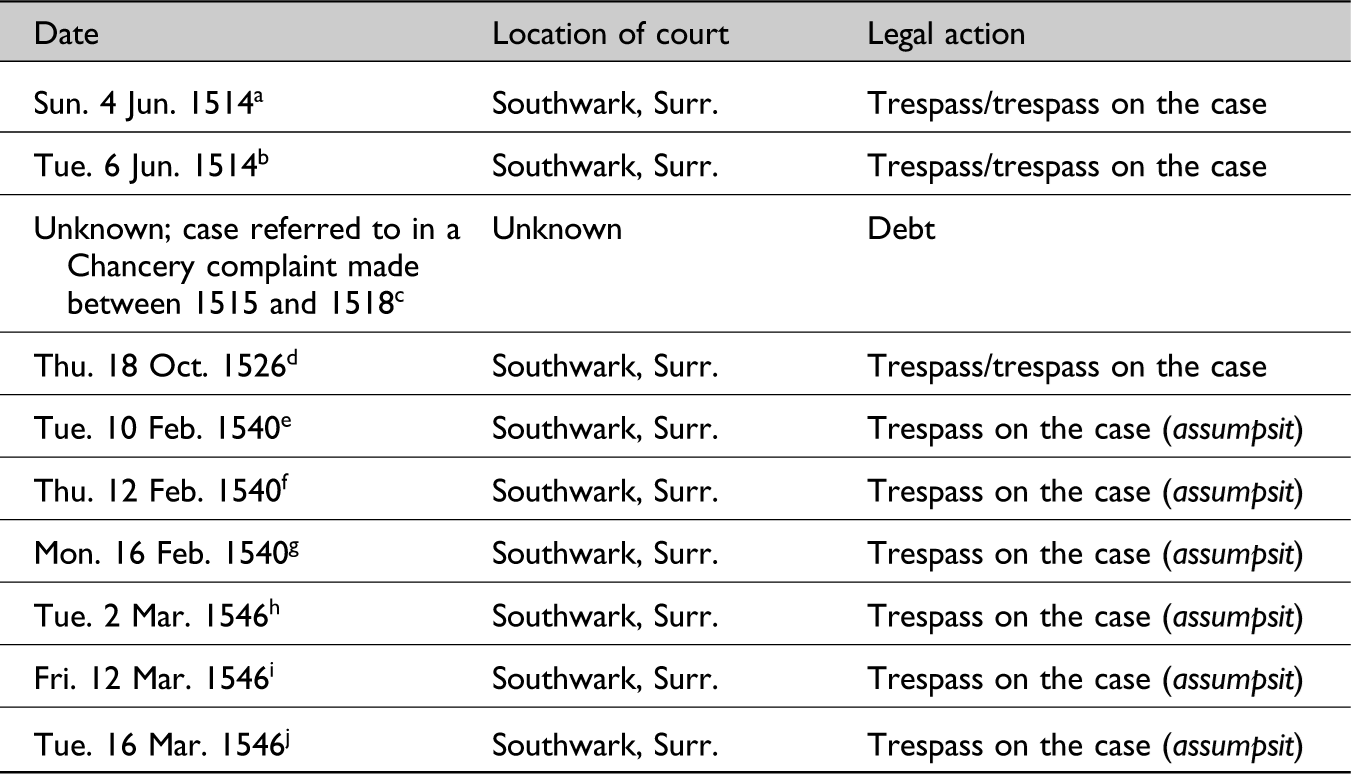
In the reign of Henry VIII, there are two known cases of civil judgments rendered at the marshalsea subsequently being reviewed for error at King’s Bench (February 10–16, 1540; March 2–16, 1546).Footnote 88 In one of these cases, it was alleged that neither plaintiff nor defendants were of the king’s household and hence that the marshalsea had no jurisdiction.Footnote 89 Three more civil lawsuits at the marshalsea are known from their being referenced in a defendant’s pleas at King’s Bench: in 1515, one William Rutter was tried for making a series of false arrests, ostensibly in support of process at the marshalsea.Footnote 90 Another marshalsea lawsuit is recorded in a King’s Bench suit for damages against a party who had wrongfully sued in the marshalsea despite neither party being of the household.Footnote 91 The dates on which the Henrician marshalsea is known to have conducted civil business are listed in Table 2 (no doubt more will come to light).
Sessions of the Marshalsea known to have Dispatched Civil Business, 1509–1547

Table 2. Long description
A table with three columns and ten rows. The columns are labeled Date, Location of court, and Legal action. The table lists sessions of the Marshalsea court with civil business from 1509 to 1547. Row 1: Date, Sun. 4 June 1514; Location of court, Southwark, Surr.; Legal action, Trespass/trespass on the case. Row 2: Date, Tue. 6 June 1514; Location of court, Southwark, Surr.; Legal action, Trespass/trespass on the case. Row 3: Date, Thu. 18 October 1526; Location of court, Southwark, Surr.; Legal action, Trespass/trespass on the case. Row 4: Date, Unknown; case referred to in a Chancery complaint made between 1515 and 1518; Location of court, Unknown; Legal action, Debt. Row 5: Date, Tue. 10 Feb. 1540; Location of court, Southwark, Surr.; Legal action, Trespass on the case (assumpsit). Row 6: Date, Thu. 12 Feb. 1540; Location of court, Southwark, Surr.; Legal action, Trespass on the case (assumpsit). Row 7: Date, Mon. 16 Feb. 1540; Location of court, Southwark, Surr.; Legal action, Trespass on the case (assumpsit). Row 8: Date, Tue. 2 Mar. 1546; Location of court, Southwark, Surr.; Legal action, Trespass on the case (assumpsit). Row 9: Date, Fri. 12 Mar. 1546; Location of court, Southwark, Surr.; Legal action, Trespass on the case (assumpsit). Row 10: Date, Tue. 16 Mar. 1546; Location of court, Southwark, Surr.; Legal action, Trespass on the case (assumpsit).
a TNA, KB 27/1013, rot. 95r–v.
b TNA, KB 27/1013, rot. 95r–v.
c TNA, C 1/737/31.
d TNA, KB 27/1064, rot. 32r.
e TNA, KB 27/1117, rot. 64r–v.
f TNA, KB 27/1117, rot. 64r–v.
g TNA, KB 27/1117, rot. 64r–v.
h TNA, KB 27/1138, rot. 63r.
i TNA, KB 27/1138, rot. 63r.
j TNA, KB 27/1138, rot. 63r.
These records offer valuable evidence about the court’s procedure. A legal action began with a bill, not an original writ. Like other courts, the marshalsea had a variety of judicial writs at its disposal to force a defendant’s attendance at court after the commencement of legal action: attachias (for the attachment of goods or chattels within the verge),Footnote 92 attachias per corpus (a writ of arrest),Footnote 93 and capias (another writ of arrest).Footnote 94 None of these writs could be executed outside of the verge.Footnote 95 Once the defendant appeared at the bar, the judges would proceed through the stages familiar from the practice of other courts: typically, the plaintiff’s declaration, followed by the defendant’s reply and further communications if necessary, then a joinder of issue, then a jury trial, and then a court judgment.Footnote 96
In the February 10–16, 1540 suit of assumpsit, the plaintiff filed a bill against the defendant for non-payment of a sum of £3. The case was briefly delayed by various stalling tactics on the part of the defendant, including a period of leave to imparl and a series of complaints about the jury selection process. Eventually, the trial jury found that the defendant had agreed to pay the plaintiff, but the sum was 19s 8d, not £3. Judgment was accordingly rendered for the plaintiff (19s 8d plus 20s costs), and both the plaintiff and defendant were amerced, in the plaintiff’s case because he was judged to have lied. This judgment was eventually brought into King’s Bench on a writ of error, but no outcome is recorded.Footnote 97 In the other plea of assumpsit from 1546, the court of the marshalsea proceeded to judgment in only 11 days due to the non-appearance of the defendant.Footnote 98 As set down in the Articuli super Cartas, actions of trespass had to be pleaded and adjudged while the king was still present within “the Verge where the Trespass shall be committed,” or else remitted to the common law courts.Footnote 99
It is noteworthy that none of the days on which civil business is known to have been conducted coincide with days on which criminal business is known to have been conducted. However, this may be a coincidence due to the poor survival of evidence. Justices of assize tried the criminal calendar (gaol delivery and oyer and terminer) and the civil calendar consecutively, sometimes on the same day.Footnote 100 Each function would generate separate documentation: for example, the assize gaol delivery business was styled “Deliberacio Gaole domini regis &c.”Footnote 101 I assume that this is what happened at the court of the marshalsea too—one side of business opening as soon as the other was closed—though of course it is not impossible that certain days were reserved for criminal and others for civil business.
The civil jurisdiction of the court of the marshalsea was severely curtailed in the reign of James I by a series of legal judgments that stripped its judges of the competence to try trespass on the case.Footnote 102 The Crown responded by instituting a new civil court called the court of the verge (which had never before been the formal name), created by letters patent on June 8, 1611.Footnote 103 The new, stationary court of the verge had jurisdiction over all personal actions accruing within a radius of twelve miles from Whitehall Palace. It was refounded in 1629/30 as the King’s Court of His Palace of Westminster, commonly called the palace court.Footnote 104 The palace court was described in 1663 as the “litigant part” of the marshalsea (i.e., the plea side), as distinct from its “Jurisdiction by way of Indictment.”Footnote 105 Both the marshalsea and the palace court operated together despite a formal separation, and both were abolished together in 1849.Footnote 106
Personnel and Reform
There were two nominal judges of the court of the marshalsea, namely, the lord steward of the household and the marshal of the household. In origin, both the marshal and steward were deputies to chief household officials. The steward of the household was originally deputy to the Lord High Steward,Footnote 107 while the marshal of the household, also known as the knight-marshal, was deputy to the (Earl) Marshal. By the mid-fifteenth century, the lord stewardship of the household was an honored position which noblemen did not scorn to occupy, while the marshalship remained the property of men of knightly or armigerous rank, as the term “knight-marshal” suggests.Footnote 108 The lord steward of the household was one of the highest household officials. He was responsible for the administration of the household “below stairs,” which involved everything from preparing accommodation to arranging meals for all the household servants entitled to bouche of court.Footnote 109 The knight-marshal, for his part, had some minor administrative responsibilities in the household.Footnote 110
The titles of the steward and marshal are described with alarming variability in court records from the early reign of Henry VIII. In some proceedings, the lord steward is called the “steward of the household” (“senescallus hospicij domini regis”) and the marshal the “marshal of the court of the marshalsea of the household” (“marescallus curie marescalcie hospicij”).Footnote 111 In other records, these forms are reversed, with the lord steward called the “steward of the court of the marshalsea of the household” (“senescallus curie marescalcie hospicij”) and the marshal, the “marshal of the household” (“marescallus hospicij”).Footnote 112 These terminological fluctuations reflect uncertainty caused by an evolution in the management of the court.
The steward and marshal remained joint judges as a permanent curial formality: the proceedings were often still said to take place coram senescallo et marescallo (“before the steward and marshal”). By the reign of Henry VIII, however, an officer called the under-steward of the marshalsea had emerged as the major controlling influence over the court. The under-steward was a deputy to the lord steward of the household, and unlike his master was invariably legally trained. By the reign of Henry VIII, it had become normal for the court to be held before the under-steward in the absence of his master, and the marshal is sometimes omitted from mention entirely.Footnote 113 To pinpoint when the under-steward of the court emerged as its de facto chief judge is no easy task. One early reference to an under-steward is from 1449, when the office was held by John Sholl.Footnote 114 In a record from 1454, John Wood is referred to as “steward of the court of marshalsea” (“Senescalli curie mariscalsie”), perhaps indicating a judicial role.Footnote 115 The under-steward had certainly emerged as chief judge by the 1510s, for it is recorded in a Chancery pleading that a recognizance was taken in the marshalsea in 1513 before the under-steward William Walwyn, with no mention of any other judges or court staff.Footnote 116 On July 24, 1533, Lord Mountjoy described the under-steward William Sulyard as justice of the court in phrasing that seems to imply that he was sole judge (given the absence of an indefinite article before the word “Iustyce”): “M[aste]r Sylyarde whiche is Iustyce of that co[u]rte vnder my Lorde Stuarde.”Footnote 117
In the appendix, I provide a list of known under-stewards of the court in Henry VIII’s reign, along with other personnel lists. All the under-stewards were experienced lawyers, and since some of them held or went on to hold prominent offices, the information presented in this article may be valuable in that it adds to what is known of their careers. Walwyn, recorded as under-steward in September 1513, was a Lincoln’s Inn lawyer.Footnote 118 Sir Thomas Neville, recorded as under-steward in 1519 and 1520, was a Gray’s Inn barrister, royal councillor, and former speaker of the House of Commons.Footnote 119 Sir Richard Broke, recorded as one of two under-stewards in February 1523, was a Gray’s Inn lawyer who went on to serve as Chief Baron of the Exchequer in 1536.Footnote 120 Richard Lyster, who apparently shared the office of under-steward with Broke, served simultaneously as solicitor-general. He was later knighted and became Chief Baron of the Exchequer in 1529.Footnote 121 Despite the biographical importance of Sir Thomas More, it seems to have been overlooked that he served as under-steward of the marshalsea while also serving as chancellor of the Duchy of Lancaster. He is recorded as having held the court in June 1526, and again in June 1528 alongside his father, Sir John More, a serving justice of King’s Bench. Both were said to have acted as deputies of the lord steward.Footnote 122 Sulyard, recorded as under-steward in July 1533 and December 1535, was governor of Lincoln’s Inn.Footnote 123 John Pakyngton, Esq., recorded as under-steward in February 1538, was an Inner Temple lawyer.Footnote 124 As was normal in the Tudor period, these pluralists served in a wide range of legal positions, often at the same time, to put their learning to good use and to collect as much income as they could.
The under-steward’s position as chief controlling officer of the court was placed on a more regular footing on April 21, 1539, when the king issued a patent for the appointment of Nicholas Hare as “steward of the court of the marshalsea of the royal Household: with power to deliver the gaol of the Marshalsea, and to hear and determine actions in the court.”Footnote 125 From this date on, the lord steward of the household is no longer described as steward of the court. The office of steward of the court of the marshalsea had become clearly distinct from the office of lord steward. The nuances here are important: the steward of the court remained a deputy of the lord steward (later lord great master) in formal terms, but now he was unambiguously steward, not deputy steward, of the court of the marshalsea.Footnote 126 Among other responsibilities, he was sole custodian of the court’s seal.Footnote 127
The emergence of the office of steward of the court as a distinct judicial office coincided with other related household reforms. Robert Radcliffe, Earl of Sussex, had held the patent to the office of lord steward in reversion since June 23, 1537.Footnote 128 However, when the current lord steward, the 4th Earl of Shrewsbury, died on July 26, 1538, Sussex was pushed aside in favor of Charles Brandon, Duke of Suffolk. The office of lord steward was left vacant until around June 1539, when the office was renamed “lord great master” in imitation of the French office of Grand Maître and granted to Suffolk.Footnote 129 The lord great master was granted authority over the Lord Chamberlain (head of the household “above stairs”), effectively making him head of the entire household under the king.Footnote 130 This reform was likely orchestrated by Thomas Cromwell to reinforce his own influence over the royal household at the expense of the Howards, who were in affinity with the Radcliffes.Footnote 131 These machinations were apparently already in the works prior to Shrewsbury’s death, as the court of the marshalsea was placed under transitional management months before he died by being temporarily brought under the supervision of ad hoc panels of judges. On February 15, 1538, the court was held by a triumvirate (Sir William Paulet, treasurer of the household; Humphrey Brown, serjeant-at-law; and John Pakyngton, Esq., steward of the marshalsea).Footnote 132 On February 24, 1539, after Shrewsbury’s death, the court was recorded as being held by Paulet again, this time described as both treasurer of the household and steward of the court “during the vacancy of the office of steward of the household” (tempore vacacionis officij Senescalli hospicij). Paulet was accompanied by other justices of gaol delivery, their names unspecified.Footnote 133
The use of judicial panels at the marshalsea continued after the appointment of Suffolk as Lord Great Master in around June 1539, at least for the purposes of overseeing the court’s criminal calendar. On December 1, 1539, the court was held before the steward, Sir Nicholas Hare; the marshal, Sir William Pickering; and “other justices of gaol delivery.”Footnote 134 A session of the court on March 17, 1540, was reportedly held before seven men: Suffolk himself; the steward, Robert Southwell; Sir Edmund Walsingham; Sir Roger Cholmeley; Walter Henley; Robert Chidley; and Robert Curson.Footnote 135 Suffolk may have really attended in person, jealously protecting his new rights, or his name may have been recorded as a formality. On December 1 and 10, 1543, the court was held before the steward together with Sir Humphrey Browne, Robert Chidley, Guy Crayford, Robert Curson, Richard Burnell, and other justices “by virtue of the commission of the said king and the said master,” i.e., Suffolk.Footnote 136 This comment indicates that the judiciary was expanded on Suffolk’s initiative and authority. The justices were seemingly appointed by the lord great master and did not receive patents under the Great Seal, as most judicial commissioners did. By the early seventeenth century, the sessions of the marshalsea held before panels of justices for criminal business had become known as “commissions for the verge.”Footnote 137
The 1530s and 1540s were evidently a time of curial experiment. Soon after the stewardship of the marshalsea had been placed on a regular footing (April 21, 1539), Suffolk’s office radically reformed the judiciary. For criminal business at least, the traditional duumvirate of steward and marshal was replaced with panels of justices, perhaps inspired by the effectiveness of the panels that had operated during the vacancy of the lord stewardship of the household. These judicial panels continued in the following reigns, even after the restoration of the lord stewardship in 1553. For example, a session of the marshalsea was held on June 10, 1556, before John Caryll, steward of the court, alongside Sir Roger Cholmeley, Sir Thomas Holcroft, Sir Richard Rede, Sir Thomas Saunders, Ralph Cholmeley, Robert Chidley, Anthony Stapleton, and John Eston, all described as justices of gaol delivery and of oyer and terminer, and as deputies to the lord steward, the Earl of Arundel.Footnote 138 For civil business, the court was still held by the steward and marshal, or by the steward alone. A suit of trespass on the case in February 1540 is said to have been heard “before Sir Nicholas Hars (sic) steward and marshal,” suggesting that he temporarily filled the marshal’s place too.Footnote 139 On May 3, 1553, an action of trespass of the case was entered before the steward, John Cockk, and the marshal, Sir Ralph Hopton.Footnote 140
By 1542, then, the court of the marshalsea had become split into three distinguishable “sides”: (1) a plea side, held under a one-man or two-man judiciary; (2) an ordinary Crown or criminal side, held under an expanded judiciary to hear and determine criminal pleas and to deliver the gaol of the marshalsea; and (3) a “palace” criminal side, probably only summoned into being on rare occasions,Footnote 141 which was held before the lord great master (or lord steward) personally together with the steward of the marshalsea. The officer common to all three sides was the steward of the marshalsea, which justifies us in speaking of a single court, not of three separate courts. Coke believed that the 1542 statute had implemented a separate court for serious offences committed within the bounds of the king’s house, a view that has found supporters,Footnote 142 but other contemporary authorities suggest that the “palace” criminal side defined in 1542 was an extension of the marshalsea’s own jurisdiction, and this seems the best opinion given that the “palace” jurisdiction preexisted the 1542 statute.Footnote 143 In the late 1530s, the ordinary criminal side and the plea side of the marshalsea became settled at Southwark, where the court’s main prison and courthouse were located, though the court continued to meet elsewhere on rare occasions.Footnote 144 There are further complications to the picture. A commission dated March 4, 1558, suggests that judicial panels were temporarily used for civil as well as criminal business during a short vacancy of the stewardship. A panel of 15 was appointed “to hear and determine … all pleas in the Court of the marshalsea concerning trespasses within the verge and of contract, etc. between persons of the household and to punish all offences committed within the said verge.”Footnote 145 In all probability, this was an aberration, and judicial panels did not normally assume responsibility for plea-side business.
This leaves us with the difficult question of the marshal’s role at the court both before and after the Henrician reforms. Coke wrote in the Fourth Part of the Institutes, first published in 1644, that the “[lord] steward and marshall of the household are judges, and the steward hath the precedency.”Footnote 146 It is possible that the marshal continued to play a real judicial role, not just a formalistic one, throughout our period. Of the eight knights-marshal who served during the reign of Henry VIII, five were lawyers (Sir John Carew, Sir John Russell, Sir Thomas Wentworth, Sir William Carrant, and Sir Thomas Wentworth),Footnote 147 and three were not (Sir Charles Brandon, Sir Henry Sherbourne, and Sir Ralph Hopton). Not only had Brandon served as a lay marshal himself, but he was also likely responsible for appointing both of the other lay marshals. Sherbourne was a courtier and naval officer who had distinguished himself in Henry VIII’s first French war; the marshalship was his reward for faithful service.Footnote 148 A lay marshal would naturally have had to defer to the steward on points of law, even if he continued to serve on the bench. A lay marshal might have appointed a learned deputy, but there is only one knight-marshal from our period known to have appointed a deputy: Sir William Huse is named as a deputy to Sir Henry Sherbourne in February 1523.Footnote 149
A telling record from June 1526 records a session of the court held before the under-steward alone and describes the marshal, Russell, bringing prisoners to the bar.Footnote 150 Perhaps this reflects the typical practice of the Henrician court, often concealed behind the formalism of the records. The under-steward (later steward) was the chief judge, while the marshal was responsible for other aspects of court order, such as producing prisoners, his role having been brought into line with that of the marshal of King’s Bench. This seems to be confirmed by evidence from Wolsey’s Eltham Ordinances, passed in January 1526, which describe the knight-marshal’s role without mentioning any judicial activities, but which exhort “the lord steward, or his under steward” to “keepe the courte [of the marshalsea] according to the order of the law and the auntient custome of the King’s house.”Footnote 151 Sometime between the summer of 1539 and the summer of 1541, there was a dispute between the lord great master and the knight-marshal, Sir William Carrant, which led to the latter being dismissed. This dispute is mentioned in a policy paper from the reign of Elizabeth I:
The Lawe also Ioyneth the marshall with the steward equally in all Lawes whereby aucthoritie is geven for governement of the same house. Whervppon S[i]r Will[ia]m Carrant marshall, standinge in over stouwte termes with charles brandon duke of Suffolk, then Lord great master, he wrought the overthrowe bothe of himself and the office at that time, which since hath never bin raysed thoroughe the diversytie and divicion of marshalls.Footnote 152
This comment may suggest that knight-marshal Carrant protested about being sidelined at the court that bore the name of his own office, possibly due to Suffolk’s employment of judicial panels in place of the traditional duumvirate of steward and marshal, but that his resistance led to the marshalcy becoming further reduced in influence.
Little is known about other court staff during the reign of Henry VIII, though every court needed a clerk and enforcement officers, at a minimum.Footnote 153 The enforcement officers of the marshalsea are described variously as servitors, bailiffs, and ministers.Footnote 154 If earlier practice is any guide, these officers carried a staff to indicate the court to which they belonged,Footnote 155 and they were under the supervision of the knight-marshal, who paid them out of a large fee levied on defendants called the knight-marshal’s fee.Footnote 156 This exorbitant fee seems to have been the chief complaint of critics of the court. Nicholas Hare, who served as steward of the court for less than a year from April 21, 1539, was assisted by a court clerk called Thomas Went (an established London attorney)Footnote 157 and by an under-steward (“subsen[escallus]”) called “Dalton.”Footnote 158 Attorneys were available in civil cases by the late fifteenth century.Footnote 159 In the 1540s, William Strode, Richard Staverton, and Nicholas Barkley are recorded as working in the court as attorneys.Footnote 160 Staverton was also a long-time coroner of the verge.Footnote 161 The court of the marshalsea gained its own crier in 1542, who was responsible for making proclamations and calling juries, among other tasks.Footnote 162
Conclusion
This article opened with an outraged comment from Henry Brinkelow, who thought that England had “to[o] many” courts and that these were “fylthyly mynystred.”Footnote 163 However embellished it may have been, his claim had some basis in fact. There are signs that the common lawyers of Henry VIII’s reign were aware of the problems that beset some of England’s legal institutions and strove to rectify these. For example, there was a campaign to reduce the use of lay judges in the Court of Requests and to replace them with legally trained officials.Footnote 164 The court of the marshalsea experienced similar reform and regularization. The steward of the marshalsea, who was legally trained and acted as deputy to the lay lord steward, saw his role placed on a permanent and secure basis in 1539, while the court’s judiciary in criminal cases was much expanded, in apparent imitation of the judicial structure of sessions of the peace. Since men of court typically held multiple offices either consecutively or simultaneously, the same officials were often responsible for overseeing reforms in various courts. Of the twelve men known to have served as under-stewards or stewards of the marshalsea in Henry VIII’s reign, no less than seven of them also served at some time or another as judges in Requests.Footnote 165 The perceptive and energetic pluralists who staffed England’s “lesser” courts were interested in bringing them into line with the best practice of more effective or more prestigious fora. In a subsequent article, I plan to discuss in more detail the physical locations of the marshalsea court and prison, together with a study of the moveable spatial jurisdiction of the court—both difficult subjects that require a fuller treatment than could be achieved here.
The symbol for suspendatur, “let him be hanged,” as used in the plea rolls of King’s Bench.

Appendix: Personnel Lists
Lord Stewards of the Household
George Talbot, Earl of Shrewsbury (1502–26 Jul. 1538)Footnote 166
Office vacant (26 Jul. 1538–c. Jun. 1539)Footnote 167
Office granted to Charles Brandon, Duke of Suffolk, rebranded “Lord Great Master” (c. Jun. 1539; d. 22 Aug. 1545)Footnote 168
[The lord stewardship was restored in 1553.]Footnote 169
Under-Stewards of the Court of the Marshalsea
William Walwyn (in loco 7 Sep. 1513)Footnote 170
Sir Thomas Neville (in loco 11 Mar. 1519; 17 Feb. 1520)Footnote 171
Sir Richard Broke and Richard Lyster (in loco 24 Feb. 1523)Footnote 172
Sir Thomas More (in loco 8 Jun. 1526; 12 Jun. 1528)Footnote 173
Sir John More (in loco together with Thomas More, 12 Jun. 1528)Footnote 174
William Sulyard (signatory of certified indictments on 9 and 12 Jun. 1528; in loco as steward 24 Jul. 1533; 26 Dec. 1535; appointed second justice of Chester in 1537)Footnote 175
John Pakyngton, Esq. (in loco 15 Feb. 1538)Footnote 176
[Office thereafter replaced by the stewardship of the court of the marshalsea.]
Stewards of the Court of the Marshalsea
Sir Nicholas Hare (patent issued 21 Apr. 1539; still in loco 1 Dec. 1539)Footnote 177
Robert Southwell (in loco 17 Mar. 1540)Footnote 178
Robert Dacres, Esq. (in loco 22 Nov. 1542, 10 Dec. 1543)Footnote 179
Sir Robert Bowes (in loco 1 Dec. 1543, Easter 1545)Footnote 180
Marshals of the Household (Knights-Marshal)
Sir John Carew (16 Dec. 1507–10 Aug. 1512)Footnote 181
Sir Charles Brandon (18 Nov. 1511–1514/15)Footnote 182
Sir Henry Sherbourne (1514/15–28 Jun. 1523)Footnote 182
Sir John Russell (28 Jun. 1523–1527)Footnote 184
Sir Thomas Wentworth alias Wentford (in loco by 9 Jun. 1528; patent issued 20 Nov. 1533; still serving 8 Apr. 1536)Footnote 185
Sir William Carrant (dates of tenure uncertain; probably appointed c. Jun. 1539)Footnote 186
Sir William Pickering (in loco 10 Jun. 1541; d. 19 May 1542)Footnote 187
Sir Ralph Hopton (26 Aug. 1542–1 May 1556)Footnote 188
Deputies to the Marshal
Sir William Huse (in loco 24 Feb. 1523)Footnote 189



 Open access

