A wide and diverse range of health professionals are being brought into the realm of emergency preparedness, response, and management due to heightened awareness and the reality that natural disasters, human systems failures, and conflict-based disasters are occurring with increased magnitude and frequency worldwide.Reference Burkle and Greenough1 An effective disaster medical response requires a well-planned and coordinated effort with many trained and experienced professionals who can apply specialized knowledge and skills in critical situations. Some of these professionals may deal with emergencies on a routine basis in their work and may also have disaster experience, ie, having served in one or more disaster response efforts. Many others, however, may lack critical knowledge and experience with disasters, and therefore may have difficulty performing effectively under the chaotic and stressful conditions that disasters create. To ensure that these health professionals are adequately prepared for disasters and public health emergencies, we first must articulate the knowledge (facts and figures), skills (psychomotor or mental operations), and attitudes (values) they will need to be effective. Only then can we hope to adequately prepare health professionals through the appropriate education and training.
Core competencies provide the fundamental basis of collective learning and help ensure consistent application and translation of knowledge into practice.Reference Galunic and Rodan2 Competencies are developed as performance measures or indicators for the workplace, akin to KSAs in many job classifications. They require contextual measurement and are generally demonstrated throughout long periods of time. Educational goals to achieve desired competencies require breaking each competency into subcompetencies with corresponding learning objectives, presentation content, and learning evaluations. Competencies can also be organized into domains, or categories of learning outcomes, as defined by Bloom's Taxonomy of Learning Domains.Reference Bloom, Engelhart, Furst, Hill and Krathwohl3
In recent years, increased federal interest has been directed toward the integration of disaster medicine and public health (DMPH) competencies into clinical and public health education. In 2006, passage of the Pandemic and All-Hazards Preparedness Act (PAHPA)4 called for the development of integrated, interdisciplinary, and consistent public health and medical disaster response curricula and created opportunities to standardize disaster preparedness education through various programs at the federal, state, and local levels. In 2007, Homeland Security Presidential Directive 21 (HSPD-21) called for federal interagency action and cooperation and established an academic joint program for DMPH at the National Center for Disaster Medicine and Public Health (NCDMPH), at the Uniformed Services University of the Health Sciences. With guidance from the Federal Education and Training Interagency Group, the NCDMPH serves as an academic home for the development and dissemination of core skills, knowledge, and abilities, and for research on education and training strategies in the field of DMPH. The National Health Security Strategy further emphasizes the importance of professional DMPH training, competencies, and standards to help ensure the attainment and maintenance of proficiency by the disaster response workforce.5 In terms of national, and not just Federal, involvement, Presidential Policy Directive-8 (PPD-8) of 2011 outlines an “all-of-Nation” approach to national preparedness; it calls for the identification of core capabilities needed to prepare for high-risk incidents and emphasizes actions aimed at achieving an integrated and layered approach for national preparedness.6
Recognizing the need to better integrate competencies across all health specialties and professions, the American Medical Association (AMA) convened an expert stakeholder group in 2007 to develop a consensus-based educational framework and competency set from which educators could devise learning objectives and curricula in the discipline of DMPH that are tailored to the needs of all health professionals.Reference Subbarao, Lyznicki and Hsu7 This competency set, adopted by the National Disaster Life Support Education Consortium™ (NDLSEC) in 2008, has served as the basis for the extensive revision of the National Disaster Life Support™ training courses.
To be effective, education and training require consensus on a set of shared competencies and learning objectives to ensure that course curricula are based on a well-defined and testable body of knowledge, skill set, and methodology. Although multiple competency sets have been developed, none to date has focused on the integration of cross-cutting concepts applicable to most, if not all, potential health system responders. In this article, we present a set of such competencies that have been defined specifically for disaster and public health preparedness, response, and management. These core competencies encapsulate the current state of knowledge about effective disaster response, and they provide a vehicle for translating research into effective practices in disaster medicine and public health.
METHODS
In 2010, with funding from the Centers for Disease Control and Prevention under the Terrorism Injuries: Information Dissemination and Exchange (TIIDE) Program, the AMA Center for Public Health Preparedness and Disaster Response (CPHPDR) convened representatives of diverse health fields to review and begin to integrate previous work on core competencies for the field of DMPH. This multidisciplinary expert working group (EWG) included about 60 individuals representing clinical medicine, public health, adult education, and emergency management. Stated goals of the project were to build upon existing competency sets and achieve concurrence on (1) a figurative construct that integrates the multidisciplinary and multitiered nature of DMPH; (2) general domains of disaster preparedness, mitigation, response, and recovery; (3) key competencies within these domains; and (4) the appropriate target audience to which the competency set would be directed.
Before the initial meeting, relevant articles published in peer reviewed and nonpeer reviewed literature were identified and shared with the EWG, with a request for additional sources. The EWG reviewed publications for relevance to health-related professionals involved in disaster response and identified potential learning gaps. Eight documents were considered highly relevant and were drawn on for guidance.8Reference Walker and Russ9Reference Subbarao, Burkle and Lyznicki10Reference Walker and Hein111314Reference Barbara, Macintyre and Shaw1618 At the close of the meeting, the EWG agreed to an educational framework on which to build the revised competency set and began the process of constructing a core, foundational set of competencies and subcompetencies. In accordance with Bloom's taxonomy, the framework included six levels of learning: knowledge, comprehension, application, analysis, synthesis, and evaluation.
Subject matter expertise was then solicited from a diverse group of national stakeholders by presenting the work of the EWG at a series of national conferences and promoting the work on Web sites of the AMA and the NCDMPH. Stakeholder input on each draft version of the set of competencies was obtained through an iterative series of four Web-based surveys, each resulting in incremental refinements to the competencies. The final competency set was ultimately presented for final review to a group of leaders of key public and private agencies and organizations to discuss strategies for validation, dissemination, and implementation.
Iteration 1: Expert Working Group
Time constraints precluded a complete drafting of all proposed competencies at the 2010 TIIDE stakeholder meeting. A working draft was adapted into a Web-based survey and made available to the EWG for further vetting. Competencies and subcompetencies were rated either “Do not include,” “Should include,” or “Must include,” and respondents were encouraged to enter comments supporting their choices. Additional space was provided at the end of the survey to contribute overall thoughts, suggest new competencies or subcompetencies, and/or identify other areas for significant improvement. Respondents to all Web-based surveys were anonymous, and no personally identifiable information was collected.
Survey data were analyzed using a weighted scale. Responses of “Do not include” received a weight of 1.0 point, “Should include” received 3.0 points, and “Must include” received 5.0 points. Competencies and subcompetencies with a cumulative score of 3.5 points or less were removed from consideration; those with a score between 3.5 and 3.75 points were marked for additional consideration by the project team; those scoring 3.75 points or higher were left in the set. The cutoff point of 3.5 was chosen because it is higher than the “Should include” value of 3.0, indicating a tendency toward “Must include.” All open-ended comments were read and considered by AMA project staff. Once changes were integrated, a revised/refined draft competency set and accompanying Web-based survey were developed for iteration 2.
Iteration 2: Public Health Preparedness Summit
The draft competency set from the initial EWG review was presented at the February 2011 Public Health Preparedness Summit (PHP), hosted by the National Association of County and City Health Officials. The audience received a 20-minute presentation on the importance and history of the initiative, and was provided a direct link to the Web-based survey. The survey was also accessible through the AMA/CPHPDR Web site or the NCDMPH Web site. Feedback from this second iteration of reviews was collated by AMA project staff using the weighting methodology described for the first iteration. The competency set was revised, refined, and formatted by AMA project staff for iteration 3.
Iteration 3: Integrated Training Summit
The third version of the competency set was presented at the 2011 Integrated Medical, Public Health, Preparedness, and Response Training Summit (ITS), hosted by the US Department of Health and Human Services. Again, the audience received a 20-minute presentation on the importance and history of the initiative, and was invited to access the newly updated Web-based survey and provide comments. The survey was once again hosted concurrently on the AMA/CPHPDR and NCDMPH Web sites. Members of the National Disaster Life Support Education Consortium (NDLSEC) were also sent e-mail invitations to participate in the Web-based survey. (A voluntary, unincorporated association, the NDLSEC comprises 125 professional organizations and individuals with an interest in DMPH preparedness, subject matter experts, and experts in professional education and curriculum development.) Feedback from the third iteration of review was collated using the identical methodology from the first and second rounds, and a fourth draft document was created for final review in iteration 4.
Iteration 4: Expert Working Group Final
Following three rounds of external stakeholder review, the EWG again was invited to provide final feedback on the draft document. The electronic survey was consistent in design with preceding surveys, with an added question to investigate whether specific domains could be identified to categorize the competency set. Final feedback was analyzed and integrated using the same process as in the previous rounds. At the culmination of this review iteration, a fifth and final document was created.
Final Review
The final competency set and a working draft of this article was presented to a group of leaders from key public and private agencies and organizations in November 2011. The group was presented with the history of the project and a synopsis of other works done to date in the field of DMPH. Participants were encouraged to provide final critique on the competency set and help develop the present article.
RESULTS
Defining the Target Audience
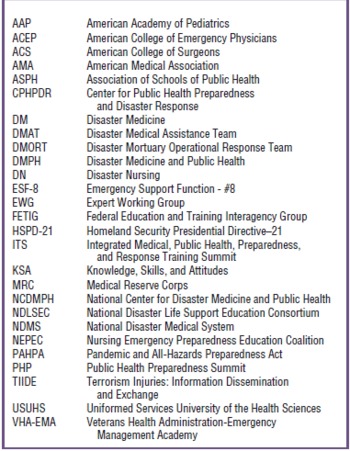
A key initial task identified at the 2010 TIIDE stakeholder meeting was to clearly define the target population. For the proposed project, consensus of the group was that the target audience would comprise potential health system responders who possess postsecondary education in the fields responsible for carrying out Emergency Support Function - #8 (ESF-8), as specified in the National Response Framework.12 The ESF-8 includes the members of licensed health professions that may be reasonably expected to play a response role during a disaster or public health emergency (for example, a pandemic), plus others who by job position and experience should be expected to have an equivalent base knowledge in DMPH. The group developed a pyramidal hierarchy to illustrate how the full range of health professions would build their contribution to effective disaster preparedness, response, and recovery from a common base of cross-cutting core competencies (Figure 1, Table 1).
Defining the Audience: A Hierarchical Learning Framework of Competency Sets in Disaster Medicine and Public Health (DMPH).
See Table 1 for abbreviations. The organizations and agencies depicted are examples of professional groups that would be involved at each level of the multitiered learning framework. Not an exhaustive list, it is meant to display a subset of all possible entities, specifically those with published or endorsed competency sets relevant to the field of DMPH.

Glossary of Terms

The four levels depicted in the Figure provide a useful starting point for delineating competency levels of health professionals in DMPH as correlated with their expected role in a disaster. The baseline or first-level competencies, which we describe in this article, are intended to serve as the foundation for the more specific competencies developed by other entities involved in DMPH. Second-level DMPH competencies are those required by the institutions, organizations, and agencies in which health professionals work, although the foundational competency education should always relate to the provider role. Third-level competencies apply to some, but not all, members of the health disciplines and professions that require more specialized knowledge and skills in disaster-related medicine and public health (eg, emergency medical and nursing personnel). The tip of the pyramid contains the very specific competencies expected of health personnel who compose various disaster response teams, both foreign and domestic, that must be highly integrated in their performances and actions.
As depicted in the Figure, DMPH competency sets become more specialized from the base to the tip of the pyramid, building expertise on a common foundation of proficiency represented by the first level of the pyramid. It is important to note that not all individuals involved in a particular agency will necessarily be required to demonstrate competency in DMPH as part of typical organizational requirements. The pyramid includes examples of organizations that, within the field of DMPH, would necessarily require increasingly specialized competencies to educate and train a DMPH workforce.
Iteration 1: Expert Working Group Initial Review
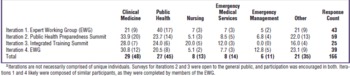
As a result of the initial TIIDE meeting, 15 proposed competencies and 35 associated subcompetencies were incorporated into a Web-based survey and sent to the EWG. A total of 43 of 85 (51%) of the EWG members completed the survey (Table 2). The group had broad representation from clinical medicine and public health, with additional representation from the fields of health education, health policy, information services, epidemiology, and crisis leadership and planning.
Respondent Field of Expertise by Iteration, % (n)a

Each of the 15 original core competencies scored at least 3.75 and was kept for future consideration. A total of 3 pairs of competencies and their subcompetencies were merged due to overlap of concept or intent, resulting in a reduction from 15 core competencies to 12. Four subcompetencies scored below 3.5 and were omitted from future drafts. An additional five subcompetencies scored between 3.5 and 3.75 and were either omitted or revised by the EWG. Many respondents also proposed new subcompetencies or replacements for existing subcompetencies. Both the proposed new and replacement subcompetencies were added to the draft set for subsequent electronic surveying.
Iteration 2: Public Health Preparedness Summit
In the first round of external stakeholder review, 12 core competencies and 26 sub-competencies were retained and integrated into a second Web-based survey. A total of 19 proposed additions (entirely new subcompetencies) and 3 proposed replacements were also included for consideration.
A total of 59 respondents completed this second round of review (Table 2), with the majority of respondents being from clinical medicine or public health. The fields of nursing, emergency medical services, emergency management, information services, dentistry, response planning, pharmacy, and bioethics also were represented.
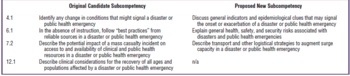
All original competencies and subcompetencies retained from the initial iteration had scored higher than 3.5. Four of the original 26 EWG-consensus subcompetencies scored less than 3.75 and greater than 3.5 (see Tables 3 and 4); 3 of these corresponded with alternative subcompetencies proposed by EWG members (4.1, 6.1, and 7.2). For each of these, the highest scoring option, whether it was the original or the proposed replacement, was retained. For two of the three subcompetencies (4.1 and 6.1), the proposed alternative subcompetency scored higher than the original subcompetency. The remaining subcompetency (12.1) was retained with minor grammatical revision.
Analysis of Alternative vs Original Subcompetencies, Iteration 2 PHP Summit a

Suggested New Competencies

Of the 19 additions proposed by the EWG, a total of 9 were retained. Of these, seven scored greater than 3.75 and were kept based on their scores alone. The remaining two additions were retained based on compelling arguments that were provided in the open-ended comments section of the survey and by unanimous decision of the AMA project team.
Iteration 3: Integrated Training Summit
After the second iteration, a total of 12 competencies and 36 subcompetencies were presented at the 2011 Integrated Medical, Public Health, Preparedness, and Response Training Summit and to the NDLSEC.
A final count of 25 respondents completed the third iteration of review. Clinical medicine, public health, and nursing were fairly equally represented (Table 2), while representatives from emergency medical services, dentistry, infection prevention, and the Medical Reserve Corps also participated. All competencies and subcompetencies scored greater than 3.5. Based on respondent comments, one pair of competencies was merged due to overlap in concept, bringing the total number of competencies to 11. An additional subcompetency was also added, such that language was kept consistent between two competencies that were very similar in scope. Four subcompetencies scored between 3.5 and 3.75. Two of these scored at the cusp (3.73), and were retained. In addition, two lower scoring subcompetencies (3.53 and 3.55) were kept and marked for specific consideration in the final EWG survey. Open-ended comments led to additional changes in language, organization, and semantics.
Iteration 4: Expert Working Group Final Review
The 11 core competencies and 37 subcompetencies that resulted from the preceding three rounds of review were presented to the EWG for final deliberation. A total of 39 of 56 (70%) of the initial EWG members present at the initial TIIDE meeting participated in this survey round. Again, public health and clinical medicine were well represented, with stakeholders in nursing, emergency medical services, emergency management, humanitarian assistance, and education and training development participating as well (Table 2).
One subcompetency scored less than 3.5 and was omitted from the final set. This subcompetency was one of the low-scoring subcompetencies from the third iteration of the competency survey. Four additional subcompetencies scored between 3.5 and 3.75. Of these, one was removed from the set, as its intent was sufficiently addressed in another subcompetency. The other three low-scoring subcompetencies were retained for lack of written arguments to support omission.
As part of this fourth iteration of review, EWG members were also asked to consider whether the core competencies could be categorized into domains, which comported with the four phases of disaster management (preparedness, response, recovery, and mitigation). About 55% of respondents felt this type of organization was appropriate; 15% did not like the idea, and the remaining 30% were unsure. When respondents were asked to determine under which of the four potential domains each competency should be categorized, the group had at least 75% consensus on 10 of the 11 competencies. None of them was categorized under “mitigation,” four were categorized under “preparedness,” five under “response,” and one under “recovery.” By majority vote, the remaining competency was placed under “preparedness” (55%), although many thought it should be categorized under “response” (45%).
Final Review
In November 2011, the final draft competency model of 11 competencies and 35 subcompetencies was presented to a small group of select professionals in the field of DMPH for final review. Overall, the group expressed strong support for the proposed model. Discussion focused predominately on the relevance of this work to the field of DMPH, how this model “cooperates” with other published competency sets, and the educational framework on which this model is based. Meeting participants also reviewed a draft manuscript of this article and provided feedback to the primary author.
At this meeting, it was suggested that core competency 3.0 and its subcompetency be revised to better reflect the language used in Bloom's taxonomy and the overall intent of the competency; this included subtle changes in language and the addition of one subcompetency under 3.0. The final competency set currently comprises 11 core competencies and 36 subcompetencies. Table 5 depicts the final version of the core competencies and related subcompetencies.
Core Competencies and Subcompetencies for Disaster Medicine and Public Health

COMMENT
Various organizations and academic centers have developed competencies for health professionals and other emergency responders.1314Reference Hsu, Thomas, Bass, Whyne, Kelen and Green15Reference Barbara, Macintyre and Shaw16171819202122 To date, the majority of these efforts have been limited primarily to individual specialties or targeted professionals, which has resulted in a lack of definitional uniformity across professions with respect to education, training, and best practices within the discipline of DMPH. It is important to note that the term “responders” has historically referred to personnel who are first responders or first receivers of the victims of no-notice incidents such as tornados. However, during a public health emergency (such as a pandemic), a much broader range of providers is required to participate in the response. Although in most of these situations incident-specific “just-in-time” training is possible, there is no substitute for the foundational elements of preparedness education. The competencies presented here are intended to be used as a set, and to apply to all personnel who may conceivably be involved in disaster or emergency planning, response, or recovery under ESF-8.12 The competencies conform to Bloom's taxonomy and are meant to be relevant and useful for adult learners across the many professions under ESF-8.
The pyramid structure shown in the Figure is intended to clarify the difference in scope and application between the work presented here and other published competency sets. While earlier competency models have been endorsed by many, decisions about exactly what competencies form the common “core” and define linkages of proficiency and escalation of knowledge through all target audiences either have not been made or are not well articulated. The competencies proposed in this article reside at the very base of the pyramid and are intended to be relevant to a broad audience. The pyramid framework demonstrates that education and training in DMPH can occur at various levels to accommodate distinct certification and accreditation requirements or other learning needs. Other recently published competency sets differ with regard to target audience, and are either discipline-specific or reflect a much more advanced level of DMPH proficiency. These differences are not meant to imply that other competency sets should be regarded as unrelated to the competencies proposed in this article. Instead, they reflect a logical progression from the cross-cutting, core-level competencies identified in this article to the more specialized competencies required by an employer, credentialing body, or sponsor of a disaster team. As previously stated, DMPH competencies logically become more specialized as an individual moves up the pyramid. However, the pyramid also serves to illustrate that everyone can benefit from establishing a basic level of knowledge, vocabulary, and skill as a foundation on which to build further expertise.
The competencies proposed here are designed to drive preparation of educational materials and programs for provider education. They were written to be concise, and precise, but because of this they include terminology and concepts that will not be familiar for members of a target audience who lack background in preparedness and emergency management. Thus, they should be used as a guide for leaders at the federal, state, tribal, local, or facility/agency level to drive curricula development. Resources that support the competencies should be referenced to provide additional depth to the materials, and competency education should be tied to the role of the provider. A clinic subspecialty provider, for example, is not expected to have specific knowledge of all surge capacity resources and plans in a community, but rather should understand a few general concepts of surge capacity (for example, use of alternate spaces or staff) and understand the options that affect them.
The competency model presented here builds on previously published competency sets and increases inclusivity, broadens stakeholder input, and garners consensus from a wide variety of experts in the field. It is unique from other sets in that it intends to apply to a wide range of professionals involved in DMPH, rather than to a more narrowly defined specialty or profession that may operate in the field. It is the culmination of four unique iterations of review and, while the initiative has been spearheaded by subject matter experts, the material has also been vetted by like-minded professionals and potential end-users active in the field. As there is currently no way to define which professionals are involved in DMPH (for lack of either a certification process or a clear definition of inclusion), it is likely impossible to gather a truly representative assessment of all professionals in the field. Although presentations to audiences at the PHP and ITS conferences may be considered convenience samples, in the absence of a discretely defined audience, they also served to increase transparency of the process and elicit response from a broad and experienced network of professionals interested or involved in DMPH.
Because DMPH is a developing field that currently lacks a national accreditation process, much work has yet to be done. If DMPH is to firmly establish itself as a unique discipline, it must be centered on an evidence-based curriculum that is vetted by certifying authorities (societies, regulatory bodies) and standardized throughout the various professions and specializations involved in the field. As this field is still in early developmental stages, it is impossible to generate a true national consensus standard. However, the methodological process used here has used the best possible surrogates in medicine and public health to achieve this aim. As the field matures, and requisite organizational societies and accreditation bodies are established, a more rigorous approach can be taken and a true national consensus sample can be defined.
CONCLUSIONS
This effort represents a significant step on the journey to establish and maintain a DMPH workforce that possesses the knowledge, skills, and abilities to support all aspects of the disaster management cycle. It recognizes that formal training in DMPH can enhance the ability of all potential health system responders to be useful in an emergency as volunteers or as members of well-established organizations with significant disaster expertise.Reference Merchant, Leigh and Lurie23 It furthermore supports the intent of federal policies such as HSPD-21 and PPD-8. The application of such competencies in educational and professional development settings can inform both standardized curriculum planning and the development of individual lessons for a wide range of learners; it can also suggest foci for professionals seeking to enhance their own competence and professional development related to disasters.
The current effort must not stop with the identification of foundational core competencies. Additional research is necessary to identify the extent to which these core competencies are a component of current academic curricula within the health sciences, what gaps exist in achieving these standards within current curricula, and what mechanisms exist or are needed to fill identified gaps. The present effort is just one step in the process toward defining a full DMPH curriculum. Future collaborative efforts to create and refine educational and training curricula in DMPH may be facilitated with the use of the hierarchical learning framework and set of core competencies proposed in this article, and it is our hope that it will be considered as the initial foundation for a national standard in disaster workforce development.
Author Contributions: Dr James had full access to all the data and takes responsibility for the integrity of the data and the accuracy of the data analysis.
Funding/Support: This project was funded by the Centers for Disease Control and Prevention under grant CCU524163. The Henry M. Jackson Foundation for the Advancement of Military Medicine, Inc, supports NCDMPH through a grant sponsored by the Uniformed Services University of the Health Sciences (USU), Bethesda, Maryland.
Disclaimer: The information or content and conclusions do not necessarily represent the official position or policy of, nor should any official endorsement be inferred on the part of, USU, the Department of Defense, or the US government.
Acknowledgments: Members of the Terrorism Injuries: Information Dissemination and Exchange (TIIDE) consortium participated in the early iteration of the initiative, participated in the Web-based surveys, and served on the final review panel. Elizabeth Weist, MA, MPH, Association of Schools of Public Health; Joan Cioffi, PhD, Office of Public Health Preparedness and Response, Centers for Disease Control and Prevention; Rick Cocrane, LMI; David Siegel, MD, CBRNE Research, National Institute of Child Health and Human Development; Roy Alson, PhD, MD, American College of Emergency Physicians; Steven Phillips, MD, and Stacey Arneson, MS, National Library of Medicine; contributed subject-matter expertise as part of the final review panel and reviewed the final manuscript. All members of the Federal Education and Training Interagency Group, in particular CAPT D.W. Chen, MD, MPH; Graydon Lord; RADM Clare Helminiak, and to Kevin Yeskey, MD, offered collegiality, expertise, and guidance throughout the initiative. The AMA library staff provided invaluable assistance in the literature searches and background research portions of the project.